This post serves primarily to record the wonderful launch of my latest book, Call Me Marigold, by Jude Aquilina, with Nigel Ford as the MC. But, sadly, it is also the last post for Wattletales. After eight joyful years talking to my heart’s content online, the time has come for me to let go.
Photo by Mark Warrell
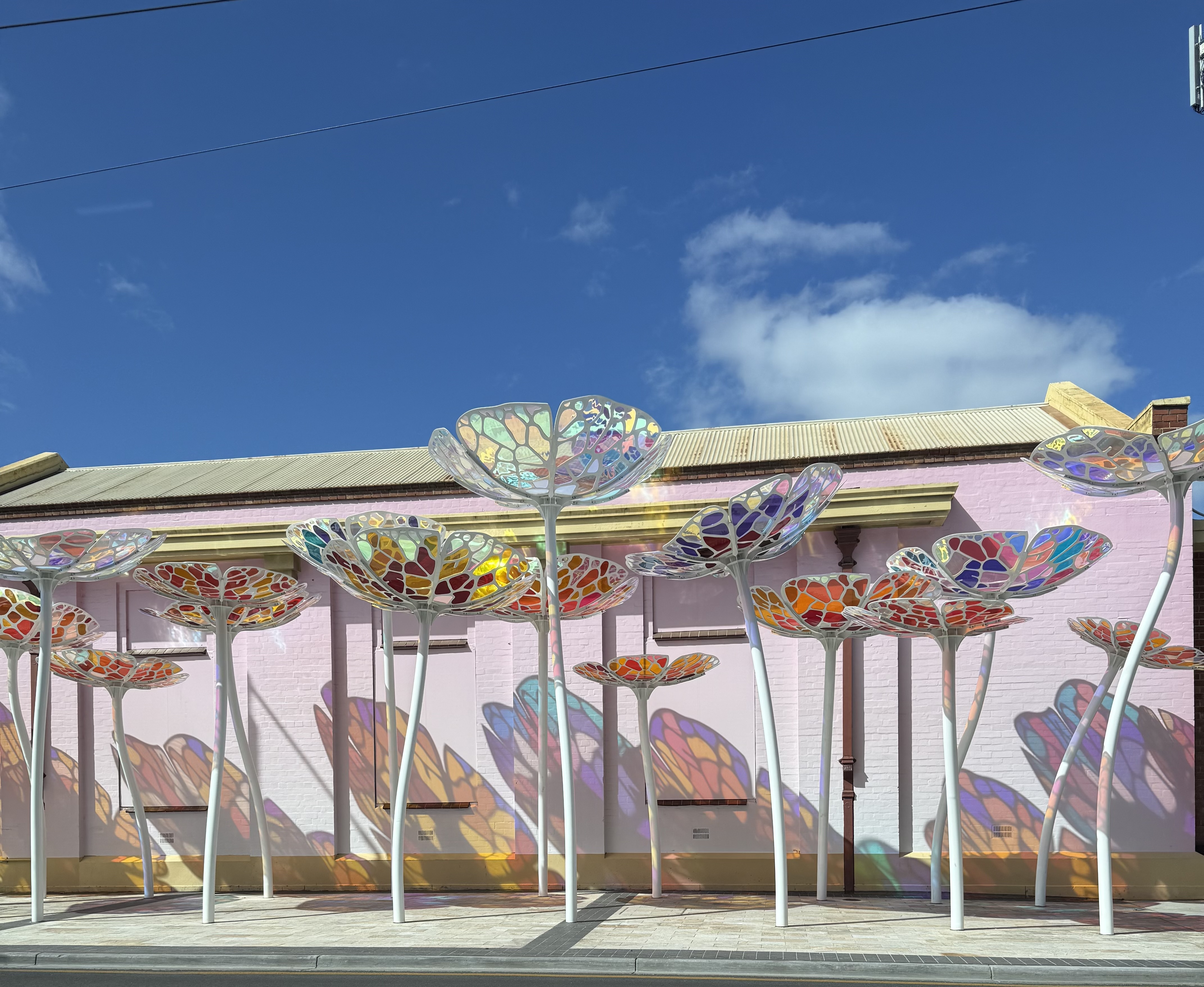
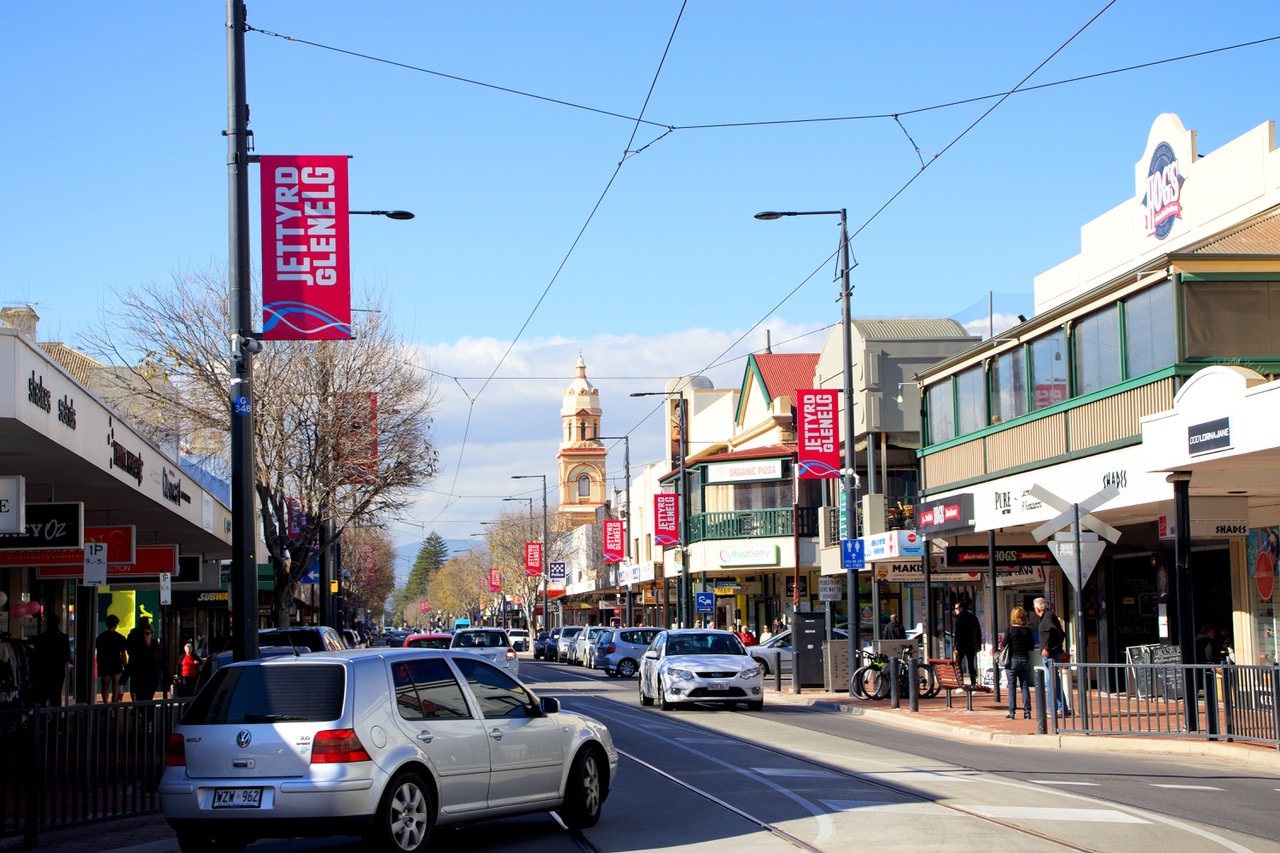
I chose the new Elysian Fields sculpture at the corner of Jetty and Brighton Road in Glenelg to symbolise both events. The ultimate paradise is a successful book launch where life, laughter and love met the life of a deceased narrator called Marigold. And, in Greek mythology, the Elysian Fields also represent, among other things, a place of delight, and Wattletales has been just that for me.
The Launch of Call Me Marigold
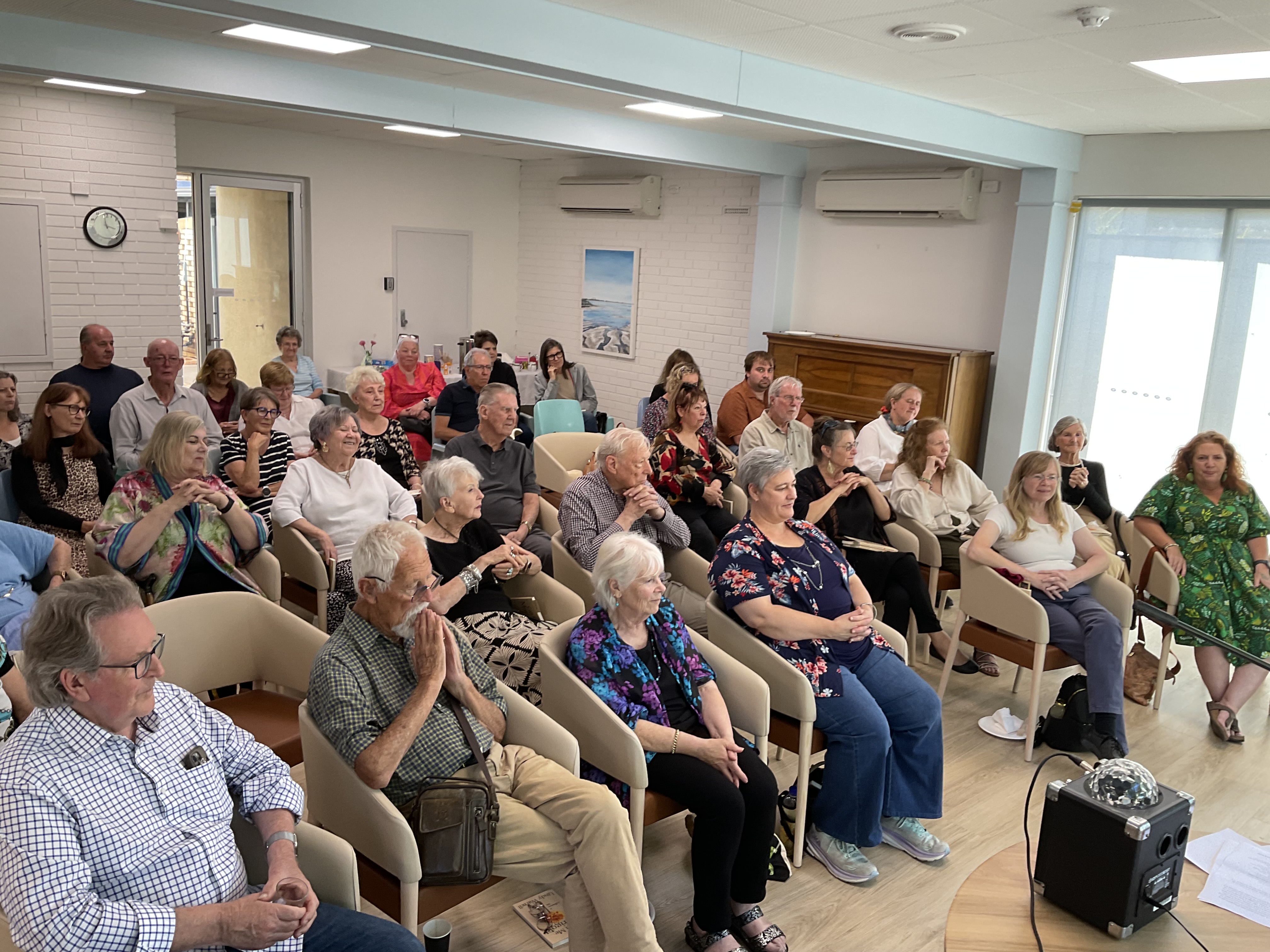
As you can see, the launch was well attended. What a wonderful audience it was, over afternoon tea, the room was abuzz with catch-up chats and introductions. I won’t show the photo taken during the launch, when, as is often the case, listening causes people to close their eyes and appear asleep. But the enthusiasm with which they met Jude Aquilina’s wonderful speech was overwhelming.
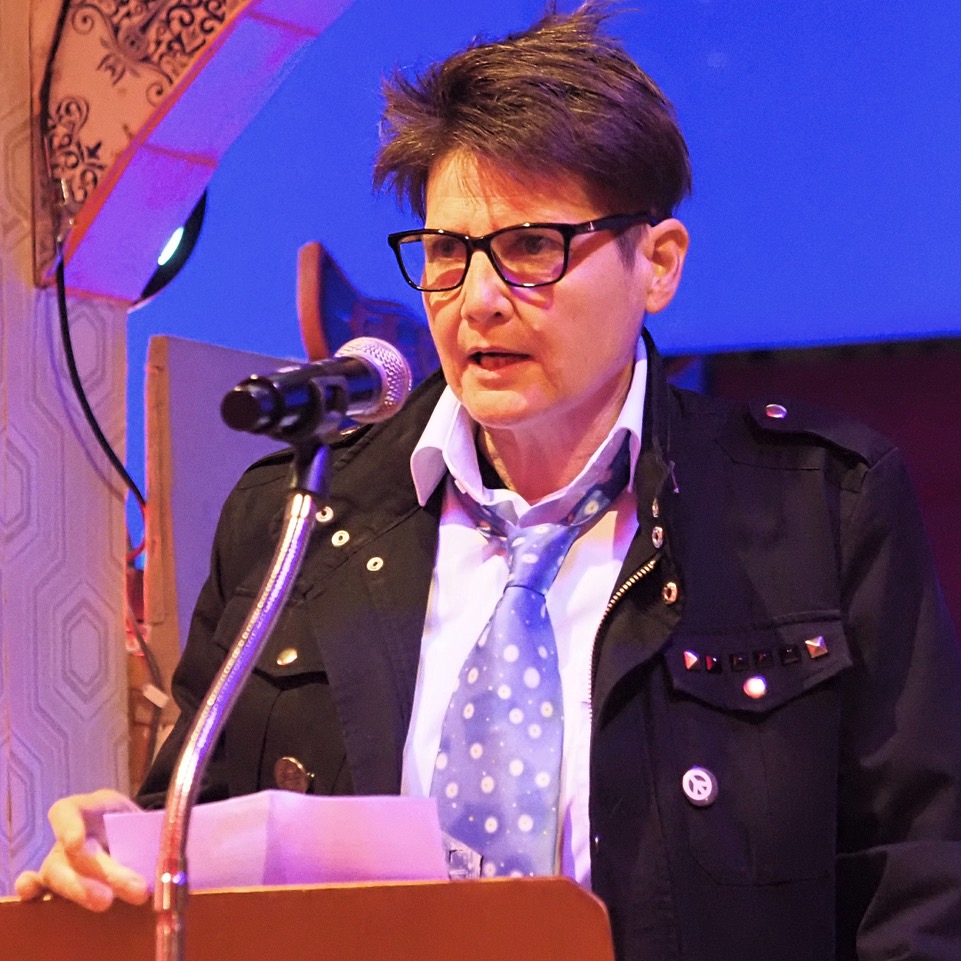
As MC, Nigel got the party started by introducing Jude, and here is a gorgeous photo of Jude followed by her speech.
Caught by Mark Warrell as Jude was talking to me. It captures her wry humour and warmth beautifully.
Jude took photos of most guests with me, during the book signing, far too many to display here which I sent to everyone so caught. I just wanted to add last one which was taken behind Jude as she took this photo by the inimitable Mark Warrell.
Jude’s shot of Alexander Brown and me, captured in progress by Mark Warrell
Farewell from Wattletales
Wattletales came to life in 2018 as my first attempt at creating an author website. I began moving beyond static content, producing tentative monthly blog posts from 2020 to the present. The first was, perhaps unsurprisingly, titled Realising Dreams Late in Life.
Since then, there have been over 90 posts, both my own monthly offerings and many by guest poets, writers, and artists who shared stories about their creative paths on Wattletales. Quite a few continue to attract readers.
To all those people, I apologise. As most of you know, I am unwell, and it is time for me to end what has been one of the most exciting and rewarding projects of my life. It is quite simple to download a copy of your page by saving it as a complete webpage. (My Mac calls the file ‘webpage complete’, and includes all the comments and your replies as a discrete file. Although it might be a bit heavy on printer ink, you can also right-click and print the entire page.
Wattletales WILL NOT CLOSE until 20 May. So there is plenty of time to read, comment and download whatever you fancy.
Many thanks to all who have contributed to this pet project of mine over the years.
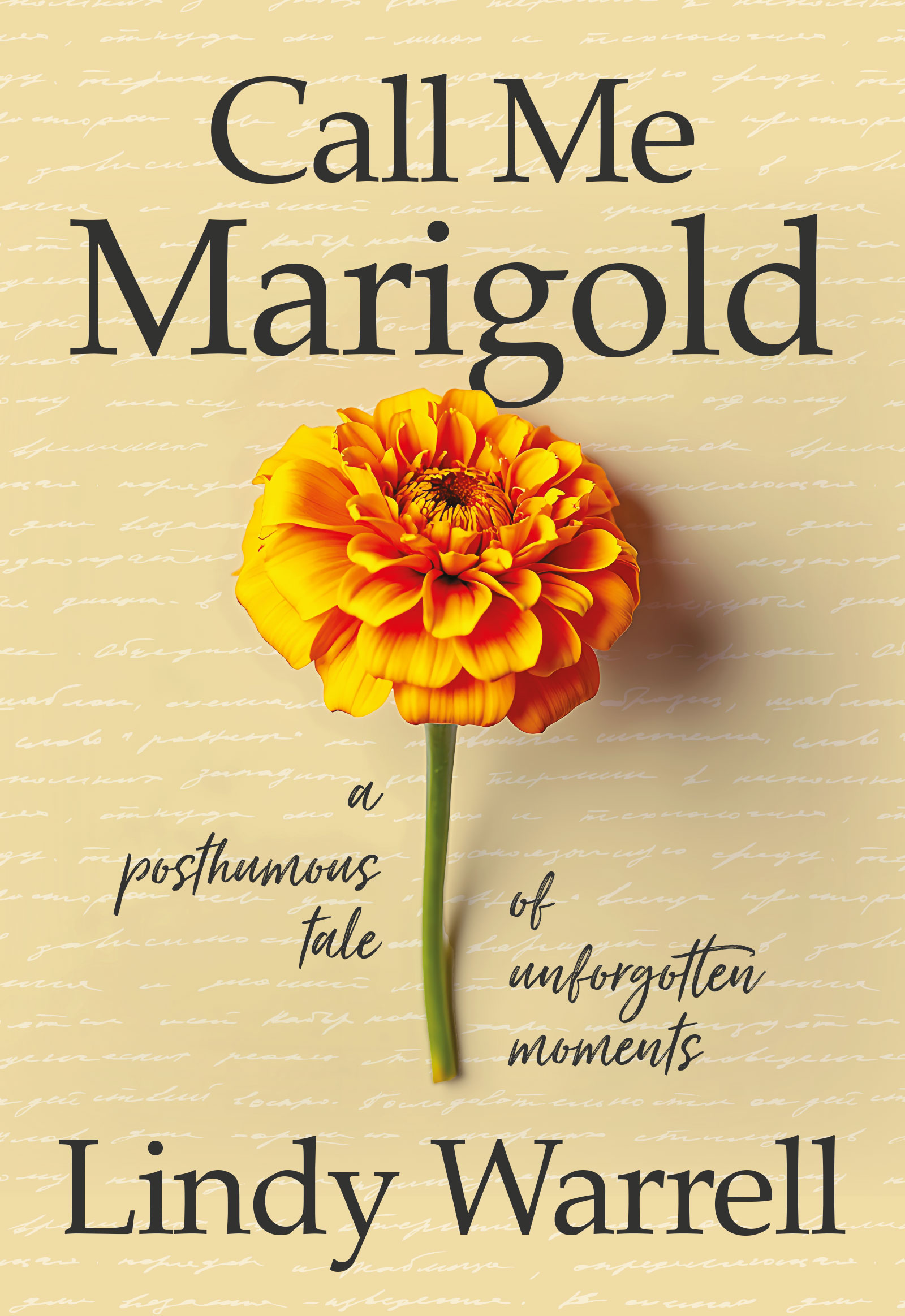
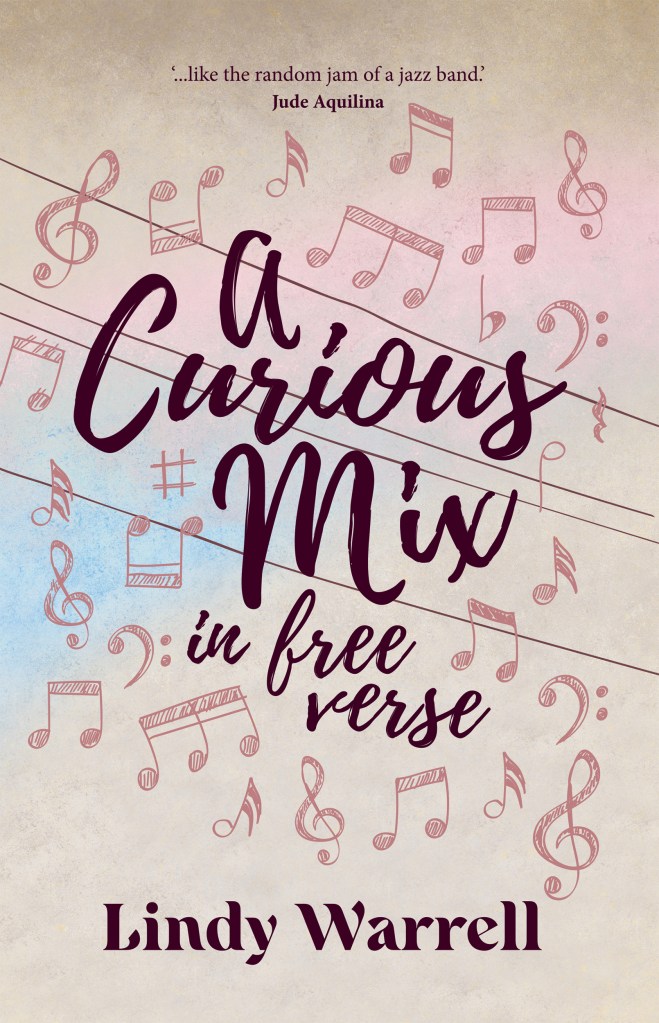
To get 2026 started, I thought I’d talk a little about my health and a bit more about my forthcoming autofiction novella, Call Me Marigold. As some will already know, I was diagnosed with lung cancer just as I was finalising the manuscript. So, I decided that today, 1 January, was the perfect day for a cover reveal as we enter an exciting new year.
My cover artist is Nicola Matthews, who has designed covers for three of my other books. The cover for my most recent novel, They Who Nicked the Sun (2024), was shortlisted for a prestigious prize. Nicola is also my internal book designer. She does an excellent job every time, so thank you, Nicola. You can find Nicola at Elect Printing, Canberra.
What a Health Romp
It all started at the end of October 2025, when, for the first time in Flinders Medical Centre’s Emergency Department, a nurse sat me on one of the four red chairs outside the nurses’ reception windows, which meant I was in line for fast ED admittance.
There was a time, many moons ago, when I waited ten hours in the main reception area, only to be told to go home because X-rays showed nothing wrong. A few days later, still in considerable pain, I saw a GP who ordered, I think, an MRI, although it could have been a CT scan, which showed I had suffered four crush fractures in my spine, one 60%.
On this occasion, with an infection that was spreading fast, that red chair sped me into the Emergency Department’s inner sanctum within half an hour, which led to a CT scan of the head at about 3 am after having been treated to a series of canula infusions of steroids, antibiotics and some other thing I can’t remember. By 5 am, all I wanted was sleep.
Instead, a sombre young doctor sat at the end of my bed to advise me ever-so-gently but in earnest voice that the CT scan had revealed a relatively large mass close to the aorta, at the top of my left lung.
Escalation
Three days later, at Daw Park Imaging, a full thoracic scan confirmed the diagnosis. My GP rang me immediately to see if I was okay, and so started a surprising round of medical tests, scans, home visits, telehealth consults, and support from palliative care and others right up until Christmas. Whew.
Now, I’m in a flurry of professional editing and preparing the book for publication.
Back Cover Blurb
Do not fret; the back cover is NOT this colour. The real thing is not yet available.
Planning Ahead
I’m hoping to have the launch in March, venue to be confirmed, likely at Manson Towers in the newly refurbished Common Room. Details will be finalised once I can confirm the book’s print date. It’ll be as soon as that, so keep your eyes open for an invitation.
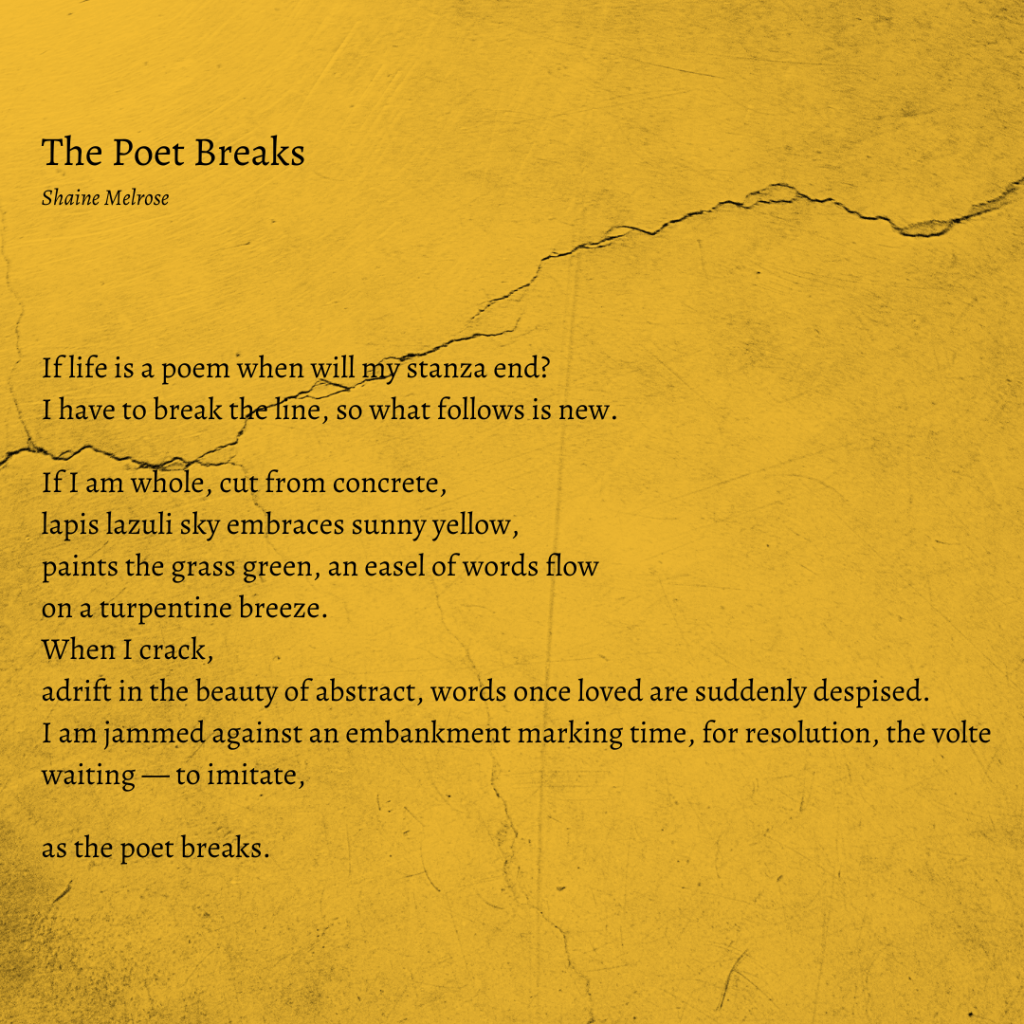
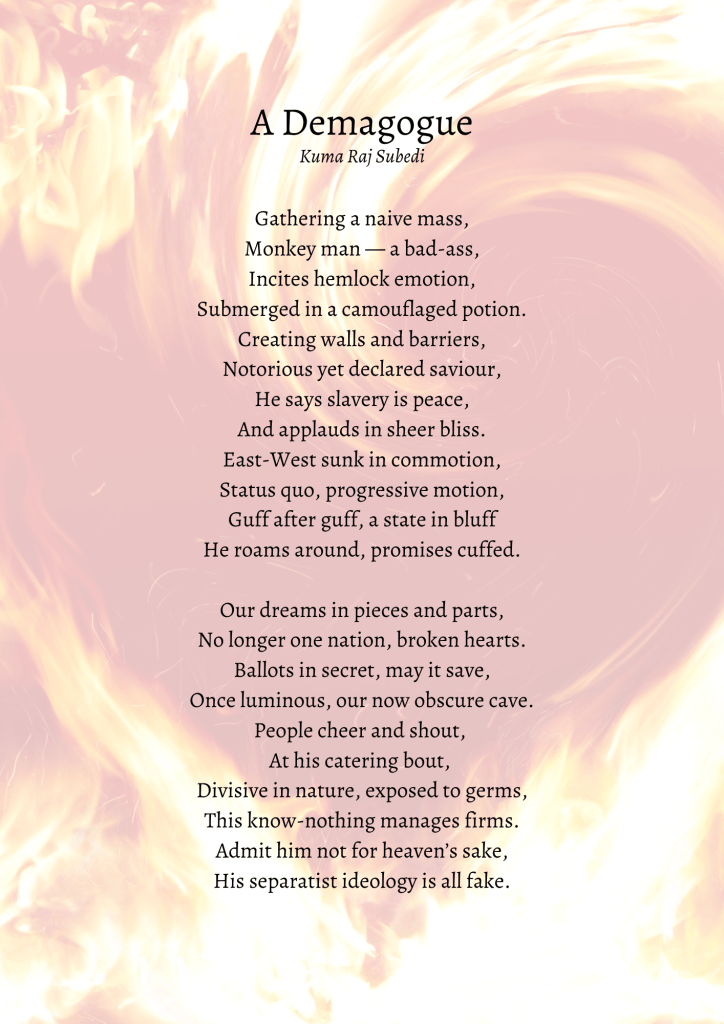
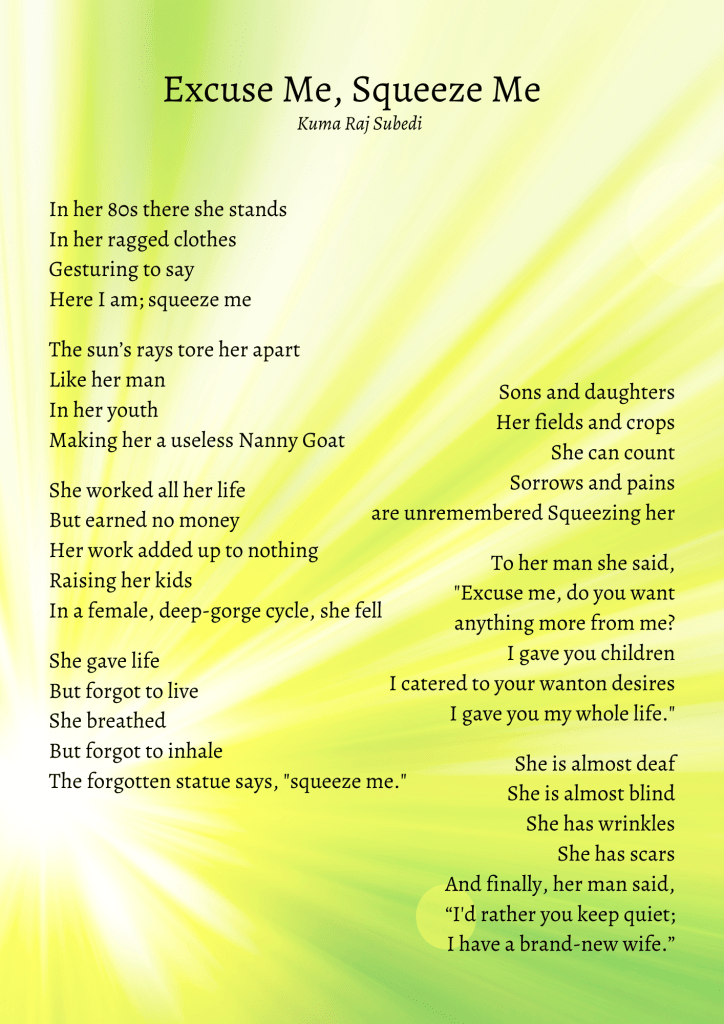
Today’s post is a tribute to the members of TramsEnd Poets, my compatriots in poesy over the best part of ten years, as I pass on the baton. TramsEnd Poets has always been a powerful critique group, and I want to thank all members, past and present, for their collegiality. Click here to find a list of stories by our members and guests over time.
The poem I was going to present in December 2025 till plans changed.
I founded Trams End Poets just shy of ten years ago at the Mockingbird Lounge on Broadway, Glenelg. After a while, we found the public space a bit noisy, so we moved to the Glenelg Library. When the Holdfast Bay Council in its wisdom commandeered the only two spaces available for a meeting, one being the staff room in that tiny library, we landed in the Common Room at Manson Towers, where I live.
Why Did I Leave?
I was diagnosed in November with lung cancer and felt it was time for me to let go. I’m so pleased the group decided to continue together, and I thank everybody for that. It was a joy over time to meet and work with many outstanding poets who taught me a great deal.
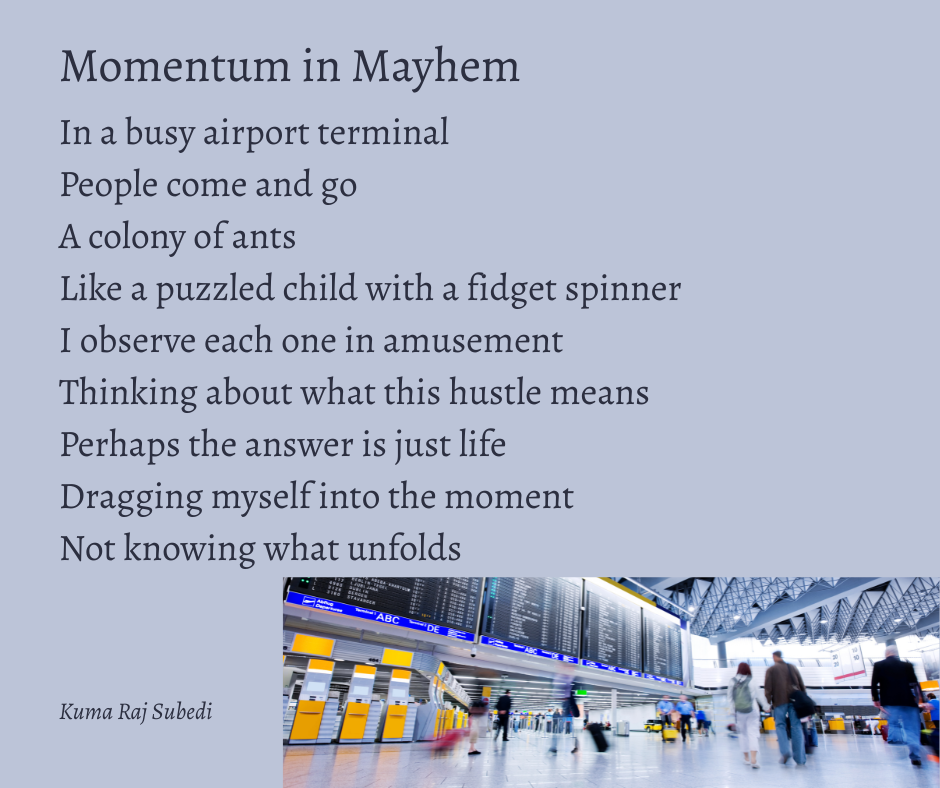
Members in 2025 were John Atkinson, who kindly agreed to facilitate the group’s move to the Glenelg Community Club; Valerie Volk; David Harris; Nigel Ford; Kuma Raj Subedi; Vicky Ireland; Elizabeth Salna; and, last but by no means least, Ivan Rehorek, aka Avalanche, who was a founding member all those years ago. He deserves a special mention for that.
In No Special Order
Here are the poems members submitted for this page. Thanks, guys. All the best.
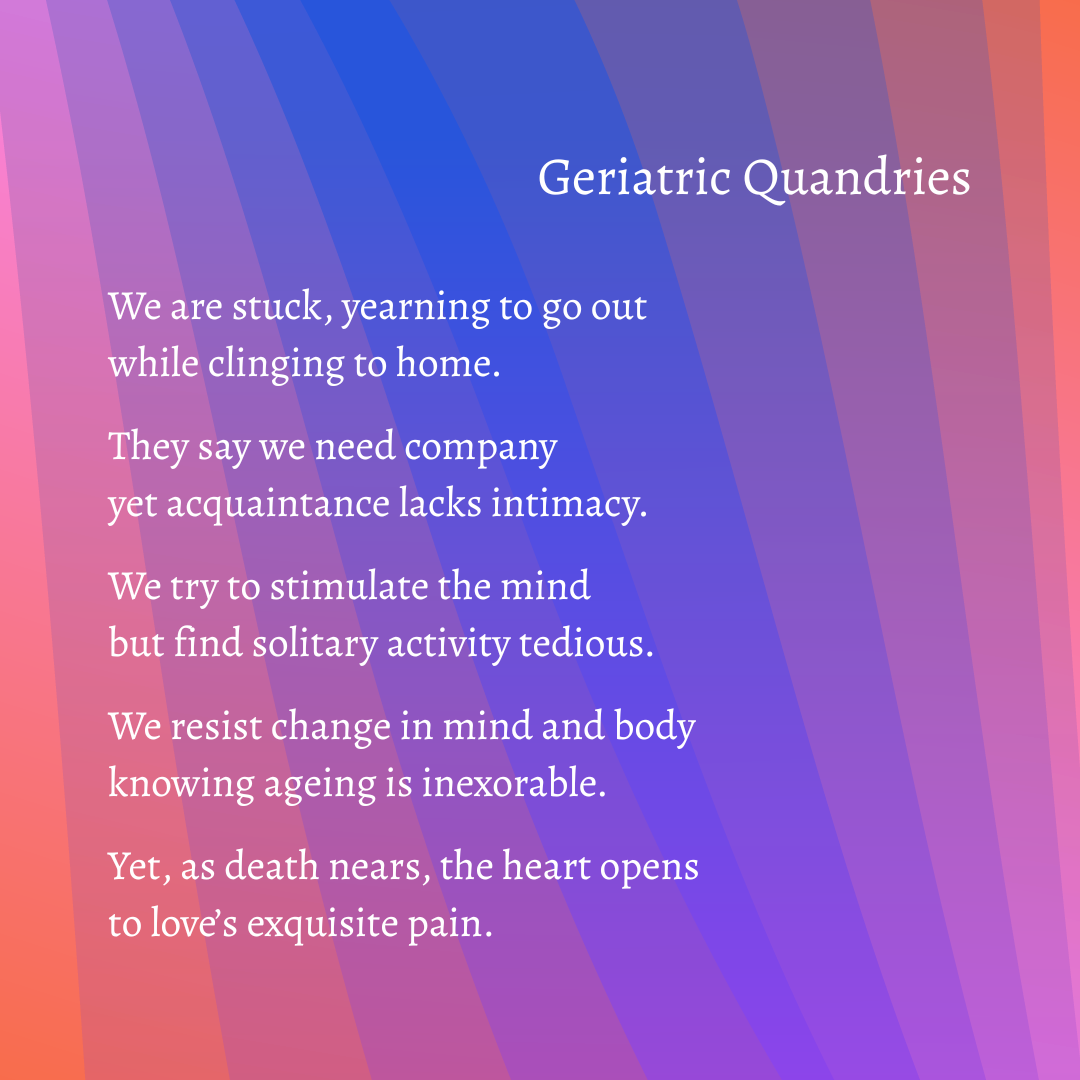
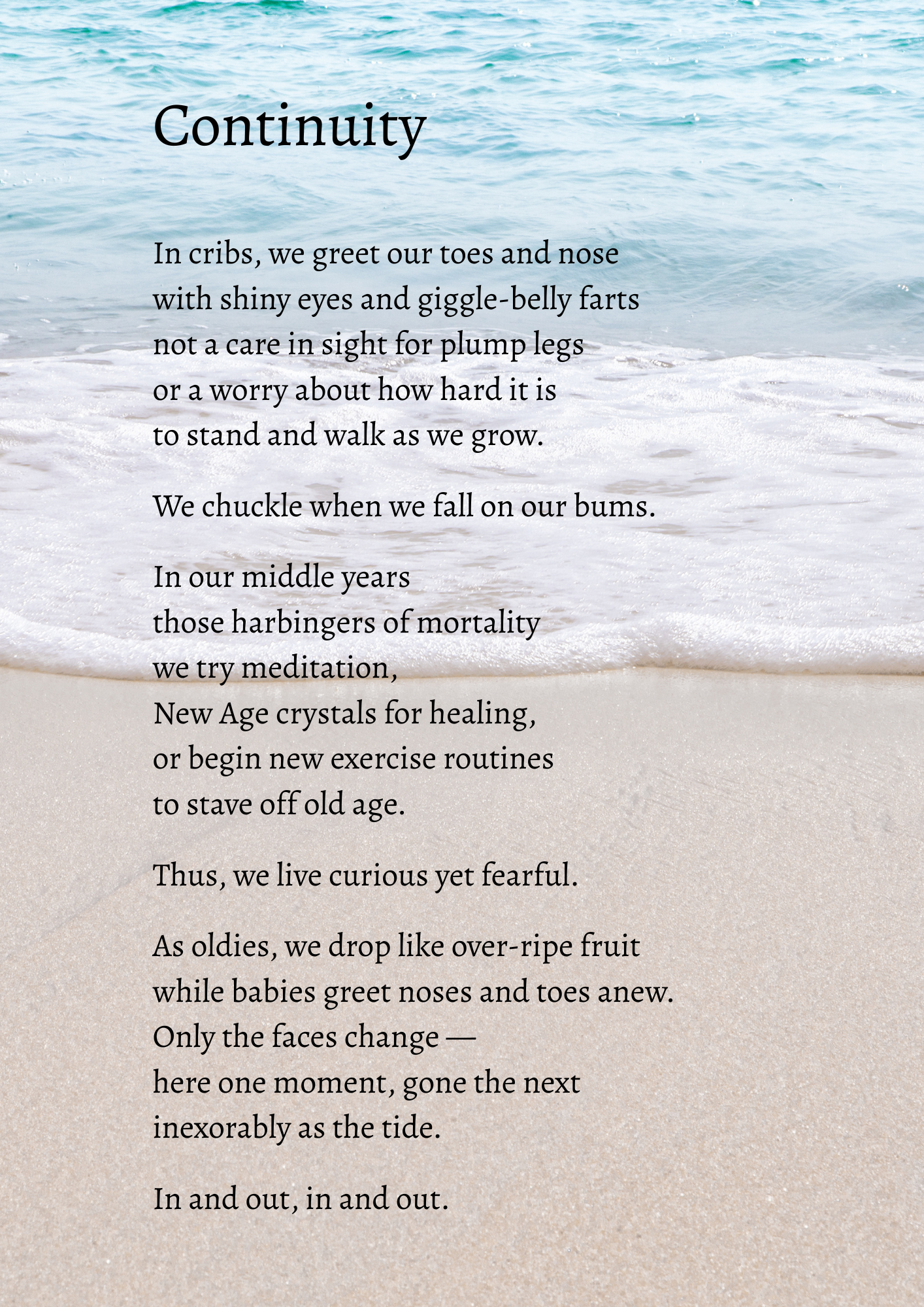
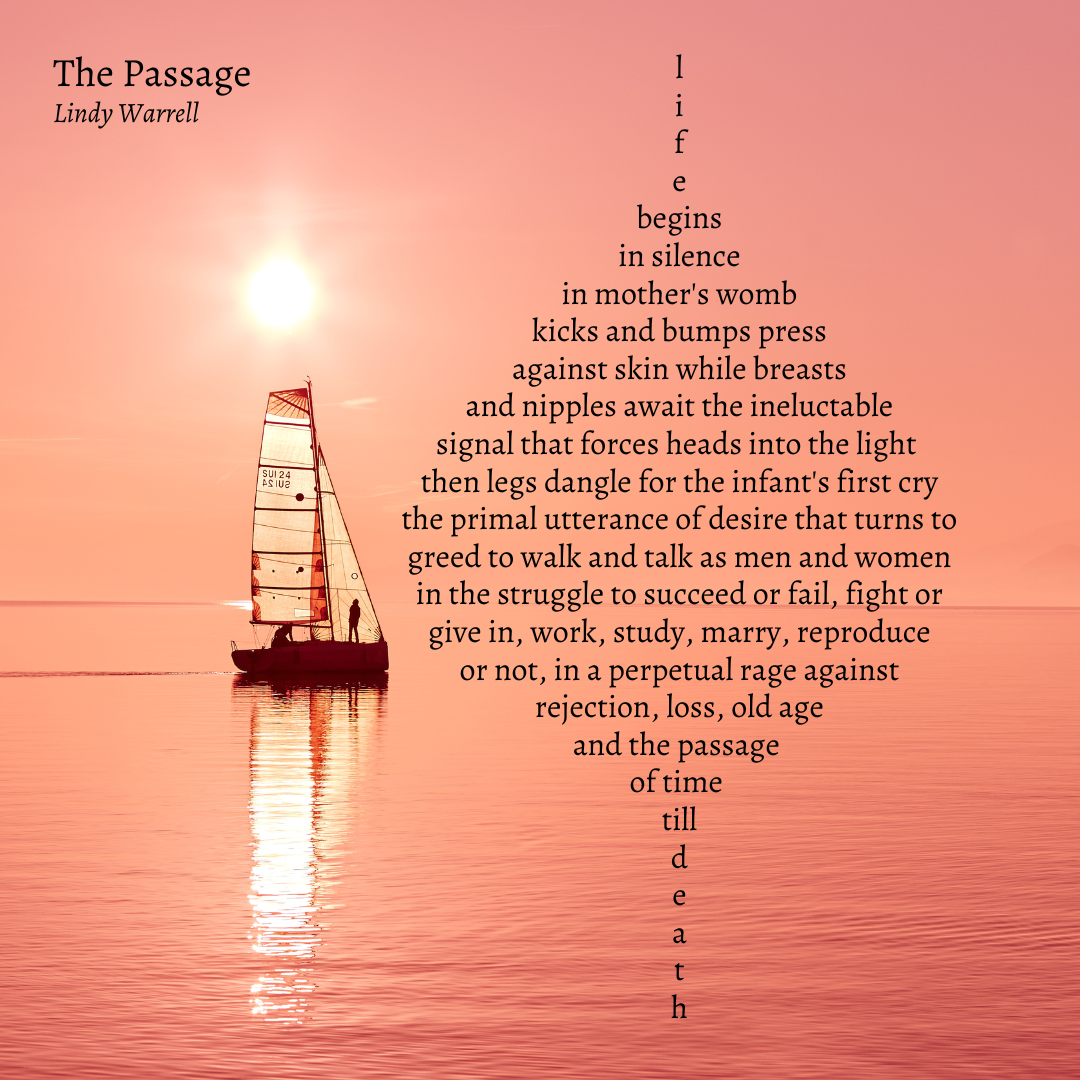
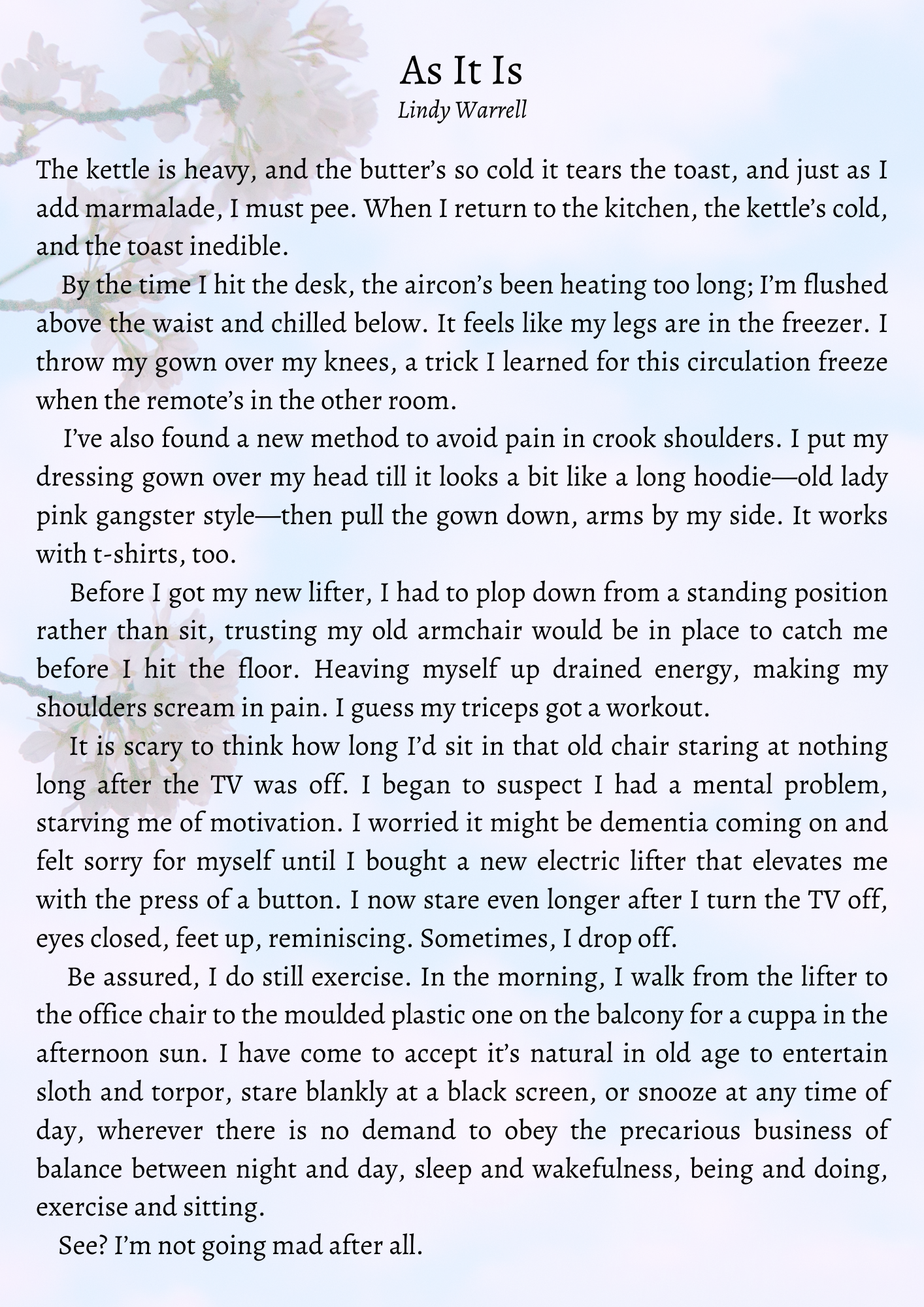
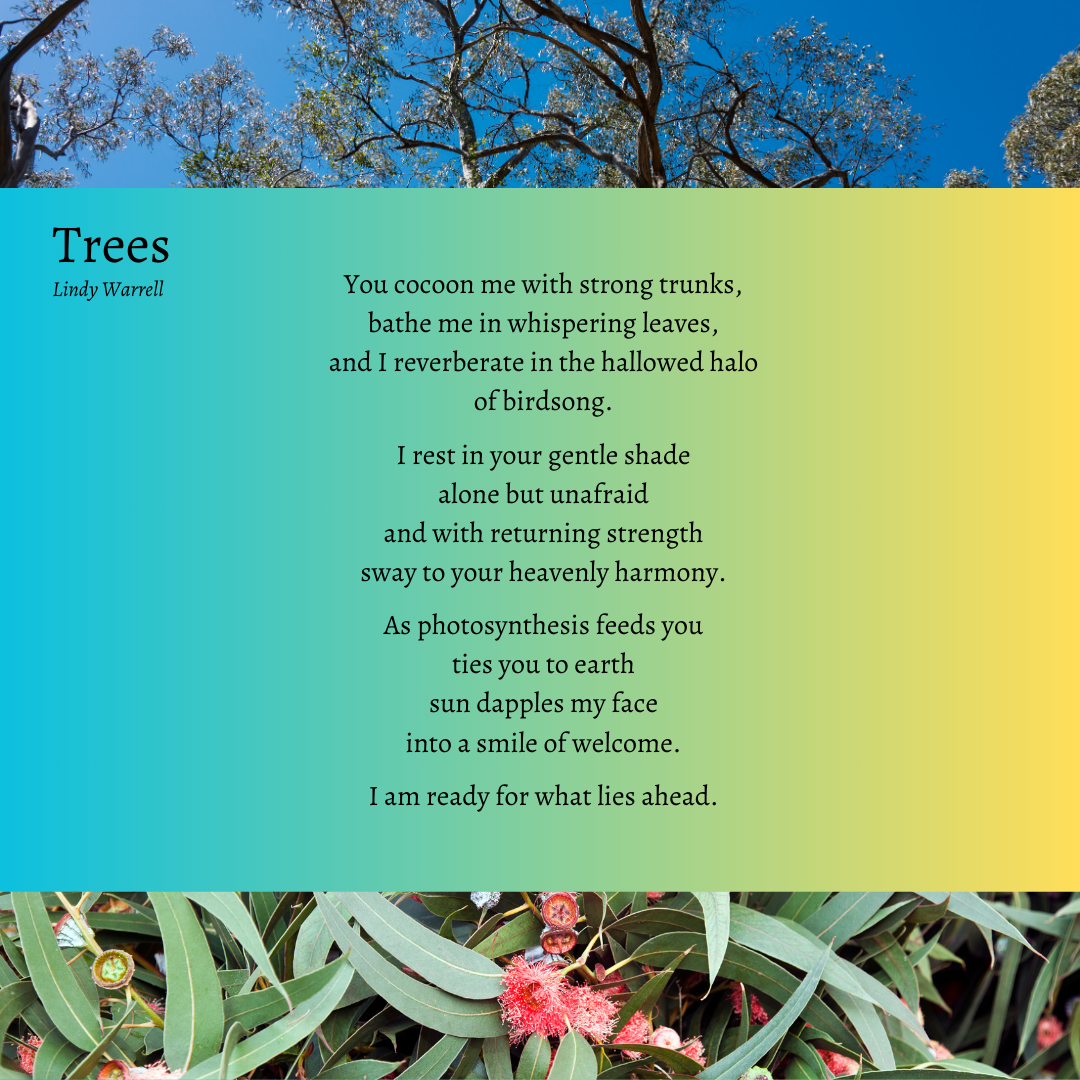
Lately, I seem to write a lot about ageing and old age. It makes me wonder if I’ve exhausted my earlier life as a source of ideas or whether, indeed, old age brings the focus home to the body in ways that others might only experience during illness. Old age may not be a sickness, but it is the gradual breakdown of one’s body, which increasingly demands more attention and time. It certainly brings focus into the now.
I realise old age is unromantic, often unattractive and, for some, a taboo subject like death; something they’d prefer to avoid. So, rather than rabbit on, today I’ve decided to post six of my most recent poems on some of the awkward truths of old age without comment. Make of them what you will.
Six Poems for your Consideration and Entertainment
It tickles me to write about being old. At times, I suspect people may find my interests a bit odd or of no interest whatsoever to anybody under the age of 50, 60, or even 70, when bodies are still relatively intact. But if I don’t talk about the last bit of life, who will? For what it’s worth, here are my contributions for today.
To me, stories come from the sandpit of life. When you dig your hands in, sift grains through your fingers, fleeting images and ideas appear. You try to grasp these ephemeral moments with words that may at first be inchoate. Yet your mind soon flashes with what feels like brilliance, and off you go with a story. Capturing these flashes is more complicated than it seems, but oh! what fun trying.
Sometimes, a story comes to you complete, and you quickly write or record its bones as though you are channelling. It is not yet literature, but it is the germ from which a poem or novel might grow. Unwritten ideas can dissipate fast, so it’s worth hanging onto them. I tend to record my flashes of brilliance (as they initially seem) on my iPhone when driving or those times when I wake at night. It scares me a bit to hear my sleep-ridden, old woman’s voice, but my clever Voice Memo app allows me to later save what I caught in print without having to type it up.
Ideas and Stories
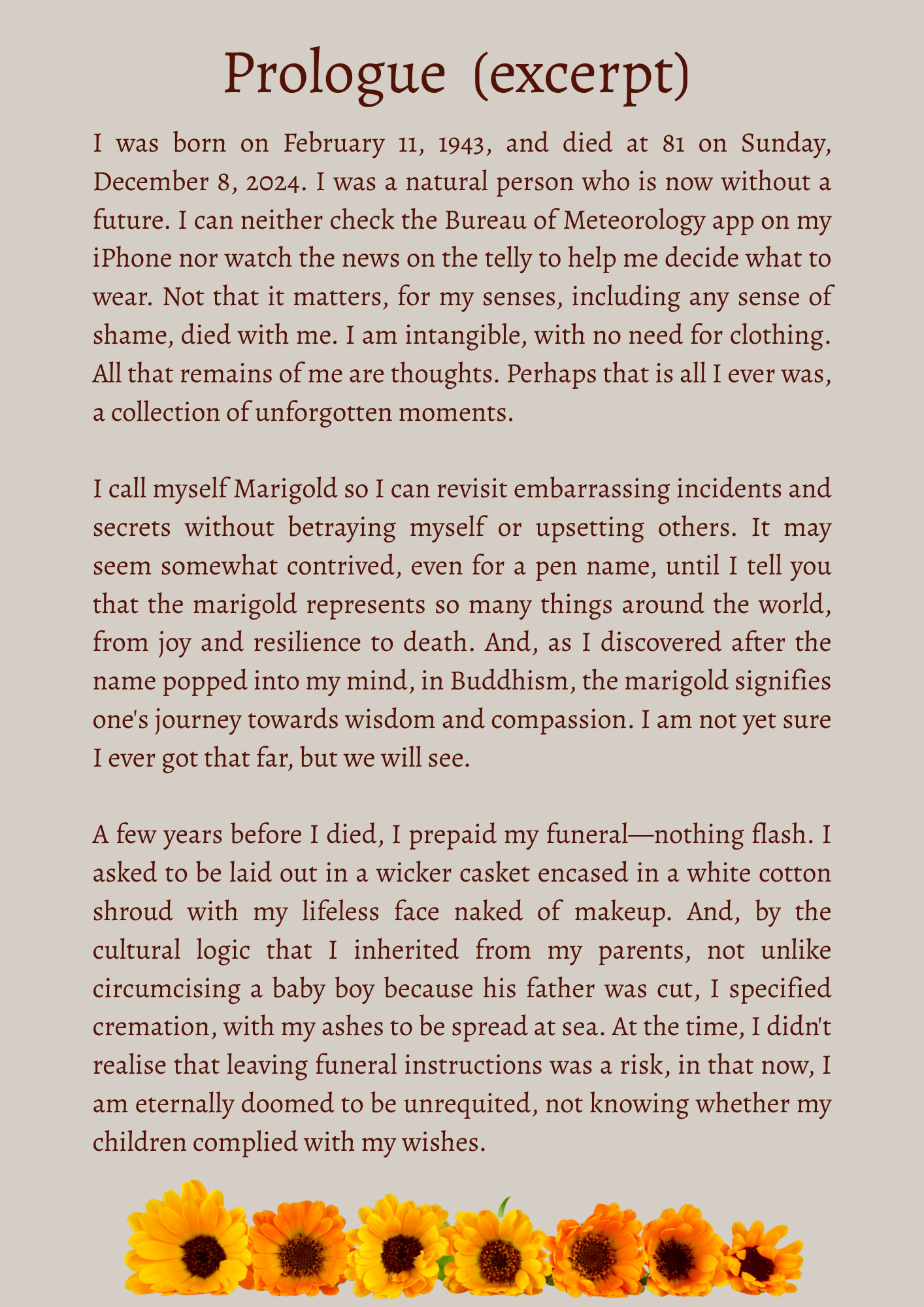
I can’t remember for the life of me (sic) why I chose to write anything resembling a memoir, but my work in progress, entitled Call Me Marigold, is a novella-length piece I’m calling autofiction until someone corrects me. The only way I could think of to tackle this material was to unsettle the protagonist as a posthumous narrator, an 81-year-old woman who could not rest in death until she understood life.
As I so often do on Wattletales, I decided to write from experience about the changes that take place between childhood and old age, using my life as an example. In other words, I wanted to explore the arc of life, similar to that depicted in the following poem, to ask what it really means to grow, age and die. We can’t know death, of course, but old age is a unique journey to consider anyway, as we move from the inside out. Or, as time goes on, outside in.
The Prologue
In the novella, Marigold (clearly not her real name) is a somewhat unreliable narrator stuck in a liminal space between life and the everafter with nothing more than memories. The story unfolds as a series of vignettes, texts and poems. Marigold refuses to name her characters. In her view, she is telling her story, so others are included only by role in relation to her. This is important because although she speaks of the joy of having children, she does not want to talk about them. After all, as she tells us, their lives are not hers to discuss.
Here is an excerpt from Marigold’s Prologue.
The most significant other character in this tale is Marigold’s mother, to whom she speaks in an italicised throughline called Conversations with Mother.
As a Writer
There is no doubt that writing from one’s life while alive is no easy task. When writing close to the bone, finding the words and purpose of each story you tell takes you deeper into your emotions. Strangely enough, this teaches you what you have forgiven and what you still need to let go of. Writing intimately about your past is a bit like time travel; it takes you there, often with intense emotional impact.
Although I’m nearing the end of the first draft of Call Me Marigold, when I got bogged down a while ago, I decided to start a new novel for respite. Sometimes, letting one story rest for a while is refreshing.
Something New
My imaginary sandpit occasionally yields the oddest things for poems and stories. Still, my writing in general tends to explore ways in which we fall through the cracks. Under the heading Questions Over Coffee in my introduction to Wattletales, I ask what it means to become broke, mad, ill, destitute, deserted, disillusioned, or denounced. What happens to our sense of self and our identity when life wreaks havoc with our intentions, plans and happiness? How porous is our mind? Is there really a line between sanity and insanity, and how do we know when we tip over the edge?
In that vein, the first idea for a new novel was to write about gaslighting in marriage. My two previous books, The Publican’s Daughterand They Who Nicked the Sun, lived in me as ideas for years before coming to be on the page. Why, then, when I was seeking respite from the emotional drag of writing Marigold, did gaslighting come up?
Gaslighting
Part of me feels that the notion of gaslighting has haunted me ever since I watched the 1944 movie, Gaslight, with Ingrid Bergman and Alfred Hitchcock’s 1954 Dial M for Murder with Grace Kelly. I have no idea when I did that, but the portrayal of gaslighting by both actresses whom I admired and adored remains clear in my mind to this day. Another part of me knows the idea came from being raised on the idea ‘what will other people think’ which inclines one to disbelieve in oneself, and my first marriage, bearing in mind my husband was 13 years older than me at 17.
Nine Banksia Street
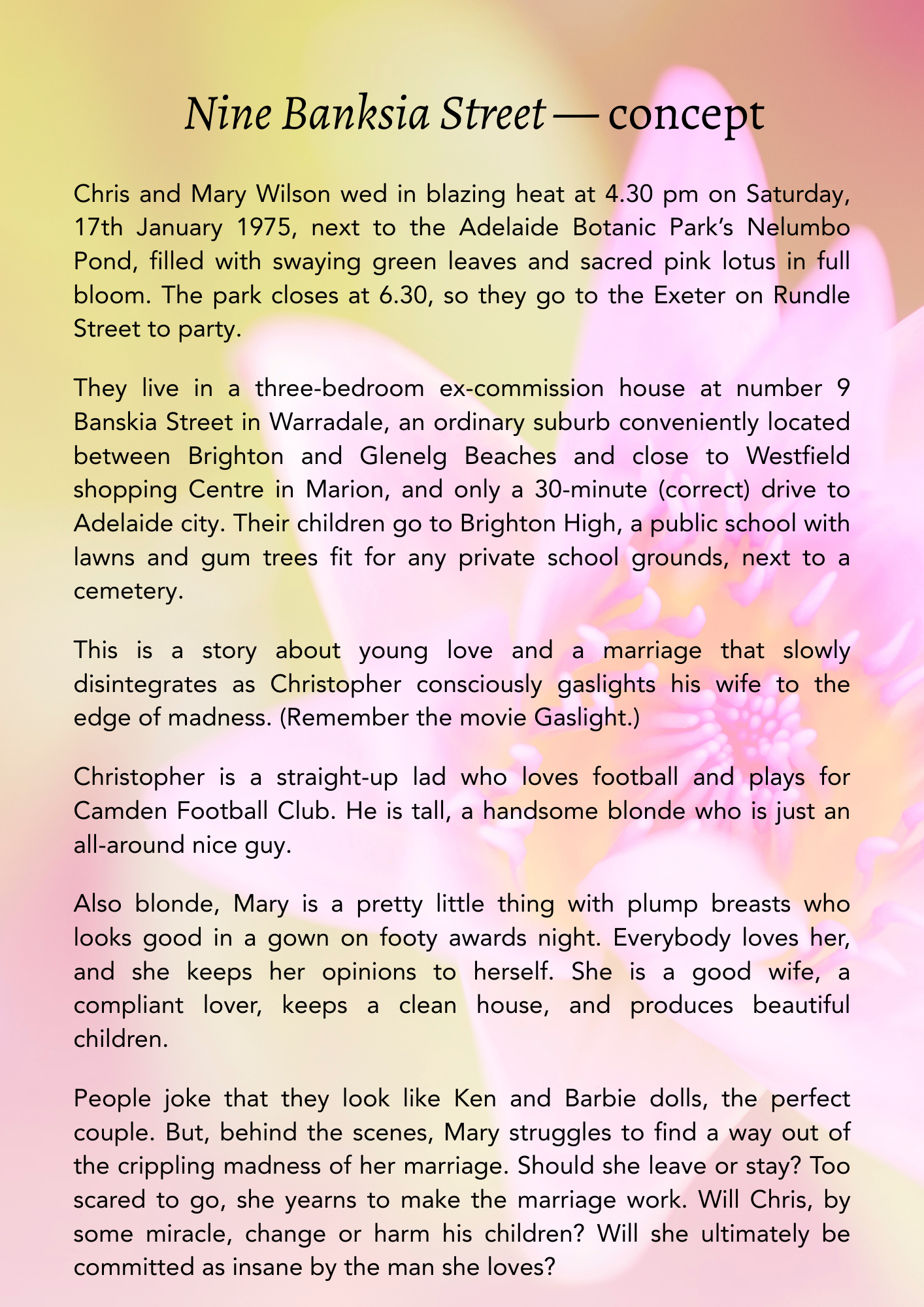
My gaslighting book’s working title is Nine Banksia Street. The main characters appeared in my mind simultaneously with the basic story concept, which came to me in a sandpit rush, pretty much word for word, as below. The story entices but remains unwritten for the time being.
The Latest from Lindy’s Sandpit
I was talking to a friend a couple of weeks ago, asking why I tend to focus on misery in my writing. When I suggested I might write something humorous about old age, she agreed.
One title that emerged from my sandpit years ago is The Grizzle and Giggle Club, which I’ve had in mind since middle age, when my women friends and I used to feel better after a grizzle and giggle together. But the more I think about it now, I’d rather use something like The Secrets Old Girls Take to Their Grave.
After several recent conversations with age-mates while waiting to see doctors and specialists, and in the Manson Towers Retirement Village, I’ve learned that we all have experiences that most of us would prefer to keep to ourselves. When I finish Call Me Marigold, it may come down to a toss-up between this idea and gaslighting.
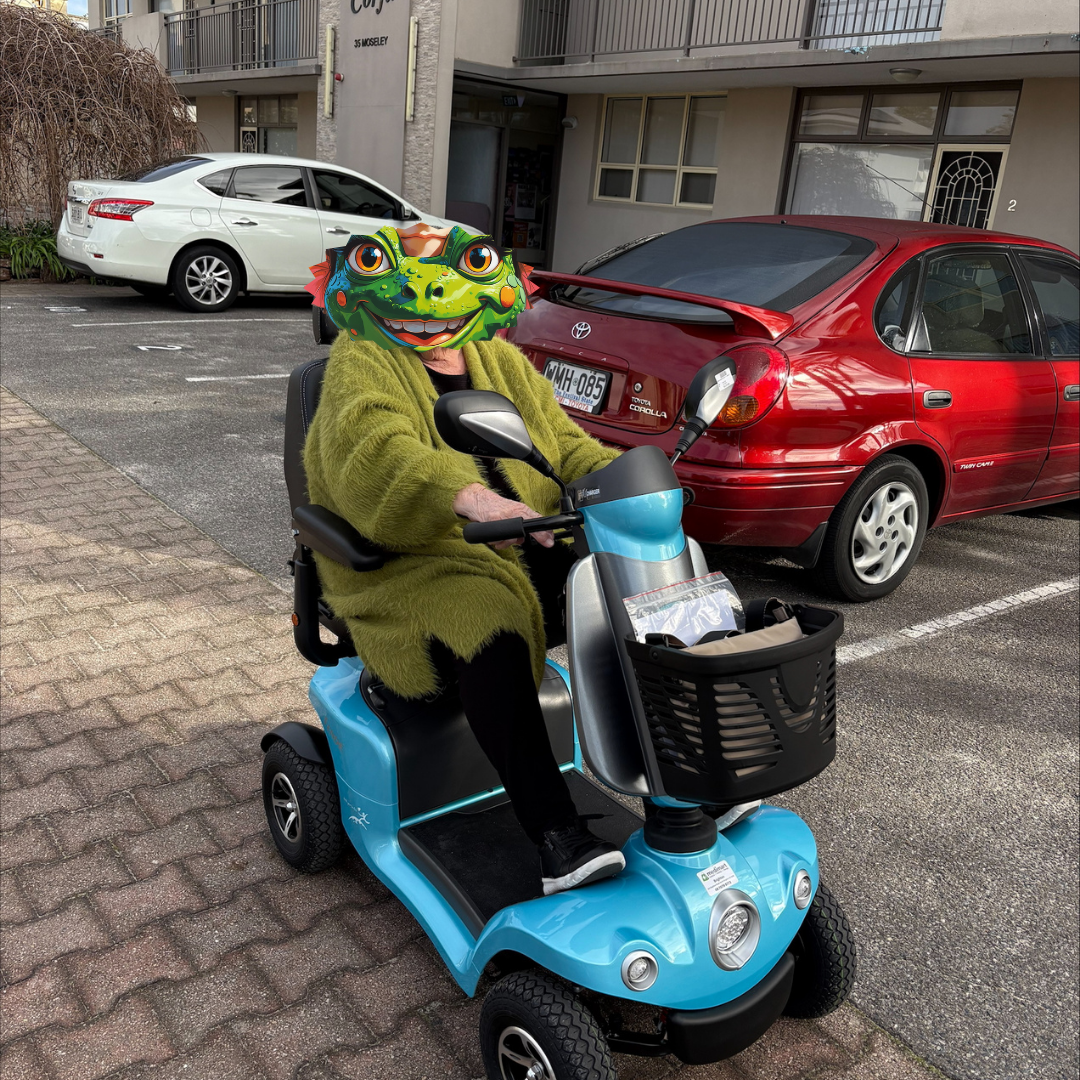
It was one thing a few years ago, coming to terms with my need for a walking frame, and quite another getting to the stage where I felt that the only way to get around comfortably would be on a mobility scooter. When I first got my walker, I hid it in a small storage room opposite my unit for weeks, maybe months, bringing it out secretly, hoping nobody would notice I was in some ways deficient. After all, I still had a car, so it was mainly an exercise supplement at first. Soon enough, however, it became an integral part of my everyday existence. I thought a gopher would be the same.
As I stand before you, unashamedly old, the question is: how did I fare in testing a mobility scooter? In truth, it was a test in more ways than one for someone like me, who, in my 50s and 60s, drove across this country’s remote outback in a 4×4, working with First Nations people. This body, which grew up riding bikes, going bushwalking and trekking, playing tennis and competitive squash, and even skimming across lagoons and bays on a single ski, found itself all shaky in the little four-wheel electric gadget. Anyway, here’s the story.
End of an Era
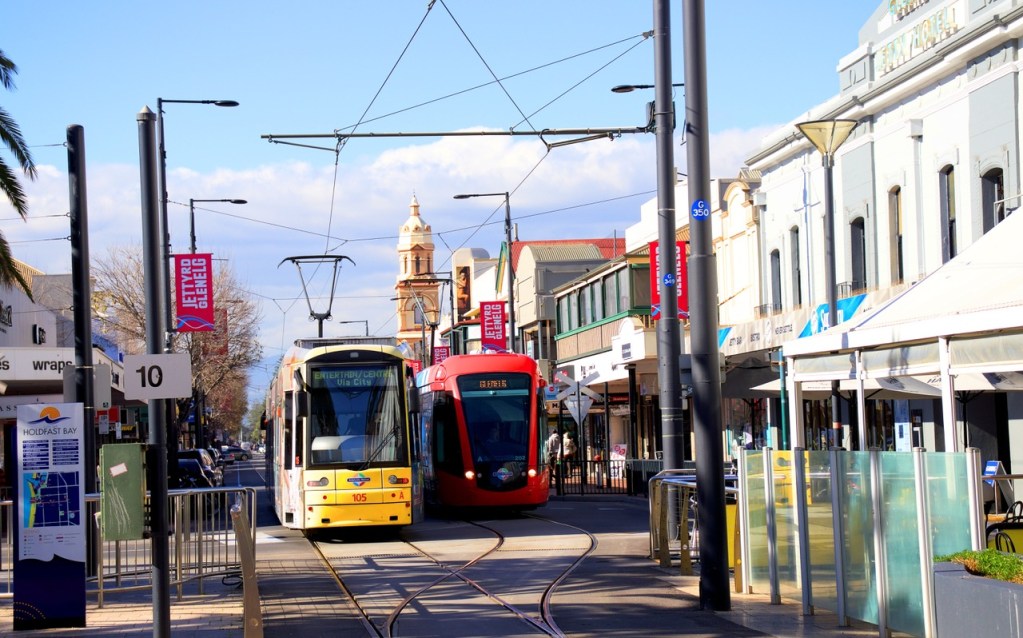
After driving for 66 years, I sold my car to make way for a scooter because my health and physical strength had been declining, with a corresponding loss of confidence. The time had come to satisfy my growing urge for something new. I had long visualised flying in an electric scooter on the Glenelg Jetty and down the Esplanade, shooting across Moseley Square and along Jetty Road’s footpaths, feeling light and breezy in the sun, like golfers do in their buggies. I thought life would be fun again.
Looking towards Glenelg Jetty Photo by Martin ChristmasJetty Road Glenelg Photo by Martin Christmas
I did sometimes wonder where such a joyful imagining came from, as it was not how I perceived others in gophers. It occurred to me that my yearning for a scooter stemmed from an incident in my younger years when I showed promise as a golfer. My husband, parents and in-laws insisted that I should stop playing because swinging a golf club might harm my baby. I felt morally obliged to comply. They then used me to caddy for them in turns while they played, and I carried their golf bags on my shoulders, watching with envy as other, wealthier golfers rode in glee on golf buggies, which are not dissimilar to mobility scooters.
A Price to Pay
I could have purchased a scooter outright from the car sale proceeds, but I decided to keep a few bob in the kitty. As a recipient of a Commonwealth Home Care Package (CHCP), I could access funding for the purchase. Mobility scooters are not inexpensive and range from $ 1,000 to $10,000 or more. The one I chose—the test vehicle above, in white—was $5,500.
So far, my package has provided me with an electric chair and cheap Lite and Easy meals; I pay only for the ingredients, and I now have a Cabcharge allocation. However, as with the chair, being funded for a big-ticket purchase has side effects, the first among them being it overrides freedom of choice..
When you are funded, everything requires assessment and acquittal. My mental and physical capacities were assessed—which is to say, measured—by a young male Occupational Therapist (OT) whose role also gave him the power to veto my vehicle choice. I hasten to add, he was a delight. And I understand that, in the Aged Care system, allied health and CHCP providers must be accountable for achieving satisfactory outcomes for every dollar spent. We get scrutinised so carers can authorise our use of our funding, which also pays their wages. Interesting.
The Trial
Photo by ECH
Finally, there I was, on the scooter, in the foyer of my high-rise village building, being showered with good wishes and smiles by passing fellow residents as I was about to buy a white version of the nifty little blue scooter featured in the lead photo that the OT had recommended. I was ready: my body had been measured, my home assessed for suitable indoor parking, and I’d been given a thorough rundown on the scooter’s dashboard and how to start, slow down, and stop.
On the street, the OT and the salesman walked on either side of me, like sentinels, encouraging, helping, and supporting me along the way. That tickled me. Had I been alone, I may well have crumbled into tears of self-pity and frozen, worrying about how to get home.
But I was terrified. The handles were fine, but my arthritic hands were sore from holding what felt like a hard, skinny, plastic driving stick. With it, the scooter flicked into action like a jump start and came to an equally sharp stop, which was scary. No wonder the dashboard had a rabbit symbol button for speeding up and a turtle one for slowing down.
In fear-tinged mirth, I managed to reach a speed of 3 km/h a couple of times, but mostly crawled along at 2 km/h. It would take hours to get from Glenelg to Westfield Marion at that pace. Not only that, the footpaths in the vicinity of my place can only be described as full of bumps, humps, and steep cambers that made me feel dreadfully unsafe. Crossing roads was fraught. Need I go on?
Back at Home Base
Back at home base, convinced I’d failed badly, I was trembling. But no. Both the salesman and the OT were quite happy that I was suited to riding a scooter and would be fine after having a couple more test drives. Uplifted by a sense of fun (and being made a fuss of), I committed to making a purchase then and there. The salesman offered to be available for after-sales queries and assistance at no additional cost. That was on a Friday.
That night, I tossed and turned, having nightmares about the three worst things about having a scooter: trying to open and close the double-glazed security entrance to Manson Towers, getting the scooter into and out of the lift and turning it in my corridor. I imagined myself on a cold, bleak day outside, having to get off the machine to use the air key, only to find that by the time I got back on the scooter, the heavy front doors would already have closed, locking me out of my home if nobody was around, as is often the case.
I spent Saturday and Sunday writhing with indecision, unable to sleep. Without shame, I then wrote to the OT and my CHCP late on the Sunday to thank them and say that I would not be getting an electric scooter after all.
Acceptance
The trial showed me how very low my confidence is. Being riddled with arthritis and having lung disease are both taking a toll. I might have become more competent with a mobility scooter over time, but given that waning confidence led me to sell my car, I knew my decision was sound.
Now, I can just settle down and enjoy free Cabcharge. After all, that’s the sort of thing that CHCP is all about. I no longer have to haul my walking frame in and out of the car, look for parks or fight with the traffic and risk-taking pedestrians on Jetty Road. I can now relax into my new chauffeured life.
This post is a slightly modified excerpt (in other words, a ripoff) from my work-in-progress, Call Me Marigold, a novella-length piece of autofiction. I’ve chosen from a section called My Six Buddhas and Three Husbands. While I may refer to husbands indirectly here, details will not be revealed until the book’s publication. However, I leave the references in because they indicate that husbands are treated in that book (in a literary sense) somewhat like ornaments, albeit with a modicum of respect.
I’m talking about ornaments because our ornaments refract time, memories and emotion. Our favourites satisfy us for years, if not a lifetime. While my Buddha figurines and statues are not my only ornaments, I have decided to discuss them primarily because they collectively create a presence or aura in my living space.
My Six Buddhas
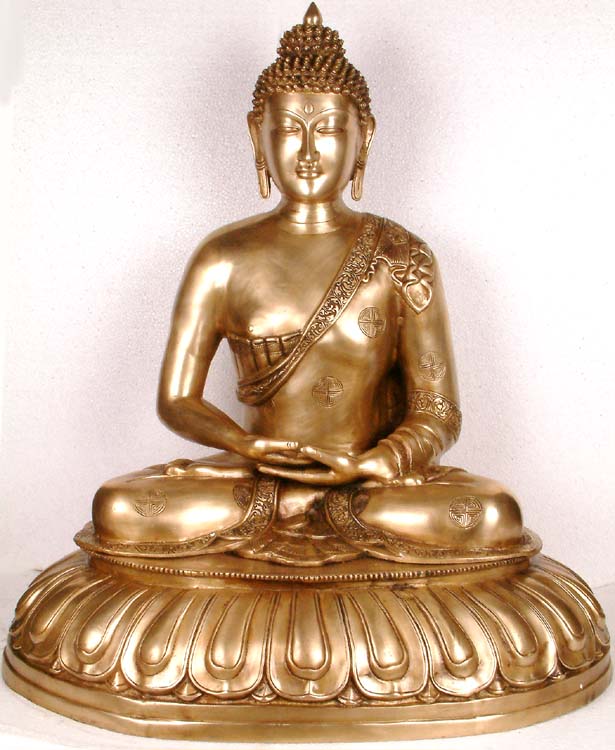
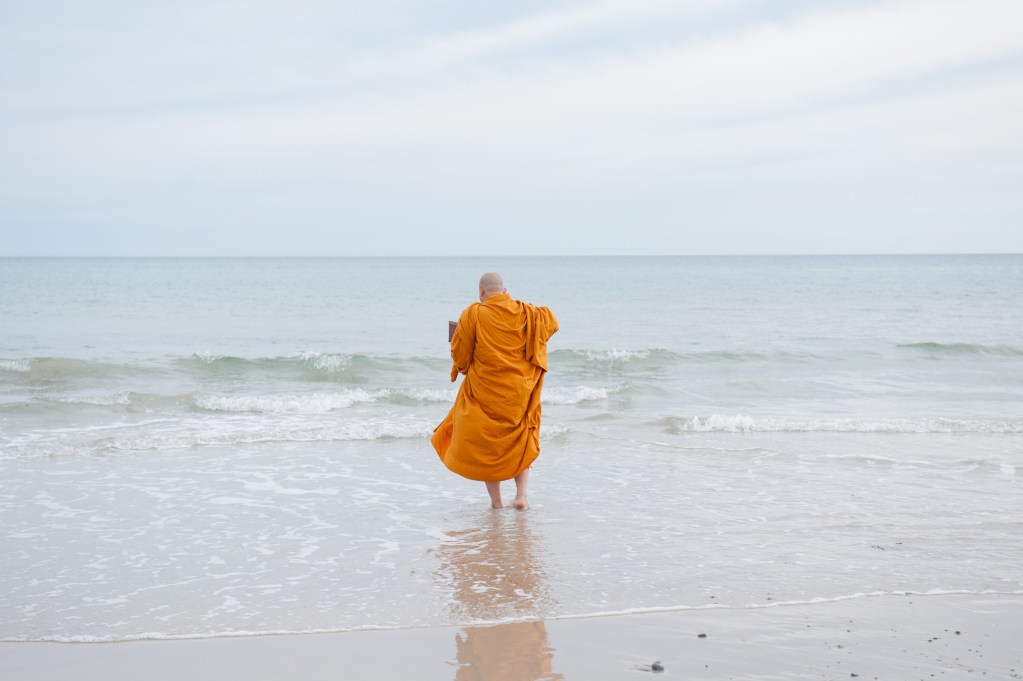
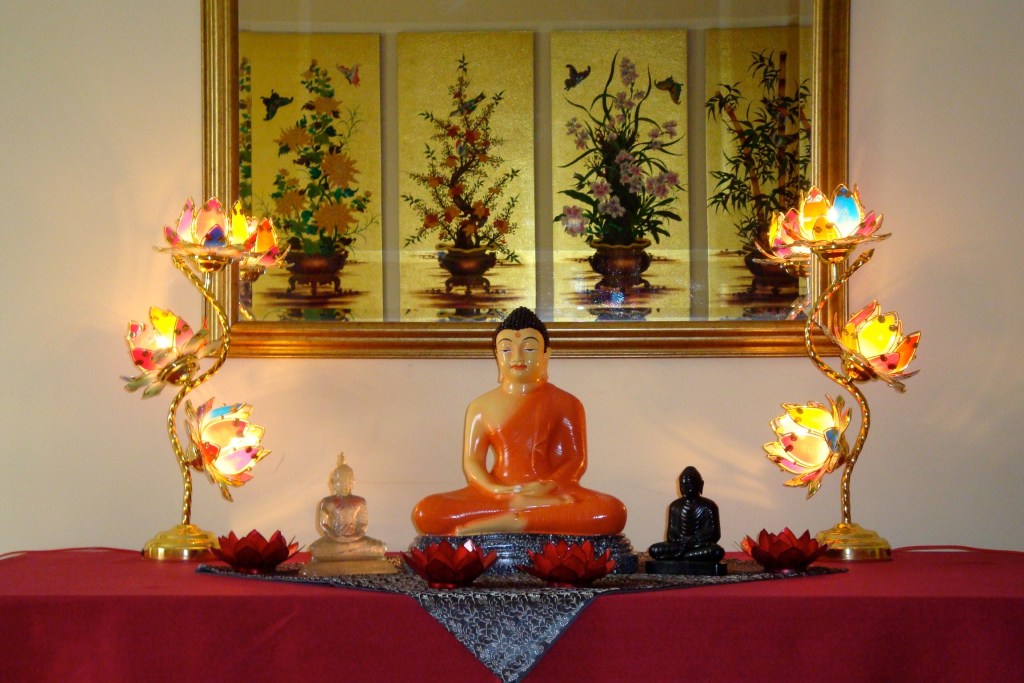
By the time I moved into my retirement village with the mass murderer’s name (Manson Towers), I only had six Buddha statues. I donated a large brass sitting Buddha, similar to the one pictured above, which was important for teaching meditation in my post-retirement days, to a Cambodian Buddhist monk, Bhante Ly, who was a dear friend. He blessed my eldest son’s ashes before we spread them at Aldinga Bay.
A small, transparent resin statue pictured later, given to me by the head monk of Adelaide’s Sri Lankan Buddhist Vihara, found a new home with my youngest son.
My First Buddha Statue
My first Buddha statue, shown in the lead photo of this post, entered my life half a lifetime ago, when I was in my early forties. I bought it in Chinatown while in Sydney to attend my first academic conference as a postgraduate. (My paper entitled ‘The Booze, the Bouncer and Adolescence Down Under’ (1994) was accepted immediately for publication and is still often accessed.)
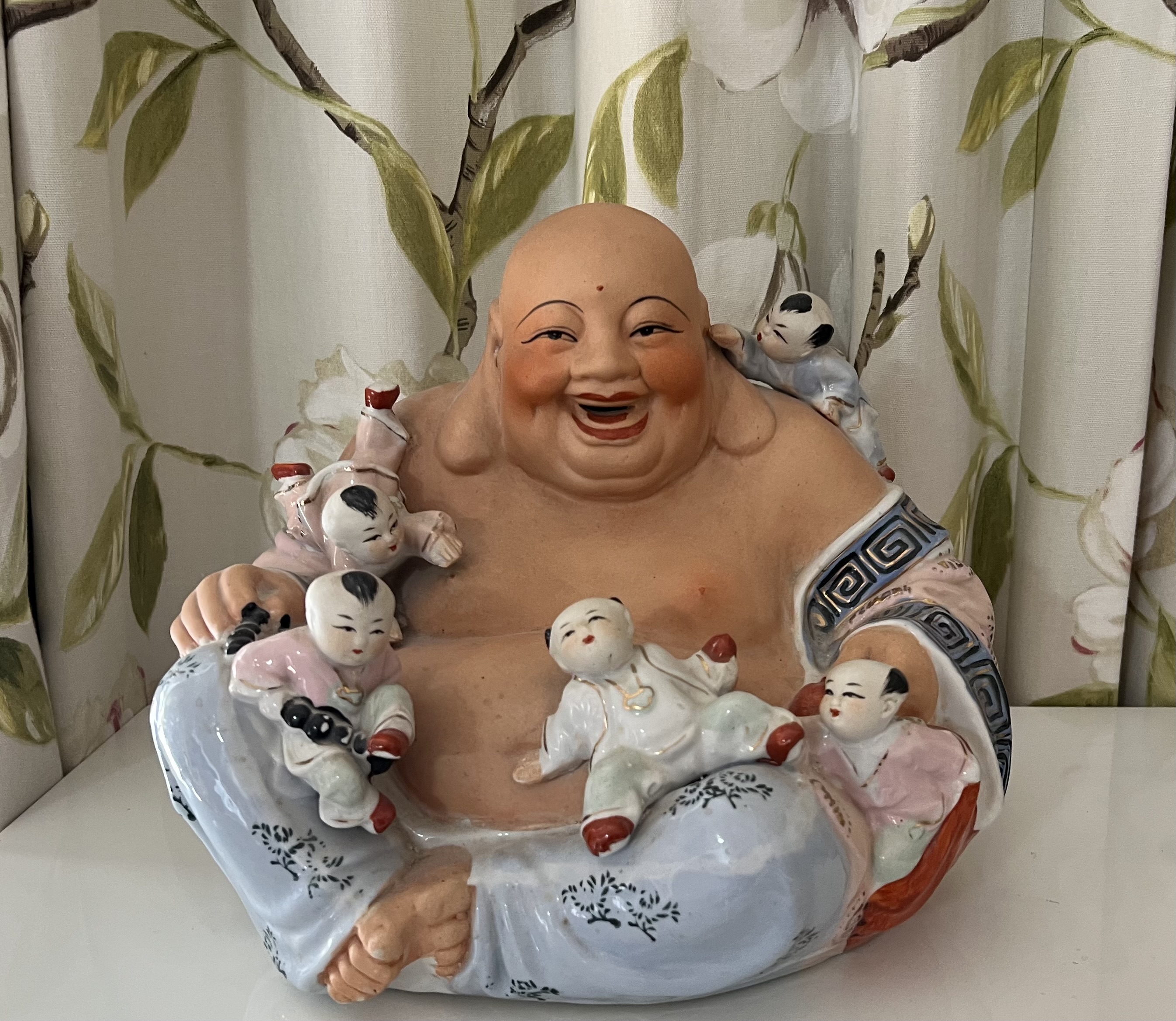
Looking back, I fell in love with it, not because it sort of reminded me of my second husband’s desertion, but because this rotund Chinese laughing Buddha in blue robes has five little children crawling all over his bare shoulders, a profound symbol of the love and joy I felt for my three young children. At the time, I had not discovered Buddhism; my choice was both aesthetic and emotional.
Place is Important
The place of purchase carries more significance. I found the blue Buddha near Paddy’s Markets, where I worked when I was about 18, after the first of my three failed marriages ended. I found a job there with Pardy Providors as a stenographer and cord-and-plug telephone console operator. My boss was a tall, well-statured man who constantly hitched his brown trousers at the crotch. Being in my late teens, I had to stifle the urge to giggle at this unfortunate habit.
Still, I never mocked, as he was a kindly soul who looked after me when I had a telephone flirtation on the console with a supply officer from Ingleburn Army Camp, a WWII, purpose-built training centre that was wound down in the mid-1990s. I don’t recall his name, but we flirted when he called to place an order. The soldier finally persuaded me to meet him, until my darling boss saved me by telling me the guy was married with two little ones.
I was going to suggest we meet at The Broadway Hotel on George Street, where I worked a second job as a barmaid at night. Being a publican’s daughter had its benefits for much of my life; I could always get a pub job for extra money. In Sydney at the time, I first lived with my aunt, my father’s sister, in North Ryde, which was then considered the countryside. We had an outhouse and a dunny can.
Much as I loved my aunt, I disliked going to the loo on cold or wet nights with spiders and newspaper for toilet paper, or travelling to work and back each day, which entailed long, hilly walks, trains, and trams. With a second job, I was able to move into a rooming house right on the curve of Bondi Beach, next to the saltwater pool.
My first Buddha holds all of these memories.
In My Sixties
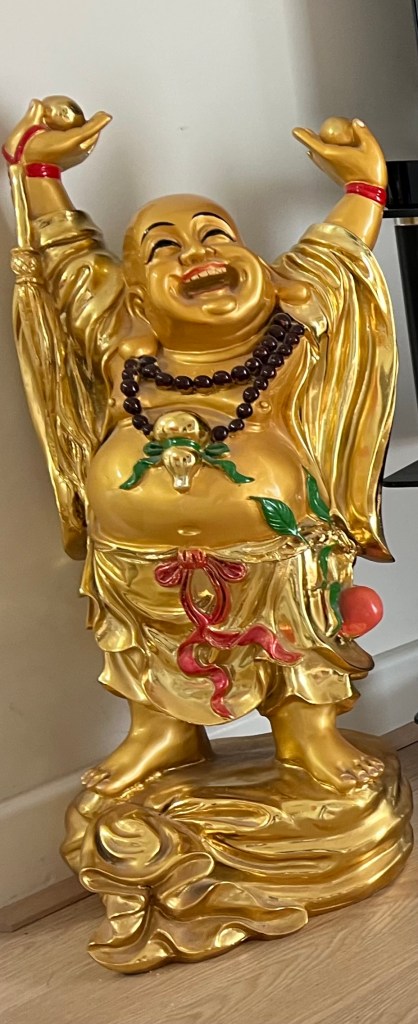
When I was in my sixties, after encountering Buddhism in Sri Lanka, I bought a 60cm-high, gold-coloured resin standing Buddha, with a ball aloft in each hand, held high, representing prosperity, happiness, and good luck. I found it one day after wandering the length of Melbourne’s Victoria Markets, already a lost soul after leaving the Northern Territory and the workforce for what seemed like forever, and looking for my car on the wrong side of the vast, sprawling marketplace. The statue’s golden smile winked at me from the window of a shop, drawing me in.
Inside, the shop was cool and calming. The old Chinese shopkeeper was dressed in what I guessed was traditional Chinese rural garb of loose trousers and a top made of rough hemp or cotton. He greeted me with a smile. ‘You like?’ he asked. ‘I’ll give it to you for a special price. You are my first customer, and that is my good luck.’ It was good luck for me, too, at a time when I was utterly drained by life, having found myself on an invalid pension and living in high-rise public housing in Prahran.
The luck of my gold Buddha was pivotal. It served me well in my transition from anthropology to a retirement filled with meditation, poetry and writing. And, as it turned out, the high-rise experience was a special time that both led to and informed my second novel, launched in 2024, They Who Nicked the Sun, set in Prahran, in Melbourne.
What may seem bad at the time often augurs better times to come.
From Sri Lanka
I concede there was an aesthetic impulse behind the purchase of the beautiful King Ebony figurine seen to the right below, which I bought for Rs 900 in the early 1980s from an expensive jeweller close to Colombo’s vibrant outdoor market, the Pettah. It is exquisitely carved to the correct proportions for a sitting Buddha and represents a country I lived in and loved, and where I met my third husband. On the left is the clear resin Buddha now treasured by my son.
From my meditation room at Aldinga Beach
The central Buddha in the photo above is a traditional Sinhalese Buddhist statue crafted by artisans as a gift from the man who was my research assistant back in the 1980s, with whom I became friends during my PhD research in Sri Lanka—a time and place that changed my life. My friend went on to become an international consultant and lifelong friend. He sent the statue unannounced, close to 30 years later. Even in our old age, we email a few times a year to stay in touch. He has a very special place in my heart.
Aldinga Beach
The Chinese gold and white porcelain meditating Buddha in the next photo evokes memories of my 16 years in Aldinga Beach. After being blocked for many years by local protests and the Council’s ignorance, the Nan Hai Pu Tuo Temple was built at Sellicks Beach.
At that time, I led three meditation groups: one at Aldinga U3A, another at the Aldinga Community Centre, and a private group at home. With my meditation students, I occasionally visited the Temple on Sundays to participate in the Temple’s Dana lunch. They were good years. People from all three groups also came together at my place monthly to share a vegetarian meal.
Childhood Memories
A few years ago, I scoured the internet to find a miniature Daibutsu Buddha, a replica of the giant bronze statue in Kamakura, Japan, built during the Kamakura period. It was first constructed in wood in 1243 and later recast in bronze circa 1252. We visited the giant Daibutsu Buddha when I was an Army kid, and I adored it even then. My tiny bronze statue, at 60mm high, is smooth, cool, and weighty in the palm of my hand. It calms me.
There’ll be more about my three husbands in Call Me Marigold, coming as fast as I can write it. They, too, have times and places that evoke experiences that, in retrospect, were transformative. Even taking into account the sad and bad bits, my memories come together in glistening vignettes, like brilliant gems of life. Till then —
On Ornaments
Ornaments are serious business. While I’ve focused on my Buddha statues today, my home contains a number of other special artefacts from my life, including wall hangings passed down to me by my mother, brother, and lost son, as well as gifts from my other children. We also keep mementos, such as letters, emails, and perhaps books by friends, as well as our own publications.
Just as museums are a testament to a culture, our ornaments give witness to our lives. What do you see when you look around at home? Do you have a favourite item that tells a deep story? Which pieces do you hope your children will cherish when you’ve gone? Do they know your history?
It would be fanciful to say that this is a day in the life of a writer, because, at my age, the first order of things is to attend to my body. Forget the morning alarm, offices, gyms, and parties, in one’s eighties, your diary is more likely to be filled with allied health, medical and specialist appointments, and days organised around a regimen of medications. So, if I say to you that I write in the mornings, that means after breakfast, and an hour or so of telly, which I watch until I’m awake enough to prime my body with pills and potions. And that’s before getting showered and dressed, which is no easy matter. I am trapped in a demanding body.
My morning routine is also hampered by having to stop to catch my breath every step of the way. Everything takes so much longer than it did in youth and the prime of life. I have no recollection of having noticed the various steps involved in facing the day when I was younger. In the moments after I woke, my mind would run through what was on for the day, and I’d choose what to wear. After a shower, coffee, and toast, I was out the door. Old age demands your time and more than a tad of mindfulness, or you risk going bonkers.
Somatic Memory is a Trap Too
They say routines are made to break. Most days, I wake at 5 am. Even living alone, I notice that when I stray from routine, I feel uncomfortable. For example, I usually struggle to stay in what my father called evening wear all day. The lessons of gossip about women taking their children to the bus stop for school in dressing gowns set me straight on that very early in life.
Nor will my body let me forget responsibilities; it has its own memory, inculcated by life. When I had children, if I happened to be out of the house, by mid-afternoon, my body impelled me to get home before 3.30 to be there when they got home from school. It was a powerful feeling.
Routine Interruptus
We all have routines of one sort or another. I remember over 20 years ago in Darwin when I had to fill my 4-4 (or SUV if you’ve not heard of four wheel drives) for a long stint working out bush, I noticed a stream of solitary men who I guessed lived alone, many old, but not all, who turned up at the servo (gas station) to by fags (cigarettes) and the day’s papers in the early morning.
I see a similar stream of men heading early to a nearby newsagent now, from my second-storey balcony.
When I had a dog in Melbourne’s Prahran, I’d see familiar faces hit the parks with dogs like me at the same time each day. However, unlike the solitary men at the petrol stations and news agencies, friendships often formed from this type of routine.
Those who travel to work have routines to ensure they arrive on time, just as I have my buzz cut every four weeks on a Monday or Wednesday. My Wattletales blog posts appear regularly on the 20th of each month. We take these little routines for granted, yet they serve to make us secure. They give life purpose and structure, without which we are often at a loss.
Nevertheless, unless we choose to do so, being diverted from our routine or even running late can make us—especially those of us living alone—uncomfortable.
To gain a sense of control over her life, my mother took her phone off the hook (no mobiles then) for morning tea, lunch and dinner. If she was lucky, her phone might only ring once a week, and it was probably me, but she did not like to be interrupted. Her life was extremely solitary and isolated until she decided to move into Kapara Nursing Home, which she loved. She loved the birds outside her window and ‘the girls’ who looked after her. If I visited while she was using her nebuliser or taking an assisted shower, I broke the institutional care routine that made her feel safe in her final years, secure enough to look at the birds and smile more often.
Puppetry
I’m sure everyone has heard of Karl Marx, the German philosopher who taught as early as the 1860s that capitalism alienated the masses from the means of production, hence themselves. I don’t think today’s corporate capitalism would surprise him in the least. Instead of being self-sufficient today (i.e, having control over the means of production), we have become nations of consumers, now controlled (and manipulated) by massive corporate entities like Coles and Woolworths for our basic needs. In Marx’s terms, we have indeed become alienated.
I simplify, of course, but alienation arises when we are controlled by externals, a bit like puppetry. It leaves one with a sense of agency deprivation, which is a danger to our health and well-being. When you start to find it too hard to go out and about to shop, you increasingly feel the power of external controls. For example, I no longer cook, so I regularly order meals, groceries and even clothes online, which sets up a whole different lot of puppet strings called deliveries.
Now scheduled by corporate computers and AI, deliveries make us puppets. While Meals on Wheels, run by actual humans, delivers to clients at the same time every day, Lite and Easy, which I use, has installed a new e-rostering system for its drivers that my regular driver of nearly 10 years told me has sent them all mad. As self-employed contractors, they are now being manipulated by a computer system. They can choose neither their routes nor their delivery schedules, and, like many other workers with little or no control over their work environment, they are technology’s slaves. (When I say that, call centres come to mind, too.)
Even though Australia Post’s electronic system delivers within an efficient two-hour window, few other delivery arrivals are predictable, which traps those of us isolated at home for hours, waiting. I live in a gated property and am too afraid to go to the loo when a delivery is due in case I need to buzz in a driver. Because they are on the clock, most will not wait more than a few seconds and missing a weekly meal delivery or a precious parcel arrival is extremely tiresome.
Just remember, if you ever get frustrated with your entrapments, close your eyes and go inside to find yourself.
First World Problems
To borrow from Gough Whitlam, ‘well may we’ joke about first-world problems, but there is a real sense of stress going on in these small everyday ways that can undermine one’s self-esteem and confidence, all of which are exacerbated for the aged and lonely by their relative isolation.
When I start to feel sorry for myself, my father’s words remind me to imagine how the other half lives. We are not being bombed to smithereens like Palestinians and, as of this week, Iran, where people have no control over their lives and are deprived of the means to protect their children. Can you imagine how exhausted they must feel, not to speak of being brutally alienated from not only their homes but also their livelihoods, their homeland, and any means to hold onto what they cherish?
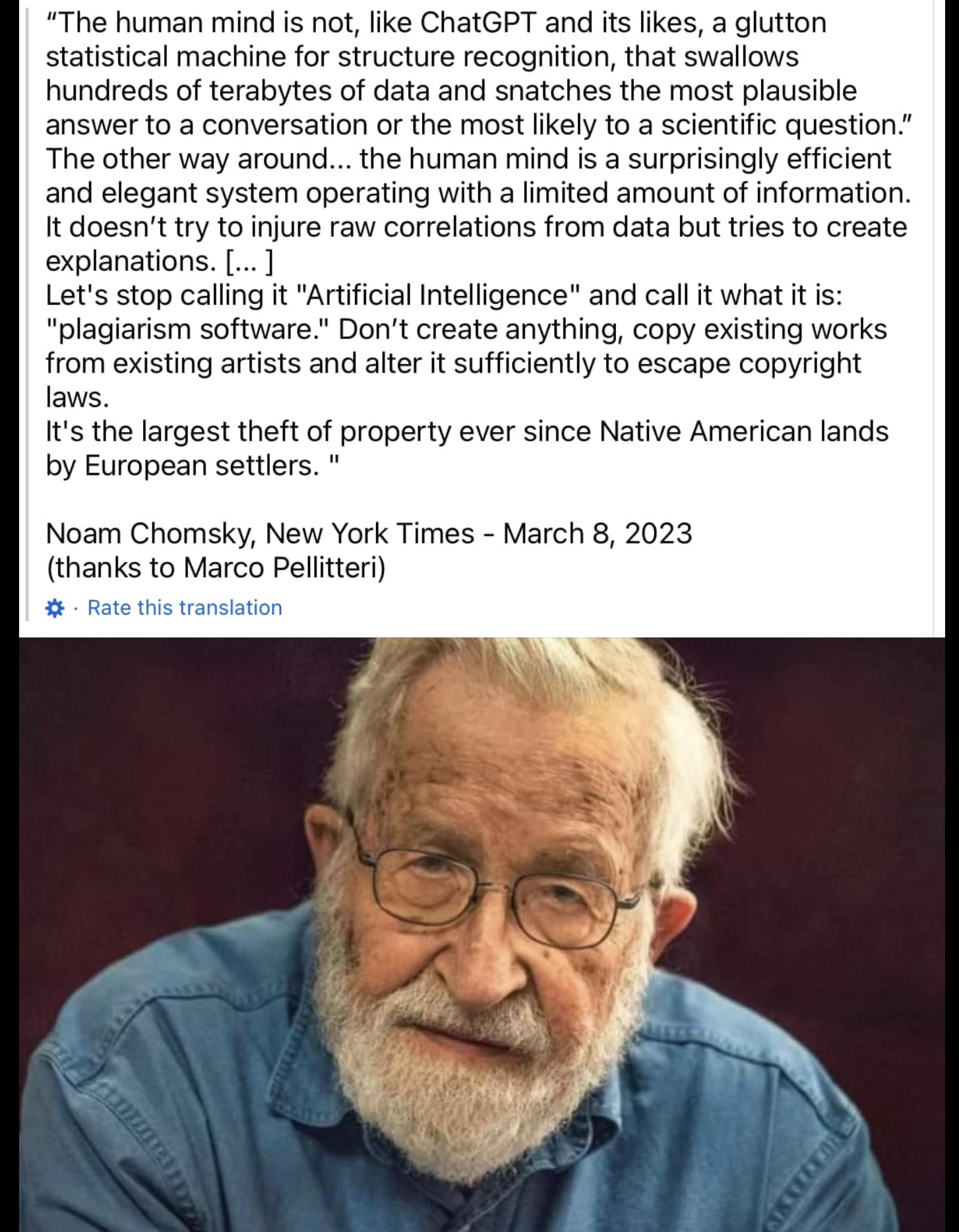
While I manage my relatively trivial constraints by simply letting go. As my grandmother used to say to my mother, ‘You can’t control the elements, dear’. It is just as futile to try to control what is beyond your capacity to do so. So, when I need to find my alienated self, I have the luxury of being able to escape into my writing, where I always feel whole. This week, ChatGPT gave me a lift with this.
To Conclude
I have used puppets as the primary symbol for what I am pointing to in this post about alienation in our modern world. Clearly, there are many areas I’ve not touched on, but the idea came to me that the popularity of End Of Financial Year and Black Friday sales makes sense in these terms. They pull our strings or, in other words, alienate us from ourselves.
On the one hand, they are corporate events that offer the thrill of the hunt, so when people find a bargain, they experience a sense of control and mastery, just like any organised sporting hunt might offer. On the other hand, big sales are actually bait. We are both the hunter and the hunted because big sales are designed by corporations to entice us to buy things we may not need, allowing them to offload unwanted goods, while writing off bargain losses with inflated prices all year round—tricky stuff.
I was going to call this post Things I Ponder and had to change to ‘think about’ because there are so many ways of using ‘ponder’; ‘ponder upon’ (a little old fashioned), ‘ponder on’, which, like ‘ponder’ suggests particular topics and is therefore constraining), and ‘ponder about’ which is silly because the word ‘ponder’ means’ think about’, but after reading these variations online, I decided that, if I leave the word ponder dangling, it might be confusing. These are a few things that literally stick in my mind.
I mention this tiny research moment on pondering as a way to show how my mind works. Where once, post-childhood, when I daydreamed a lot, I didn’t ponder anything much, preferring to think I was right (which I often was, although it made me unpopular). Now, in old age, I find I second-guess myself to the extent that I search the World Wide Web to check most thoughts that may, to my shame, go viral if they’re wrong, like my poor failing body, so often told it’s not right by medical science. While I don’t like to be incorrect, I am aware that few things in life are straightforward, as my little ponderings today exemplify.
Welcome to Country
The Idea
The idea to ponder Welcome to Country ceremonies in a post originated from my son, who encouraged me. These traditional ceremonies got a lot of bad press in the pre-election political discourse. Unlike me, he has travelled to New Zealand, where he was impressed by the way traditional Māori culture is integrated into daily life, from a visitor’s perspective. He wishes Australia could be like that towards First Nations culture and peoples here, as do I.
I am not an authority on this matter, but I am, as many know, an anthropologist and have worked with First Nations people across Australia. So, while it is not my place to speak for them or on their behalf, I can say, both as an anthropologist and as a publican’s daughter who was raised and worked in pubs for the first half of my life, I understand Australian culture at various levels. Well enough, I trust, to make a few general observations while sidestepping the specifics of recent journalistic and political discourse and similarly grossly ill-informed social media discourse.
It’s All To Do With Semantics
Much like my earlier discussion on the effective use of the word ‘ponder’. The term ‘country’ appears to be the main sticking point for those who perhaps operate under the notion that it means the same thing as ‘nation’. Such a flawed conflation leads many people to ask why the Australian population at large should be invited to their own country. They find it offensive.
The answer depends on what you mean by ‘country. Failing to understand this fuels racism.
Welcome Ceremonies
Bear with me if you know this already. A Welcome to Country ceremony is offered by a small group of people whose ‘country’ is defined by the stories they hold for a particular tract of land. The traditions of that land are part of their being, defining First Nations people as who they are. Tradition places the responsibility on them to take care of that land, their ‘county’, just as we look after ourselves and our homes.
Seen like this, it is easy to see that Welcome Ceremonies are more like opening the front door to welcome someone into your home than taking over Australia or speaking on behalf of the nation to which we all belong equally. Indigenous country is the literal territory of ‘their mob’ or ‘my mob’, and it does not threaten anybody’s rights as a citizen one iota. Everyone should know this by now. Those with a public megaphone should report it that way instead of fuelling division. After all, most of us are by now familiar with the name of the First Nations area in which we live.
Compiled over many years of research by the anthropologist Norman Tindale, the Adelaide Museum’s Map of Tribal Australia shows us the traditional lands occupied before conquest. You can find what is likely to be an updated version of this map in the Aboriginal and Torres Strait Islander Studies Library (AIATSIS) if you want to scroll through it for a closer look.
Other historical maps show First Nations songlines crisscrossing the entire continent like a great big web. It is a shame that these trade and ceremony routes are rarely shown or talked about by the mainstream media, as they would encourage understanding and a greater respect for First Nations traditions.
Smoking ceremonies are a special gift from those who still live in or know the ancient stories handed down over generations about the lands of their ancestors. It is the gift of welcome to a history that precedes the nation we all compose, and now resides within the island of Australia defined by national borders.
In Conclusion
I think the confusion comes because we tend to think of Australia as a country, our country. Whereas we are, strictly speaking, a nation, which is a nation-state. It says so on our passports. And, as an aside, the whole concept of nation and nationality is itself fraught when you look into it. We all get into high dudgeon about ‘my country’ and ‘my nationality’, but, after all, as Benedict Anderson said long ago in 1983, nations are imagined communities.
Historically and politically, a nation is far removed from the face-to-face networks of traditional community life, where kinship-bound people together as political entities. We divide ourselves by class, political persuasions, sports affiliations, and other cultural identities, including race, as well as age. Such cultural distinctions serve capitalism’s marketing purposes well. Extended kinship ties would be a threat to that.
Our island provides a natural national boundary, and our states are clearly delineated by jurisdictional boundaries. Anyone wishing to cross our national border must hold a passport or have the necessary right of entry (and exit) documentation. Crossing state lines requires us to comply with that state’s jurisdiction on entry. If our move is permanent, we must change our electoral entry, our driving licence and so on. Though we roundly resisted carrying a national ID card when the idea was mooted in the 1980s, we take all this jurisdictional ID stuff for granted. Our strings are pulled by bureaucracy.
In traditional Aboriginal society, as I understand it in the simplest of terms, groups passing through the ‘country’ of others don’t simply crash the campfire; they wait to be invited in. Now, all Australians are welcomed into traditional local areas (a First Nation’s traditional ‘country’) with a smoking ceremony that has transformed to meet the contemporary world. Things have to change to stay the same (a phrase that stuck with me from a book I read many years ago about Sicily as it moved away from landlords and peasants, giving rise to the Mafiosi and political bureaucracy).
Thoughts that end up in poems
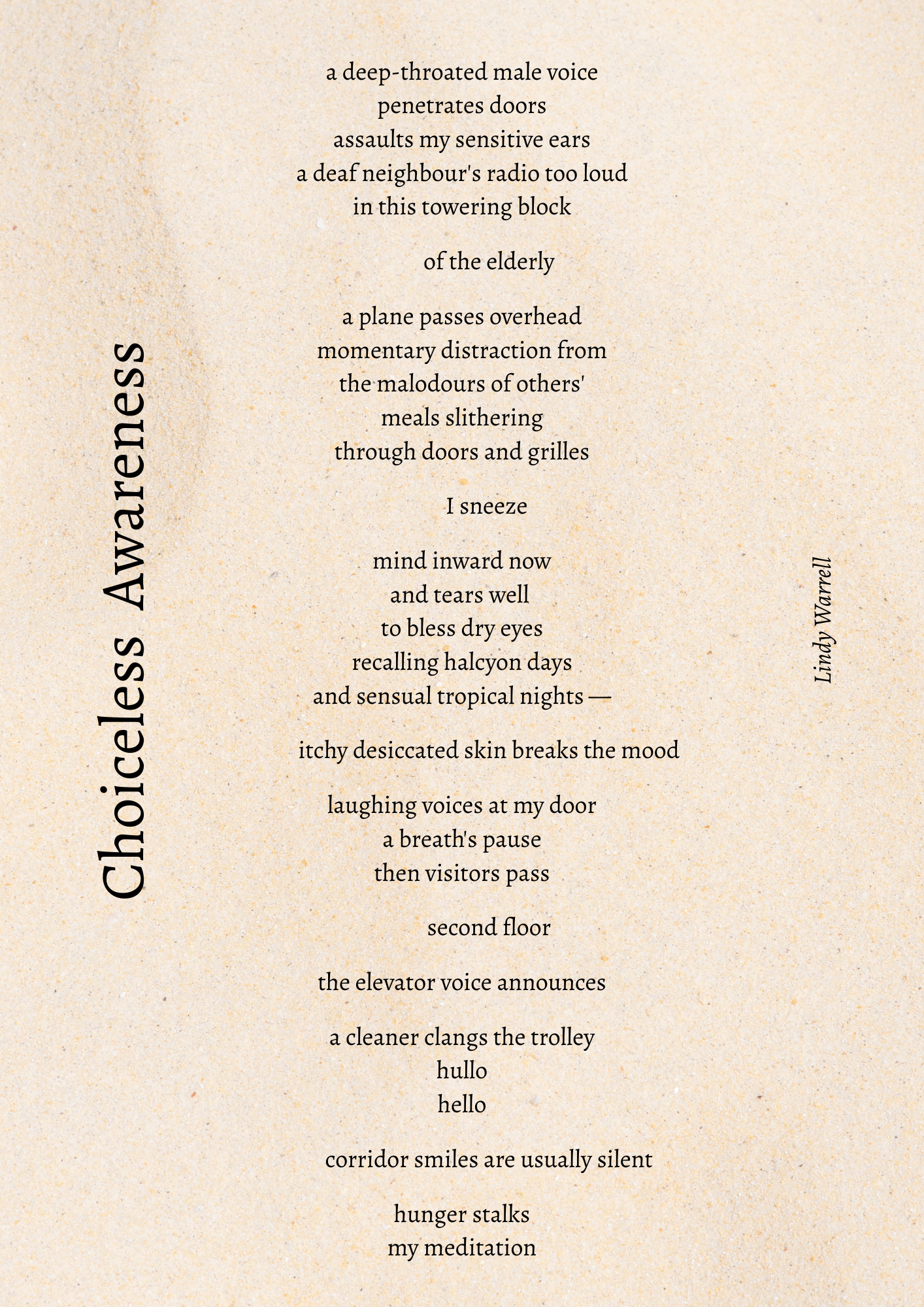
This first poem came from my meditative ponderings on living in a high-rise retirement unit that was built before soundproofing became a thing. It reminds me of old hotels in George Street and Chinatown in Sydney, many, many years ago. You didn’t need a glass to the wall to hear what was going on next door or anywhere else, for that matter. Even pipes creaked.
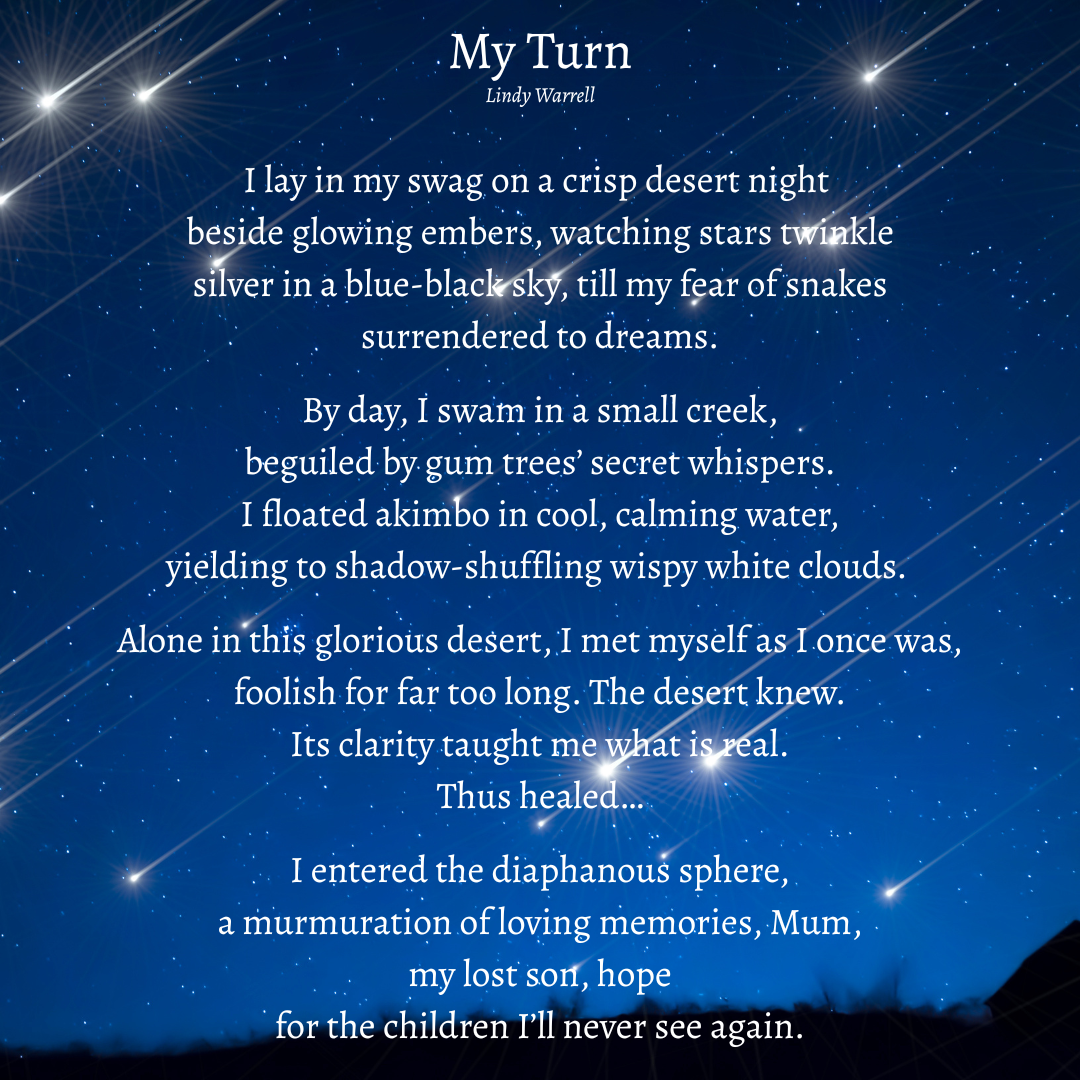
My Turn is something of a contemplative dream sequence predicated on my love for and experience of camping in the outback, often when working with First Nations people on their country. How could anyone forget such a privilege?
Thoughts about Hospital Stays
Toast
Toast has vanished from Flinders Medical Centre’s (FMC) breakfast menu.
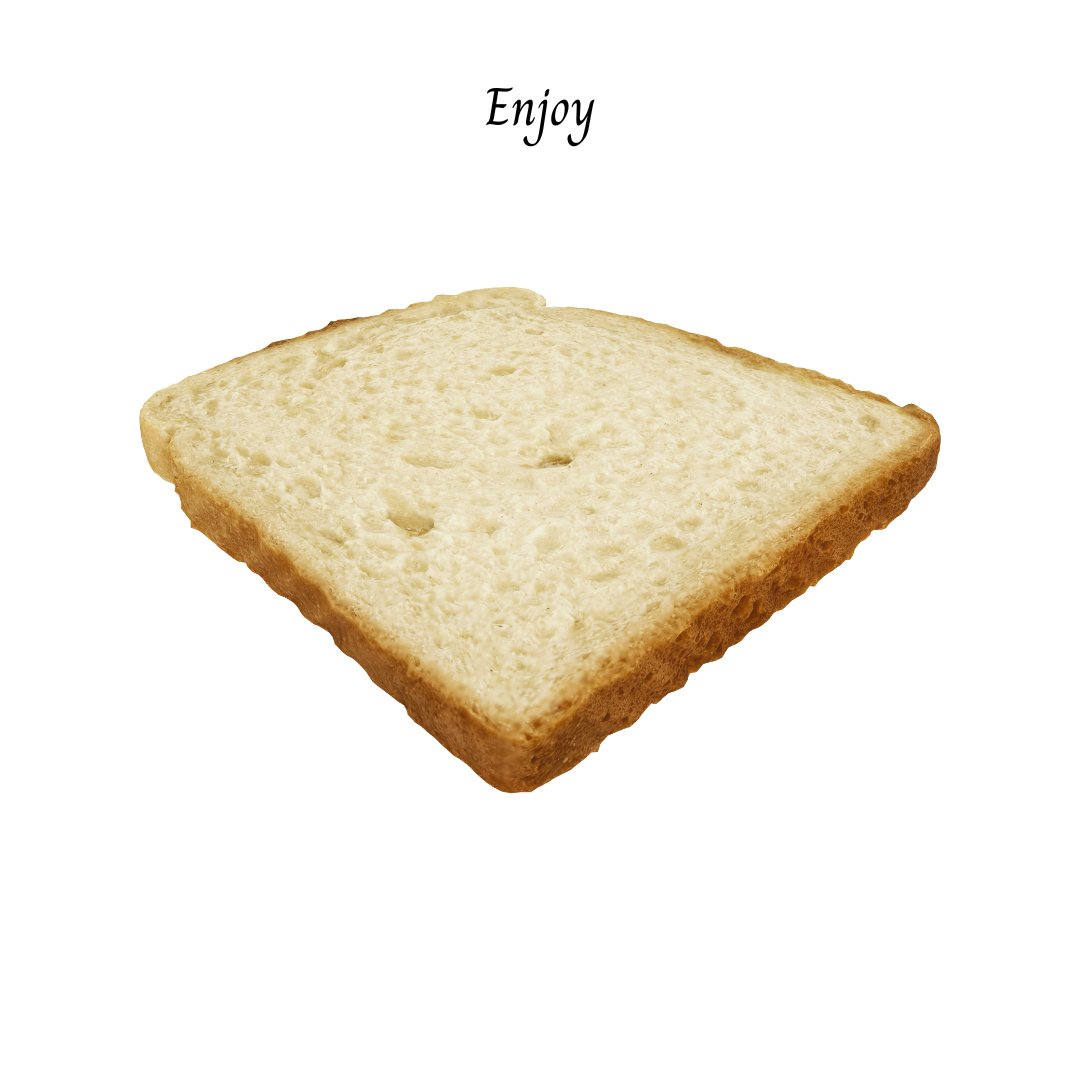
Nobody will starve with cereal, fruit and a cuppa, but who eats pale white bread, butter and jam for breakfast? That was a treat (sans butter) for my father, born in 1910 to an impoverished family living in Sydney’s Glebe, then a slum, after his barefoot walk of three miles each way to school. To me, therefore, a single slice of white plastic bread is tantamount to workhouse food. Have hospital authorities never heard of croissants or muffins? I don’t like either—I’m a toast girl in the morning—but hey, I’d put that dislike aside in favour of flavour.
Showering
What has also disappeared, at least from the public wards at FMC, are white shower-chairs for the frail and elderly. Instead, some bright spark in finance has decided to give commodes a second use, minus the potty.
At 152 cm nowadays, I’m not very tall, so my feet do not hit the floor when I’m perched on the front edge of a bariatric-sized commode. (Most wheelchairs nowadays are bariatric too.) Furthermore, because of its size, the commode must face outwards from the cubicle, which requires you to shower sideways using a handheld shower rose; your arms are constrained by high armrests from which soap slips to the floor. A commode might almost be acceptable when someone else is washing you, but on your own, it’s a bugger. And yukky, too.
FMC’s commodes also feature shiny metal footrests resembling those of a wheelchair. Without a counterbalancing weight, these make it extremely hazardous to stand up. They cut into the back of your legs as you reach for the floor. You dare not put weight on them.
I was so appalled by this turn of events that the matter went beyond mere pondering. I wrote a letter of complaint to SA Health.
Unexpected Germs
I’ve since learned that I have been colonised, yes, that’s the right word, by pneumonitis. Although it is a non-contagious inflammation of the lungs, I must now advise hospital staff of this, if and when I am admitted again, as it can exacerbate other afflictions. I also had to undergo tests for a bug that colonises the digestive tract because SA’s Local Area Health Network (SAHLHN) advised that I may have been exposed during my last stay at FMC. Fortunately, that little bugger did not gain traction in my old body.
Ironically, hospitals were historically built to remove the populace from infectious community environments to promote healing and reduce the spread of disease. It would appear that this cycle is reversing.
Another Surprise
In addition to sneaking in their mandatory cognitive test for the elderly and the insane, no matter how cogent and intelligent you might be, one is always weighed on admittance to a ward at FMC.
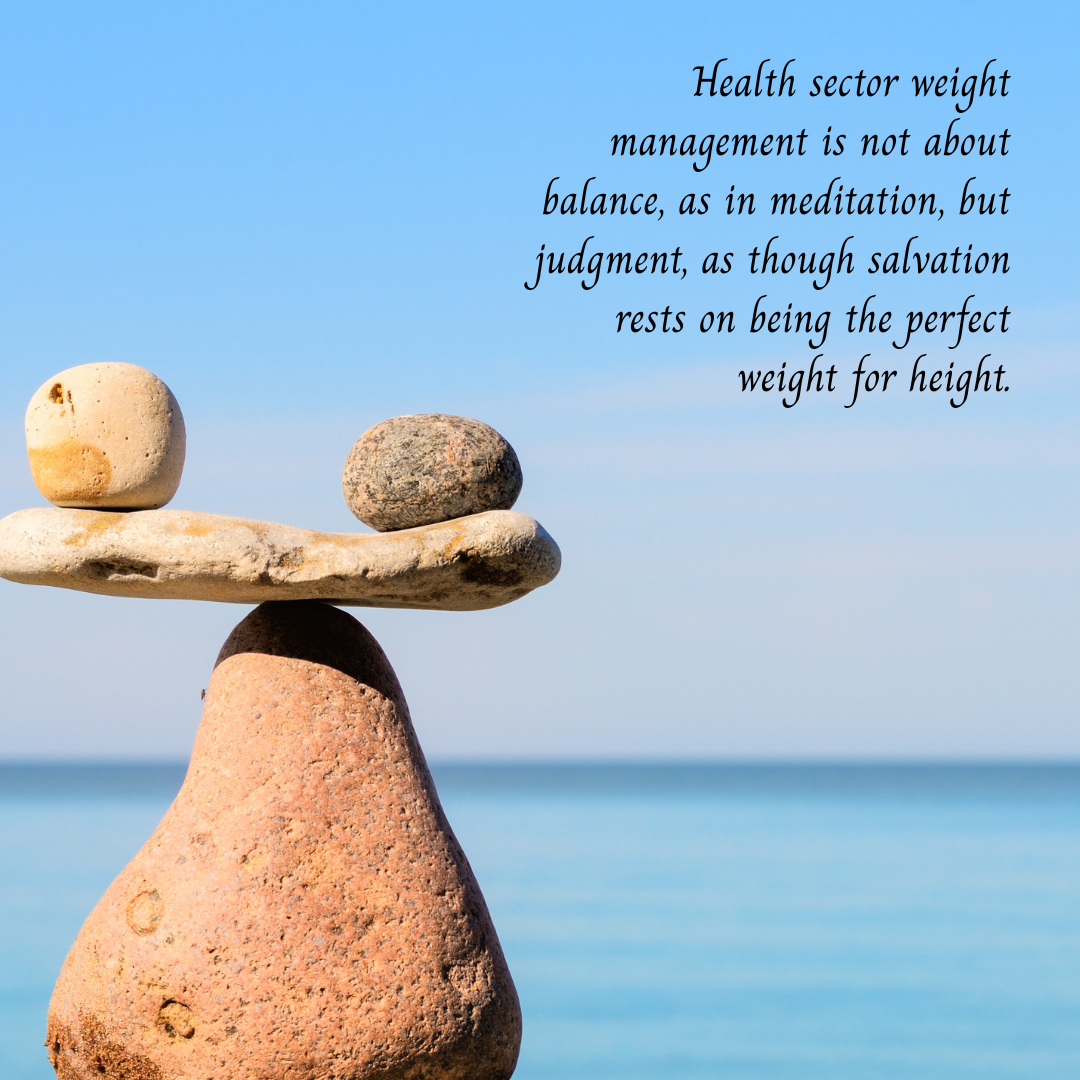
It turned out that I had lost 6 kilos since my previous stay a few months earlier, without realising it. (I gave up on home scales 40 years ago.) Instead of congratulations, however, I was advised that I would be put on a special diet, because such rapid weight loss indicated that I was malnourished.
The nurse and I had been talking about white bread for breakfast until her remark about my weight loss had me roaring with incredulous laughter.
‘At least you’ll get scrambled eggs for breakfast,’ she said, laughing with me.
Can you imagine scrambled eggs on plain white sliced bread?
Happy Writing
Wattletales
If you'd like to be added to the Wattletales post mailing list, make a request in the comments below, your email address is always hidden from public view. Lindy
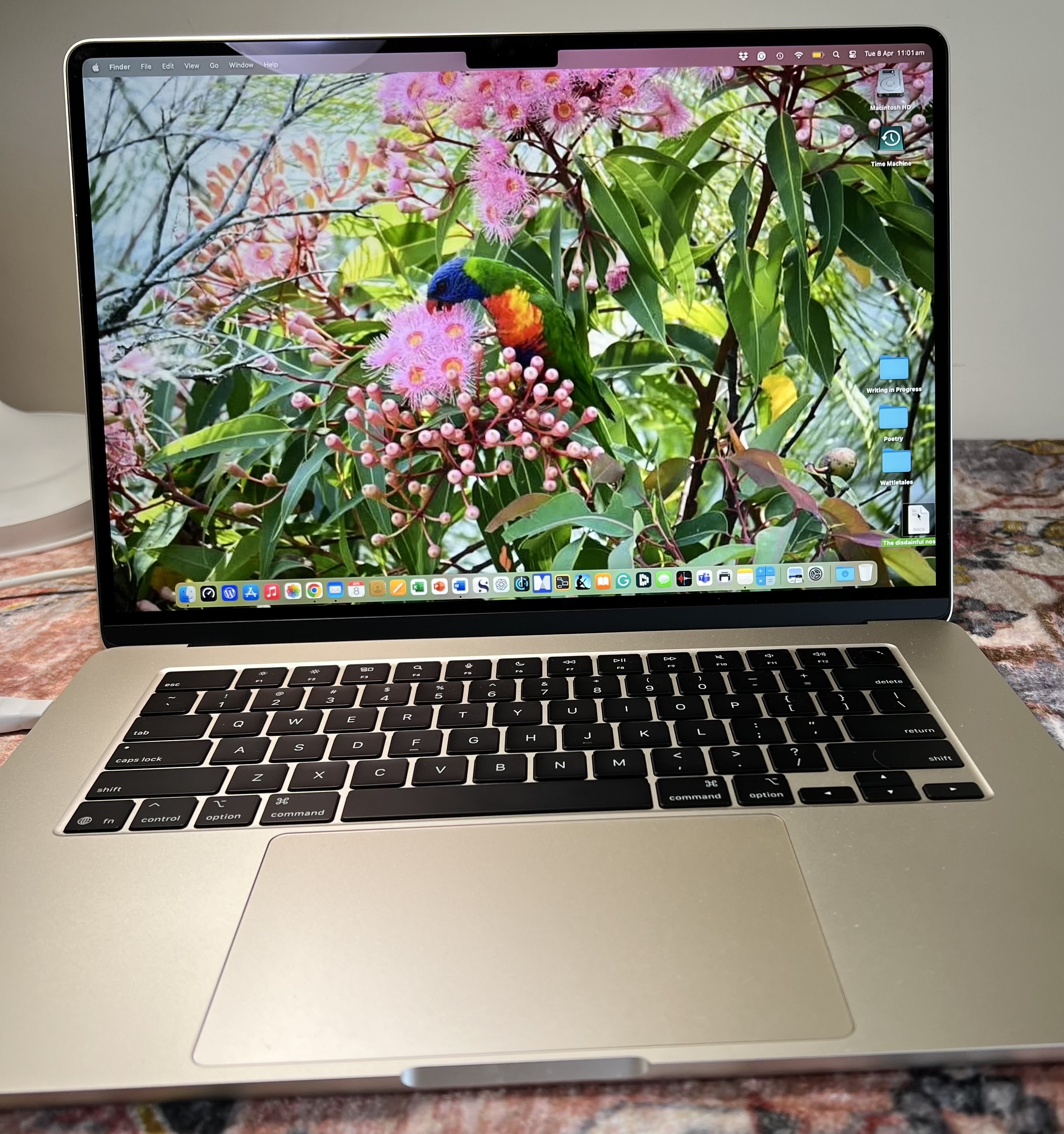
We oldies must first give thanks for being here. For those like me, with bodies burdened by the limitations doctors call multiple comorbidities, the best luck in the world is having a strong mind. By that, I mean I am still curious about the world; I get upset by wickedness and excited when good things happen. I follow politics with a keen eye and am lucky to have a good education, a computer and the will to write. I thank my new MacBook Air for inspiring me this month to showcase what I’ve been up to, both reading and writing-wise.
Many computers have centred my world and orchestrated my daily life for a long time. In fact, I spend more time on one in retirement than I did at work years ago, but I’ve been lusting for a new laptop as they served me well for many years as a roving anthropological consultant. Although I’d been saving for one, my son, who lives far away in Queensland, surprised me with his generous gift of a new MacBook Air. As I’d hoped, it makes the act of writing more intimate, more like handwriting. I like that.
This Time Last Year till Now
Although it seems like yesterday, this time last year, I was busy with the launch of my novel, They Who Nicked the Sun, a delightful occasion with Devonshire Tea. As the poem Braindead, written in March 2024, tells you, I was utterly lost for a while after that, with no book to work on.
Slowly, an idea seeped into my mind for a story about ageing. Initially, I came up with the title By Way of Dying, a story about a woman who could not rest in death until she understood life. It took time to formulate and find its shape, but now I think I have it!
Meanwhile, the title, By Way of Dying, morphed into Call Me Marigold. It is a novella, and yes, the narrator is posthumous; and yes, it is about me, despite the pseudonym, because, clearly, I am still alive, while Marigold is stuck in limbo and can only look back on life.
Call Me Marigold also morphed from memoir into autofiction, a genre that combines elements of true stories with fictional tools. We all draw on our lives when writing fiction, but memoir and autofiction should be distinguished from each other. To quote from the linked article —
The label of memoir comes with a promise: that the events described happened to you. Autofiction, on the other hand, promises an exploration of self. It is not just a fictionalized account of the author’s life, but a rendering of true experience in the midst of fictionalization, in which embellishments or deviations from reality may provide a commentary on the author’s journey. (my emphasis. American spelling in the article.)
What I am Reading
The universe is supporting Marigold. A dear friend gave me a book this week that I had borrowed from the library but had badly wanted to own: Nobel Prize-winning Orhan Pamuk’s wonderfully illustrated Memories of Distant Mountains. I’ve only read two of his earlier novels, My Name is Red and The Museum of Innocence, but I am a fan. In this 2025 coffee-table delight, he draws on a lifetime of personal notes and paintings to offer insight into his writing and himself. It is neither memoir nor novel, yet through his reflections, he shares his inner world.
Another genre-bending, multi-award-winning writer I admire is Australian author Michelle de Kretser, whose recent work, Theory & Practice, according to author Nicole Abadee in the Australian Book Review (Nov.2024), is not autofiction but a novel that introduces ‘a splinter’ of memoir. My de Kretser favourites are The Hamilton Case and Questions of Travel.
Last on my recent reading list, although I read it first, is The Chinese Postman by Brian Castro, a former Professor of Creative Writing at the University of Adelaide. I love this book because it also challenges taken-for-granted literary assumptions and reflects on ageing. I could not do justice to Castro’s story in a few words, so here is the publisher’s blurb (I have the eBook).
Abraham Quinn is in his mid-seventies, a migrant thrice divorced, a one-time postman and professor, a writer now living alone in the Adelaide Hills. In The Chinese Postman he reflects on his life with what he calls ‘the mannered and meditative, inaction of age. God, offering up memories and anxieties, obsessions, and opinions, his thoughts on solitude, writing, friendship, and time. He ranges widely with curiosity and feeling, digressing and changing direction as suits his experience, and his role as a collector of fragments and a surveyor of ruins. He becomes increasingly engaged in an epistolary correspondence with Iryna Zarebina, a woman seeking refuge from the war in Ukraine. As the correspondence opens him to others, the elaboration of his memories tempers his melancholy with a playful enjoyment in the richness of language, and a renewed appreciation of the small events in nature. This understanding of the experience of old age is something new and important in our literature. As Quinn comments, ‘In Australia, the old made way for the young. It guaranteed a juvenile legacy.’ (my emphasis)
I came across a sensitive and insightful article, “The Chinese Postman,” by Professor Tony Hughes-d’Aeth, Chair of Australian Literature at the University of Western Australia. In case you missed it in ‘The Conversation’ last year, Hughes-d’Aeth identifies a key ambiguity in the narrative, emanating from Castro’s transposition of his biographical data — ‘born in Hong Kong of mixed European and Chinese heritage’ — onto the protagonist, Abe Quinn. Is it Castro’s story, which Hughes-d’Aeth sees as a lament, or is it fictional to the core?
I am reading these books by authors who brilliantly cross genre boundaries to understand how top writers do it. Truth be told, I find the various ways they upend convention both fascinating and freeing. Their works gave me the confidence to experiment in my Call Me Marigold narrative, which takes a scrapbook approach to various aspects of my life, serving as an exploration of the self — a defining feature of autofiction.
A New Novel
During the lull that followed the publication of They Who Nicked the Sun, when I was floundering and trying to figure out how best to tell my story as autofiction, I began to yearn for a new novel to work on. My earlier novel ideas came to me long before I started writing them. I then met a fellow writer who works on several projects, alternating between them. I’ve usually stuck to one at a time, but as soon as I wished for a novel idea to come to me, an idea burst upon me in rough synoptic form, and I am now alternating between Marigold and a fictional story.
In the Welcome pages of Wattletales, I write about what fascinates me as a person and writer—
What does it mean to fall through the cracks, to become broke, mad, ill, destitute, deserted, disillusioned or denounced? What happens to our sense of self, and our identity when life wreaks havoc with our intentions, plans and happiness? How porous is our mind? Is there really a line between sanity and insanity, and how do we know when we tip over the edge?
So, it should not come as a surprise to say that I’m fascinated by gaslighting, which is what my new novel is about. The provisional title, On Banksia Street, tells the story of an everyday couple, Wendy and Peter Wilson, who live with their children in Warradale, where I raised my children (ordinary suburban life!). There is no real Banksia Street in Warradale, so the setting is fictional, as is the story. The Banksia reference is, of course, about our lovely native Banksia flowers and the scary Big Bad Banksia Men of Mae Gibb’s marvellous imagination that terrified me as a child.
New Poems
In between writing projects, including this blog, I have recently written a few new poems. Here is a small selection as part of this show-and-tell post for April 2025, my favourite month of the year for its promise of cooler weather.
Before you go, why not check out our wonderful Guest Posts, featuring some great stories and poems from local Adelaide poets? For a complete list, click here.
Happy Writing
Wattletales
If you'd like to be added to the Wattletales post mailing list, make a request in the comments below, your email address is always hidden from public view. Lindy
I use Apple’s iPhone, iPad, iMac, HomePod Mini, plus a Sony Bravia Smart TV. As I stay home more, I increasingly live in an online world, and without all these bits and bobs, I’d be isolated and terribly alone, whereas online, I still exist. Or do I? Can we?
I’ve been computer literate for a very long time, from the mid-1980s when my PhD supervisor defiantly poked a pen into his ink-stained shirt pocket, saying, ‘This is my computer’ when Adelaide University’s Anthropology Department installed air-conditioning to protect its new computers. My first personal computer was a second-hand Epson that looked like a portable sewing machine with a click-on and lift-up top and a green screen. Epson now sells inks and printers.
Inheritance
I stuck to Ericsson mobile phones in the early days, a company instrumental in bringing internet capability to mobile phones, and I was one of the first in my world to get that. I do love my technology. However, there is a distinct digital divide now between young and old. Young people who grew up with computers and the internet are now called digital natives. My generation (war baby) is called silent, and many of our cohort are effectively locked out of the online world.
Before I moved into Manson Towers, an ECH retirement village in Glenelg, I lived for 16 years in Aldinga Beach. There, I taught oldies at the Community Centre how to use mobile phones, tablets and other devices handed down by younger family members who had upgraded to newer models.
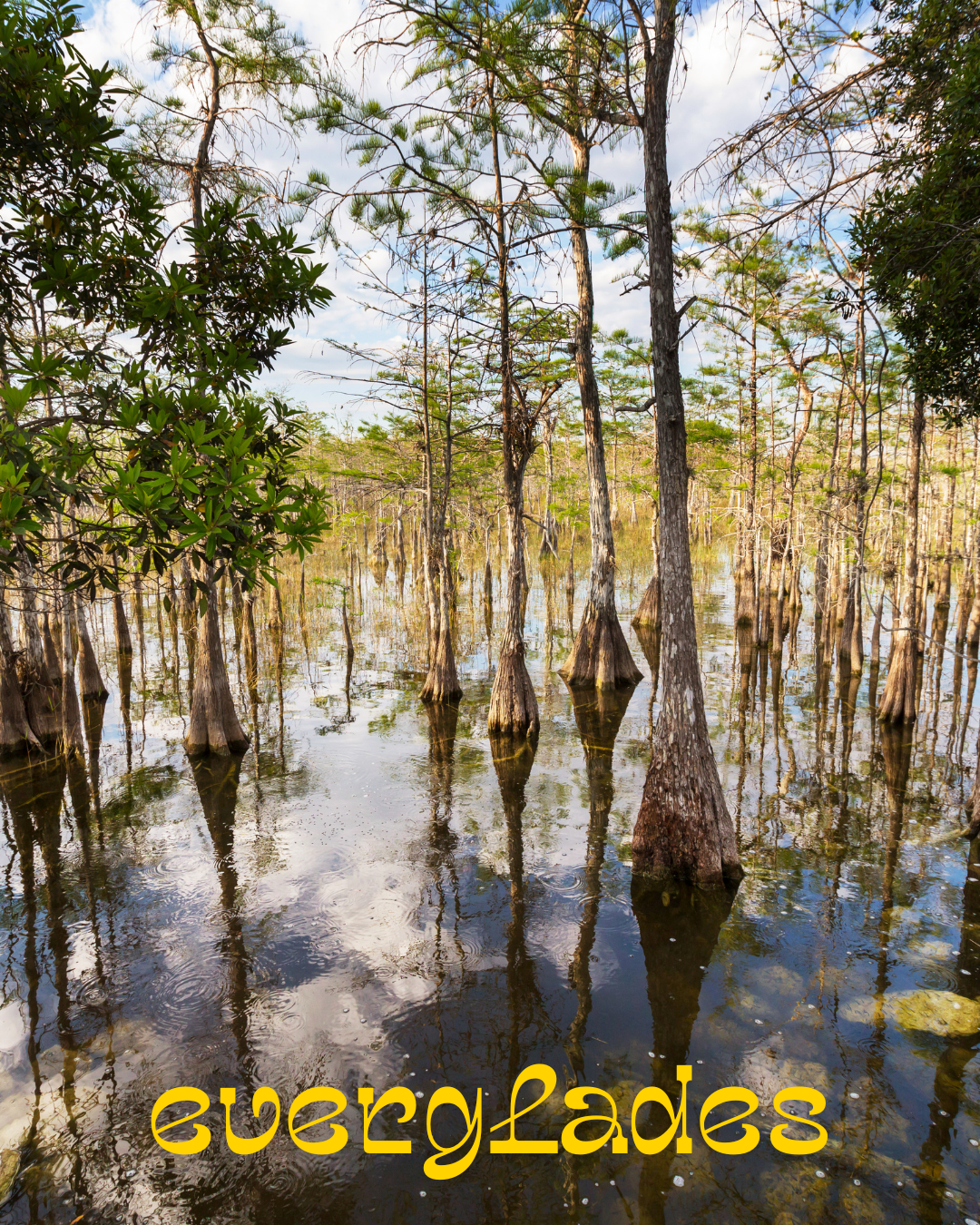
With second-hand, ageing phones, people were forced to wade blindly through the Everglades of someone else’s apps and usage history without a password and with no access to that of their benefactor. They could neither download apps nor change anything at all without relying on others. All they could use was the phone. Over time, bit by bit, with task-based learning, they overcame this disempowering situation and, with new-found confidence, bought their own devices to set up and use as they wished.
Letter Writing is a Dying Art
I am old enough to remember the joy of writing and receiving letters. As a schoolgirl, I had overseas pen pals whom I found in newspaper and magazine advertisements and at the library. When I left home in my late teens, I wrote weekly letters to my mother. Even while living in Sri Lanka in the late 1980s doing postgrad field research, Mum and I wrote letters to each other. My friend Margaret, who died in France at 83 in 2022, was a letter-writer to the end of her days, and that thrilled me.
What about email? Is email the same as letter writing in the old-fashioned sense? Do we sit down and write about our lives as we once did in handwritten letters? We seem to email mostly on matters of the immediate moment or agree on a time to catch up. It’s fast, and if you have no computer, emailing and texting on a mobile phone is tricky for fumbling old fingers.
Resist Change or Support Failure?
My retirement village has recently installed an app for residents. We were advised of its existence, fait accomplis, by snail mail a couple of months ago. To my knowledge, there was no research among residents into how many people in this high-rise village were computer or internet literate, and I have to say from experience, it’s probably not many.
Just as I was writing this segment (which I had to change accordingly), we finally received a letter advising us of a forthcoming meeting and telling us to bring our phones (sic) for a demonstration and learning opportunity. (It has yet to occur to ECH to install a couple of computers for general use in the Common Room.)
You might say it’s better late than never, but really, is everyone going to pick up a how-to in one session if they are not already technologically literate? At least, as this pictograph shows, the symbols are simple and oversized, as SA Health recommends for us oldies, which says a lot, doesn’t it?
Will such a session dissipate the silent generation’s generalised fear and resistance to the complexity, dangers and scams of the online world? I guess few will be convinced.
I suspect institutions dealing with the elderly, such as retirement villages, hospitals, medical specialists, councils and governments, will continue to use paper until the present cohort of aged computer illiterates passes. It’s sad, really.
What is Real?
In 1991, the movie Soapdish questioned the relationship between the television screen (online) and real life in a hilarious story about a soapie production starring Sally Field (everybody’s darling), Robert Downey Jr (who in it looks 12), Whoopi Goldberg, and my favourite, Kevin Kline, as the love interest. In the soapie’s episodes, the madness of real life and the storyline blurr; real life becomes fiction, and fiction solves real problems in the lives of the actors (in both soapie and movie). I watched it again last week, and while it is a bit out of date, it is hilarious.
My interest in Soapdish is in the way it played with boundaries between what is real and what is not, which caused me to reflect on the nature of our online world as it now is. Is it real? I’d like to trivialise for a moment to observe that the proliferation of porn sites suggests the internet has the potential to breach the divide between online and real life in bodily terms.
So, what does skyping mean compared to catching up in real life? Does it bring us closer to distant friends and adult children living overseas who can show us their babies and their homes? Skype and other similar media allow us to engage in everyday conversations on a regular basis, as though we were in the kitchen or living room together. Sadly, Skype is on its way out, but something new will replace it. We already have Zoom.
We can’t hold our loved ones online, but we can see their expressions and enjoy their company. Over time, we can see little ones grow and watch each other age gradually instead of experiencing the shock of changes in someone we love at the airport after years of absence.
Options
For those of us in our later years who were fortunate enough to have acquired computer skills and internet familiarity through work, the transition to online friendships, learning, shopping, and banking was and is easy.
Online sites for people 50 and over to meet or communicate are a blessing. I recently stumbled upon Stitch, a not-for-profit entity founded by an Australian. Stitch offers a variety of gatherings in your local area, not unlike Meetup, but it is much more. It brings people from all over the world together in interest groups and discussions where there is an opportunity to find pen pals and make friends from far away. For those of us who live alone (and we are many) or don’t get out much, Stitch is ideal.
I’ve joined two online Stitch groups; one is poetry appreciation, and the other is a writing group. Both conduct monthly meetings. The interest areas are broad, and you can create groups yourself and arrange lunches and beach or park walks.
While Facebook has changed over the years, it remains an excellent site for renewing and maintaining connections with people. I am still in touch with people in Sri Lanka after thirty-odd years. These forums both create and sustain relationships.
Is Social Media Socially Satisfying?
I have travelled to Sri Lanka, Japan, China, Thailand, Nepal, and India, but I’ve learned more about the world through Facebook and Instagram than I could have seen in a lifetime of travel. The online world is replete with videos, images and information about natural and engineered wonders, places, people and happenings that teach us so much about our shared humanity. I am sometimes agog with amazement and joy, seeing and learning about these things.
Even though it has nothing on Twitter, which it replaced, I also get instant political updates on X without having to watch mainstream TV news.
There’s no Substitute for Family
My online life notwithstanding, it is true to say that the only time I felt I deeply belonged in this world was when my parents and brother were alive, and I had three children depending on me.
Sure, I celebrated my freedom from responsibility when the kids left home, and my parents’ passing was a natural progression. We can’t expect life to stay the same. Change is inherent in all things, and we must accept that.
What I’m trying to point out is that life with people close to you who care, whether or not you disagree with each other from time to time, is more grounding and more satisfying than going online. But, when they are far away, it’s the best.
And, when you live alone as many oldies do in an increasingly dislocated world, online social life is a lot of fun, and it feels just as real. As a bonus, if you don’t like something or someone, you can delete or block them without a fight! You have complete control.
Happy Writing
Wattletales
If you'd like to be added to the Wattletales post mailing list, make a request in the comments below, your email address is always hidden from public view. Lindy
In 2023, I published an ebook called Dressed & Uploaded: Poem Stories. The title, of course, comes from the way I ‘dress’ poems for Wattletales, both in my posts and those of my wonderful guests. Some may find this practice tawdry, but I think of it as a visual poetic feast. So, I thought I’d add a few of my new poems (and a couple of oldies), freshly dressed, to tell their tales here as I do in the book.
The cover art of Dressed & Uploaded.
You can download a free copy of Dressed & Uploaded either as an epub (best for Mac users) or in .pdf format for Kindle or desktop reading. The links take you to Dropbox, where you can click to download. It takes about 30 seconds. It is also available to purchase online.
Without further ado, here are today’s poems. I hope you enjoy their stories.
On Love
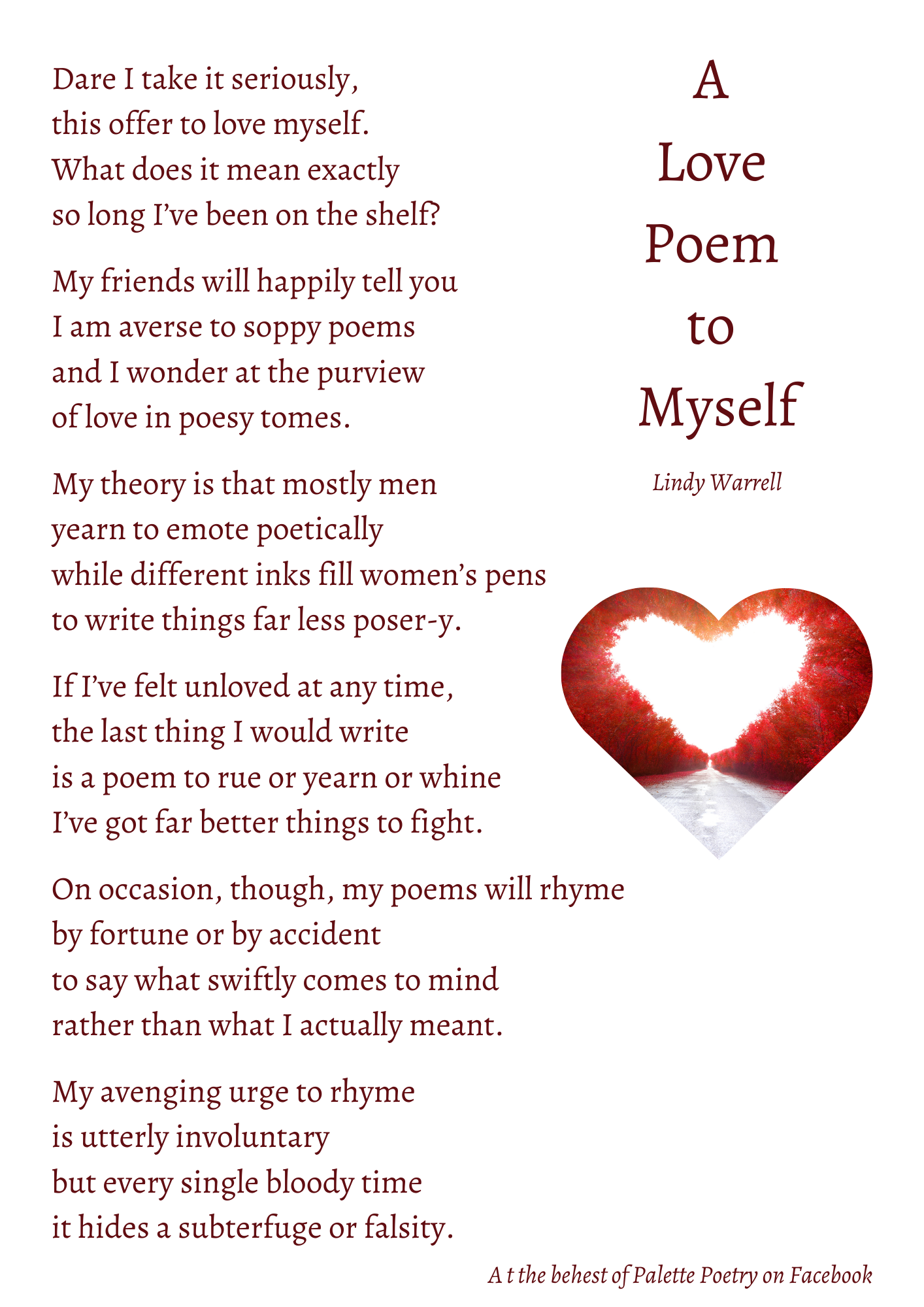
I wrote A Love Poem to Myself in response to one of Palette Poetry’s regular Facebook prompts because I do not like love poems at all, especially not soppy ones, which, as it feels to me without due research, are primarily written by men. My TramsEnd Poets compatriots think I’m nuts, and I may well be precisely that, but I’m happy to be wrong to protect my belief.
As the following poem from Dressed & Uploaded shows, I do occasionally refer to love, albeit obliquely.
I read Yearning on Gabriella’s popular Radio Adelaide 101.5FM program, Poet’s Playlist. which aired on February 13th in her special Valentine’s Show on love. Thank you, Gabby. The link will take you to the program to hear me and other TramsEnd Poets on love.
Losing Control
Do you remember that old saying, used in elocution lessons in my childhood, ‘What noise annoys an oyster? A noisy noise annoys an oyster most.’ Well, today, beeps, bells, and whistles drive me up the wall. Everyone is deadly serious about mental health issues, but they only look at psychological factors like a bad childhood or a harsh mother, the ‘when did you first hate your horse’ sort of thing.
Very few people talk about the incessant demands made on us by everyday electronics over which we have no control. Most of you will be familiar with Karl Marx’s wisdom that alienation is discombobulating. Being pushed around by machines is worse; it’s personal.
Mobile phones and personal computers constantly upgrade their operating systems or software — note, the agents here are technical objects! We frequently feel out of control with these insidious invasions of our private lives by the World Wide Web (and, yes, it is a proper noun). They even infiltrate our televisions. Everything technological changes faster than we can!
As for streaming services, there’s another headache in the making lately. When you’ve paid a subscription to one provider, Apple TV or Netflix, for example, you may suddenly find the item they promoted is actually on another streaming service like Paramount or Binge. Pay up, please. There is simply no respite.
The Natural World
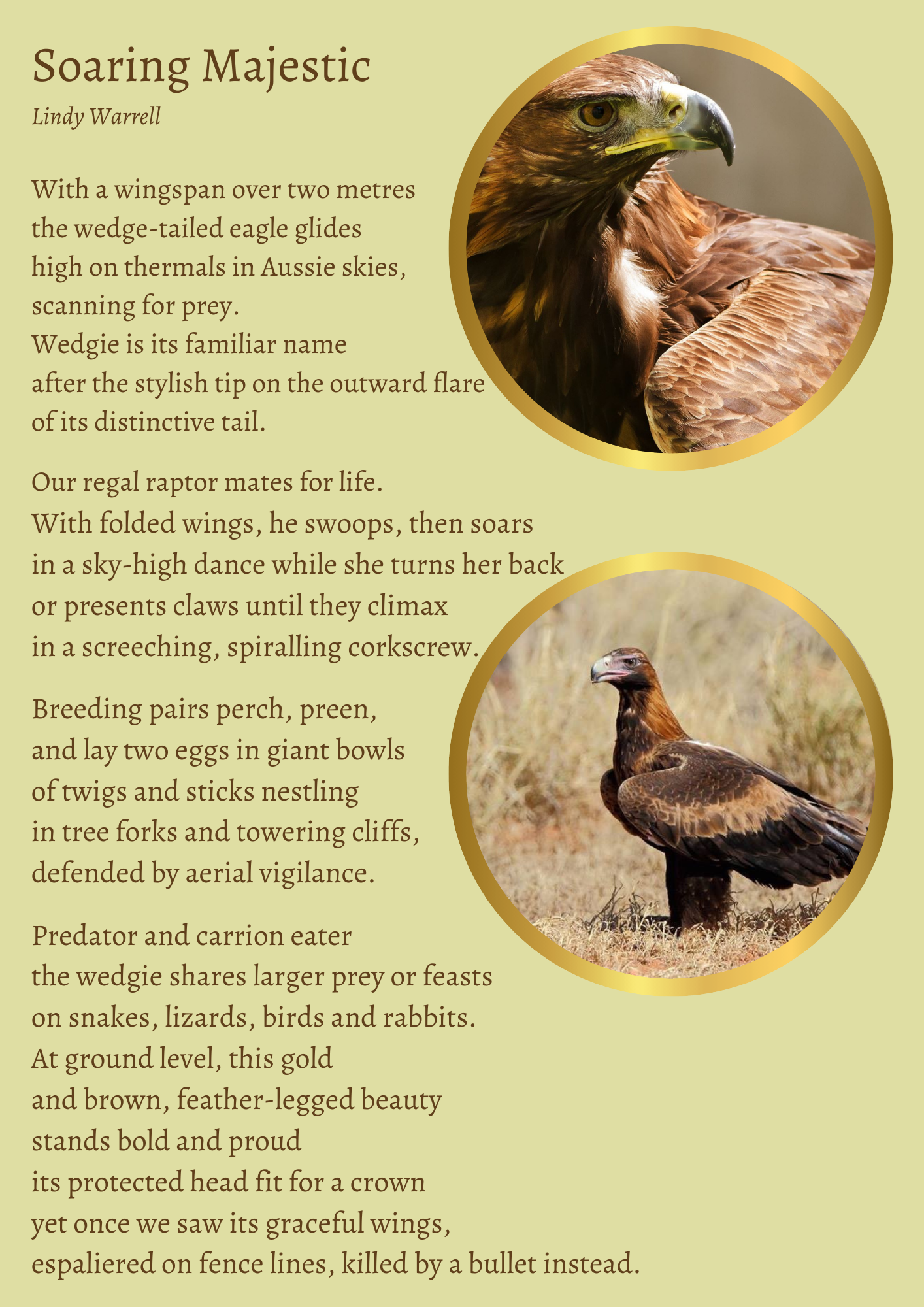
The Wedge-tailed Eagle
I love and admire the wedge-tailed eagle (Aquila audax) whose colours match our earth. The wedgie was declared the Northern Territory’s first emblem in 1975, just after Cyclone Tracy, which my children and I experienced in 1974. I have loved the bird since childhood when I was a member of The Gould League of Bird Lovers in rural NSW around Albury. Founded in 1909, the League was the first to foster and encourage a love of Australian native birds, and it is still active in schools.
Since 1975, the wedge-tailed eagle has also been a protected species across Australia. I genuinely don’t remember where I first saw a dead bird slung through fence wires, but the image has remained with me. A bird of prey can be a pest for farmers with small animals, so the image was probably burned into my mind during my preteen years in the NSW hinterland, which is sheep country. Yet, I also spent many years before (and after) 1975 in the outback, so it could well have been anywhere.
Mother Nature
Storm Enlightenment comes from my love of the wet season in the Northern Territory, where I spent many happy years. Need I say more? Even when it was hot, thunderstorms made you feel chilly enough for a cardigan. All I can say is that it is an experiential poem. Even now, I love to snuggle when it storms. They bring out the philosopher in me.
Back then, the wonder of waking in the morning as Tracy abated was like being re-born, re-ignited with joy and anticipation, emerging from a cocoon. So, too, when the sun peaks through the clouds after a storm. Although capricious, nature is precious and teaches those of us who survive its fury how fragile life really is.
Personal Journeys
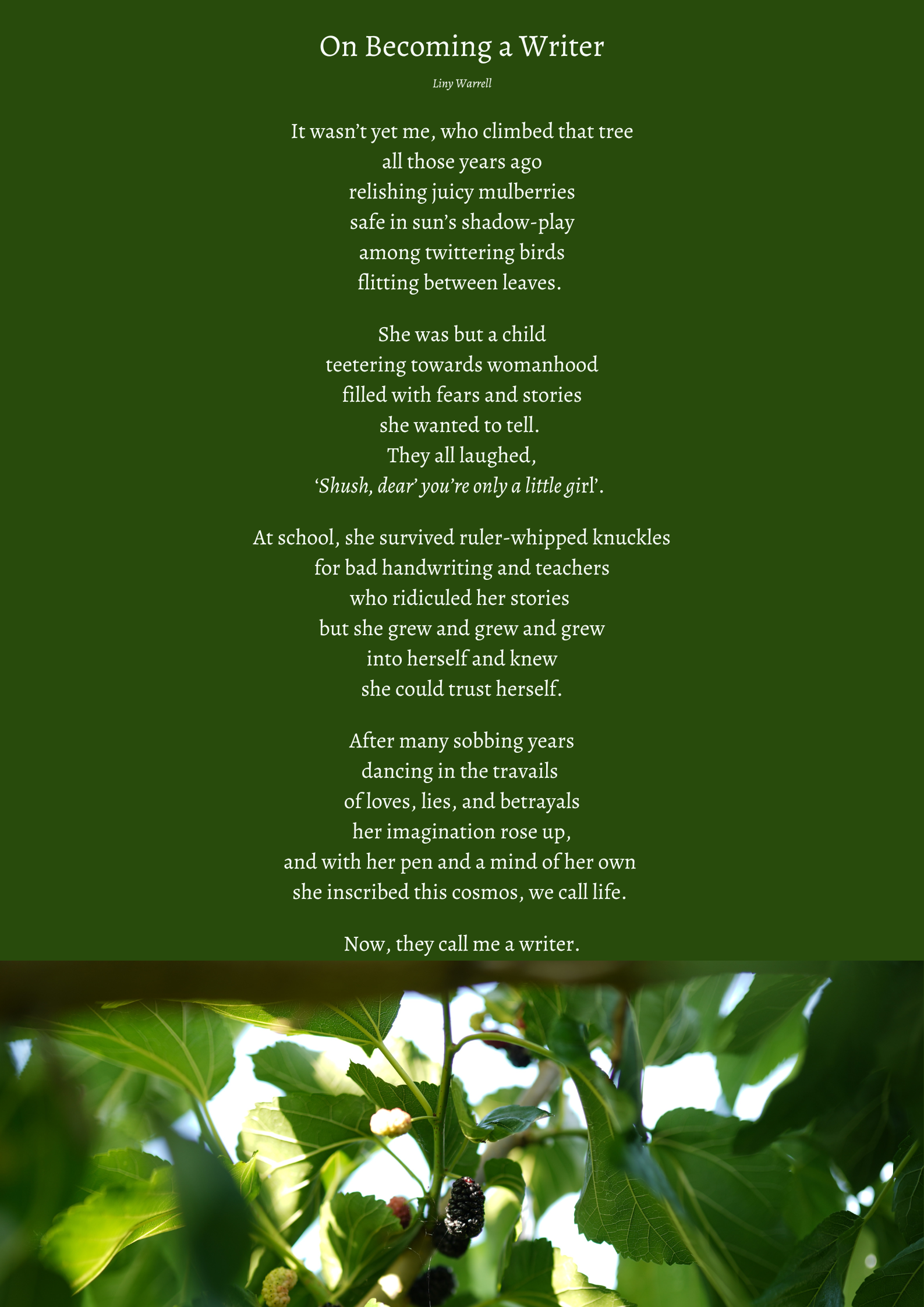
Each poem I write has something of me in it. Most of my poems have a message or tell a story. I was 12-13 when we lived in Albury, where my parents first managed the Hotel Albury and then bought a guest house called Tara, which had a giant mulberry tree in its backyard. That tree and my childish musings in it stayed with me for 70 years of yearning to be a writer. I used to say that life got in the way because I didn’t write creatively until I retired, but the truth is, I needed life in order to have something to write about.
Last but Not Least, a Bit of Fun
What can I say? These odd little pieces come from story fragments, phrases or words that catch my eye and touch me somehow. The phrase ‘She married in a drip-dry dress’ came to mind one day recently after I told a friend about my mother taking me to Woolworths on Rundle Mall after my first (violent) marriage broke up to buy me a new dress for Darwin, where I was heading for the first time. I was around 18.
Mum thought the dress was suitable for a tropical climate and said that nobody up there would know it was a cheapy from Woollies (Darwin’s population when I first lived there was 14,000, and nobody had heard of Woolworths).
I wore that ghastly green floral, pleated drip-dry dress to my first Darwin job interview and got the job, which was just as well because I’d arrived with only ten shillings in my pocket. I never wore it again as it stuck to my sweating body with static electricity in the humidity. The dress didn’t last as long as the brief, failed marriage I’d left behind.
If you are curious, you can read more about that disastrous marriage at the bottom of this linked page.
Happy Writing
Wattletales
If you'd like to be added to the Wattletales post mailing list, make a request in the comments below, where your email address is hidden from public view. Lindy
I have never been what you might call a shopper. I’m not a committed browser. I’ve always searched for particular things when I needed or wanted them, and I’m pretty much the same online, although I browse more. In my ageing lazy-bones, I do not fancy, nor could I cope with going from store to store seeking anything. The very thought of a trip to the vastness of Bunnings or Ikea fills me with dread.
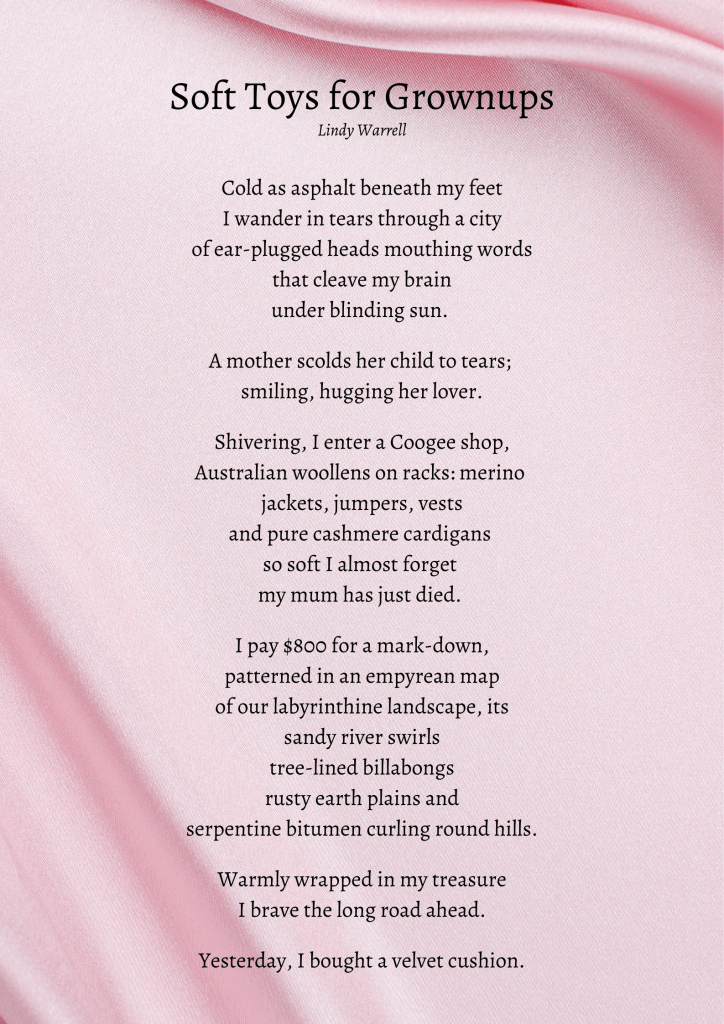
From the cover of soft Toys for Grown-Ups, a poetry collection. See the eponymous poem later.
As for trying on clothes, well, I have long forgone that unpleasant, sweaty task in stores with tiny dressing rooms. I don’t wish to surrender my ageing body to the surrounding mirror gaze ever again. Still, as you might imagine, there are downsides to trying clothes on and assessing quality online.
My Shopping Story
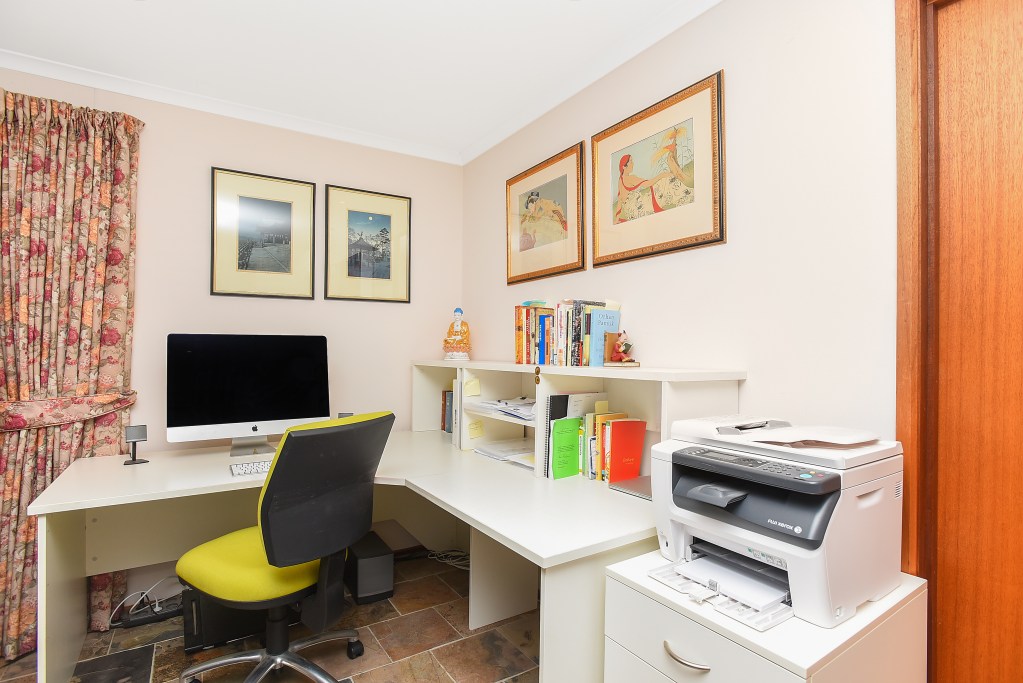
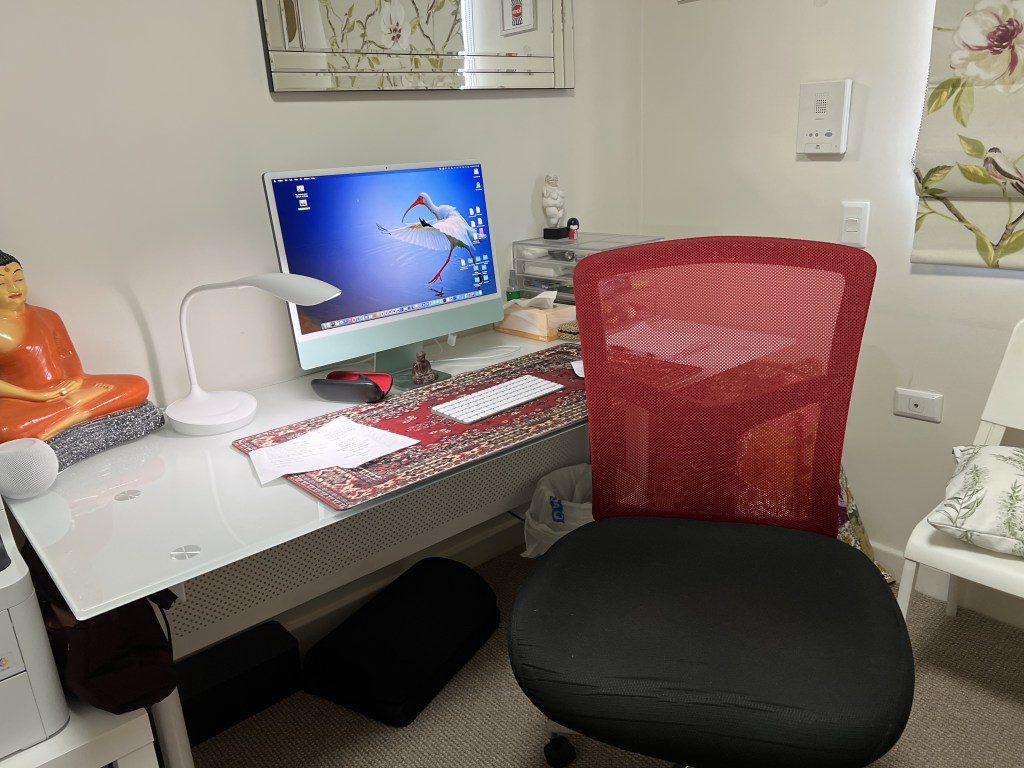
There are continuities in my shopping habits, one of which is to change furniture more frequently than most. There is a reason for this, which has more to do with my circumstances than the shopping medium, as the trifecta of office chairs below indicates. I bought the chartreuse office chair in the gallery below from a posh office furniture store at Mile End. It nearly got old, but I stopped loving it before it had a chance to do so. I ordered the other two online.
Chartreuse White Ruby and Black
The white chair from Temple & Webster was very smart, but it wasn’t comfortable. I am now sitting on the Office Works black and red chair on the right, but — dare I say it — it is also uncomfortable. All this may remind you of a little girl, beds and three bears. But there are differences.
First, my old body is hard to please nowadays. Second, buying such items online might be easy, yet it is a trap for innocent players. The nightmare is facing up to your errors. In choosing the bits and parts of this chair online, as I had to do, I failed to consider its size and weight properly. While attractive enough, it is big and too heavy to roll smoothly on my carpet! All we can do, as the adage has it, is live and learn. But there’s even more to it than that.
Choosing Furniture is a Serious Business
My penchant for changing furniture may have you thinking I’m a dilettante, but I’ve come to see that it reflects my current state of being. Let me unpack that, starting with a poem.
When I left Darwin, where I lived and entertained for many years, I had to relinquish a second-hand treasure: my beloved Jarrah dining table, which had so much history inscribed upon it.
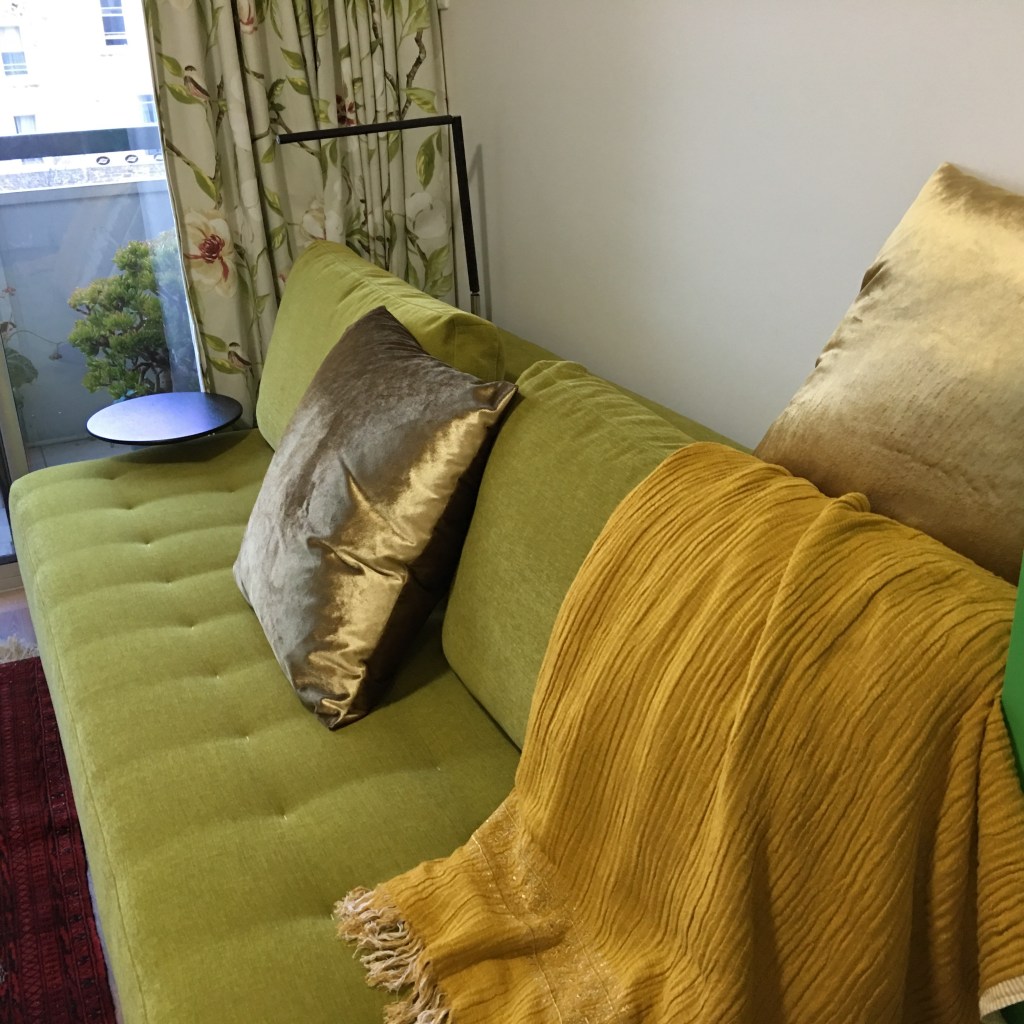
Rapid changes in lounge furniture years later, after I moved to Aldinga Beach, marked my initial ambivalence about settling back into South Australia while I still yearned for Darwin! At first, I had an apple-green three-piece lounge setting, which I soon replaced with two expensive American oversized camel-coloured armchairs. After a few months of discomfort, I sent them for auction, and the pair brought an embarrassing fraction of what I’d paid for them.
I replaced the California chairs with a lovely brown and tan leather and microfibre L-shaped lounge that settled in very well, and that was when I seriously got into writing — honoured by the chartreuse office chair.
And, Again
Furniture similarly symbolised my rocky start to retirement unit life in Glenelg. Clearly, the brown L-shaped lounge had to go, as it wouldn’t fit into any unit in Manson Towers. So, too, did my pre-bought fashion item, a King Living press-button but totally unsuitable sofa bed. After heaving those giant back cushions on and off morning and night (when they dangerously filled the floor space), I soon switched to a single bed—which I still have nine years later!
King Living Furniture press-button sofa-bed.
Pre-ordering, even in-store, is a risk best avoided. It is hard to imagine how small some of these units are until you are in them.
As Serious Nonsense describes, since losing the sofa bed, I’ve gone through three armchairs. Next month, a white leather electric recliner, more suitable for old ladies, will replace the Scandivanian Ruby Leather.
Shopping Satisfies
Shopping, in various forms, pertains to different stages of life, but it also gratifies inchoate yearnings.
We all tend to buy for emotional reasons at times. Shortly after my mother died, I bought an expensive Coogee cashmere cardigan that I wore for many years. Without Mum, I was desolate and in need of comfort. I had no intention of buying anything when I stumbled into the Coogee shop on a side street off Adelaide’s Rundle Mall, but I treasured that cardi until it was threadbare, and I had to discard it.
I was so sad when Coogee went out of business. Today’s airport rip-offs simply do not match up in quality.
As December 1994 marked 30 years since Mum died, I hope you’ll forgive me for including here a little tribute to her adventurous spirit in old age.
Shopping Online is still Shopping
Whether in a showroom or online, shopping is easy. Credit cards work instantly when you pay for something. Online, however, refunds — if you can get one — take between five and ten working days. Hmm.
Most regular shops and stores have well-designed websites, and online business websites are equally tantalising. However, some are utterly disreputable, wherein lies the hidden nightmare of online shopping. A good website can lure money from your bank as fast as any shop might empty your purse, but the risks differ.
Online, we sometimes get it right, and, at others, we can lose as drastically as any gambler.
Getting it Right
I adore Persian rugs and have owned a few small ones with the Bokhara design. Browsing carpet websites on dull days lifts my heart and excites my passions. It takes me back to the carpet stores I visited in India, piled high with rugs of all qualities, shapes and sizes, including exquisite silk pieces of craftsmanship.
It is an immense privilege to enter those stores (better than any website by far), where staff and management treat you like someone significant, offering you a seat, a cool drink or a cuppa while peons roll out rug after rug for you to view. It’s not easy to extricate yourself without buying. I am sad that I didn’t buy a silk rug that I loved when I had the chance. Here, they cost many thousands of dollars more.
Yet a couple of years ago, I found a little treasure: a small Zardozi embroidered rug, a glittering delight that I found online one day when aimlessly browsing Persian and Indian rug sites. (Yes, I do browse online, where it is so much easier to fill tedious hours among tantalising possibilities.)The gilt frame I chose to set it off cost as much as the rug.
Zardozi Embroidered Feature Rug
You can’t see the gems shining in this photo, but they do. The poem below speaks of the Zardozi tradition.
Getting it Wrong
As simple as online shopping can be, it is easy to get it wrong. While I moon over rugs to fly away on or bags (my other favourite thing) to gather my personality in one convenient package — you know, phone, license, credit cards, poems to read and, lately, pills and potions rather than mirror and lipstick — there are pitfalls.
For example, take clothing. I once ordered what looked like a long, loose Jacob’s striped cardigan that looked gorgeous online, only to receive a shrunken piece of rubbish in tacky, unrecognisable fabric, its sleeves so small they could only fit a broomstick. Returns and refunds were impossible.
To avoid such a nightmare, choose your sites carefully. Check them out, and ask Google if there are risks or complaints about them. The same garment is still frequently advertised on Instagram by several different ‘companies’. All appear legitimate and offer lovely things, but pictures tell lies.
I now buy my clothes from Taking Shape. I order online, but I know my sizes and recognise the fabrics. Even if I get something wrong, returns are guaranteed, and you can even return by post.
Online Banking
I do all my banking online, and when a company is reputable, the bank is there to help you recover your money. However, you can’t trust official-looking renewal notices arriving via Australia Post.
Last year, I received a notice to renew my three-year business name registration for $198. I paid the company online, only to discover soon afterwards that the actual cost of business name registration through ASIC was $98. I fought with them but failed to get a refund. I only discovered my expensive error after a second company sent a similar renewal notice closer to the due date, causing me to check things properly.
Read the fine print; these things have twisted policy wording to entrap you.
Grocery Shopping
I even mess up my Coles orders at times. Only a couple of weeks ago, I accidentally bought a giant pack of Uncle Toby’s oats, enough for me for two years. I gave it away. Then, I purchased a four-litre liquid laundry detergent that I could not even lift to decant and had to ask my cleaner to do it for me. This week, I bought Arnott’s Shortbread Cream biscuits instead of Scotch Fingers! Yes, both are shortbread, so I’m not totally losing it, but these silly errors put a frightener on a girl in her 80s.
Deliveries
The worst nightmare for me with online shopping is the endless procession of deliveries. Living as I do in a ‘gated’ high-rise building, I need to stay in to let drivers into the building, which is a pain. Fortunately, Australia Post, Coles and other entities now give notice of a two-hour window for when things will arrive, but it’s tricky if you want to go out on that day or have plans for the time they allocate. I guess it is the price I pay to avoid shops.
I still go to Woollies, Coles, Baker’s Delight, and Caruso’s Greengrocer for top-ups or to the chemist for a visit, so my soul’s need to shop in person remains satisfied.
I’ve yet to find an online way to fill the car with petrol.
Happy Writing
Wattletales
If you'd like to be added to the Wattletales post mailing list, make a request in the comments below, where your email address is hidden. Lindy
Merry Christmas and a Happy New Year, everyone. Thank you for your support in 2024. This year, Wattletales brought you a number of posts about ageing, which is fast becoming my specialty, as well as a mix of features, including AI, feminism, a short story, observations about the power of words, guest posts, and more.
Each post was graced with positive feedback and great comments, and I hope our guests’ work has received just a little more exposure by being on Wattletales.
Guest Posts
Our guests in 2024 were Kuma Subedi, Valerie Volk, and Shaine Melrose.
Kuma Subedi
Kuma is an award-winning, Adelaide-based poet who grew up in Nepal. His knowledge and love of Nepali and Western classical poetry traditions give him a unique poetic voice.
In his post, ‘The Play of Nature, Love and Oppression in Poetry‘, Kuma invites us into his childhood and speaks of the simplicity and rhythms of the songs he sang during seeding and planting seasons as a young one and how proud he was that his father was a farmer.
And, in his words —
My love for writing poetry in English was catapulted by Shakespearean sonnets, W. B. Yeats, Robert Browning, Andrew Marvell, Sylvia Plath and P. B Shelley. I dearly admire E.E Cumming’s and Emily Dickinson’s style, and was profoundly influenced by the romantic elements in Wordsworth and Keats.
Valerie Volk
Valerie introduces us to her new poetry collection, Marking Seasons, which was published this year as a special edition of the journal Studio. She talks about how hard it was to choose poems from six earlier poetry collections (plus some new ones). As the blurb says —
Marking Seasons is a record of one woman’s life in poetry. Poems dealing with love and loss, poems telling stories of the past, poems where characters reveal their own lives, or the poet responds to the natural world — this is a remarkably diverse collection. From tender and elegiac love poems to fondly nostalgic reminiscences of past days to the misery of deeply-felt family tensions to the sharply pointed, witty and even scurrilous retelling of classic fairy tales — there are poems in this collection for every reader.
Shaine Melrose
Shaine first contributed to Wattletales in 2021 with her piece ‘What Made Me a Gardener.’ This year, in a piece entitled, ‘Slaying the Demon of Doubt‘, she talks of her declining health and how it offered a turning point, leading her deeper into her creativity. In her words —
When my life choices were critically challenged by declining health, I was forced to reinvent myself. No longer free to use my limbs and horticultural knowledge at a whim, I returned to poetry.
It’s a powerful piece, and Shaine’s poems are superb. When her post went online, her first poetry collection, The Natural World Somersaults, was forthcoming. It is now published and available in various bookshops across Adelaide.
Wattletales Standouts
Three Posts about Ageing
In case you missed them, here are the links to 2024’s posts on aging. This subject increasingly occupies my attention not only because of my slow but noticeable decline (one cannot hide a walking frame or oxygen bottle in a purse) but also because I’ve begun working on a novella entitled By Way of Dying.
By Way of Dying has a posthumous and somewhat unreliable narrator called Marigold Merriweather. Not one to hold back, Marigold (not her real name) uses only first-name pseudonyms for all her characters to avoid being sued. Stuck in a liminal space with nothing but her memories, Marigold is unable to rest in death until she understands life.
Who Are We? Reflections on a Life Half Hidden
Who Are We? Reflections on a Life Half Hidden is my favourite post for 2024. It was inspired by V.S Naipaul’s book, Half a Life, in which he explores how difficult it is to find a coherent self. As someone like me who has moved on average every 18 months throughout her life and lived in Japan, Sri Lanka, and the Australian outback, travelled in India and Nepal and lived in various Australian states, cities and towns, I explored how so much of our lives remains hidden in embedded experiences that are unseen by others when we move a lot.
The 1947 photo in this image is of the Marunouchi Hotel, where I lived as a little girl in post-WWII Tokyo. Kuma Subedi kindly took the 2024 photo of the Marunouchi Hotel as it is now. The juxtaposition speaks to the idea of hidden histories.
In Conclusion
I hope you take the time to catch up on some of these posts if you missed them.
And, wherever you are, whoever you are with, I wish you a joyous festive season.
Happy Writing
Wattletales
If you'd like to be added to the Wattletales post mailing list, make a request in the comments below, where your email address is hidden. Lindy
As you age, do you ever wonder how you got to where you are as fast as you did? Time is a slippery thing. For the young, waiting for the weekend takes forever. We oldies find time slips by too soon. By the weekend, we wonder where the last week went and why the years accumulate so quickly. When I was in my late teens, I yearned to be 25, thinking that would mean I was grown up. When I hit thirty, I felt old. Fifty was fun. Sixty was not. I became creative in my 70s, but turning 80 felt like a threshold moment towards the abyss. Now that I’m 81, I alternately yearn to reach 83 at least and wonder whether I’ll hit 87, like my father. Either way, the decider is not far off.
Although we have no control over time, milestones tend to trigger memories that transport us back in an instant. For example, yesterday was my youngest son’s 50th birthday. He lives in Brisbane, so we don’t meet up, but our family all sing Happy Birthday over the phone, opening our hearts with love and laughter.
As I reflected on my son’s time of life this week, my mind travelled back and forth from now to the day he was born. It brought back the few brief weeks he was at home with me before he was re-admitted to the Darwin hospital with meningitis. It was Christmas Eve in 1974 when Cyclone Tracy ravaged our world. I had no idea he was safe until late on Christmas Day. There are so many competing memories around that event, including my mother arriving from Adelaide to support us just as our house crashed around us.
In a Day
Time also seems to be swallowed up as we get older because energy diminishes, making the days feel shorter. In other words, it takes longer to do stuff, which results in an inverse relationship between the swiftness of time travel in our minds and the few small things we can manage to achieve in a day. Everything we do becomes a project that requires planning and forethought.
For many oldies, the days when we could sit up in bed, swing a leg to the floor, rise and walk to the bathroom or kitchen while checking our phone and donning a robe in one smooth, swift movement are long past. Getting out of bed is a project, like taking a shower. Stiff or shaky legs and painful hands and backs hamper routine activities. A pain level assessment of body parts is often required, and it takes a while to check oneself out. Every endeavour needs planning and effort before action, even for something as simple as going to the bathroom, making a cup of tea and getting breakfast — in my case, toast — before settling into the day.
Freedom
My moments of freedom now come when I drive because when my body is still, it is relatively free from pain and the breathless discomfort I experience upon exertion. On days when I maintain mindfulness on the road to my daughter’s place, I soak in the natural beauty of the Fleurieu Peninsula. The trees replenish me.
On bad days, when I worry about this or that, I can get from Glenelg to Encounter Bay, quite unaware of anything but the road ahead. Driving and thinking while being old may sound dangerous, but it’s not. Thinking while old does not necessarily blind us any more than listening to music prevents young eyes from seeing what’s ahead.
Blank Times and Brain Fog
Brain fog differs from deep thinking. It is a shared experience, not exclusive to the elderly, although it may happen more often as we get older. We don’t speak about it, even though any cohort of oldies will chuckle a little at moments of forgetfulness. We treat forgetfulness in the elderly as a cultural joke. However, our capacity to remember is measured before surgery and, sometimes, on hospital admission, where authorities reserve routine cognitive assessments for the mentally ill and the aged.
In this context of power and frailty, it would be dangerous indeed to admit to longish periods of brain fog lest we be admitted to a facility or filled with pills. It is better, in my view, to simply sit with it and stare into the void and be comforted by the fact that you are not alone in this.
The Body Project
The body project has distinct parts. Those you can speak of and the unmentionables.
Permissible
Let’s start with the medical merry-go-round. Looking at us oldies from the outside, for the most part, we look normal, albeit a bit hunched and often slower than our younger selves. Inside, we gradually become a mass of bodily failures called illnesses and conditions that need management by body-part specialists, hospitals and allied health workers. Our bits and parts ping back and forth from these diverse professionals.
Our only anchor is a general practitioner who, if they’re good — and if we find one when we need one — is capable of bringing us back to a complete human being. Still, medically speaking, we are classified as suffering from multiple comorbidities, a pseudonym for the natural process of decline called aging. As inevitably as the tides, we come and go.
To anyone willing to listen, we may speak openly about a selection of medical conditions and supports. The disease and its pills, exercises, and classes that teach us how to cope with it. These are the externals.
When the time comes, most of us are also relieved to outsource routine chores, like cooking (for some), cleaning, gardening and household maintenance. Although these moments of diminishing capacity cause us to reflect on our mortality, we can talk about them. ‘I’ve got a cleaner’ sounds like a good thing.
Internal stuff is a different matter.;
Unmentionable
We might be comfortable speaking about poor sleep and, if we wish to bore others, pain. But we must stay within the framework of what’s acceptable. Talking about anguish, mental struggles, bowels, bladders, or sexual urges is out of bounds. We might jokingly mention how we furniture walk for balance, but with most of these matters, we manage ourselves by trial and error in the privacy of our own homes, often in frightened secret.
Then, we have solitary moments when we sit and cry for no apparent reason or stare vacuously into the distance. Are we really comfortable sharing how lonely we often feel when spouses and friends are too busy, become ill, frail, or die? How scary must it be to be a carer when you need care yourself? Can we lament the fact that our children often don’t understand? No, we remain silent. Not for shame or hurt but because we don’t want to burden them.
Whether we are stoic about these things or keep our hearts open with forgiveness, some secrets are destined to go with us to the grave.
Social and Mental Stimulation is a New Name for Play
Everyone tells us we need social and mental stimulation to stay young at heart. So, we go on bus tours, day trips, and river cruises and join our local community centre for mental stimulation, exercise and creative opportunities in an environment where we mingle with age mates in a process that makes it feel safe to offload what once distinguished us as individuals.
When we sell our craft, art or writing, younger folk praise it as something great ‘to do at your age’. We are commended for keeping our minds active, not for the quality of our creativity, which is resoundingly disappointing, yet we smile and say thank you.
Age sets us apart in a world of experts, where the knowledge and wisdom of elders is out of fashion. When our bodies fail, we have to give up things we once loved doing. For example, arthritis cripples many until they can’t walk, knit, or do woodwork. When frailty and illness overwhelm us, we become housebound or find ourselves in a nursing home.
Riding horses is no longer an option either, except for those oldies who have lived and worked in the bush all their lives, and I guess the time will come when even they must dismount, as we all ultimately have to in our different ways.
In Conclusion
Human paths differ. Everyone ages in their own time and way. Many are not lucky enough to reach old age, so despite the challenges, we who do are favoured. All of life is precious, and I’m of the view that retiring into ourselves to reminisce and fade into social irrelevance is okay, or possibly the right way to go, because the name of success in the ageing game is acceptance.
I keep myself alive by writing, and this post is like a prelude to my novella-in-progress entitled By Way of Dying — as long as I don’t lose my words.
Happy Writing
Wattletales
If you'd like to be added to the Wattletales post mailing list, make a request in the comments below, where your email address is hidden. Lindy
I am yet to uncover the extent of our new AI world and responses to it. In some areas, it certainly has its detractors. AI, in general, is causing controversy for NaNoWriMo (National Novel Writing Month), which is held each November. It has been ‘torn apart’ since AI was introduced as a ‘useful tool’ for writers. Some folk believe AI will take over from humans but I’m not at all sure that will happen. My interest here is specifically in AI’s ChatGPT as a writer’s handmaiden. In this area, perhaps naively, I am in awe of its capabilities.
3D rendering of cyberpunk: a genre of science fiction set in a lawless subculture of an oppressive society dominated by computer technology
As a writer, I share the concern that as AI develops in creative fields, it will require regulation. For example, writers, artists, and intellectuals are angry at the plagiarism factor, as artificial intelligence is already swallowing copyrighted material to use in various ways without the consent of creators and authors.
Chomsky raises hot issues that will rage for a good while until something gives, but for now, we need to recognise that AI already inserts itself into our daily lives and wait until the worst aspects come under control, for there are undeniably some good bits.
We may think we can safely criticise and avoid AI, but Microsoft already offers ten ways that AI helps you on their site and apps. It is also embedded in Facebook, which uses it, so they say, to manage Community Standards. Many Facebook posts also boast the little Meta AI blue circle, which reveals additional information about a subject. You can install this yourself on Facebook and Messenger. AI is already everywhere, whether we are aware of it or not. Here is a recent list of the top 20 models.
We could add Microsoft’s latest AI offering, CoPilot, to this list. It’s included in the Business 365 option but does not come with Office 365 Personal.
This morning, I even discovered AI image generation is an option on WordPress, my web page host.
Most of us have assimilated AI into our lives through our phones, cars, and computers with Siri and Alexa. They are helpful in answering questions when we argue about details of various sorts. For example, ‘Hey Siri, what is Australia’s favourite sport?’
Favourites
Writerly favourites like Grammarly and ProWriting Aid have long used AI to correct spelling and grammar. With all sorts of accessible dictionaries, they have a relatively slow-to-change data set to choose from, making them surprisingly accurate. However, they are both now expanding to include AI phrasing suggestions, which is a tad hit-and-miss.
For the unwary, Grammarly’s suggested phrasing, in particular, tends to change your voice — by which I mean your manner of expression — from Australian to American. An example is the way it tries to force the article ‘the’ before the word ‘hospital’. I ask you to think about how you tell someone that a loved one has gone to hospital. Do you say, ‘the hospital’? Using ‘the’ leads us to expect a specific medical institution. Doesn’t it? Grammarly’s latest trick is a tab at the end of a sentence it wants to ‘improve’. You can just press the tab, and change is wrought without a thought. Watch out for that one.
What is handy about Grammarly is its multilingual spellchecker. You can choose American, British or Australian English spelling. Still, it is not as clever as ChatGPT, which I forgive for using American spelling because both its grammar and its phrasing are pretty damn good.
Last but by no means least, I must mention Giphy. It professes to help social interaction. We all love our little GIFs, don’t we? Some of us have fun making them. Giphy works on Facebook, Twitter, Slack, Instagram, and Snapchat. AI is indeed everywhere.
I played with this little sketch of mine. On Giphy it dances with skeletons.
I also made this Angry Lady With Booby Eyes dance seductively as a GIF.
ChatGPT – Three Reviews
One day, a friend on Facebook posted a ChatGPT critical analysis of one of his books, so I thought I’d give it a try. I downloaded the ChatGPT app (free version) and asked for the same thing with my two novels and one of my poetry collections. All you have to do is give the title and ask!
The first result for my novel, The Publican’s Daughter, was not bad, but the app got the protagonist’s name and the setting wrong. I figured this could have been because there is another book with the same title by a different author. Oops. ChatGPT is clearly not infallible.
However, as you read the following items produced by ChatGPT, remember that there were no reviews of these books anywhere else other than one interview-style commentary on The Publican’s Daughter in the Yankalilla News by Kathryn Pentecost.
Notwithstanding the initial errors with ThePublican’s Daughter, I gave ChatGPT a second shot using my name as author which I omitted first time around. This was the result.
Although I couldn’t help but wish that someone — a living, breathing human being — had written so kindly about my work, I fell in love with ChatGPT in this way. However, there is a remarkable absence of detail in each of the three pieces. They are abstract. They use words like ‘setting’ without descriptors or specifics That’s not good writing.
The Real Value
The real value came afterwards when I decided to ask ChatGPT some literary questions about my novella in progress, By Way of Dying, about a woman who cannot rest in death until she understands life.
By way of background, I left school at 15. My PhD (as a special entry, mature student hitting my forties) was in anthropology, not Creative Writing or English Literature. While anthropology gave me a lot, as did the strict grammar I learned at school, I’ve had no literary education other than reading, and I wanted to test some of my ideas.
ChatGPT gave me options around writing a novella with a deceased protagonist as an unreliable narrator and ideas about tense and person. The process felt like a student-supervisor conversation. The app elaborated by drawing on my previous questions and its earlier answers. That’s clever stuff, and I cannot tell you how much fun I had.
One Thing I Wouldn’t Do
I just discovered this ad on my Facebook page that almost spoiled this post for me. Hmmm. I like to use ChatGPT as a resource for learning, but this Designrr ad introduces a whole other level of ‘not right’. Still, we don’t have to use these things. I am a writer and I prefer to write myself.
AI in Context
AI indeed has information benefits in our quick-quick world of the shiny and new, if only because it has the potential to save time and effort like all our pristine household goods, cars, aeroplanes, war machines, and pretty new clothes. The problem is, where does all that stuff go to die? We don’t see a lot of it, but very little disintegrates gracefully. Could AI fix that?
We rape our planet daily. Our garbage leaves our homes in sanitary green bins with yellow, red, green and blue plastic tops filled with the detritus of impulse buying from the yearnings that advertisements and promotions elicit in us. And, so, we feed the profit principle. Profit leaves us no choice but to cover the earth with rubbish and fill oceans with garbage. Most of us are fortunate not to have to scrounge in such places to survive, but we do enrich the wealthy. Can AI save us from all that? Perhaps one day, its power will be harnessed for something more than plagiarism, facial recognition technology and military surveillance.
To date, we have rendered ourselves increasingly useless and powerless with various technologies, becoming fit only to accumulate capitalism’s objects, tastes, styles and fashions as a way of defining who we are. We are feeling the pinch more now that human creativity is under threat. Unless things change, AI may accelerate the malaise of capitalism and further alienate us from our humanity beyond what Karl Marx ever imagined. Or, it could change direction at our behest. Only history will tell.
To Conclude
With Marx in mind, we could say that the driverless car has become the symbol of our AI times. It is an expensive symbol of power and status, over which we have no control! Could alienation be the reason for our fascination with reality shows like I’m a Celebrity, Get Me Out of Here, Survivor, SAS and Alone on our television screens? Is that underlying unease the reason we adulate sport and gamble on everything?
Short of an apocalypse, I guess AI is here to stay. Thank goodness it is cleaner than the spent ordnance now littering our world. We need to remember this: humans invented AI. It did not and cannot make us. It serves. Right now, however, as far as creative industries go, generative AI needs to learn to play by the rules, as Justine Bateman argues.
Happy Writing
Wattletales
If you'd like to be added to the Wattletales post mailing list, make a request in the comments below, where your email address is hidden. Lindy
Seven years ago, something happened in my life that gave me the opportunity to slay a demon and achieve a dream I had long ago.
Photo by Martin Christmas
I had wanted to study journalism after high school and was interested in writing plays and short stories. Being a very creative student, attending a high school with a strong arts and drama department was perfect.
My poetry was acknowledged at school, winning school poetry competitions, twice becoming schoolPoet Laurette, laurel crown and all.
Younger me with short hairYounger me with long har
That young kid also had drama opportunities, being one of ten accepted from applications state-wide, to attend DramaCareers Week in Melbourne at what was called then the Drama Resource Centre, working with MTC.
Sadly, it was in an era when pressure was on to work in a real job and not pursue art. This made me cynical towards my dreams and myself. I was a grief-stricken kid trying to become an adult and fucked a lot of opportunities up.
The need for nature and sanity tumbled me into the horticultural trade, where I remained for three decades.
Although always a writer of poetry, I hadn’t pursued writing earnestly since high school, over thirty-five years ago.
When my life choices were critically challenged by declining health, I was forced to reinvent myself. No longer free to use my limbs and horticultural knowledge at a whim, I returned to poetry.
Adelaide has been such fertile ground for a middle-aged emerging writer like myself. There were many poetry events and open mic nights in Adelaide for me to begin this reinvention and fire up some old skills in performing.
Through attending readings and then reading myself, I began to develop a little more confidence. It took over a year before I could remember the reading, so terrified of exposing myself it would just blank out from my mind, poetic amnesia.
My partner would film the gigs she attended and seeing my performance replayed helped me to remain in myself and develop stronger performance and writing skills.
I wanted to write well and perform, but I was up against time and illness. I did not want to become the multitude of medical conditions that chewed away at my body. I wanted to be a writer.
I wanted to get up and belt out poems in competitions, write books, and submit poetry to journals and magazines, hopefully to get published. The start was slow. It still is, and it is always difficult.
I suffer from chronic pain and chronic fatigue. My primary condition is Fibromyalgia, and unknown to me at that time, I also had hyperparathyroidism.
The effort to practice and perform was debilitating, but it was feeding my soul. Surrounded by a broad mix of people, young and old, all with a similar creative drive was life-changing.
I felt purpose and joy when, for the many years prior, it was despair and worthlessness.
First, I collected all my written work and transcribed it into the computer. Then, I selected the best poems and put them into a little collection I self-published to use as a CV. The process was like one long affirmation; it took a year. I called it The Road Will Take You There.
Then, I approached mentors to work with to enrich my knowledge of poetry and writing. I wrote and re-wrote, felt humiliated, threw stuff away, and read anything I could get my hands on. It occurred to me that I needed to write something more meaningful than what I was working on. I had a new plan.
For three months, I worked on an application to Arts SA to apply for a grant to pay for mentoring to create my project, attending as many workshops as I could afford. I often couldn’t get out of bed, felt ill, and lacking in confidence.
I had joined Writer’s SA, subscribed to magazines and journals, and aimed high, but was dejected, rejected, and occasionally accepted.
I read with Friendly Street Poets, critiqued work in critique groups, and made friends with anyone who would talk about writing and poetry, but I became increasingly ill. Then Covid 19 hit.
My grant application to Arts SA was accepted. I couldn’t believe it. Bolstered by that, I worked day and night on the project. My partner re-named our study ‘The Bard Cave’.
Lockdowns prevented live events, giving me more energy. Zoom allowed online events, and I attended some, meeting more wonderful people on the Eastern seaboard and in America. Learning to keep a little energy for later rather than burn it off in a fury of passion.
Zoom
By the middle of 2021, my grant project was finished and “The Natural WorldDoes Somersaults” was submitted to the Friendly Street Poets Single Poet Competition. It was Highly Commended, much to my delight.
That demon stopping me from reaching out for creative expression was certainly mortally wounded.
Towards the end of 2022, My chapbook Shooting Words From My Soul won a place in Friendly Street Poets, New Poets #23. Meanwhile, my full-length collection worked on the tiny circuit of poetry publishers in Australia and was constantly being honed with each rejection.
L-R Helen Nimmo — Stephy Kate Dewan — Shaine Melrose
In 2023, I was shortlisted for the 2022 Judith Wright Poetry Prize with my poem ‘Soft Fruit’, and later that year, I was on the longlist of the 2023 Canberra University Vice Chancellor’s Poetry Prize, with my poem ‘Hold Me Together I am Dying To Live’.
A fantastic achievement from two competitions my sometimes ambitious, forgetful, tongue-tied inner poet had aimed for from the beginning.
Local achievements also helped spurr me on.
Runner Up at 2018 Goolwa CupFriendly Street Poets High Commendation
My inner voice constantly chanted, ‘aim high’, and helped me to focus on an endpoint. It’s tough; you don’t always make it in the fashion you imagine, but I broke through obstacles the whole way, and that was encouraging. I have met fantastic people, who enriched my life, made me grow and taught me valuable lessons.
Some people have shown great compassion; some offered friendship that continues, and others couldn’t care less. I like them all. We are all trying to navigate our baggage and ambition.
I am grateful I have had the love and support to get through some enormous struggles which are ongoing. I was certainly given a great dose of resilience.
I knew the demon was dead the day I received the letter from Walleah Press saying something like, ‘Hello, thanks again for your manuscript, The Natural World Somersaults. It’s a terrific book (though painful to read at times); it’ll be a pleasure to publish it if you remain interested.’
The Natural World Somersaults — my debut poetry collection — is due for release by Walleah Press in 2024.
The cover image is from a piece of mine, made up of 15 related small paintings. Some were for my Year 12 Art submission.
The Natural World Somersaults collection is coming soon to Walleah Press and Goodwood Bookshop, SA. Matilda’s Bookshop stocks My Shooting Words From My Soul chapbook in both Stirling and Goodwood, SA.
AUTHOR BIO
Shaine Melrose is a queer writer, poet, and retired gardener living on Karuna Yerta with chronic illness. Her work appears in Overland, Saltbush Review, Wishbone Words, Australian Poetry Journal and Bramble Journal. In 2023, Friendly Street selected Shaine’s poetry to be published as a prize winner in New Poets No. 23. Her poem ‘Hold Me Together I am Dying To Live’ was longlisted for the Canberra University VC’s Poetry Prize, and ‘Soft Fruit’ was shortlisted for the 2022 Judith Wright Poetry Prize.
ACKNOWLEDGEMENTS
'Hold me together I am dying to live', The University of Canberra Vice Chancellor’s International poetry prize anthology 2023, published 2024
'Soft Fruit', Overland Journal, #150 June 2023
The poet breaks Published Online, Mindshare.org.au writing, Nov 2022
Click here to read more about Shaine and her wonderful poetry.
In April 2024, the NSW publisher of Studio Journal gladdened my heart by suggesting a collection of my poetry of the last fifteen years to be selected from six of the poetry volumes I’ve had published (his choices) plus a seventh section of new or unpublished poems chosen by me. The last was difficult: to go through the 1500 poems written during these years and cull to 25 final choices for the book was a trip down memory lane and both a delight and, at times, an embarrassment. The outcome was my thirteenth book, Marking Seasons, a selection from several decades of writing.
Back Cover Blurb
Marking Seasons is a record of one woman’s life in poetry. Poems dealing with love and loss, poems telling stories of the past, poems where characters reveal their own lives, or the poet responds to the natural world — this is a remarkably diverse collection. From tender and elegiac love poems to fondly nostalgic reminiscences of past days to the misery of deeply-felt family tensions to the sharply pointed, witty and even scurrilous retelling of classic fairy tales — there are poems in this collection for every reader.
Drawing on six poetry collections and a range of new and selected poems, some previously published and others appearing for the first time, this book offers poems from two decades of writing. With an observant and sympathetic eye, Valerie Volk brings scenes and characters from her world to life, real and imagined, sharing both the joy and the pain of contemporary life.
My Introduction to the Collection
Seasons come and go, and for any writer the awareness of passing time and inevitable change, though potentially depressing, is also stimulating. The creation of this volume, Marking Seasons, has been a fascinating chance to consider the poetry I have written over many decades and to recognise the changes that the years have brought.
It has also been a chance to remind myself that, as my late husband, a wise and perceptive reader, once had occasion to remark: Not all your geese are swans. True, but his comment, however kindly meant, led to the opening lines of this poem:
“Not all your geese are swans,” he said.

Now that’s a hard thing to accept,
especially when it comes to verse.
This child that I have laboured to create,
that I have carried deep inside,
swelling pregnant as it grew, developed,
took on a life that was its own,
no longer of my making,
in travail flung into the world …
While remembering and accepting the validity of his comment, this opportunity to review my life in writing has been a source of real pleasure, and I value the chance to share with others the poems in Marking Seasons.
From childhood on, time spent writing has been one of the greatest joys, as well as the greatest sources of frustration, in my life, and it’s significant that the original version of a poem included in this book, ‘Shedding’, was written forty years ago. The sentiments expressed in that poem are ones I feel even more acutely today!
Although my twelve published books are an equal mix of poetry and prose, it is to verse that I turn most readily when the need to write is too intense to resist. For, let’s face it, writing is a need, even an addiction, for those of us who experience the happiness of seeing words appear on paper. Or, in this age of modern magic, the screen of our computers.
It is our way of satisfying many deep demands. The wish to understand our own feelings is central: I have always agreed with Flannery O’Connor’s famous comment: “I write because I don’t know what I think until I read what I say.” Writing gives me the opportunity to explore, clarify and, ultimately, record what is in my mind. Equally important is the wish to communicate. I have always found it hard to comprehend the mind-set of those who can put their work away in drawers to be found years later by heirs and executors. The response of readers to what I have written is something I value deeply. It validates not only my work but even, at the most basic level, my existence. For me, it’s not Descartes’ Cogito ergo sum, but the more I write, therefore I am.
Since the unanticipated publication of my first book, In Due Season — poems of love and loss, written during and after the dying of a much-loved husband, I have found poetry the way of living my life on a deeper more conscious level and finding myself through discovering the past. People fascinate me, and my ancestors have provided a rich minefield of lives to explore (and create), though in that writing I turned to prose, and two historical fiction novels were the result.
Verse, however, has allowed me to do what I enjoy most, to live many other lives besides my own. In two verse novels, A Promise of Peaches and Passion Play – the Oberammergau Tales, people in all their richness and diversity have been the focus. A critic’s comment that Passion Play creates a tapestry of life and people similar to Chaucer’s capturing of medieval people is one that I cherish. Not always pleasant people, though, and the social and sexual deviants who are the characters in my Even Grimmer Tales are justified by my conviction that it is only by understanding people that we can deal with the oddities and evils in our society. And perhaps also, in ourselves. We may not like or accept these characters, but we need to know them.
Excerpts from later books, such as Marking Time, which tells of living through cancer years with another loved partner, have brought moving responses from others who have found my words articulated what they could not say. These poems are very different from those that come from Of Llamas and Piranhas, written during my travel time in South America. In many years of travel, I have revelled in a sometimes maddening, usually exhausting, ritual of writing a poem a day, wherever we may be. “Why?” friends ask in wonder and disbelief. I know that this is my way of capturing experience, often only trivia of the day, but something that will make it live for me in future years through the travel books that have resulted.
While the excerpts from the published books that have been chosen for Marking Seasons give a sense of these larger works, the selection of individual poems in the final section has been a most difficult task. From the thousands of poems I have written over the decades, to choose a set of 25 is equivalent to ‘Sophie’s Choice’ impossible to choose one child for saving. I am glad that Paul Grover, Studio editor, has made a perceptive and sympathetic culling of the ninety I offered, and I know that readers will understand the feelings that lie behind the closing lines of ‘Not all your geese are swans’:
No swan, perhaps. But oh so hard
to turn away
from what I have created.
Impossible to say
“You are rejected by your maker.”

Let other hands, more cruel than mine,
crumple these sheets, consigning them
into the rubbish bin where my fond heart
will grieve to see them go ……
Valerie Volk
May, 2024
Two Poems to End On
AUTHOR BIO
I’ve always been a closet writer. With an academic background in English, History and Education, when I retired from teaching and lecturing, I completed two long-held objectives: a PhD and an MA in creative writing.
Now I write! In recent years I have published several hundred award-winning poems and short stories and twelve books: historical, verse and biblical fiction, plus poetry collections and travel books.
When possible, I love to read and enjoy the cinema, plays, music (especially opera and jazz), travel, cooking — and the company of friends. But one of my greatest pleasures in life is simply to write!
I recently wrote a little poem about my walking stick that tickled people. So today, I thought I’d write about my walker. Whether you use a walking stick or a walking frame, aids add dignity to one’s ageing perambulations. Whether your sticks are strong, found on the ground or traditional, goatherder-crook style, they make a poetic statement. Flash metallic fancy coloured sticks with ornately carved handles often match the style of their user’s wardrobe and glitzy spectacles. I now prefer my walker to a stick, but either way, an aid is all about balance.
Unlike walking sticks, walkers — known as rollators — are defined by having four wheels. They come in different shapes and sizes too.
Medically speaking, where a walking stick offers comfort when one feels a bit shaky, a walking frame is used for convalescence, especially post-surgery, to support our weight against pain. A rollator, in contrast, like a walking stick, has the potential to make a statement, if only in terms of colour and wheel size. Indeed, this very morning I spied a rollator online with a leopard-skin frame. Very snazzy, not, unlike sexy nightwear for the ladies.
A convalescence walker used to be called a Zimmer frame, and it is for use indoors while the rollator takes us onto the streets with its four wheels. It has a portable seat to rest on along the way and has a handy shopping basket.
Liberators or Lethal Weapons
My father loved his you-beaut Zimmer frame when he was in The War Veteran’s Home in Myrtlebank many years ago after undergoing massive surgery at age 83. It was a hybrid model with wheels at the front and stick legs at the back, and he zoomed around on pebbly paths in striped flanellette pyjamas, navy plaid dressing gown and leather half-slippers so fast I was terrified he’d fall. He didn’t. His skinny old legs must have been a great deal stronger than I thought. ‘I’m alright, Luv’, he used to reply to my remonstrations. Looking back now, I reckon the old bugger was full of glee not to have the cancer pain he endured before surgery, not that he’d ever admit such a thing.
I began using a rollator about seven ago when my left hip gave up. Even after waiting forever to see a specialist in the public system, I had a two-year wait after that for hip replacement surgery, and the pain by then was truly bad.
When I first chose my rollator, I hid it in the storeroom opposite my unit because I was embarrassed about having to use such an outwardly visible sign of my decline. But the freedom it gave soon overcame my misgivings. I became proud of my first one, an AirGo I called Pearl Black. People commented what a good-looking companion it was, so here it is, under a tree in a photograph taken with pride on the Glenelg Esplanade.
I now have the same model in burgundy as featured in today’s lead image. I call it Bella Burg.
In between the two, I tried one from Aspire, a brand that has now taken over the Adelaide market. Mine was lightweight at 6.5 kg and had a short wheelbase. For reasons unknown, Aspire calls their rollators wheelie walkers, which is catching on online — an innovation for marketing novelty. It’s hard to keep up. Aspire’s range includes the relatively inexpensive small-wheeled walkers sold by pharmacies pictured earlier through to those for the street made of lightweight aluminium or carbon fibre, ranging in price from around $190 to over $700.
How people get about on their tiny, wiggly-wheel frames from the chemist (or Aspire), I do not know, but I blamed my expensive Aspire’s short wheelbase for my street tumble last October when I fell flat on my face. A short wheelbase is a design fault that makes it hard to navigate up and down gutters.
The lightweight aluminium is even more of a risk for lesser footpath obstacles. I recorded the early bruising on Facebook with this pic.
Like a Tortoise Shell
Why do I go through rollators so fast? Well, as my left hip became insufferable, my lungs also pleaded for respite. Thus the handsome Pearl Black, the perilous Aspire, and the delightful Bella Burg have all supported me in both ways, such as worsening spinal arthritis. Even with supplemental oxygen, I now need to sit every 50 meters to rest. (Pearl and Bella have the best seating).
Given that a medical oxygen bottle has usurped the front shopping basket, my walker now looks like a packhorse when I go out. It carries my handbag with ID, iPhone, purse, and stuff on the left arm, as well as shopping bags on the right. The seat is often filled with shopping spoils or blankets for the dry cleaner. Notably, the oxygen bottle weighs close to half the weight of both the AirGo and Aspire rollators. Neither brand offers space for medical equipment. In the old squiggly-wheel walkers, you can add an attachment beneath the seat, which is probably why they are stocked in pharmacies.
Still, Bella Burg is my home away from home. With Bella, I can go out, I can walk. Without a walker, rollator or whatever you want to call it, I’d be housebound. From an insider’s point of view, it offers independence, and that is the gift of dignity.
On the Streets
Jetty Road Glenelg Photo by Martin Christmas
On the footpath, walkers do not make friends. Prams, in particular, are a force to be reckoned with. They carry the future, and a walker defines us as the past. It’s all a matter of street etiquette of who gives way to whom and why. Some parents herd their children away from the frame with polite smiles as their kids scream past, unaware.
Romantic couples (I am speaking summer on Jetty Road, Glenelg here) in various forms of undress rush past in erotic glee fuelled by booze and waves. They are all more than a foot (oops, 30+ centimetres) taller than me, reminding me that, with Bella Burg, I am now a footnote to life. But, there is decidedly more to it. When a walking aid such as a rollator conjures debility and old age in the imagination of the young and able, it triggers a message that we are in the way. Worse than that, they turn away from the appearance of old age and decline, which are hints of their own mortality.
In retaliation, I now bow my head to oncoming foot traffic and stick to my path. Bella Burg is right there in front of me, ready to mow anyone down. I jest, of course, but such are my thoughts at times. We oldies are entitled to a bit of the footpath. And the young would do well to respect the possibilities of their futures!
Cafes are Tough
Walking sticks, skinny little things that they are, don’t intrude upon the public consciousness like a rollator does. They irritate their owners but are small and often attractive enough not to incur censure from the majority of a café’s clientele.
Rollators, on the other hand, are larger than space-saving cafe chairs and won’t fit between tables set close, which means wrangling chairs this way and that before you can park the thing and sit down at a table. Your process interrupts shouty conversations and turns heads with staring eyes full of irritated pity your way. Still, we set the example. Some come around after seeing that even old girls with rollators do interesting things out and about, like having lunch or coffee with friends.
They wave at you as they leave, looking you in the eye with kind, no-longer patronising smiles. I could be cynical and ask whether their estimation of me increases when they recognise that my companions are all whole, unimpaired, and we make interesting shouty conversation ourselves. But I won’t. I am thankful for the concern they send my way upon parting.
I feel good when I am out and about, like a natural person. With that in mind, my next move will be to a motorised mobility scooter, and the answer to my question about how we maintain dignity with a walking aid is that it depends on attitude. More succinctly, just as we need to change in order to stay the same throughout life, as we become old, we must accept the way things are in order to stay independent with a modicum of dignity.
Happy Writing
Wattletales
If you'd like to be added to the Wattletales post email list, make a request in the comments below, where your email address is hidden. Lindy
As human beings, we all get triggered daily by various feelings, emotions and events. Nature’s beauty does wonders for many, and it is even true for those who are entangled in the material nexus of our globalised modern world. Expressions of feelings in poetry can have a cathartic effect, primarily for the poet and secondarily for readers who identify themselves in a poem or when somebody narrates their story. The Greek-derived word ‘catharsis’ literally means purification or cleansing. Therefore, creative writers and their readers can both purge or assimilate powerful emotions.
AustraliaPantai Jerman Indonesia
Influences in My Formative Years
I grew up reading poetry and other genres by luminaries of Nepali literature such as Bhanu Bhakta Acharya, Laxmi Prasad Devkota, Lekha Nath Poudyal, and Balakrishna Sama. The earliest poems that inculcated my love of poetry was Kishan Ko Rahar ( A Farmer’s Desire) by the poet laureate, and founding father of modern Nepali poetry and literature Lekhna Paudyal’s Pinjada Ko Suga (A Caged Parrot).
Because of A Caged Parrot, I dedicated my time to the preservation of birds and their habitat; I felt utterly uncomfortable seeing caged birds in the community I grew up in. Chitwan National Park (CNP) in Nepal is considered a paradise for bird watchers as it houses over 700 bird species, even today.
I have read all of these poems many times and sung among peers during the rice seeding and planting season and in gatherings. The simplicity and highly rhythmic nature of the poems made me proud to be a child of a farmer and a political activist. Later I read significant works of BP Koirala, Bhawani Vikhchhu and some contemporary Nepali writers like Ram Babu Ghimire, Dhan Raj Giri, Bijay Kumar Pandey and so on.
My love for writing poetry in English was catapulted by Shakespearean sonnets, W. B. Yeats, Robert Browning, Andrew Marvell, Sylvia Plath and P. B Shelley. I dearly admire E.E Cumming’s and Emily Dickinson’s style, and was profoundly influenced by the romantic elements in Wordsworth and Keats.
Nature
My childhood days were well spent in the lap of nature’s abundance. I swam fearlessly in the rivers Rapti and Dhungre infested with crocodiles: gharial and marsh magar, be it in the monsoon or in the summer. Goat herding in the vicinity of the Chitwan National Park as a young boy and exploring the nooks and corners of it as a naturalist in search of rare flora and fauna with enthusiastic travellers.
My first published poem in the newsletter of the then King Mahendra Trust was about the beauty of the CNP and birds. The poem was titled “Suryodaya Sangai Chara Ra Ma”. It was the only poem published in that edition. My affiliation with the Bird Education Society (BES) and time in nature to study birds helped me exploit vivid symbols and imagery in my poems.
Bygone days and coming of age are also evident in the poems I have written in adulthood.
Love is an obscure and abstract symbol commonly used in creative writing. In human history, we have seen now it can cause great wars and settle disputes! It is another frequently occurring theme in my poetry. This instinctive human emotion can bind two souls as one and give hope to move forward. At the same time, love is agony for a person denied. In both its physical and metaphysical sense, a human heart can bleed and experience exaltation. At both extremes, it triggers unique emotions such as nostalgia, euphoria, intimacy, passion, and commitment, which have the power to heal a troubled monkey-mind. My own intense jealousy and companionship always played a crucial catalyst in my early love poems.
Exploring these emotions mingled with the natural beauty in a pristine and peace-loving country, has resulted in a number of my poems being well-received internationally.
Oppression
It would be a lie to say that I’m apolitical. Politics has a direct impact on people’s everyday lives. A country bumpkin like me, I gained political awareness as a teen, listening to the BBC news in Nepali on Dad’s licensed radio. I also experienced a major political upheaval in 1990 and again at the beginning of this century.
For the first time in my life, I had the opportunity to exercise freedom of speech when democracy was restored in Nepal — in 2046 by the Historical Hindu Calendar, Bikram Sambat or, in Gregorian terms, 1990. My family supported the freedom fighter of the time rebelling against the Panchayat Governance System, and Dad occasionally had to go underground to escape arrest. His politically oriented stories and events of the 1990s movement impacted me profoundly when I was at school.
I started writing poems and short farcical political satire on big cardboard, released weekly and erected them on a wooden display board by the roadside for villagers. I received some inspiring feedback! Political awareness and restoration of freedom of speech worked as catalysts in my creative writing until now.
Later, in my college days, when I was also working as a lower secondary level English language teacher and Free and Open-Source Software (FOSS) activist, my political satire, write-ups and interviews on Information Technology were published for some years in The Chitwan Post, the oldest national daily in Chitwan district.
Women’s Suffering
Nepal is still a developing country. Although women have been given equal rights in rural villages, they are still subservient. The Patriarchal structure of conservative communities does not allow women’s voices to flourish. There have been recent changes in the situation due to education and government initiatives, but up until a couple of decades ago, women mostly busied themselves daily with household chores. They had neither financial freedom nor the freedom to protest polygamy.
In some cultures, polygamy is still practised. Female education has largely been neglected in conservative societies that regard males as the charioteers of family life! My mother was fortunate enough to attend school, but she was utterly subordinated like other women living in a joint family: looking after younger siblings, working on farms and adhering to rigid cultural practices which were barriers to their smooth education.
Later, working as a permanent government English language teacher, I witnessed the effect of prevalent social practices on young girls. Some of my poetry echoes the voices of these voiceless gems of the Nepalese societies.
AUTHOR BIO
Kuma Raj Subedi, born in 1997, is a bilingual Australian poet and translator. He is also the recipient of The Best Poet of the Event Award at the International Nazrul Poetry Festival 2023, in Bangladesh. As an ESL lecturer, Kuma often writes about nature, female suffrage, religion, memories and identity. His numerous poems have been featured in a variety of international journals, magazines, anthologies and reviews. Subedi’s debut anthology, The Colours of Spring, was published in Nepal in 2023.
ACKNOWLEDGEMENTS
“Childhood Memoir” was first published in The Misty Mountain Review 2013
“The Colours of Spring” was first featured in The Gorkha Times in March 2021
“A Demagogue” was first published in The Indian Review
“Excuse Me Squeeze Me” was first published in Muse India in 2021