

In each of my posts to date, I have explored ways in which life informs poetry and fiction, using my life to exemplify. And there is no doubt that fiction and poetry, like film and other cultural events, inform who we are.

Stories in novels, movies or on television are texts in and of this world, whether they are set in the everyday world or imagined space as in sci-fi and fantasy. Have you ever noticed the resemblances between futuristic stories and good old westerns? Goodies and baddies prevail in both and, for me, that raises issues in reality and the imagination.
There is an inherent contradiction in trying to distinguish imagination from reality. Both are equally embedded in the real world — or, should I say, the world as we imagine it to actually be.
Do you see yourself in your writing?
Let’s start by asking, do you see yourself in your writing? And if so, how? This is one way to begin exploring what is real and what imagined.
Life in one form or another enters our writing whether you are, like me, realising dreams late in life, or just starting out. We cannot escape ourselves when we write. If we are not in our poems or novels explicitly, we are always there implicitly.
I think here of the way the movie director Alfred Hitchcock made an elliptical appearance in all his movies. It used to be fun trying to spot him. (If you’ve never seen a Hitchcock film, let me suggest Psycho. (You can view it on YouTube here for a couple of dollars. IMDB still lists it as an 8.5 film.)
As writers, everything we do, from the choice of topic to genre and style, speaks of us as living humans in a partly real and part-imagined world. I’d go so far as to suggest that we imagine most of our personal reality in much the same way as we do our fiction, albeit with different emphases.
Life and what we write
Below is a schematic representation of Wattletales posts since its inception. While I started with no plan about what to write, as you can see, somehow the posts interweave. They derive their meaning from my interests. What I know, what I write and how I am in the world are clearly represented in it even though I decided each month’s content ad hoc.
Even if I’d planned, the result would be similar. What I recognise now is that the theme of my posts has been one that explores the relationship between reality and texts, between what we take to be true and the stuff we make up. Until writing this post, I had not realised how much my thinking has been influenced by Michael Taussig.
From writing directly about my life in On Being a Guest Poet to poetry in Tragedy and Despair in Fiction and Poetry, or when fictionalising myself as a writer, as in Author Bios: Are You a Person or an Object, I explore the relationship between life and the written word, the mind and the imagination and inner and outer realities. Real or imagined.
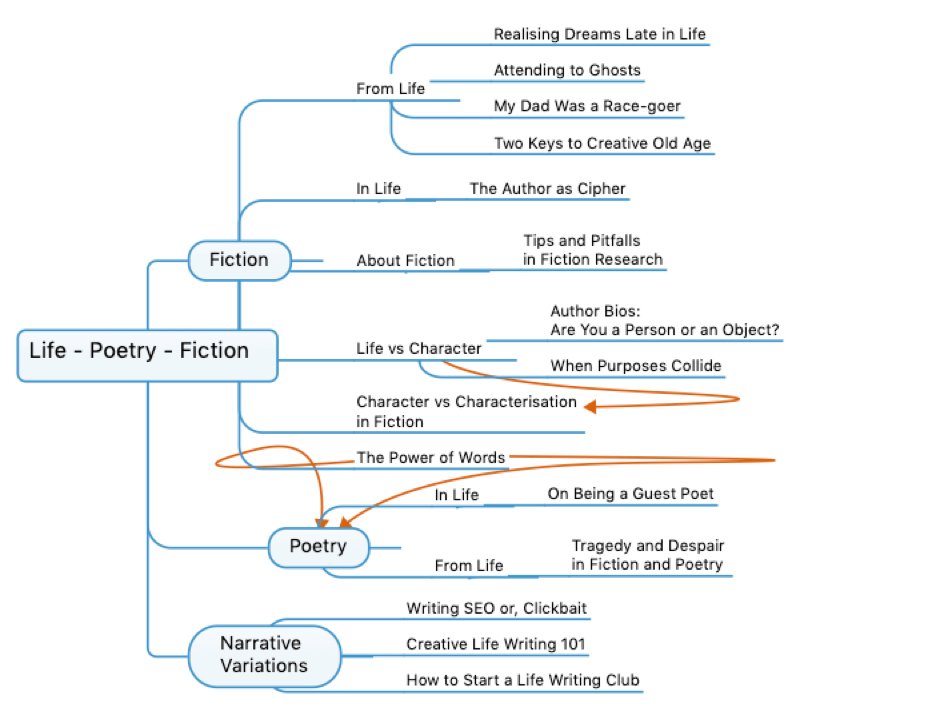
Interweaving Wattletales Posts to Date
Influences we sometimes forget
As I’ve argued before in Life Writing 101, there is no such thing as a stable, enduring or fixed self. As a Buddhist I understand that one’s sense of self is a mere collection of stories we tell about ourselves, many of them contradictory. I have quoted him before, Michael Taussig (Mimesis and Alterity: A Particular History of the Senses, Rutledge 1993) puts this succinctly —
Now the strange thing about this silly if not desperate place between the real and the really made-up is that it appears to be where most of us spend most of our time as epistemically correct, socially created and occasionally creative beings. We dissimulate. We act and have to act as if mischief were not afoot in the kingdom of the real…
Michael Taussig
I argue that the way we construct ourselves is pretty close to how we create stories on the page. Our memories even play with time as we do on the page when we gather together themes or topics.
As for life, so for texts
Like the Author Bios post, When Purposes Collide is also in many ways key to what I am saying here because it discusses the same strange disjunction we make between our ‘real selves’ and our ‘constructed image’ for the web. Both are equally fiction.
Whether I’ve written about being creative in old age, Life Writing or the issue of character in fiction, my theme is a constant. Life, poetry and fiction are all part real and part imagined. So, whether talking about writing or writing about talking in fiction and in poetry is much of a muchness to me.
I concede that a few of my posts have been pragmatic, such as Writing SEO, or Clickbait, where I discuss the nature of ‘internet language’. How to Start a Life Writing Club and Tips and Pitfalls in Fiction Research are also more along the lines of advice. I call these pieces my flat earth writing. It is OK to occasionally stop analysing and just treat the world as though it is real but I suspect I would have been raising questions, even then.
There is no right or wrong way to write
Not everybody is interested in the way life plays with fiction and poetry and vice versa. Or whether things are real or imagined. Readers and audiences admire substantive work that unambiguously addresses the issues of the day as though they are real and otherwise enhances our experience of the world from another’s perspective.
We see this both in positive literary reviews (the establishment) and spoken word slams (the people) where intimate lives are often revealed. The former is more often than not written in the context of other texts, or a history of texts (a specialised history and language unto itself). In the latter, in spoken word slams, context is often taken for granted as being now, as though history doesn’t exist and this moment is all there is.
My questions are all about contradictions, dilemmas and, yes, struggles and the effort it takes to get these things on the page. It’s a truism to say that we must start with what we know. The struggle starts when we examine how we, as writers and our work are socially, politically and historically situated. In other words, when we check in to see whether our words have an impact.
The posts, Author Bios and When Purposes Collide indicate that we need to ask what are the insides and outsides of creative life at both social and personal levels. Deeper still, we might well examine the relationship between persona and the inner world as I have in this little poem called ‘The Poet’ which is a mix of the real and the imagined.
 My Poet

 I get in the way of my poet
 who's silent before I know it
 I think and think
 and try not to blink...

 I stare outside
 to forget, forget, forget myself
 till my poet pops up
 with right words

 it doesn't always work you see
 but there's a lot to like about me, me, me

 my façade for example
 goes for a ramble
 to all sorts of places
 among all sorts of people
 where it may well extrude by mouth
 but lest we forget it ingests
 by eye and ear and mind
 just to feed my poet
Understanding context
As an anthropologist, I write both poetry and fiction close to life. Stylistically I am a realist so I gravitate to issues such as ethics, truth versus verisimilitude, and the individual in politics and history. These are simultaneously topics of interest to me as a writer and the contexts in which I write.
Even when we take the world to be wholly real, there are dilemmas for the imagination.
Politics and Ethics
In life, there are some things we can be sure of and others that take the wind out of our sails. Politics and ethics certainly make things difficult for a writer who wants to write about other cultures, their own families or even themselves when they have children old enough to know what they say.
Ambiguity:
When my children were young, the dilemma of what I could and could not say about my role as a mother proved problematic. How could I tell anyone how if or when my kids did something outside the box? Could I write about such things? Or, would that be a betrayal?
Uncertainty:
Anthropology teaches that it is offensive to write for or about others from the safe and privileged space of one’s own world view. The risk is that we will compare and judge rather than objectively record and thus skew what we see.
To prevent that, we must examine with some rigour our place, our own social and historical situation, in relation to those whose lives we claim to represent in our writing. We must be aware of the way our position distorts the context.
Anthropologists today suspend their values and realities — to the extent that is humanly possible — to try and see the world from another’s perspective without judgment. In disciplines like anthropology, discourse about the right to write about ‘the other’ abounds.
The first to articulate the political distortions that come from a politically dominant perspective found in earlier scholarly work was Edward Said in his groundbreaking text, Orientalism, London: Vintage 1979.
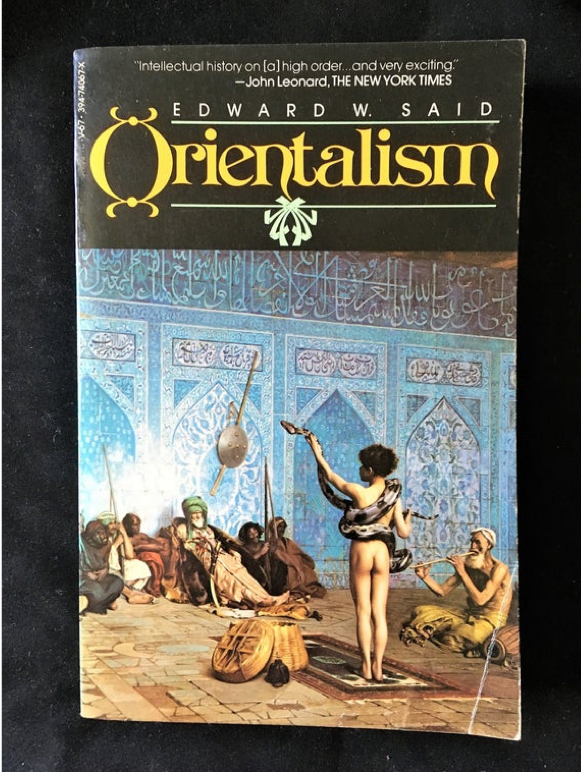
Orientalism presents a style of thought based upon an ontological and epistemological distinction made between “the Orient” and (most of the time) “the Occident.” Thus a very large mass of writers, among whom are poet, novelists, philosophers, political theorists, economists, and imperial administrators, have accepted the basic distinction between East and West as the starting point for elaborate accounts concerning the Orient, its people, customs, “mind,” destiny, and so on … the phenomenon of Orientalism as I study it here deals principally, not with a correspondence between Orientalism and Orient, but with the internal consistency of Orientalism and its ideas about the Orient… despite or beyond any correspondence, or lack thereof, with a “real” Orient.
Edward Said
The quotation is drawn from an anonymous online obituary from The Guardian. In the simplest terms, he speaks of the de-humanising or stereotyping potential of writing without reflection from a position of power and we must take note.
Truth and verisimilitude
In our scientific world, we learn to believe in ‘the facts’. Concrete truths, however, are often difficult to pin down in social worlds.
In fiction, if we wrote our stories with what I call the ‘and then, and then’ the way a child might, or with the detail employed by science, nobody would ever read our work. Novelists evoke. Their aim is to write in a way that gives readers their own experience, to create a story that reads as though it were true. And, we borrow from life and re-imagine it.
The space between the real and the imagined on the page is deeply ambiguous. We borrow from ‘the truth’ and write in the register of verisimilitude and add imagined things to create moments on the page that ignore temporality and space in order to represent a truth about human life as I have done in this poem called ‘Home’.
 Home

 My mother
 fills a crystal vase with flowers
 for the mantelpiece —
 lies drunk in congealing fat
 roast lamb and potatoes ruined
 on the lino floor.

 Always there after school
 she waits for me to tell her
 everything
 tells me I cannot live
 without her.

 She loves me
 my mother
 who hates my father,
 He says he loves
 his wife but gets me
 to put her to bed when
 she's 'like that'.

 Always a spotless kitchen
 fresh fruit on the table
 my mum in apron and perm —
 like TV ads
 but she never smiles.

 She holds on till dark
 to seek herself.
The individual and history
In life writing such as biography and memoir, as in fiction, we must situate ourselves or our characters, in context. Humans are social, political, ethical and historical beings and so are our characters. Context is more than setting, it is the entire world or cosmos that our characters act within. We cannot write complete contexts which are the very fabric of our being in the world and should be for our characters as well.
History once fell into the trap of recording wars, empires, explorers, governments and kings (almost all men) which effectively silenced not only their subjects but largely excised women from history. We don’t want to do that in our writing.
The Feminist example:
Until very recently, women’s lives did not rate in authoritative historical texts. In Australia’s official war photos, women on the front were not named. They were collectively and individually labelled; subjugated to their role such as ‘nurse’ and forever silenced, sacrificed if you like, to the history of the national war effort. The world of war was imagined as being ‘about men’.
But, when the voices of ordinary people speak out or write up as in social media nowadays, you get a groundswell for change. Imagined realities are threatened.
contemporary voices:
Consider the #metoo movement. When women are trapped and silenced as individuals in untenable circumstances by sexual abuse and domestic violence, political change is not possible. But whenever many speak together, something extraordinary happens.
Feminism created opportunities for women to speak up. Its struggle was to overturn cultural imaginings. And it worked and is working even better now. You only have to read the paper. Women are now moving to the front and centre of the historical and political stage which means, the world is being reimagined.
What more proof is needed than Finland appointing the world’s youngest serving prime minister in history who, at 34 is one of the five female leaders of that country’s all-female government. A world reimagined.
Then there is Greta Thunberg, the 16-year-old environmental activist who has inspired young people across the world to protest about climate change. She has been named Time‘s Person of the Year for 2019.
As the Buddha might say, life is always in a state of flux and is illusory. If we stick with the reality principle, wanting things to remain the same, we suffer. The outrage at Greta Thunberg from mostly white, middle-aged, established men is evidence of this.
Move over emperors and kings. Remarkable women are making a mark.
Politics and the individual
true stories:
Nothing is ever quite as it seems. History is not a straight line. Power plays everywhere competing to convince us of diverse flat-earth theories. It’s fascinating to see how the real and the imagined are distorted by power.
Let me tell you that when I went to university in my late 30’s having left school at 15, I was unaware that women then worked for two-thirds of a man’s wage for the same job. I had an early divorce from a violent man, but because I’d been married, even at 17, I no government or military entity would employ me. I wanted to be a policewoman.
Even when we were working in ‘women’s’ jobs, employers sacked us when we married. A friend of mine had an affair with an engineer in her office; she was sacked and he was not. Even after these embargos on women’s employment changed (I’m not sure if they were laws or mere customs, like changing your name upon marriage) we had to leave the workforce when we became pregnant. That was the real world.
even overseas:
When I started university as a special entry student I questioned the idea that ‘the personal is political’. During fieldwork in Sri Lanka, I was forced to reconsider.
In Sri Lanka, I felt like a ‘powerless’ single mother of three and student on a low scholarship income. However, my income made me relatively affluent and, because I was a researcher, people described me as a lecturer or called me by the honorific, ‘Madam’. They treated me as a ‘powerful’ representative of an ‘advanced nation’ and its interests. Could I then play ‘powerless’ in the face of a people who at that time had very little?
Everything is relative. We cannot be extricated from the social, political and historical contexts in which our lives take place. What we feel and experience is not necessarily the way others think of and experience us. We imagine our realities based on the specifics of our context.
Our stories are simultaneously private and collective, individual and historical and personal and political. Everything we write has ethical implications and, yet, the real world is half-imagined.
Respect those you write about
the power of words:
I’ll leave this post here with a reminder to always pay attention to the power of words; words are socially, politically, historically and ethically as situated as you, your words and the written word in general. Whether we write journalism, history, poetry or fiction, our words affect and could possibly harm others.
In order to write with respect, therefore, we must examine how and why we write and the degree to which we are writing what is real or imagined.
real and the imagined realities:
Nobody wants a review like that by Russell Marks in the current issue of Overland (No.237 summer 2019 pp 52-57). In an article provocatively entitled ‘Crocodile Tears: On Misreading Justice’ Marks critically examines a popular novel called Saltwater by Queensland Barrister, Cathy McLennan. As I read it, Marks exposes the implicit and explicit racism of a work in which a person in a position of significant power romanticises suffering.
Marks charges McLennan with a failure to understand the Aboriginal world about which she writes even though she is in a position of power over that world as a Magistrate. Her novel is apparently recommended reading, including at university level which says a lot about how misinformation can feedback into society if not checked.
Marks remark that the book’s …myriad problems could have excluded it from publication altogether’ is circumspect given his damning review. But what he has shown is how very important it is to examine one’s own context and understand the extent to which we imagine the worlds of others wrongly while believing our unexamined perceptions to be real.
As an aside
Have you ever played with mind mapping? As you can see from the map I shared above about my blogging tendencies, it can be very helpful in sorting out what’s what in your writing or your thoughts.
I use Mindjet’s Mind Manager. You can try it for free for 30 days and it is available for both Mac and Windows. There are cheaper options if you look around but it might help as you work on the exercises below.
What is real and what is imagined in your world
The first step in writing fiction and poetry is to be real on the page. A little bit of integrity goes a long way in all writing, even if only you read it.
- Do you see yourself in your writing? If so, how?
- List your major life turning points and the ethical struggles they represent for life-writing or fiction.
- Examine what your writing says about you.
- Re-write things that, when you read them now make you cringe.
- Check your contexts: individual, political, ethical, historical — real or imagined.
- Articulate the ways your life is embedded, no matter how slight, in all of your work.
If you have any ideas for topics you’d like to see covered here next year, please let me know.
Happy Festive Season from Wattletales