

Falling in Love
The night I first stepped from the plane into Sri Lanka’s humid midnight arms, I fell in love with the lush greenery, tropical fragrances, and warm-hearted, welcoming people. This beautiful, bejewelled island, shaped like a teardrop at the southeastern tip of India, hosts an annual caparisoned elephant procession that parades the Buddha Dalada (eyetooth relic) surrounded by costumed dancers, drummers, and fire throwers, attracting huge local and international crowds every year. Such an adventure.
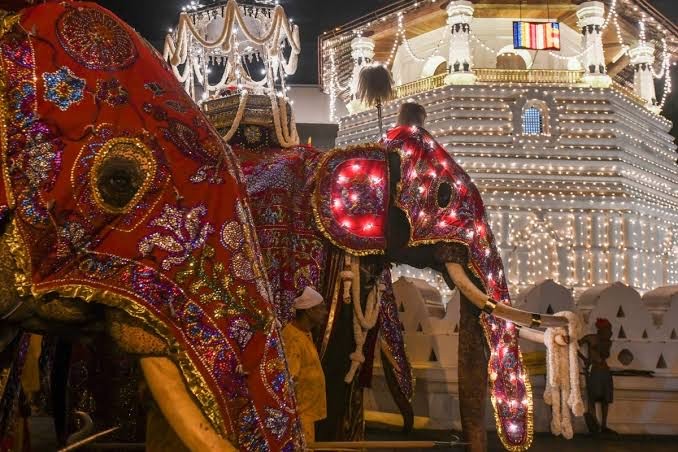
I returned to Sri Lanka in 1984 as a postgraduate researcher to examine the Perahara and another large-scale ritual called the Gam Maduwa or village hut. The Gam Maduwa celebrates and propitiates the only female deity in the Sinhala pantheon, Pattini Amma.
Once sponsored by kings, the Perahara has proliferated. As one famous dancer once told me, nowadays, everyman is king. Similarly, individuals may now host what was a community and harvest festival, the Gam Maduwa, for a small crowd or an entire village for personal reasons. Ritual has democratised.
Where to Start?
With one suitcase apiece, my children Grant, 12, Vanessa, 11 and Mark, 9 and I spent 18 months In Sri Lanka while I did postgraduate research. When we arrived, we first stayed in homeshare accommodation in Colombo. Our hosts helped us find a place to live. My landlord then introduced me to a marvellous woman called Soma who cleaned, cooked and otherwise looked after my family. My children attended Alethea International School, an English medium school for Sri Lankans near the beach in Dehiwala-Mount Lavinia.
We were thus kindly facilitated to where we were supposed to be, in Sri Lanka, by Sri Lanka.

L-R Mark, Grant and Vanessa 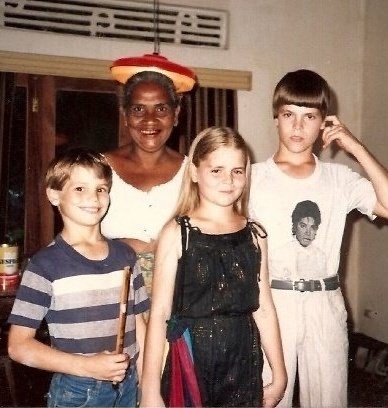
Soma with her charges 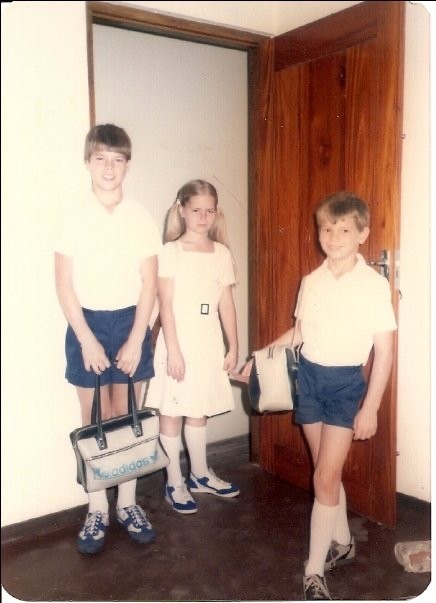
Sri Lankan school uniform
Once settled in our home in Sri Jayawardenapura Kotte, my precious children took the bus to and from school each day. My youngest, Mark, learned to recite the conductor’s spiel, rapidly naming one suburb after another at each stop, much to our delight.
I could not have done fieldwork without Soma who, sadly died many years ago. I was away a lot, travelling on jam-packed buses to attend more than 54 rituals of different types, big and small. Many were all-night affairs. Others took longer, always somewhere different.
Mine was a peripatetic life. Following ritual performers across the southern littoral, I walked many tropical miles through jungles, paddy fields (and occasional leeches) in flat leather thongs to attend magical nights of ritual drumming, dancing, and deity propitiation. Large crowds gathered in delight and devotion at these events (more of which later). In this adventure, I was never alone.
The Best Assistant is a Friend
Once I’d sorted accommodation and schooling, I had to find an assistant. One applicant whose resume was perfect didn’t show for his interview. I ended up engaging someone with whom I struggled because he insisted that the people we met pay me deference, find me a chair and so on. I did not want that. It went against the Aussie spirit for one thing and was alienating for my purposes. I began to panic.

Three weeks later, the missing applicant, LR Perera, showed up unannounced to apologise for not attending for interview. A shy man with a Batchelor’s degree majoring in Sinhalese Language and Literature, LR taught himself to speak and write English in his remote home village by reading English novels and poetry. In Colombo later, he studied newspapers too. LR said he stayed away because he’d been teased for his spoken-English accent and lacked confidence. Our people, he said, are very cruel. LR went on to achieve acclaim as an international consultant.
LR’s English was then (and is) excellent, and having similar interests, we got on like a house on fire, travelling everywhere together month after month. To this day, nearly 40 years later, LR and I remain in touch. As you do in Sri Lanka, we became siblings where, as anywhere, kinship terms define a moral code that structures appropriate behaviour. The use of kinship terms there, however, extends to strangers as well as actual kin. (Do we still call daddy’s girlfriend aunty?)
Under Scrutiny
Speaking of kinship, What I hadn’t realised, and nobody thought to warn me, was that it was probably thoughtless of me a single woman to do fieldwork alone among male ritual performers. Not because I’d be unsafe, for that was never and could never be the case, but because my presence could compromise those with whom I worked. I am grateful for how well everybody looked after me.
Still, the predominant question I got until people knew my circumstances was, where is your husband, Madam. I told the truth (that I was divorced), and I think that earned some respect but, I should have read the clues. How could I not guess from a visa application process requiring the name of my husband or father? No wonder touts called a white woman travelling on her own, Tani Aliya (lone elephant).
Methods and Possibilities
When I did my research, anthropological fieldwork employed a participant-observation methodology. I didn’t speak Sinhala, and back then, such research did not yet require ethical clearance. The idea was not to become the Other (I didn’t wear a sari) but to hang around and watch others live their lives.
Even then, I used to wonder how I’d feel if a foreigner knocked on my door to ask if they could live with me and follow me around for months on end, recording minutiae of my daily life to get a degree. (In Australia, we can only empathise with our First Nations people on this.)
Fortunately, the ritual practitioners I worked with welcomed the chance to share their traditional knowledge, their cultural gems, and they were always in charge of how much they divulged!
Both of my boys wanted to learn the traditional arts. The drums especially fascinated them. Here is a small taste of the sound of Sinhalese ritual drumming. In performance, it gets louder and faster as it goes, especially for trance dances.

Unfortunately, Grant was already too tall to dance, being taller than many performers. However, Mark learned the traditional dances of the Gam Maduwa. The press got wind of this just before we left.

Media release — Mark in costume 
Elaris Weerasinghe with Mark and son, Chaminda, off to work
Life Bleeds Into Research
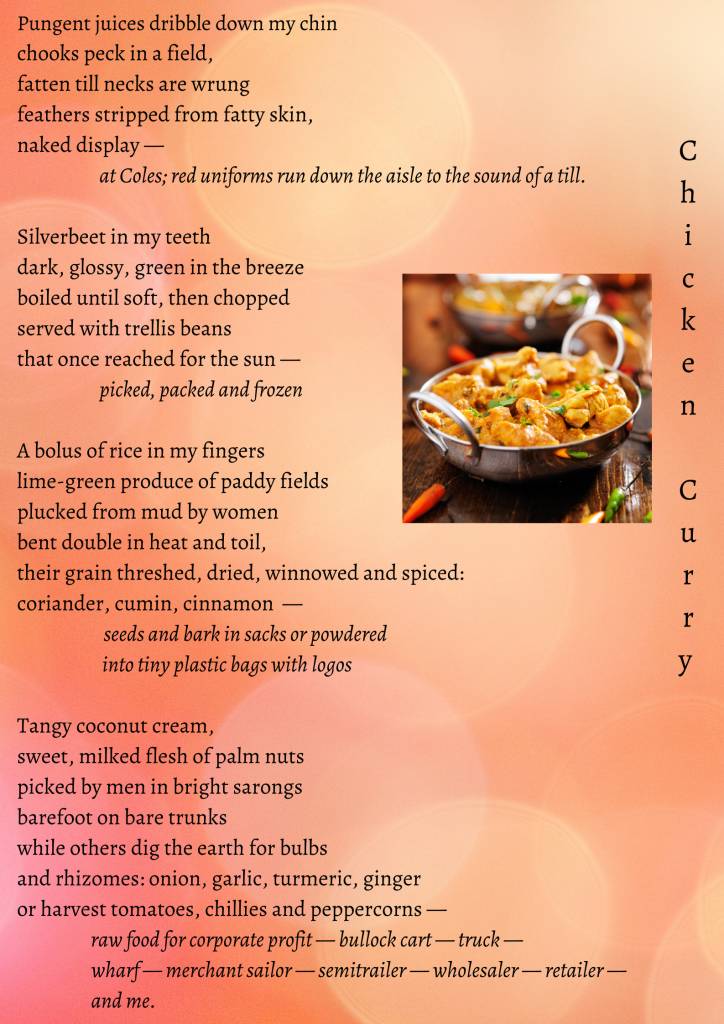
I was in Sri Lanka to research myth, ritual and religion. Strictly speaking, it was about the politics of specific rites, but that did not stop me from learning about Sri Lankan food, social mores and everyday customs. It took me years and being back in Australia before I was game to serve rice to anyone. In Sri Lanka, a woman who can’t steam rice properly is almost inconceivable. I learned to cook decent chicken curry, Kukulmas (chicken meat), but, as this poem attests, I couldn’t help but contextualise the recipe in my world.
The Gam Maduwa
One of the most spectacular aspects of a Gam Maduwa is a trance dance performed by a deity priest, dressed in a strict ritual process as the Goddess.
Early in the proceedings, members of the dance troupe wear white sarongs to propitiate the deities and invite their presence. In the poem below, you will see them in silhouette. Such ritually washed white cloth separates the sacred from the profane and pure from impure. Boundaries abound if only we look. In church, a woman must cover her head in the sight of God, but men may go bareheaded.
Dancers introduce their intricate hand-made, glass-beaded costumes later in the performance as a build-up to the main event. They gradually dance faster and the drums get louder although drummers stay in white throughout. Their music mediates sacred and profane as they facilitate performance and costumes indicate that we are in the presence of the divine (or demonic).
Performers worship their costumes and instruments before use, and dressing the priest is a sacred duty. In this photo, a drummer dresses Sirisena Kapumahattea (a diety priest is a kapurala, and mahattea is ‘sir’) in preparation for Pattini’s midnight dance. The priest fasts for a specified time to ritually cleanse before the event. In dance, his sari instantiates the Goddess.
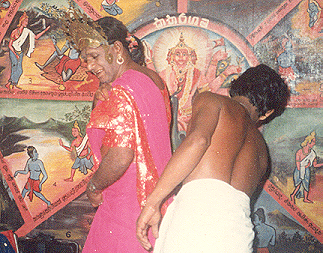
The Goddess and the Demon
Pattini Amma was once a village goddess overseeing harvest and community wellbeing. Pregnant women propitiate the divine mother to this day, but she has historically become one of the four major deities of the Sinhalese pantheon. In a Perahara, where male deities (their icons) sit atop caparisoned elephants, Pattini travels in a palanquin. (Remember hats and no hats?)
A Gam Maduwa of any size may be a votive offering, but mostly they give thanks for good fortune. Their size varies according to a host’s wealth. Some feed their entire village, the many performers and an occasional anthropologist and assistant. Dignitaries and Buddhist monks sometimes attend.
The Gam Maduwa is an elaborate affair. Ritual practitioners spend days preparing the arena to build the coconut-frond palace for the gods, in which Pattini appears at midnight. This poem gives an idea of what it’s like to be there.
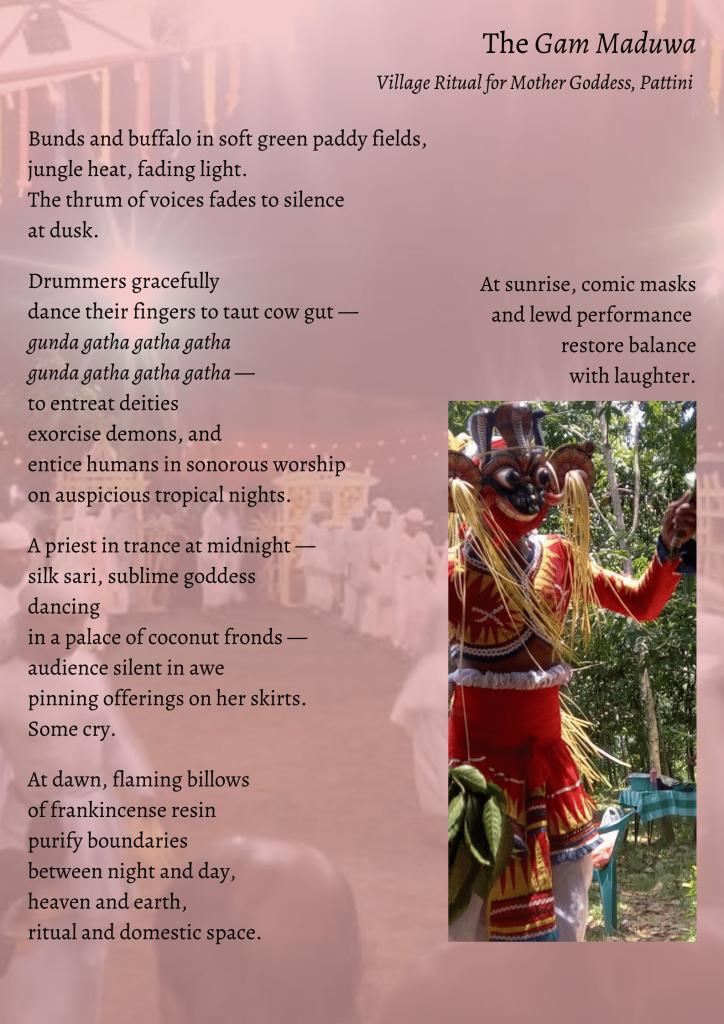
This is my Gara Yakka. He hangs over the door inside my flat. I was humbled when an internationally renowned dancer took his mask off after a tiring performance to present it to me publicly.
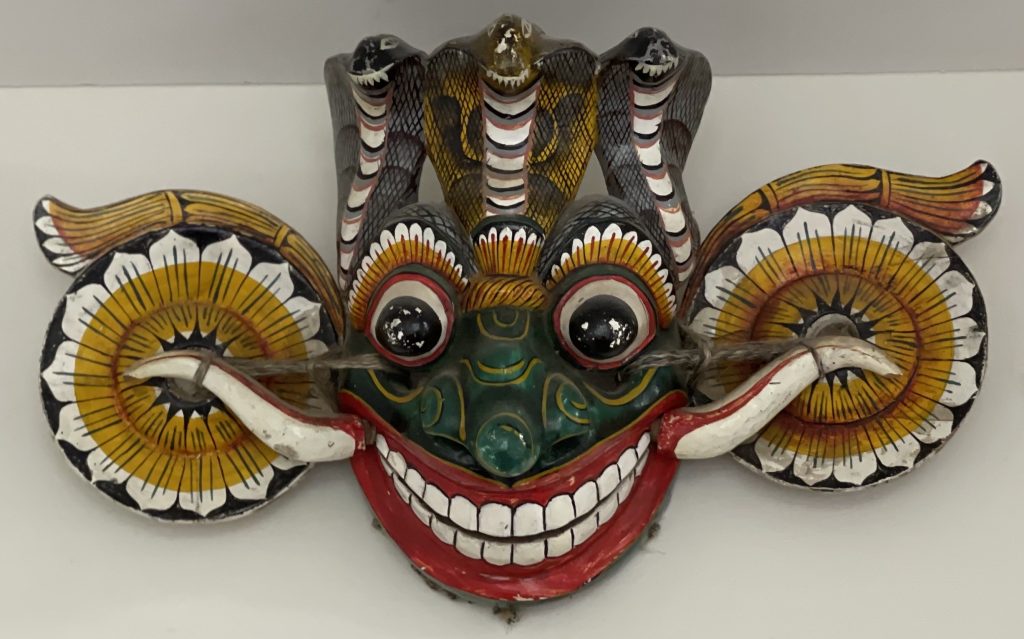
Sri Jayawardenapura Rajamaha Viharaya (Kotte Temple)
At the spectacular Kotte Perahara, after I’d worked closely for some time with the same loose coalition of Low Country ritual practitioners, something changed.
Back then, I used to smoke — we all used to smoke — and in the beginning, I got into the habit of taking a couple of extra packets of cigarettes to rituals to share. Over time, people who knew me started offering me a cigarette, and I’d take the extras home.
However, at this particular perahara, performers from the central highlands (Up Country or Hill Country), the home of the original royal Perahara, were also performing. Quite rightly, they saw me as a stranger and approached me for a cigarette en masse. As though by magic, familiar faces surrounded me and shooed them away. Funny how unspoken gestures like this still touch so deeply, years later.

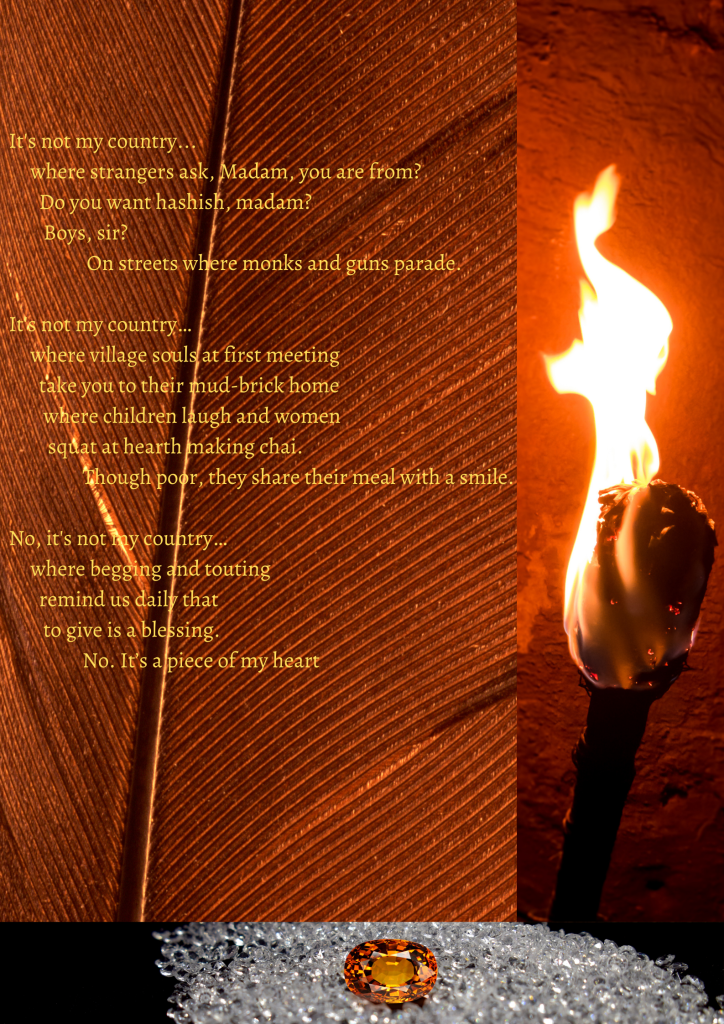
I structured the poem to echo the perahara (procession).
In the Crowd
Bigger Peraharas like the one in Kandy, where the Dalada resides throughout the year, and those in cities like Sri Jayawardenapura and regional centres, take many days (up to three weeks) to complete. Even small processions in villages are at least all-night affairs. They take place on or around the full moon night of Asala in the Buddhist lunar calendar. In Sri Lanka, every full moon commemorates an event in the life of Buddha and full moon (poya) days are public holidays.
Maybe COVID has stopped the Perahara in recent years. But I used to imagine multiple brightly lit, vibrant clockwise processions as auspicious spinning wheels illuminating the entire island, an apt metaphor for ancient South Asian Chakravartin Kings and Buddhism’s Dhamma Wheel (Dhammachakra).
Perahara processions of elephants, dignitaries, dancers, drummers, acrobats, flame-throwers and more can be a mile long on the critical night when the Buddha relic joins the parade. When I was there, kerosine lanterns lit the procession on the bare shoulders of men. Gone were the dangerous oil lamps of old and the sweet smell of burning coconut oil.
A Perahara is far too big to describe in full. They are exhausting. Yet, people line up for hours to get a good vantage point, and police cars drive very close to their toes to keep them in line. Before it all starts, young men promenade along cleared streets, making subtle eyes at girls who giggle behind their families behind the line.
Stands are built, primarily for dignitaries (and tourists). Through high-volume loudspeakers, a voice endlessly recites the names and status of event donors and how much they contributed, an act that brings merit. It’s a hot, humid crush of humanity that takes getting used to after the open plains of Australia. LR and I devised means to make it fun.
Back Home
The line between life and fieldwork is tenuous. Many who know me know I married Mark’s teacher, Elaris Weerasinghe. Sadly, Elaris died some years ago, but his children in Sri Lanka are in touch with me on Facebook. When I heard the news, I organised a Buddhist rite called Dana, a giving which can be a big public event or as simple as a gift of food or personal donation to a Buddhist monk or temple.
Remember, the Buddhist Order (Sangha) is a mendicant order, reliant on donations to survive. Dana creates merit for the giver. Sponsoring a ritual puts the giver in a symbiotic relationship with Buddhism, like that between the Sangha and Kings of old. The last paragraph of my poem, The Tourist, equates begging with Dana. Beggars offer an opportunity to give, to earn merit, which is the logic of Dana.
My Dana at Aldinga Beach in February 2010 honoured my parents, my brother, Phillip and Elaris. Four Buddhist monks officiated, and about 35 people came. It was such a special day.
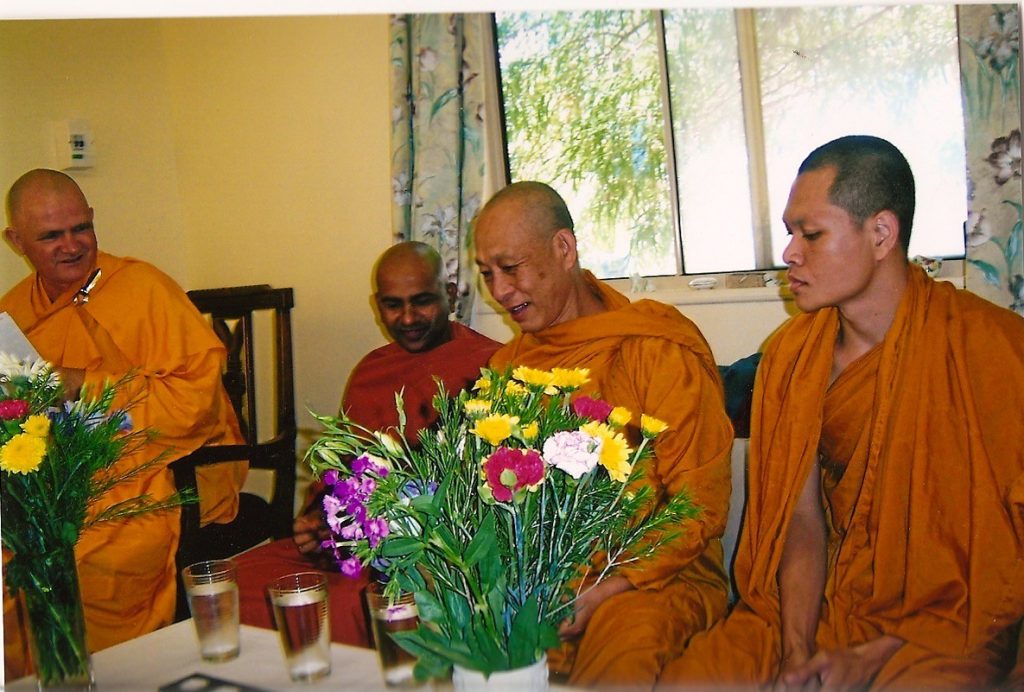
Four monks (see below) 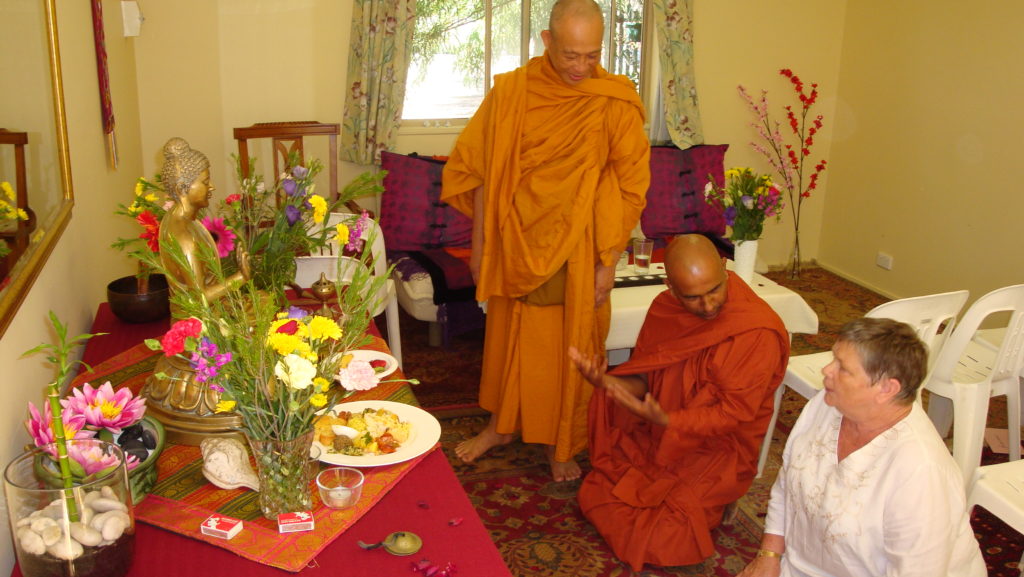
Bhantes showing me what to do 
Chairs filled, some outside
Writing Tip
As for an anthropologist, observation is an invaluable skill for a writer to develop. But, it doesn’t always bring heart and soul into the picture. Always remember the little things and share them with your readers.
Happy Writing
Wattletales
ACKNOWLEDGEMENTS
The photo of the caparisoned elephant in Kandy is licenced to AFP.
‘The Tourist’ is published Kaleidoscope, 2019, Friendly Street Anthology edited by Nigel Ford and Valerie Volk.
Dear Inez, Thank you for reading and understanding as you do. It was a life-changing experience for me, one I’ll always treasure. I’ve only been back once since then, many years ago now…I’ll tell you all about it one day.
Oh Lindy! How lucky you have been to spend time in Sri Lanka and to witness these dances and rituals. I can only imagine how mind-blowingly colourful they must have been! I love the term ‘lone elephant!’, that’s me, and the Gara Yakka mask you have is gorgeous! I really enjoyed this Lindy and in particular, ‘The Tourist’ poem, the contrast in culture, yet we are all the same, or want for the same things. A beautiful story and rich life. Thank you, Inez
Thank you Julie, Glad you enjoyed this one, it’s one of my favourites so far and I loved that you found it warm. Yes, it was a marvellous experience.
What a wonderful read, Lindy, and a wonderful experience for you and your family. No wonder you are so grounded.
How marvellous that you married Mark’s teacher. Xx
I saw the parades, the colours and elephants, through your words.
Thank .you for sharing this warming story.
Julie Cahill.
Thank you, Veronica. 🙂
Lindy, it’s a pleasure to read others’ responses to your writing. I do remember a couple of your poems, but that didn’t detract from the overall reading experience. So well done, thank you.
Veronica Cookson
Thanks for reading, Maria.Yes, anthropology taught me a lot about the suspension of disbelief, and to allow ‘the other’ and others to be themselves. But, I did love Sri Lanka at so many levels.
What a sacred, primal and spectacular ritual. I liked your detailed description and your obvious enchantment and admiration of the culture and spirituality. Good thing you learned to cook rice. Love the pics of your children and I imagine they were deeply enriched through immersion in a very different culture. Your poems and prose worked very sinergistically and helped my connection as a reader to you.the writer. I love Anthropology and its premise to not judge. In Greece we went to dances that started in Church on a saint’s day but went on for 3 days straight in.Bacchanalian excess. My own anthropology studies helped me situate the Pagan / Christian amalgam.
Dearest LR, What a thrill to receive your comment on my blog post. You know, more than most, how much I loved living in Sri Lanka and I thank you for your enduring friendship. We had a lot of fun and I certainly learned a lot from you. I have to thank you for your patience with me and support without which I would not have had the success that I’ve had, such as it has been. I wish we’d written poetry together all those years ago. Lindy
What a great research study it had been using the most effective research methodology in social science – the participatory observation. It was an in-depth study not even the local researches had gone into that much enhanced participatory methodology level. We not only attended the rituals and other related activities we absorbed in to their social and cultural events not as just observers but as being part of their societies. The community who performed those rituals and festival too treated us as part of their own societies so that we could be able to get a deep understanding of those rituals, festivals and related social-cultural aspects. On the other hand, it gave me an excellent experience and opportunity to improve my abilities to be a Social Scientist- Researcher academically and professionally to be recognized both at the local and international levels and receive national and international awards too for research. Those days the study was done the participatory research methodology was in some initial stage in sociological research and with the experience, I gained I used in almost all my research studies the enhanced ‘ ‘Participatory Action Research Methodology’ – the most appropriate research methodology in the Social Science.
Thank you my dearest friend (sister) for your great job done in this study, and for giving me the opportunity to direct me to the right path of my career too.
LR
Dear Jenny,
Thank you for your thoughtful response. I’m so pleased you enjoyed the piece. It’s all so long ago, but Sri Lanka is still part of who I am. Even back in the day, many people said it was a big deal, taking my kids, but, if you think about it, how could I not? I would not have survived without them for 18 months.
Dear Lindy,
Your sensitive enlightening post reveals another life ..one I knew almost nothing about. It’s a big read and I was fascinated throughout. You have an amazing mind; one which notices detail and then provide a description which holds my attention throughout. And, you took your children with you. That is a feat in itself. Maybe you really wanted to do this project. Jenny Donovan
Thank you for reading, Veronica. I thought you’d remember those poems, but maybe they came after Ochre Coast. I think the kids’ experience has been significant for the kids, but it may have been a slow burn as they had to fit in when they got home. Still, it was a wonderful time.
What a different life you’ve led, Lindy. It’s wonderful to read about the little (and large) ceremonies and your feelings about the whole experience. The photos added to the atmospheric writing. I loved your Chicken Curry poem and also, The Tourist. Your children were old enough to retain memories of their time in Sri Lanka and that would have been invaluable for their growth.
Thank you, Veronica xx