

Ancestral Origins
My mother’s songs seeded the starburst of my poetry. Like a bird sings to its eggs, she sang the melodically and rhythmically fertile songs of the Aegean Islands while I was in her womb. When I hatched, she continued to prime me through infancy and childhood. I still sing and drum the haunting modes and hiccupping rhythms of Greek music. They feed my poetry with metre and syncopation.
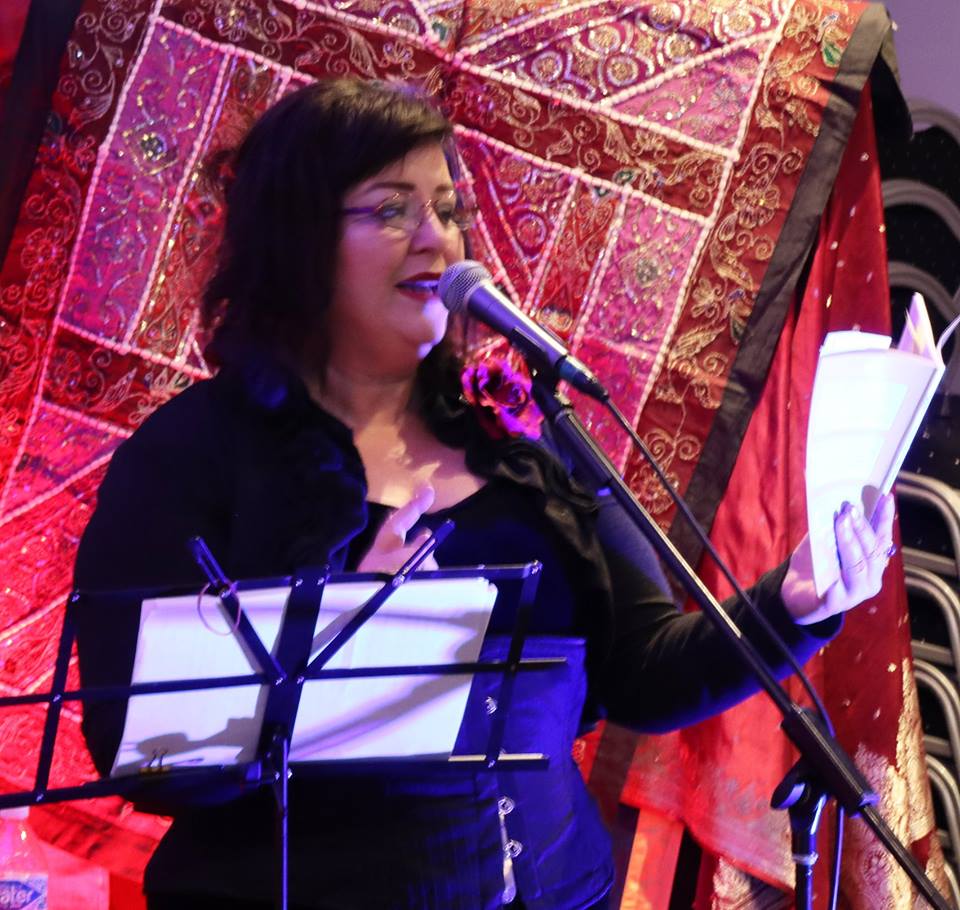

Oral and Musical Roots
It’s tempting to believe my pilgrimage with poetry began at Flinders University, where I completed a Creative Writing Graduate Diploma. Academic learning validates. It teaches the craft, but the richest source for poetry for most poets is ancestral.
I inherited a deep, unconscious, but musical and poetic pulse from my family; my mother’s voice permeates my writing. More than theory, I draw power from this heritage. It lends authenticity to my poetic voice, which comes from deep within.
Many cultures, Greek, Ethiopian, Arabic, and Irish, to name a few, have strong oral traditions. Poetry in our Anglo-Celtic society does too, both in form and musicality.
Before Europe invented the Guttenberg Press, poetry was sung and recited in communal groups. The rhyme and metre we know from traditional poetry were mnemonic devices. Today, slam poetry which is almost a sport, has a similar musicality. Being performance, it is popular among young people and attracts large audiences and cash prizes.
I run an open mic with Julia Wakefield called SPIN (Southern Performers Interactive Network). We celebrate the connection between music and poetry and support early and emerging poets and musicians to develop their craft and confidence. I performed at the Goolwa Poetry Cup in 2017 with my show, Little Poems about Kisses. It was thrilling to win an award for Mr Lizard Lips.

Stones of Dislocation
My father’s forced migration as a political refugee is a troubling childhood memory. My family travelled from cosmopolitan Piraeus, a traditionally built home, to a Housing Trust duplex in Whyalla, South Australia, where Dad worked at the BHP steelyards as a rigger. His ship’s captain qualifications were not accepted.
Dislocated like many migrant families, fractured clan roots caused suffering. I felt I did not belong. Already bi-lingual, my father picked up English as his third language of necessity. My mother struggled.

The Strange Gift of a Double Tongue
Torn as a child between my Greek mother tongue and English was bewildering. I morphed into a bi-lingual child and quickly qualified to act as an amateur translator of adult medical mysteries, a junior social worker for my mother and a legal document reader for my father: a common situation for migrant children.

School classified me as ‘English-less’, which was a shock at five years of age. However, I graduated with the Year 12 English prize and have written mainly in English since. I gravitated towards creative writing and drama and was always the top performer in most English classes. Sadly, my Greek language is now much weaker than English, an expected loss for migrant children.
A Life Raft
Poetry was a life raft for me during my mid-thirties when I experienced a series of traumatic losses. My father died of cardiac arrest on a public health waiting list. My mother committed suicide. I left my de-facto husband, lost the job I held in our business then lost my own business and singing career. Even my cat died. For a time, I was homeless. Grief choked my song. Anxiety set in, and panic attacks still plague me.
Poetry, for me, was firstly a therapeutic tool. Though I rolled punch-drunk with grief, I scratched my sorrow into journal scribbles. Later, many of those raw feelings turned into published poems. I captured trauma in words, which eased the pressure of that catastrophic period. As Bessel Van Der Kolk notes in The Body Keeps the Score, trauma is visceral. Creative practices such as writing, painting, singing, and exercises like yoga, dance, walking in nature and ocean swimming are healing remedies.

What is poetry? Who knows?
Poetry can be anything, everything and something in words. It is mercurial. I use Samuel Taylor Coleridge’s definition to guide me: ‘The best words in the best order.’ His words are my mantra, and I ask the question constantly as I practice. Is this the best word in its best place? It helps me progress through a poem, especially if my writing is stuck. Of course, the judgement of ‘best’ is often a personal one.
As a poet, I like traditional poetic forms. Form in poetry is like a corset: it restricts but gives support and shape. I enjoy the challenge and practice of villanelles, haiku, sonnets, tanka and sestina.
Even free verse is not as liberating as its name might suggest. When I write freeform poetry, which I do a lot, it forces me to make an oppressive number of personal choices about rhyme, metre, lineation, punctuation and many other things. Decision fatigue happens even before the engine of a poem — its literary tropes, metaphors, similes, hyperbole, personification and others — fires up.

How I Craft a Poem
In 2007 I returned to university to study poetic craft, history, and traditional forms with Professor Jeri Kroll and A/Professor Steve Evans. Learning poetics enhanced the instinctive skill I inherited from my ancestral heritage.
While studying, I held down a job and acquired my first dog, Dora, a beautiful companion. The discipline of crafting a poem helped me order my thoughts and shape my journal scribbles into readable poems. It also aided my recovery from the previous decade’s ‘personal holocaust’, as I now call it.
My best poems, I think, do two things at once. They draw with clarity on raw personal situations and emotions that link to human universals when honed. My first poetry collection, Eye Print, won the Friendly Street New Poets 19 manuscript prize.

Keeping Poetry Muscles Fit
Poetry is a continual practice for me. I often get it wrong and sometimes get it right. Some helpful things are participating in critique groups such as Ochre Coast Poets and TramsEnd Poets and elsewhere. Collaboration and critique are invaluable in the journey to polished poetry.

A poem in GRIEVE 
Musical Trio, Maria on Drum
In the Community
But, all engagement in poetry helps me learn as I build my profile as a practising poet.
I professionally edit manuscripts and mentor young and emerging poets like Asher Seiler Simmons, a Year 12 Steiner student whose project culminated in a published poetry collection.
Between 2019 and 2020, I conceived the idea of poetry as a Life Writing project for seniors. The seed for this came through many fruitful conversations with Dr Lindy Warrell, who successfully ran Life Writing workshops in her local community.
In creative partnership with Steve Evans, I successfully sought funding from the Onkaparinga Council and SA Health, resulting in ‘Your Story Life Writing’, a workshop series we delivered throughout regional South Australia. I used poetry, mainly haibun, and prose to help participants create memoirs and record family histories. I loved working one-on-one with participants; the learning went both ways. We had fun.
Another initiative was my ‘Frolic with Forms’ workshop. In 2020, I collaborated in the publication of Ochre 10, an Anthology. Running school-based workshops in poetry across four schools in the South was an exciting experience. The local poet Virgil Concalves won an Onkaparinga Council grant for this project.
Where to now?
Over the last fourteen years, I have poured a lot of money, time and energy into poetry. But poetry is a fragile axle to drive your life on. Very few people earn money from it, and the satisfaction derived from publications and prizes is fleeting. Banging your odes against gatekeepers like editors and judges is a formula for disgruntled disappointment. To run the long race and stay sane, a poet needs to have a deeper purpose for writing poetry than publication.
The pilgrimage is about binding the ephemeral to words then sending them out to bond with another. It is a sacred linguistic process.
Poetry continues to lure and torment me. Its language compression, sinuous syntax, magic metaphors and rhythmic heart prey on my time and energy.
Like a true addict, I quit poetry 20 times a day and return to it for one more line.
AUTHOR BIO
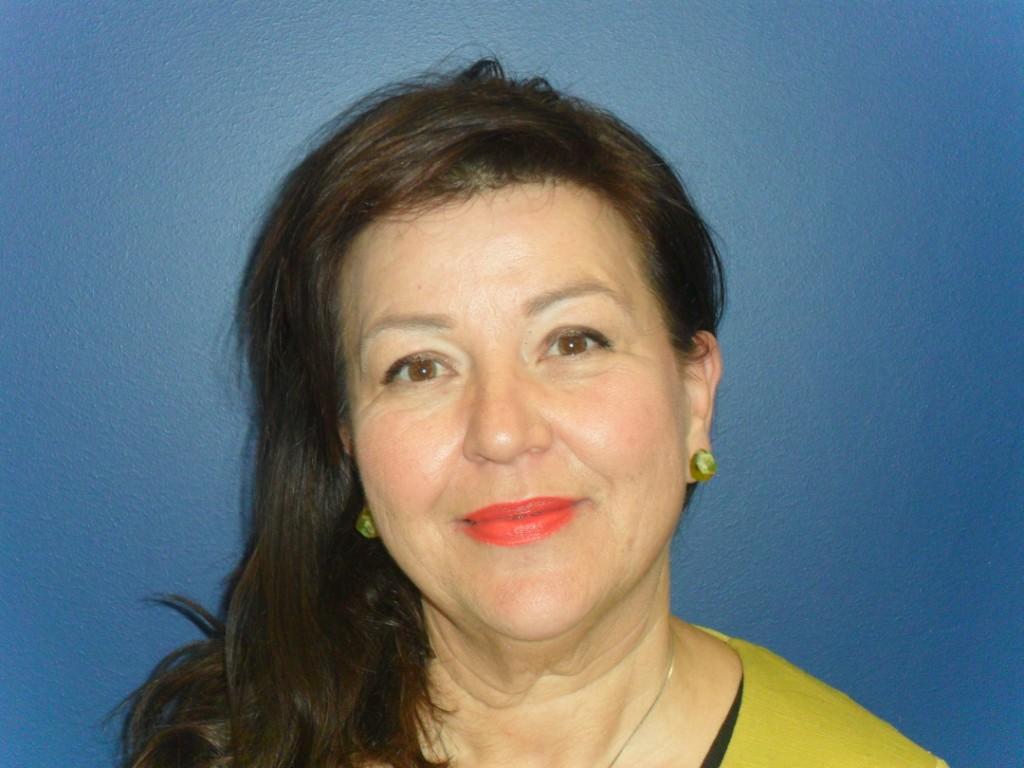
Maria is a child migrant. The schism of a two-tongue world fuels her poems. Maria is polishing her manuscripts Two Tongue World and Dogolalia, bothering editors, publishers, and literary friends alike.
Her poetry won a place in the Newcastle Poetry Prize 2020 Anthology and a manuscript prize for Friendly Street New Poets 19. Maria’s poems are also in the Canberra Times, Victorian Writer and SCUM Magazine, Poetica Christie, Friendly Street and Ochre Coast Anthologies.
Read more about Maria and her love of dogs here.
ACKNOWLEDGEMENTS
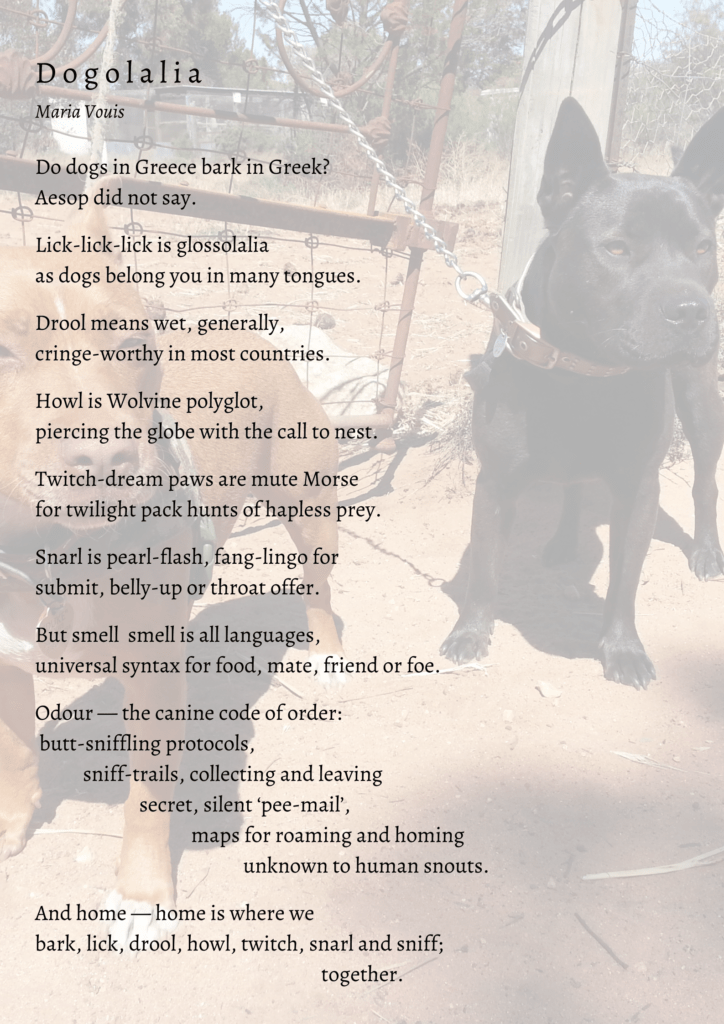
‘Dogolalia’, The Victorian Writer Autumn 2021
‘Fire’, Canberra Times Panorama Literary Supplement, 2019
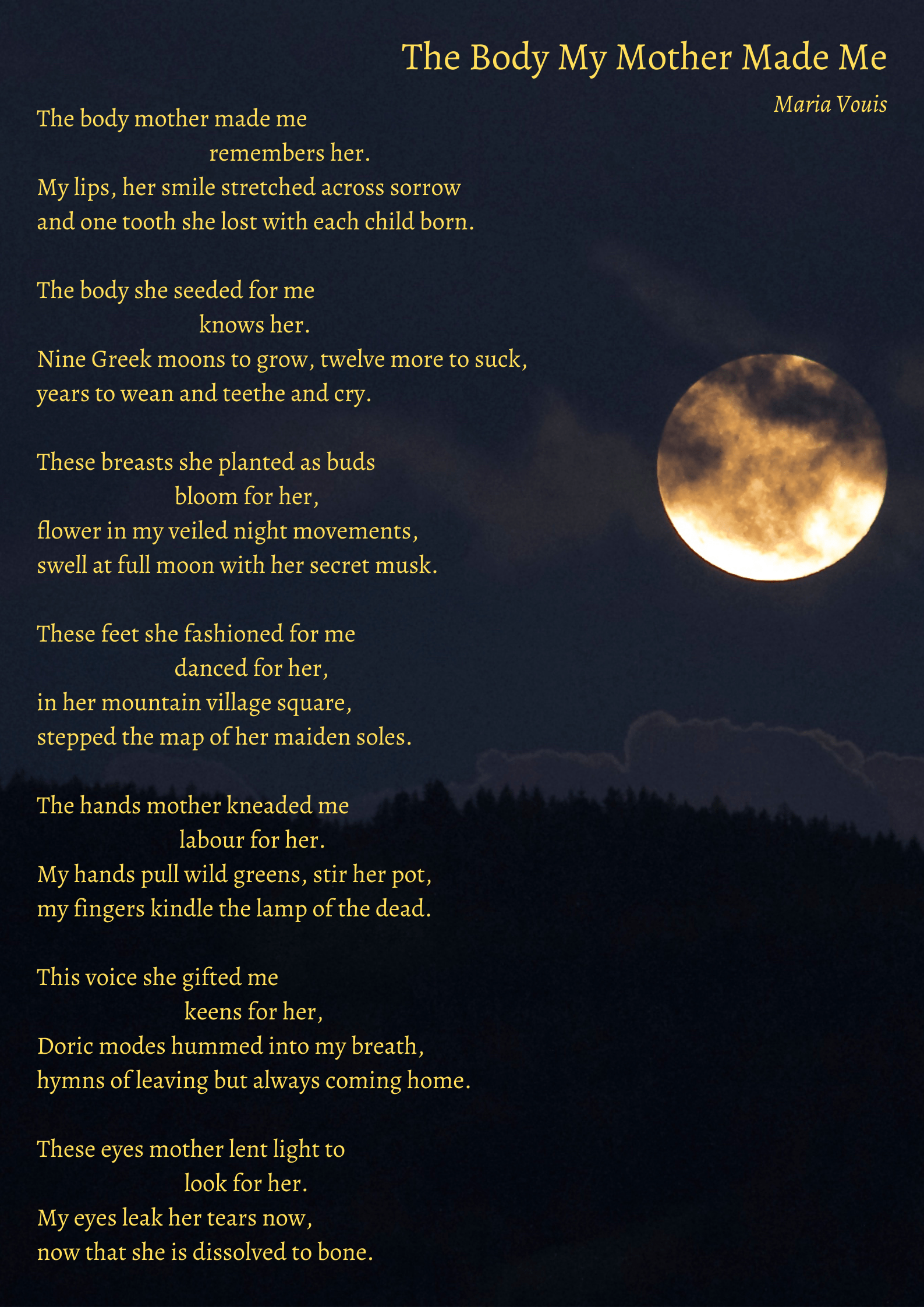
‘The Body Mother Made Me‘, Grieve Anthology 2017, Hunter Valley Writer’s Centre, Friendly Street New Poets 19, and In Daily.
‘Sonnet to Mother’s Eyes’ and ‘Gesthemane Kiss’, Friendly Street Poets, NewPoets 19, 2018
Thank you Carolyn and also for asking me to read at Poetry at the Pub. I came up in 2018 with Lindy to hear Avalanche read. It was very entertaining and I learned about ‘barku’ which I adpated into my poems ‘Dogku, Loveku, Lustku; etc. Look forward to reading at Gawler in 2022 and especially to read ‘Sepia apama’, my Satura prize winning poem. So rare to win anything in the poetry world.
Fine words, both poetry and prose. I certainly look forward to hearing more from Maria, early next year, in Gawler? I hope so!
Thank you for your kind comments Sue. I love your nature poems and you grow awesome figs. Make me drool. Congratulations on winning the New Poets manuscript prize. I hope it is the start of a great poetic career for you. M
Maria, these poems from your life richly reward reading and then demand re-reading !
I especially enjoyed ‘Gethsemane Kiss’ – the villanelle form captures the story’s inevitability
Grief is palpable in the poems about your mother.
I enjoyed following the links to explore kisses and dog love.
Thanks to you and to Lindy Warrell for a wonderful read
Thank you Desma for taking the time to read the blog. All art is a vehicle for ferrying emotion, thought, observation ftom one human to another and there is a magic which happens when the message is successfully received. It is wonderful that we are literate and can write and express our thoughts for our oen therapy and for art. A few generations back and our grandmothers were not taught that skill. Your paintings also Desma are evocative and so well crafted.
Thank you for reading Andrea and I am glad it was enjoyable. Sometimes it can be a bit like death by poetry.
It’s powerful to know our creative core is ancestral, therefor we carry it with us and it is always ours.
And it is just a given that creativity is healing – a strong tool.
So good to read your poems at long last
You writing is so varied with interesting descriptions of feelings and events. You write about life and pain courageously. Enjoyed the humour in Mr Lizard Lips. Enjoyed all of them actually. Thank you for sharing! I agree that writing is therapeutic, it has done that for me also!
What an absolutely beautiful read! What really struck me as true was ” the richest source for poetry for most poets is ancestral” this is the same for my own writings. There’s something about sitting in the comfort of our ancestors that releases that creative flow. And like you point out, creative processes provide healing remedies.
Thank you for sharing!
Hello Julie, thank you for your extensive critique of my poetry. I do miss Trams End and hope to be back soon. Thank you also for reviewing New Poets 19. The maternal relationship is rich in ppetic material. Like any art form poetry is a practice in crafting the original raw impulse or line into a vessel that successfully carries the essence of that impulse to another human.being. I spend hours agonising over words, line breaks and pesky punctuation.
I always think that you never finish a poem, you just abandon it.
Hi Maria,
It was great to read more about your life’s experiences. As I have said on more than one occasion, your best poems are those which have grown out of your mother and your ‘two-tongue world.’ That relationship has set in train a long journey of reflection that you have allowed to reach into the deepest places of your soul and fearlessly examine. I have always appreciated the care with which you try to truly represent in words that which is truly beyond words. You epitomise Coleridge’s definition of poetry and that is what makes your critiquing of my poetry so valuable to me; I know that you will be trying to help me see the best and truest way to express what is in my heart and on my mind. I always look forward to you popping up in our TramsEnd group. See you next time. Love, Julie x
Dear Mike, thank you for reading and commenting. Creativity for many of us is the tunnel through dark times; and these times come to us all. I enjoy your creative and compassionate presence in Ochre Coasr poets, sharing both the craft and essence of your poetry with us all. Just one more line, eh?
Maria, the strength, fluidity and music you find in your reflections upon your past and present, amazes. Love of your parents, particularly your mother is paramount. ‘Washing’ ‘The Body My Mother Made Me’ stand out. ‘Little Blue Bag’ adds insight – quite a few poets carry such. All the best for your many poetic endeavours.
Thank you for your comments Aris. Your role as a temporary teacher in Whyalla during my formative years gave you incisive insight into our family life and the life of many child-migrants living in an industrial town. It shines a light on the texture of that time. The schism of the two-tongue-world is constant and some families weathered the stress better than others. I appreciate the time you took to read the piece and the feedback you gave me during our recent catch-up. This will feed my poetry with even more precision.
Dearest Maria. so amazing you touched base with me. I’ve known your family in those early days and it felt so right and comforting being in your family’s presence. We all have stories to tell behind the day to day masks we wear. You have used poetry to perfection! love your work and the openess you give readers into your life.
Your struggles and pain and things you enjoy and have fun with. what an amazing journey you are on. Keep going and using your amazing writing skills. Look forward to our next cuppa.
Louise – what caring and wonderful feedback. Thank you. In the worst parts of my loss journey, this thought came to me: ‘suffering is the training ground for the compassionate.’ I hope I am compassionate. You certainly are compassionate, creative, generous and so very competent in your yoga teaching. Your classes have been a life raft for me and so many others. I enjoy too your photography and Geoff’s photography as a creative expression. Creativity is spiritual and healing and leaves a letter from us to the world.
Blessings dear Maria. You have a wonderful talent and express your truths and feelings so openly and eloquently and often humorously. I have always enjoyed the truthful, open, honest emotions you are able to share with us with such skill. I have always admired and enjoyed your work beautiful lady! As I know you also have a magnificent singing voice, your lyrical style reflects your vocal talent. You have a deep understanding of life that touches our hearts and unites our souls. Wishing you all the success you so obviously deserve!
Thank you for your vote of confidence Veronica. It has been a long and winding road at OCHRE Coast poets developing our craft and so illuminating to watch emerging poets develop their work into a strong and unique ppetic style. Congratulatiions on your win with New Poets 22 – your words are blossoming.
Thank you Val. I know you too use poetry creatively to express the mamy extremes of emotion and mental health. I remember you bagged the Friendly Street Nova Prize one year – something I have not done. I am grateful for your time and comment. May you stay well.
Thank you Val. I know you too use poetry as a creative vessel to express the mamy extremes of emotion and mental health. I remember you bagged the Friendly Street Nova Prize one year – something I have not done. I am grateful for your time and comment. May you stay well.
Thank you Maria for sharing the ups and downs of life as a migrant child and the constant battle with ‘finding just the right word’. You are not alone there.
You are a truly great poet and you can tackle any subject that takes your fancy – a true wordsmith.
May you keep on writing – and sharing.
Veronica
Thank you for sharing your poetic pilgrimage Maria.
I love the way you write with passion about your Heritage, your Parents, and your challenges as a migrant child.
I am impressed by your direct approach to writing, and your ability to describe experiences and emotions with total honesty and just the right words.
You have overcome many hurdles to write the many poems we enjoy.
Poetry has indeed been a ‘Life Raft’ for you and many of us poets.
Your success so far is well deserved and I am sure there is more to come.
Love the Sonnet to Mother’s Eyes.
It is sad, but beautiful.
Thank you Monique. It was wonderful to meet you at the Your Story workshop Steve Evans and I ran and I admired your writing and passion immediately. You are a creative tornado and I am agog with how much you are achieving. I look forward to seeing your visual work when you complete it. Sharing stories of our ancestry, dislocation and adapting to our new homes is bonding and helpful. Grateful.
Maria,
Exquisitely crafted, raw and real in its resonance. The haunting and the ancestry so poetically and powerfully sung, and yet your vulnerability is carried so beautifully. It’s a deep resonance for me, as you know, and such pleasant camaraderie with you. Thank you for sharing this. Monique.
Hello Diane,
thank you for your kind comments and thank you also for bringing your professional quality cooking to our OCHRE Coast meetings – makes the bitter criticism easier to swallow! Ha, ha! The two poems you mention are quite visceral and I wonder if others relate to the feelings. Yes, we do have different styles, but I really enjoy the rhyme, rhythm and humour of your work. It is entertaining and I know it has wide audience appeal. I can see you as the Pam Ayres of the Fleurieu and better. Look forward to more good lines.
Your poetry has always been an inspiration to me, Maria, even though I have a very different style to you I feel having the opportunity to share with you through Ochre Poets has helped me to grow as a poet. I especially liked the poem the Body MyMother Made Me, and Blue Paper Bag. Best wishes Diane
Maria, thank you for your kind comment. Thank.you also for your feedback on my poetry at Trams End sessions – valuable insights. Poetry seems to be a life raft for us both as we have similar experiences and traumas in life. Healing through creative expression is such a mercy. Hope we bump into each other in Adelaide’s poetry soup
Dear Maria i was deeply moved by your poetry and your autobiography left me speechless. It has been an honor to have met you and have very much enjoyed the depths and mysticism in your writing..
Dear Inez, Mother, is a deep and visceral experience for most of us I think. Nurturing or not nurturing – depends on our luck. As poets we can draw on these primal connections to bring power to our work and connect with others who have the same experience. Your poetry does this – the visceral bomb. I am grateful for your lavish comments and get so much from your writing. Thanks for reading and your time. Maria
Oh, Maria I love how you write about your mother and how integral she was to you becoming a poet and teacher. I love how you always offer advice and writing wisdom to fellow poets and students. Somehow your bi-lingual upbringing created one of the best wordsmiths, and poetry I have ever read. This has got to be statistically rare, and a credit to your mum’s love. Thank God you channelled your grief into writing, we are richer for it. I really enjoyed ‘Washing’ this is your amazing signature style, bringing the past into the present, gratitude for your heritage and ancestry, their sacrifices that have given you a life enrichened with the arts. You are a wonder Maria, truly gifted and blessed. Ps: Lizard Lips is hilarious 😊 Inez
Hey Geoff, I loved the year you, me and Bruce spent doing four readings and reprinting New Poets 19. I value your collaboration and the effort you put into developing your poetry. It shows in the changing texture of your work.Maria
Yes, it is Maria’s dedication and precision that makes difficult subjects resonate for many who might otherwise be denied such access. I am still humbled to share a place in NP19 with you. Geoff Aitken.
Thank you Tess for your kind comments. Working with you and the Ochre Coast team on the Ochre10 Anthology and school workshops was an exciting and theatrical experience. We also learned the sad news about the demise of teaching poetry in public schools: how so many students are missing out on the power of this language. I loved the drama and colour you put into your delivery of your poems and I appreciate your skill as a poet and warmth as a friend. Maria
Thank you Dr Steve for taking the time read my post and your comments on my ‘care with language’. Training in music, voice, drum and piano over the years gives me the grunt to keep honing a poem. The repetitive disciplining from my music and voice teachers makes it automatic to keep at it. A second language helps too. Most importantly to me is that my poems marry the personal with the universal in our human experience. Maybe they give the reader an insight, a sense of being understood or just a laugh in return for their precious for their time investment. I so much enjoyed developing and delivering the ‘Your Story Workshops, ‘ – all those miles. Maria
Maria is a joy to work and write with. Her honesty and shrewd, intelligent appraisal and comment are always valuable. She is thorough in her poetry knowledge, kind and humorous. The poetry groups she workshops with admire and value her as a poet and friend. Tess Driver
I’ve always enjoyed Maria’s precision with poetry and how it advertises her care for using language to create arresting images and stories. A pleasure to read.
The background here unpacks some of the key reasons for her selection of subjects and her approach to them.
Well done. Steve Evans