

Stories about Stories
If you asked me, Lindy Warrell, to tell you what I prefer to read when it comes to the novel, I’d say I like quiet literary works centred on a protagonist’s journey. Such tales raise existential questions, embed philosophy and speak the truth about power. I also like books that excite, challenge and enlighten me. When it comes to books that open my heart and mind, like The Songs of Trees by the erudite yet lyrical David George Haskell, I am in awe.
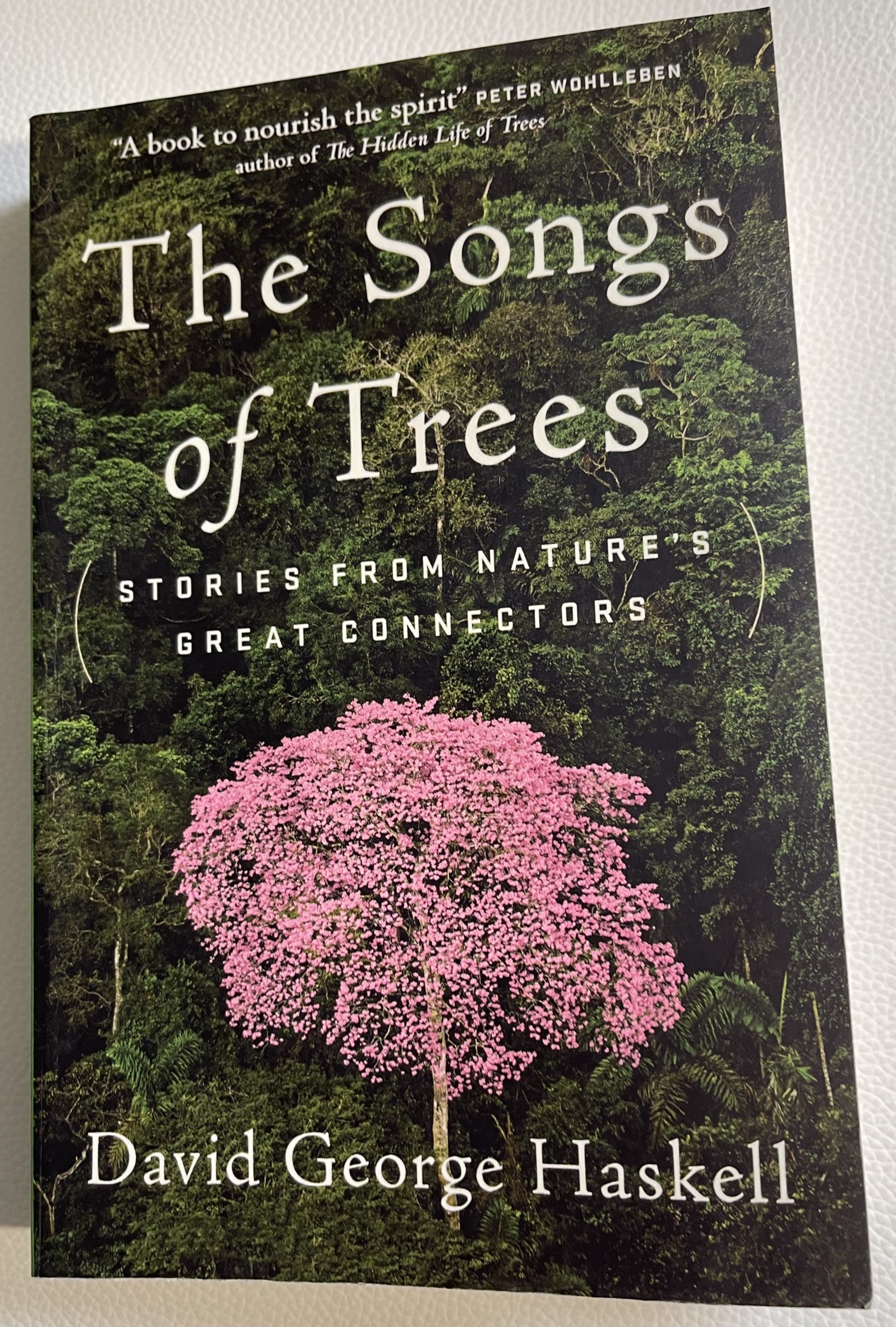
However, when you’ve lived for nearly 80 years as I have, the number — and range — of books you’ve read is immense. Whittling them down for a blog post is no mean feat. Yet, my reading proclivities make it easy as I naturally gravitate to books I fell in love with, whether scholarly, poetic, literary or popular. As you’ll see, I am an eclectic reader who yearns to be transported and thrills to new insights offered by writers who take me on a journey into the unknown.
At university, I read tables of content and scanned indices as an aid to learning, but I am a free reader for the rest. Nobody could ever accuse me of being in thrall to fashion or rules. Whether anything I’ve read influences my writing remains moot, although everything I have read exemplifies or reveals my tastes and inclinations.
Books of Knowledge and Insight
Let me start with works by novelist and philosopher Aldous Huxley and his father, Sir Julian Huxley, who was a humanist and, scarily, a eugenicist. I found both in the Darwin Library when, aged 21, I used to shelf browse on wet season, pre-TV weekends, hungry for knowledge. As a girl who left school at 15, I struggled to understand, but reading stuff beyond my reach then challenged and excited me. To this day, I retain the thrill of profound insight about this thing called society from Brave New World (1932) that may even have led me to anthropology half a lifetime later.
Curiosity has led me in heaps of different directions over the years. And who can go past accidental discoveries? Ania Walwicz was such for me not long before she died in 2020. While I critiqued her book Horses on Goodreads, I have to admit that I never completely understood her.
I read Horses much as I read Karl Marx at University and Salman Rushdie at times, rolling with the words and allowing meaning to arise by osmosis. One exception to this was her critique of Australia, popularly known as ‘You Big Ugly‘, the penetrating insight of which had me laughing out loud with recognition, and I wrote ‘The Shame’ in its wake.

A Book That Changed Me
In 1966 French anthropologist Louis Dumont published a ground-breaking work called Homo Hierarchicus which he called an essay on the Indian caste system. I first read HH in the 1980s in my undergraduate years. As a hitherto uneducated Australian, I fought with everything he said (after I finally understood what that was), so entrenched was my cultural egalitarianism.
His thesis was that an encompassing hierarchy of superior and inferior, pure and impure, is natural to humans and social order. In contrast, possessive individualism in the West has turned society upside-down like the nursery rhyme hand game, here’s the church and here’s the steeple [fingers locked facing down, then invert your hands] open the door and here’s all the people. In other words, he identifies the underpinnings of our disconnectedness by comparison with India.
My fight with Louis Dumont persisted into my postgraduate writing, but I eventually thanked him for what turned out to be the Indian seeds of his innovative analysis of possessive individualism elaborated a decade later in From Mandeville to Marx (1977). Of course, I learned these things in other ways, but Dumont was my introduction to a critique of the taken-for-granted in my world, a protracted but profound lesson in humility.
Books the Way I Think
Nobel Prize-winner J M Coetzee’s signature novel, Disgrace, which won the Booker Prize in 1999, blew me away. His seemingly simple narrative style spoke directly to me as it took me to dark places in everyday life as though that was the most natural thing to do. I’ve read nearly all of Coetzee’s books and admire him greatly. As an author, he is unafraid to confront stark truths, and he trusts his reader enough to shock. How clever is that?
I defy anyone to say that Disgrace does not linger. I can see the setting, the horror of the rape and the symbolic role of dogs as though I read it yesterday. In all of Coetzee’s books, the prose is sparse, concise and piercing in its honesty. Reading Coetzee leaves me with the sense that he writes as I think. Had I the skill, I would emulate him.
In Journey to the Stone Country (2002), Alex Miller is another author who speaks my language. For a girl who grew up reading stories set elsewhere, I love the way Miller naturalises Australia as a setting. My first experience of that was with Peter Goldsworthy’s marvellous short story collection, The List of All Answers (2006). When I read about driving up Magill Road, I had permission from Goldsworthy to write about home.
A Book that Gave Me Permission to be Myself
Although I was acquainted with the classics from school and elocution classes, I came to contemporary poetry late in life through Jude Aquilina, primarily through Women Speak (2009), which she co-authored with Louise Nicholas. Who knew that a mammogram could find its way into a published poem or that vulvas could speak.

What a charming, magical and hilarious collection this is. It taught me that women could speak out, that their concerns are significant enough to write about.
Books as Lifelong Loves
After I forgave it for not being Sri Lanka where I lived and loved, I was in thrall to India when I visited that country a few years before Vikram Seth’s 1400+ page classic, A Suitable Boy (1993), came out. As one of the longest novels in a single volume in English, it is ostensibly about a mother wanting to find a suitable husband for her independent daughter, but it delves into the anguish caused by the partition of India. I sat on my flamingo-pink velvet armchair (true) with this tome for a fortnight (at night), cross-legged; transported. The story is now beautifully portrayed in a 2020 Netflix series of the same name, which made me love it all over again.
Nobel Laureate Naguib Mahfouz similarly drew me into Egypt’s history with his fascinating Cairo Trilogy*. The three books, Palace Walk, Palace of Desire and Sugar Street, tell the story of one family through generations in a society transforming. I could not put these books down, and I escaped into their pages.
Maybe I just like epics, but these writers write history and politics through family dramas full of people to love and hate, not unlike the popular TV series, The Crown. The scope and depth of these authors’ knowledge and research is astounding, their skill as storytellers unsurpassed. They are literary, not historical, novels that remain part of how I feel as a person.
* First published in 1952, and in English in 1990. As a collection at various times between 1966-2001.
Books We Must Not Be Ashamed Of
A writerly friend recommended Julia Cameron’s self-help book The Artist’s Way. Written for creatives, it came out in 1992 and is still in print and all good bookshops today. I bought it and tossed it aside with disdain for some time, but I learned so much when I finally got to reading it. I had dissipated my creative energy with what Cameron calls crazymakers, friends and family whose needs always seemed so much more important than mine. Such was my need to be needed earlier in life — a salutary lesson.
Learning to stand up for yourself comes late for some of us. I learned similar lessons through Buddhism and subsequently taught meditation for years. Here is a book I’d recommend to anyone who struggles to feel free, as it offers a way out.

Don’t Take Your Life Personally (2010) is a Buddhist-inspired text by the renowned American monk Ajahn Sumedho of the Theravadin tradition whose teacher was the beloved and enlightened Thai monk, Ajahn Chah. The title tells the tale.
A Quiet Book
Let me come back to the novel. I mentioned quiet stories in my introduction and recently read one that I loved, by the doctor and prizewinning Australian author Melanie Cheng, Room for a Stranger (2020). The story is about a relationship between an old Australian woman and a young Chinese student. She needs someone to help around the house; he needs cheaper accommodation.
Cheng transports us into a slightly run-down inner-suburban Melbourne cottage as she delicately explores issues of race, aging and the human need for comfort and a sense of belonging. This gentle and sensitive story of profound social and cultural significance exemplifies what I call a quiet book.
A Random Book To Complete This Collection
I want to sneak in a book called The Dialogic Imagination (M Holquist Ed 1981). It is a collection of four writings by Mikhail Mikhailovich Bakhtin, who I love so much I’ve used his name for an old Russian character in my current novel, High Rise Society.
Bakhtin introduces several unique concepts for writers; he explores how the novel changed from the epics of old where a hero went through all sorts of strife but emerged heroically unscathed (classical epics). In the new novel, he argues, the whole point is that protagonists change in light of the challenges they come across.
Bakhtin introduced the idea that every time we make an utterance, we select from ‘a world aswarm with names’ to create anew. He made it explicit that each sector of society has its own language. We only have to think of the self-referential language of the mainstream media and political discourse, the medical lexicon of diseases, causes and cures, academic jargon, the dialect of betting, horse racing and football or the argot of the streets. All conditioned by context and each other.
Bakhtin’s take on languages and utterances aside, I actually introduced him here as a somewhat derivative way of sneaking in a poem to end this post, based on Rabelais* and his penchant for list-making, which I discovered through Bakhtin. Reading reaps rewards.
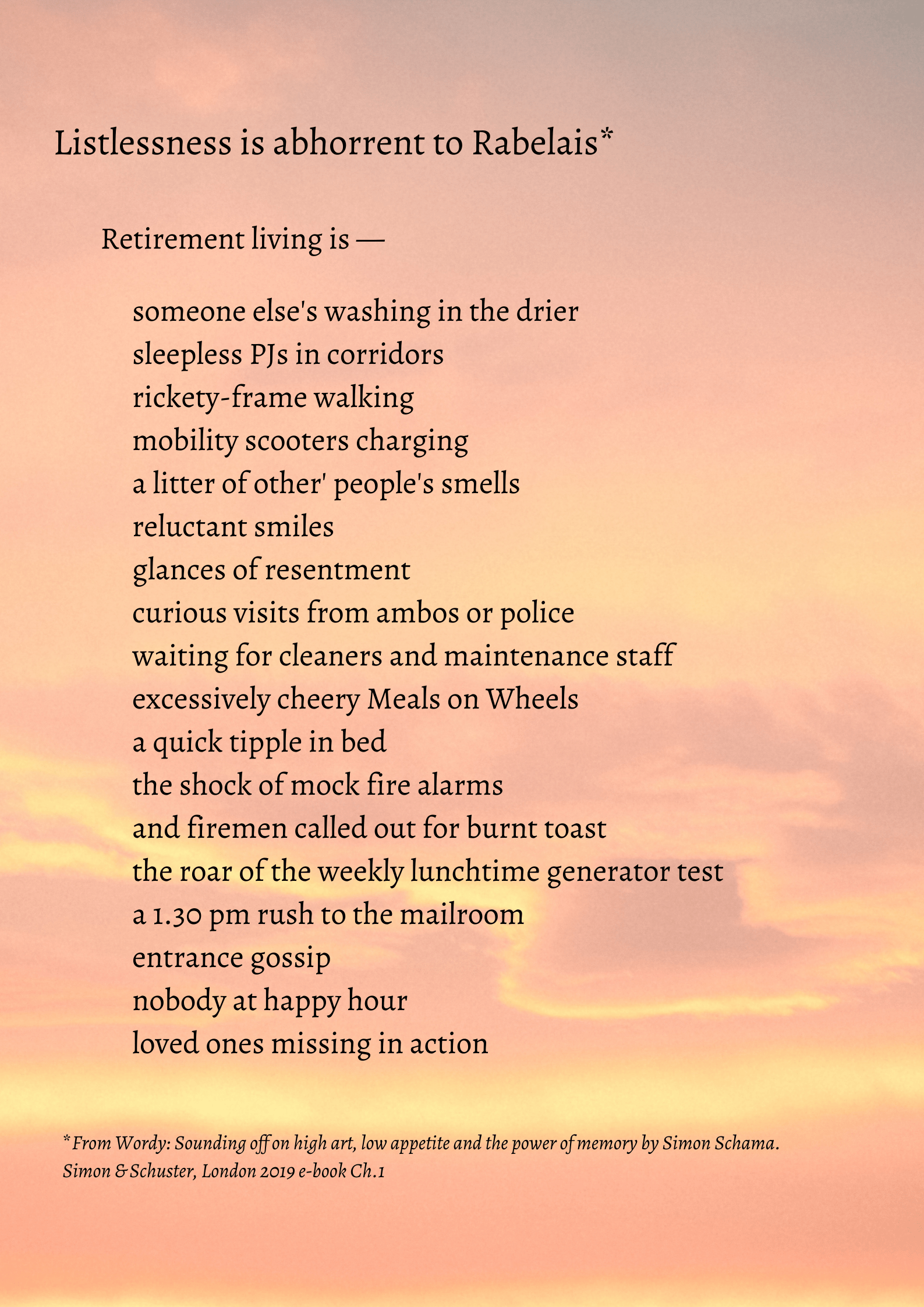
*Francois Rabelais was a French Renaissance writer, physician, humanist, monk and Greek scholar. He is primarily known as a writer of satire, of the grotesque, and of bawdy jokes and songs.
This eclectic collection of writings has shaped me. But, there are many more writers to whom I attribute the way I think and even feel about the world and what it all means. Do stories embed themselves in you, as they do with me?
Thanks Veronica. It’s true that books that have never let me go just magically arose from the pile. I’m glad you liked The Shame, and Listlesness… I forget that you don’t hear my poems much any more. Thank you.
Lindy, I can’t pretend to have read (or to read in the future) all those titles, but it’s fascinating to have a glimpse into what has inspired you over the years. It must have taken much consideration to pare the numbers back. I loved ‘The Shame’, ‘Listlessness is abhorrent to Rabelais’ and must get out my copy of ‘Woman Speak’ and read again – I know it’s a great piece of work.
Thank you for sharing.
Thank you, Carolyn, I’m so pleased you liked ‘The Shame’…it’s an odd poem, but I’m glad you get it…that’s lovely to hear. Some may see my readings as a bit random, but it’s true, they are all books that I love and hold inside forever.
Beautiful and interesting, Lindy! You’ve given us a terrific list of books to consider ourselves for reading, or at least thinking of reading, or perhaps pretending to have read, (HAHA joke there!)
And that prose poem of yours “The Shame” didn’t just speak to me, it crawled into me, and hugged me tight with love shared and feelings understood. Thank you.
Thank you 🙂
LOl Don’t fret Julie. I do ahve to watch my tendency to highfalutin writin’ so glad to hear I’m not that bad 🙂 And, yes, let’s hope the feeds will bring a bigger audience to our wonderful SA writers and creatives.
Sorry, Lindy,
I didn’t mean that you wrote in a highfalutin manner, but that you have the ability to interpret the highfaluting writing of others. ♥️
Congratulations, Lindy.
How clever you are. Xx
BTW I didn’t mean that you write highfalutin, but that you have the ability to interpret it. 😁✔
Oh! Gosh, did I do ‘highfalutin’? So sorry, but thank you for reading anyway. More particularly, I really appreciate your eternally joyful response to my posts and those of my Wattletales guests. All of it is now going further now that Wattletales.com.au linked to Goodreads and my newly developed Amazon author page…
Again, thank you, dear friend. Delight teases at the senses each time your blog appears, be it stories written from experiences throughout your journey, or be they snippets from other peoples’ treks.
‘The songs of trees,’ at your recommendation is a book I may be able to digest, me being as I am. Fingers, toes and eyes crossed. Is there nothing more sacred than the language of trees? ♥️
Salman Rushdie’s lexicon popped me back to first grade, when I joined Sand Writers book club, moons ago and then some. A thesaurus of bafflement stands erect within my book-shelf, gathering dust and also spiders the size of the author’s language.
That particular story is at the base of my bucket. 🤔
‘Stop now there’s a word that shines red.’
Not only do I love your terminologies, Lindy, and your stories written for everyone, (although you understand the highfalutin stuff,) but your passion for all aspects of life shine golden through your words.
Love always
Julie Cahill.