

Independent it is not.
I have lived in an Independent Living Unit in a not-for-profit high-rise retirement village since May 2016. Since moving in, I’ve written far more poems about the village and ageing than is decent. While ageing is inevitable, enjoying independence in old age is hard-won in a place where an insidious institutionalisation process crowds you out and defines you as ‘other’ to the busy outside world.
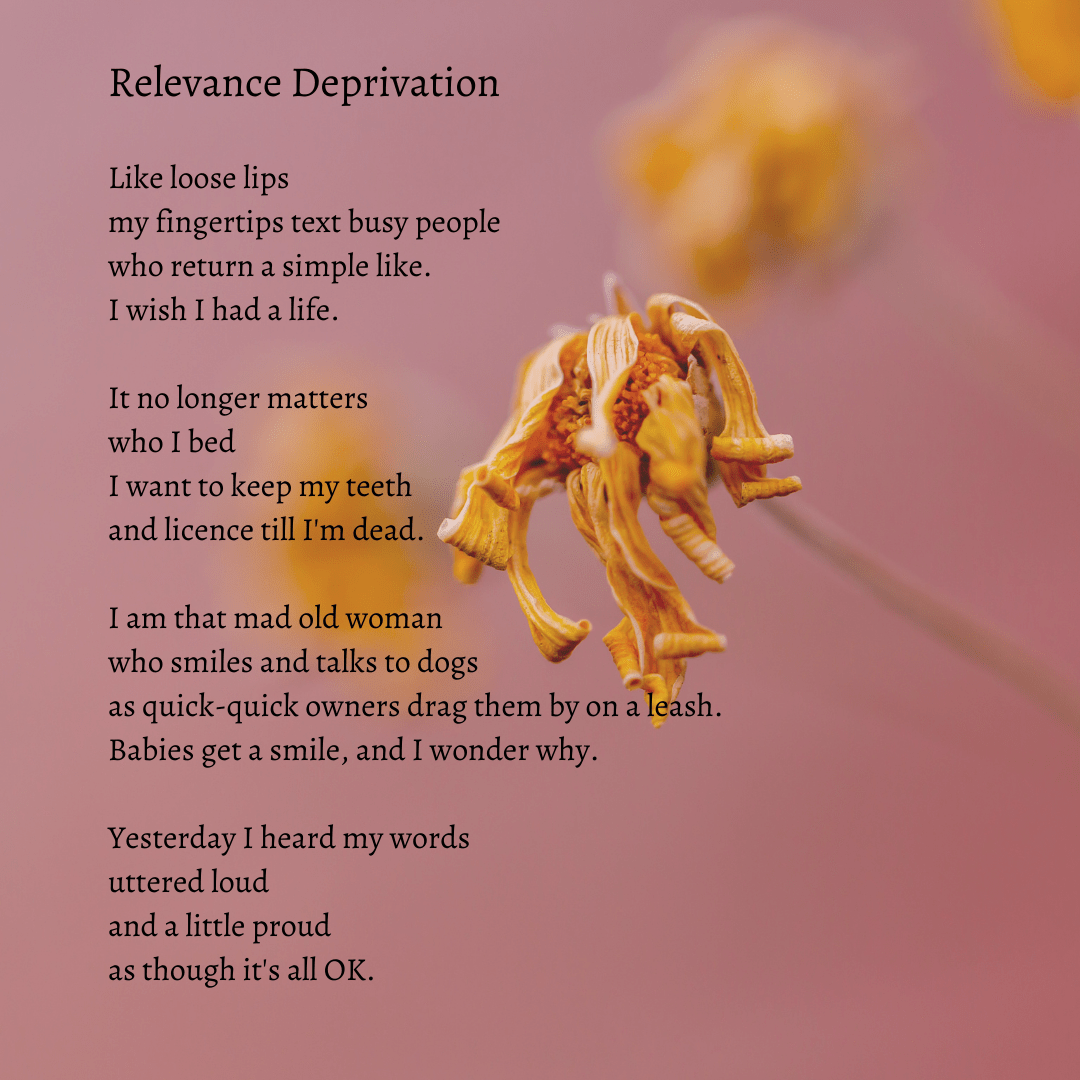
It’s not only the walking aids lining corridors and ambulances in the front parking bay or the heavy-duty sanitising agents that cleaners use in common areas that declare ‘institution’. Nor is it the degraded, ill-matched paintwork, carpeting, furniture and discarded books in those areas that define what’s going on. It is more in the chirpy voices of Meals on Wheels deliveries, cleaners, personal helpers and staff of dubious qualification who ‘pop in’ to see how you are going, whether you invite them to or not. Staff don’t shout, but a patronising hum oils their every word. The exception here is the maintenance crew.
What is Independent Living?
Independent gated living for the elderly contains. It locks us in with other peoples’ noises, smells and peccadilloes. The only thing we have in common is advanced age and life rendered externally bland by the homogeneity of the building.
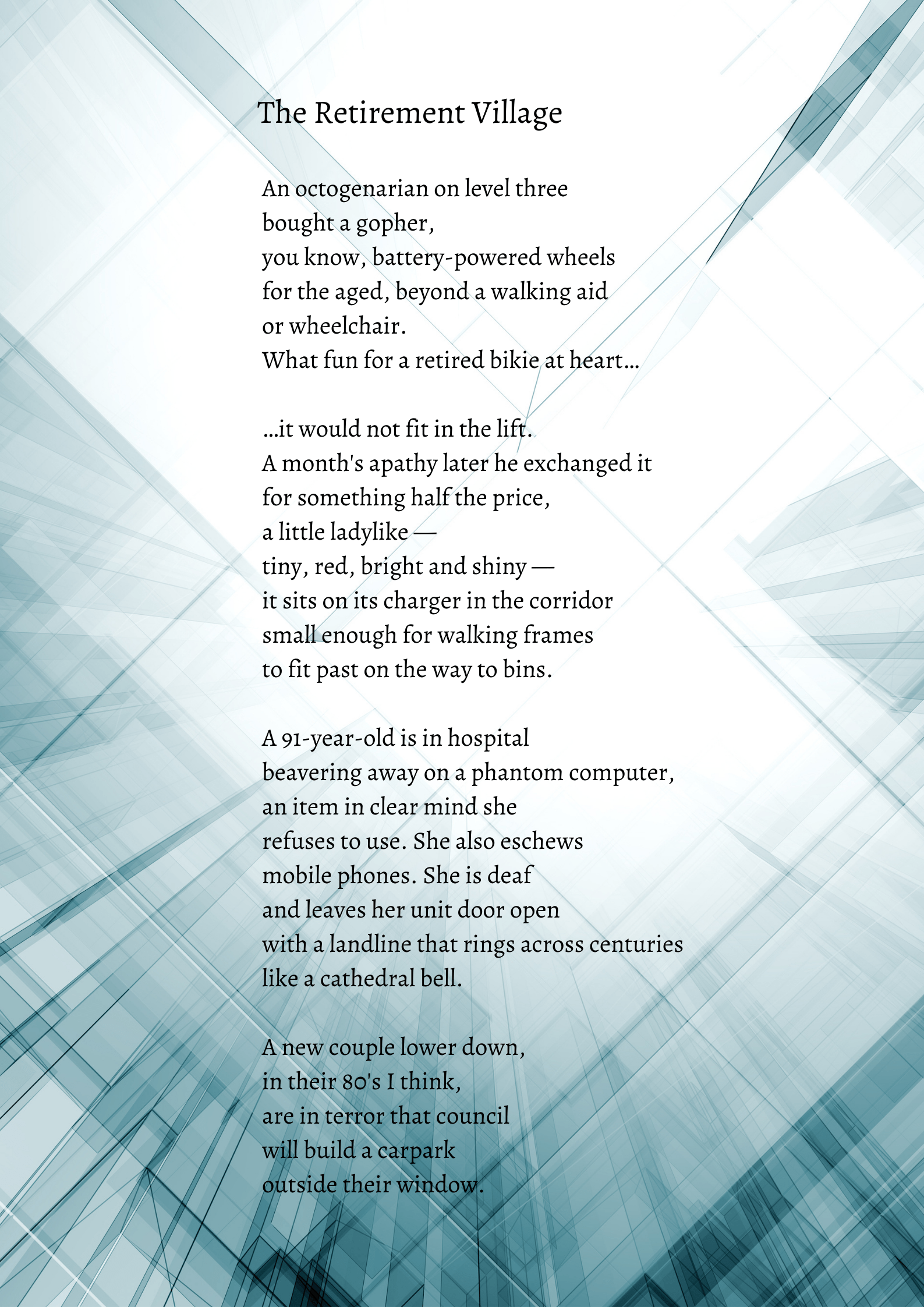
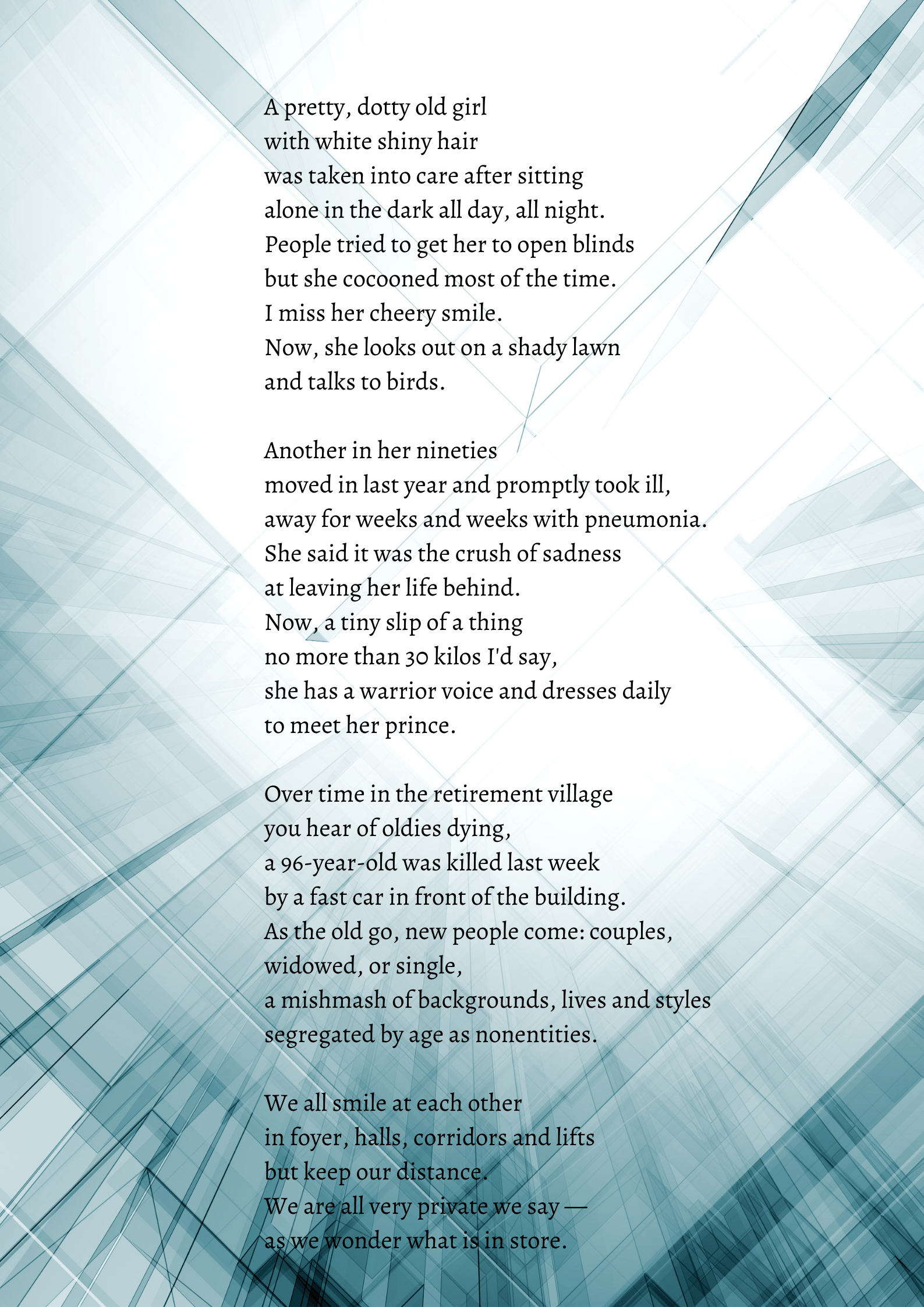
Aged Care vs Independent Living
There is a clear distinction between Aged Care and a residential retirement village. All Aged Care is overseen by the Federal Government, and admission requires a formal aged care assessment process by ACAT. Villages broadly fall under state jurisdiction. However, while we pay for village entry, a provider’s bureaucracy can structure residents as recipients of beneficence, mocking the term independent living. What you pay for is not always what you get.
In a not-for-profit village like mine where exit fees do not apply, people pay a substantial upfront ‘right to occupy’ fee of around $80,000 to $150,000 that is non-refundable after four years. In the first year, you can recoup three-quarters of your investment; the second allows you to get back half and so on. If you live long enough, say ten years, the investment is worthwhile compared to renting because you can stay until you become infirm, demented or die.
Refunds cease at the beginning of the fourth year. Those who opt to pay close to market value for their unit lose an equivalent proportion in the first four years and forego market value increases on their original contribution, no matter how long they reside in the village.
Centrelink pays rent-relief to residents based on financial status, but buy-in residents pay close to $6,000 per year in four-weekly instalments for maintenance. The fee is for cleaning in common areas, building repairs and, although you may have to fight for them, replacing fridges, air conditioners and floor coverings. Things are a bit different for those who rent, subsidised by Centrelink.
Checkup Scrutiny
An annual well-being checkup by a staff member may be the highlight of the year for some. I have opted-out, for now. It involves a liaison officer acting as a confidant while documenting pages and pages of information about your family, your health, your capacity to live independently and other intimate details. I find the very idea intrusive. After all, we pay to live independently in retirement villages. The property owner is not a carer unless or until we engage them in that capacity for specific additional services through My Aged Care.
Most staff dealing with residents speak the smooth talk of protection wherein coercion always lies. Residents are often cast as institutional inmates by those who think of themselves as superior; it is implicit in how many speak.
While they don’t shout as they might to foreigners, who are thus — like residents — considered imbeciles, the overall manner is simultaneously ingratiating, distant and condescending. It diminishes. Only today, I heard a resident complain that the provider never listens. She said it was demoralising. And, so it is.
Routine equipment checkups and other maintenance activities affecting everyone create other regular opportunities to discover what is happening inside one’s home. While I must say again that the maintenance staff are marvellous, no matter how friendly and obliging they are, they, too, are required to report to head office. The sense of being scrutinised is hard to escape.
Ageing is Not for the Faint-Hearted
This little poem fits with the idea of becoming invisible as we age, as indeed we do. It also shows that views of the elderly in the village are consistent with those of the wider community. (press start twice if need be.)
All We Share is the Laundry
In a high-rise residential retirement village, there is no sense of community. I don’t entirely blame shared laundries for this, but they don’t help.
Each level of my building has a laundry equipped with a single domestic washing machine and drier to serve up to eight units. People on some floors get half a day per week to do their washing. The lucky people on floors with fewer units get a full day. Recently, the provider engaged a new cleaner and dropped shared laundries from their responsibilities. There could be a riot. I can’t see much geriatric mopping going on, can you?
Laundry complaints are often ignored. One tenant tried to report the abuse of facilities and rosters. Another resident reported a neighbour who let her non-tenant relative wash business laundry for a full day every week. The complaint came to naught. A cold admin voice that defines you as a troublemaker greets any report. The fear is that the provider might ask you to leave if you push too hard — and then, where would most of us go? An implied threat of being evicted is a powerful disincentive to assertiveness.
The most common staff response is to say we should sort it out ourselves. This attitude also covers noise pollution as though residential contracts requiring us to refrain from disturbing others did not exist. Residential contracts are with a provider, not other residents, so this appears to be an abdication of fiduciary duty, given that there is no soundproofing in this particular building. Different responses include a failure to return calls.

The AGM
Once a year, the provider invites residents to attend an advertised meeting in the common room. They call this an AGM even though residents have no input, vote or right to reply. The CEO presents fait accomplis the organisation’s entire annual budget across all properties and otherwise reports on or promotes activities and resources for the elderly in the same way it does in TV ads for the wider community.
The theory is that residents should subsequently take to the floor to raise issues of concern despite those they live alongside sitting close; a perfect example of silencing. Can you imagine reporting your neighbour in front of others? Not being heard can send you mad, by stealth…

My Good Fortune

I am content in my own space. The bedroom of my tiny unit is a studio where I write. It’s not so onerous there to guard the intercom when expecting deliveries or to let friends in. Such a small price to pay for being safe and — dare I say it, independent, which on the best interpretation says I’m not in a nursing home.
After settling into my unit, I set up a meditation group that ran for two years until I had to stop for health reasons. I made two friends during that time who, like me, are constantly updating or upgrading furniture and other things to enhance their units.
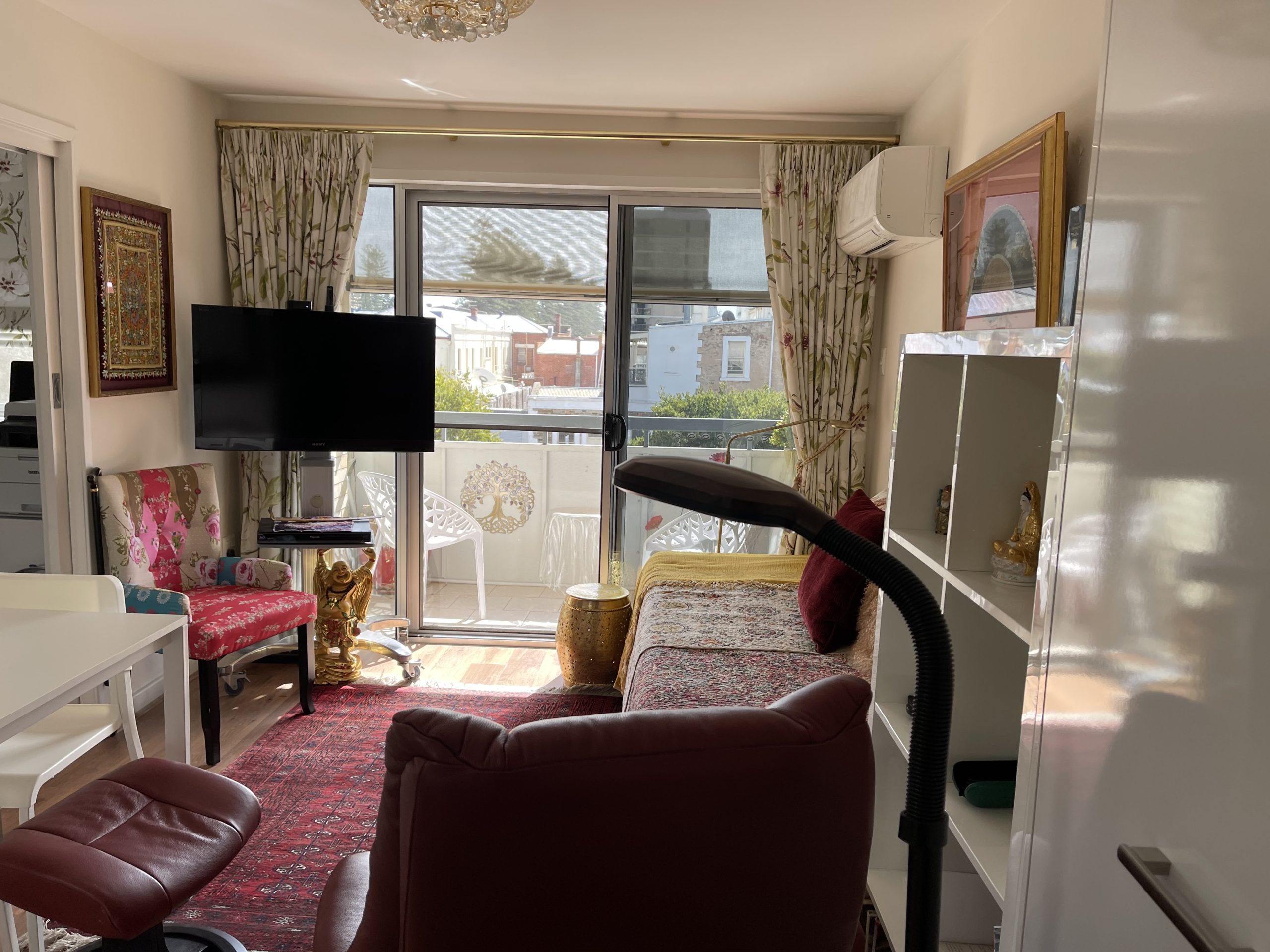
Cocooned with delightful things, we are protected from the elements and within walking distance of the beach and shops. Together, we go for coffee or lunch from time to time and count ourselves lucky to live in such a special place.
I entertain, sleep, watch television and read in the lounge.
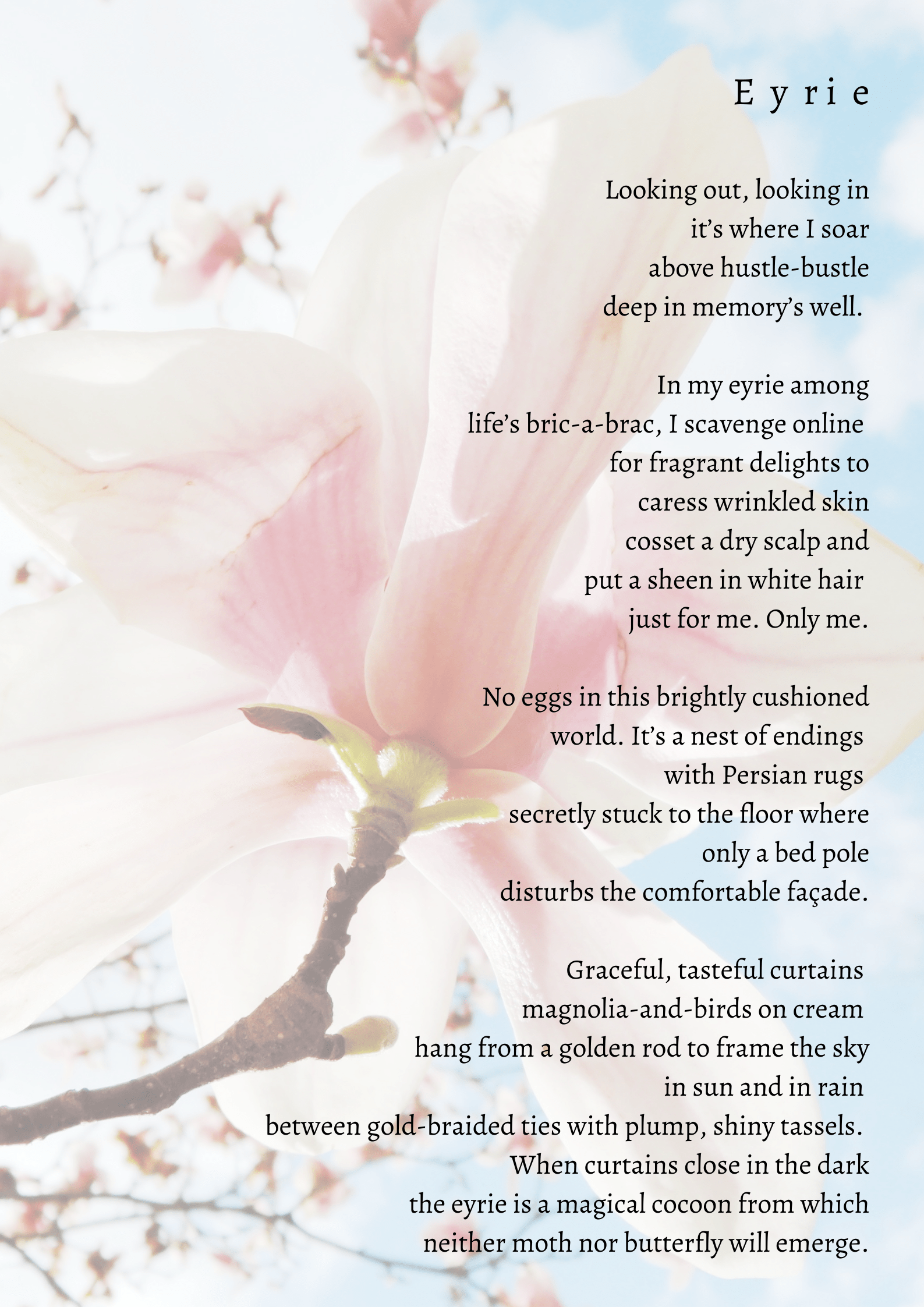
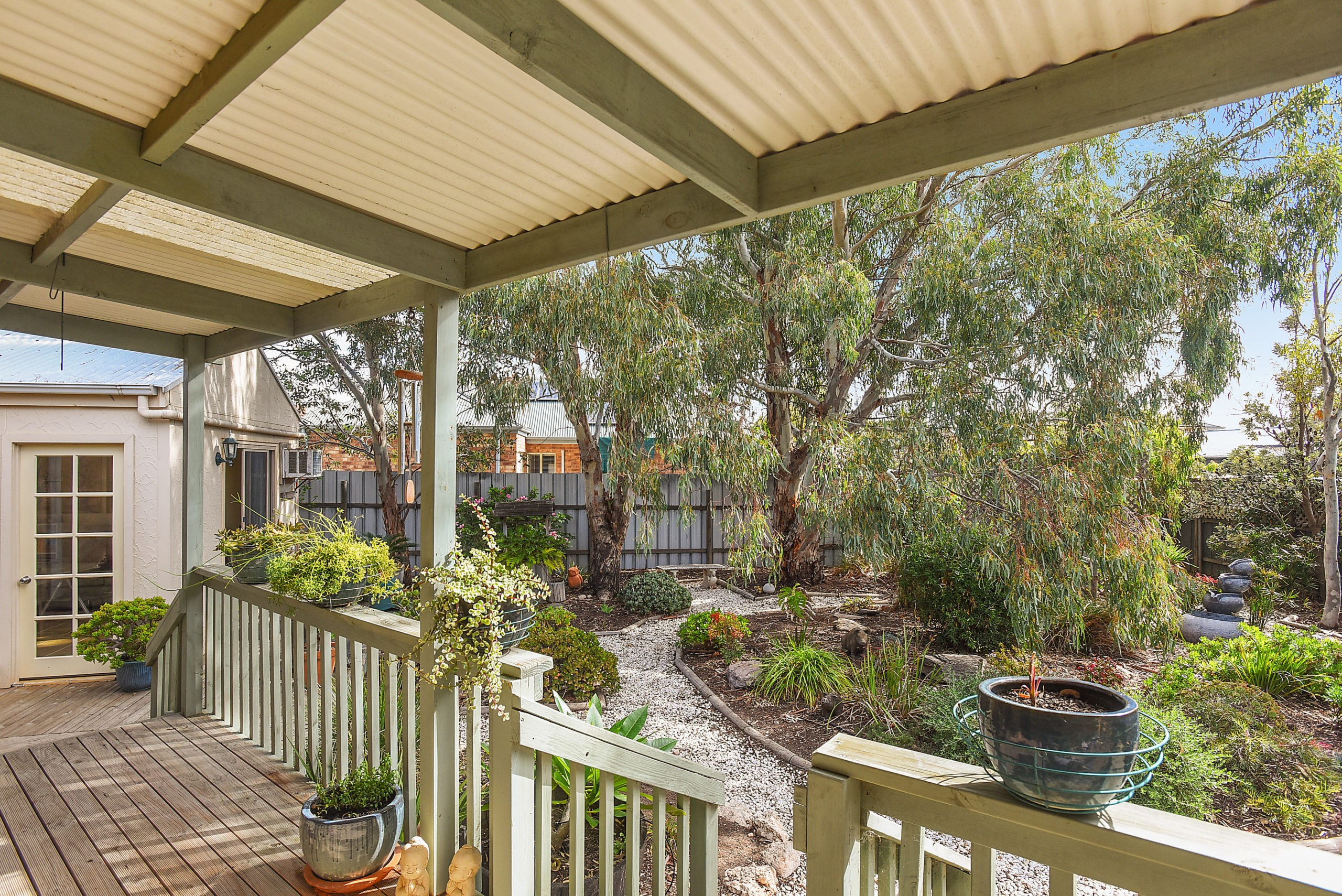
My brother Phillip’s untimely death gave me a house with a studio in Aldinga Beach. I thank him for, without that, like many women my age, I could have ended up homeless from sexually transmitted poverty earlier in life. Now, with a decent place to live in my last years, time is my own to do leisurely but vital things…

No Pets Allowed

I was sad when I moved into the retirement village, saying goodbye to my beloved dog, Clarrie, named after CJ Dennis (Clarence), whose poetry my father recited to me when I was young.
This is Clarrie in his heyday (I always clipped him in summer because he didn’t like the heat).

Clarrie has a loving new home but, sadly, is getting very old, like me. His new family brought him to meet my daughter and me a week ago, and he’s suddenly become very skinny but is just as loveable and loved as ever.
As it is, he’s had a better life where he is now than I could have offered as my own health has declined.
Writing TIp
Always be aware of what’s going on around you. Catch the sideways glances, words designed to deceive. Question everything. Whether in a retirement village or the wider world, our observations are grist for any writer’s mill. Take notes. Remember details. Write short pieces and cobble ideas together in poems. You never know when they might come in handy.
Writing is like that; watching, listening, thinking about why something disturbs or upsets is foundational. Bringing curiosity to life helps relieve suffering.
Happy Writing
Wattletales
ACKNOWLEDGEMENTS The photo of Clarrie in his heyday is by Deb Saunders, Photographer in Aldinga Beach.
Oh! Inez. Don’t feel guilty for the time comes for us all to
Lose our independence which we take for granted for so many years. Ageing and moving inexorably towards death – when it seems real – is the time to let go. Nobody tells us about it. ❤️
Lindy, this piece was sobering for me. Brilliantly written. I felt guilty for thinking my mum should be in assisted living. The audio poem ‘Who are you?’ is really confronting and needs airplay, on TV or somewhere to show us our unconscious selves. I loved the humour in ‘The Retirement Village’ the idea of co-existing with all these interesting characters seems like a dream for a writer and poet. So too, with ‘The Flat.’ The AGM sounds infuriating and very much like my own strata AGM, where you leave feeling powerless. Despite all this, your gratitude is here in spades. How lucky you and we are xxx Inez
Thanks for commenting Jenny. Yes, it is a reflective piece. I don’t do academic articles any more 🙂 My guess is that differences will pertain across different types of village, but more likely that people will enjoy various places more according to their fitness levels and age. Just a guess. Wealth of course buys greater comfort, but that institutionalisation is likely to be everywhere. It’s in the air…especially as we get older.
It says it all Lindy. I wonder what other/different insights occur in different types of retirement villages/choices? It feels a lot like reflection. I find this piece of writing sobering and yet wonderful. Thank you. Jenny Donovan
Thanks Kate, so I don’t need to put a footnote? Lol your comment is as creative as you are. Lindy
What a fabulous post. It lifts the roof of the buildings to show the everyday, the things that actually happen, that get left behind, overlooked and deliberately ignored by residents, property owner and the community. No-one likes to look at the reality of getting old. Thanks for sharing the insights – the reality
Thanks for reading and commenting Veronica. Yes, it is me, but so was my house at Aldinga Beach…still, it’s best that I am where I am now that my health is giving me curry. Gotta make the best of things and I am lucky I didn’t end up on the street 🙂 I sometimes wonder if I write these posts just to give my poems an airing LOL
Lindy, it’s an interesting read – doesn’t convince me to move into a unit such as yours. But it seems you’re making the best of things. Your little space is delightful. So you! It is sad that you had to leave Clarrie but marvellous, if sad, that you are able to see him from time to time.
Thank you for your poems – as always succinct and full of insight.
Love, Veronica
Glad you liked the poems Julie and thanks for reading. I do look forward to your comments as you are so very positive. I hope you are feeling stronger today and improvin all the time..Miss you at Sand Writers. Lindy
Well, Lindy, thank you for this vivid imagery. Independent living doesn’t seem to crack-up to much.
Your succinct poetry however hilights your brilliance, and your zest for life despite circumstance.
Your audible ‘who are you?’ is mesmerising.
‘Removing effluent,
from high rise living . . .
And, pets nuzzling into the lonely,
demonstate your majesty of words.
Go, girlfriend.
Julie Cahill. Xx
Thank you, Maria, for reading and insight, and especially for the Greek comparison. Other countries may treat the elderly worse than Australia, but the segregation here is sad. Instead of being integral to family life, we are segregated, cast as a burden, an interruption to others who care for us which strips the aged of their agency. I fondly remember Dutch weddings and parties in local halls when I was married (to a Dutchman, if you recall) and all generations mixed companionable together. It is a loss.
An anthropologist’s clear eye Lindy on aging in a society that devalues the aging. Your writing is powerful for its observation and strong craft minus sentiment. My grandfather lived with us briefly in the few years I had in Greece as an infant. The aged were valued and threaded through communities not just deposited in boxes as an inconvenience and care obligation. ‘A house without an elder is not a home’, my mother said. How can we replace the long term wisdom and experience of an elder? It is invaluable. Thank you for your fearless insight and sharing. Maria Vouis
Thanks for reading, Steve, and for your kind words. It’s funny how poems have a thematic logic even though one writes them here and there over several years. Lindy
What a compelling and erudite piece, Lindy. And the poetry is delightful (right word?). I suggest that everybody listen to the recorded poem. Steve Evans