

A Ward’s Eye View
My doctor recently sent me to the Emergency Department (ED) at Flinders Medical Centre as my oxygen saturations were extremely low. I have a lung condition, and I was struggling. It is not unreasonable to be jaundiced in one’s view of a hospital when ill. Pain, debility and loss of dignity in that environment all contribute to bias, even, I suggest, for those in private rooms in private hospitals. Forgive me then if I sound a little dark as I expose the borderline farce of my recent night in a public hospital ward.
The Journey Begins
I called a taxi on the day to take me to the ED to avoid being ramped in an ambulance. The waiting room was relatively quiet, and because I wasn’t too good, I was quickly ushered into a cubicle where a thoughtful specialist respiratory registrar admitted me. I then waited. And waited for a bed.
The nursing staff breezed in and out, regularly checking my oxygen status and heart rate and taking my temperature. Fortunately, even after being there for many hours, I wasn’t hungry as nobody offered sustenance, not even a cuppa, and I had to ask for water.
Once the hospital found a bed, an orderly wheeled me to a four-bed ward, each bay delineated by dark grey, folded all-around privacy curtains. The first hint that things might not be OK came when the orderly brought the ED blanket to the ward with me. Was it always like that, or was it a new cost-cutting measure? Worse was to come, and this is the tale.
The Setting
The Ward
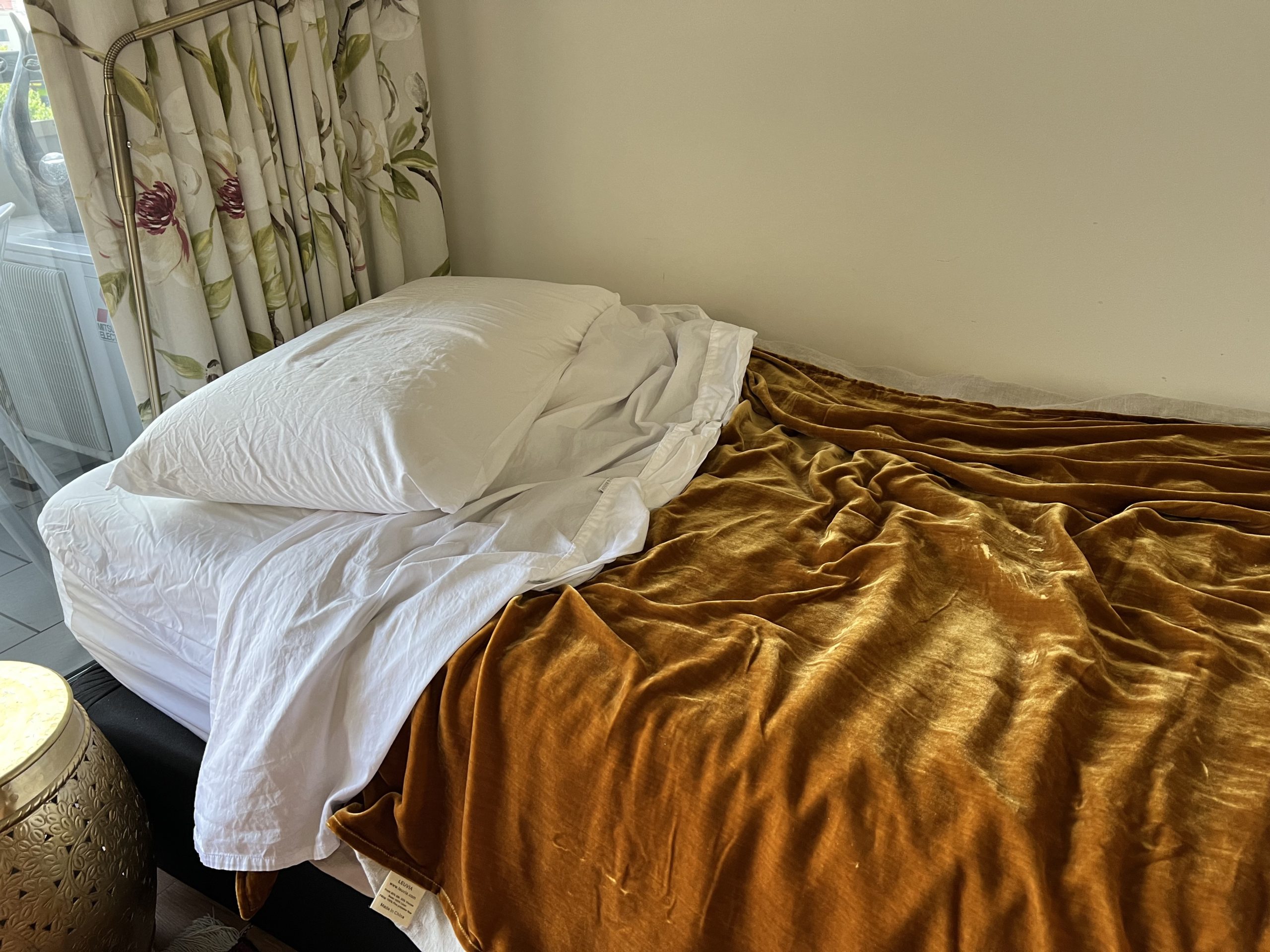
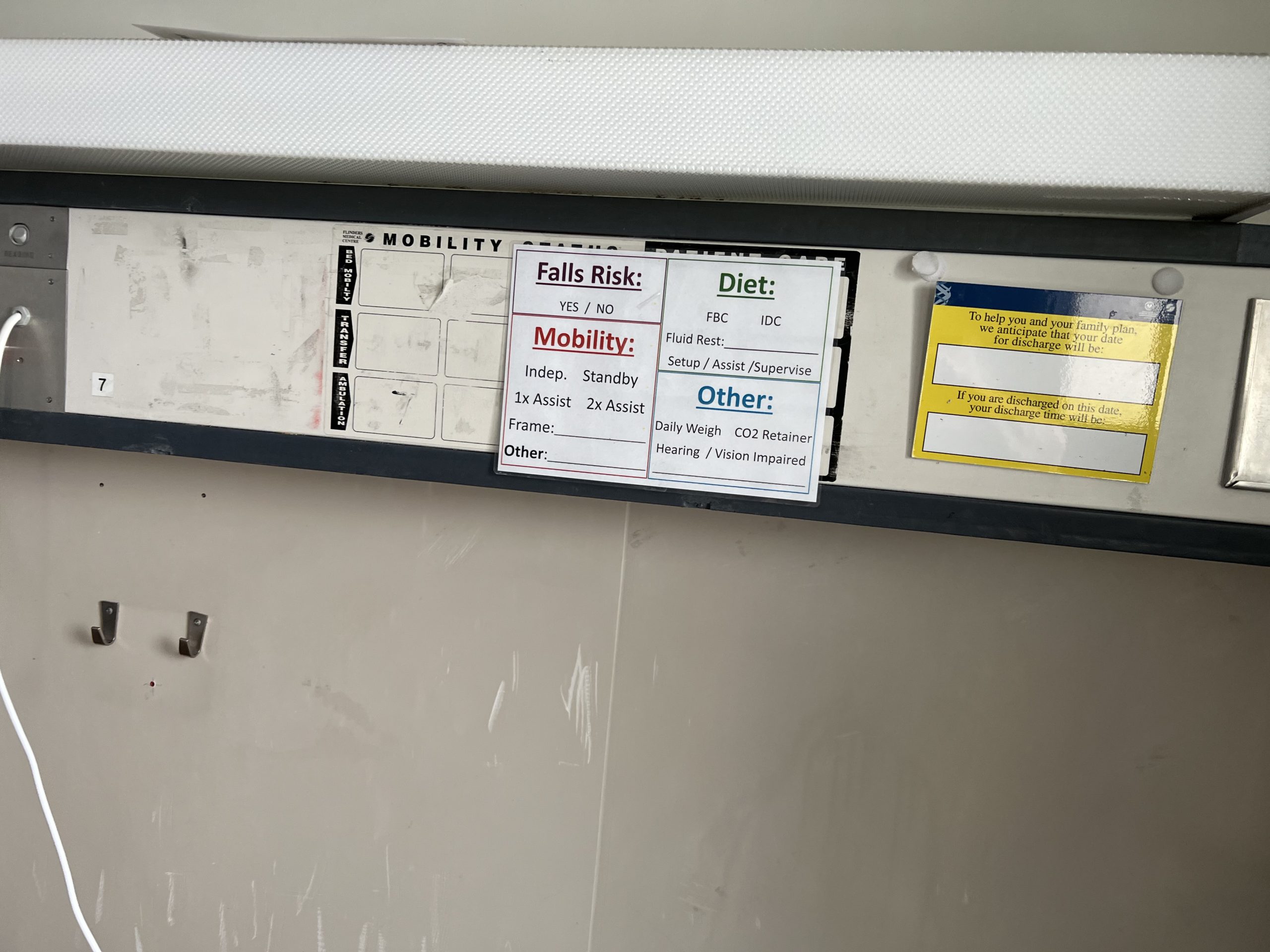
According to the headboard in my bay, I didn’t exist. Indeed, it looked as though nobody had been in that bay for a considerable time. It was a grungy, scrappy affair.
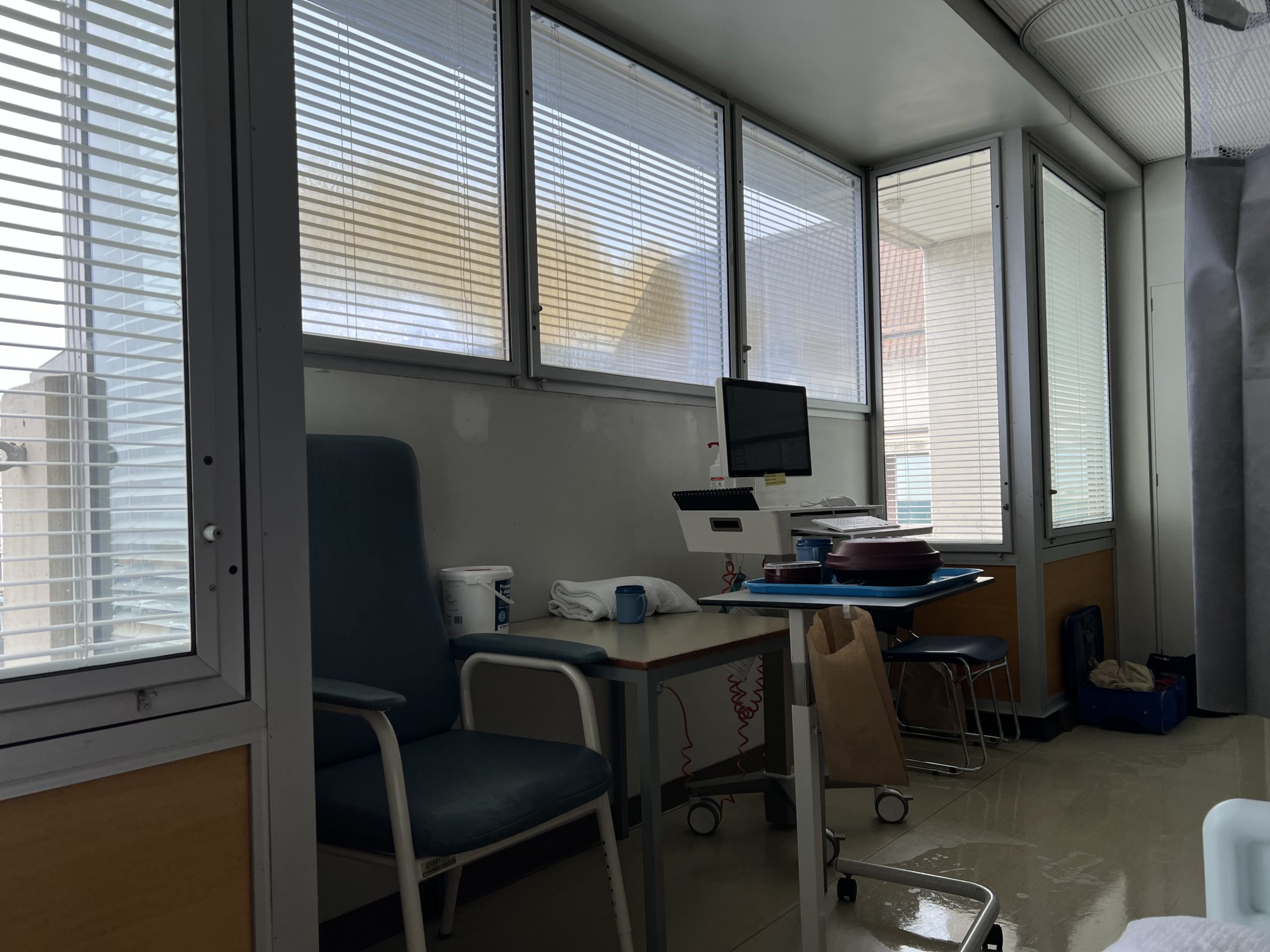
The next photo is of the ward taken from my bed. It may seem familiar or unsurprising, but closer inspection shows a large, suspicious puddle on the floor. The staff said the roof leaked. Indeed, rain during the night was heavy enough to wet my walking frame and the foot of my bed, let alone create a slip hazard for the infirm.
Please note the mysterious yellow stain on the ward’s windows.
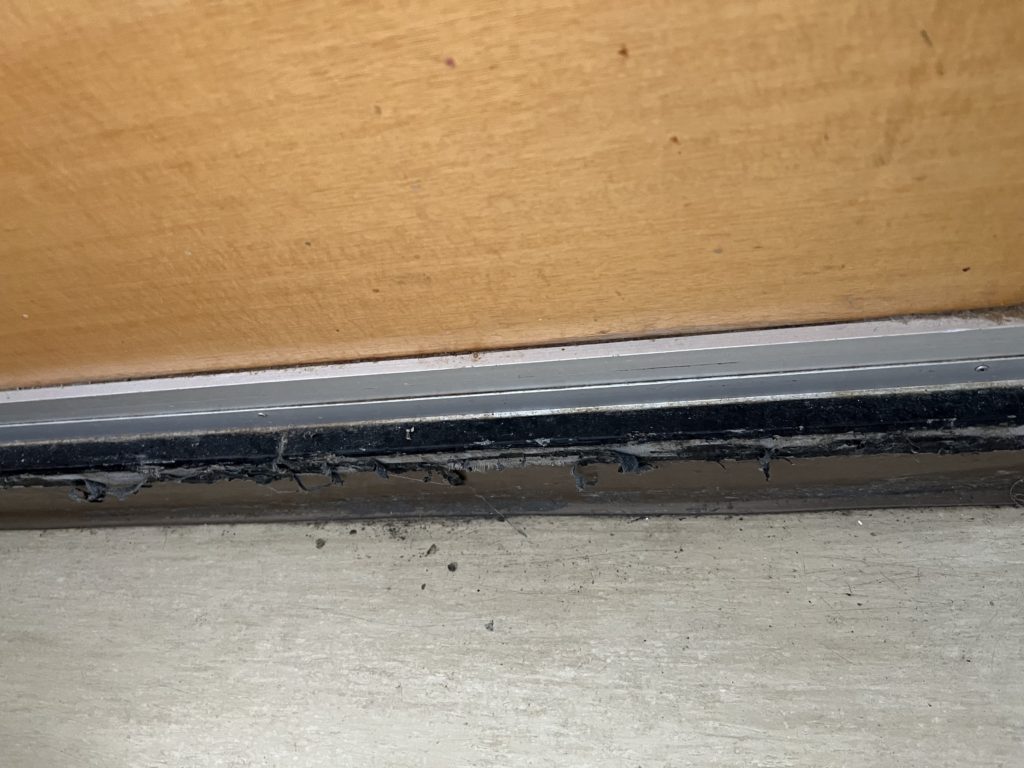
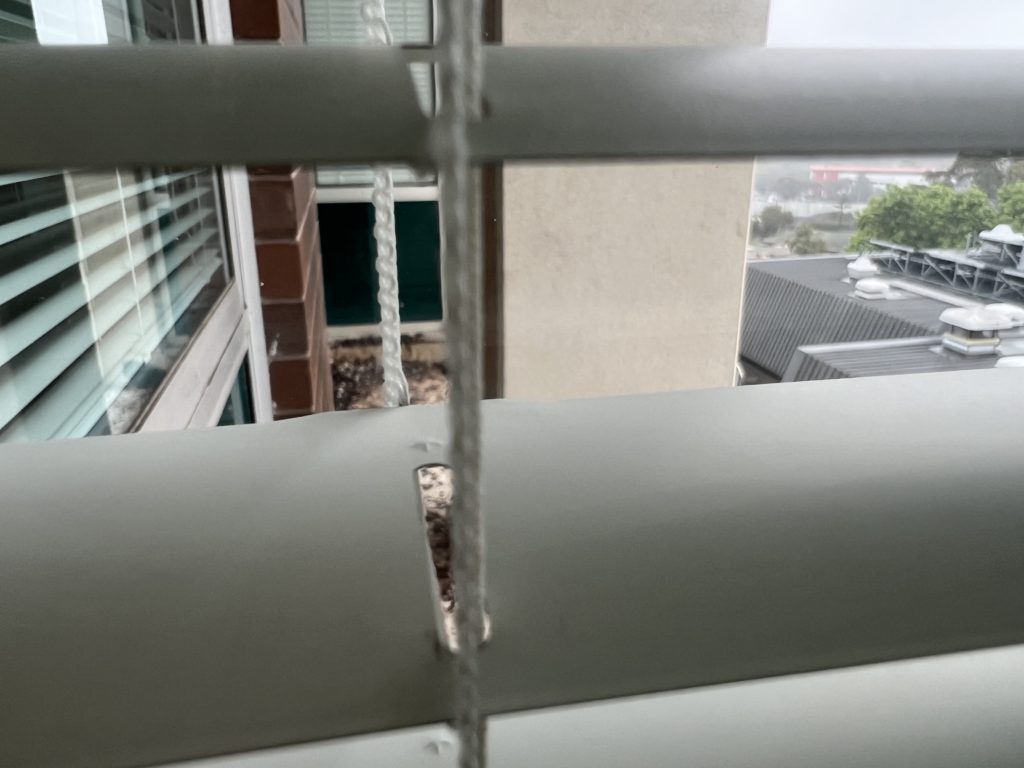
The following two photos combine with the first to show a forgotten ward with dirty, peeling skirting beside my bed, plywood on the wall, and piles of pigeon poo on the ledge outside my window. At least I had a window!
The Bathroom & Toilet
The solid doors on the ward’s bathroom were so heavy I could barely slide them open and shut, especially while holding a walking frame with one hand. The door’s tiny, out-of-date snib was nigh on impossible to manoeuvre with arthritic fingers like mine. Standard accoutrements like a pad disposal unit, rubbish bin and spare toilet rolls were absent.
A further challenge confronted me about how to move the clumsy, over-the-toilet commode left in situ by the previous occupant. Even when the cleaners finished in the morning, they replaced it over the toilet as though that was where it belonged.
There appeared to be no daily bed-making routine or effective cleaning in the ward while I was there. One cleaner ran a dry mop over the floor, skirting around rather than under chairs and beds. Another came before lunch to remove the accumulation of unsanitary hospital gowns on the table under the yellow-stained window.
The Cast

Let me introduce this little drama’s key players. Opposite me was an extremely unwell elderly man who slept heavily unless roused for treatment or food (which he refused). The aged woman beside him was desperately ill, too, constantly calling to go home. Although hooked up to oxygen and pumped full of pills and potions, I was comparatively fine.
Then there was the star, a mystery man in the bay to my right. Let me call him Jim, who kept his bay curtains closed tight day and night. He was the invisible man.

The Drama
Scene 1
My first encounter with Jim was indirect. I needed the toilet. I’d completely forgotten Jim’s earlier announcement to the ward that he was going to take a shower. Indeed, he made a loud, sound spectacle of the fact, but I hadn’t expected him to be in the bathroom for two hours. A kindly nurse led me to a different ward on the other side of the building, quite a long walk, even with my walking frame, when I could hardly breathe. She explained he was ‘like that’.
In earlier times, senior nursing staff or even an orderly under a nurse’s direction might have marched the Jims of the world to and from the shower within an allotted time. But, according to a reliable source, the client (sic) nowadays can do no wrong.
Scene 2
Being separated from Jim by barely two metres and a thin curtain, I was intimately privy to his non-stop cacophony of self-pitying self-talk, shouts to nurses, wailing about pain, crying or moaning and screaming to unknown demons in his head, alternating with tuneless singing and ugly bursts of laughter. It was unpleasant, loud, and persistent.
At one stage during the night, I woke in shock at the sight of someone taking my walking frame from beside my bed. The poor bugger was trying to walk backwards with it. Not understanding who it was in the dark, I called out that it was my frame and pressed the nurse’s button. Jim then shouted at the nurse who came, saying they should take no notice of me because I was a mean bitch.
I detest nastiness, so I ‘made friends’ with Jim through the curtain, being conciliatory for not having realised that the walking frame ‘thief’ was the elderly man opposite’. Jim played along, being affable and understanding.
Later, a nurse explained that the older man opposite me, whose frame sat beside his bed, was severely disoriented and confused. All rather sad.
Scene 3
I got my first and only fleeting glimpse of Jim in the early hours, short and wiry, like an ageing jockey, lifting the chair beside my bed to take into his bay. He already had two, and with bleary eyes, I said the chair belonged in my bay. He raved, saying I thought I owned the place, then rang the nurse’s bell incessantly. In high victim mode, he bad-mouthed me to her in a loud whisper. Boy, did he give it a go?
Later in the morning, he attempted to seduce the young nurse as she discussed his imminent discharge. He wanted her telephone number and had some peculiar logic for why she should give it to him. A cunning manipulator, Jim knew the poor girl was out of her depth yet became obsequious when a senior nurse came to put an end to that bit of nonsense.
Shortly after that incident, I overheard the discharging doctor listing Jim’s ailments, and I felt sorry for him. We may all have multiple comorbidities as we age, but Jim was not that old, and he had a lot going on and should have been in a ward better equipped to deal with his idiosyncrasies. This was a failure of an underfunded and understaffed health facility that was probably severely over-stretched well before COVID.
Denouement
I confess to finding the ward’s disrepair and overall uncleanliness distasteful. The nighttime walking frame and chair antics entertained me. But, remember, I was a sick old lady too, and these things rattle you a bit.
As for Jim’s incessant noise, I am lucky to sleep through most sounds, probably from growing up in pubs. More so, perhaps because years of meditation taught me how to switch off the irritation factor. Noise, the Buddha might say, is merely sound — be grateful you can hear the world and the myriad ways it makes itself known.
The nurse who walked with me to the loo twice because of Jim’s periodical co-opting of the bathroom told me that nursing staff must also use ward toilets because black mould had taken over in the only staff toilet within cooee. She also confided that Jim had been in her ward for six weeks.
I asked why Jim got away with so much, and she replied it was easier to give in to clients like him. We laughed. The situation would be ludicrous if it were not so serious, as his needs took up so much of the limited nursing capacity.

Secrets in Plain Sight
In the abstract, we all know the health system is in crisis. But the secret in this tale is that neglect is now visible in crumbling facilities and probably was so before COVID. It takes time to get as bad as it is, and it reminded me of the sorry state of the old Adelaide Airport before we got the new one.
That is sad for me. I typed the mechanical and electrical tender specifications for the FMC prepared by Mark Tostevin & Associates of North Adelaide in the early 1960s, when I was in my early twenties. Back then, the future looked so bright.
While I have no complaints about the medical care on this one night over the 24-hour period I’ve described, I must also mention the 10-hour wait I had the last time I headed to the ED with four crush fractures in my spine in 2020. Ignoring my pain level, the ED doctor, who consulted me in a corridor at 2 am, sent me home at 5 am. I arrived at 5 pm the previous evening.
The x-rays didn’t show what an MRI subsequently proved, that T6, T7, T8, and T9 had broken down. One was a 60% fracture, and the other three were slightly less severely crushed. That was tough.
The Moral of the Story
Getting old is inevitable, and bodily decline is an increasing part of that journey. Three of the players in my little drama, including me but excluding my friend ‘Jim’, were elderly, not to put a finer word on it, to appease grammar editors. When sick, we are often not in complete control of our faculties. I am lucky enough not to have lost it altogether yet, but time is closing in, so I wrote a futuristic poem about being in a nursing home. Let me end this story with that.

As for the Future

Of course, SA Health has recently delivered two magnificent extensions to FMC, the Centre for Innovation in Cancer, which shines proudly over old buildings. Along Flinders Drive is a new, state-of-the-art Aged Care Rehabilitation and Palliative Care block joined by walkways from the old hospital and a discrete Older Persons Mental Health Unit.
The new Federal Labor Government has committed substantial funding for upgrading, and the SA Labor Government is also determined to create world-class facilities. May these welcome fixes come soon to rectify the maintenance decline I allude to here, which coincided with SA’s previous LNP government’s privatisation of hospital maintenance. No surprise there.
PS I noticed that the 2023 forward plan for Southern Health, which embraces FMC, speaks of patients in bureaucratic terms, not as clients as nurses are now required to do, but as consumers — a fascinating philosophical change.
TIP
Life is grist for a writer’s mill.
Oh, Jane, How awful for you both.
After months in CCU THEN ICU my daughter brought home a bedbug infestation
Dear Susan, So pleased you understood Jim’s impact…but,it made a story for me and I’m glad you agree — to use a word — with the premise of the poem. As they say, it is tough getting old, probably harder than being a teenager in some ways, but it also shows us that we need not have bothered with much of angst of younger years. It’s all a lesson 🙂 Lindy 🙂
A sad reason that prompted this tale, Lindy, but what a wonderful tale it is. Loved Jim although it would have driven me mad if I’d been in the same ward as him.
When I had my knee replacement 17 years ago the woman in the next bed kept calling for the nurse during the night. Mostly it was to go to the toilet just next to her bed. But she was mobile & didn’t need a nurse. She didn’t ever use the button, just shouted. I complained, they asked her to use the button but she took no notice.
Your lovely poem is spot-on. No-one younger likes to be reminded of what is to come as they age. However, we are still alive and while maybe not kicking as well as years ago, still giving meaning to our existence- your writing is proof of yours. xxx
Dear Val, I’m glad you could detect the note of humour. I didn’t want the story to be all misery but, it is true that as we get older, we become less visible all round. It’s tough. I’ll take extra care next time I’m admitted as I’ll tip into 80 next month 🙂 Lindy
Dear Lindy, what an unpleasant experience for you. You write about your one night stay so well and although it must have been difficult for you, there is still a little humour in telling your story. Thank you.
I have had similar experiences and my complaint about hospital stays is that once we reach 80 we are considered deaf and stupid by most staff and that really bugs me. Cheers.
Dear Julie, Thank you for your thoughtful comments. I am so sorry you have to wait for surgery, even with private health cover. No the golden years are not always comfortable but, as you say, we do still have good health care in this country. In America, people have to pretty much sell the organs to get it as good if they are not covered by employers. Lindy
Dearest Lindy,
you write so very well.
Perhaps your factual ‘play’ should be played in parliment. I know this government is planning upgrades, but have members of cabinet been patients in cabinet sized mixed-gendre wards? Do they really know the decay of
our public hospitals?
As if illness isn’t bad enough, having every Tom, Dick and Jim (in this instance,) know the ins and outs of your privacy, is as ludicrous as the public health system.
My grizzle out, I’ll add how fortunate we are to have health care. It’s so true, Lindy, that staff are overworked and the majority of the baby boomers are just entering the system.
I’ve had a five year wait for an appointment at Flinders. My doctor has recently escalated things, plus thankfully I have private health cover even when we can ill afford it.
With two pending ops I have two hospital stays to not look forward to. At least the rooms may be free of black mould, but will golden staff join my bad-luck in private hospitals?
I was once given the wrong operation, and two other ops were performed incorrectly.
I’m not sure where the golden years fit with poor health, but at least we are still here to hope . . . and of course for you to write and me to read brilliant plays. ❤
Love and friendship
Julie Cahill.
Gosh, I didn’t expect you to read today. I certainly hope David’s experience does not match mine, but he’s a private patient so hopefully, it won’t be so bad. thanks for reading.
Well, that was eye-opening Lindy. Glad I never had that kind of experience and hope I never do. I’ll be visiting David in the private hospital tomorrow and presume if there are tales like that for him, he’ll have it all written down in his trusty writing book, using it in future poems to entertain many, as yours have here. Old age is certainly not for sissies, especially sick old age.
Thank you
Thanks for your comment, Jenny. I’m glad the piece sounded authentic to you. Things have changed so much over the years, haven’t they? Lindy
Dear Lindy,
I’ve almost finished reading it. I have a similar tale when I thought I’d had a cardiac event, although my lens is through the eyes of an experienced yet old, nurse. The public health system is stretched beyond imagination and the staff, not as well trained. I was shocked by what I experienced and saw .. It brings it all back.
x Jen
Thanks for reading and commenting, Andrew. I’m sure we’d all rather not go to hospital, but I do so now with fractionally less confidence than in the past. It will all take a while to recover. Lindy
Wonderful writing Lindy you describe the broken health system in an eye opening way.
I rang a friend who is 77 a few weeks ago when he answered he was on a stretcher in the back of an Ambulance they had been on the ramp at Flinders for 6 hours.
Hopefully you stay well enough Lindy to stay away from that place.
Happy writing for this new year.
Thank you for reading and commenting, Dee. Yes, it was a bit of a strange one that’s for sure. More entertaining in retrospect of course 🙂 I’ve had great experiences in public hospitals over the years too, so it is about the lack of funding and proper facilities. Lindy
Gosh, that must have been an awful experience. So glad you weren’t there too long. Poor public hospitals, sounds like the legacy of years of not enough staff, and not enough funding. I’ve always had good experiences in public hospitals; such a shame that it’s come to this. Dee