

Characters are Friends
When I write, my characters are either my friends or my enemies. Sometimes, they are me, the child who read a lot and got lost in imaginary worlds, the little girl who fell in love with heroes and heroines who conquered the odds. For all their different faces and voices, I adore following their ups and downs as life trips them up, provides challenges or sends them to bottomless pits, hoping they’ll overcome.
In my youth, my heroes were human. They had a thousand faces and a limitless cast of voices. Back then, heroes did not need action costumes or bionic parts any more than Tarzan in his jungle home (what a metaphor). Even Superman was the very human, bespectacled Clark Kent beneath the flying red cape.
In this context, let me recommend Joseph Campbell’s groundbreaking book, The Hero With a Thousand Faces written in 1949. This brilliant work underpins the storyline for the same hero’s journey that you will read about today in various how-to-write-a-novel texts. Given his lifelong interest in mythology (1904-1987), I’m sure Campbell would love the irony of that.

A brilliant book for your collection.
The heroic quest is not always spatial and external. It may also be an internal, psychological or spiritual journey which is why I advocate the exploration of suffering in Questions Over Coffee. The external can be metaphorical and some narratives encompass both internal and external aspects of the hero’s journey which gives greater depth.
Life is Our Teacher
My poem The Passage in an earlier post shows that humans share a lot in life. But equally, we are diverse, and we traverse a range of often-difficult paths alone like our fictional heroes whether in film or on the page or TV. In our variety, we are fascinating creatures, whose lives are story-making factories that build character in much the same way as we bring fictional characters to life in our writing.
As humans, we bring diverse cultural and social backgrounds into a world that acts upon us as we act upon it. Dislocate us and we are out of place. As in life, so in writing, dislocation shows the true grit of a fictional character. We must put them in positions that force them to make choices and follow paths; some leading nowhere, others causing people to come together, break apart and, ultimately, change.
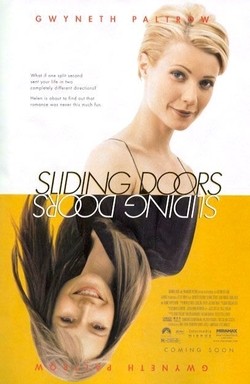
Like us, characters must choose which way to go. In that sense, sliding doors are part of any heroic journey.
Writers are the Puppeteers
I introduced the hero’s journey here to make the point that, we are much more than surfaces and our characters must be too. But, a hero’s journey is only part of the story. Creating a character with depth also requires more intimate techniques and this is where faces and voices come in.
I remember how my children laughed wickedly when they were young, mocking the way my face and voice changed, depending on who I was speaking to, on and off the phone. It was a valuable lesson to have innocent eyes see me like that. And I’ve been interested in the relationship between faces and voices ever since.
I suspect we all have a phone voice or what I’ve come to call my pompous voice because there is always so much more going on beneath the externals. For example, a pompous voice might indicate a character’s self-consciousness or denote insecurity in relation to their interlocutor. We must go beneath the surface to hear inner voices properly. But, first to faces.
Faces: the one-way gaze
Consider these photos.
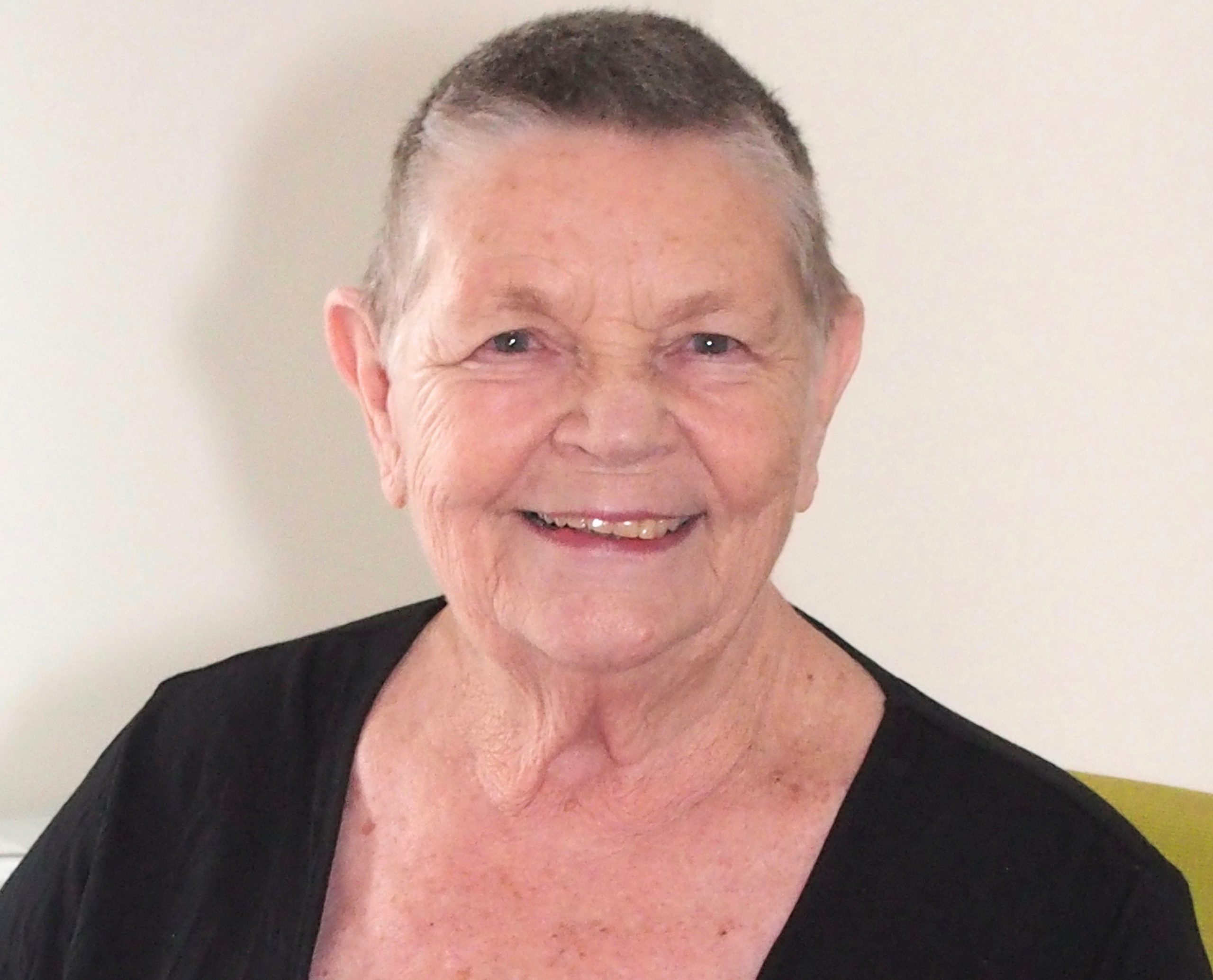
This is my web page profile picture. Do you think ideas about me would vary in terms of the age, status and social leanings of a viewer?

Here I am as a 1970s bride. If I used this photo as my profile picture would people read what I say differently?
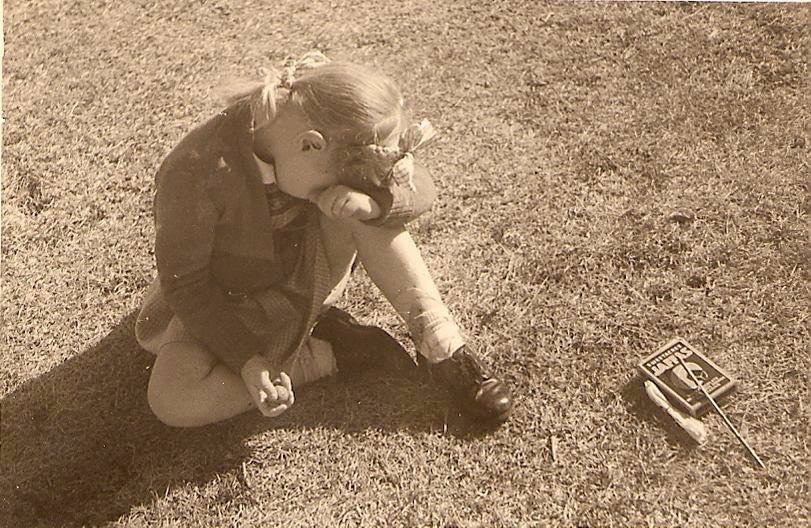
Here I am as a little girl sulking. Feeling invisible to the adults around me I hid my face.
Although the sepia photo is 70 years old, that sulky child still lives in me. While my hopes as a young bride were dashed, inside, I am still that young woman at times, full of optimism. The old woman I’ve become holds those (and other) earlier moments in memory along with a range of social roles: daughter, wife, mother, academic, poet and novelist, BUT
It still pisses me off to be treated as invisible.
Lindy
When people say things like ‘aren’t you clever for your age’ or, ‘it’s good to keep your mind active’, they are talking to my age, not me. Nowadays, I no longer hunch to hide myself away as I did as a child. I roar! Or, write a poem.

As humans, we are all complex and whole, not just types. Typology is for scientists, not artists. And that’s the point. We must not type-cast our characters and, even though we are puppeteers, we need to work with both faces and voices to develop subtleties of character.
Voices: in action
High Rise Society, starts with the 60-year-old, middle-class protagonist destitute and on the streets in Melbourne. When she gets public housing she is initially grateful to have found a home and seeks acceptance and friendship among her high-rise counterparts. But when her best friend dies unexpectedly, she begins to feel the new world she had begun to love, degrades her.
Although I don’t develop it here, as the story progresses, the protagonist Ruby develops two distinct voices: beneath her polite and open veneer lurks a mean inner voice of self-talk contradicting what she says.
Here is an excerpt from a first chapter scene in High Rise Society, showing a brash young social worker talking to high rise residents who she sees as her project. Here, I use dialogue to sketch context and voice as a shorthand way to convey character.
Excerpt
Social worker Gaye Bailey interrupts a private conversation in which old-timers Annie and Mary are initiating Ruby into high-rise life.

End of Excerpt
Try This
Let me first ask, in this selfie-crazed world where we objectify ourselves to ourselves, are we what our photos portray? Are we merely a surface with faces posed in emulation of the rich and famous in ‘in’ settings as contrived as our Insta-pics? Or, are we more than that? Take a moment to reflect, then ask how many voices you have in your head. How many of these do you use in speech, and which do you heed inside?
Exercise:
Write a scene exploring two people on public transport who board and sit opposite each other. One person may be a black-jeans-wearing, tattooed youngster. The other a motherly or even grandmotherly figure in a cotton dress.
You decide who your characters are, and how they dress or behave, based on appearance to start. Whether you create two men of different generations, two women or a male-female pair or some other configuration doesn’t matter. However, it is best if you make at least one character completely different from you. Pick a type you have strong opinions about.
Sit quietly inside each of these characters, looking at the other. Then, working from one perspective at a time, write what each one is observing, thinking about the other. Remember, they are sitting opposite each other, possibly with knees or parcels and bags in close contact.
Write about the following —
- The way your characters enter the bus, train or tram, choose their seat and sit opposite you.
- What they look like, what ‘you’ (the other character) smell or feel or think.
- What they might be thinking or feeling from their perspective.
- If they speak, what do they say, how do they sound?
- Is the voice what you imagined it would be?
Change places and do the same with the second character. In other words, be both of these people, each looking at and sizing up the other, and see what comes up.
Happy Writing
wattletales