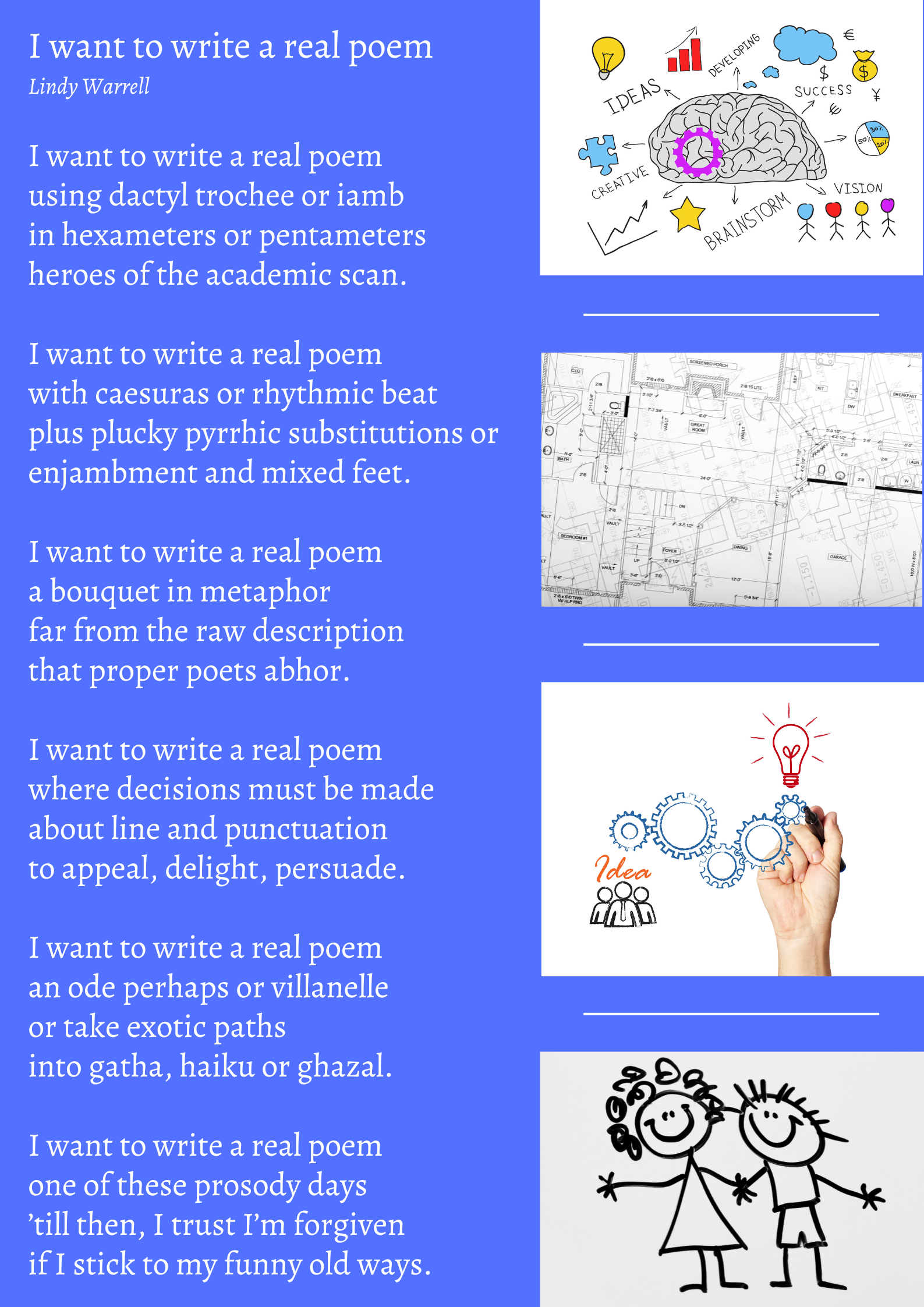
We live in a world that encourages us to grow, follow our dreams, develop our creativity or achieve goals, pushing on to change, renew or better ourselves, but is there a time to stop? Moneymakers. powerbrokers and insane world leaders governed by iron egos don’t change as they wreak havoc upon us all. But as mere mortals, should we persist in seeking acclaim or find acceptance by turning inwards as we face the inevitability of death?
Does moving into a retirement home develop or limit our potential? What does it say about our society that the elderly gather, locked away, albeit in comfortable circumstances? We may be isolated from family, but we can reach out and do community work and creative stuff despite being subtly pointed towards the grave the moment we retire. TV ads don’t tell the full story.
We move into retirement living voluntarily in the expectation that smaller dwellings might save us from a nursing home. People in my building certainly live longer. One man will be 100 in February 2025. But who are we, really, when we leave our houses and pets behind? The overarching aura of independent retirement living often feels more like being institutionalised than independent, as I’ve written before.
What Does it Mean to be Old?
I first thought I was old at 30, fearing I’d lose my figure with my imminent third baby (born on Cyclone Tracy’s cusp of fury). When I turned 50, that same baby boy gave his mother a single red rose when I hosted a party for women friends; a powerful women’s party. After a tipple or three, some guests broke down at the thought that they had, indeed, achieved power and insight through tertiary education yet wondered who they’d become and mourned the innocence they’d left behind. Others bemoaned their failure to follow suit with excuses for not having achieved anything because of children and bad choices in men. It was an interesting evening.
Rejuvenated at 75, I published my first poetry chapbook with two novels and several other poetry collections to follow. Living the dream. I turned 80 on the Marina Boardwalk in Glenelg over lunch with my daughter, but this year, my 81st has seen me turn inwards. I find myself wondering whether that is a natural progression or a portend of decline.
I have come to believe we tend to settle into ourselves more as we age, but is that by adaptation, cultural isolation as we drop out of social things or something else altogether? When I see elderly friends who are younger than me but with healthy pockets and living partners tripping around the world or visiting interstate all the time, going places and doing things as though nothing has changed, I can’t help but wonder if the changes I see in myself are peculiar. But, changed I am.
Change Brings Grief
When I look back over the posts I’ve written over the years on Wattletales, I realise that I have often summarised those parts of my life that I’ve most valued, using them as a trigger to make a point about something that was niggling me at the time.
Recently, however, I’ve worried because, since the publication of my second novel, They Who Nicked the Sun and its recent launch at Manson Towers, where I live, I have not written a word until today. An article on grief gave me a clue as to what’s going on.
When I told my doctor recently that I often cried for no apparent reason first thing in the morning, she looked at me blankly. The topic got lost in the more important stuff that she thought a test or a different pill might assuage. It must be hard being a GP for the elderly in a discipline predicated on the heroics of scientific medicine more suited to acute conditions. You simply cannot fix ageing; most conditions thereof resist the force of nature.
But the grief article showed me that I am grieving for parts of myself now defunct, and living in the confined space of my independent unit seemed the most suitable thing to grizzle about. Instead of taking pride in myself for being content with my lot and commending myself as I usually do for not fearing death, I sought to blame.
Like those women at my powerful women’s party years ago who blamed husbands and children for their failure to achieve, I have been blaming retirement living for pretty well all the changes my mind and body have experienced of late. My tears dried up the moment I understood that fact and once again accepted who and what I am at this moment. Then, my words —these words — began to flow.
The Truth Is
I grieve the diminishment of my mental acuity, my way with words (when speaking), and the decline of my physical strength and energy. I have been independent for so many years and now have to go slow, take it easy and ask (or pay ) others to help. Yikes! We need to listen when they say ageing is not for cissies. Frailty and weakness are simply not valued in our world, and I’m not too shy to report that old age sucks at times. But, then, so can life.
Nevertheless, old age has rewards. I am content not to be on the constant ‘doing and going’ merry-go-round. Even if I had the money and energy, I know I’ve had my turn, and I’m still here. My mental meanderings always find answers, and there’s nobody around to tell me I’m wrong. In writing, I found my home, and that is true freedom.
Happy Writing
Wattletales
If you'd like to be added to the Wattletales post list, make a request in the comments below, where your email is hidden. Lindy
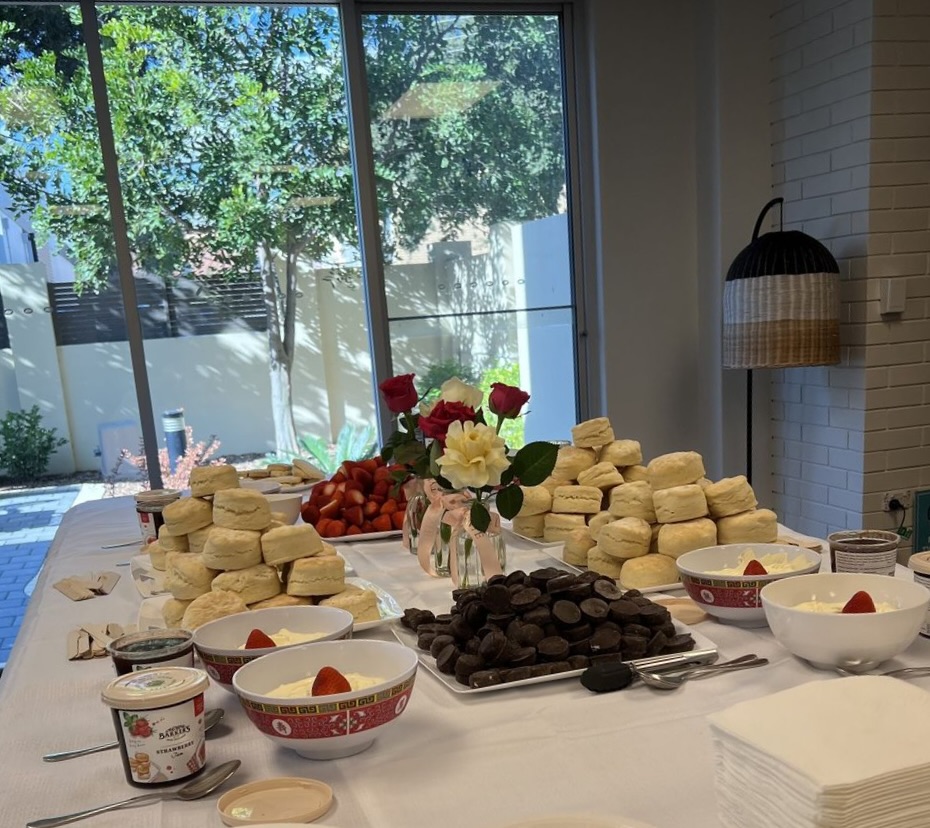
I won’t name the bakeries ignorning my early enquiries about supplying plain scones. In desperation, I turned to Drakes, Coles, and Woolworths, but theirs were all buttermilk. I thought of Baker’s Delight, whose scones are tasty but misshapen, a bit big and have ‘flies’ as my father used to call sultanas and raisins. I finally asked Dulwich Bakery in Bath Street, Glenelg, who graciously accepted my special order of plain scones for Devonshire Tea, and they were clouds of perfection. Caruso’s on Jetty Road delivered plump, South Australian strawberries in time to put them fresh on the plate to complement strawberry jam and cream.
What a party for my new book, They Who Nicked the Sun. The day overflowed with goodwill for my secondnovel being launched into the world of readers.
A Dedication
I dedicated this book to my dear friend Margaret Luginbuhl. We met in the high-rise housing tower setting of No 25 King Street back in 2004. Although I returned to Adelaide in 2005, we stayed in close touch. In 2020, COVID forced Margaret to cancel her advanced plans to return to France to live near her daughter, Albertine.
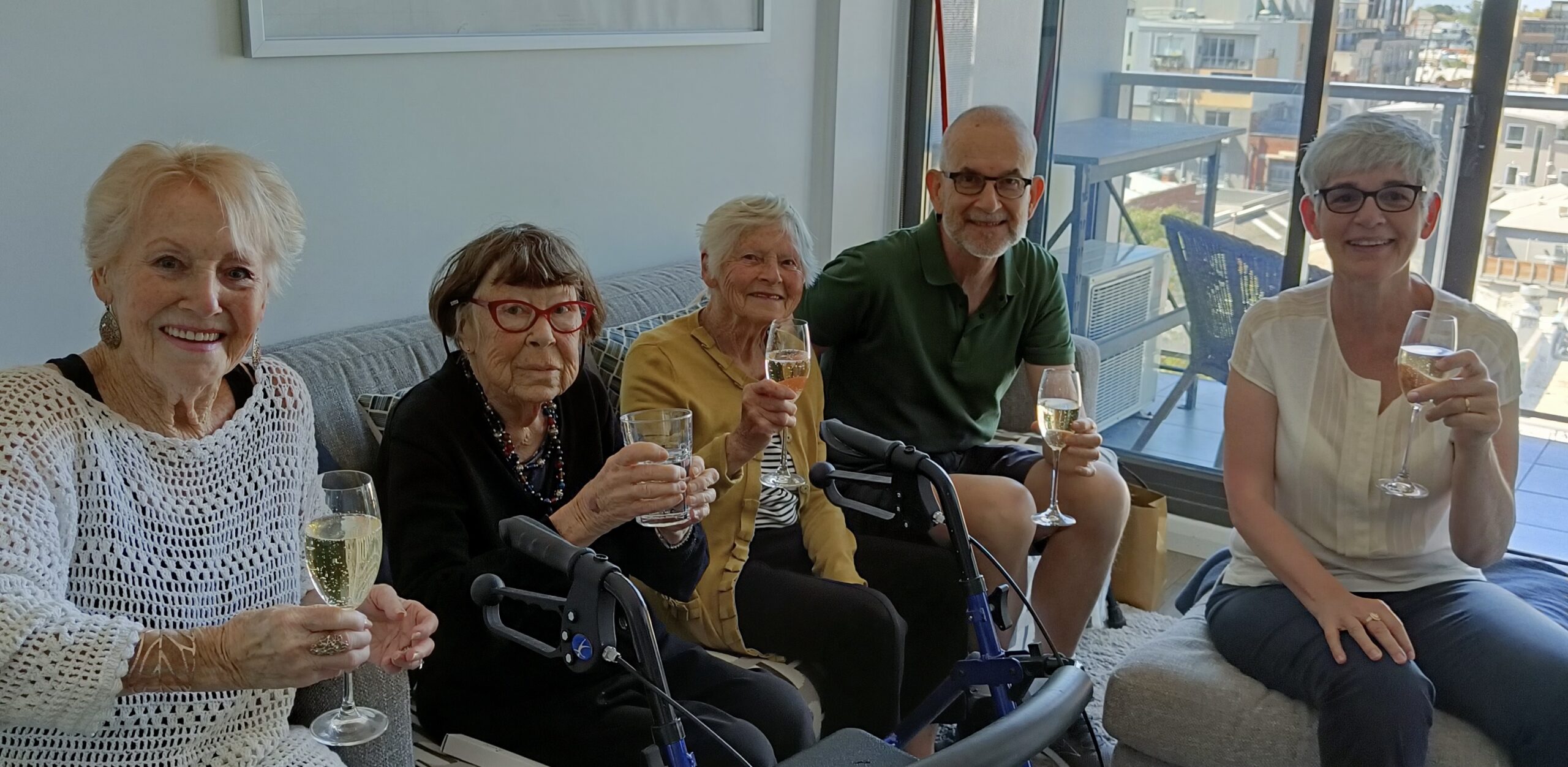
By the time Melbourne’s lockdowns lifted, Margaret’s health had declined, and her loving daughter travelled from France in 2022 to take her mother to Paris to care for her there. Sadly, and ironically, within three months, Margaret died of COVID, aged 83. I miss her wry humour and wisdom still.
Photo by Albertine Luginbuhl
This photo of Margaret’s farewell shows her seated by her walker between Melbourne friends, with Albertine on the far right. Below is the sunken lawn at Princes Gardens that Margaret and I loved. You can see our building through the trees, and if you look carefully at the book, you will see this photo etched on the back cover.
Princes Gardens is the primary setting in the novel. This photo is etched on the back cover.
The Launch
Nigel Ford was our generous and genial MC on launch day. He has kindly been the MC for five of my seven book launches, including my first-ever poetry collection at his Fleurieu Poets gig in Victor Harbor on my 75th birthday in 2018.
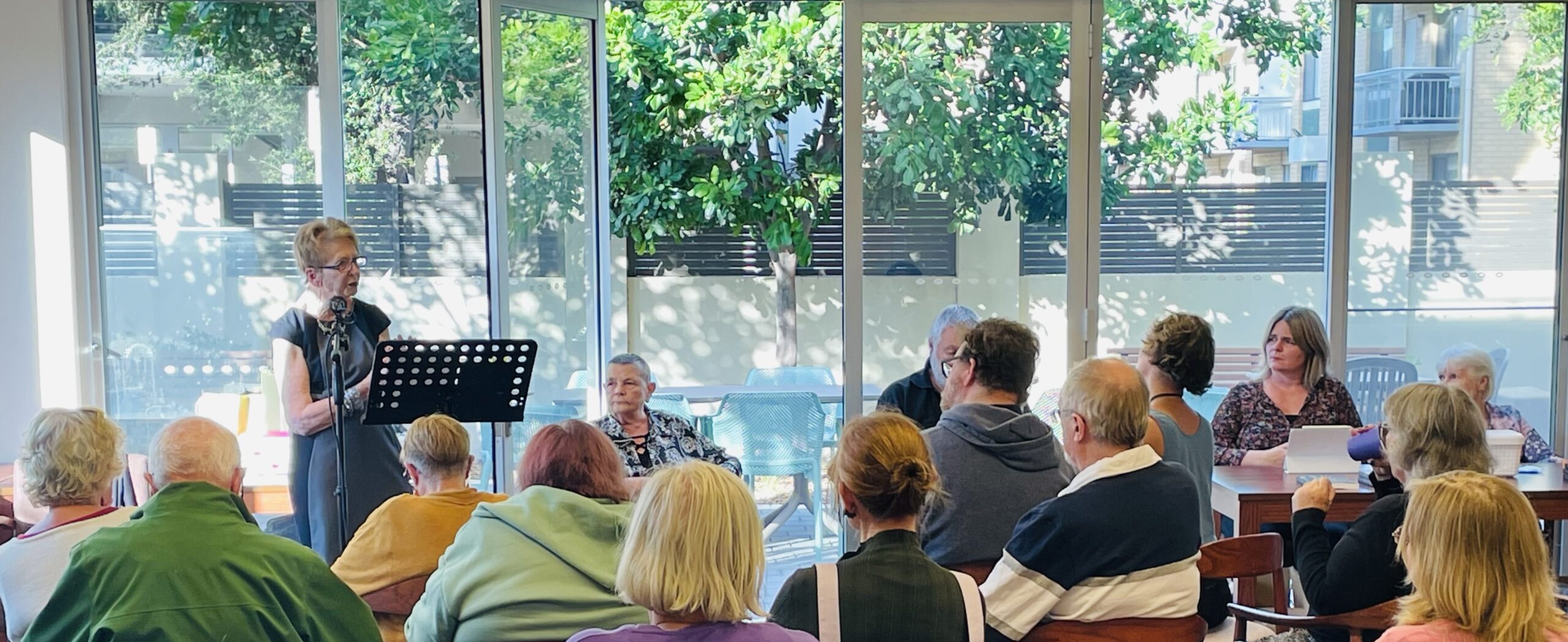
This photo features the well-known Adelaide author and poet Valerie Volk delivering her launch speech. With Valerie’s permission, I cite a couple of excerpts below as she introduced the setting and the story.
We meet Misha, the old Russian pigeon feeder, and watch Ruby build a rapport with the three ‘old girls’ from the adjacent public housing block, Annie, Mary, and Marge...It's a world that Lindy, a well-respected Adelaide poet, conjures up well for us in her introductory poem to the book. It’s done so evocatively that I’m going to read the poem, because this world is central to the book.
We see Misha and his pigeons, Esther and her chicken bones, Danny and his art classes, Thomas and Muggins, Mary and the booze, and we feel for them. Not just people, but also places and scenes. Dogs are often the focus, and Lindy evokes the surroundings vividly.

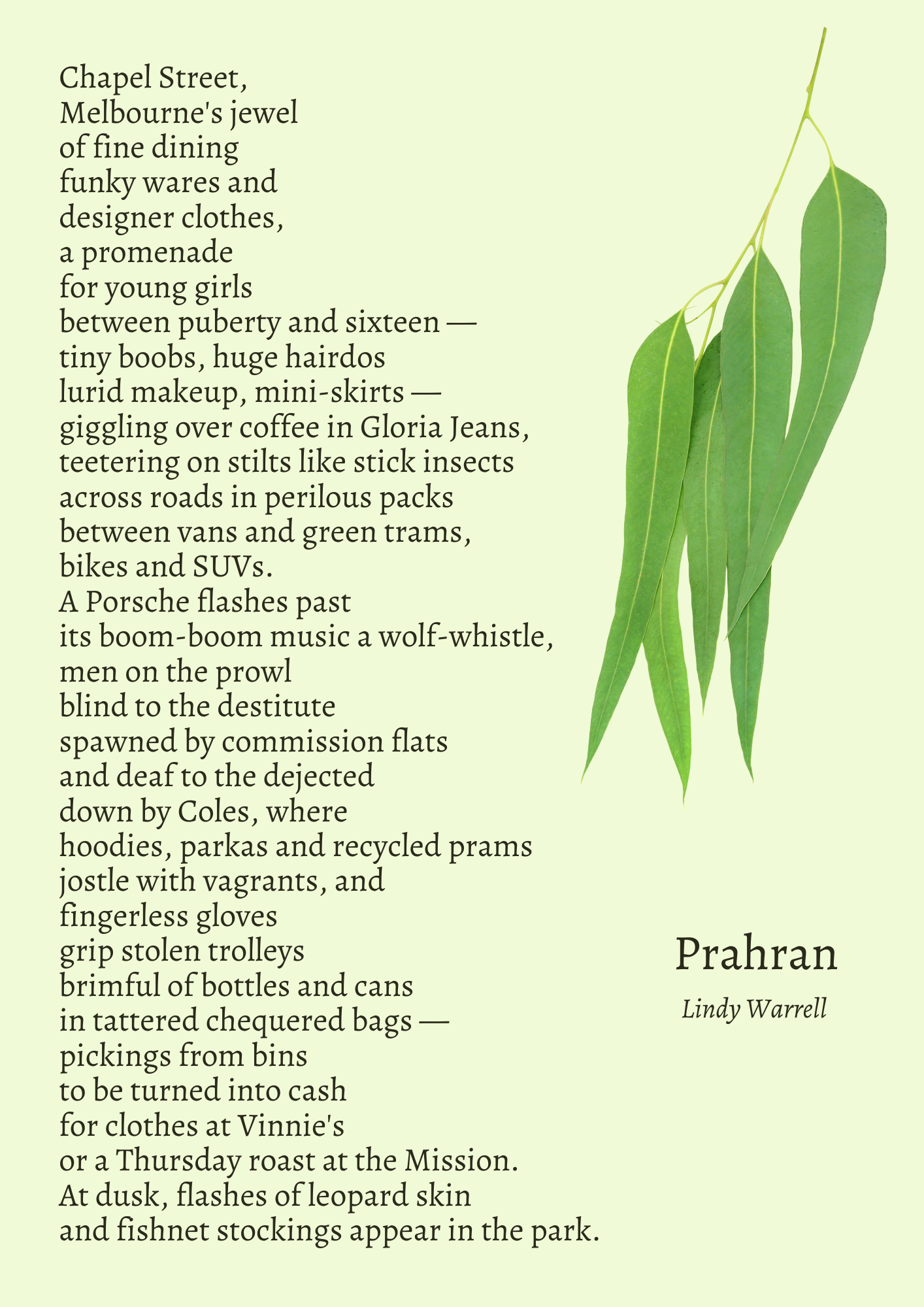
"As she walked, the sun flickered through the oaks and plane trees, and she heard the songs of dark and light leaves dancing again. Workers still hurried this way and that through the park to catch their morning tram or bus. When their numbers diminished, professional dog walkers turned up. The strain of so many dogs would take a lot of work to manage. Retirees shuffled around with their ageing pets a little way behind. Alma Park was different from Princes Gardens, where all age groups mingled, young and old, with dogs short and tall, purebred and mutt, like the diversity of people on Chapel Street do: young, old, rich and poor." (pp.234-5)
Our Attentive Audience
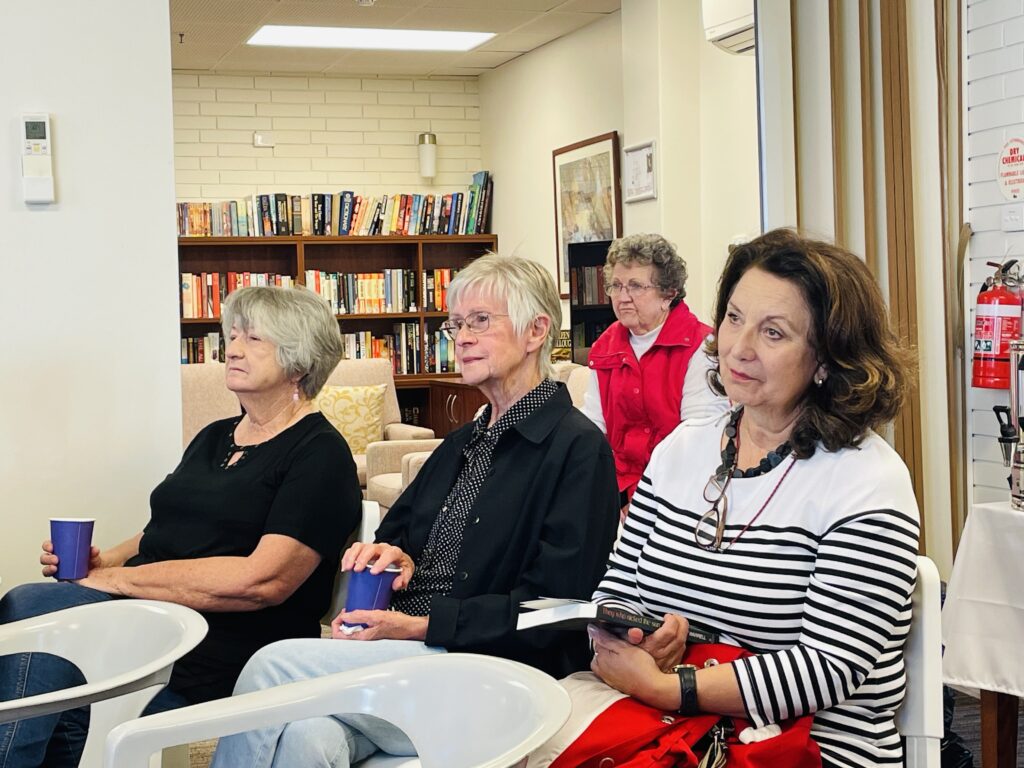
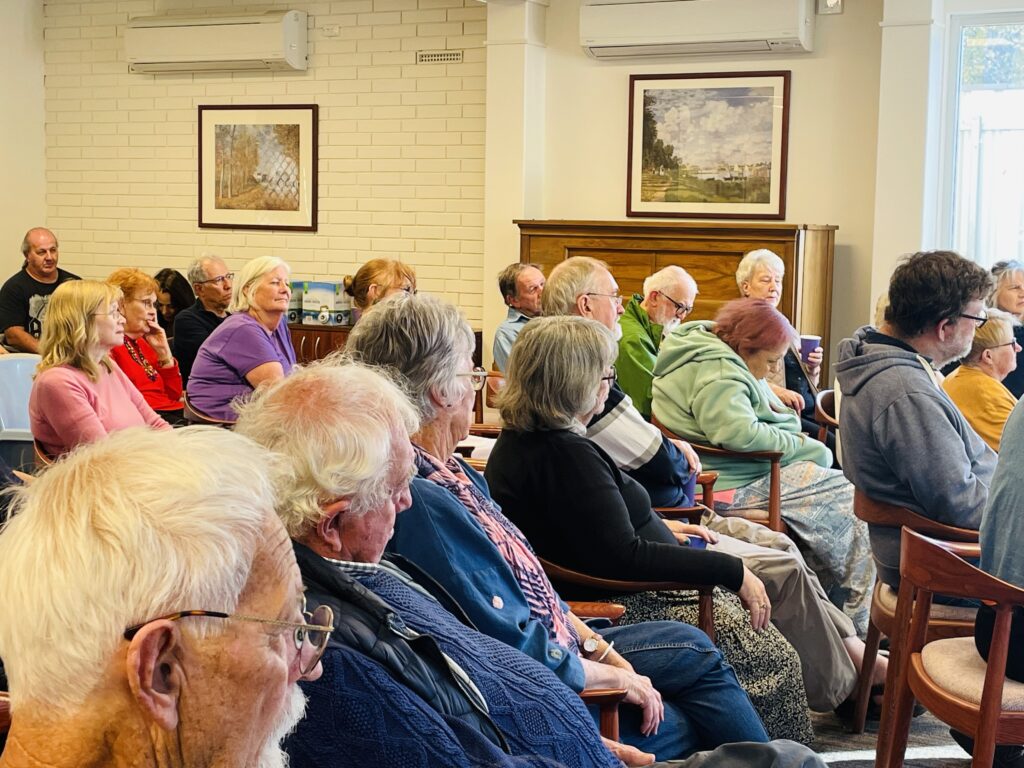
We held the launch in the Common Room of Manson Towers in Glenelg, where I live. It is a lovely room. The audience was wonderfully appreciative as the late afternoon sun washed over their smiles, interest, and applause. It was a joyful occasion, and I thank everyone who made the time to attend.
The pictures by Raj Kuma Subeda
My Talk
In the weeks before the launch, two items appeared on my Facebook feed and found their way into my talk, and I quote, starting with Anne Summers.
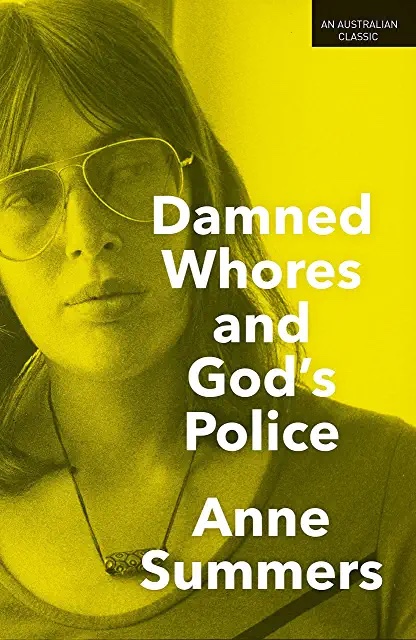
The story touches on a theme from one of my favourite feminist authors, Anne Summers of Damned Whores and God's Police fame. In 1975 Summers’ landmark book identified encompassing female sterotypes in Australia. We read this week that young boys in private schools still grade women from cutie and wifey to unrapable. Little has changed except Summers now has emblazoned in pink on her Facebook Cover Photo, the words, 'CHOICE, Violence or Poverty' which is precisely the choice my protagonist makes as many women still must.
If I felt that Summer’s Facebook textual image conferred relevance, that sense was augmented by a recent article in The Conversation by Carol Lefevre, a Visiting Research Fellow in the Department of English and Creative Writing at my Alma Mata, Adelaide University, who writes —
If older women move through the world with a sense of being unseen, in the world of books, and especially in contemporary fiction, they have all but been erased. So pervasive is their absence that it is nearly impossible to draw up a list of novels featuring older women as main character.

Of the older women who do make it to the page, most will have been reduced to stereotypes: the demented, the eccentric, the quarrelsome, the devoted yet sidelined grandmother, the meddling mother-in-law, the faded beauty, the disappointed spinster.
My 60-year-old red-headed protagonist, Ruby Marie Wilson, is no stereotype.
PS
Unfortunately, I forgot to take photos of the book table and one of me holding a copy with a triumphant smile — the usual fodder. Instead, here’s a little video of our first guest, which features me, the book table managed by my daughter, Vanessa and Nigel, pensive by the window, and our first guest.
I thank everybody for making the day a success — Valerie and Nigel, of course, for honouring me as they did. I thank Kuma for his photos, Pat for her help and this video, Veronica Cookson for writing a blurb, selling books, and all-around support, Deb Stewart, who couldn’t attend but wrote a second blurb, and Inez, who conducted the lucky door prize. And thank you to my darling daughter, Vanessa, who supports her old mum in all ways.
Where to Get the Book
I’ve already received some lovely feedback on the story. If you are local and would like a copy from me, please touch base in the comments below or on Facebook Messenger. The paperback is available from Dymocks, Amazon, and Barnes and Noble. The ebook is on Apple Books, Kindle and Kobo. It is also now the SA Libraries Catalogue.
Happy Writing
Wattletales
If you’d like to receive a link to Wattletales posts, drop a word in the comments below. Your details will be hidden.
I ask the title’s question because I have long known that my words reveal me, they are keys to knowing who I am. Some people hide behind their words. I guess it comes down to whether you write from the heart or the intellect. Either way, as a reader, I tend to believe I have a poet’s measure from their words. This is, of course, an introductory palaver because I haven’t really got a proper topic today. Rather, I’m posting a few of my recent poems because, being a creature of habit, I find it hard to skip a month when I’ve been writing regular monthly posts for around five years, and this month, I have nothing to say.
Poems Past
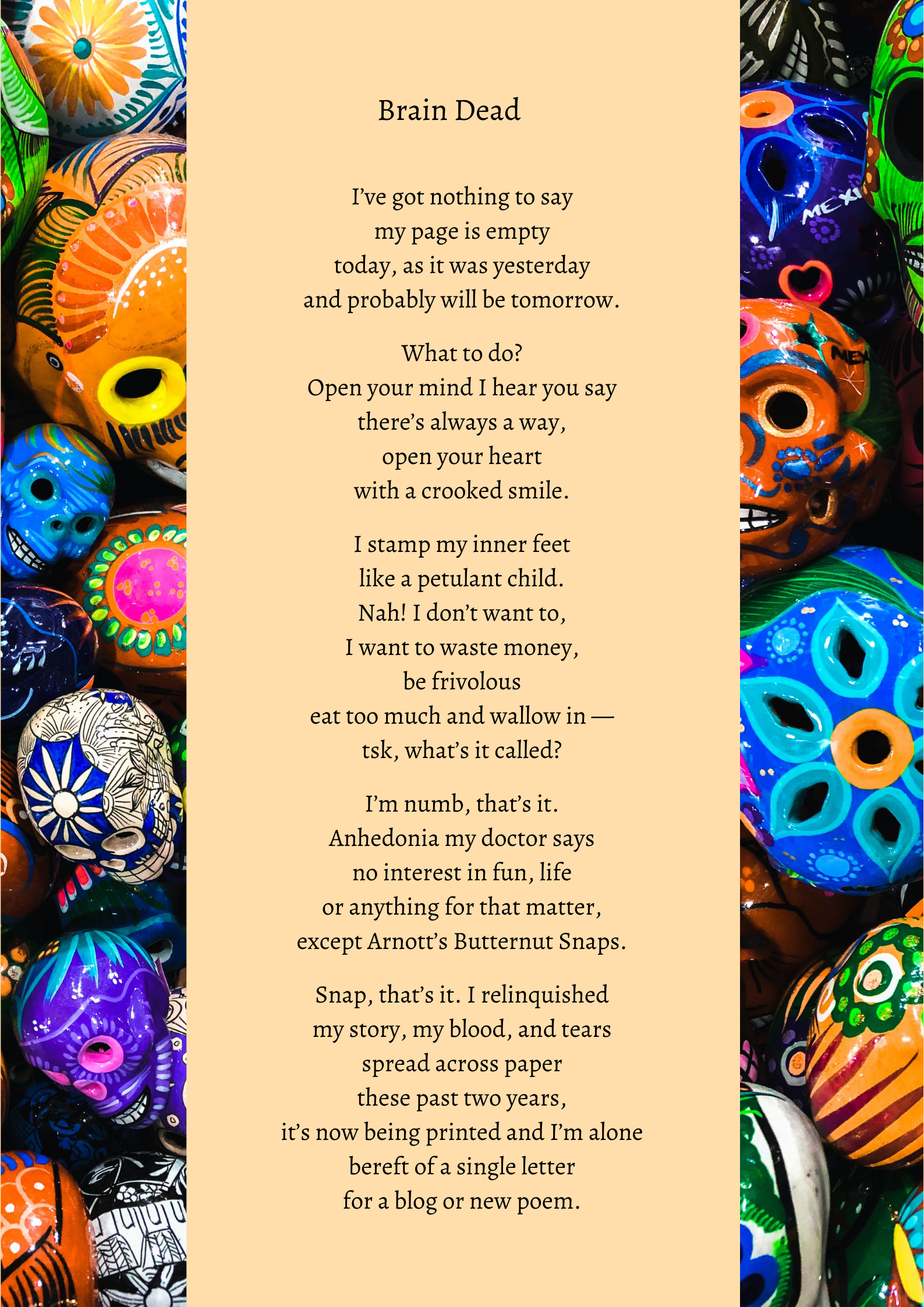
Some of the poems here will be familiar to those who follow me on Instagram. Some are new, and the first one, ‘Brain Dead’, sums up my current situation quite nicely. I have just finished my second novel, They Who Nicked the Sun, which (see below) will become available soon, and until its launch in May, I feel in limbo.
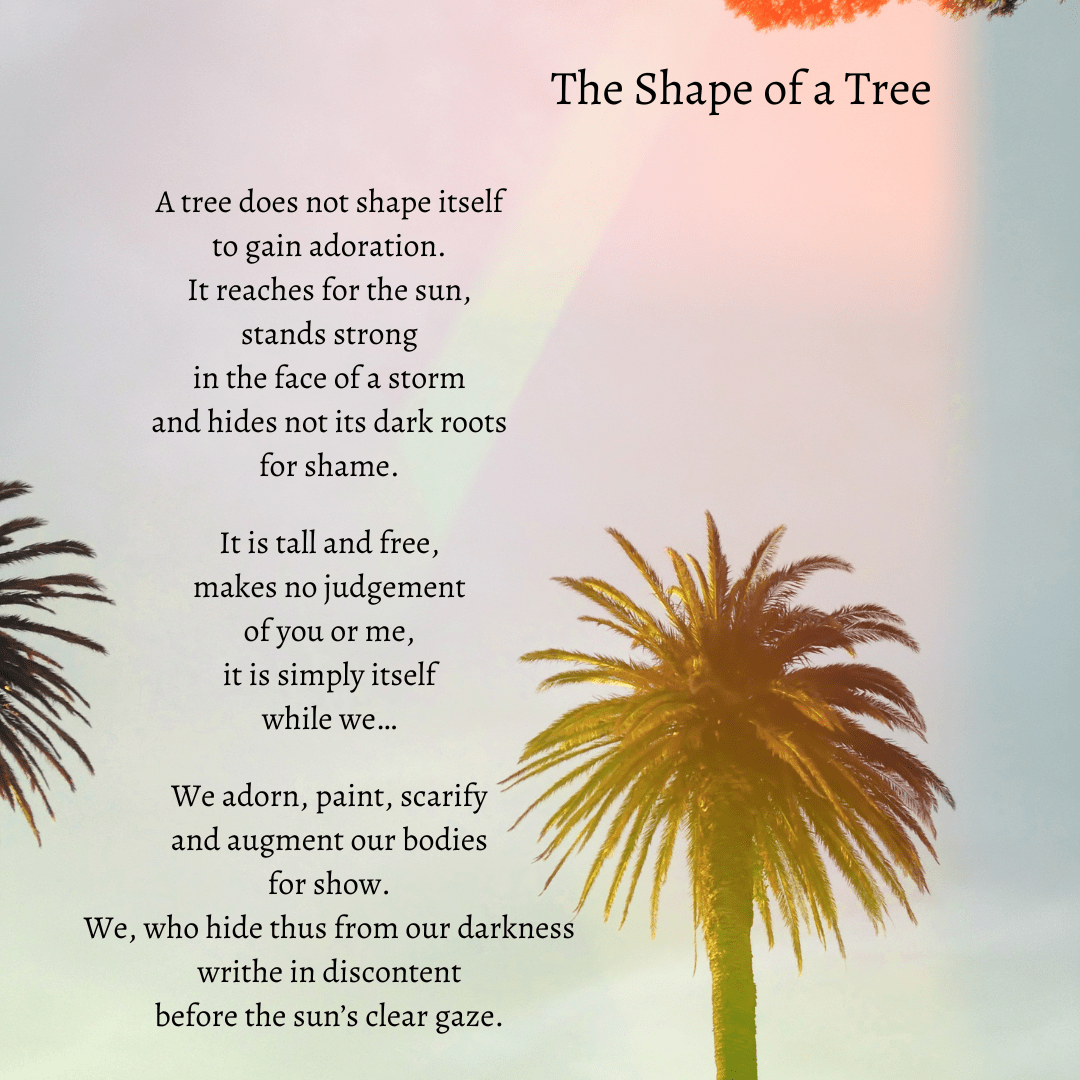
‘The Shape of a Tree’ was written just before I finished my novel. Trees feature in my book, but the way the poem developed, I can now see, describes me writhing away, hiding from criticism, not that I knew it at the time of writing.
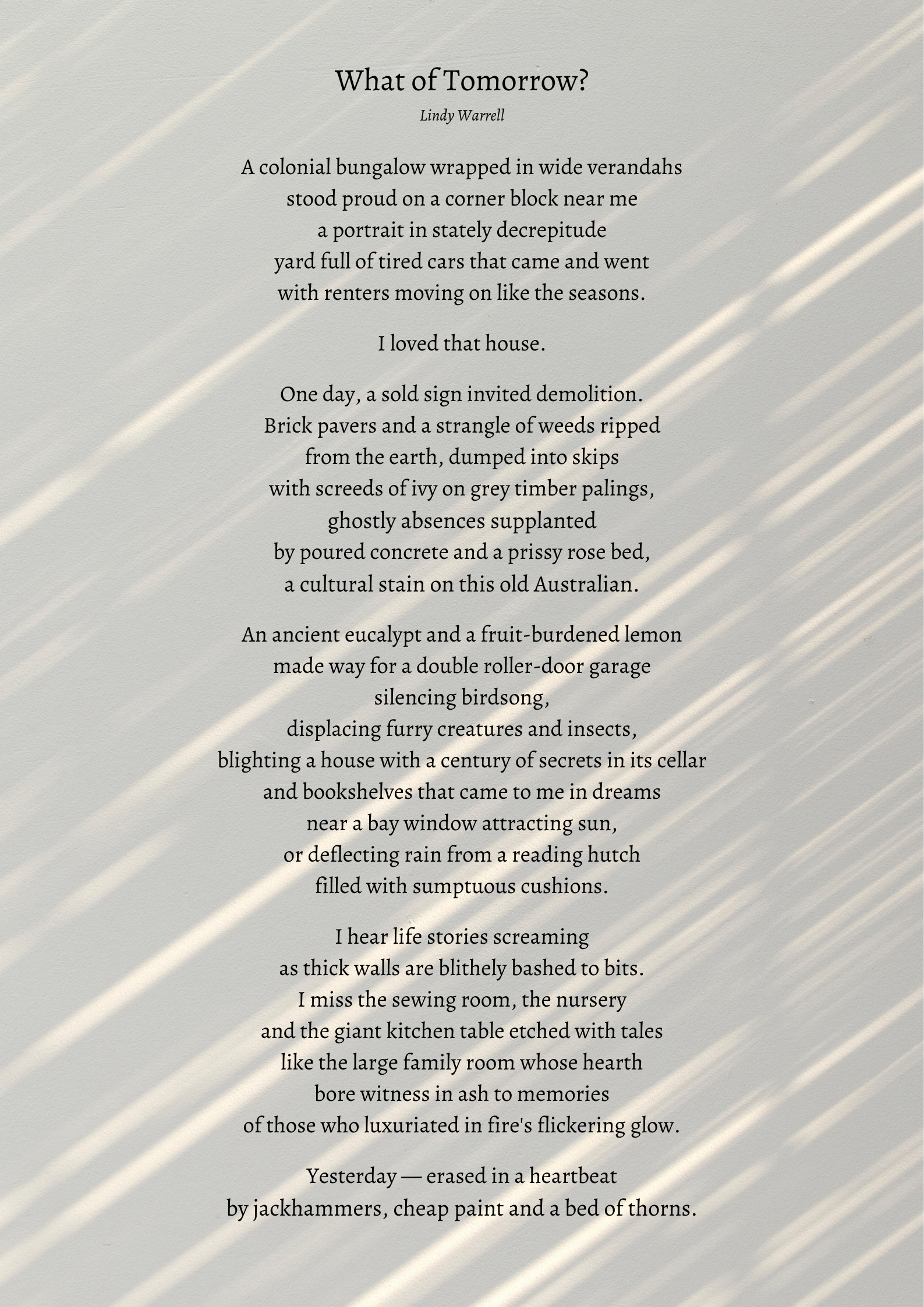
The next poem comes from meandering around the streets of Glenelg and the transformation of a lovely old colonial house that I dreamed of living in for many years. As I read it now, I think it is also a metaphor for ageing or being supplanted.
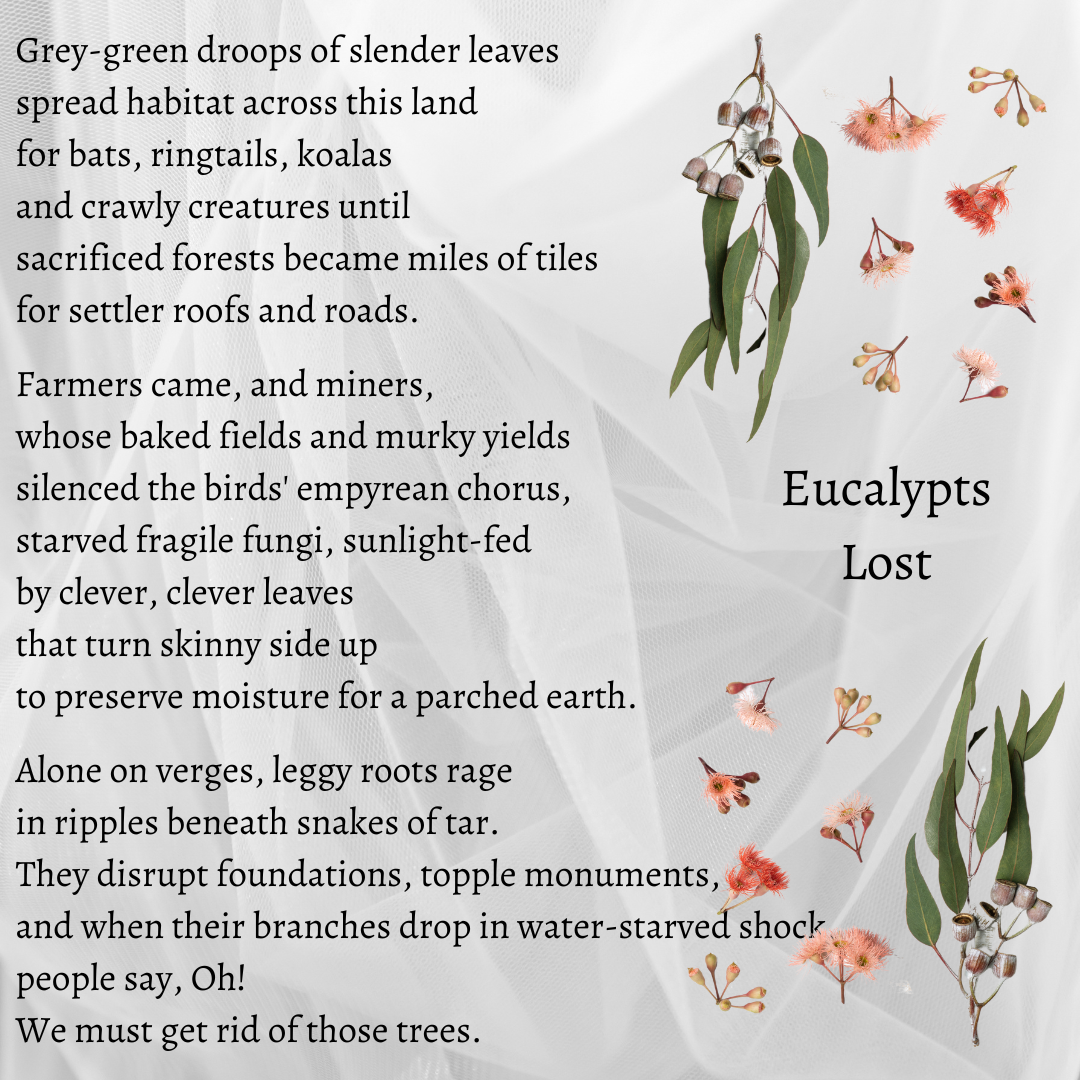
The next two poems are about trees. Funny that they formed in my mind as I wrote my tree-full novel.
I hope the following two poems are not too bleak. Death and dying have become central to my thinking as I age, and reflecting upon them fills me with love for this wonderful planet we share. My life has been enriched by many different landscapes, from the desert to the tropics.
It is a truism to say that life is fleeting, but I remember something the Dalai Lama once said when a journalist asked him if he got lonely travelling all the time as he then did. The monk replied, how could he be lonely, for every chair he sat on connected him to the carpenter who made it, every mouthful of food put him in the company of a farmer. I wish I could recall his actual words, but his point is that the world around us is alive with the history, activities and even personalities of people who are integral to our surroundings and his argument was therefore a question. How can we be lonely if we pay full attention?
Although this last poem was not consciously written with the Dalai Lama’s philosophy in mind, it echoes it.
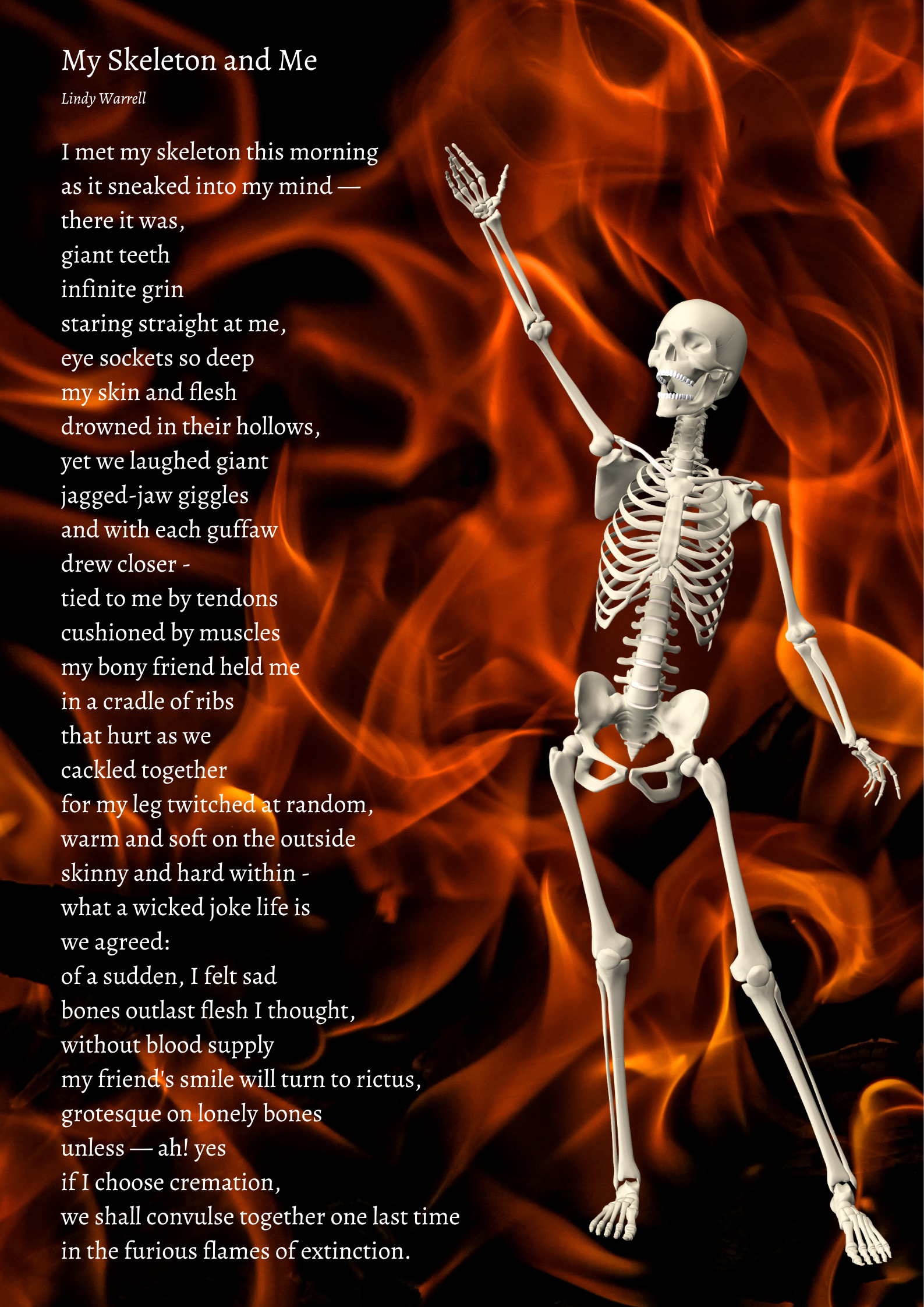
So, did these poems tell you something about me or offer something to you? Please click below to download a free ebook collection entitled Dressed & Uploaded, where I offer the stories that underpin many of the illustrated poems on Wattletales and Instagram.
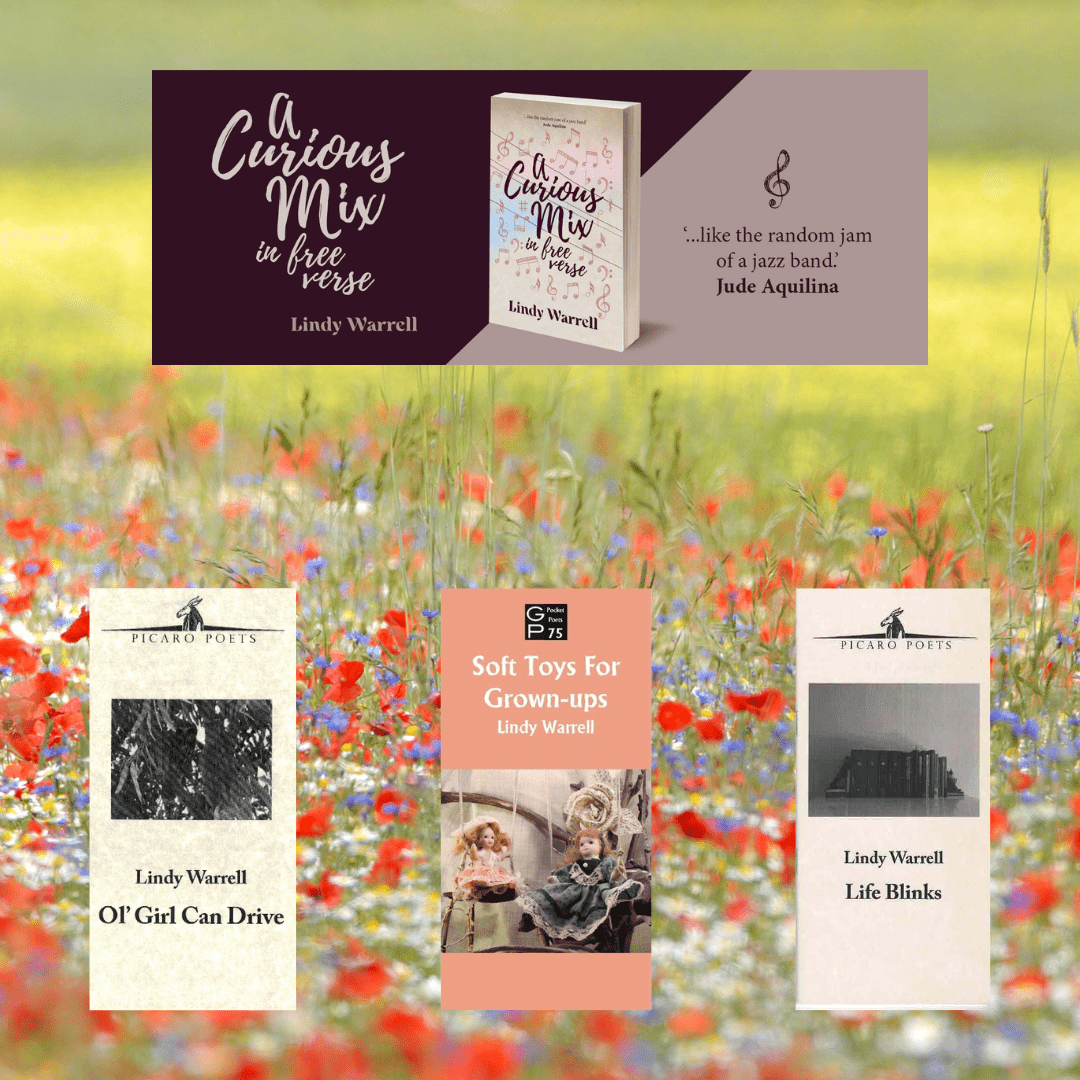
If you wish to purchase any of my other poetry books featured in the opening image, leave a message in the comments section below, and I’ll get in touch.
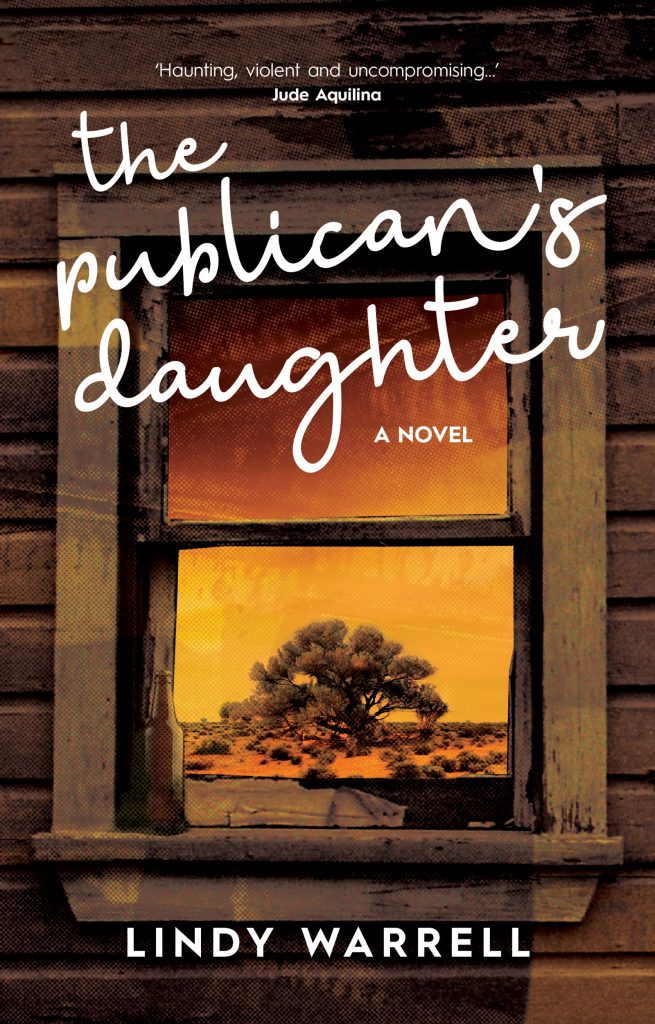
My novel, The Publican’s Daughter is available from Amazon and other print-on-demand outlets and Kindle. They Who Nicked the Sun will similarly be available as of 21 April. However, you can also purchase either or both books directly from me by leaving a message in the comments below or emailing me at lindy@wattletales.com.au.
Novel
Happy Writing
Wattletales
If you’d like to receive Wattletales posts regularly, drop a word in the comments below, and I’ll add you to the list.
I wrote a bad poem a while ago, so my TramsEnd Poet friends told me, and I took their suggestion to turn it into my first short story. I wanted to call it Edth and Joan Do Coffee, but it was not a good title for SEO (search engine optimisation). The current title is supposed to be more searchable and, funnily enough, talks more about the story of two old girls being supplanted in life anyway.
The Baby SUV Invasion
Edith fondled the glass, waiting for her latte to cool, thinking, if you had coffee in a ceramic mug, it’d be half bloody cold, so why is it so hot in glass? At her age, she fancied hot coffee, preferably without burnt fingers. Still, her latte was delicious. She never believed the young barista who once told her that milk burns coffee beans and sours the taste if it is too hot.
‘Sorry, I’m late.’
‘Never mind, I ordered anyway. What are you having?’ Edith stifled an urge to tell Joan to her face that she was always bloody late. The woman’s frivolous apology irritated her.
‘I’m going to try Caramel Macchiato. It’s Starbucks, for heaven’s sake. We might be pushing 80, but I reckon we should expand our horizons, don’t you think?’
‘Excuse me.’
Edith and Joan swung around in unison as a young mother pushed past them with a bulky, black pram on large pneumatic wheels. Her infant mewled under blue blankets beneath the hood. They gave each other a knowing look as if to say that young mothers should park their monstrous SUV prams outside.
Joan remarked that young mothers no longer seemed to want to hold their babies. ‘And, did you notice? The infant’s face was florid and beading with sweat under all those blankets. Someone should tell her we’re in a hot Australian summer, not the middle of the Arctic Circle. Crikey, look out, Edith, here comes another one.’
By the time a waitress brought Joan’s Caramel Macchiato to the table, Edith and Joan were transfixed as the two pram-wielding mothers moved tables and chairs to make room for more mums filing through Starbucks’ glass doors. The ensuing circle of mothers rocking prams with their faces turned to each other, away from their babes, created a veritable spinning wheel of grizzling babes in SUVs
Edith and Joan concluded that the young mothers’ overly loud chatter and high-pitched laughter hinted more at desperation than fun.
A waitress approached to ask if Edith and Joan were okay. They thought the girl looked about twelve and kindly said they were fine. They appreciated the thoughtfulness.
~
When Joan arrived at Gloria Jeans as arranged the following week, Edith forced her lips into a smiley shape when her friend finally sat opposite her, huffing with exertion, saying, ‘Sorry, I’m late.’
‘Never mind, I ordered anyway.’ There was no point in pouting or turning a cold shoulder, as Edith wanted to do.
‘I’m tempted to have a sweet treat today, not just coffee. Can I buy you something, Edith?’
‘Joan, how come you’re offering to buy my coffee when you’re the one on a pension? Feeling guilty?’
‘Guilty for what?’
‘Nothing. Don’t worry about it. ‘ Edith’s irritation was rising. ‘What sort of bloody cakes have they got here? Starbucks was all doughnuts and muffins.’
‘You’re right. It’s not much better here — Gloria Jean’s is all mud cake and banana bread, heavy, thick stuff. Still, I like Gloria Jean’s coffee. I’ve ordered a chai latte, but you know what I mean.’
‘That’s what I got, too. But I’ll give Gloria’s gut-binding cake a miss, thank you very much.’
The old friends stopped talking to enjoy their chai till Edith broke the silence. ‘Do you know what I really fancy? A slice of rich black forest gateau with layers of chocolate sponge, sour cherries, syrup and cream. You can’t find that anywhere nowadays.’
‘Oh! Yum. It’s hard to find a decent carrot and walnut cake, too, slathered with cream- cheese icing. The best I ever had was in the Yarra Valley years ago. The icing was about half an inch thick, and the cake was tantalisingly moist. I’d happily drive to Victoria tomorrow to taste that again.’
Edith snorted. ‘Neither of us drives any more, you silly old git.’
‘Oh, well,’ Joan prattled on. ‘A girl can dream.’
Edit changed the subject. ‘Have you ever tried the pies and pasties here? They are the worst. I guess it’s an Australian shop with American recipes.’
Joan picked up the cake thread as if Edith hadn’t spoken. ‘Chain coffee shop cakes are as bad as all that soft bread the supermarkets force us to eat nowadays. Do you ever wonder what happened to hot bread and crumbs all over the kitchen floor, from cracking through the crust to the soft, warm dough inside? Did you ever pull the dough out to eat on the way home when you got a half loaf still warm from the baker? Mum used to yell at me when I did that.’
‘As for pies’, Edith refused to let Joan hijack the conversation. ’Once upon a time, you could get a Balfours or Mrs Mac’s pie or pastie in any Adelaide petrol station — or garage as we used to say — which would have stocked Villies pies and pasties too. These new servos make their own. I’ve never tried one. Not once. The pastry is too thick. You can tell by looking at them through the pie-warmer glass, which nobody ever seems to clean properly. The pies we got at school were the best, Balfours, I think.
As they finished their chai, Edith and Joan watched a parade of youngsters and middle-aged women with adult children filing in and out of Glenelg’s Gloria Jean’s café. Edith broke the silence. ‘My daughter took me to a posh lunch in Port Adelaide the other day. I fancied Pavlova. She ordered it, and bugger me, it turned out to be a deconstructed pavlova. Have you ever heard of such a thing, Joan? It was a piddling little serve of crumbled left-over pav shell, with a few bits of fruit cut so small you could hardly tell which was what, and a small dollop of cream.’
Joan banished the disturbing frown that tried to wrinkle her forehead earlier and fell into line. ‘I know that place, along the main road. I had an expensive green leaf confection there that I wouldn’t feed to a rabbit. Drowning in vinaigrette, it was, but with not enough substance to be called a salad.
Edith’s forehead was less compliant listening to Joan when rattling on about the snitty, a dish that evolved from the Weiner schnitzel. ‘We used to sprinkle it with a lemon quarter to mitigate the fat, but now, they drown the dish in gravies and sauces until the crunchy golden crumbs are sodden.’
‘The thing is…’ Edith interrupted. The thing is, every chef in every pub, restaurant, and café now invents or reinvents food presentation. It’s all about visuals and photographs since nouvelle cuisine became the rage and the internet. Schnitzel doesn’t really fit that scenario, does it?’
The two women emptied their cups, tightened their smiles, and stood to leave. They arranged to meet next week in the afternoon for a change at The Grand Hotel in Glenelg, where they serve high tea.
~
‘Sorry, I’m late.’
‘Joan, do you realise we’ve met for coffee on Wednesdays for at least 35 years, and you’re always friggin’ late. I do not recall a single occasion when you were on time.’
‘Don’t be like that, Edith. You always start without me anyway, and you’re halfway through your coffee before we even say hello.’
‘I’ll be whatever I like, but here’s the deal. Next week, l will wait for you no longer than 10 minutes past the appointed time. If you are not there, I’ll leave, and you will never see me again.’
‘Well, if we are going to be honest, I’m fed up with you being the one who thinks she always knows best.’
‘What?’
‘You did it last time with the pies.’
‘The pies?’
‘I wanted to talk about bread, and you insisted on yapping on about pies. You’ve always thought you’re better than me because you married an engineer and my husband was a tradie, but I remember well whose husband treated who better.’
Edith stared at her friend, mouth agape.
‘That shut you up, didn’t it? You and your David treated my Gary and me like we were not quite the full quid sometimes. Did you think we didn’t notice?’
‘Well, you should have learned how to cook properly. We used to make sure we’d eaten before we came to your place for dinner. You couldn’t cook a roast to save yourself: wet, overcooked cabbage, squishy pumpkin, dry meat. Your roast potatoes were never crisp, and you used Gravox. ’
Joan burst into tears. ‘You were just jealous of Gary and me. I always thought you fancied my husband, and all the while, your up-himself David, used to try to put his hand down my shirt or up my skirt if ever he found me alone in a corridor or the kitchen while you were swanning around showing off your world’s best gravy.’
‘Me? fancy Gary? You must be joking. The man’s fingernails were never clean.’
Joan stood up abruptly, still crying and ran out of the café.
Edith apologised to the staff for Joan’s behaviour, saying as she paid the bill, ‘My friend’s a bit mentally loose. She’s getting on a bit.’
~
A few days later, Joan’s heart missed a beat when she discovered Edith’s funeral notice in The Advertiser’s obituaries, which she read every day. There it was, in black and white. Edith was dead. It read, ‘Beloved wife of David and mother to James, Carry and Barbara, died peacefully at home on 11 February. The funeral will take place on 16 February at the St Peters Anglican Church in Glenelg at 2 pm, followed by cremation at Centennial Park.’
So much for high tea.
Joan decided her eulogy, were she to go to the funeral, would be: ‘Edith and I were lifelong friends who grew up together on a Housing Commission estate. We shared birthdays, weddings, births, and deaths. We outlived our husbands, and our children long ago fled the coop. We were two women defined by the lives of others. We said we were friends but had nothing in common. We simply clung together from habit over a waft of caffeine.’
Happy Writing
Wattletales
If you’d like to receive a link to Wattletales posts, drop a word in the comments below. Your details will be hidden.
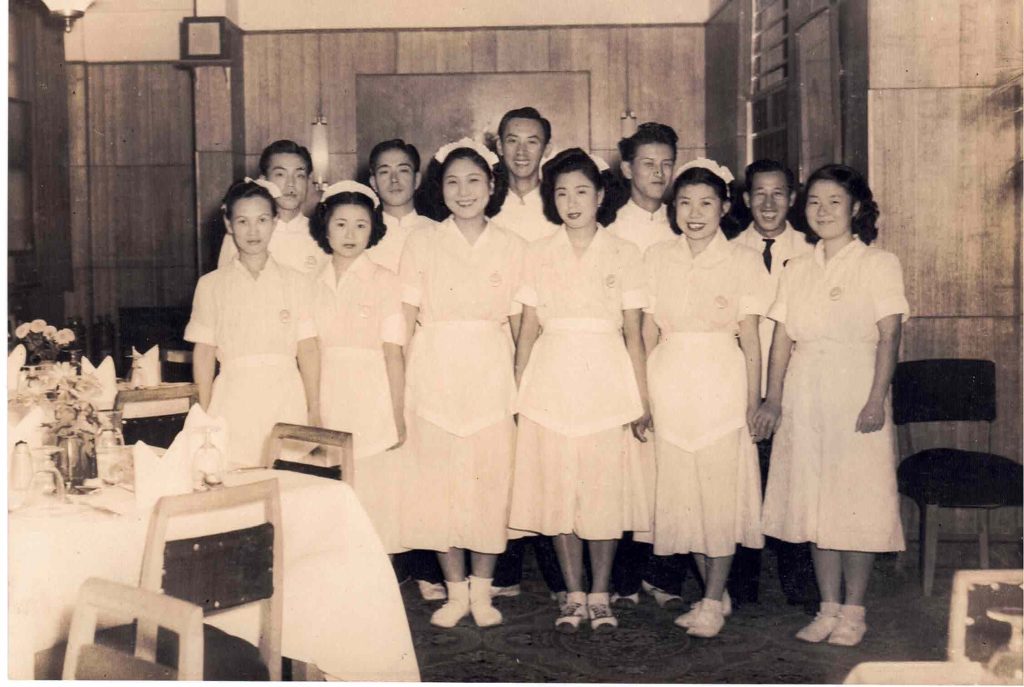
Early this year, a friend of mine travelling in Japan was kind enough to take a photograph of The Marunouchi Hotel in Tokyo where I lived as a child for several years post WWII. The contrast between that hotel now and how it was in 1947 during the British Occupation moved me profoundly. It raised the issue of one’s hidden side. No matter who we meet or where we go, our life travels with us, but so much is silenced in the company of others without similar experiences. I want to explore that today by asking, for example, why these before and after photographs affected me so.
Photo of modern Marunouchi Hotel by Kuma Raj Subedi
An Australian student of mine in the 1980s adopted a Vietnamese child. For his dissertation, he explored the complex issue of cultural identity for those thrust between cultures by adoption. I’m sure many dissertations have since appeared on this topic, and crossing cultures is a complex lived reality for those who emigrate or are displaced by war and famine. It also raises important questions about our sense of who we are.
Whatever our culture of origin may be, I suggest that we are one thing to ourselves and quite another to everyone else, and it is not only across cultures that we find parts of ourselves hidden. It also happens through time unless, perhaps, we had the good fortune to live with the same people around us from youth to old age. Even then, as my father would say, ‘The whole world is weird, except you and me, and even you are a trifle odd’.
Japan
SBS recently screened a short but delightful series set in Tokyo called Three Star Bar. It got me thinking about the book I planned to write, Beyond Ginza, based on my childhood in Japan. I’ve mentioned this before in Dislocation, which explores how I moved a lot as a child and throughout my life.
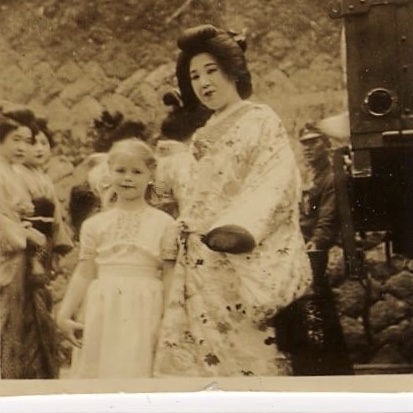
I may never write Beyond Ginza, but I attach a few character sketches of the child protagonist, Alice May Caulfield (not quite Lindy Warrell, but close) in the attachment below. The two photos below form the setting of the first sketch.
Not many seven-year-old girls would have the experiences I drew on for those sketches, and yet, here I am, at 81, with the sensations and feelings as alive today in my memory as ever. I learned so much in Japan, not about the politico-military goings on, but about the people who were kind to me and those in power who were not kind to the Japanese. I still feel connected to Japan, but it is to a place that no longer exists, as my photos of the Marunouchi attest. I know nothing of contemporary Japan.
I lived in a hotel co-opted by the British Commonwealth, managed and operated by my Australian father to serve non-Japanese military officers and gentlewomen, hardly the ‘real’ Japan of the 1940s. However, my mother’s forays to the countryside, villages and markets introduced me to perfumed Geisha beneath cherry blossom trees. With Mum in Shinto and Buddhist temples, I smelt incense for the first time.
I remember thinking the Geisha was the most beautiful woman I’d ever seen, everything so perfect: her dress, makeup, perfume and graceful movements, like a cloud dancing. I felt blessed.
My point is that I was an outsider in Japan when it was at its lowest point, and I lived in relative luxury amid great suffering. My ‘inside world’ entailed arrogance and people who mocked Japanese products like cigarette lighters, then seen to be inferior to the British Ronson and, later, the famous US Zippo (which was found in the 1980s to have used asbestos).
These vignettes from my life don’t resonate with anyone I know. These moments, these memories and others are somatic memories hidden from others. My ability to share these things died with my parents.
Sri Lanka
I have written in some detail about my life in Sri Lanka as a postgraduate researcher, but no matter how deeply embedded in that world I felt, I remained an outsider. Nevertheless, the outward experience is internalised as both vital and valuable. If I speak about that inner journey, people often become uncomfortable. It’s not easy to appreciate other people’s experiences.
Living white in a black country means you are the one who stands out. Occasionally, in the streets, someone would call out ‘suda’, meaning ‘whitey’, and laugh. People laughed if I jumped around at a bus stop when a snake — a common occurrence — slithered between my feet. These were small things. More often, people were kind — curious, yes — but welcoming and, over time, one acquires a certain confidence of movement that tells locals you are not a tourist per se.
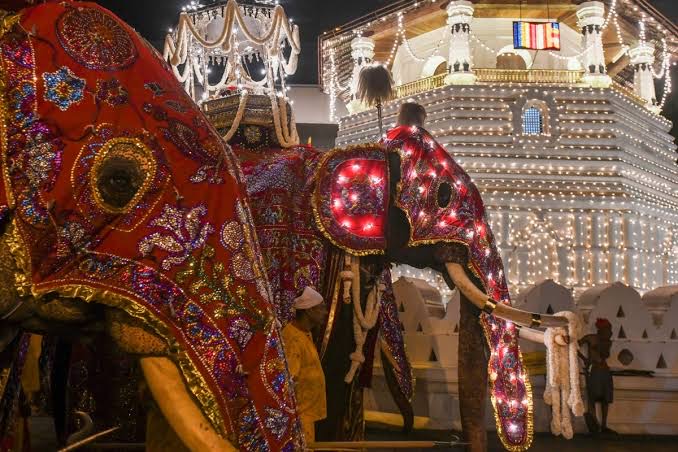
The people I worked with protected me from uncomfortable moments. At a week of an all-night street ritual called the Perahara, when performers from other areas of Sri Lanka tried importuning me for cigarettes or cash, my friends shooed them away (in a bugger-off tone). They were told to leave ‘ape Madam’, ‘our Madam’, alone. You see, with few exceptions, I wasn’t Lindy Warrell. I was Dr Lindy Warrell, the researcher of their rituals. They used the honorific even though I was far from having the PhD at that point.
Caparisoned Elephants in the Kandy Asala Perahara 2019. The Temple is called the Dalada Maligawa or, in English, The Temple of the Sacred Tooth Relic of the Buddha. Photo by Agence France-Presse (AFP)
Please understand me. I admired and grew close to the people I regularly worked with and their families. They were genuinely generous and caring towards me. I still have friends from that time on Facebook and email. My point is that it was my status that people responded to, either as a tourist or Madam.
It makes sense, doesn’t it, for an outsider? Parts of who we believe ourselves to be, are rendered invisible when interpreted in other people’s frameworks. Sri Lanka was not interested in my Australian identity and by the time I got home, nor was Australia interested in how Sri Lanka had re-formed me. I felt different, but the internal changes in me largely remained hidden.
Outback Australia
I lived in Oodnadatta for a decade and the Territory for more years than I can remember. I have also worked across outback Australia with a variety of First Nations groups. These experiences changed me, as all experience does.
Photograph by Steve Parish
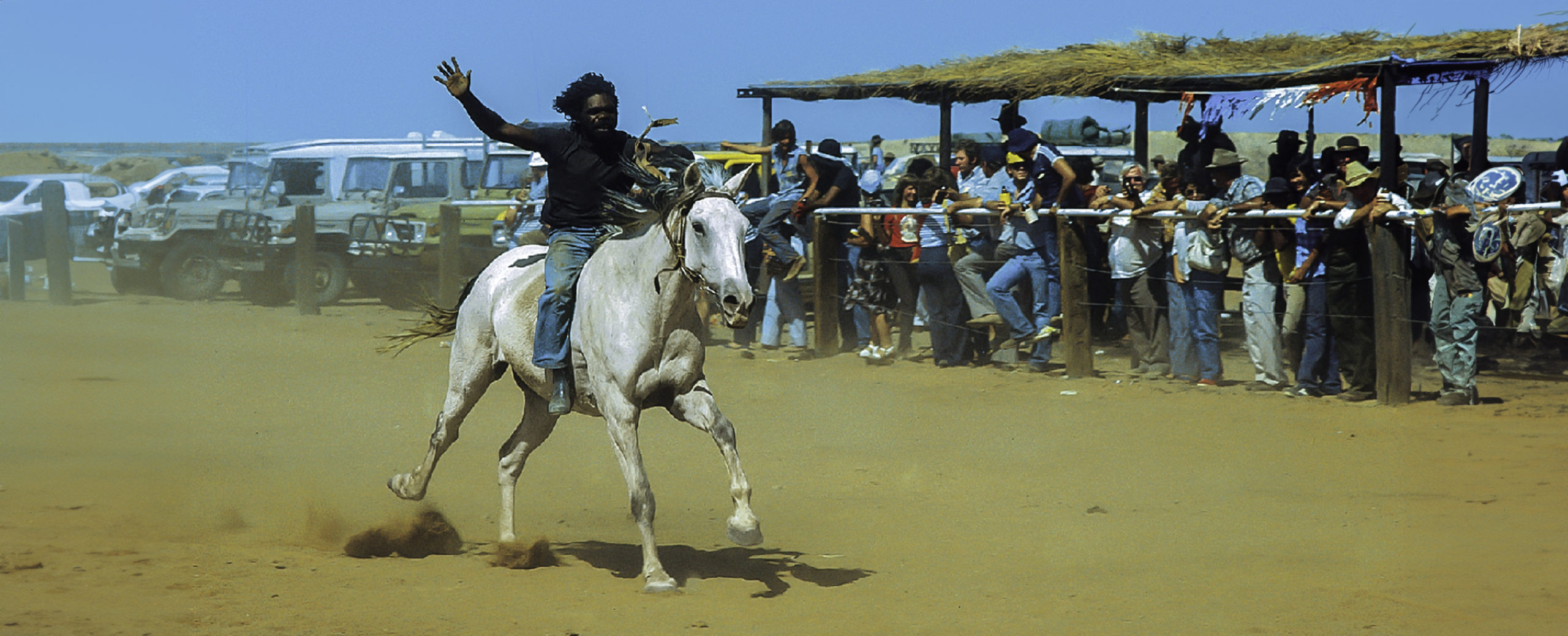
I fell in love with the Flinders Ranges in my late teens and early twenties, from the windows of the Ghan on the way from Oodnadatta to Adelaide. In the early morning, the magnificent purple ranges rose beneath blue skies to take my breath away and steal my heart. My experience of red dirt and gibber plains was as the publicans’ daughter in Oodnadatta, riding horses to show off to boys or partying in the claypans at night. As we lay back, slightly tiddled beside a dying campfire with a lazy guitar playing in the background, I’d gaze at the stars and believed the world to be filled with magic and destinies unknown.
I’ve never camped in the Flinders Ranges, but I’ve camped across this land, working in the Northern Territory, Queensland, NSW and South Australia. The stars brought back my youth, the red dirt still filled my heart and Queensland’s stony river plains called to me of my father at the precise time my mother was dying in Adelaide far away. I have posted this poem before, but this is its true moment.
Secrets
We all carry secrets, parts of ourselves that we dare not share for shame or simply because such secrets are treasures we prefer to hold dear without others knowing. Secrets are conscious parts of our hidden halves. But all experience becomes entwined, creating our sense of who we are.
I would go as far as to say that who we are is a tangle of stories, some of which we recognise as such, others that we don’t understand or would deny. Our stories tell us who we think we are, but some stories remain suppressed because they find no audience in our present. They are hidden.
As I started to write this, I remembered the works of VS Naipaul. My favourites were A House for Mr Biswas, about alienation and Half a Life, which matches today’s topic. I now see why those books resonated so well with me.
This link will take you to several reviews for Sir Vidiadhar Surajprasad Naipaul, who won the Nobel Prize in Literature in 2001 ‘for having united perceptive narrative and incorruptible scrutiny in works that compel us to see the presence of suppressed histories. I’ve excerpted two comments from the linked article as they pertain to this post.
On Being Invisible
We talk about being invisible in old age, and we are. I remember many moons ago, in my forties, dancing with a seventy-year-old man to please a mutual friend at a dinner party. The guy was an adventurer, his skin deeply tanned, and he wasn’t bad looking as far as wrinkles and rough skin allow. He’d travelled and more, yet gauging him as I did only as a potential love interest, all I could see was his age. How shallow was I? However, the incident lets me rest comfortably now when I am invisible myself. It is, I believe, in the order of things to an extent as we age. His exciting life remained hidden from me. It did not count then, as mine often does not now.
This invisible business is in the structure of our world. I was in hospital for a few days recently, which invites reflection. Lots of lying around doing nothing frees the mind to float wherever it may. To medical practitioners and nurses, I was an old lady with a touch of pneumonia who had to be medicated, stabilised and discharged most efficiently according to the medical lexicon, and that is how they treated me.
Lindy Warrell, mother of three and thrice a wife, barmaid and anthropologist who has travelled, written poetry, novels, blog posts, essays, a PhD dissertation, and academic publications, is not in their lexicon. She tried to raise her head a couple of times only to find that views from a different framework were unpopular among authoritative professionals in expert positions. They declare but do not discuss.
In the movie, ‘Shall We Dance’ (2004), Susan Sarandon spoke a line that has stayed with me for years; ‘We all need a witness to our lives’, and we do. Is talking about my hidden moments in this public forum betraying what I write? Possibly but, more importantly it comes from getting older and trying to understand one’s life in hindsight.
An Afterthought
Let me finish with an invitation: Take a moment to examine your life to see if there are contexts where experiences, especially times that have profoundly changed you, are silenced in the absence of an appreciative witness.
Happy Writing
Wattletales
If you’d like to receive a link to our regular monthly and occasional guest posts, drop a word to that effect in the comments below. Your details will be hidden.
Children are naturally curious; they are, let’s say, biologically driven to learn. The joy of discovering fingers and toes and nose indeed drives them on. At school, the intense curiosity of childhood is channelled in definitive directions. It is where we all risk becoming the same or failing because we are not. Adulthood further cramps us as we discover, without trying, how little control we ultimately have over our lives. However, acknowledging the depth of our ignorance can spark our curiosity again, like magic.
When I write, I start at the surface, but as I put words on the page, others follow, taking me in directions that would otherwise not have come to mind. Clarity, for me, takes time to emerge on the page. If I think I know where I’m going before I write, I’m wrong. I discover what I want to say as I write, and that’s because I start in ignorance, which is pretty much how I’ve lived my life. Ignorance is, to me, the premise from which curiosity springs,
Wait Till You Get There
When I taught at Adelaide University, I learned something important from students who would come to me terrified at the beginning of their Honours year or as PhD students about to go abroad to do extended fieldwork.
Honours students had great expectations of themselves to ‘be an honours student’. They felt they had to be more than who they were, someone who’d just achieved a first degree with distinction. They thought they had to be something they couldn’t yet grasp. In other words, they wanted to be what they would become at the end of their honours year before they started. That’s a pretty scary thing to do to yourself, trying to be the future in the present. It creates a gut hole called panic.
Postgrads had a similar temporal displacement thing going on. Mostly, they did not know the country they were going to and, once there, had to find people to work with. That fear is similarly about trying to control the future when we simply cannot. That’s it. It’s not possible. We may be able to plan, but plans can go awry. In those pressured moments when the gut hole appears, we need to remember our decision-making capacity will be with us wherever we go. Preparation aside, trying to control what we can’t know is useless.
My philosophy is that we should avoid yearning to be who we’ve yet to become by staying in the here and now and starting everything from where we are. And that means starting in ignorance of what we are about to learn. That also goes for the act of writing. Whether we write an essay, a report, prose or poetry, we have to start somewhere, but the question is, are we inscribing what we know intellectually or creating something new? The latter must start from ignorance.
Years ago, an artist friend told me she had no idea what she was doing but kept doing it until her work manifested in an installation she could later ‘read’ and understand.
Different Types of Knowledge
As Executive Officer at the Darwin Menzies School of Health Research many years ago, I worked with the head of the Indigenous Department to help doctors and scientists understand that doing research is a privilege, not a right, especially when working in communities.
Our course challenged everyone. We were talking to senior health and medical professionals accustomed to gathering knowledge-as-object and being the knower. They liked to collect facts, put them in a pocket and walk away satisfied, whereas to work effectively with First Nations people, they needed to learn about themselves to understand others, especially in communities. We were not popular. The school soon brought in consultants to replace us.
We know that fact-finding is objective science at work, but it turns humans into objects and denies that the researcher’s humanity is integral to the resulting body of knowledge. Objectivity like this is part of patriarchy.
Collecting facts and data is very popular nowadays. Experts stand outside of whatever they are researching, which means measuring. Once upon a time, researchers measured the heads of tribal babes and deduced that larger or smaller heads meant intelligence or its lack. Nowadays, doctors measure old bodies on a routine basis (BP, oxygen saturation, height, weight, bloods), but they do not understand aging. Statistical results create a bodily mean, an average that we are all measured against, but we are more than our bodies.
The Magic of Words
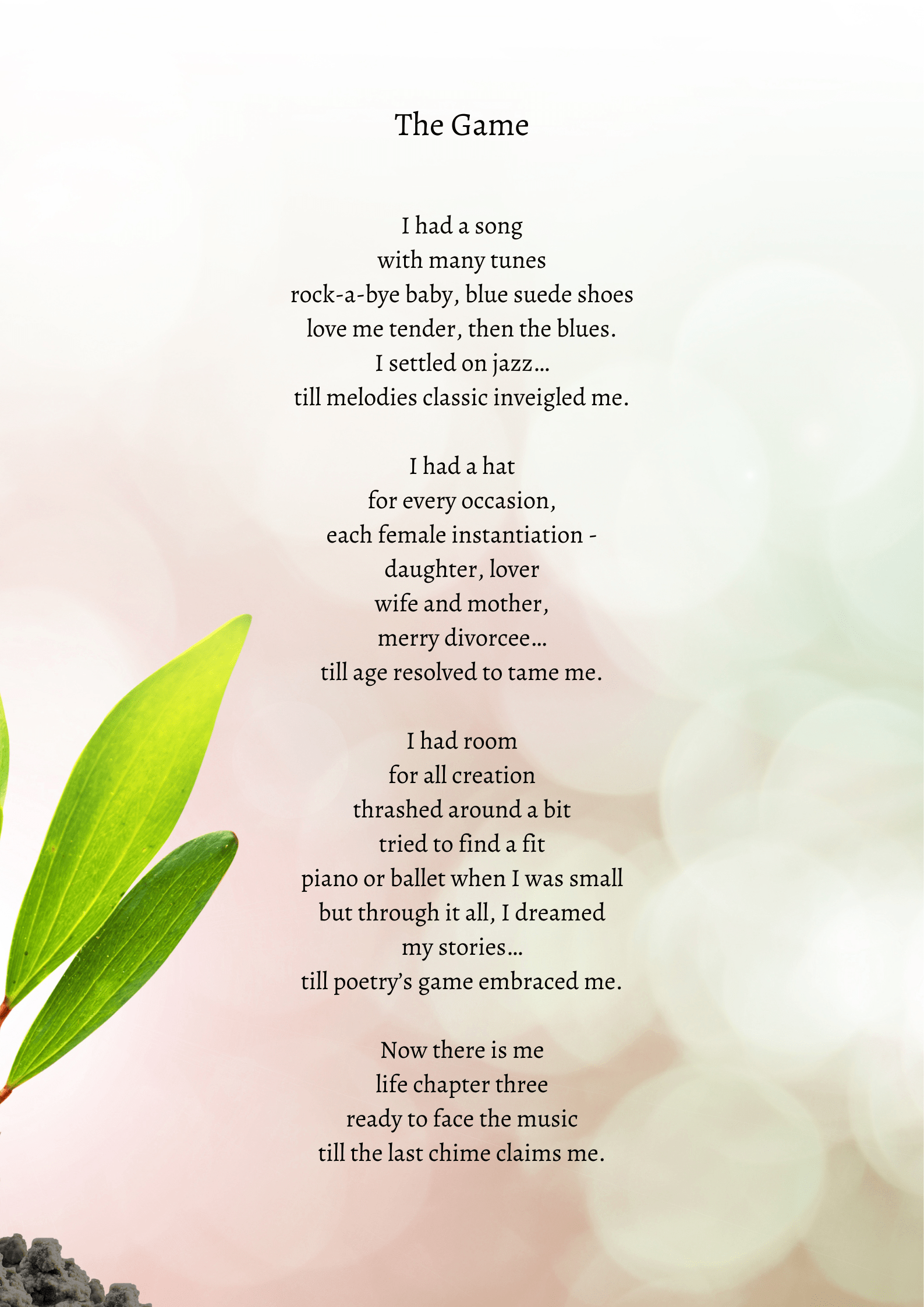
When we write, each word on the page asks what comes next. Here is a poem I wrote many years ago in a workshop. We were asked to write about home. I knew my poem would not be full of nana-made marmalade, gardening and knitting, but I didn’t expect what emerged.
Looking back on one’s life produces a different effect. In the former example, the word ‘home’ was a trigger; in the following poem, The title’s question, The Game (of life), sent me on an archaeological expedition.
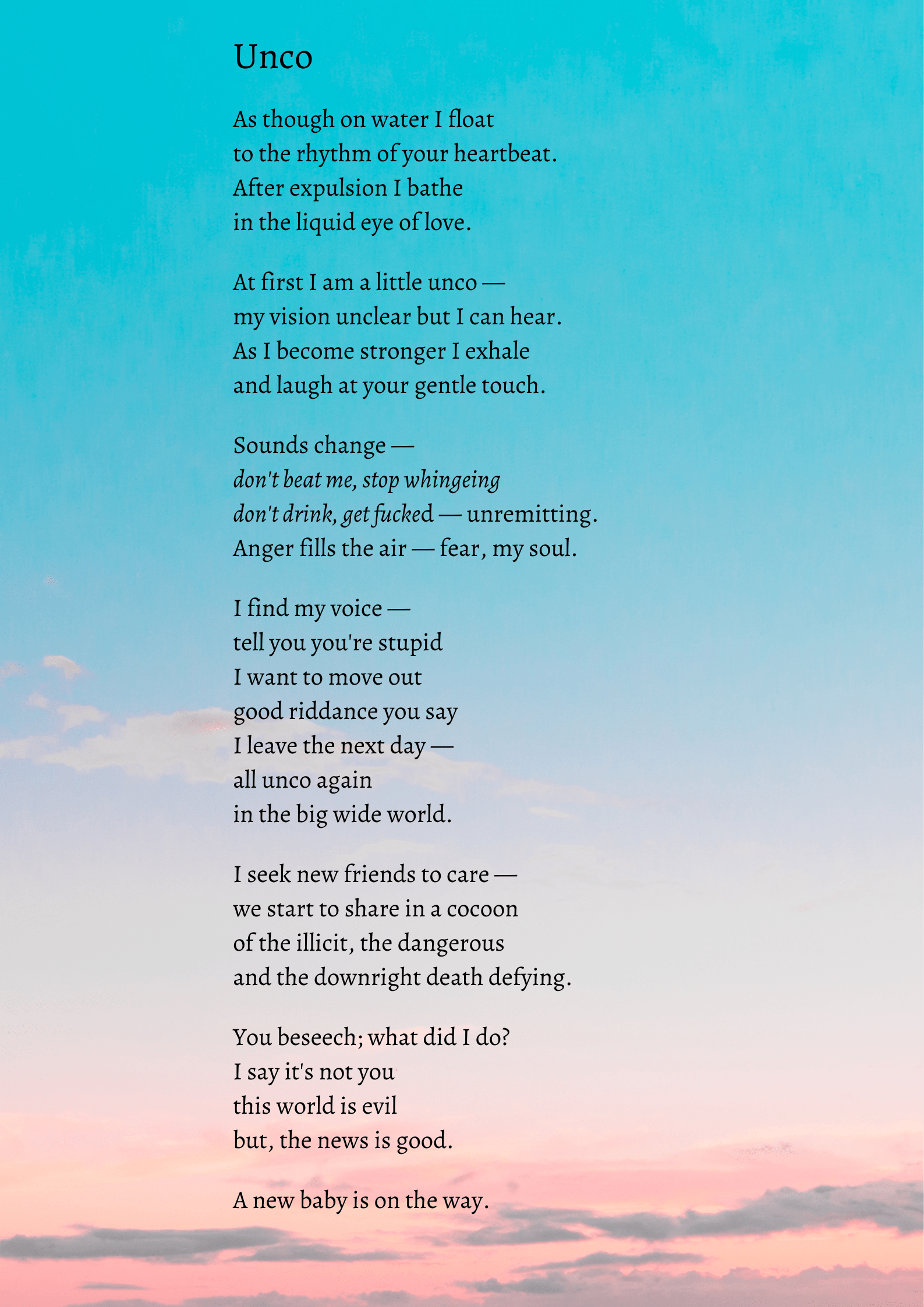
Staying open produces something else entirely. Where Home was a topic and The Game a question, I have no idea where Unco came from except that I heard the word and let it do the digging. Unlike the other two poems, Unco has nothing to do with my life. I include it here because it points to being forever in the moment, ignorant, uncoordinated, and unable to predict the future — as in life itself.
We Are All Different
Saying that we are all different is hardly novel. We all have different creative processes. I wrote this blog post because I wanted to know what I think. I trust my intuition, but when it comes to explaining how I come to clarity, I have to dig.
Writers speak of being a plotter or a pantser. Although I’m organised, I am, in essence, a pantser. I go where the moment suggests and learn what I’m trying to say along the way. When I wrote essays at university this was pronounced. I could never write an introduction until I’d found the conclusion. Other people know what they want to write and plan or plot accordingly. They are inscribers. Those with visual memory may be more like sculptors. Some writers may have no interest in how they get words on a page.
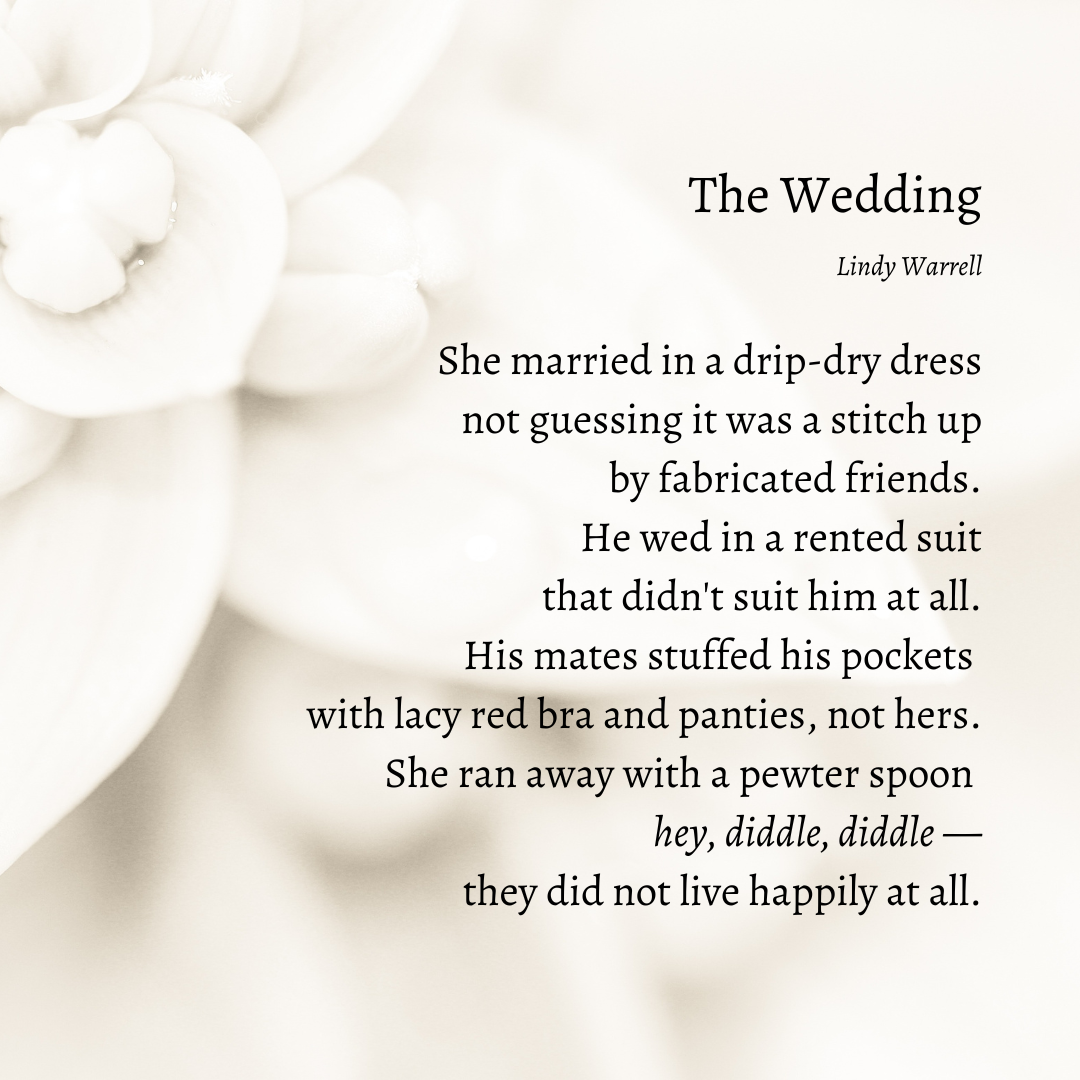
I’ve neither researched nor studied how my mind works nor why I sometimes write such odd poems. As for the following poem, I seem to recall it came about from the phrase, ‘she married in a drip-dry dress’ that popped into my mind out of nothing, which is to say, ignorance, but it took my fancy, and away I went, using it to excavate.
Happy Writing in 2024
Wattletales
Drop a request in the comments if you’d like to receive a link to our regular monthly and occasional guest posts. Your details will be hidden, but I can add you to the mailing list. Lindy
Let me start by wishing everyone the happiest festive season for 2023. I hope you have friends and family to get together with and enjoy. However, I know you’ll agree that this time of year is not called the Silly Season for nothing. I’ve therefore decided to talk about my odd Christmas history. It is probably good that my previously prepared post on this topic was lost with Wattletales’ first big crash this past week because it may have been a tad miserable. So, I’ll press ahead with this somewhat less salubrious and less well-thought-out tale.
As you can see, I’m a koala, gum tree and wattle girl this Christmas. While I don’t mind a roast (with salad) on Christmas Day, it really doesn’t suit our usual hot weather at this time of year. The traditional ideal of red and white, reindeer-in-snow images of other worlds have never appealed to me. We got our own flag down under, we chose the bilby for Easter and will one day become a republic. It might be too much to want to see our Christmas iconography change my lifetime, but I can wish.
On Being Alone
As we know, many people are alone at Christmas time for various reasons. I have personally spent quite a few years far from family and friends. I’ve had a few pity invites over the years. I only accepted once but found it increased my sense of having nobody. That was years ago.
Once, I took myself to a hotel for a slap-up Christmas lunch (Christmas Dinner as it used to be known), but the long stares penetrated with a degree of patronising sympathy I found uncomfortable. And I paid for it! Since then, I have celebrated my solitariness whenever the need arose without succumbing to self-pity that my life was seen by others to be falling short of mandatory merriment and gifts.
A Publican’s Christmas
Those who know me have heard me say I was born and bred in pubs many times. I also worked in hotels of various degrees of status, from receptionist to cabaret-night and dining room hostess to waitress, housemaid, cook and bottlewasher, both full-time and part-time until my mid-forties.
My last two jobs were as a kitchen hand and waitress at the Ensenada Motor Inn on Colley Terrace in Glenelg and the Atlantic Tower Motor Inn, where I cooked breakfast and cleaned rooms on weekends, then vacuumed the entire space of the tower’s revolving restaurant. Those jobs gave me extra money for my postgraduate fieldwork in Sri Lanka, where I took my three lovely kids.
L-R Mark, Vanessa, Me, Grant
The thing about being a publican’s daughter in my day was the tradition — I don’t know if things have changed — for the publican’s family to serve staff a feast after the crowds went home. As a family, we had small private moments to exchange gifts first thing in the morning. New Year’s Eve was as busy, and the world stayed busy until February when life returned to normal. I still feel as though the year doesn’t get properly under way till then, although earlier Easter marketing sometimes spoils that.
Where to Go?
A lot of folderol accompanies decisions about where to go and who will entertain at Christmas time. Families may fight about these things, for often, there are conflicting demands and jealousy between siblings and generations.
We were lucky. My in-laws were Dutch, and they celebrated St Nicholas on Christmas Eve rather than Christmas Day, so we could celebrate with both families without concern. After the divorce, and as the children got older, my parents, my kids and I would more often go to a great Chinese restaurant that used to be nearby on Brighton Road for Christmas Day, particularly when my brother visited us from Canberra.
Over the Years
It’s impossible to categorise a lifetime of Christmases. My three children scattered to the winds, my eldest living in London and the USA for many years, the others interstate. Before they left home and both of my parents were still alive, the kids and I visited my father, then living in the War Veteran’s Home in Fullarton. Later, as Dad’s life was ebbing, I visited him alone.
At one stage in my middle years, the idea of orphan Christmas celebrations emerged. If you are travelling, away from home or even simply alone, they can be a lot of fun. One of my favourites was eating Chinese food for Christmas in Delhi, India, with like-minded travellers from other parts of the world.
Somewhere between young children and dying parents, Cyclone Tracy intervened. That was a non-Christmas I’ll never forget.
As for New Year’s Eve
I always look forward to a new year, just as I look forward to each new day, but I’ve never liked New Year’s Eve celebrations. In pubs, the drunks got a bit much, and there was so much to clean up afterwards. In my younger years, everyone seemed to go on a party crawl, looking for the best place to be, leaving many hosts bereft and insulted, and my guess is the crawlers would never have found a decent party with that attitude. Even then, I thought that way.
As I got older, and mostly alone by preference at this stage, I preferred a good night’s sleep and still do. Living in Manson Towers in Glenelg, I now go to bed early, and should the crack of midnight fireworks on the foreshore wake me, I listen, smile, and go back to sleep. Sometimes, I get up and watch the highest sparkles, which I can see from my balcony.
Apart from that, I tend to spend the festive season, and the build-up to New Year’s Eve, musing.
My 2023 Guests
Wattletales has been privileged again in 2023 to have had a number of guests share their creative journey tales with us all. I thank them all.
While their contributions appeared in my regular post, I also thank the members of the Everyone’s a Poet Workshop at Glenelg Community Centre for sharing their work with Wattletales as well.
A Final Word
For those of us lucky enough not to be in crisis this year, I’m going to repeat my old Dad’s admonishment whenever I grizzled, ‘If you think you’re having a rough time, just read the papers, Luv’. I am personally thankful for being where I am and for the gift of a long life without ever having to suffer the torments that people elsewhere now experience in many parts of the world. May they find peace soon.
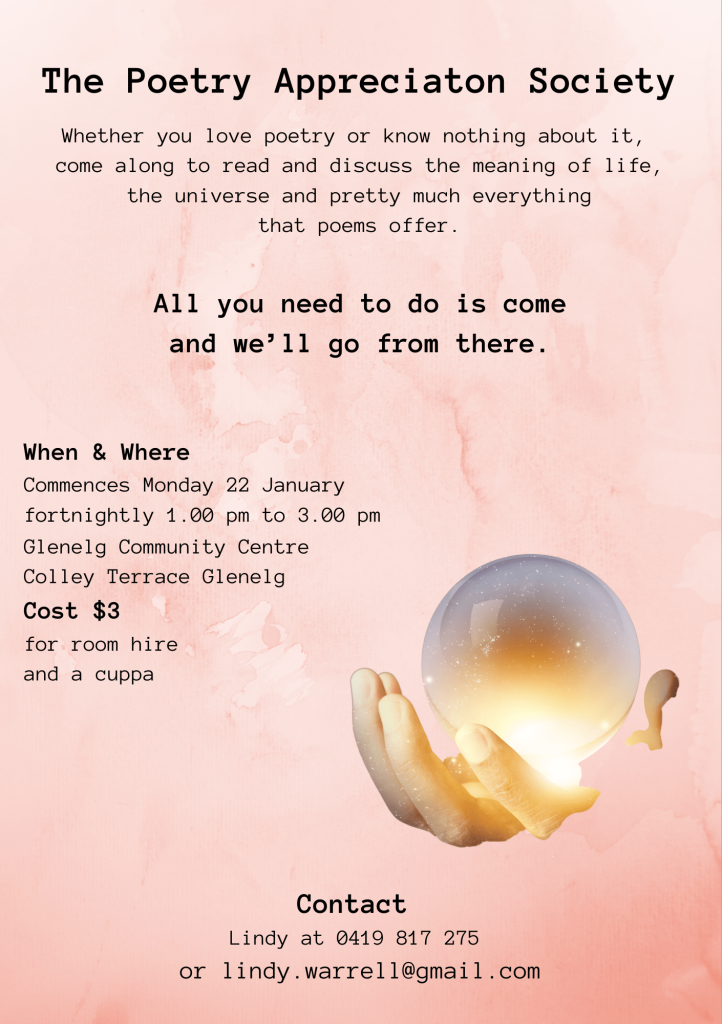
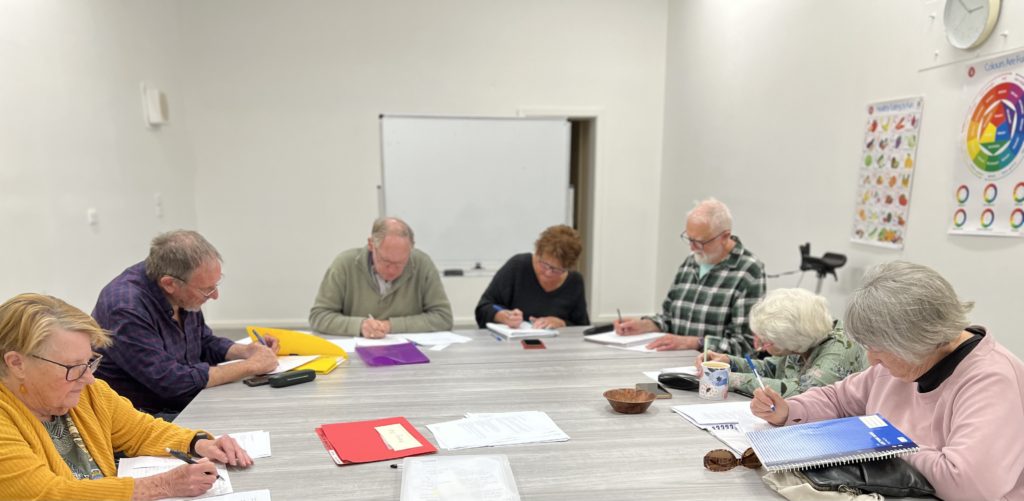
Since the beginning of this year, I have enjoyed convening monthly poetry workshops called Everyone’s a Poet at the Glenelg Community Centre. In 2024, I’m offering The Poetry Appreciation Society for anyone who loves reading poetry. Both will run fortnightly on alternating weeks. In the meantime, I take great pleasure in introducing poems from seven workshop members with a big thank you for sharing them with Wattletales.
The Workshop in Action
Oh, and I’ll also be running a Mindfulness group in 2024.
Introductions and Poems
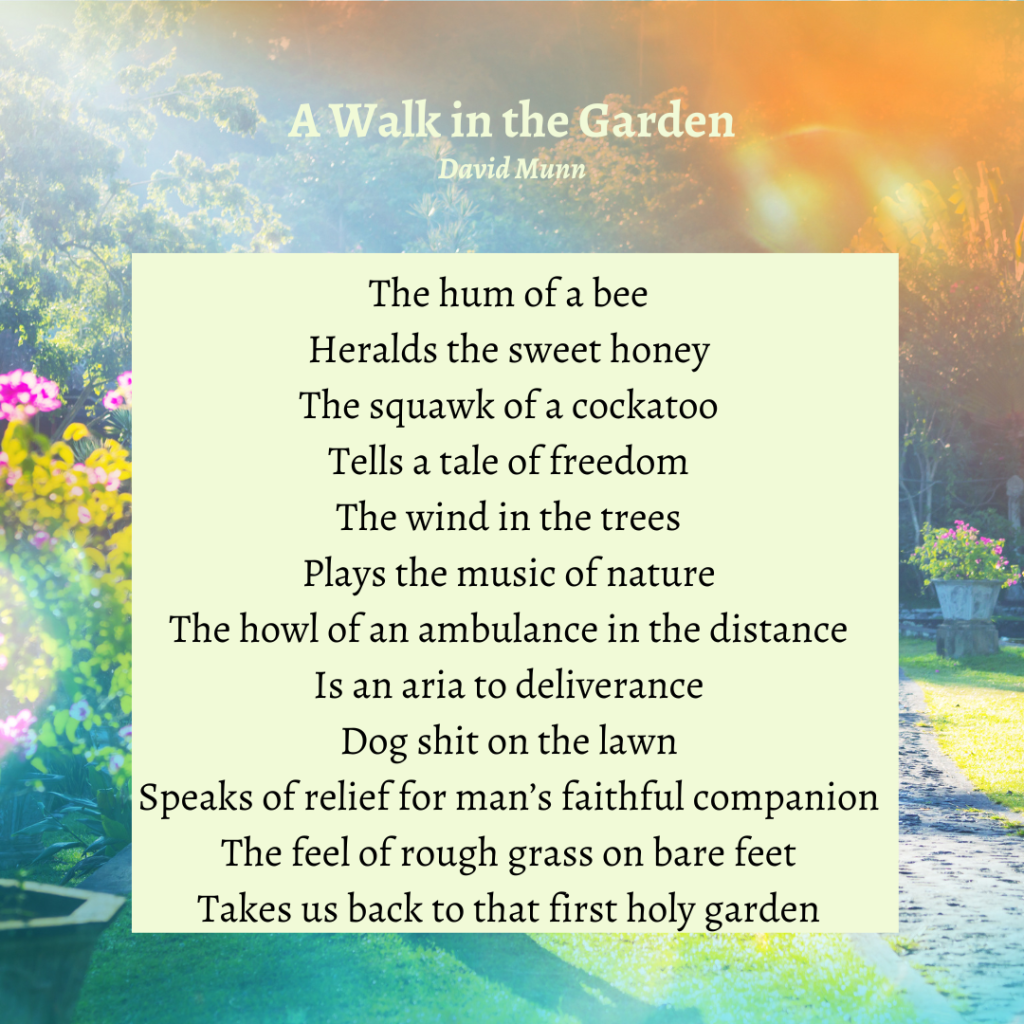
Arranged here by colour, the poems below were written during our workshops. Each is as unique as its poet.
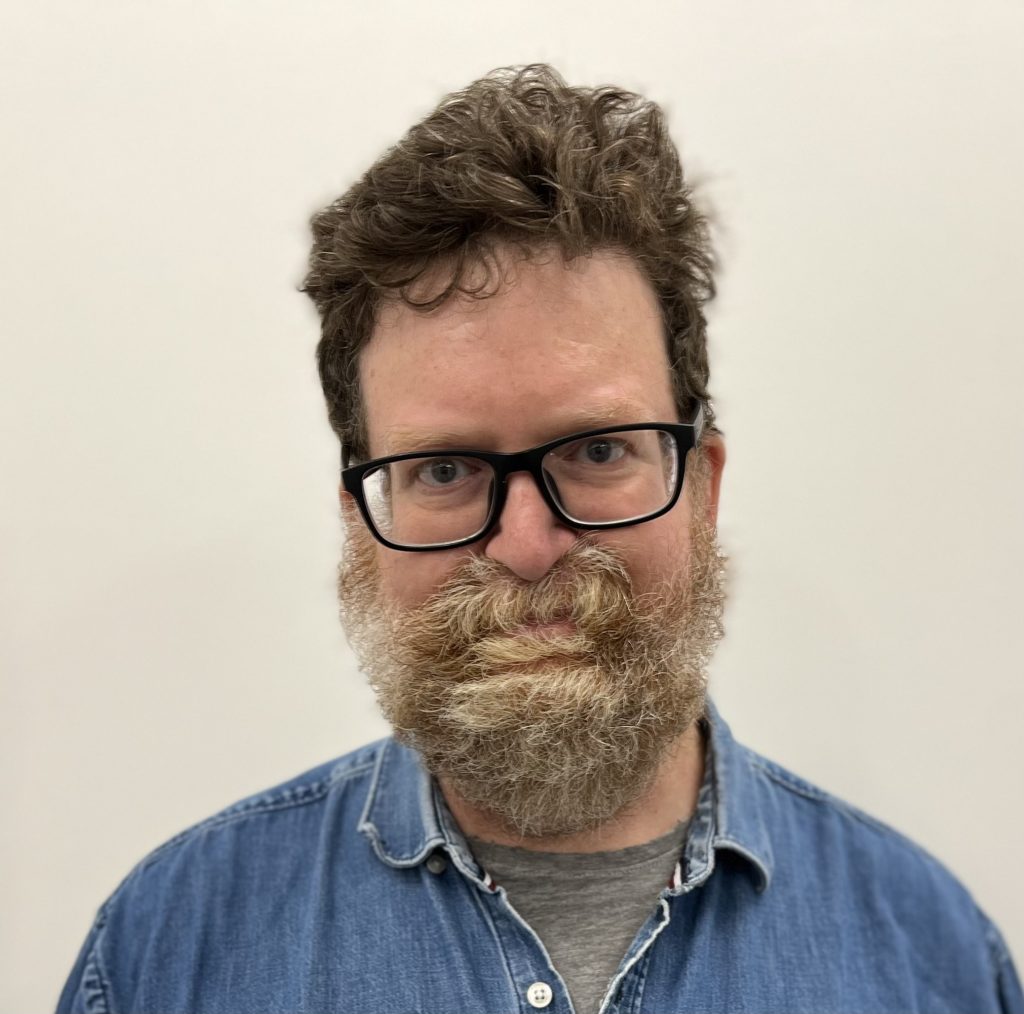
David Munn
David Munn has worked in the Brighton Library for 40 years. He is a movie fanatic with a particular fondness for comedies and horror films. He once was a volunteer for Urban Ecology, an environmental organization specialising in ecological cities. Under the pseudonym Joe Blow, he is the author of the self-help book How to Be Free
Sally Ann Hunter
Sally Ann was a biologist, then an environmental policy officer. Since 2000, she has been writing poems and novels (published). She finds inspiration from the many different effects of light. She writes about nature and spirituality. She loves fine music and gardening and practices meditation daily. She lives in a bushland setting with many native birds and animals.
Andrew Piper
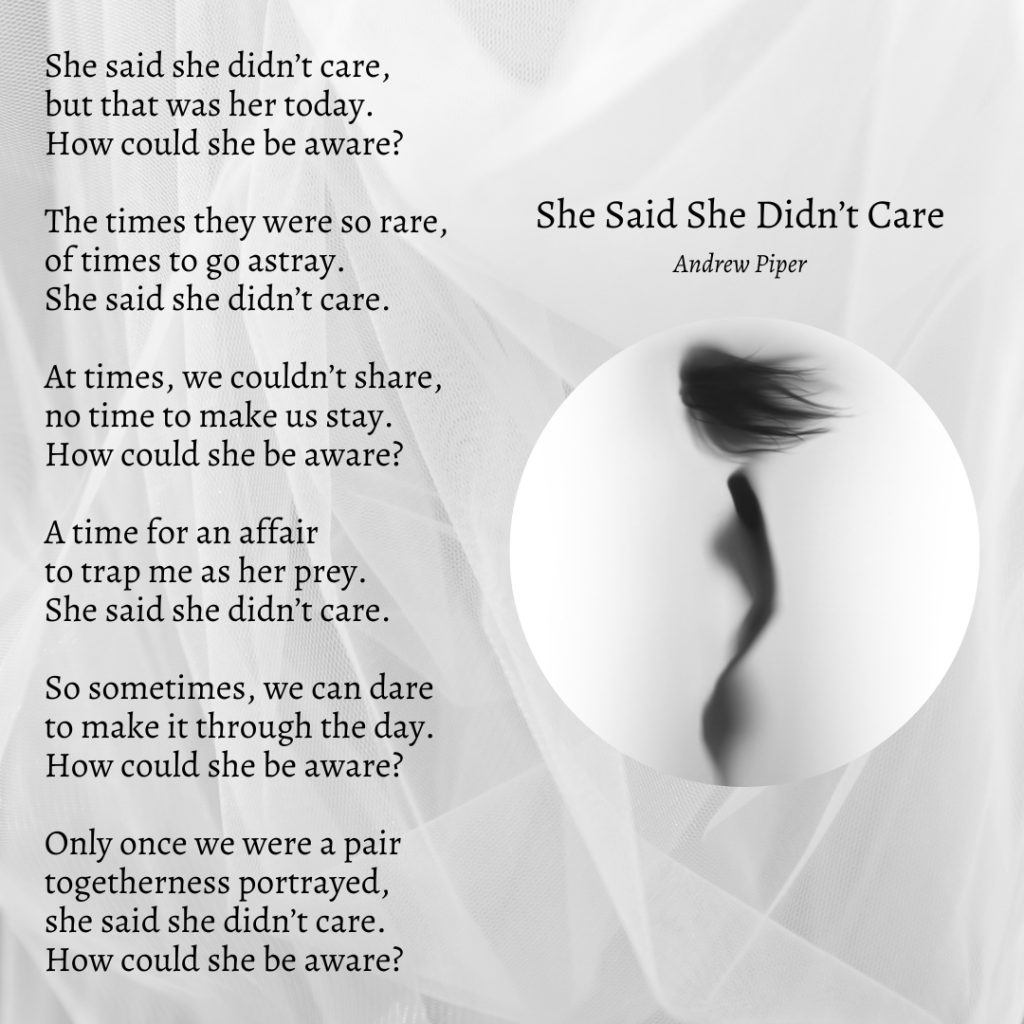
Andrew has spent most of his working life as a high school maths teacher but has always been interested in the literary arts. Andrew has done corporate and media writing and preparing other official communiques. Now venturing into short story and poetry writing, he is a member of a number of local writers’ groups.
Trish Mossop
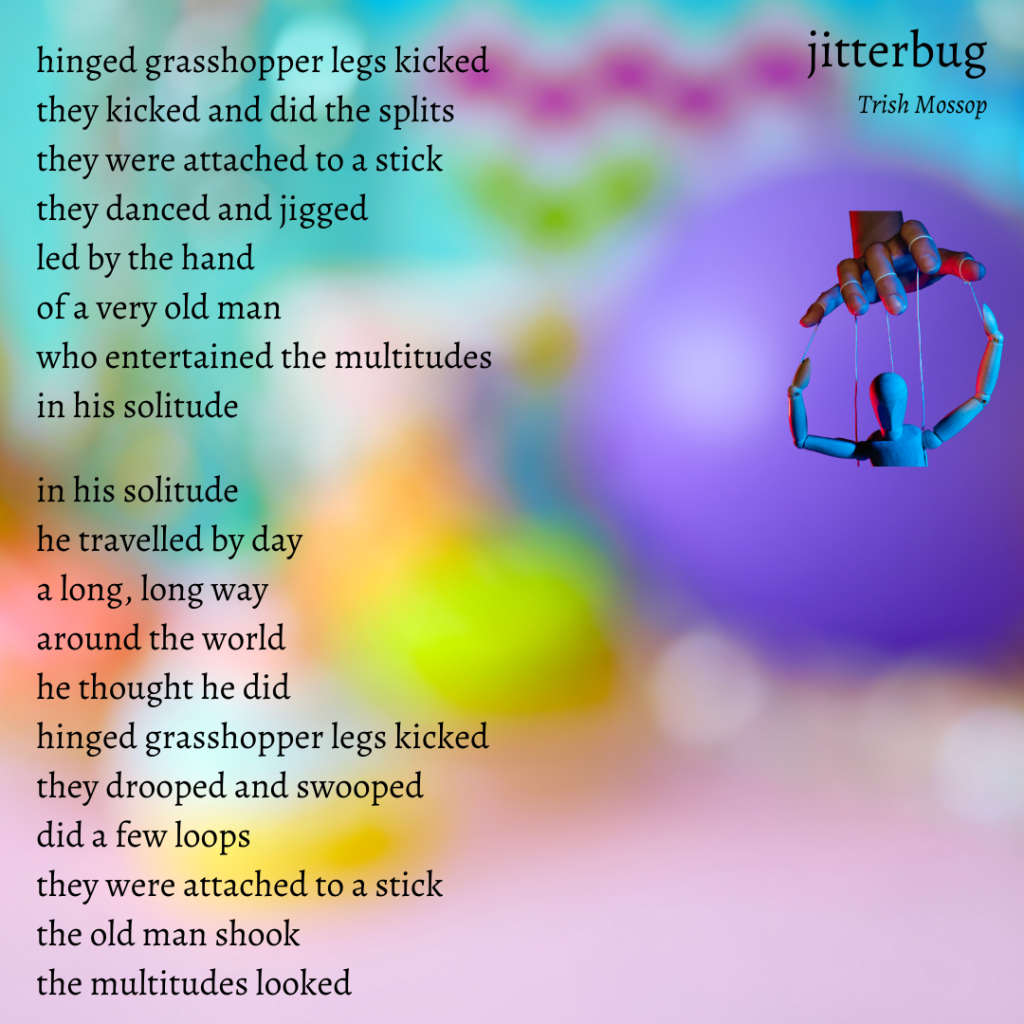
I love creativity in all its forms and have indulged in many. I have been using words for as long as I can remember, and my Mother once said, “They’ll get you into trouble.” So far, so good. I really enjoy writing, mainly lyrics and poetry. I love the ocean and its rhythm; my favourite thing apart from my grandchildren.
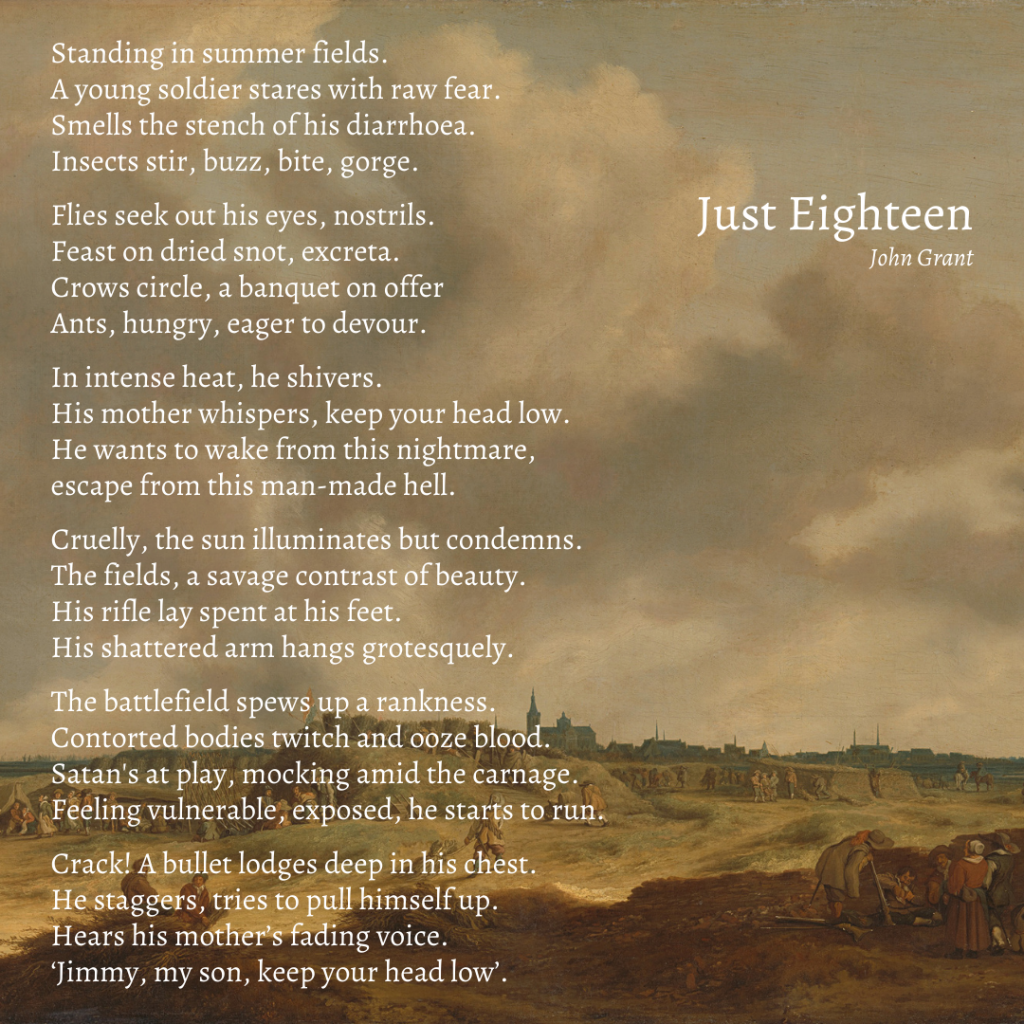
John Grant
John was born in the UK in 1945 and adopted at three by his mother’s second husband. His father died aged 36. His mother died at 43, a year after they emigrated to Australia in 1969. John spent his life driving and now lives in Hove. He loves to read, write, dance, and socialise with friends but is happy by himself.
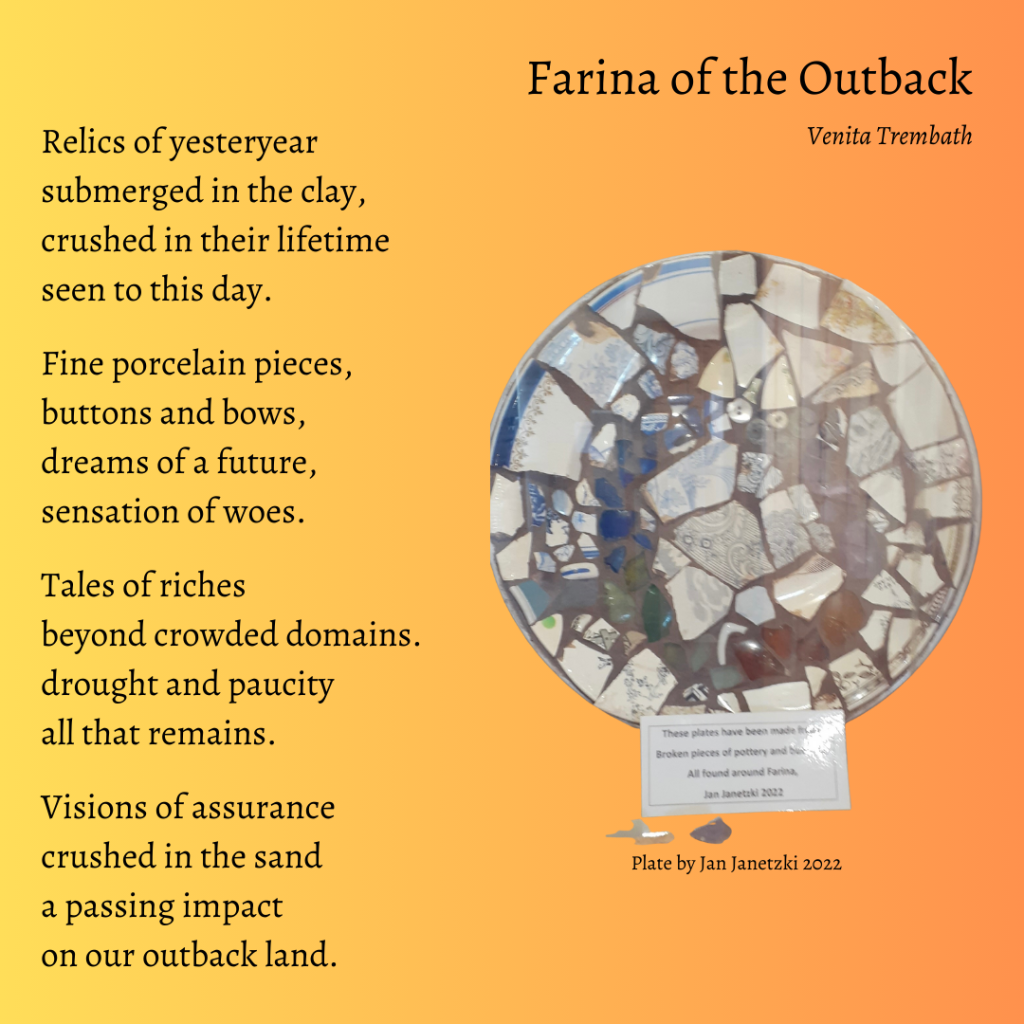
Venita Trembath
I am a retired nurse, midwife, sociologist, wife, mother and grandmother of two teenage boys. I love learning, travelling and being creative. Since COVID, I rekindled an interest in writing and watercolour art. When I accidentally stumbled into a poetry group and was invited to stay, I found the experience and the encouragement to develop a new skill very enjoyable.
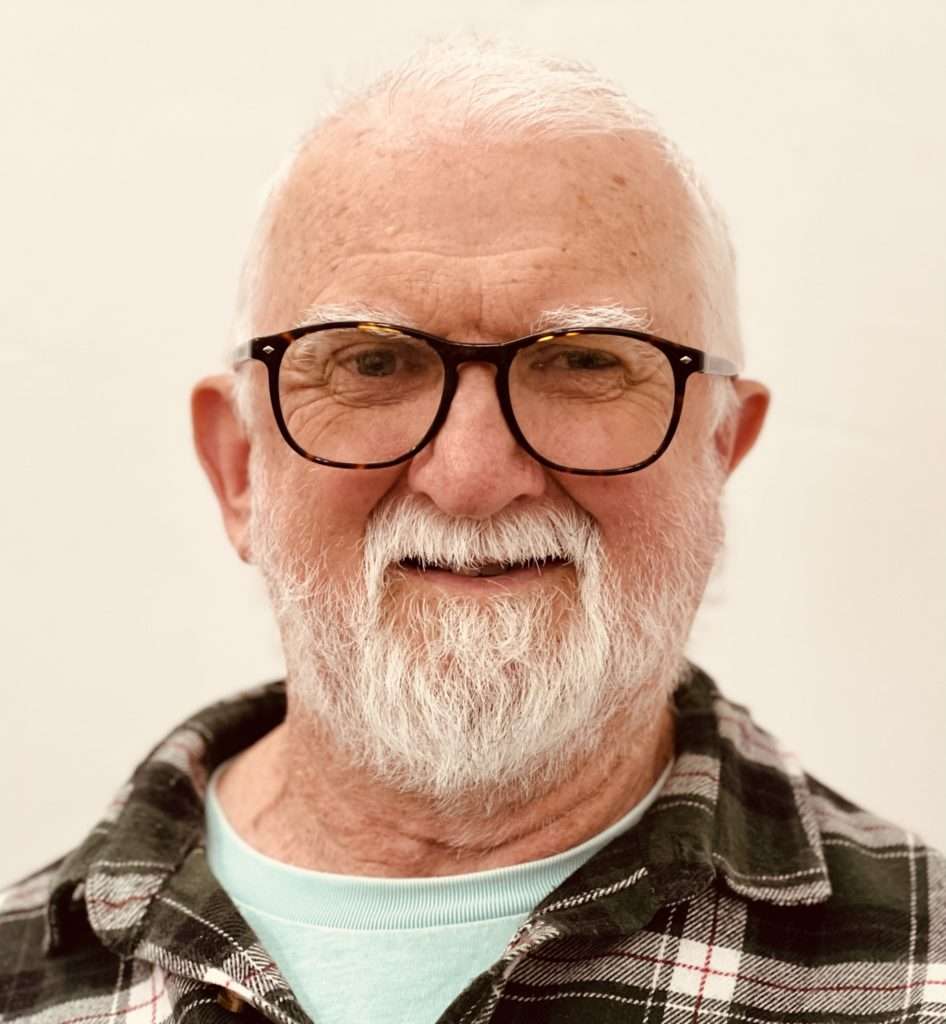
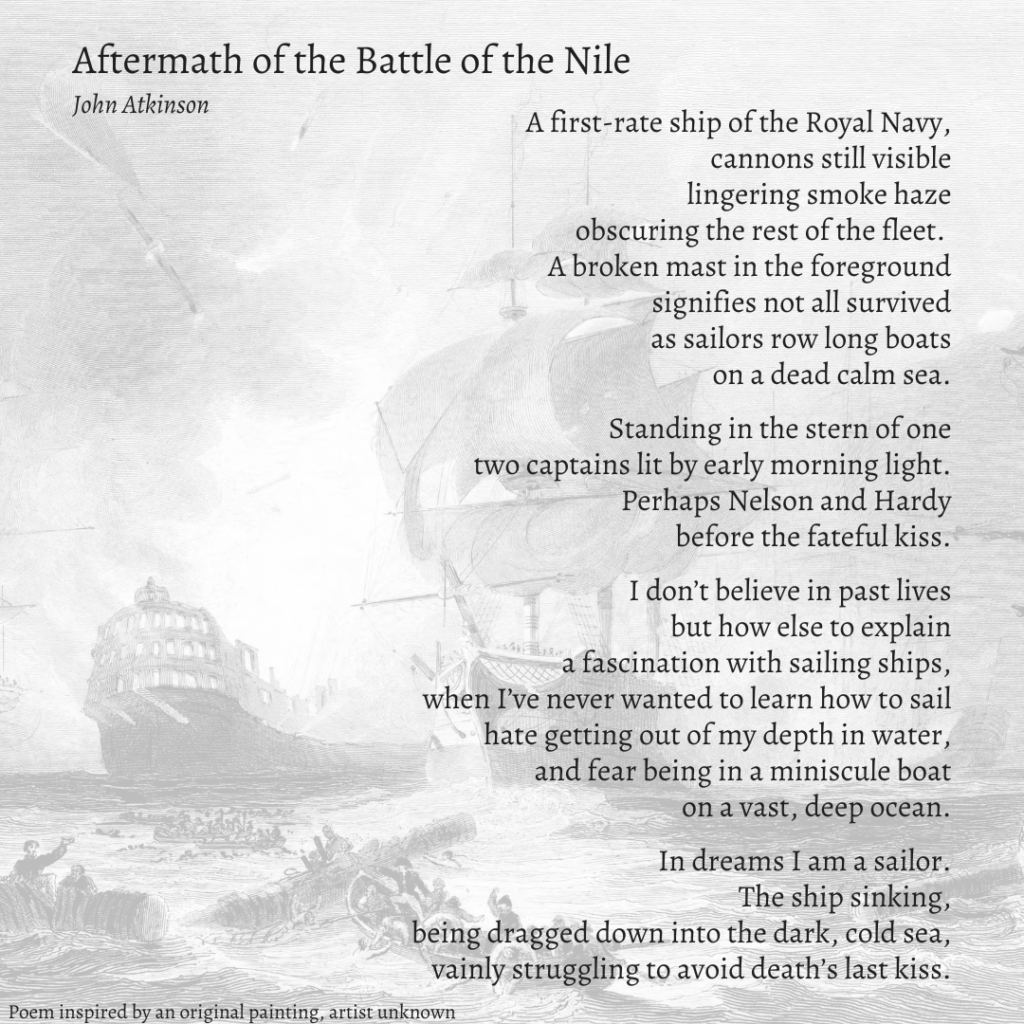
John Atkinson
I was born in Port Lincoln but lived in central Queensland for 35 years. After retiring, I returned to South Australia and now live in South Brighton. I’ve written poetry and journals intermittently, but involvement in a successful LGBTQIA+ monologue writing project in 2022 made me decide that it was ‘now or never’ to start writing more consistently.
Linda Williams
Lin Williams grew up in Country South Australia. She left school at 15, but thanks to Gough Whitlam’s free tertiary education, she later earned a BA and a rewarding mid-life career as a Lifestyle Coordinator. Now retired and living in Glenelg, Lin treasures family and friends, indulges her childhood dream to become a writer, haunts cafes and does crosswords.
Have you ever heard of the Native American potlatch or the Kula ring of the Trobriand Islands? I read about these practices with awe and excitement in the French sociologist Marcel Mauss’ 1950s classic, An Essay on the Gift. In that little book, which you can download below, Mauss describes the moral, social and political power of personal gifts and communal feasts. I take my cue from him. Gifts are magic because they are never morally, socially (politically) or emotionally neutral.
Do you agonise over what to give or how much to give to various people in your life? Should we give what we like, what they want, or guess? Can we give someone a book we think they should read? What does that say about us? Do we secretly wish people might treasure our gift over others?
Giving or gifting, as it is now known, is a fraught area of social life, especially now, with Christmas bearing down upon us. Gifts magically pull our strings or push our buttons, and wherever you find magic, danger also resides, as this little poem suggests.
The Vulnerability of Receiving
My father used to say, ‘Thank you, Luv’, with such warmth to everyone, even when receiving presents he had no use for and was a pleasure to give to. Once, my brother gave him an expensive pure silk dressing gown. Some months later, I noticed another resident wearing it at Adelaide’s War Veteran’s Home in Myrtle Bank, where Dad lived. I didn’t tell my brother, who then lived in Canberra. It would have smashed him. It was Dad’s way to please in the moment.
On the other hand, Mum declared it straight up when she didn’t like a gift. She became cold with what felt like criticism to me when I was younger. I now understand that disappointment runs deep when we yearn to be understood as Mum did — as we all do — and a wrong gift can signify how alone we really are in this world. Gifts of love are often complicated.
Giving as an Act of Dominance
Some people shower us with valuable gifts as an overt statement of care that is often subliminally about control. Some do it to mask guilt or compensate for years of neglect, but this type of gifting is more about controlling the recipient’s perception. It says, look at me; I’m being good to you.
I dislike being lavished with gifts. I use the passive phrase, ‘being lavished’ advisedly, as it perfectly expresses the impact of such giving. Even with my cynicism, it makes me feel so vulnerable I have to resist squirming. Without naming names, a couple of significant people over my lifetime smothered me in that way as a distraction designed to divert and confuse, which is a type of gaslighting. In the extreme, it is an abusive ploy.
Overdoing it with gifts is a big no-no, except when words fail because our hearts truly go out to a beloved to whom we wish to express deep feelings. Such giving is fine when the intention is pure — as long as the recipient shares our feelings; otherwise, from a recipient’s perspective, it can feel oppressive or appear foolish. Gifting is a risky business.
Giving and Receiving
Giving and receiving are, of course, the two sides of the same coin. You can’t have one without the other. This is where the Native American practice of potlatch and the Trobriand Island ceremonial exchange Kula ring teach us what is really going on.
Potlatch
Mauss argues that there is no such thing as a ‘free’ gift. He argues that in traditional societies, ‘gift cycles engage persons in permanent commitments that articulate the dominant institution’ — they are political. Unlike purely economic exchanges such as barter, the potlatch is ‘totalised competitive giving’ involving gifts and feasts — the display of wealth — on an annual or social cycle to create or strengthen ties between people and groups.
Ironically, the conspicuous consumption of a potlatch is succeeded or crowned by conspicuous destruction. The point of a potlatch is not to demonstrate who has more. Rather, it is about who can afford to destroy the most, with wealth items like blankets, canoes, and precious artefacts being thrown into the sea or burned in a competitive display of power like no other.
We might find this strange, but I can’t help but think of today’s extravagant and opulent weddings, often held overseas in luxury tourist spots. We may not burn canoes, shoot firearms into the sky or bomb cars, but as a culture, we certainly rob from the future when a wedding costs more than the deposit on a house or, worse still, we find ourselves in debt. Such indulgences are the very definition of conspicuous consumption, succeeded by less conspicuous but just as real destruction as a potlatch. Status is always hard-won.
Kula Ring
Traditionally, Trobriand Islanders circulated abalone shells among groups, people and islands. They named their beautiful shells. Each shell increased in political and spiritual value as tales of its circulation between groups and islands accumulated through time. Anthropologist Bronislaw Malinowski, the first to undertake a participant observation methodology, wrote about this complex system of ceremonial exchange in his classical work, The Argonauts of The Western Pacific(1922).
I do not know if Kula is still practised, but in its many manifestations, gifting was typically inherent in most traditional societies’ social and political structures. The gift, in all its forms, articulates relationships between people and place. You can read other examples in Mauss’ essay.
Politics, religion, and economics are separate institutions in our world. Yet, an Australian study by Diane Bell (1987) called Generations: Grandmothers, Mothers and Daughters documents one of the many ways family treasures accrue value when passed through time, in this case, by women. Our ‘shells’ take many forms, but antiquity and provenance — an object’s story — still create value, as is well documented in the British TV production The Antiques Roadshow. Also, museums and art galleries display a culture’s most treasured items — the older, the better — as state property.
Our economic and political systems may have transformed, but human beings have changed little.
The Feast
There are many other forms of giving, from donations and philanthropy to votive offerings and alms, but feasting is worthy of discussion at this time of year. At one level, eating together or commensality is a form of social bonding. But in contemporary society, families are often separated or fragmented, so we find ourselves haggling over who goes to whose place, who is the rightful head of the family, and who can and can’t or won’t go where they are invited. And who is snubbed?
Christmas is a case in point. Even as adults, childhood sibling rivalries surface when we do get together. Expectations and desires are often met with unpleasant realities, and painful arguments erupt. Whether for feast gift, we often overspend because we think we must or to show off, which, again, has the touch of the potlatch about it. Or we might offer gifts to mask unexpressed resentments.
It is well known that emotions run highest, and suicide rates peak during the festive period, which is not known as the silly season for nothing. So, it may be helpful if we practice gratitude this year as the Venerable Thich Nath Hanh encouraged us to. His teachings on mindful eating invite us all to reflect with each bite on where our food comes from and who ploughed the earth or sowed the seed. This poem engages that advice.
Acceptance
While we may have difficulty accepting trivial, unwanted, prolific or extravagant gifts, we usually muster our manners enough to reward the giver with gratitude, albeit tempered by a niggling unease that we probably have to repay. Although it does happen, few of us throw gifts back in someone’s face. Gifts, by definition, require reciprocity of equal or greater value, depending on relationships and status.
At a personal level, there is magic in the way gifts create connection and sustain affection. While Mauss argues there is no such thing as a free gift, if I recall gift theory correctly, the only genuinely altruistic gift is seen to be from parent to child, where there is or should be no expectation of return. We may argue with this, but it is a thought to end on.
For more on my favourite books and classics, click here.
In 2010, I presented a paper called ‘Religious Poems from Around the World’to Aldinga U3A. The compilation is downloadable below. Drawing on it today, I explore ways in which spiritual love is evoked in the present by ancient words. I was inspired to do this after being profoundly moved by the work of poet friends. Poetry, to me, is at its finest when a poem radiates love — religious or secular, if there is such a distinction — even when speaking of war or disaster.
I’ve heard say a number of times that poetry is composed of the best words in the best order. I can’t cite the origin of this phrase, but it causes me to wonder what is best and how that can be judged in anything, let alone poetry. I include this little poem in protest against prescriptive definitions.
Personally, I love poetry or any work of art that moves me, invites me to think, laugh and empathise or illuminates the ineffable. Hence my predilection for spiritual works.
We Don’t Own the Land, the Land Owns Us
I start with a First Nations poem about what is to be inextricably part of the land. The religious quality of this poem is in the claim, ‘I am Australia’; Aboriginal being is of the land.
Love is in Humour
Religious poetry often turns to humour, which I think of as beseeching us not to take ourselves too seriously. Here are two poems, the first from the Bahá’í Faith, named after its founder, Bahá’u’lláh (1817-1892).
The second poem is from Ryokan Taigu (1758-1831), a quiet and eccentric Zen Buddhist monk who lived much of his life as a hermit. Ryokan shows great humility by refusing to accept labels such as a priest or poet. But, even as he decries the vanities of his peers in this short poem, he recognises his weakness for comfort.
If you think of the Dalai Lama for a minute or have met a Buddhist monk of any tradition, you will have encountered their complete absence of judgment. Their acceptance of life as it is and the spontaneous warmth that goes with it are manifestations of joy. Acceptance allows one to open up to self and others. It makes us vulnerable but is extraordinarily powerful. It is love.
Like Ryokan, Japanese Zen Poet Ikkyu (1394-1481) also celebrated the ironies of life in wry observations of reality. Once again, his words show acceptance of things as they are and the spiritual love that implies. Ikkyu may observe the peccadilloes of his more stick-to-the-rules counterparts but is as accepting of them as he is honest about his dismissiveness and fleshly needs. I feel fresh air in that.
To Hear and Speak of True Nature
Rabindranath Tagore
Most people will have heard of Rabindranath Tagore (1861-1941) if not from his poetics, then perhaps from a marvellous recent Netflix series, ‘Stories by Rabindranath Tagore’. As a poet, novelist, musician, and playwright, Tagore reshaped Bengali literature and music in the late 19th and early 20th centuries by spurning classical forms. Tagore won the 1913 Nobel Prize in Literature and penned the anthems of Bangladesh and India. God, that is to say, love is the sound of the flute and the flow of the River Yamuna, life and surrender; if only we paid attention.
Tich Nath Hahn
Thich Nath Hahn (1926-2022) was a much-loved Vietnamese Zen Buddhist monk, poet, scholar and activist who joined a monastery at 16. During the Vietnam War, he worked tirelessly for reconciliation between North and South Vietnam but was exiled for many years. His lifelong efforts to generate peace moved Martin Luther King, Jr. to nominate him for the 1967 Nobel Peace Prize.
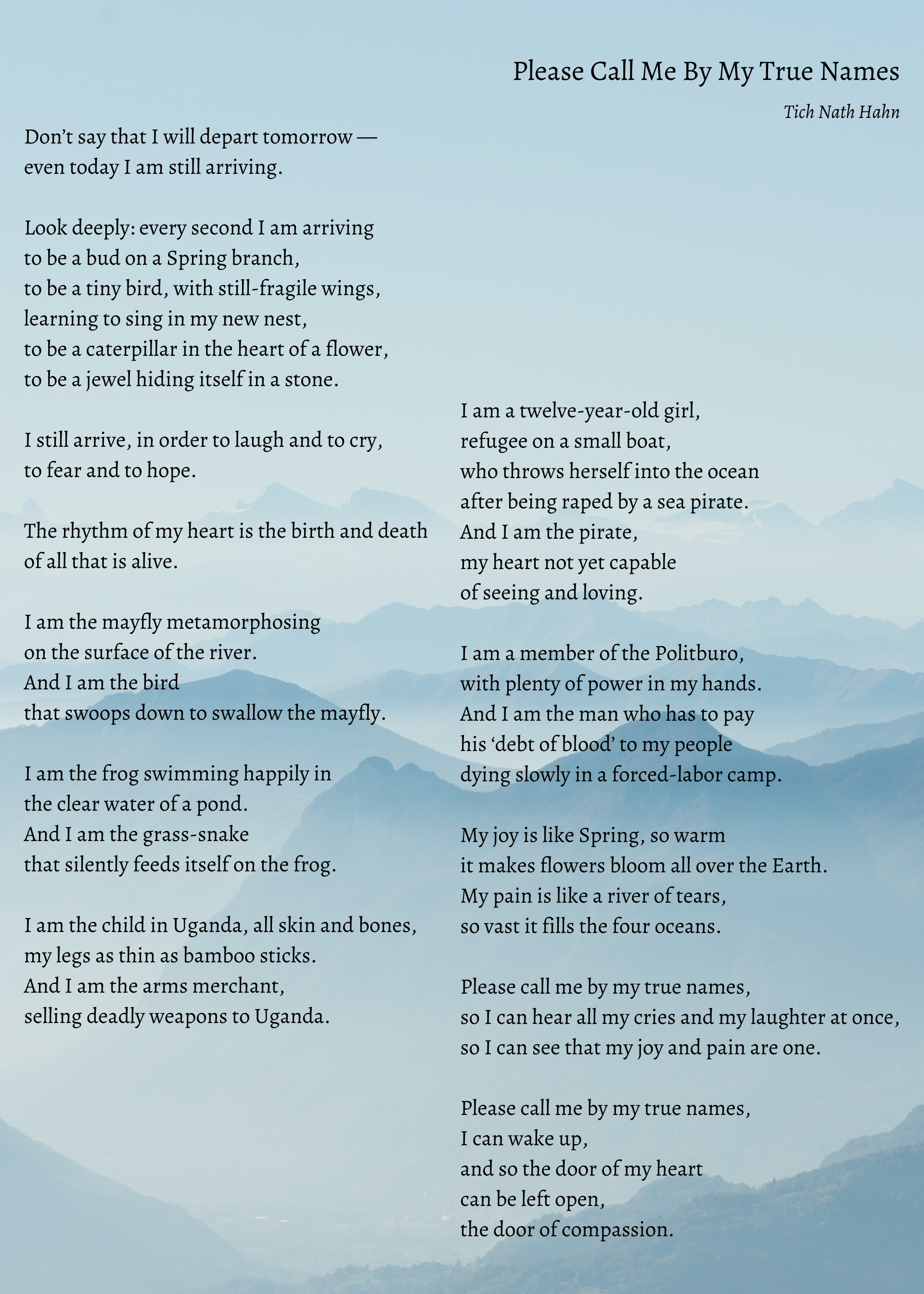
In 2022, finally repatriated, Thich Nath Hahn died in his country of birth, leaving a profound legacy to Buddhists and laypeople across the world who know his marvellous body of work. I include two of his poems. The first should be read alongside Tagore’s poem. They complement each other, resonating as they do in accepting what is, but he also shows in this poem that, seen clearly, accepting reality’s many faces is spiritual love.
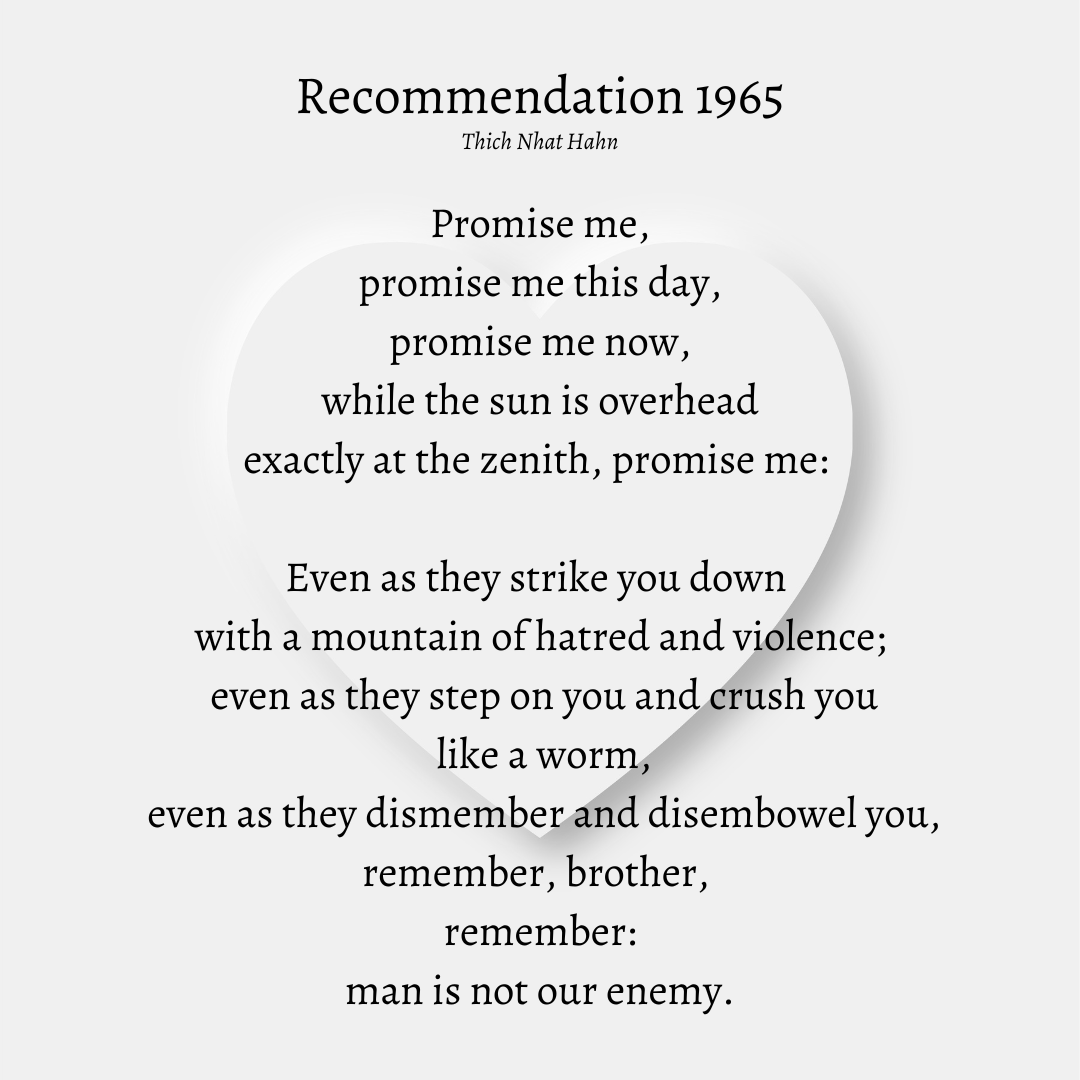
The second poem from Thich Nath Hahn is a loving prayer he wrote to prepare the young who risked their lives during the Vietnam War to die in peace. The love in this poem always moves me. As with all of this Master’s work, it reverberates with compassion.
Haiku Potpourri — Basho (1644-1694)
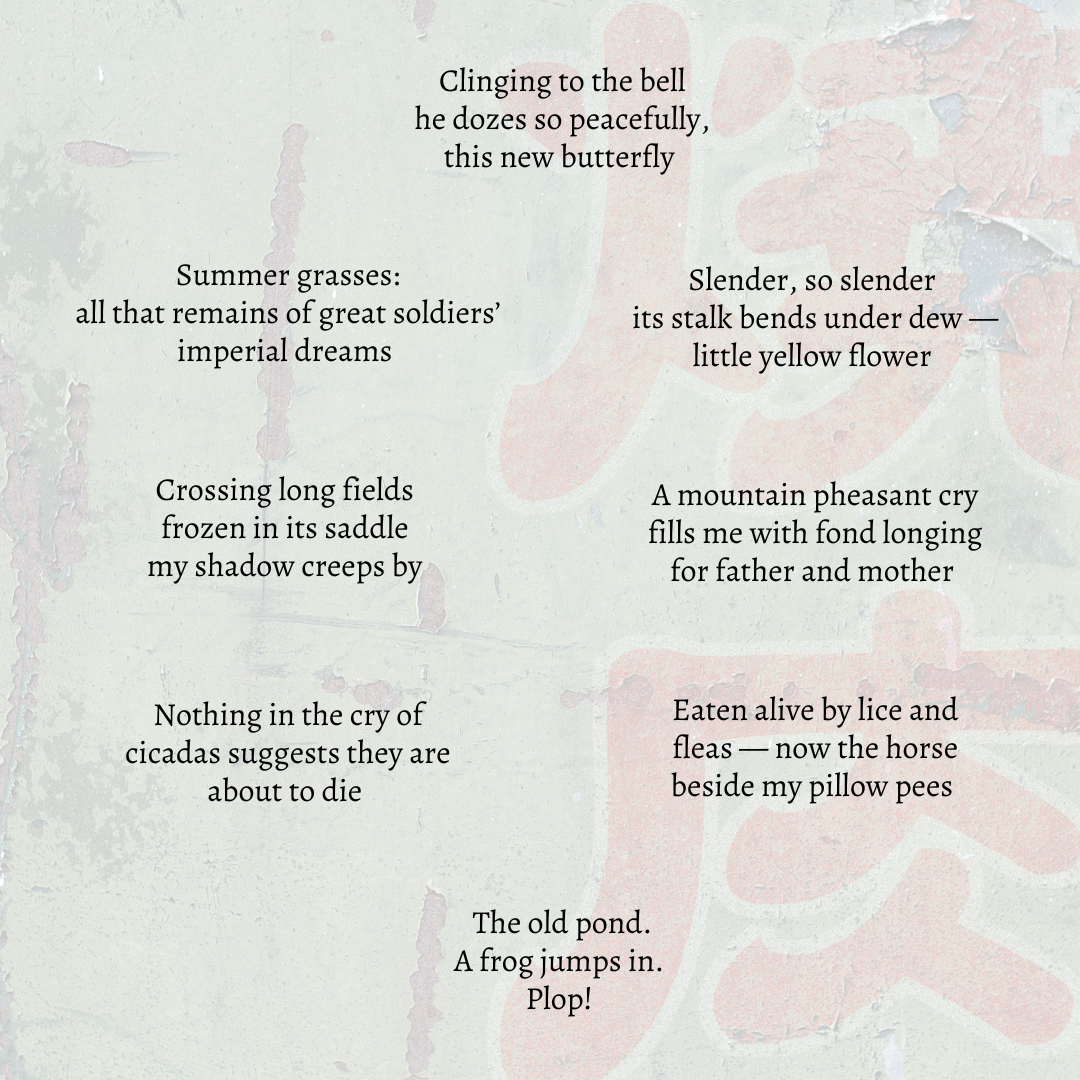
Most poets today have heard of Matsuo Basho. His work is profound, and its relevance persists across centuries. A Japanese warrior-poet, not a monk, Basho nevertheless had profound respect for and love of nature. Reading his concise words can make us smile, but it is spiritually uplifting because it is emotionally honest. Basho’s keen eye for concrete ways to open our hearts is a high spiritual art. Each of his word-image-moments offers profound insight into the beauty and fragility of life, inviting acceptance and love for all that exists.
Religious Poetry
Please feel free to download my U3A presentation. Forgive, if you will, typos that I can no longer correct as my only copy is a .pdf. In my introduction to this piece, I wrote, ‘I personally found more commonalities than differences across the major religions and through the centuries. The poems often refer to the immersion of the self into God or nothingness, and they speak of blood and the body, nature and light, and, most of all, of love.’
The question for today is, what is it like to be an anthropologist in the field? So, I decided to explore my experience as a consultant working with Australia’s First Nations People. I write personally yet in general terms because I can’t divulge details not in the public domain. The reasons for this are manifold, but it is primarily because I am not authorised to speak for Aboriginal people or tell stories that are not mine to share.
Tranquility
To elaborate, when undertaking site mapping and gathering social history for environmental impact studies and related projects, sacred and historical sites must be documented if they are to be protected. Whatever a report’s findings, the document masks the differential power between traditional knowledge, copyright, and intellectual property rights. The first must be respected, but the latter wins at law.
For example, if I record oral histories or stories about places, the copyright in the report is mine by virtue of writing it. The physical report, however, belongs to the commissioning body, while the information recorded is First Nations people’s cultural and sacred knowledge — oral traditional knowledge. Tension is inherent.
Definitions
I use the term Country in my title advisedly because it is often susceptible to misinterpretation as meaning ‘all of Australia’ by those wishing to excite fear and cause harm, as happens in the media around the forthcoming Referendum on the First Nations Voice to parliament. Wherever I worked, Aboriginal people spoke of Country as the place on the land(scape) they and their Mob belonged to. To them, the word defines the areas they are required by tradition to look after.
I could have included ‘nation’, an entity we often conflate in everyday speech with Australia as a country. However, while patriotism is fine, I didn’t want to introduce the concept of nationalism and its associated politics. It is enough to say that all citizens of this nation are Australians. Belonging to Country in the Indigenous way is something else altogether.
Wangi Falls, Litchfield NP NT
Nuts and Bolts
Being a consultant anthropologist requires business acumen to tender for projects against a brief, specifying costs, timelines and deadlines. You must carry professional indemnity insurance. While some lucky folk had their own Toyota or Mitsubishi four-wheel drive, as they were once called, I hired mine from Hertz. Vehicles then didn’t have the marvellous GPS coverage of today’s systems. I had to reset my clunky portable device every time I crossed state borders or moved outside the range of a previous pivotal setting. The old devices could put accurate site mapping at risk unless set correctly.
Consultancy projects frequently take you into remote areas. Basic bush tackle includes a gas bottle, a portable stove, a billy, matches, enamel plates and mugs, cutlery, a torch, batteries, a decent first aid kit, toilet paper and food. Plus, your bag, laptop and swag.
Outside Silverton, NSW
Project participants often took me to places only they knew where they’d hidden blackened barbecue hot plates. A feed of steak, onions, and snags with tomato or Worcestershire sauce cooked on old iron is the best, as is tea made in a tannin-stained billy boiled over a smoking fire to chatter and laughter.
I am grateful to the women Elders in the Northern Territory who encouraged me early on to wear loose-fitting dresses like them to let even the lightest breeze keep me cool in summer’s heat. I wore an Akubra and strong hiking sandals but avoided my profession’s jungle green fashion in favour of comfort. Like the women, I carried a strong stick, beating the ground to warn curious snakes of our impending presence.
On the Road
I love driving, but long hauls driving alone from Adelaide to the Queensland Gulf country via the Murray-Darling River basin or up and down The Track, as the Stuart Highway in the NT is fondly known, are exceptional. Experiencing the silence, the changing scenery, the solitude and an occasional off-road frisson of fear is awesome. I used to be proud as punch when my four-wheel drive got covered in red dust or mud; it spoke to me of adventure.
The Track
In my mid-sixties, I decided it was no longer wise to take other people, often older women and little kids, out bush alone. I have to say I was blessed never to blow a tire. However, I did get bogged in sand and mud a few times on longer trips, but stronger people (men and youths) got us out of trouble, thank goodness. One of my favourite poems came from a trip over the NT’s Daly River Crossing with a group of women, which resulted in one of my favourite poems, Ol’ Girl Can Drive.
The Wider Context
When First Nations People tell family and Dreaming stories to consultants hired for site clearance work, they are asked to prove who they are in kinship and biographical terms and demonstrate that they have the traditional right to speak for an area. Just imagine that for a moment. It is so invasive. Their traditional authority is questioned in favour of legal definitions.
Little wonder it causes deep concern to think that the information people provide might be misused or made public against their wishes; for example, in a court of law, should what they say be contested by another stakeholder’s legal representative. Such matters (think Native Title claims) can drag on for years. Can you imagine the stress?
Community Intrusion
Researchers often turn up in communities, expecting people to drop everything. Many remote communities are regularly bombarded by light planes and SUVs full of people wanting something from them: government officials, police, social and medical researchers, media and others. Visitors on a strict schedule often get frustrated (and show it) when the people they want to see are unavailable. In my day, few considered the inconvenience their visit might cause.
When you work with women, as I often did in places with no resident doctor, they care for others and often need to attend long-awaited medical and specialist appointments regardless of your schedule. A community may be in the middle of its ceremonial season, preparing a funeral or be in crisis. My point is that few of us experience the intrusions that Aboriginal people endure all the time. The context we enter when working in the field is life.
Droving, Qld
Going Fishing
In my day, sharing knowledge of stories and sites rewarded most First Nations participants little more than a free ride or two to an outstation and a modest day payment for their time. Longer trips were not too different in that regard. This may have changed, but as strangers, we should not be surprised to learn that we had to earn trust to achieve anything.
In anthropology, making sure we talk to the right people is vital, but at first, someone will point you in one direction, and another will send you to someone else, and this may continue until you think you’ll get nowhere.
I later learned that ‘going fishing’ is the metaphor for hanging around, being patient, and having a cuppa and casual conversation with whoever is willing so that people have time to observe and assess you before they decide whether to work with you. This happens even when you write well ahead, seeking permission and attaching a project outline with dates and times. Although you write to what you think is the right entity — an Aboriginal Association or Community Manager or call a recommended person — you still have to go fishing. It’s a different process.
Before long, someone with the authority to speak on behalf of the community takes you under their wing, and you know it’ll all be OK, just like that.
Dust Storm
First Nation’s people understand well what most projects need, and they take the lead to show you what has to be recorded. Apart from your analysis, what you write is, in that sense, determined by them. After all, it is their knowledge you are recording. Once your report is written, you present it as a draft at a meeting of the entire community for discussion and approval before submission.
The involvement of lawyers at such meetings introduces another layer of complexity. All I can say here is — if the notion of ‘going fishing’ disrupts the gaze of professional anthropology’s participatory observation method — who is looking at who — the law has different eyes again.
Accommodation
The best accommodation in the world is a swag around a campfire. Falling asleep beneath a sky of lambent stars awakens awe. Further delight comes when someone in an adjacent swag tells you tales about Venus, the Morning and Evening Star, and the Milky Way. As you drift off to sleep, other stories might be told about snakes slithering into vehicles and swags to pretend-frighten you. First Nations people have a wicked sense of humour.
A Bush Dream of Mine
Some jobs entail repeat day trips from town. That’s the time for motel accommodation, which varies in quality nationwide. As they get to know you, a few people might visit to talk things over, explain further or just sit down for a while; at other times, you are entirely alone with your computer and poor TV reception.
Staying in a community is different again. Most have visitor accommodation with basic facilities, and when it’s time to eat, you quickly learn how poorly stocked the community store is for people for whom fresh food is a luxury.
A Sample of Projects
While I mention only consultancy projects here, I was lucky enough to also work with First Nations people at different times in different capacities out of Katherine towards the Kimberley region, on the Tiwi Islands and in the Queensland Gulf country.
Site Clearance
A government or developer typically commissions site clearances for environmental protection work. My first site clearance consultancy with First Nations people was in Port Augusta. I learned women’s stories about the Pleiades, known as The Seven Sisters Dreaming and the significance of ceremonial dancing. My report was one of the first to document this.
I also worked for a long time down The Track when I lived in Darwin, travelling to places like Rum Jungle (I love that name), Yellow Waters in Kakadoo, Litchfield Park and the Daly River crossing mentioned earlier.
Family Histories
When recording family histories, I was fascinated to see how people deferred to each other to recount different aspects of their biography, history and traditions. Complex kinship rights and obligations are enacted in this way.
One project funded by a National Estate Grant gave me great joy. My brief was to document women’s knowledge in the far north of South Australia. Anthropology had, till then, largely ignored women’s knowledge. Although the women were well-known and often related to each other, at their request, I documented their stories in seven separately bound reports under the encompassing title, This is Women’s Business: An Anthropological Report on Aboriginal Women’s Cultural Knowledge in the North of South Australia. They imposed the condition that their stories could not be read by anyone without formal consent.
A senior woman who became my friend wanted me to share her tragic family history of inter-racial love, war and loss with my mother, who grew up in inner-city poverty and experienced WWII. Mum was fading from life at the time. Such a profound gift.
Despite the initial awkwardness of getting to know people, I made many friends as a consultant and, over the years, had some of the most memorable experiences of my life in the field, professional challenges notwithstanding. Although my task was to take notes and ask questions of others, in the end, I learned more about myself from First Nations people than I could have imagined.
Pastoral Lease Forensics
I spent periods in and around Mount Isa recording sites, stories and family histories for an Aboriginal organisation wanting to assert formal ownership of a pastoral property. I thoroughly enjoyed that project and was thrilled when I finally got the news that their claim was successful. The stony landscape in that part of the world is unique, different from the gibber plains of far north South Australia, but equally stunning in changing colours.
Cloncurry to Mount Isa, Qld
A Test Case
The NSW government commissioned me to undertake research along the route of a Bronzewing Pigeon story between the Flinders Ranges and Broken Hill. I was not to socialise at all with the participants or other parties after our field excursions. I was there to record stories and take photographs — no fishing required. The government had pre-selected the participants in consultation.
After the fieldwork, my brief mandated that I eat alone and isolate day and night for ten days to write up my findings. It was a tough gig. The government was keen to have a pristine piece of work as a test case to underpin proposed new sacred site legislation in NSW along the lines extant in South Australia. It was later enacted.
Flinders Ranges SA
I documented the South Australian stretch of the storyline as we travelled by bus from Port Augusta to Broken Hill, stopping along the way. The NSW participants then shared their knowledge of the same story on sites out of Broken Hill. While working in Queensland a couple of years later, I learned that Bronzewing Pigeon also travelled up to Mount Isa and beyond. The next poem is my take on that story. The detail I use is on the public record; the poem is eclectic.
Research reports of any nature are peer-reviewed. Despite a moment of controversy when women in anthropology caught media flak in the wake of the Hindmarsh Island affair, my report achieved its aim. I was delighted to learn it was later lodged in the Aboriginal Institute of Aboriginal and Torres Strait Islander Studies (AIATSIS) Library by the authority of those with whom I worked for being a comprehensive record of the Bronzewing Pigeon story. It is available to view (not borrow) on request from any library.
Memories Linger
Often, we don’t understand an experience until it is in the past. We don’t analyse how we feel while dancing in a nightclub late at night. Only when we reflect in the morning can we see ourselves clearly. At times in my years as a consultant, I felt defeated, mainly by the politics of the scene, but when I look back, I see how fortunate I am to have had the experiences First Nations people gave me. It remains a miracle that they greet researchers so well.
It is thrilling to be taken to places you’d never otherwise see, drive across a landscape that breaks your heart with its diversity and rugged beauty and be entrusted with private family and sacred stories. That is to say, to learn some of the deeper meanings in the landscape. I cherish that experience and am grateful for the warmth, charm and care I received, often in difficult circumstances all around.
My mother died when I was a total stranger in far west Queensland, yet people there treated me with great compassion. There, and in other places, people often took me to the back of beyond, far outside the scope of my brief, to show me secret places especially significant to them, a privilege I shall never forget.
Stuart National Park, New South Wales
Homage to a Life’s Work
I first came across Steve Parish’s work at the University of Adelaide in the 1980s, a photographic record of the outback I fell in love with as a child who lived in books. I often gave his beautiful publications as gifts.
Last year, Steve invited me via Facebook to contribute a piece of writing to his webpage. I was both honoured and thrilled. He then generously offered his photos for use on my website, a perfect fit for this post in particular. Steve has spent his life capturing the beauty and diversity of the land and the creatures we all love and want to save from destruction by overdevelopment, mining and climate change.
Steve describes the photo below as one of his most treasured images. It is of a young bloke from Oodnadatta coming in last, riding like a winner at the William Creek races. Read Steve’s account here.
Thank you, Steve. Your photos bring this land alive. Here, they hint at the areas where I worked and demonstrate what it must be like for First Nations people to belong to and care for Country.
ACKNOWLEDGEMENT
All Photographs by Steve Parish.
‘A Distinctly Aussie Morph’ first appeared in 2013 in Jill Sampson’s Brindlebox Nature Reserve Project: Brindlebox Birds 153 (also read on Radio Adelaide with Julia Wakefield) and in Life Blinks, Ginninderra Press, 2019.
‘Goanna and the Snake’ in Life Blinks, Ginninderra Press 2019
‘Of Heat and Flies’ in Alchemy Friendly Street Poets Anthology 43, 2019
It’s taken three years of intensive research, typing and editing, but I have written my first full-length non-fiction book with a working title of Changing Fortunes: A Story of Love, Loss and Resilience. My other writing has been short-form — poetry, non-fiction articles, essays, and business reports. None of those prepared me for the marathon that is long-form writing on a topic close to my heart.
My parents —John Toczek and Eileen Hayes-Smith married at Caxton Hall Registry Office, London. 15 October 1949
The book tells my parents’ turbulent life stories from 1938 to 2019. I wrote the first draft as a narrated piece before rewriting it from the individuals’ points of view. I think this makes it more accurate, more in-depth, and more emotional. So, it is reimagined. I know any creative non-fiction is subject to the writer’s perception, and the closer to home the story, the more likely that is to be so. This is why it is now out in the world for a first read-through by a select audience of family and friends. I have to wait for their feedback before seeking more unbiased reviews.
The response so far is encouraging. Words like “tear-jerker, riveting, I couldn’t put it down, a truly remarkable story” are exciting to hear, but I know this doesn’t guarantee I’ll find a publisher. So far, it seems it might have broad appeal, but switching off is difficult.
Change of Scene
Yesterday, I tried to write a poem, but my heart wasn’t in it. I wanted to draft this article for Wattletales but could not find my theme. I gave up and headed, with my notebook, to Picklemee Grandma café in Mannum’s iconic Woolshed. In the past, my local café has provided fodder for my writer’s notebook, and I needed a distraction. I also love their food and told myself I’d find it easier to write with a full stomach and a decent caffeine fix.
After the town’s recent flood devastation, relief warmed inside me. The sun shone, and the Murray River flowed serenely between its banks.
Mannum Floods 2023
Picklemee Grandma Cafe
Teresa and her partner Kim run the Picklemee Grandma Café at Mannum, where I live, and today, Kim was trialling a dressing for her quiche and salad. “Is it too oily?” she asked. I told her not at all. The peppery, spicy flavours added a touch of elegance to my delicious, freshly baked lunch.
Teresa, Kim and me in front of the counter.
As I tucked into my quiche and sipped a flat white, I heard a strong male Yorkshire voice behind me.
“That looks good. I’ve been looking forward to this.”
I turned to see a grizzled face beaming down at a heaped plate of bacon and eggs with all the trimmings delivered to his table by Teresa.
“Is that a Yorkshire accent I hear?”
“Yes, it is. I’m from Bradford,” he said.
“So am I,” I grinned.
The Yorkshire spirit is such that we look out for each other. I’ve met compatriots in airports, boats, shopping centres and theatres, and I knew he wouldn’t mind. And, to find Jimmy in my local café soon after completing my manuscript about my parents was a delight.
He was turning eighty soon, he told me and liked coming to Mannum. His eyes drifted longingly to his lunch. I suggested he eat his meal before it gets cold, and we can chat afterwards. His relief was palpable. He didn’t want to be rude to a fellow expatriate.
I finished my meal and immersed myself in reading manuscript submission protocols online.
So Much in Common
A figure appeared beside me. “I’d better move on, but it’s always nice to meet another person from Yorkshire.” He hovered expectantly. Forty minutes later, Jimmy and I exchanged Christian names, shook hands for a while, like old friends and parted the better for our fleeting bond. We had covered a lot of ground. I know that he was a great hiker in his day. We talked about Kendal in the Lake District of Cumbria, where he often walked and where my family and I lived for a few years.
We spoke of the small towns we know and love. Gargrave, where the Leeds-Liverpool Canal and the River Aire cross paths; Skipton with its market and medieval castle; Ilkley, for which the Moor is named; and Howarth, famed as the home of the Bronte sisters. We discussed Bradford and World Heritage-listed Saltaire Village, an entire community built for workers by woollen mill owner Sir Titus Salt.
This was where I grew up, where my best friend bought a house recently. She lives in London but needed that connection to our country. Jimmy was born and went to school in the heart of grimy industrial Bradford town. It gave him a love of soccer and English cricket and a heart for the North of England. My brother still lives in Bradford and wouldn’t live anywhere else.
Jimmy’s voice shook when he described a visit to his father’s grave in Bari, Italy, as did mine, remembering Uncle Bobby’s name inscribed on column 298 at the Normandy War Memorial in France. They died in World War Two. Bobby has his place in my book.
Jimmy and I will not meet again, but I know him, and he knows me. Jimmy’s travels have been hampered by a bad traffic accident in outback South Australia in 2019, mine tempered by my mother’s death in Ilkley in the same year.
Other Chance Meetings
There was an American woman in the departure lounge in Hong Kong. She, her husband and their four children had sold up and set sail around the world. Her Mum was ill, so she’d flown home and was returning to the family waiting in a Thai port where their boat was undergoing maintenance. I followed their travels through pirate-infested waters on her blog for months.
Another time, I spent two hours on the train from London to Leeds talking to a woman about travel, home and books we’d read. It was an instant connection. How we laughed, my new friend and me, till she left the train at Doncaster. Then there was the British army officer who took charge when a bunch of us were stranded in Nigeria for three days. Now, that was an adventure to write home about.
Jimmy reminded me why I wrote my book. A desire to honour my parents, whose lives were torn apart and thrown together by the cataclysmic forces of war. It is set mainly in Yorkshire, where their marriage of fifty-seven years was lived.
Reflections
Chance encounters stay with you, spark memories of people and places you have known, and bring to mind poems you once wrote.
“I reckon I’ll drive back to Golden Grove the long way,” Jimmy from Bradford said with a nod as he left that day. “Call in at Blanchetown. I might have a drink there. But I’ll be back to Mannum; it’s a good place to visit.”
I was glad he visited. He set in motion a flood of memories and writing ideas I captured in my notebook after he left. Maybe we’ll meet again next time he drops in.
AUTHOR BIO
Born in the north of England, Mandy Toczek McPeake now lives in Mannum. At times, she craves the rain-soaked, dry-stone, lichen-encrusted walls and green hedgerows of Yorkshire. Mandy, a published poet and writer, photographs local wildlife and scenery to go with her words. With help from Australian Silky Terrier Molly, she and her husband Lee grow native trees, shrubs, grasses, organic vegetables and fruit trees. Princess, Glossy, Baby and identical triplet Isa Browns provide a bounty of eggs, compost for the garden, and laughter with their antics. All of the above, and the beautiful River Murray, inspire Mandy’s writing.
To read more about Mandy and her writing, click here.
ACKNOWLEDGEMENTS
‘That Icy Wind’, first published in Friendly Street Poets Anthology No 46 2022. ‘Summers End at Mannum’, first published in Mannum Mag, May 2021. ‘From the Window’, first published in The Crow by Ginninderra Press, September 2020.
As life forces me inwards in old age, I find I have less and less to talk about. We complain, of course, that society renders us invisible as we age, and so it does, but are we complicit in that process when we make our world smaller?
I first noticed this turning-in business in my mother years ago. Even though her phone (a dial-up) might ring only once a week — if that — she used to take it off the hook for morning and afternoon tea and at mealtimes. She would say, “As sure as eggs if the phone rings, it will do so when I’m busy”.
Even if you are lucky enough to find yourself in old age (I don’t say ‘reach’, for few of us aspire to that state), the decline is likely to be there in one form or another, like it or not and retreating inward is probably a natural part of that process, as is resisting onslaughts that prevent peace.
Why is My Life Limited?
Mum also took the phone off when she showered because the sensuality of hot water flowing over her ageing body brought comfort by dissolving the rest of the world, as it does for me. Still, when you are alone in a limited social and physical space, your sensitivity to others and outside forces increases. I hope articulating my irritations here will alleviate boredom, if only for a moment.
Electronic Communications
The Imperious Buzzer
Living as I do in a multi-storey retirement village, I am often on tenterhooks when a delivery is due, waiting for the imperious buzzer that tells me I must let someone into the building. When I’m expecting a delivery, I’m scared to go to the loo in case I miss it.
From buzzers to ring tones, my new iPhone rings as infrequently as Mum’s old green handset used to. Yet it beeps with endless messages around deliveries, first of all advising me something is due. A second message telling me a parcel has been delivered comes after delivery, as though I couldn’t guess that from buzzing someone into my building.
Mum’s Life as PalimpsestWe think we have time to do it all.
I signed up for an Australia Post Parcel Locker to avoid the tension of waiting beside the buzzer. Like other deliverers, Australia Post texts to say something is ready for collection, then emails a thank you once I collect, as though I’ve done it a service. The first two texts are followed, often by email and text, by a request for a rating. These nuisance texts — misnamed communications — allow the source of goods to give itself points for good customer relations.
As I order most things online, this triple electronic bombardment surrounding deliveries is bloody invasive. Does it forestall loneliness? No! It is not communication but an interruption to one’s peace on par with noisy neighbours.
Noisy Neighbours
I am often subjected to the continuous sound of someone’s radio or television in the background when I am trying to write. Not quite loud enough to hear what is being said or played, it is a muffled but insane-making thrum of media cadences that penetrates not ears but the mind. For someone like me who loves silence, it touches all the wrong buttons. It may seem odd if I tell you that identifiable sounds, like traffic and trams outside, don’t bother me. I can even withstand the weekend invasion of motorbikes, but I’m allergic to evidence of neighbours.
One person on my level is 97. She leaves her door open day and night unless she goes out, which is rare. Every morning, two people from Meals on Wheels shout cheery greetings at her door at 11:30 as though they are Father Christmas. She is deaf, and her TV regularly drowns mine out through my tightly locked door, as does the indecipherable chatter and laughter that erupt from her unit on weekends and the late afternoon gossip fest she seems to host with others on our level every afternoon — in the corridor outside my door.
When I hear Meals on Wheels’ daily happy-clappy voices, the word patronising leaps to mind. It’s fine to feel good for doing good, serving the elderly as a volunteer, but I prefer the genuine friendliness of my harried commercial delivery drivers from Coles, Lite & Easy and Uber Eats, for they treat you like a person in control of your faculties. That said, if the day comes that I need or want Meals on Wheels, I may allow myself to enjoy that jollity.
Then There’s the Laundry
I used to silently mock my mother in Glenelg’s Kapara Nursing Home when she begged me to wash her tiny nighties (she was four and a half stone when she died) because she didn’t want her clothes washed “with the dementia patients’ stuff”.
My problem is similarly laundry-related. I loathe the cloying odours of someone else’s stale fabric softener and soap scale lining the rim of the shared washing machine’s barrel. I wonder if the offending residents believe there is a magical staff member who will appear in a cloud of stardust to clean up after them. I should write a poem about that.
Does anybody remember these old clotheslines and machines or days when the poles fell over, and wet washing hit the lawn?
Not everybody on my floor is inconsiderate, but one new resident adds insult to injury. Despite a prominent laundry roster, she seems to think her washing can stay in the dryer, in the machine or on the line forever. I could go on about my laundry blues, but I don’t want to bore myself so much that I won’t finish this post.
My Solutions
How do I turn inward? In the laundry, I limit myself by washing around 5 or 6 in the morning when nobody else is around. It’s not hard as I am always awake at that time. I also refuse to store anything in each floor’s small residents’ storeroom. (I don’t want my stuff leaning against theirs!) I lock myself in to luxuriate in solitude and comfort to write or look out at the City of Glenelg from my balcony.
In recent months, I’ve had two new friends across the way, two cranes. One is blue and the other yellow. I watch in wonder as the operators work high in the sky with such precision. What a job. They must climb hundreds of zig-zagging fire escape-style steps in a small vertical cage to get into their pod.
Seeing novel things up close like that is a delight. My balcony view excites my imagination. Sadly, the yellow crane disappeared last week as its building nears completion, but the blue one will be there to entertain me for months to come.
External Factors
While hiding or retreating (looking out from within) offers a solution at home, external factors also play a role in diminishing one’s quality of life.
Health Checks for the Elderly is a doozy. Like Meals on Wheels, the intention of geriatric (75 and up) checkups is good, but they create a profile for posterity denuded of history and personality. All identity is effaced as formal detail constructs a failing body for management.
In my sixties, I scorned the idea of these tests, but by 75, after my first, I learned that they could help provide access to support services and funding. Recently, I asked for an 80-year-old assessment. The completed 10-page form appears in the photo. After seeking consent, the assessor probes your life against these headings —
Background information (domicile) — Medical History — Relevant Family History — Medications — Immunisation Status — Allergies — Alcohol — Smoking History — Social History (a misnomer)— Other Health Care Providers — Mobility/Activity — Home Safety (can you bathe yourself)— Nutrition — Frailty Screen — Oral Health — Vision — Hearing — Personal Wellbeing and Safety Assessment — Cognition — Continence — Skin and Feet — Assessor Comments and Assessment. (my inserts in brackets)
Wow! What a profile it makes. I have now been screened as pre-frail.
Not so long ago, I was also required to undertake a supplementary assessment with My Aged Care. They lost the original done seven years ago to access subsidised ancillary services such as podiatry, physiotherapy, a nutritionist and exercise classes. The recent assessment took 1.5 hours. The assessor had no medical or nursing training, yet the last thing the questionnaire asked of me was to demonstrate how I get in and out of bed. That took me by surprise.
Forgive me for breaching taboo by writing about these things. I cannot imagine having a scintillating conversation over wine about the potential impact all this measuring of ageing bodies can have. Faced with such facts, it is instinctive to fall silent and turn further inward. These are not popular topics for lunchtime chit-chat chat, even though they start to fill one’s life in old age.
Time
Ageing disorganises our success calendar as book launches, theatre, concerts, poetry gigs, parties, and coffee or lunch on the sidewalk with friends give way to a merry-go-round of medical appointments. The slow loss of social identity that ensues tends to limit acceptable topics of conversation. Relatedly, people increasingly speak to or address us by age grade rather than in terms of our character or personality, which is painfully patronising.
I say we turn inward as we age, and I certainly have. It may not happen to everyone or at the same time for all. The sad thing is that it would be so easy to succumb to the official view that we are nothing more than our failing bodies. It is a form of silencing when people cease to find our history, achievements and experience interesting because of our age.
For Sanity’s Sake
In the meantime, I have poetry and creative friends in my life with the TramsEnd Poets critique group. I run a poetry workshop at the local community centre, and the first draft of my new novel is nearing completion. Then, there is Facebook, and I have Wattletales. While my writing keeps me happy, I am once again pretending I can paint.
Paints and the beginning of something on my kitchen bench.
I prefer sketching, but the Glenelg Community Centre offers a watercolour group at a good time, so painting it is. I thought it was a sign of regression to use block paints as we did in childhood, albeit in a plastic ‘tin’ as pictured above, but I’m told they are more acceptable now.
Playing with desert colours — unfinished and naive but lots of fun
When I moved into my retirement unit, I gave away hundreds of dollars worth of art supplies I’d accumulated over the years. So, I nearly died of shock to discover that a small tube of Winsor & Newton watercolour paint now costs around $23. Still, paint is paint, and I’m no artist, so what the heck? You’ve gotta live while you can.
To read more about Retirement Living, click here. For further insight into old age, click here.
In the past few years, I’ve so enjoyed finding suitable background images for the poems in my posts (and those of my guests) that they started to appear together in a colourful, recurring dream that gave me the idea of creating a little eBook. This month, that dream became a new publication called Dressed & Uploaded. The subtitle, Poem Stories, refers to how I reverse the way I illustrate poems in my posts to comment instead on each poem’s significance to me.
A Small Gift
Dressed & Uploaded is free to download below as my little gift. You are also welcome to share the file if you wish. Many of you will recognise some poems, but I hope you find the presentation and commentary titillating.
The eBook is also available to purchase through Apple, Kobo, Libreka, OverDrive and Scribd or to borrow from SA Libraries on Libby.
The Launch
This post is Dressed & Uploaded’s official launch, giving me a chance to publicly thank my daughter, Vanessa Warrell, for copy editing and Jude Aquilina, Veronica Cookson and Susan Thrun Willett for writing wonderful promotional words for the inside cover. To give you a taste, this is from Jude —
Dressed and Uploaded speaks from the big fiery heart of a poet whose raw honesty, original imagery and no-holds-barred subject matter make for memorable reading. Lindy Warrell gives voice to the people of our era, to women, to the marginalised and to the forgotten. Lindy’s poetry also speaks to the inner self, especially through this genre of poetic memoir. Knowing yourself is the beginning of all wisdom, wrote Aristotle. Lindy’s blog Wattletales and this collection, Dressed and Uploaded, are visually attractive records of our time and valuable additions to South Australia’s poetic wealth. Jude Aquilina
Formal acknowledgements are, of course, in the book itself. Here is the cover poem writ large.
While You’re Here
As this is a short post, I decided to celebrate the launch of Dressed & Uploaded by promoting my other publications, starting with my three chapbooks published in 2018 and 2019 by Ginninderra Press. To read a little more about each, click on the links below. To buy a copy, email me at lindy@wattletales.com.au. The books are $5 each, and postage for a single item is $1.50.
My poetry collection and debut novel were both self-published in 2022 under my imprint, Wattletales Publishing. The link for A Curious Mix takes you to a record of its wonderful launch party. The Publican’s Daughter link offers several reader reviews.
You will find these books in the South Australian Libraries collection in paperback and ebook.
You can also purchase both books (or eBooks) from your favourite supplier. Dymocks has priced the paperbacks of A Curious Mix at $29.33 and The Publican’s Daughter at $42.78. Booktopia is closer to the mark at $23.50 and $32.63.
To celebrate the launch of Dressed & Uploaded, I offer A Curious Mix and The Publican’s Daughter at the author price of $20.00 and $25.00, respectively, plus postage — email me at lindy@wattletales.com.au.
Only recently have I been able to reflect on my life and see the influences. Now, I will share some of my not-so-dull but insignificant life for the first time. Born in the small town of Fairlie in the middle of the South Island of New Zealand, I come from a family of nine children, eight girls and then a boy. I am the eighth girl.
Beth Baillie reading Poetry (Photo by Martin Christmas)
Origins
My father, a returned serviceman in WWII, was a carpenter who became a Building Supervisor for Māori and Island Affairs. My father spoke Māori and was dark-skinned, so many assumed he was Māori. At a very young age. I couldn’t understand why I wasn’t. I have always loved the Maori culture. My father didn’t like me; the feeling was mutual.
My mother was a schoolteacher specialising in special needs. She had a love of English. I remember her writing a poem for my sister’s homework. My sister believed she wrote it, but mum and I talked it out; it was a rhyming poem about the Agridome and Godfrey Bowen, a famous sheep shearer. In her later years, Mum and I had some great conversations. She was an amazing woman who pretty much raised nine individuals single-handedly.
My Mother and Me
I lived in a world of my own. My older sister, who was 10 when I was born, mothered me in my early years, but when I was seven, our family moved, leaving her with her new husband in another city on another island.
My sister and me in both photos.
Bedlam
My formative years were bedlam. My mind started to overtake me. It raced ten paces ahead to the next thing to do, and I was doing things before I’d sorted whether or not it was good. I was trouble, not for me, of course, but for my parents and teachers. I could not for the life of me see why I did everything asked of me. I was top of my class in school, I was an athlete, and I earned my own money from an early age babysitting, yet every school report I got seemed to say the same thing: Beth is not living up to her full potential. No one ever explained what my full potential was. No one offered guidance.
I wrote poetry all the time, all in one book. When I was 15, my English teacher asked what the other book on my desk was, and I showed her. I was shocked when she told me she was impressed and asked if she could show the book to a friend of hers who was a publisher. I agreed and left the book on her table. It was stolen and destroyed by a jealous classmate, which was the end of it. It was different then — no computer backups. The story was on paper, written in pen and ink, and gone was gone. I stopped writing poetry. It felt pointless.
I can only remember one poem from the book, influenced by Edgar Allan Poe, who I read a lot at the time. It is pure fiction, my mother passed away in 2007, around some 30 years after I wrote it. Ironically, when my mother passed away, it was my brother who woke me in person to tell me she had passed.
First Love
At 15, I met a man who put me first for the first time in my life. I fell in love. My staunch Catholic mother said no and sent him on his way. I went ‘off the rails’ and into the world. I moved in with my sister and her family and suddenly had a freedom I hadn’t had before, and I blew it through sheer stupidity. My brain wasn’t connecting. I couldn’t slow down. There was too much to do, and I got pregnant when I was barely 16.
My Family Life
The child, a girl, was given up for adoption. While in the Catholic home for pregnant girls, I met a soldier who lived in a city I’d never been to. It was my way out, a way not to return to my parents. I had an opportunity to reinvent myself, so off I went, much to my mother’s chagrin. My father made ridiculous threats, telling me if I left, he would not welcome me back. I knew I could happily live out my life without ever seeing him again and married that soldier, by then a farm hand when I was 17.
My husband came out to me three days after we got married. Looking back, I admit it was a convenient marriage for us both, him to hide his true sexuality and me to hide from my family. We had our first child when I was 19 and bought a house when I was 20. I was pregnant again at 21 and had my second child by age 22. It was downhill from there for ten years. It took 16 years for our marriage to reach its foregone conclusion — my husband moved in with our best man.
A year or so later, I made a friend. We had a beautiful daughter who excelled in every way. My friend and I became flatmates, sharing the responsibility of raising a child, but that was not enough for me. I felt something was missing.
My New Life
I was lonely. Out of curiosity, I searched Facebook, and there he was. My first love. Would he remember me? Would he want to see me? The bio said single. I messaged ‘Boo’. I waited for what seemed like an eternity. He saw I was friends with his sister, so he asked me who I was. He didn’t recognise my name, but it didn’t take much to jog his memory. Thirty-two years seemed to disappear in a flash.
A few months later, he flew from Adelaide to New Zealand, where we met and had a romantic rendezvous, a week in a motel on one of the best little beaches in New Zealand. Three months later, at 47, I packed and left New Zealand for the first time to start a life with him in Adelaide. I left my 12-year-old daughter and her father. Bill and I married two years later at Parihaka, a real honour to be able to be wed at Ti Niho Marae on the eve of my 50th birthday. We wrote our vows. Mine was a poem. His were, ‘Ditto, what she said’.
Wedding PhotoBill and Me Today.
Settled
My life is finally settling. I’m still racing to a certain extent, but it’s not so dangerous. I’ve learned to laugh at myself and not take life so seriously. I live by the mantra, ‘I’m as good as you, and no one is better than me’.
I attend open-mic poetry nights in the city and find writing poetry cathartic. I write some poems for fun, some are dark and a little more serious, but I write to better myself. I’ve always been a bit of an artist, and I consider poetry an art.
Author Bio
Caughley is my maiden name, and BMC goes on all my art and craft work except writing. I have had nothing published nor won any poetry competitions. I’ve not entered any. It’s not why I write. I’m a crafty artist, and you can see some of what I do on my arty Facebook page. https://www.facebook.com/BCAirbrushArt/.
You can also hear me as a presenter on PBA-FM 89.7, where I co-host the Program Short & Sweet Spoken Word.
Bill and I live a happy life in Salisbury, South Australia, with our little dog Molly.
I am a doggy person who has never written a doggy poem. Today’s post, therefore, rests on photos and snippets about the dogs in my life. Humans have always lived with animals. I remember learning as an undergraduate that African herders love their cattle. Although the size of a herd signifies wealth, men name and know every beast intimately by its markings. Throughout history, people have cohabited with or domesticated goats, chickens, camels, birds of prey, and more. As city dwellers, we now live in the era of fur babies and experience dogs (and cats) as part of the family.
Meet Clarrie
The cost of keeping a pet in food and health has risen proportionately to the degree we anthropomorphise them. We may no longer safely chuck the dog a lamb chop or chicken bone from our plates. They have dietary requirements. We can’t get away with flea collars from Coles. Instead, we pay substantial monthly amounts to protect our pets from fleas, worms, ticks, and other parasites. Like our children, pets get regular inoculation against disease. They sleep with us. We buy specialised cleaning equipment to rid our homes of fur, and good councils provide free plastic bags so we can scoop their poop. Stepping in dog poo is an almost forgotten experience.
First Loves
Even the friendliest dogs bite. I grew up without pets. We lived in hotels and moved a lot. When I was ten, I fell in love with my best friend’s Cocker Spaniel. One day, I tried to hug him with all my yearning, and he snapped and bit my face. I had 13 stitches, and although the scar got lost in wrinkles over time, my right cheek sagged slightly after that. The emotional damage was a fear of dogs that persisted for many years, with one or two exceptions.
We had a greyhound in Albury. Well, Dad, a gambling man, had a greyhound, and for the life of me today, I cannot recall his name, although I remember vividly how soft his silver-grey fur was to the touch. He was a gentle creature with pleading eyes, and I hated muzzling him for walks. I felt for him when he was chasing the electronic hare and wished he had a better life. He used to look after Petty-Pie, our hen who was so clucky she happily laid on old golf balls. What sad creatures they were. After laying an egg one day, Petty Pie finally had a single chicken, and my infant brother, bless his soul, loved it to death. We were a needy pair, all right.
Mum’s Dog
Jump years to Oodnadatta, where Mum and Dad had the Transcontinental Hotel for over a decade. A station owner gave Mum a puppy, a little ball of white, a Bull Terrier-Blue Heeler cross she named after the giver. I was charged with his care. He slept in my room and went everywhere with me until I fled the nest at 19 to live in Darwin. He was a happy, gentle soul and a damn fine watchdog.
Oodnadatta, dog and jeep.
I should mention that I also had a pet budgerigar in Oodnadatta. He had a cage, but we let him loose when we were in the kitchen, playing cards or games like Monopoly, Scrabble and Dominoes. He loved to sit on the lip of a glass of beer and often got drunk — awful animal husbandry on our part.
You may notice that my early life had a paucity of pets. They were not then considered essential to well-being as they are today. Nor were they officially considered sentient or to have feelings like us. It is one of life’s cruelties that my generation was raised long before the lessons of interconnection and the Gaia principle came to the fore, believing humans were a superior species, not part of the animal kingdom.
Doomed Creatures
My first dog as a married woman was a Silky Terrier. We lived in Glenelg then and bought it for my mother as a gift. She didn’t want it. Warnings about buying pets for others were yet to be on the radar. That dear little puppy ran under the front wheel of the garbage truck in front of our house as my husband, children, and I watched on helplessly. It was devastating.
I must add that our piglet died in the same house. My husband brought that tiny creature home one day after rescuing him from a truck to the abattoir. What a dear little poppity he was, but so small, so frail and as always, I had no idea how to look after it properly.
That house was doomed. My marriage broke up there as well, and I left it soon after with my kids.
Absences
The Kid’s Dog and Cat.
In our new home, sans father and husband, I felt my children should have a dog and a cat. We got Melly first, a little poodle-bitser from the RSPCA in Lonsdale. His mother was dumped when she was about to burst with puppies. We met her when she was pregnant and selected our puppy as a newborn. We visited him every week until it was time to take him home. That was a special time. The cat came later, and the first thing it did as a kitten was destroy our Christmas tree. We called her Christmas.
Vanessa with Christmas, Mark in the middle and Grant with Melly
It broke my children’s hearts that we had to let Melly and Christmas go to a new family — our neighbour — when I needed to take them to Sri Lanka, where I undertook 18 months of fieldwork in a tropical world of drums, myth and ritual. Life was different for us all after that.
Half a Life Later
When I was young, I thought of myself as a cat person. I loved their independence. In my late 50s, while living in Darwin, I began to yearn for the companionship of a dog, something to lean on and love me. Once back in Adelaide, I hiked back and forth between two pet shops at Marion Shopping Centre, one at the Myers end, the other near Woolworths, trying to decide whether to go with a Scottie or a little Maltese-Poodle. I chose the latter because of his non-allergenic woolly coat.
Just as I had no idea how to look after a newborn baby — my three children are lucky indeed to have survived — I had no idea how to look after the tiny little puppy that he was. Soon enough, he was riddled with fleas. What an awful admission, but I took the vet’s advice and began to look after him properly after that initial scare.
Poor Lolo came into my life in Adelaide. I invented the name as a twist on Lulu, which my father called me when I was young, but the ‘l’ and ‘o’ were in memory of my brother whose star sign was Leo. One day, a derelict fellow on Wrigley Park asked what I called my dog, and when I told him, he got angry. How dare I call him ‘low’? Later, I discovered that Lolo is a Dutch girl’s name.
Lolo in the Territory
After an out-of-work stint in Adelaide, my lovely routine with Lolo got pushed out of shape. A job came up in Katherine in the Northern Territory. The move meant I had to put him in kennels for several weeks while he was still very young. He was such a darling, and I missed him, but he was excited to see me when I finally got him back. In Katherine, we lived in a furnished domestic garage during the week and spent weekends in my flat in Fannie Bay. Lolo and I became roadies, driving between the two towns twice or sometimes three times a week when I had to visit the head office.
Our next stop was the beginning of retirement — on a Disability Pension — in Melbourne, where the clever little fellow learned to go down two flights of stairs to do his business and return without me going with him. Lolo died in Aldinga Beach.
Along Came Clarrie
With Lolo gone, I missed having a heartbeat in the house, so I set out to find a puppy. I’d decided on an Australian Terrier. I bought from a breeder this time and visited regularly until the pup was ready to leave his mother. All my mistakes with pets over the years made me a far better dog owner, and Clarrie was spoiled, but he was an independent little soul. Still, I thought of him as my pussy-dog because he did love to snuggle. I called him Clarrie after CJ Dennis or Clarence James (Michael Stanislaus) Dennis, whose poems my father recited to me when I was little.
Clarrie at Aldinga Beach.
Clarrie died last year, but he had a long life, albeit only the first half with me. After I moved into a retirement unit where pets are banned, he spent the second half with my dear friends Rowan and Tina, who loved him as their own. I knew I could visit him any time, but that was painful at first. Still, we met up from time to time till the end, and Clarrie always seemed to remember me.
In Retirement
Nowadays, I get lots of love watching passing dogs on fine days when I can sit in Moseley Square and pat those who come close. I also have my daughter’s dog, Obi, who is always pleased to see me when I visit, or he comes to me. Her other fur baby, Paisley, is no longer with us, but she knew Clarrie well. They were puppies together, and I loved her to bits. Obi still misses his companion.
Paisley as a puppyObi as he is now.
Being old licences me to take pleasure from a distance in the parade of dogs (and other creatures) that find their way to my Instagram. Ugly dogs, clever dogs, old dogs and puppies and before and after videos of animals brought back from near death. It seems trivial, but these photos and their sharing bring joy. Some are a bit over the top, puffed-up poodles and the like, but hey, it is reassuring to know the whole world is as enamoured of dogs, koalas, pandas, sloths and other animals as I am.
A Final Word
Love others unconditionally, as your fur babies love you. And, be kind. We can never give enough love and kindness.
My relationship with words and reading began well before I started school. When I was around eighteen months of age, my mother, Valerie, began teaching me to recognise and pronounce words using flash cards with words written in black felt-tip pens.
Sitting in the sunshine.
Apparently, the first proper words I uttered were ‘brown boots’, but these didn’t come from the flash cards. Somewhere in the early 1960s, there was a ‘song’ on the radio by Stanley Holloway called ‘Brahn (brown) Boots’, and I had learned the phrase from listening to it. I recently looked up this song on YouTube and discovered that it is a humorous monologue / spoken word piece. Quite a revelation, as it could well be the first form of poetry I encountered! Could it have inspired me, at such a young age, to follow the path of poetry?
How I Learned to Love Nature
As a young child, I spent a lot of time outdoors in the sunshine, first in my pram and then in my playpen, and I associate these experiences with an awakening of my senses. I smelled the lawn and the flowers. I stared up at the blue sky to watch the butterflies, birds, and bees. The sun warmed my skin, and the birds’ songs were a joy to listen to. These are simple pleasures I still enjoy, and I often write about the natural world in my poems.
Observing the world from my playpen.
When I was a little older, I romped in the dirt, smearing it on my arms and legs, and one of my favourite pastimes was playing with water in a plastic bowl. I lived in England until the age of seven, and for much of that time, we lived near an airport and army base. I remember the excitement of very loud and fast jets, including the Red Arrows, flying over our back garden, creating a sonic boom. This excitement was akin to the feeling I get when I listen to good poems read aloud.
For a couple of years, we moved to a village in the countryside — a place called Cholsey, near Wallingford. I remember mist and rain and open fields, the smell of hay and the distant sounds of horses and cows.
The Importance of Encouragement
At School
In primary school, I wrote stories or compositions, and at home, I wrote short pieces I called songs, but essentially they were poems. Many were inspired by the music I listened to back then, such as Suzi Quatro, The Beatles, Sweet and David Bowie. I wrote these pieces in a lined exercise book, and I wish I still had it to look back on, but it was probably thrown out when we moved from Elizabeth (North of Adelaide) to Christies Beach (South of Adelaide) in the mid-70s.
At high school, like many other children, I was often bullied, and my escapes were either reading in the library or focusing on creative writing in English classes. I wrote one short story called Through the Rain and hid during the creative process to tune out the taunts of girls further along in my row. I still have a copy of this story. My mum typed it up for me many years ago.
I’ve come to realise that the next poem, which I experimented with for a YA verse novel, draws upon my experiences of high school bullying.
I was lucky, though, because three or four English teachers encouraged me in various ways, one of whom was also my class teacher in years 9 and 10. I have recently reconnected with her via Facebook, and it was wonderful to thank her for her support back then. One of my music teachers, Mr Z, also encouraged my songwriting and offered kind words when I was upset after being bullied. Encouragement is so important, I feel.
As An Adult
As an adult, I spent many years in situations that actively discouraged my writing, but despite this, I continued as best I could and became involved with Friendly Street Poets in the late 80s to late 90s. I was the treasurer of Friendly Street for a couple of years and edited the 23rd anthology in 1999 with the late Stephen Lawrence.
Other groups I have initiated are SPIN (Southern Performers Interactive Network), which I was involved with for 4 ½ years, and the Australian Poets’ Exchange (a national Facebook group), which I still run today, with Adrian Heathcote’s help. This group has over 3,000 members.
Me performing with Ash Stewart at a 2017 poetry slam. Photo by Lucinda Corin.
In the mid-90s, I started a poetry workshop group, A Passion of Poets, and was encouraged by the support of fellow poets at monthly meetings. When I was unable to continue with the group, other members kept it alive, and I believe it is still running today, although the membership has changed.
My Professional Life
In the early 1990s, I went to university as a mature age student and completed a BA (Honours), majoring in English. My honours thesis was, in part, a collection of poems, and I believe that completing my two-volume thesis gave me the confidence I needed to go on and publish a collection of poems.
2019 Launch of The White Line of Language, Wheatsheaf Hotel. Photo by Samra Teague.
My first slim volume of poetry wasn’t published until 2003, a few years after I completed my Graduate Diploma in Library and Information Management, and I have since published two further collections and a chapbook.
I also collated and edited an anthology of poems about the city of Adelaide, Adelaide: Mapping the Human City, which was published in 2021. While working on this anthology, I was selected as poet-in-residence at the Adelaide City Library, which provided an opportunity for me to involve participants in writing poems for submission to this anthology project.
Poet in Residence, Adelaide City Library.
Finally, Time to Write
I always longed for the day when I would have more time for writing and perhaps even write a novel, and now I find myself retired, albeit busy, and living at Milang, on the shores of Lake Alexandrina, with my husband Ash. I am currently putting the finishing touches on my first novel, for which I am very grateful to have received an Arts SA grant, and I am working on a second chapbook.
Photo ‘Pelican Dawn’ by Marion Halliday, Red Nomad OZ.
I enjoy living in Milang, walking by the lake and watching the pelicans and other bird life gliding over the surface of the water or congregating on the jetties. I walk as often as I can and ride my bike occasionally. After a walk or ride, I feel relaxed and ready to create, be it poetry, songs, or fiction. I also believe it is important to make time for reading every day, and I like to read the work of other poets, as well as novels, song lyrics or historical non-fiction.
A sense of place is important to me, as is being attuned to nature, and I believe this is often evident in my work, as in this poem that attempts to capture a Milang sunrise over the lake.
The poems here illustrate my story. If you’d like to read more of my work, you can purchase my recent publications, The White Line of Language 2019, and Love Songs & Naughty Bits, 2023, from Ginninderra Press. I also have a poetry page on Facebook.
AUTHOR BIO
Deb lives with her husband Ash, who she met at a poetry and music open mic at Christies Beach, the town where they both lived as kids. In early 2022, they moved from the suburbs to Milang and have adapted well to country life. They are currently building a new studio where they plan to write and record songs.
Besides writing, Deb enjoys reading, walking, gardening, photography and music. She also enjoys eating the various culinary treats that Ash whips up in their kitchen. Life is never boring with twelve grandchildren!
Photo by Randall Foote
ACKNOWLEDGEMENTS
‘Water in a Blue Bowl’ and ‘’Returning’ both previously published in Slow Notes (2008), and The White Line of Language (2019)
In any media — television series, movie, novel — characters hold things together through their travails. Should you ask me about endings, I rarely recall. Even in cop shows, it is not the whodunnit of things that stays with me; it is the settings (I have an eidetic memory) and how evocative a character’s trajectory is. Although I admire and might study such things, I don’t watch for direction, production or dialogue either. I want the drama to touch me. Whether I laugh or cry, I need to emote.
Inspector Rex Lookalike.
Today’s post topic came to mind at the end of Season 1 of Inspector Ricciardi, recently on Stan. It left me in tears. In its 1930s Naples setting, this series is beautiful to watch. Still, it is the character that hooked me, despite the slightly embarrassing stylised curl on Ricciardi’s face until he is caught in pouring rain one dark night, causing his hair to spring into wiry curls all over his head instead of the flat Brylcream look from which the single curl peaks out — great characterisation right there, in a head of hair. Actor Lino Guanciale won the day as the Inspector.
I love the telly because I love well-told stories. While I’m an author and fan of novels, I am an actor follower when it comes to the screen. Good actors — those I like — typically appear in stories I relate to. It is characterisation that unites the genres. Little wonder that many good movies and series come from writers. Think how often you see ‘characters based on books by’ in the credits.
Talking Telly
Do cultures of origin influence our enjoyment of cinema or television? What gives a translated book, film or TV series universal appeal across the world? Closed captions don’t seem to destroy our enjoyment. I don’t intellectualise this, but surely at its core, any language can move human hearts, and an actor who portrays a character well does, too.
Italian Favourites
Italian television has a magical way of drawing viewers in with memorable characters, and Inspector Ricciardi is that. The show is a slow burner. Unlike Inspector Montalbano and, for those who remember, Inspector Rex, which originated in Germany and was slightly more corny but still loveable in the Italian franchise?
Inspector Ricciardi is from Italy’s RAI, the same studio that gave us Inspector Montalbano, played by Actor Luca Zingaretti, who delighted us as a police inspector always just about to eat or have sex when work intruded (a common trope), whose police antics were a sideshow to his relationships with staff and lovers with the Mafia a faint echo in the background of ordinary lives going wrong. Well, it had to be there; the setting is Sicily.
While Sicily’s stone buildings and bright blue sea drew me in, Montalbano, the character, attracted me and millions around the world over and over with a glorious mix of humour, serious crime and politics. Wikipedia tells us it ran for 15 seasons over 20 years and broadcast in over 65 countries. But the best bit is that the character of Montalbano came from Italian crime writer Andrea Camilleri’s pen.
Modica Sicily is one of Inspector Montalbano’s settings.
Nordic Noir
Switching scenery to my favourite genre in recent years, Nordic Noir. My passion for this began with Borgen 2010, classified Noir despite being a political drama, and The Bridge 2011.
Snowscape
The stories are gripping, and the acting is superb. I was bewitched by Sidse Babett Knudsen, playing Birgitte Nyborg, a female PM who steers her way with fortitude and resilience through work-life tensions while dealing with major political issues and serial chauvinism, deception and betrayal in parliament. This is gritty stuff created; one would like to think, with the female viewer in mind.
Set in Denmark and Sweden, The Bridge offers a different hero; a young female cop played by Sofia Helin. Although she suffers from Asperger’s syndrome, she is a brilliant detective. I adored her — a socially flawed but fabulous female character.
The bridge between Denmark and Sweden
The prominence and relative equality between the sexes in these Scandinavian shows are part of the attraction. But the setting defines the production aesthetic. We watch as our Australian home of red dust, blue skies, and a burning sun gives way to bleak rain, snow, ice, and dark days and nights.
Nordic Noir is endlessly fascinating to me. Whichever Scandinavian nation produces the show, be it police drama or something else, their telling is realistic and close up, mainly with a small cast of characters in intense atmospheric settings. Indeed, these settings are powerful characters in their own right, a vivid reminder of the importance of settings in writing, too.
Bucolic Britain
There is much to like about British cinema and television: humour, drama and eccentricity, but how different it is from its European counterparts. Bucolic backgrounds and local villages with bungling impoverished lords and bland police officers with friendly families are common since Midsomer Murders gave life to that idyll in 1997, created once again by a writer, Caroline Graham.
Then along came Vera in 2011. A stocky middle-aged policewoman with a mind of her own, who doesn’t mind her p’s and q’s with underlings or crims and even the victims to whom she often later shows immense compassion. What a character. Sex does is not the only thing that tells. Vera lives alone in an old stone house on a moor, drinks Scotch and eats poorly but always solves the crime. I adore actor Brenda Blethyn, who breathes life into this wonderful character who has survived 11 seasons of global popularity.
Female solid leads appeal to me because there was no such thing when I grew up, but please note the British crime writer Ann Cleeves created Vera. The writer is a hero once again. While I haven’t read Cleeves’ books, I have watched several Vera repeats and never remember the ins and outs of the story. I am obsessed with the character — and the cold, windswept moors, cliffs, wild seas, the smell of fish and the squelch of mud. Settings like this will be with me forever, right there with Sicily and Inspector Montalbano and, as I show next, Australia with Rolf de Heer and David Gulpilil.
How Does Australia Stack Up?
Movies
I rarely look for filmmakers’ names, but I notice them when I like what they do, and one of my Australian favourites is Rolf de Heer, who I first admired with his wicked movie Bad Boy Bubby. A few of my friends could not get past the initial mother-son incest scenes, but it proved to be an uplifting story in the end for the son.
Then there was The Tracker, a movie that had me wondering what on earth was I watching as three men trekked in near silence through the desert sands. But soon, the delicate interplay between characters became mesmerising. Gary Sweet plays a white cop who escorts David Gulpilil, a black convict suspected of murdering a white woman, to jail.
The long collaboration between de Heer and Gulpilil also produced cinematic magic by understatement in Charlie’s Country and Ten Canoes. We are so lucky to have such talent in our world. I miss David Gulpilil and his wicked sense of humour.
Television
Our talent for TV drama is excellent. One of the best political shows, with tension as high as a de Heer film or Nordic Noir, was Total Control in 2019. Deborah Mailman and Rachel Griffiths are astounding in their roles, grappling with racism, sexism and power in the Australian parliament. It is so clever, and Mailman gave one of the finest Australian performances I have ever seen on screen. She is so good.
In 2015, Last Cab to Darwin, starring Michael Caton, is one of those iconic Aussie films, like The Castle, where he found fame talking class in Australia, and Paul Hogan’s big knife up to America in Crocodile Dundee.
The Okker or Aussie cultural triggers are much the same in all three films, but Last Cab tackles the controversy around legalising euthanasia in Australia. A dying cabbie travels from Broken Hill in NSW to Darwin via Oodnadatta. Darwin legalised euthanasia in 1995 — the first in the world — only to have it overturned by the Feds in 1997. The debate continues in some parts.
Conclusion
I have talked only about shows I particularly like. Today’s home viewing world swarms with streaming material, so I had to be selective to make my point about the importance of character and setting in significant stories.
I was going to talk about Mexican, Spanish, Turkish and Indian series and films too, but have to leave them for another time. We are lucky to have the brilliant creative world at our fingertips. Especially oldies like me who spend more time at home.
Creating characters is art at its best. I always go back to my favourite Russian scholar, Mikhail Mikhailovich Bakhtin, who argues the literary shift from ancient epic to the novel was about characterisation. In heroic myth and legend, he argues, the hero rode a horse through trauma, tragedy and dislocation, only to return unchanged as a person. Now, on both the page and screen, characters have realistic life trajectories, even TV cops, to an extent.
Whether we read or watch stories on a screen, characters are now portrayed with frailties and peccadilloes writ large for our delight. Indirectly or secretly, we can laugh at ourselves, scoff at others, excuse or even understand better our foibles and stupidities or even rage at things we disapprove of. Stories are fun. Whoever creates excellent characters (and settings as characters) is my hero.
I was paid, once upon a time, many decades ago, to shut up. Looking back, it wasn’t surprising because I was curious and vocal about words for as long as I can remember. As a child, wherever we went, reading aloud any words I recognised became a habit. So, I jabbered on about these words, ‘Taxi’, ‘Bakery’, ‘Bus Stop’, ‘Street’. I also recalled seeing and saying, ‘Toilets — Whites Only’. I asked, loud as a lorikeet, ‘So where do those who aren’t white go?’
In Portuguese Headgear
I could tell by my parents’ fretful frowns that my question was prickly, especially in the context I realised much later, of living in apartheid-era South Africa. So, while I was told to shut up and paid a penny to do so, it was probably the questions asked rather than the talking itself, which earned me the hush money.
(For the uninitiated, black people in those days had to go around the back to a separate loo, usually not as well self-contained.)
Family Feuds
In Primary School
First Communion
I was too preoccupied with sports as a child to care about schoolwork. Though enjoying English and typing classes in high school (I was the first boy at our school to join a typing class because I somehow felt the skill would come in handy one day), for most of my free time from the age of 10, I played tennis. I was capable enough in my early teens to rank seventh in South Africa. My father was one of those adults who pushed and prodded, so I voluntarily called it quits at 17. He wasn’t amused. Sadly, we never became best buddies.
Dad and Me on My 21st.
While Dad and Mum (both born in Madeira) encouraged me to go to university and worked their butts off in local delis to pay for that to happen, we clashed about politics. We argued often, particularly after I decided on my choice of uni: Rhodes, in Grahamstown. It was the first white uni in the country to enrol black students. Dad disliked it even more when I told him I was helping a few black lads improve their tennis skills in the local township.
When I was arrested for joining a protest supporting black students, he was justifiably unhappy. I didn’t have the money to pay my fine and had the temerity to ask if he could help me out. Years later, when I was 65 (the age he’d died), I wrote, filled with guilt and regret, the following poem.
Introduction to Poetry
I wasn’t sure what degree to study until writing a random two-paragraph letter to the editor of a local newspaper. It was published, so I decided, based on that flimsy accolade, to become a journalist (especially as I could type). My majors were journalism and English.
While doing the latter course, we delved deeply into literature, and it was then, for the first time, that I fell for the Romantic poets, particularly Wordsworth and Keats. Reciting Wordsworth’s poems became a buzz. Following my stint at university, I moved farther away from my parents — geographically and emotionally — by joining The Daily Dispatch newspaper in East London, the first newspaper in South Africa to employ black journalists.
Its editor, Donald Woods, was a supporter of anti-apartheid activists Nelson Mandela and Steve Biko and later had to flee the country. (The movie ‘Cry Freedom’ portrayed his life.) I learned a lot from Woods, particularly about the basic concept of all people being treated equally. My course as a human being was set. And Mandela became my hero.
More Journalism Forays
I worked over the years on three newspapers in South Africa as a reporter (general news, local government, and sport) and then as a sub-editor. My love for writing grew, and this continued after our family (including my wife Lesley and our two sons, Kyle and Ross) emigrated to Australia in 1986. I was 34.
We left for a life less permeated by pandemonium. I continued working in newspapers, joining The Whyalla News, where I became editor, a stint that lasted five years. The closest I came to poetry during this time was when the paper won national recognition for editorial writing. It was called The Shakespeare Award but likely had very little to do with The Bard himself.
Christmas Carols at Whyalla with My Family
Further study
We remained in Whyalla, where I moved into academia, tutoring and lecturing at the local campus of the University of South Australia. Included among the courses I taught was creative writing.
Again, I delved into poetry while attempting to teach the craft to students. Later, I joined The Advertiser in Adelaide in 1997 as a sub-editor but realised, after 35 years, I’d fallen out of love with journalism. So, I studied again and obtained a Grad Dip in TESOL from Uni of SA, and taught part-time at the Intensive English Language Institute at Flinders Uni. But I hankered after my first sporting passion: tennis.
With My Grandson
More Searching
I became a qualified tennis coach. Then, as the resident club coach at Grange, I helped dedicated members grow the club from one team of four players to 18 teams (72 players) and started a program for refugees. We coached up to 40 refugee children weekly over three years. The program won an SA Building Communities Award and was featured on ABC’s Stateline. At 58, it rendered me speechless to be honoured with the 2010 South Australian Tennis Coach of the Year.
Despite our differences, I knew Dad, now long departed, would’ve been proud. During this period, there was little time for wordplay. Later, though, I wrote the following poem.
Back to Writing
In subsequent years, while working as a travelling tennis coach on the Eyre and Fleurieu peninsulas, I tentatively dipped my fingers into pools of paragraphs. I joined Eyre Writers Inc. in Port Lincoln and was introduced, in a one-day course, to novel writing. I became obsessed with the idea. So, I wrote a novel. Then another. Not as rapidly as constructing those two sentences, but the process beguiled — the braiding of plots, the building of characters’ lives, fictitious usually, sometimes based on fact. I was engrossed.
It became a meditation. Each day, without fail, I wrote. Even on trips away, I devoted mornings to writing. At the end of each sitting, I jotted down keywords so I could continue where I left off. The next morning, at my desk again, I went into that world of make-believe. I was so smitten; I wanted to spend more stints in that space. Also, in Port Lincoln, I piloted volunteer writing classes at a high school and for older residents in a home.
Curious as ever
In 2013, we moved back to Adelaide, to Aldinga Beach, where I made up for time lost when coaching tennis full-time. I joined writing groups — Ochre Coast Poets, U3A Creative Writing, and a group at a retirement village in McLaren Vale — got my work critiqued and attended open mic events. I self-published and held book launches for both of my novels.
Early Book Launch
I have an affinity for short stories but, in latter years, have become besotted by the art of writing poems. I’ve tried all sorts – haiku, sonnet, villanelle – but felt most at ease with free verse, especially toying with various structures and last lines which try to startle. I’ve become fond of quirky. Using fodder from playtime with my first grandchild prompted me to write this poem.
I began submitting poems to anthologies and also competitions. Winning The Gawler Poetry Prize left me speechless. The judge, Jude Aquilina, always passionate about poetry, has lately become a mentor. She’d encouraged me to chase publishers to print a collection. So, I did. Ginninderra Press agreed to publish my first poetry anthology. Then a collection of short tales and a second poetry anthology. I still relish all kinds of writing, including academic and slang, but these days I’m possessed by poetry.
I count myself fortunate to have been born curious, particularly about words. While I don’t babble on as I used to as a child, I’m happy to let my fingers do the talking via the keys of my computer — and contentedly no longer care if I’m not paid any pennies.
AUTHOR BIO
Virgilio Goncalves migrated to Australia from South Africa in 1986. He lives in Aldinga Beach with his wife, Lesley. In 1997, Virgilio self-published One Life, Two Lands. He also self-published novels My Brother, My Saviour (2013) and No Match for Matilda (2016). Ginninderra Press has published his poetry anthologies Stings in Tails (2018) and As Clear as Modder (2022) and a short story collection, Quick as a Wink (2020). Virgilio won the Gawler Poetry Prize in 2016 for ‘Attitude’. Other poems have appeared in Friendly Street, Ochre Coast Poets and Poetica Christi anthologies, and in The Crow and Tamba.
ACKNOWLEDGEMENTS
‘Street Cents’, Stings in Tails, 2018; ‘Crushed’, The Crow, Ginninderra Press, 2021; ‘Please God No!’, ‘Country Tennis Trip’ and ‘Jealousy’, As Clear as Modder, 2022.
Channel Nine’s Millionaire Hot Seat with host Eddie McGuire is a litmus test of changing times. At 4 pm, Monday to Friday, Eddie quizzes Australia on culture and history with snippets of maths and science. Both the host and the show are cultural icons. Eddie, because he’s done it for 25 years, and the show because its questions highlight a generational chasm in taken-for-granted cultural knowledge.
Eddie is 22 years younger than me and around 30 years older than his younger guests. While he shows no judgement, I am often astonished when a person under 30, descended from convicts, cannot answer a simple question about common Aussie sayings. People whose families of origin are elsewhere often do better.
I admire Eddie, whose calm and friendly demeanour never wavers, no matter who is in the hot seat. Further, he shows a genuine interest in contestants while introducing us to a wide range of people from different backgrounds. He brings out the best in everybody in 30 seconds each, most of whom are under a spotlight on TV for the first time. It’s a tough gig, but he does it with charm and good humour.
Change and Continuity
Millionaire Hot Seat is a window into our culture. It reveals a distinct shift away from my generation and even Eddie’s common sayings. The young appear to know more about American football and celebrity than Australian culture and history. Those up in years have little knowledge of popular music. You often hear the young claim: ‘I wasn’t even born then’, or, ‘That’s before my time’. It’s as though the world before them is irrelevant. It’s a puzzle.
However, I raise the idea of disparity between generations here to highlight the fact that some things remain the same. Many things have changed since my day, but two phrases will never hit the quiz circuit because we take them for granted in everyday life. I refer particularly to ‘You’ve got no sense of humour’ and ‘You’re so strong’.
Well known to women of my generation (I checked yesterday with an age mate), these remarks and others with similar intent are still not uncommon.
Growing up Girl
If I expressed an opinion my father disliked when I was little, he would say, ‘What would you know, you are only a little girl?’ Hmm. We all sometimes dismiss children, but those words stung. As I got older, when Dad disliked my mother’s or my response to a put-down, he would declare, ‘You’ve got no sense of humour’. That phrase trivialises and demeans.
I won’t dwell on it, but resisting mockery goes against unwritten rules about what it is to be feminine. In the company of others, ‘You’ve got no sense of humour’ always came up with a wink and a laugh or followed by, ‘I’m only joking’. The accompanying sideways glance suggested we, as women, were not quite bright enough to notice.
I’ll end this section with the following poem because, although I am speaking up (sic) against my father, I want also to honour him for the love he showed me. He was a kind man, yet, like us all, a product of his times. I am simply drawing attention to the fact that some things haven’t changed. We have not scrutinized the sort of jocular teasing women put up with, even though it makes a statement about how a woman should behave or become.
Women of Power and Influence
The phrases I draw attention to come with a smile but can be as manipulative and damaging as gaslighting and bullying. Mockery has the same structure as blaming girls for getting raped by dressing provocatively or walking alone at night; for being themselves.
Let me introduce two scholars I admire who paved the way for a better understanding of how stereotypes and implicit views affect women in our culture.
Anne Summers
I was sad to see online that Anne Summers AO has dropped off most current lists of prominent Australian Feminist writers. Born in 1945, she was a former First Assistant Secretary to the Office of the Status of Women in the Department of Prime Minister and Cabinet under Bob Hawke from 1983 to 1986.
Damned Whores and God’s Police (1975) broke new ground. Its title immediately captivated me. It encapsulated in a few words the way the male gaze casts women (read patriarchy) either as sluts or keepers of morals. (In my day, men often slept with any girl but preferred to marry a virgin.)
Before publication in 2013, Summers gave public talks in 2012 about The Misogyny Factor, not long before Julia Gillard’s famous speech in parliament denouncing Tony Abbott for his misogyny. Summers argued Australia had a long way to go before accepting women in power and influence. Her work received acclaim and flak. The flak was not about her being strong per se, but she spoke up to power, loud and clear.
Jane M Usher
Like Summers’ two books, Jane M Usher’s 1992 Women’s Madness: Misogyny Or Mental Illness? systematically exposes structures of power at the highest level, so we might comprehend it when we see it in daily life.
I remember my delight when I read Jane Usher’s book. It will now be a little outdated, given changes (I avoid saying advances!) in our understanding of depression in women, but the title retains veracity. She raised questions about the relationship between a mental condition (women’s madness) and social pressure for women to conform (misogyny). This question is paramount even today in understanding how gendered concepts play out in daily life.
In Summary
In their landmark texts, these scholars both point to structures that are reinforced in everyday practices, like saying you’ve got no sense of humour and you’re so strong to women. They measure someone against an inchoate or unspoken ideal and give us tools to recognise gendered asymmetry at the local level.
As For Madness
When the husband of one of my aunts deserted, leaving her with three children to manage alone, she cried and became depressed. He was cruel during the marriage, yet nobody encouraged her to heal. Rather, the brutality of shock therapy diminished her for the rest of her life. (I am talking about half a century or more ago.)
Another aunt would put her head down and knit the minute her husband raised his voice. She’d smile, go silent and only later would say, ‘I don’t like fights’, too scared was she to defend herself or speak her mind. I’m not sure we are yet aware of how often fear of reprisal silences women whose minor transgressions, like speaking out of turn, can turn nasty.
A third aunt’s husband bullied and beat her black and blue because she defied him by working on a factory assembly line where she could express herself and laugh with other women. He disappeared, never to be seen again. When her only son subsequently died, she had no one to turn to.
All three aunts (two mother’s sisters and one father’s sister) were further punished by poverty after their abusers left.
Mockery is a Power Tool
Mock threats towards women happen more often than you think, and they underpin domestic violence. Who remembers the poolside practice of a man picking up a girl or woman and threatening to throw her into the pool only to be put down before doing it? (I’ve seen this done to children too.) The message is, look how powerful I am, but I am saving you. This time!
I always loathed that ‘game’. The response to my angry demand to be put down was a collective, ‘You’ve got no sense of humour’. It’s not a big stretch to suggest that is another way of saying you’re too strong (for standing up for yourself). It blurs into the same trope after a while.
Such personal snippets exemplify patriarchy in everyday life. Patriarchy (dare I say the word?) is not some overarching cloud that glowers down from above like a judgmental god. Nor is it ‘all men’. Power disparities exist even in the little things, the small things that I’ve talked about. These phrases and their companion ideas delineate as they perpetuate that.
We can include bigger things, like domestic violence; it’s a matter of degree. But patriarchy exists in taken-for-granted power imbalances. Women also support it when we participate in our own oppression. An example would be a right winger who denies being a feminist.
Wrapping Up
I can’t tell you how many times I’ve had people tell me I’m ‘so strong’, either as a compliment or a putdown. Neither allows for vulnerability. I’ve even been told that my strength frightens people. Sure, I don’t suffer fools gladly, but am I really that scary? Especially now, as a social category, I am an old woman with failing health and no money. I have no power, no cultural capital, but were I to decry, I can hear the response now, ‘You’ve got no sense of humour’.
You may think I am harsh, yet I only consider everyday structures of behaviour that reinforce by repetition. Have you ever heard a man tell another that he has no sense of humour or is so strong? There would definitely be a power imbalance if so.
That said, I admit there can be ambiguity between the intention and effect of gendered comments. For example, my postgraduate supervisor once said he’d have to teach me how to write like a man. He said it kindly; he intended to be supportive, and I appreciated that, but it jarred because the phrase implies that writing like a woman has no value. Please think about that.