

Curiouser and Curiouser
I was paid, once upon a time, many decades ago, to shut up. Looking back, it wasn’t surprising because I was curious and vocal about words for as long as I can remember. As a child, wherever we went, reading aloud any words I recognised became a habit. So, I jabbered on about these words, ‘Taxi’, ‘Bakery’, ‘Bus Stop’, ‘Street’. I also recalled seeing and saying, ‘Toilets — Whites Only’. I asked, loud as a lorikeet, ‘So where do those who aren’t white go?’
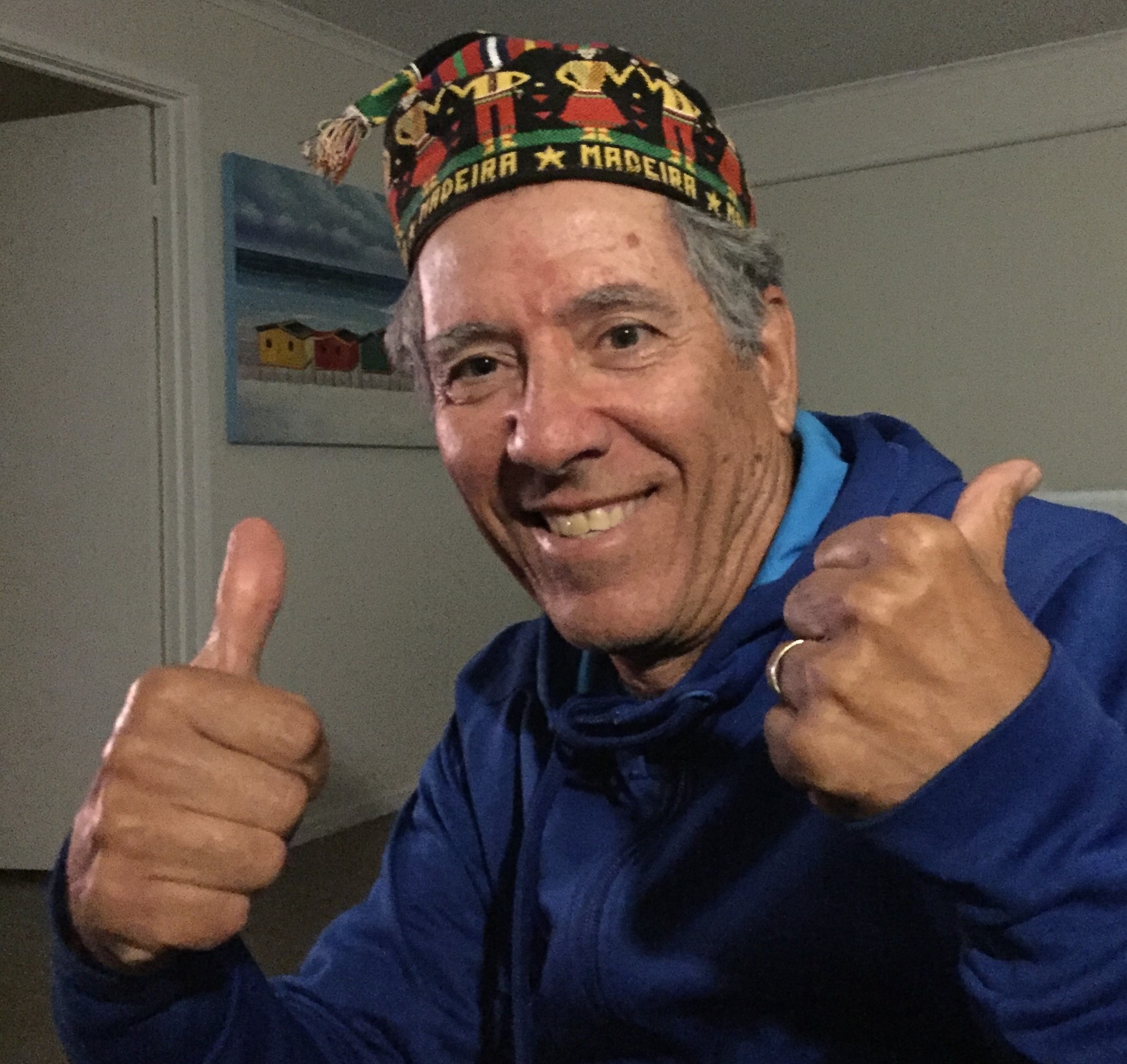
I could tell by my parents’ fretful frowns that my question was prickly, especially in the context I realised much later, of living in apartheid-era South Africa. So, while I was told to shut up and paid a penny to do so, it was probably the questions asked rather than the talking itself, which earned me the hush money.
(For the uninitiated, black people in those days had to go around the back to a separate loo, usually not as well self-contained.)

Family Feuds
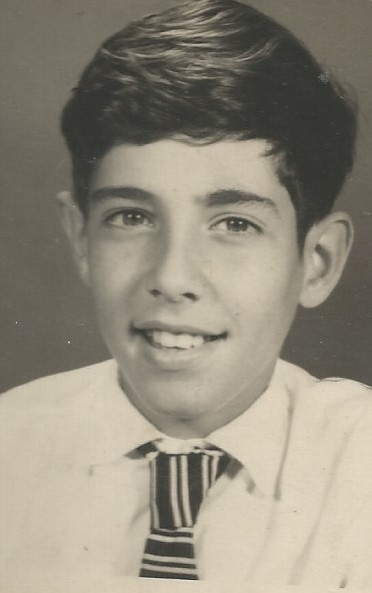
In Primary School
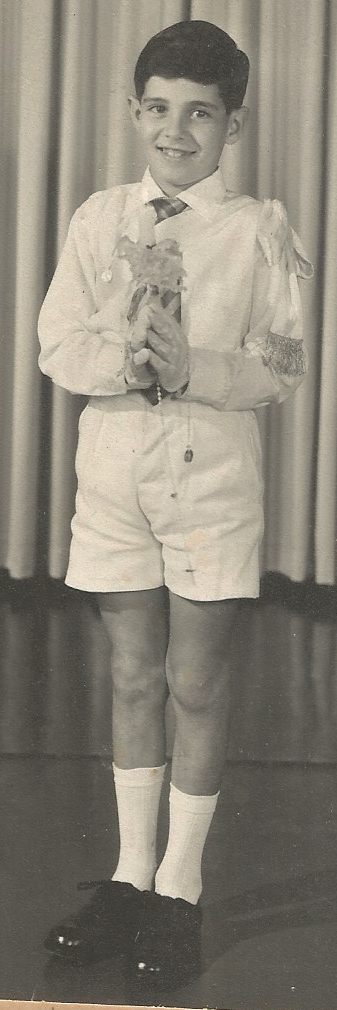
I was too preoccupied with sports as a child to care about schoolwork. Though enjoying English and typing classes in high school (I was the first boy at our school to join a typing class because I somehow felt the skill would come in handy one day), for most of my free time from the age of 10, I played tennis. I was capable enough in my early teens to rank seventh in South Africa. My father was one of those adults who pushed and prodded, so I voluntarily called it quits at 17. He wasn’t amused. Sadly, we never became best buddies.
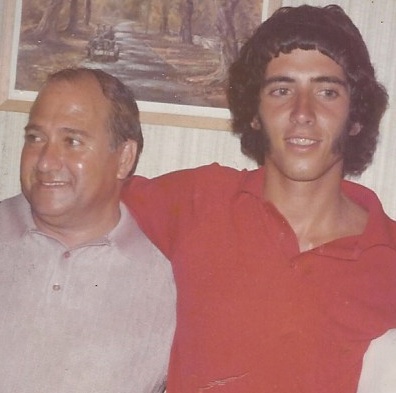
While Dad and Mum (both born in Madeira) encouraged me to go to university and worked their butts off in local delis to pay for that to happen, we clashed about politics. We argued often, particularly after I decided on my choice of uni: Rhodes, in Grahamstown. It was the first white uni in the country to enrol black students. Dad disliked it even more when I told him I was helping a few black lads improve their tennis skills in the local township.
When I was arrested for joining a protest supporting black students, he was justifiably unhappy. I didn’t have the money to pay my fine and had the temerity to ask if he could help me out. Years later, when I was 65 (the age he’d died), I wrote, filled with guilt and regret, the following poem.
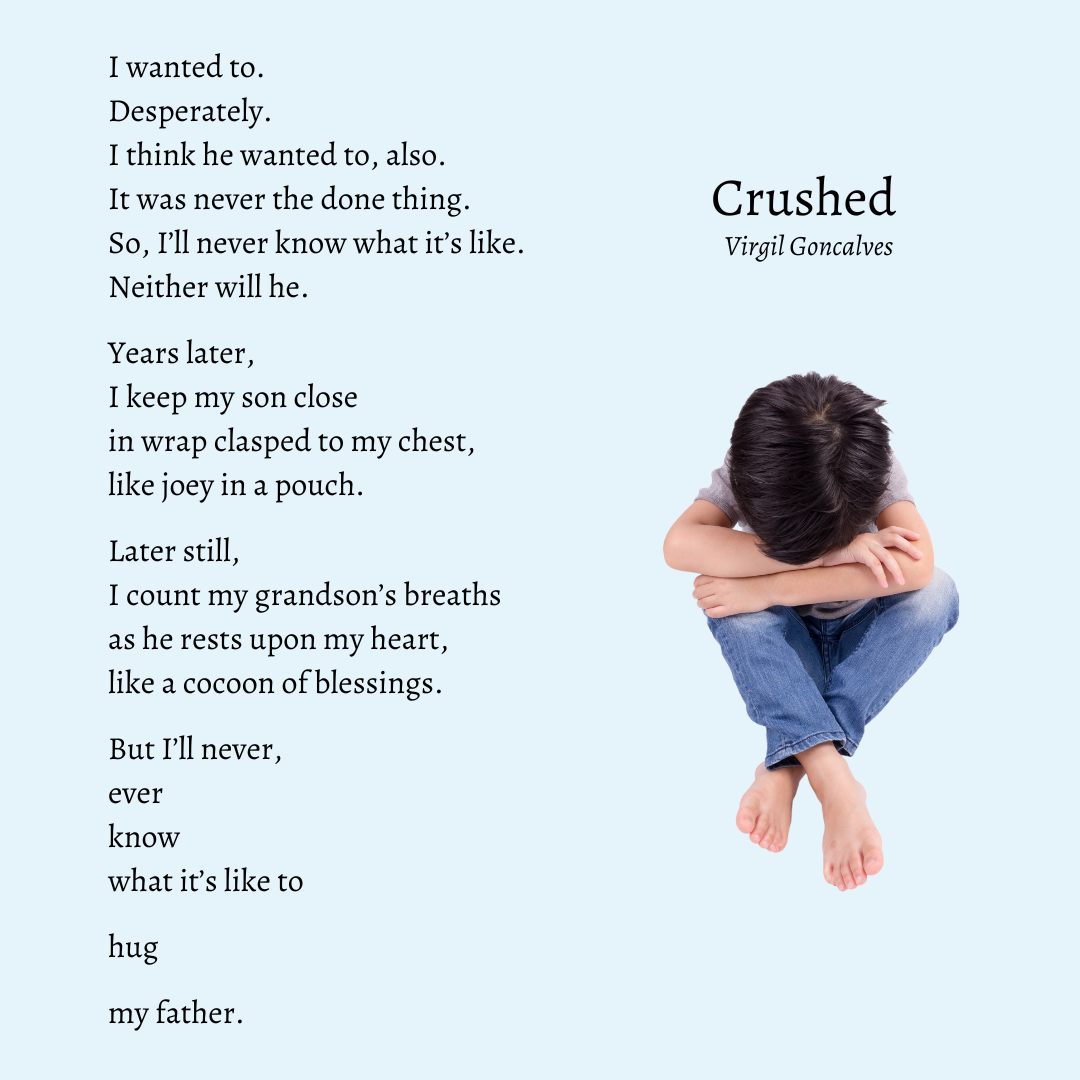
Introduction to Poetry
I wasn’t sure what degree to study until writing a random two-paragraph letter to the editor of a local newspaper. It was published, so I decided, based on that flimsy accolade, to become a journalist (especially as I could type). My majors were journalism and English.
While doing the latter course, we delved deeply into literature, and it was then, for the first time, that I fell for the Romantic poets, particularly Wordsworth and Keats. Reciting Wordsworth’s poems became a buzz. Following my stint at university, I moved farther away from my parents — geographically and emotionally — by joining The Daily Dispatch newspaper in East London, the first newspaper in South Africa to employ black journalists.
Its editor, Donald Woods, was a supporter of anti-apartheid activists Nelson Mandela and Steve Biko and later had to flee the country. (The movie ‘Cry Freedom’ portrayed his life.) I learned a lot from Woods, particularly about the basic concept of all people being treated equally. My course as a human being was set. And Mandela became my hero.

More Journalism Forays
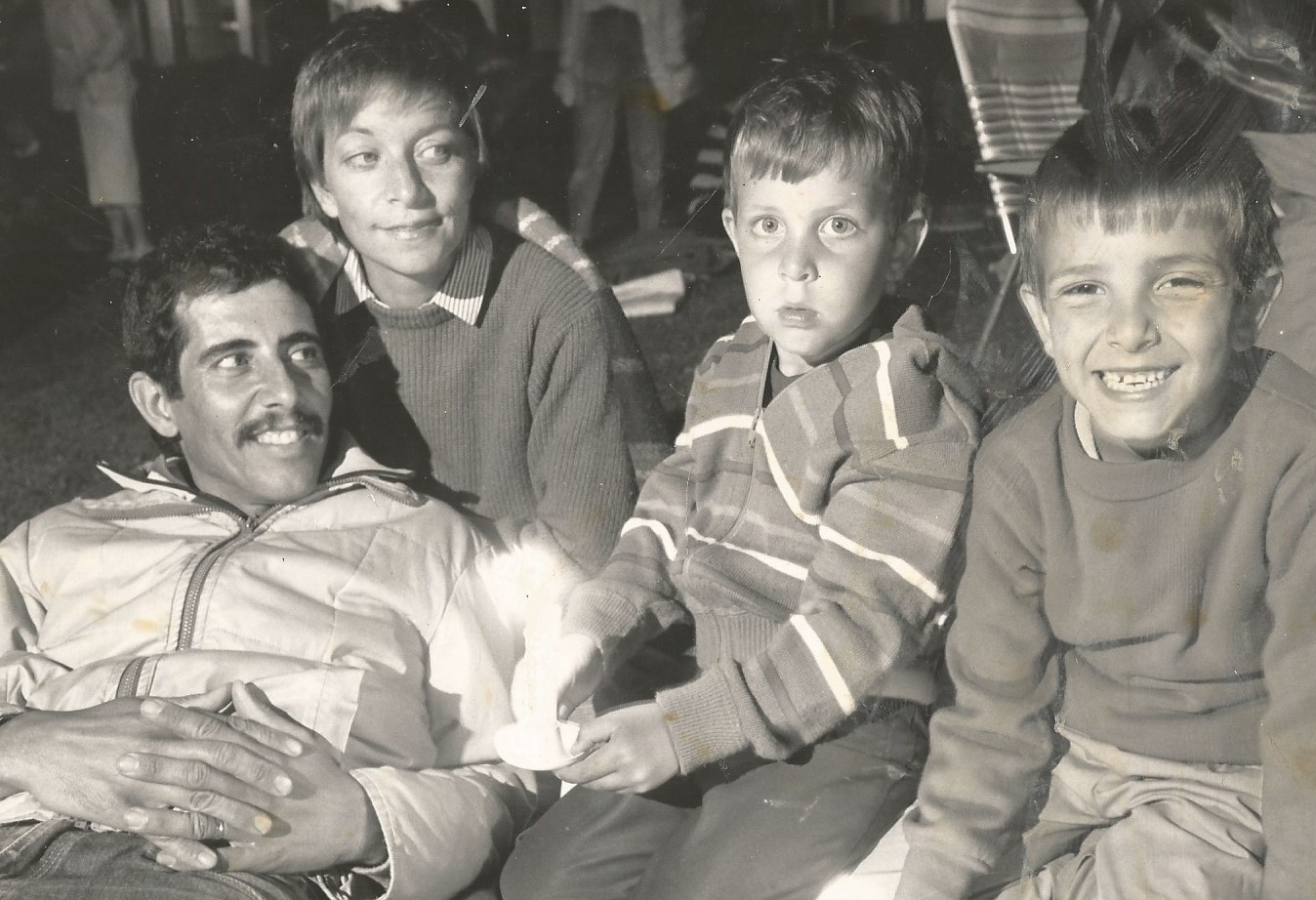
I worked over the years on three newspapers in South Africa as a reporter (general news, local government, and sport) and then as a sub-editor. My love for writing grew, and this continued after our family (including my wife Lesley and our two sons, Kyle and Ross) emigrated to Australia in 1986. I was 34.
We left for a life less permeated by pandemonium. I continued working in newspapers, joining The Whyalla News, where I became editor, a stint that lasted five years. The closest I came to poetry during this time was when the paper won national recognition for editorial writing. It was called The Shakespeare Award but likely had very little to do with The Bard himself.
Further study
We remained in Whyalla, where I moved into academia, tutoring and lecturing at the local campus of the University of South Australia. Included among the courses I taught was creative writing.
Again, I delved into poetry while attempting to teach the craft to students. Later, I joined The Advertiser in Adelaide in 1997 as a sub-editor but realised, after 35 years, I’d fallen out of love with journalism. So, I studied again and obtained a Grad Dip in TESOL from Uni of SA, and taught part-time at the Intensive English Language Institute at Flinders Uni. But I hankered after my first sporting passion: tennis.
More Searching
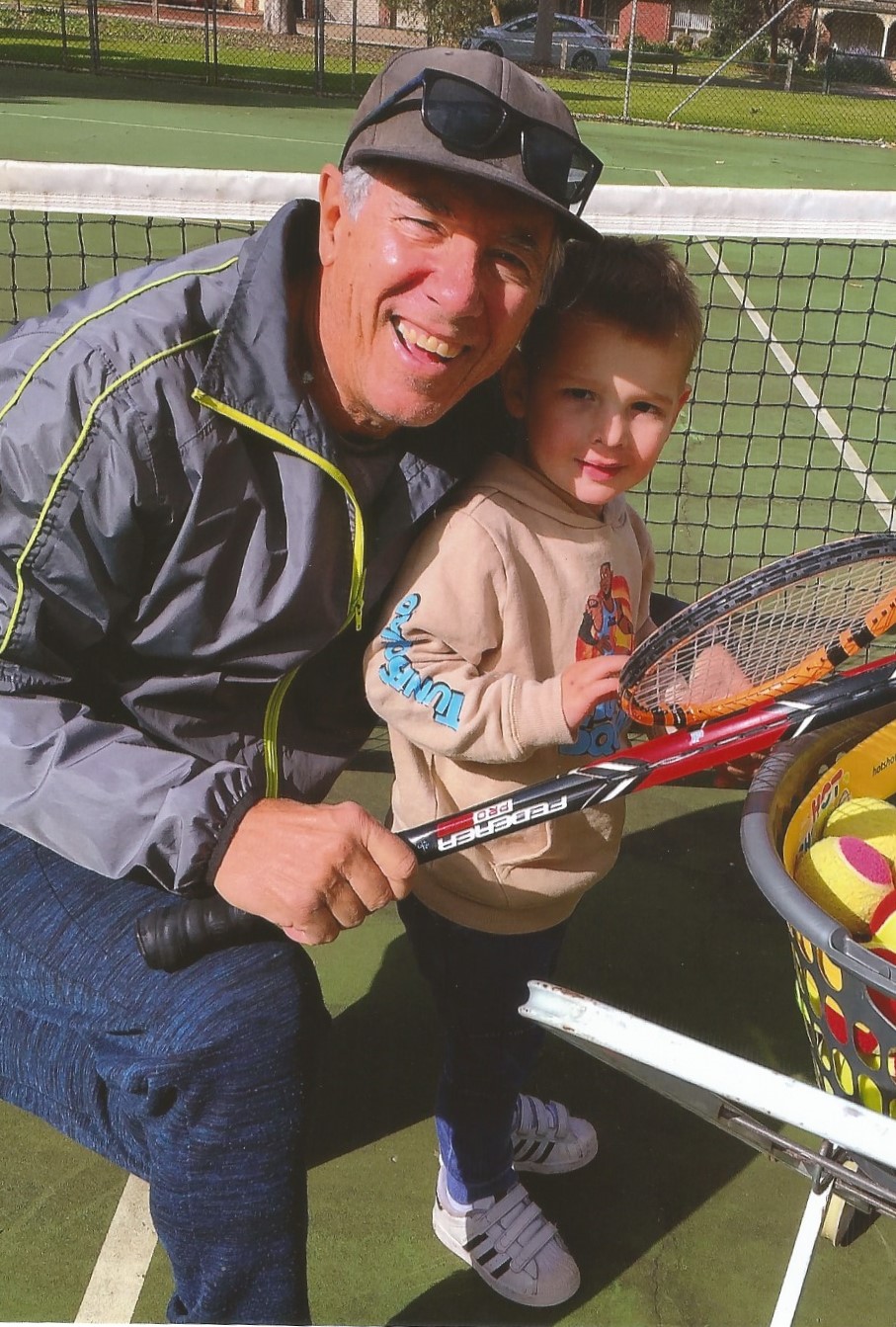
I became a qualified tennis coach. Then, as the resident club coach at Grange, I helped dedicated members grow the club from one team of four players to 18 teams (72 players) and started a program for refugees. We coached up to 40 refugee children weekly over three years. The program won an SA Building Communities Award and was featured on ABC’s Stateline. At 58, it rendered me speechless to be honoured with the 2010 South Australian Tennis Coach of the Year.
Despite our differences, I knew Dad, now long departed, would’ve been proud. During this period, there was little time for wordplay. Later, though, I wrote the following poem.
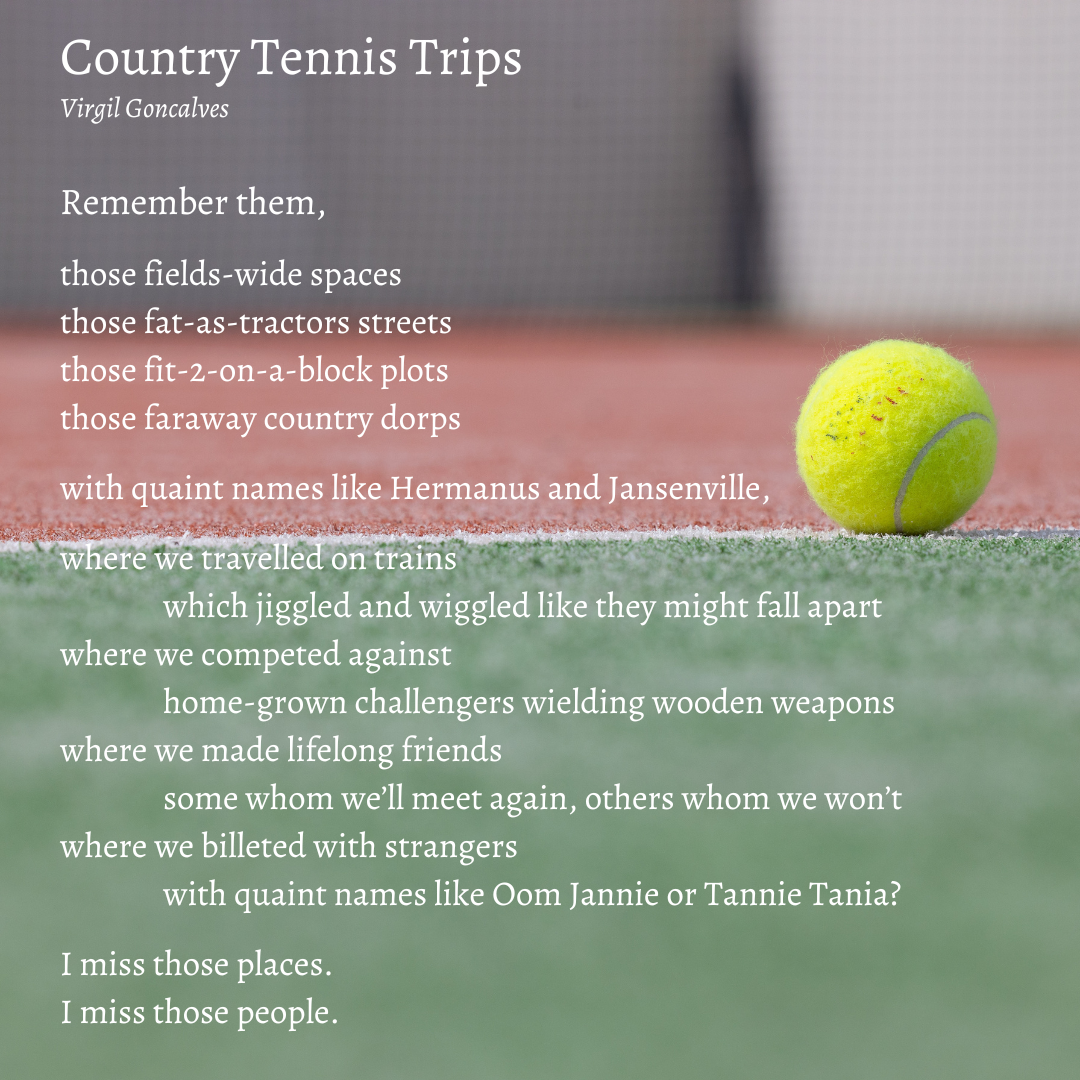
Back to Writing
In subsequent years, while working as a travelling tennis coach on the Eyre and Fleurieu peninsulas, I tentatively dipped my fingers into pools of paragraphs. I joined Eyre Writers Inc. in Port Lincoln and was introduced, in a one-day course, to novel writing. I became obsessed with the idea. So, I wrote a novel. Then another. Not as rapidly as constructing those two sentences, but the process beguiled — the braiding of plots, the building of characters’ lives, fictitious usually, sometimes based on fact. I was engrossed.
It became a meditation. Each day, without fail, I wrote. Even on trips away, I devoted mornings to writing. At the end of each sitting, I jotted down keywords so I could continue where I left off. The next morning, at my desk again, I went into that world of make-believe. I was so smitten; I wanted to spend more stints in that space. Also, in Port Lincoln, I piloted volunteer writing classes at a high school and for older residents in a home.
Curious as ever
In 2013, we moved back to Adelaide, to Aldinga Beach, where I made up for time lost when coaching tennis full-time. I joined writing groups — Ochre Coast Poets, U3A Creative Writing, and a group at a retirement village in McLaren Vale — got my work critiqued and attended open mic events. I self-published and held book launches for both of my novels.

I have an affinity for short stories but, in latter years, have become besotted by the art of writing poems. I’ve tried all sorts – haiku, sonnet, villanelle – but felt most at ease with free verse, especially toying with various structures and last lines which try to startle. I’ve become fond of quirky. Using fodder from playtime with my first grandchild prompted me to write this poem.
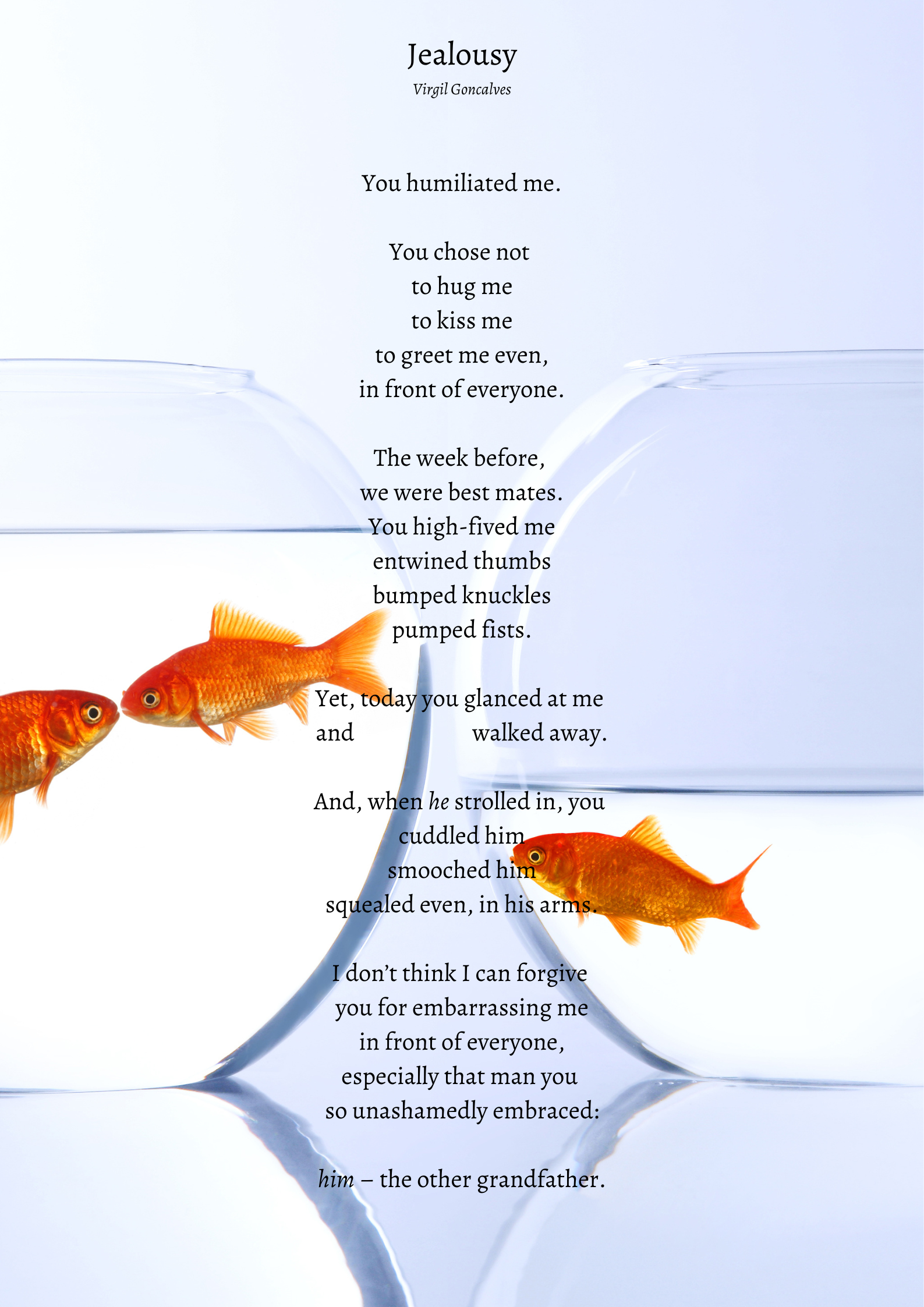
I began submitting poems to anthologies and also competitions. Winning The Gawler Poetry Prize left me speechless. The judge, Jude Aquilina, always passionate about poetry, has lately become a mentor. She’d encouraged me to chase publishers to print a collection. So, I did. Ginninderra Press agreed to publish my first poetry anthology. Then a collection of short tales and a second poetry anthology. I still relish all kinds of writing, including academic and slang, but these days I’m possessed by poetry.
I count myself fortunate to have been born curious, particularly about words. While I don’t babble on as I used to as a child, I’m happy to let my fingers do the talking via the keys of my computer — and contentedly no longer care if I’m not paid any pennies.
AUTHOR BIO
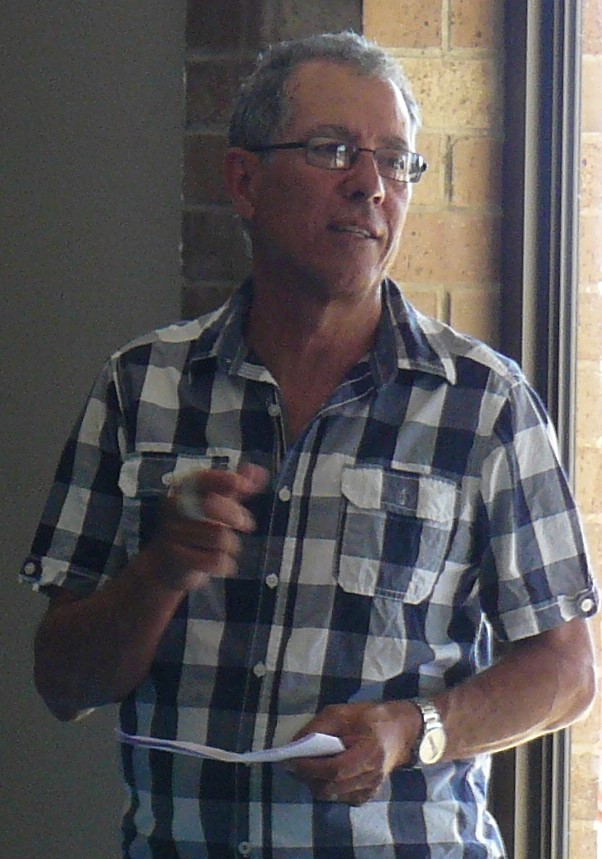
Virgilio Goncalves migrated to Australia from South Africa in 1986. He lives in Aldinga Beach with his wife, Lesley. In 1997, Virgilio self-published One Life, Two Lands. He also self-published novels My Brother, My Saviour (2013) and No Match for Matilda (2016). Ginninderra Press has published his poetry anthologies Stings in Tails (2018) and As Clear as Modder (2022) and a short story collection, Quick as a Wink (2020). Virgilio won the Gawler Poetry Prize in 2016 for ‘Attitude’. Other poems have appeared in Friendly Street, Ochre Coast Poets and Poetica Christi anthologies, and in The Crow and Tamba.
ACKNOWLEDGEMENTS
‘Street Cents’, Stings in Tails, 2018; ‘Crushed’, The Crow, Ginninderra Press, 2021; ‘Please God No!’, ‘Country Tennis Trip’ and ‘Jealousy’, As Clear as Modder, 2022.
Wow, I can’t believe I came across you on here!! You won’t remember me but I have never forgotten you from Uni SA. While achieving a degree in Social Work I attended one of your classes in about 1992/93!! I learnt so much. You TOLD me to become an author and now I am finally taking you seriously!! We had to journal – often after you’d given us a word or short sentence. I remember I receive a HD for my journal. Your message at the end is practically seared into my brain. “This is the sort of journal you read on a winters night, in front of a roaring fire with a glass of red wine”. I’m now writing stories for my grandsons. Their father my son is an excellent drawer so together the boys will end up with some personalised books. But wait there’s more. I am also in the process of writing a couple of books!! I LOVE to write and you Virgil nurtured that in me. THANK YOU!! Bless you. Warmest regards Sue Appleby
A very good read!!! Not surprised … always a good writer. Excellent journo!!! To think that I had the privilege of studying with you at Rhodes then working with you!!
Now we are in Aus where you hv bn rightfully recognised for your talent.
Fond memories of you and Lesley!
Was wondering how to get in touch with you. Hopefully chat soon. Gillian gillpc@iinet.net.au
gillpc@iinet.net.au
Hi Christine. Good to hear from you – and hope you are doing OK. Sorry I can’t help with information about suitable online writing groups, but I’ll be in touch should I hear of one. Interesting observation about how little we use our brain! Please keep playing with words… I’ve always thought doing so can help keep dementia at bay. Regards, Virgil
I would love to find an online writing group. I have never forgotten your work shop on writing a synopsis. . Eyre Writers do not satisfy me. I write doggerel and non fiction. I write because of my love of words not to necessarily be published. I wrote the following because to help me cope with the dementia in my loved ones.
When I lost my memory and couldn’t find it anywhere I decided to google “Body Spare parts”. It was amazing, there’s
Knee or hip replacements or reconstruction.
Liver and heart transplants.
Facelifts and hair transplants.
Deafness is covered with hearing aides or cochlear ear surgery.
Damaged or aged eyes is covered with cataract surgery, contact lenses and spectacles.
However I couldn’t find any mention of the brain or memory. It was frustrating but I did discover we only use a tiny bit of the brain. If this is correct surely technology and our medical team could graft some stem cells into the brain and fix the problem?
Thanks, Mike. It has been a privilege to get to know you since you joined Ochre Coast Poets. Really looking forward to reading your latest anthology, ‘water on the moon’. No doubt it will up there with all your other work we’ve been lucky to enjoy.
Hey Virgil, more of the life story – with pictures. ‘Country Tennis Trips’ has always been a favourite and now there’s the tennis pro look to go with it. There is sadness in ‘Crushed’ and tinges of it in your early history but pride in country and family, evident in your poetry, also. What happened to the line about you being a supreme optimist and a bloody good bloke?
Thanks Julie, for taking the time to provide your kind words. Much appreciated.
Thank you, Deb, for your comments. I was at IELI in 2003-04, I think. I sometimes went up to the library so, if you were then, we may even had a brief chat!
Thank you, Veronica. You and David have been amazing stalwarts and mentors over the years for our group, Ochre Coast Poets. I walk away from each monthly meeting, having learned so much. Thank you both for that.
Thank you for Val for your comments, too. Appreciate them. You need to know we miss you at our monthly OCP gatherings, especially those gentle words of yours which uniquely fill the pages.
Dearest Julie, Thank you for that. As you know, it gives me joy that people are willing to share their stories on Wattletales. Love, Lindy
Thank you, Lindy, for show casing another fabulous writer.
Thank you, Virgil, for sharing your life story, your fears, regrets and hopes.
Julie Cahill.
You have a very interesting story Virgil and I particularly like the very poignant poem ‘Crushed’. I didn’t know you had worked at IELI / Flinders…not sure when you were there but I worked more or less upstairs in the Sturt Library for several years.
Wow! Virgil you have lived a very interesting life and you write so well bringing your experiences to your readers. I have always enjoyed your poetry particularly those with a surprise final line. Wishing you continued success for all you undertake.
Wow Virgil…such a busy, productive life. It’s a privilege to get to know your story. I loved your poem ‘Crushed’ and wish you and your father had been able to have that hug. Wonderful also, ‘Please God No’. I’ve heard your poem ‘Jealousy’ before, but it’s still quirky – one of your almost trademark last lines. Hope you and your family continue along the road you’re on now, in peace and good health.
Thanks for your comments, Jenny. Yes, agree that was the expected behaviour of fathers in those days. Wonderful that you got to share a special hug with him in his later years – he was obviously moved as well. Regards, Virgil
Thanks for your generous comments, Geoffrey. Too kind, but most appreciated. Regards, Virgil
Wow. Extraordinary. Under those thoughtful contributions, even deeper riches might surface. I fully hope we see/read more, Virgil. An incomplete but tantalizing life story – still unfolding. Geoffrey.
I can relate to your writing Virgilio ..no hugs from your Father ..hmm..sounds like those times and the expected behaviour of fathers. I remember clearly the ‘hug’ I insisted on when my father was around 80, and particularly the tears in his eyes.
Your poetry says so much …thank you,
Jenny