

The book that lost its (first) publisher
I have learned a lot in my publication journey. My first contract for On Gidgee Plains, signed in July 2019, was rescinded in January 2020. The publisher I was with ceased business. All author contracts, including mine, were cancelled and all I gained was this fantastic cover art and an ISBN. Handy if I choose to self-publish.

Cover art by Nicola Matthews of Nikki Jane Design, Canberra.
In business, these things happen, especially for sole operators and small entities like Small Press Network (SPN) publishers such as the publisher with which I signed. I read recently that if a new publisher lasts two full years, they are on their way. Mine didn’t quite make the two-year mark. I empathise with the publisher for whom business failure was a shattering blow.
Of course, I was devastated too but, in retrospect, my first experience in seeking a publisher was, to put it mildly, naïve and a bit haphazard. Still, I’ve learned along the way.
My journey — finding the right reader
I had played around with the concept for On Gidgee Plains for a long time but got writing seriously in 2013 when I felt I’d developed a decent storyline. I finished writing and editing as far as I could go in September 2016 at which time, I hesitatingly sought a professional reader.
Although my local writers’ centre offers manuscript assessment, I appointed someone I knew well because the book was close to me, precious, and I was not ready for the sort of slash and burn approach I might get from a total stranger. Bit silly, really, when most prospective readers are unknown.
I waited for four months to hear back, which was a stretch. My question had been, was the book publishable or not. The appraisal included a recommendation that I submit the novel for a national literary award. With such positive feedback, I became reckless. I believed my book to be ready to go out into the world. I accepted most of the editing suggestions (pleased they were few) and set forth on my publishing journey.
My journey — finding the right publisher
While I’ve published academic articles, reviews and poetry over the years, my publishing journey as a novelist was a new experience. Publishing is a competitive business. And it is slow. Very slow. Which means living in hope for long stretches, being patient enough to get on with other things while you wait.
Perhaps foolishly, I decided to bypass the agent idea. There are arguments for and against working with an agent. They take significant fees, but they also know the industry which is large and complex.
I chose to send my manuscript directly to the Big Five publishers as they are known in Australia who are open to unsolicited manuscripts on certain days and at particular intervals. These are —
- Allen & Unwin: The Friday Pitch.
- Hachette: submit by email.
- Pan MacMillan: Manuscript Mondays.
- Penguin and Random House: First week of every month.
Almost every publisher who accepts unsolicited manuscripts advises at the outset whether or not they’ll get back to you and how long they expect to take either way. I was optimistic. I was patient, but I waited in vain. Eventually, this door closed.
The next step
As deadlines passed, and rejections rolled in, I began searching in earnest for specific publishers, niche publishers that I thought might be interested in my story. I discovered Australia’s Small Press Network of independent publishers, and it was here that I had a modicum of success.
One SPN publisher wanted me to change the second half of the book. I declined. Another offered valuable advice. Like many new writers they said, I tended to overwrite, but I mustn’t lose heart because my book had many beautiful lyrical moments. More editing would do the trick.
To the uninitiated, ‘overwriting’ is pretty much a form of telling rather than giving the reader credit for keeping up. It includes the use of unnecessary tags like ‘he said’.
Getting positive feedback from these two publishers sent me back to my manuscript. I asked an editor friend with a literary editor’s eye, what she thought. She was fierce but armed with her detailed critique, I went through the novel with a fine-tooth comb, cutting 15,000 useless words. The original manuscript was 87,500 words. The word-count is now 72,500.
I touched base again with the publishers who’d wanted me to change the ending and asked if they’d reconsider the manuscript now that I had substantially edited it. They reviewed and accepted the revised version. It was soon evident that the publisher was struggling but I hung on until the bitter end. The thought of starting again did not appeal to me.
So, here I am in January 2020, heading towards 77 years of age next month and six years on from idea to failed contract. While it hurt, I have removed forthcoming’ from On Gidgee Plains on my books page — for now.
Author Promotion
If 2018 was the year of submissions, 2019 was the year of waiting, but I kept busy.
I kept up with my poetry as you can see in my new book, Life Blinks launched on 12 January. I got stuck into my second novel, High Rise Society and am making good progress there.
Most exciting of all, I attended a brilliant workshop series called ‘So, You Want To Write a Novel’ run by a well-known and respected Australian writer and poet, Jude Aquilina. She had us writing synopses, character profiles and much more that got me started on my a third novel entitled Beyond Ginza. I’ve collected books and undertaken research for this story and, I can’t wait to get into it. It spurs me on.
Other helpful workshops I attended covered the how-to of seeking publication and one on author branding. It was mandatory, workshop convenors said in unison, that writers develop a professional web page. And I did.
Wattletales, as you see it now, is my first web page. I am proud to have created it myself on WordPress.org. There is always so much we can learn. Yesterday I attended a Canva workshop and I’m booked to do one on promotion and publicity.
I still struggle with SEO (search engine optimisation) which means learning a whole new language, a whole new way to portray yourself. It also requires you to objectify the self, something I’m not doing here. Today, I’m telling the story of my journey towards the desired goal of getting my novels published. The dream is to have three novels published before I depart this planet.
My publishing journey Mark 2
My first publishing journey is a cautionary tale. Do not rush in with your novel before you are absolutely sure it is ready. I say this because, last week when the mere thought of again preparing my work to suit the requirements of different publishers exhausted me, I decided I’d give the previously discarded path of seeking an agent a go. Trouble is, that is as much work as going direct.
Nevertheless, I looked through the list of Australian literary agents on the Australian Society of Authors (ASA) website and happily selected three I thought might possibly accept my work until I read the submission requirements. One stated categorically that anyone who had submitted to more than three Australian publishers, need not bother to send their work. They would not read it.
Don’t lose heart. There are many valuable sites where you can get quite a bit of free advice. Try Jericho Writers on how to find an agent and Authors Publish for ideas on where to send your work. These are both top-shelf sites to help you on your way. A bit expensive for some of us to become a member, but if you can afford it, why not give them a try?
I’m still undecided about which way to go, direct or through an agent but one thing I am doing before I make up my mind is giving my manuscript another thorough proof and edit. Every time you return to your writing, you can improve it.
Traps for young players
A note to the wise, please avoid Austin Macauley Publishers who seem to get top billing via Google every time you search for a publisher. Austin Macauley gave me a thrill a few months after I started sending On Gidgee Plains out. They sent a signed contract (in duplicate) in a glossy folder with a letter of offer to publish. Their proviso was that, as an unknown writer, I would have to pay.
Pedlars of false dreams are out there
wattletales
There is a range of publishers who will produce your book for you for a fee, but you need to beware. Some, more often known as hybrid publishers, are genuine. Still, it is a fine line between partnership publication and a scam. Check them all out. You’ll find reviews on the internet and at your local writers’ centre or association. I consult the Australian Society of Authors website. It’s worth being a member.
Success, or slush pile?
All advice, from workshops, readings and online forums, is that we must, first of all, bring our manuscripts up to standard, not only for publishers but agents as well. Indeed, we need to do that before we submit to a professional reader. First work on your story.
When I started writing, I read a lot of how-to books. Here are my two favourites.
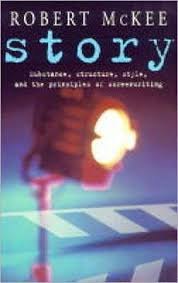
I think I’ve mentioned Robert McKee’s work entitled Story: Substance, structure, style, and the principles of screenwriting in a previous post. However, I cannot emphasise how important this book is. Yes, it says it is about screenwriting, but it is excellent for novelists because it explains in easy-to-use and straightforward language how to captivate your audience.
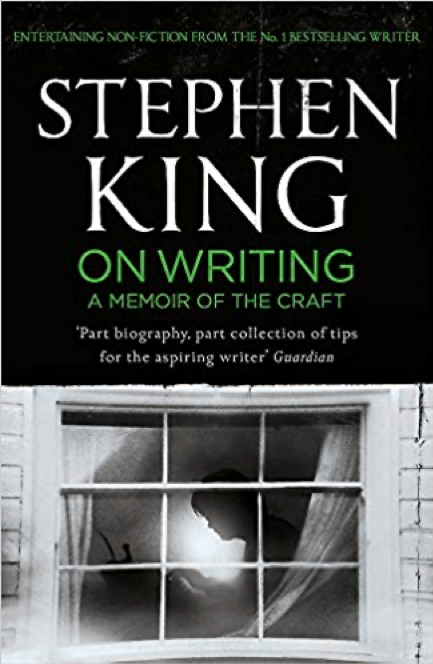
Stephen King’s book On Writing: A Memoir of the Craft is part biography, part writers’ helper but it is deeply honest and insightful. It is available on Amazon.
Before you send anything out, whether to publisher or agent, pay a professional reader, or engage an assessment service (again, find these through your local writers’ centre).
Be professional about getting published
When I started writing, the only app I used was Scrivener which I still use and highly recommend to this day as an aid to creative output Scrivener lets you save web pages, character profiles, research and other material right there where you write in the same project window. It also facilitates moving text so you don’t get lost as your manuscript grows as it does with an extra-long Word document.
writing is the first step
editing and proofing for publication come after the creative phase
wattletales
Before you think about sending your manuscript to anyone, even when you feel your story is working well, make sure you check it thoroughly for grammar, spelling and style.
No matter how good you are, be aware that grammatical rules change, and language is always in flux. When I taught at University back in the 1980s and early 1990s, I was amazed at the low literacy levels of students because, in my day, schools hammered grammar and spelling and punctuation into us. Not so, nowadays.
Now, language and rules change fast, but apps keep abreast of the game. It wasn’t until I proofed my first novel manuscript with the apps I’m about to introduce, that I realised my comma and inverted comma style was out of date. So, too was my use of articles and tags. And flowery overwriting! My mistake was to send my manuscript out to too many, too soon. It was not ready.
Getting your manuscript, your synopsis, author bio and even your covering letter all in tip-top order is a priority when seeking publication and there are tools to help.
Editing and proofing apps
I recommend three editing and proofing apps for writers. There are more, for both Mac and PC, but as a Mac-using writer, not a techie, I include only those I know best.
My process is to forget about editing and proofing while working in Scrivener. Still, as soon as I finish my first draft, I save to Microsoft Word where the long editing, refining and proofing phase begins.
Grammarly
You can use Grammarly for free. If you fall in love with it as I did, it’s worth paying for. I use the Premium version, which is not cheap, but I wouldn’t be without it. It checks both spelling and grammar at a much more sophisticated level than Microsoft Word. You can set your own language and goals for correctness, clarity, engagement and delivery according to what sort of what genre and effect, you hope to achieve.
I was over the moon just before Christmas 2019 when Grammarly announced that its Beta app for use on a Mac. You can use it online or embed it in your Word documents. It corrects your language on web sites, including social media sites.
ProWritingAid
I have a friend who swears by ProWritingAid. It is similar to Grammarly but cheaper. They say it is better for novelists because it has more proofs around style, but I don’t find it is as sophisticated as Grammarly.
Hemmingway
Authors often write long sentences, lovely long sentences, but they are brilliant only to the extent they transport their reader, rather than lose them. Hemmingway is the doctor for that problem. Hemmingway is another freebie which is excellent when you are working on a first draft. It is less about grammar and spelling and more about style.
Check this out
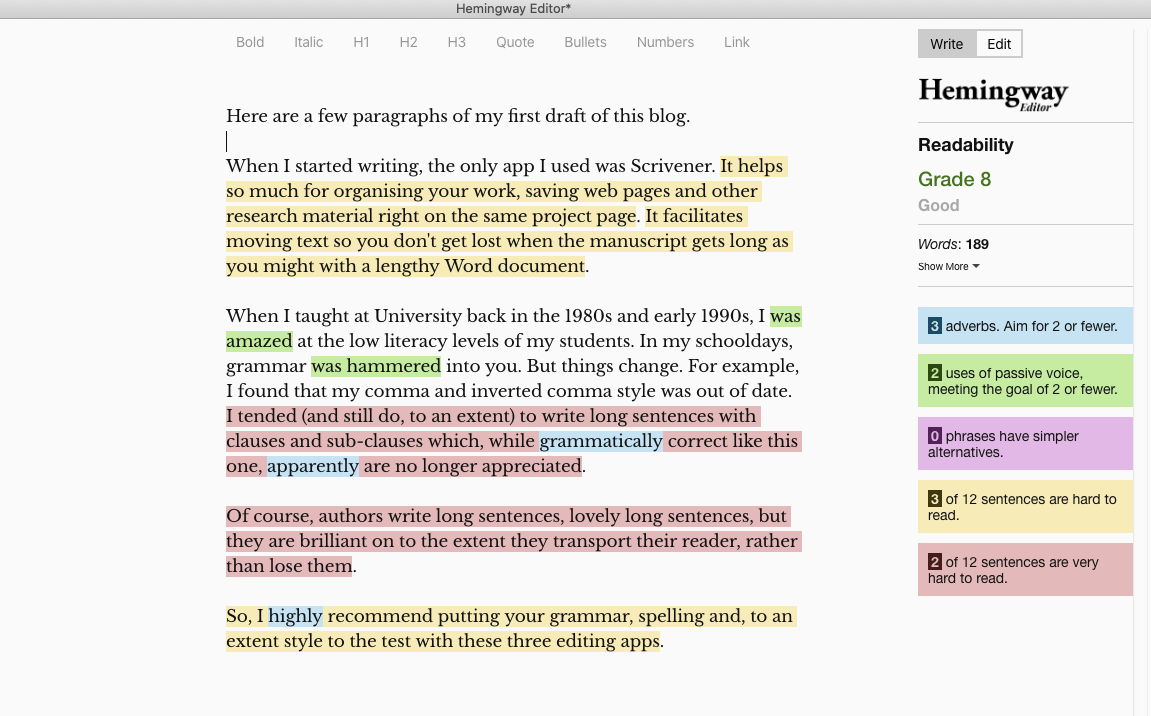
I tended (and, still do to some extent), write long sentences with clauses and sub-clauses which, while grammatically correct like this one, are apparently no longer appreciated by the reading public in this fast-paced meme-y world of ours.
So, here’s a pic of the first draft of a part of this blog. I thought it might amuse you because, right now, Grammarly is telling me my text is 100% perfect, but Hemmingway says, long sentences, lady! Fix that.
Try This
If you feel uncomfortable trialling new apps with your current project, bring out some old drafts and run each piece through Hemmingway. Then give Grammarly or ProWritingAid a try. See which works best for you.
I recommend a combination of Hemingway followed by Grammarly which has helped me (and a couple of my writing buddies) to stop overwriting.
Habits are hard to shake, but these clever companions make it easier to refine your writing and learn along the way.
All the best with your work. Lindy
This was a fantastic read! Thank you so much for your insight into the publishing world. I am currently in the final process of publishing… So much work to be done!
I’ve heard back from my beta readers and the main issue is structure, signposting and structure! So, I was delighted to hear about Hemmingway. I am going to be using that tool for sure.Grace Tulloh