

I Write Because
With a lifetime of experience behind me, I can draw on a plethora of ideas, a diverse background of failed ambitions, modest achievements, many ways of being and even disasters for my writing. Call me a veritable museum of womanhood in Australia since 1943 and continuing.
I write my blog because I have things to share, poetry because it excites me. And, I write stories to fulfil my childhood dream of being a novelist. And, along the way, I’ve found myself.

In a post a couple of months ago, I talked about my first novel On Gidgee Plains. Six months after I signed a contract for it, the publisher went into liquidation. That broke my heart. Yet, I persist because I love to write.
Yes, I have stories to tell, but writing is also my ally, my friend, my place to turn. It is where I can rediscover myself in a world where the elderly drop out of sight. Characters are my imaginary friends, my compatriots and my companions.
Where other people’s stories allayed my childhood loneliness, in my later years, my stories complete me. Through poetry, and especially in my novels, I negotiate the past, create imaginary futures and, in so doing, recreate myself.
Make Space for Your Heart
When I taught Life Writing a few years ago, I started by encouraging new writers to, first of all, permit themselves to write. We need to say; it is OK to put ideas, thoughts, and feelings on the page without judgment, crafting comes later.
This checklist is like many others, but it is worth setting it out here for those who may never have seen them before.
A Writer’s Checklist
- Create a particular writing space for you alone.
- Create a ‘do not interrupt’ time for your writing.
- Show up on the page every day for a specified time or number of words.
- Keep a notebook or phone mike with you at all times to record observations, ideas, thoughts or feelings: anything that takes your interest or fancy.
- Write three longhand stream of consciousness pages first thing in the morning to free up your creativity: anything goes, you can just grizzle on the page if you like. (Julia Cameron in The Artist’s Way calls these the Morning Pages.)
- Another brilliant idea from Julia Cameron is to take yourself on a weekly Artist’s Date. Take yourself somewhere as though you were a child to visit a place that thrills you or gets your creative juices flowing – a flea market, aquarium, museum, bead shop, fabric store, garden centre, botanic park, art gallery, antique shop, pub, tourist venue…go sky diving if you want to!
- For further inspiration, go to your favourite café or nook to reflect and write.
- Remember writers’ block exists in the conflict between the creative mind and the rational editor. So tell editor in your mind to mind its business until your creative intelligence has finished its work.
there is no such thing as a bad first draft
My Space
After I sold my house with its external studio and following my own advice, I designated the bedroom in my tiny retirement unit to be my writing space. That means that I sleep in the lounge where my bed doubles as a settee by day. I can sit and read on my balcony, which attracts the winter sun.

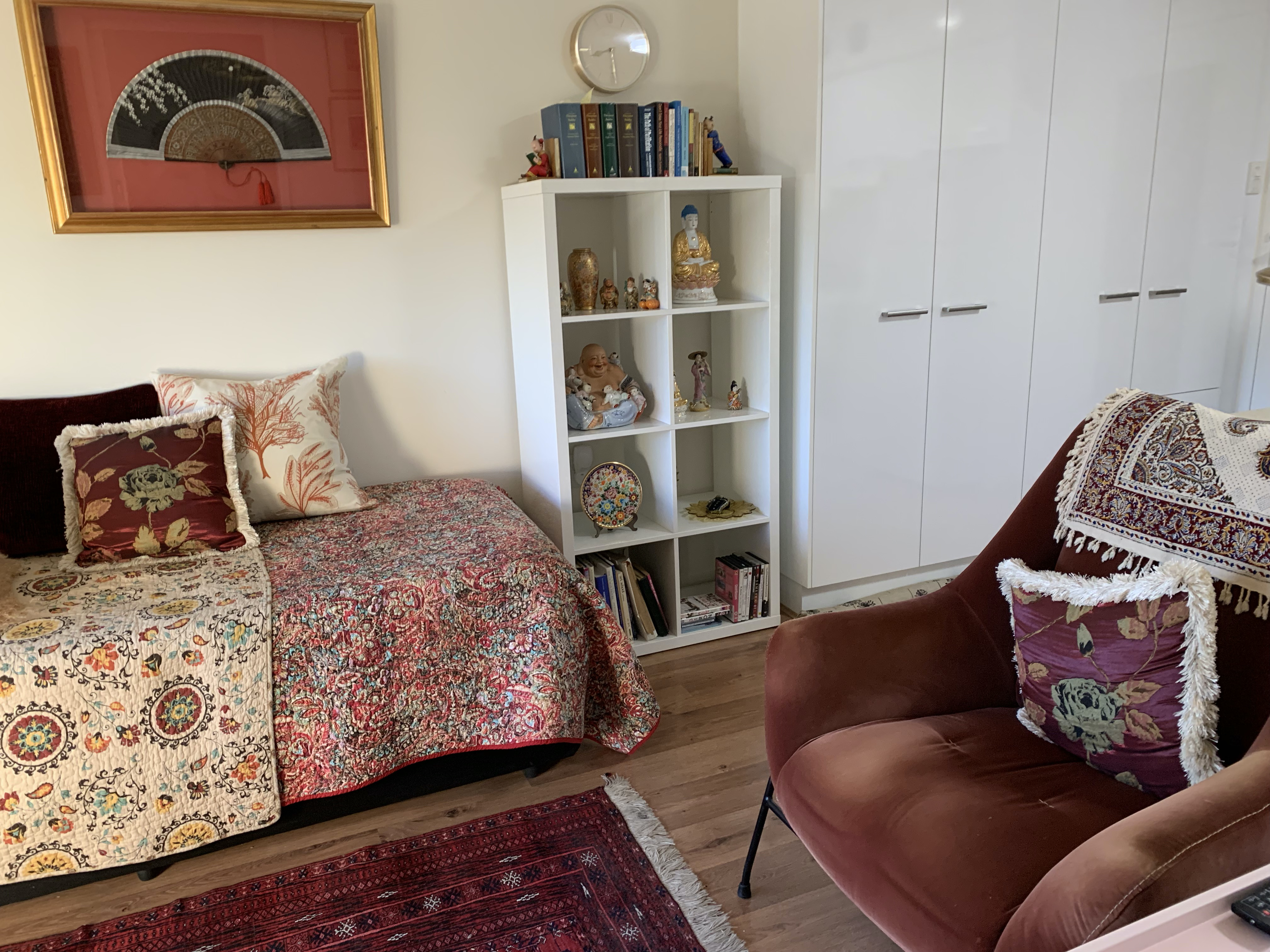

My Space, My Eyrie
The Eyrie

Looking out, looking in
it's where I soar
above hustle-bustle
deep in memory's well.

In my eyrie among
life's bric-a-brac, I scavenge online
for fragrant delights to
caress wrinkled skin
cosset a dry scalp and
put a sheen in white hair
just for me. Only me.

No eggs in this brightly cushioned
world. It's a nest of endings
with Persian rugs
secretly stuck to the floor where
only a bed pole
disturbs the comfortable façade.

Graceful, tasteful curtains
magnolia-and-birds on cream
hang from a golden rod to frame the sky
in sun and in rain
between gold-braided ties with plump, shiny tassels.
When curtains close in the dark
the eyrie is a magical cocoon from which
neither moth nor butterfly will emerge.
My Family of Ideas and Words
There was no television when I was young. Because I read so fast, the library of whatever town we were living in at the time gave me dispensation to take out additional books. I grew up in a different buzz of ideas and words in a family of readers.

When my mother was young, her favourite novel was the lesbian tale, The Well of Loneliness by Radclyffe Hall published in 1928. Mum spoke of it lovingly throughout her life, often saying she hoped I would read it one day. In retrospect, I can see that she was trying to share something of herself as a woman that way, beyond being a wife and mother.
Mum spoke with similar awe about the wonders of Ancient Egypt. She had yearned to go to university, but circumstances and times were against her.
In a similar vein, my gifted gay brother who died aged 52, was an avid reader of poetry and literary classics from an early age. He adored Ancient Egypt and at university, turned his intellect to the study of the Classics. He became fluent in both Ancient Greek and Latin which was quite a feat but, with a facility for languages, managed to also speak fluent French.

As for Dad, my mother’s family accused him of being gay because he wore a camel hair coat yet, all he ever read apart from his beloved racing pages were what he called his yippees. He kept stacks of them beside his bed, next to a full ashtray, and, as he aged, false teeth in a glass of cloudy water. He regularly took the yippees he’d read to a book exchange shop only to return with a new collection.
We are, I think as much what we read, grow up in and later surround ourselves with, as we are what we say, do or believe we are. Indeed, without the ideas and words that nurtured us and those we embrace along the way, how could we write at all?
My Writerly Journey
My own reading adventures began with Mae Gibbs’ Snuggle Pot and Cuddle Pie and Beatrix Potter’s Tales of Peter Rabbit until I graduated to Enid Blyton. As a young woman, I progressed to Sir Julian Huxley’s Evolutionary Humanism, and a particular favourite, Fyodor Dostoevsky’s The Idiot. My eclectic reading also included Doors of Perception by Aldous Huxley.
My youthful intellectual perambulations covered a type of magical realism in children’s stories through to humanism, madness, and mysticism, all in keeping with my interests today. Later, through anthropology, I was fascinated by and studied South Asian myth, ritual and religion, and the emotions. In among that, I retain a hearty Okker bent like Dad’s, which springs to life in some of my poetry.
Writing is a splendid art and, for a writer like me, the joy is not in the product, but the process: the writers’ journey. I agree with Nuala O’Connor who says in her article, ‘Out of the Iron Cage to Swim’ —
I think a lot of unpublished people have a skewed idea about what being a published author might mean to the writer herself. The book is the end-product of years of research and writing; of unsuccessful experiments; and of the mid-book cri de cœur: ‘I’ve failed – again!’ Often, when the book is published, the writer is finished with it, emotionally and physically. The joy is not in the made object, or the party, or the wandering about, talking about the book. Those things can be fun, and celebration is important, but it’s not what the creative act is about. What the writer most wants is to be at home, alone, bubbling with anticipation, nurturing a fresh bud, being neatly deluded by nature and glad of it. Virginia Woolf said, ‘I want to be through the splash and swimming in calm water again. I want to be writing unobserved.’ Amen, sister.
Nuala O’Connor
Being-in-the-World
At the risk of repeating myself as I’ve quoted him in a previous post, let me cite Milan Kundera from, The Art of the Novel (p.42).
A novel examines not reality but existence. And existence is not what has occurred, existence is the realm of human possibilities…But again, to exist means: ‘being-in-the-world’. Thus, both the character and his world must be understood as possibilities (i.e., qualities of a promising nature – i.e., something is going to happen)
Milan Kundera
If, to exist means ‘being-in-the-world’, I am lucky to have grown up in a world before the selfie. I could lose myself in the imaginative world of characters, including my family. If, as it did with me, reading arouses curiosity, it was also my great fortune to grow up in pubs where I came into contact with all sorts of people; rich, poor, high and low status, with various social, religious and cultural backgrounds and education levels.
Whether on the page or the other side of a bar, characters are characters. And in telling stories from our lives as humans are prone to do, we create ourselves as characters along the way. No wonder I became an anthropologist. I was born to be a people-watcher, now poet and writer.
Try This
- If you write or wish to, ask yourself why.
- Ask yourself how you came to that desire.
- Look for clues in your family, your past, your childhood dreams in the way I have in this post.
- Don’t fear to tread through failures and disappointments.
Under Items 1-4 list whatever comes to mind and, using that information, write the story in the way outlined next. You may surprise yourself.
Tips Before You Start
Avoid writing remembered stories. These are stories already analysed to the point that we can recite them by heart. We see remembered stories clearly in our minds, as though we are the star in our very own TV show. They are so well-rehearsed we tell them for a purpose: self-presentation. We often modify or embellish them to suit our audience until we come to believe they constitute ‘me’.
Remembered stories are ‘front of house’ stuff. Forget them, at least for now.
Instead, dig deep into memory’s treasures by taking yourself there through the senses (sight, sound, smell, touch and taste). Stop talking and even thinking long enough to ask where you were, the time or place. What did it feel like? What light was there, was it hot or cold? Can you hear, see or smell anything? Bring tactility into it such as rough bricks, puppies, furry rugs or flowers and trees.
Working with the senses in this way you can tap into what Patti Miller in Writing Your Life calls original memory which brings together those things we exclude from remembered stories. Original memory is poetic. It is clear and connects things in ways that are unique to a particular moment.
Happy Writing
Wattletales
Dear Glen,
It is serendipitous to me that you found my web page via a search for Acacia cambagei because I have been thinking of changing the novel’s title for being too obscure. But, not now! On Gidgee Plains yet in print but, hopefully, it will be soon.
I appreciate your thoughtful comments and thanks for taking the time to read some of my stuff. Let me now take the liberty of asking you to just write. Get your stories onto the page in your rolltop desk worry about editing later.
All the very best.
Lindy
Hi Lindy,
I came upon your site/blog, by originally looking into an Australian hardwood timber to rival Japan’s renowned Beech/Oak wood ‘Quercus serrata’ which is called ‘white charcoal’ or ‘binchotan’ Jp, it burns white hot and is used in top Japanese Yakitori restaurants.
The timber I found interesting was Gidgee (Acacia cambagei) stinking wattle it is the 5th hardest wood in the world, it grows primarily in semiarid and arid Queensland. I don’t know how good this timber/charcoal would be to cook with, but would like to try it one day.
Anyhow, (Paul Hogan just came to mind…’have a Windfield’)
it was nice to stumble upon your blog and your book ‘On Gidgee Plains’ it sounds compelling & for some reason, I have to read it, where do you get it? I don’t read generally, which is hard for me to admit, particularly in writing. I do like writing, unfortunately I hold back because my spelling/grammar is not good, I feel embarrassed that someone might read it and fault me, as teachers/smarty pants do. I like exploration of the creative side and imagery that evolves. I have bought an old roll top desk so that one day I can sit down and write and write, I don’t know if I ever will, as time keeps passing by.. The discovery of your book title which in turn led me to you and the hard times you have had with you publisher has inspired me, not to be a famous published writer but to record something of my mind somewhere.
Thank you for being in the cosmos and for being.
You have opened my heart and allowed me to shed a tear, reflecting on myself and my need to open up the deeper me, and discover the pyramids within…
Kind Regards
Glen
Thank you for reading, and your encouraging feedback Julie.
Thank you, Lindy.
Your most inpiring blog carried me inside your pocket, for a while. The wooded smells of your childhood still cling to the lining.
No wonder you write. Thank you for sharing your richness.Julie Cahill
Thank you Julia, That is lovely feedback.
Maria just told me about your blog. Well done, it’s just beautiful! Julia Wakefield
So glad you enjoyed it, Val. Thanks for your comment
Wow! What a brilliant blog with invaluable advice. Took me back reflecting on my own life. Thank you Lindy for your words. Val Smith