

(An Autobiographical Excerpt)
The Trans-Australia to Loongana
My mate Mick drove Morse and me out to Parkeston in that FE Holden I’d only sold to him the day before. Still, it was sad for me to have to part with my faithful car. It had never missed a beat while I’d drove it all the way from South Australia right across the Nullarbor to where we finished in Kalgoorlie. I knew I couldn’t have driven the Holden to where Morse and I’d soon be going, out in the middle of nowhere to this railway siding at Loongana on the Nullarbor Plains.
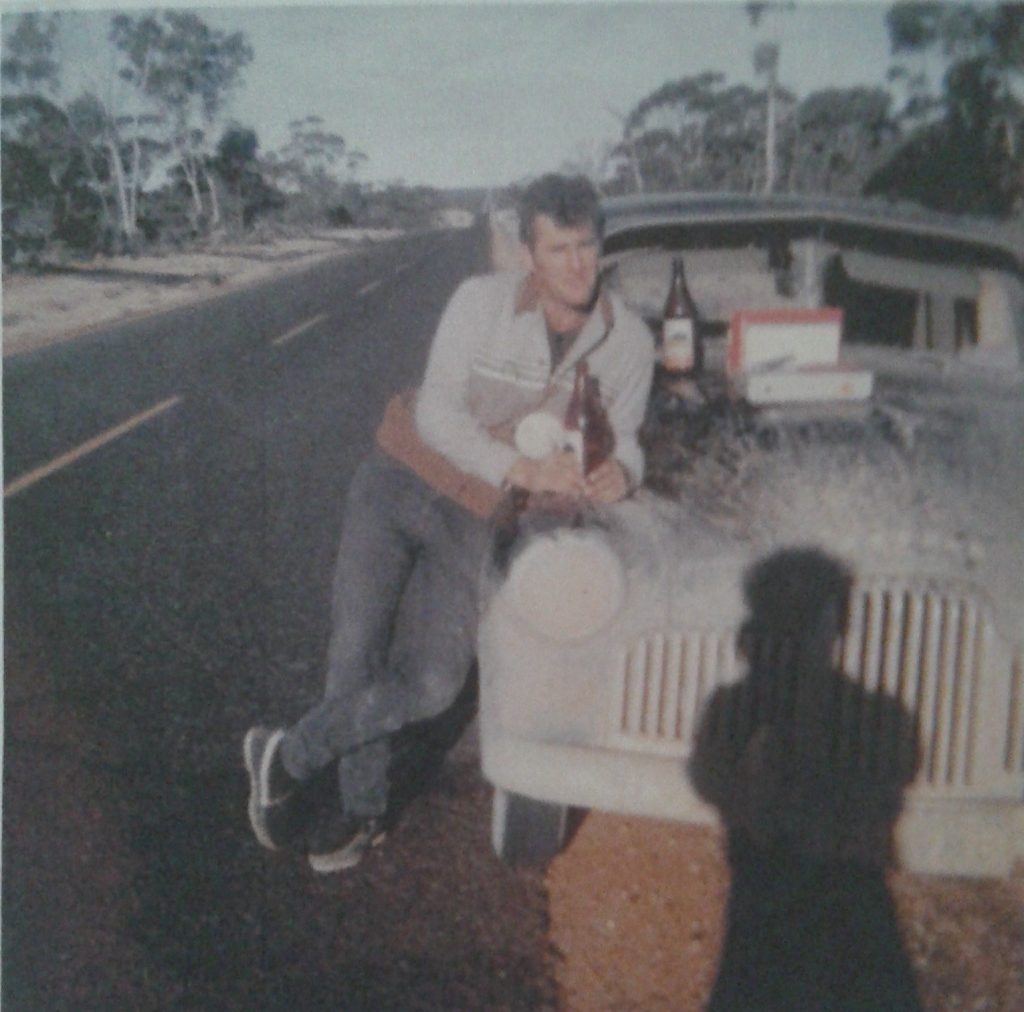
Me 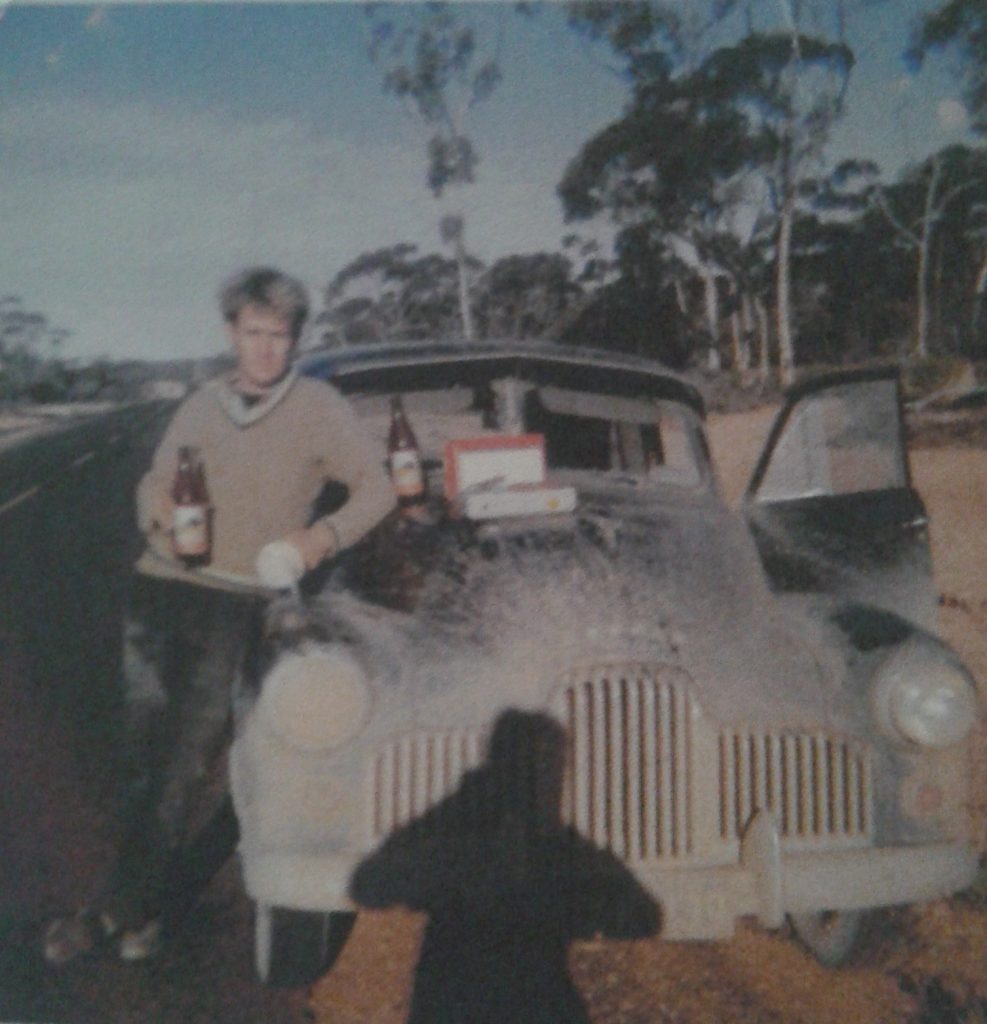
and Morse
The next evening, Mick again drove Morse and me in the Holden to Parkeston, a suburb in Kal, to board the train to Loongana. He wanted to see us off. I’d been expecting the girl Morse had visited there at the Hay Street Brothel to have been on the platform too, to wave him off. Many others stood on the platform that evening, waiting to board the train; some of them being married couples with their children, those willing to brave very harsh conditions.
When they signed up for the job, many of these families hadn’t expected the Nullarbor to be so tough. Some families I’d spoken to had plans to save up enough money so that when the time came for them to leave the Commonwealth Railway, they’d have enough put by to buy a house in whatever town it was they’d come from.
A lot of single blokes also travelled on that train: Morse and I soon learned that a few of them were running from the law for various crimes, with most wanting to avoid paying maintenance to their wives. What these blokes hadn’t realized at the time of signing on with the railways was that the cops already knew their whereabouts and that they’d sooner or later get sick of working out along the line in the middle of nowhere. Their longed-for return to the good life there in the big smoke would soon become their downfall.
With there being only two ways to travel for these blokes, either back to Parkeston in WA or to Port Augusta in SA, the cops would be waiting on either of the platforms to meet them, ready to handcuff them as they stepped off the train. Never had there been much hope at all for those working out along the line for the Commonwealth Railways wanting to escape the long arm of the law.
Sitting up on the train that night for me and Morse wasn’t very enjoyable at all. We had to put up with those who were pissed, yelling and wanting to fight each other and then wanting to have a go at those blokes who were sober. Then we had these couple of idiot drunks, who tried to get on with a couple of the married women there on the train.
Still, there had been quite a few of these blokes I’d heard about, tried doing the same thing wanting to get involved with the married women. Yet, for those stupid bastards, I’d been told, they never got to leave the train without looking somewhat different than how they were when they boarded! It has always been the same rule for single men while working out there along the line, for them not to go fucking around with other blokes’ wives or their girlfriends.
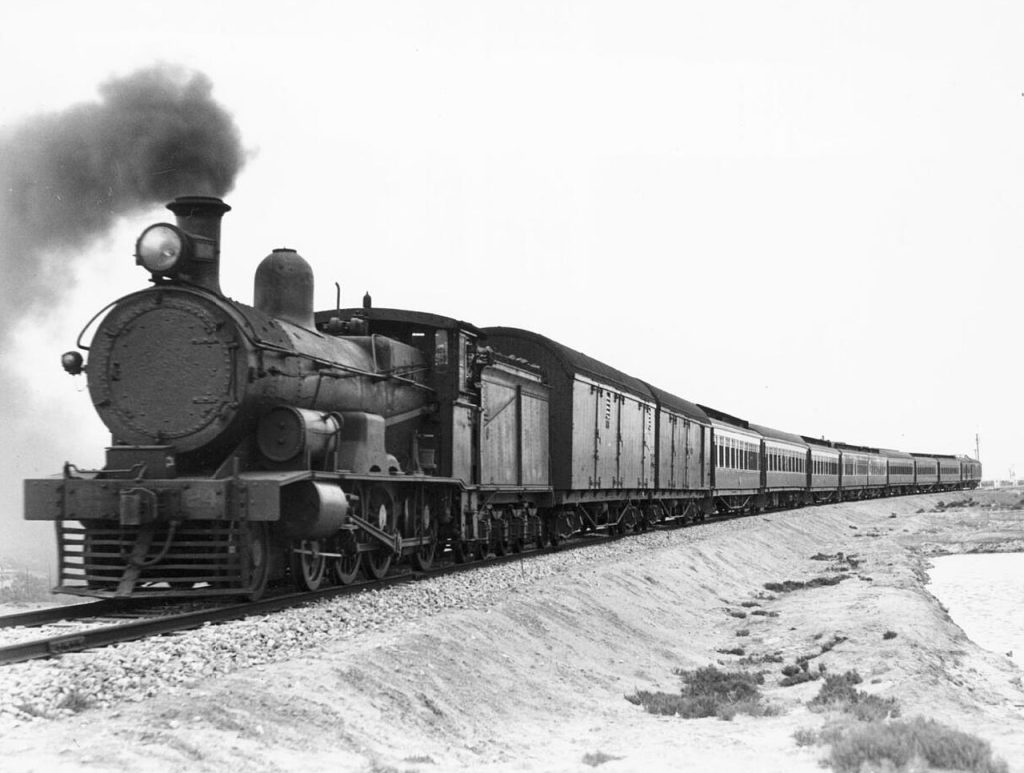
To read more about what are now ghost railway sidings on the Nullarbor, including Loongana, click here. For a summarising map, see here. The line was completed in 1917.
Loongana Siding at the 1292 km peg
It was close at 11 pm on the 2 July 1965 by the time the train rolled into Loongana. Me and Morse were both well and truly stuffed as we stepped down off the train that night, most likely because we’d been trying to stop these couple of arse holes from causing trouble. Barry Pall met us. He was the Ganger in Charge of the fettler gang stationed here at Loongana.
We met him once before when I was with Heavy Plant down at Port Augusta and had always found him to have been a good, decent bloke to those working under him. Barry’d been working for the Commonwealth Railways ever since he had left school, so there wasn’t much he didn’t know about this job, Morse and I’d been sent out here to do.
‘Hi fellers, how’d the trip out here go? Were you blokes able to get much sleep on the train?’ He asked. I replied, ‘No, Barry, we had no hope of getting much sleep at all, with all the yelling and screaming going on between a couple of those hot heads on the train’.
‘I bet them drunken idiots, tried making out with those married girls, hey Rocky?’ Barry turned to Morse, who replied, ‘Still, one thing’s for sure, those bloody idiots are going to have sore bloody heads, by whatever time it is they get off the train.’
‘Anyway, fellas, come on, I’ll show you where you’ll be camping, then once you’ve had yourselves a decent sleep, I’ll catch you both up in the morning at breakfast.
The Camp
We found this to be a really good camp. Every one of the rail huts had a single bed with an innerspring mattress. Morse and I decided before we hit the sack, we’d go and have a shower first. After a good night’s sleep, I woke up the next morning feeling fitter than ever, being able to breathe in all that nice fresh Nullarbor air. Morse and I then headed over to the washhouse, had ourselves a good splash and a piss then headed over to the mess for breakfast.
Barry was there in the mess, waiting, ready to introduce Morse and me to the rest of the gang, already sitting at their tables waiting for breakfast. Soon as Barry headed off, Morse and me then went and sat at this table with Colon and Hughie and ordered a good feed of bacon and eggs on toast, with a mug of black tea to finish it off.
While sitting there at the table, I noticed most of the blokes in the mess with us seemed to have had done a lot of hard work in their day. Even though he knew, it never worried Barry one bit that some of the blokes in his gang were running from the law. Just as long as the blokes were able to get done what they were paid to do and never caused any trouble, he’d just leave them alone.
Getting to Work
After we’d all finished breakfast, Barry then got Morse and me aside and explained to us the job we’d be doing — ripping out all the old sleepers along the line before replacing those with new sleepers. Our start time was 7.30 am every morning, from Monday right through to Saturday. Our first job was to grab hold of whatever gear we needed to take out along the line. That then had to be loaded onto a couple of flattops, and when loaded, we’d hook both flattops up to the section car. With that done, we then climbed up on the section car to be taken out along the line, ready to begin a hard day’s work.
Barry got those working with the claw bars to start ripping the dog spikes out first on our arrival at the destination. Then, he had some of the other blokes going on behind dragging out the old sleepers from under the line soon as the dogs were removed and stacked up in piles. It was then Morse, me and the rest of the gang who went and picked up the new sleepers and carried them over and trussed them under the line where the old sleepers had once been.
Those boys who’d dragged them old sleepers out, they now had to grab hold of the jiggers and begin drilling eight holes in each and every one of those new sleepers we’d just finished laying under the line. Once there had been a dozen or so of those sleepers drilled out and the fishplates placed on top, Morse, Hughie, Col, me and a couple of other blokes, we’d then grab hold of a twenty-four-pound sledgehammer each and begin hammering those dogs home.
This had been hard going for a start, us trying to hammer those dogs down, and it’d taken many a blow of that sledge to do so. But, after about a week of doing this, we were then able to hammer them doggies down into those sleepers, taking only three strikes of the sledgehammer to do it.
Hell, it used to get bloody hot out there at times, with most days always up around the 100º F mark. Yet, at night it could get very cold out there at times. Even the water bag we’d have hanging up under the shade was at times close to boiling point, especially on those scorching summer days. No matter how hot the water was, it still came in mighty handy for quenching the thirst for those of us swinging those twenty-four-pounders.
The Best Parts
It felt really great being way out there on the Nullarbor, breathing in all that fresh air and with nothing to see for miles around — except for saltbush, crows, and those beautiful wedge-tailed eagles with their wings spread wide out gliding around up there in that wide-open blue sky.

We had a spare couple of rail huts at Loongana, so we set a couple of old tables and chairs inside for those wanting play cards. Morse also put a dartboard up for anyone wanting to play in their spare time. This hut was soon known as the Loongana police station.
Another Bloke Morse and I knew there at Loongana, was Curly Turner. Curly was the ganger in charge of the married men, those who had brought their wives and kids out along the line with them. The houses supplied to these families by the Commonwealth railways back in the 60s were pretty well built, with three bedrooms and kerosine fridges.
AUTHOR BIO

On 24 May 1948, my mother dumped my brother Graham and me at W R Black Home for Girls in Chelmer QLD. Our lives changed forever. It burdened Graham until his early death in 1974 aged 28 and affects me to this day. I later found myself in the Presbyterian Blackheath Boys Home, the Salvation Army’s Riverview and for no reason Mt Penang Juvenile Justice Centre in Queensland. There was no schooling in those places.
I started writing about my life much later. My books include A Tormented Life, and Brutalized: Institutional Abuse in Australia.
Well done Warren- a great story of a tough time. This is a unique piece of social history talking of a pioneering time long gone. Thanks Heather Webster
Thanks for that Warren. It’s amazing just how much someone who’s been abused can pull themselves out of the muck and move on with nothing much except the will to do so. As you have.
Best of luck with whatever lies ahead.
An interesting story.
Veronica Cookson
Thanks Julie. I hope Warren likes it, I’ll ask him on Friday 🙂
I love Warren’s raw and honest voice. His stories depict a time when children were neglected and abused in Australian institutions, and how these same children faced the world as young adults.
Rocky has emerged through sheer willpower and having found love.
Go, Rocky, all who know you are astounded at your courage and endurance. Xx
Thank you again, Lindy. You have presented Warren as he is, a true warrior. Xx
Julie Cahill.
Well done Rocky. Craig Harris