

Image and Story
I am of the view that poetry refracts who we are. If stories constitute us as humans, then poetry’s words and lines distil and distort them, yet find truth through variations of content, tone, imagery, and style. In this way, I am often my father’s ventriloquist, my mother’s mood or even an earlier self as I write. Such complexity bears no resemblance to frozen moments captured in photos like the one below. Our poetic voice works with a rich recollection of sensory details, people, places, and times.
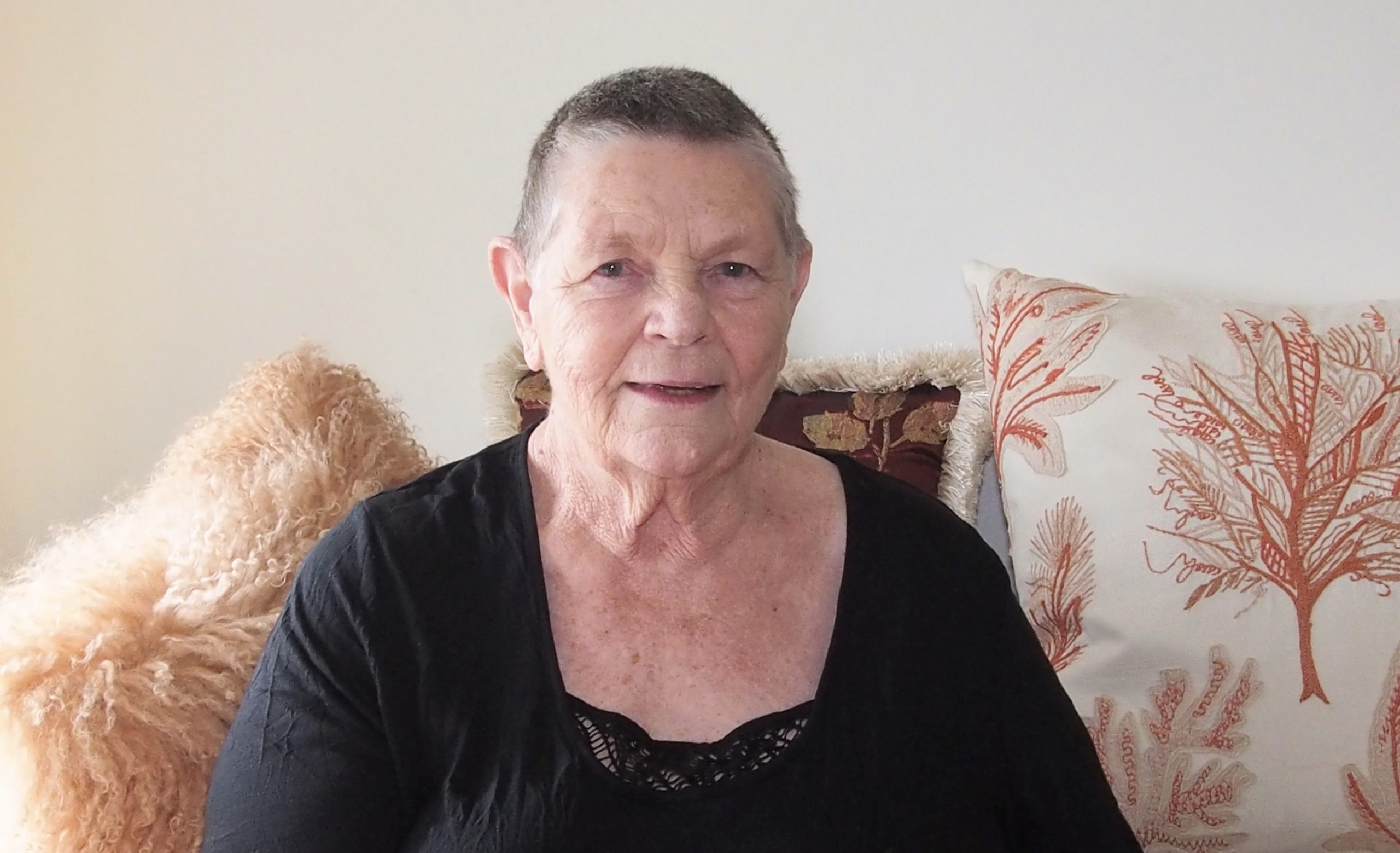
The Essential Me
My favourite poem is ‘My Skeleton and Me’, where I appear alone, albeit with my skeleton. I post it here in contrast with other poems below. This one is just me. The poem earned a High Commendation certificate for the Nova prize thanks to Murray Alfredson, one of the Friendly Street Anthology Editors, in 2016.
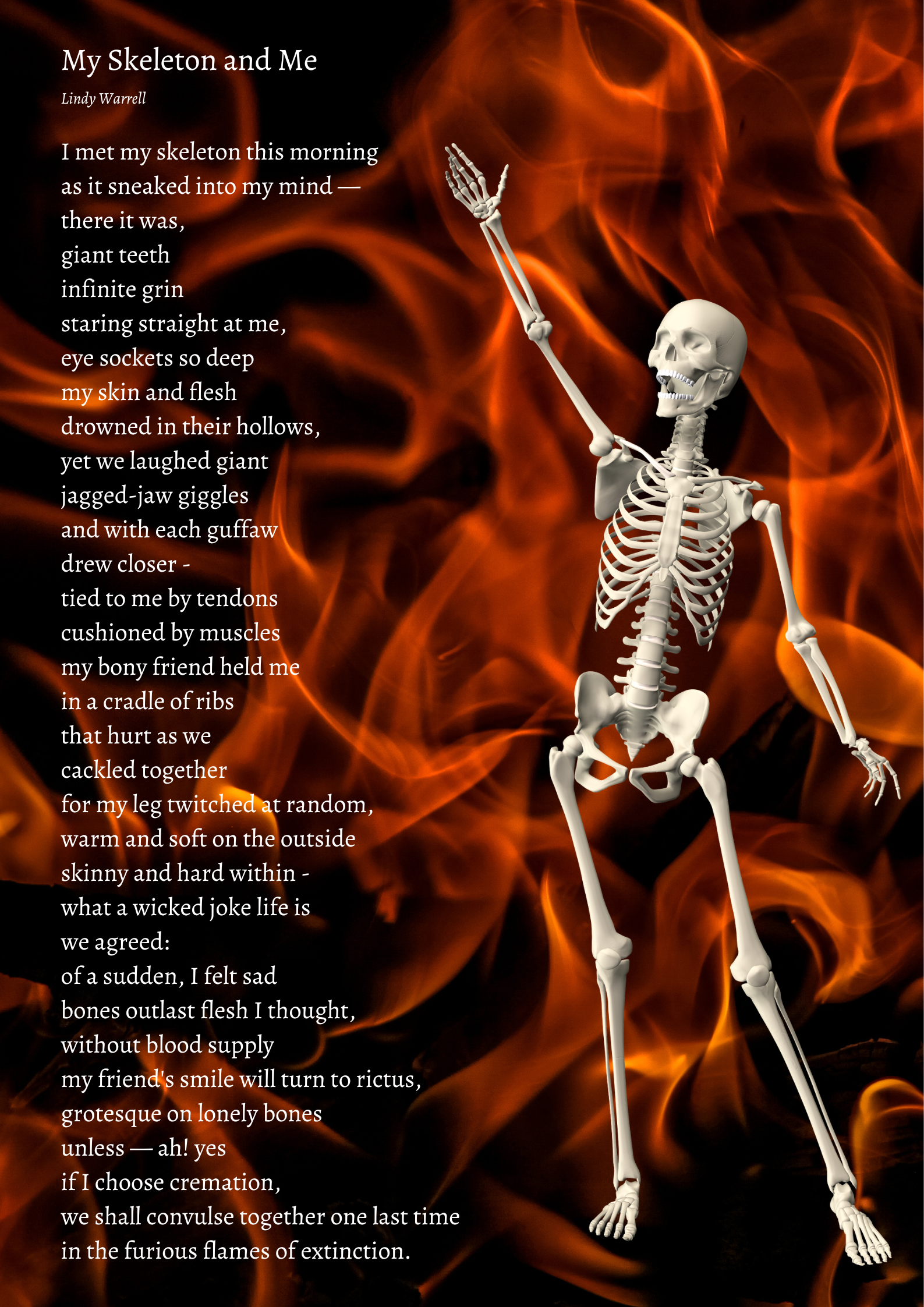
This poem wrote itself in my mind during a lazy afternoon on my couch, where I experienced my skeleton as integral to my being and as my lifelong compatriot. It came to me during a period when I meditated regularly, so it was a close-to-the-bone moment of clarity, which made me giggle with delight. It still does.
Change and Continuity
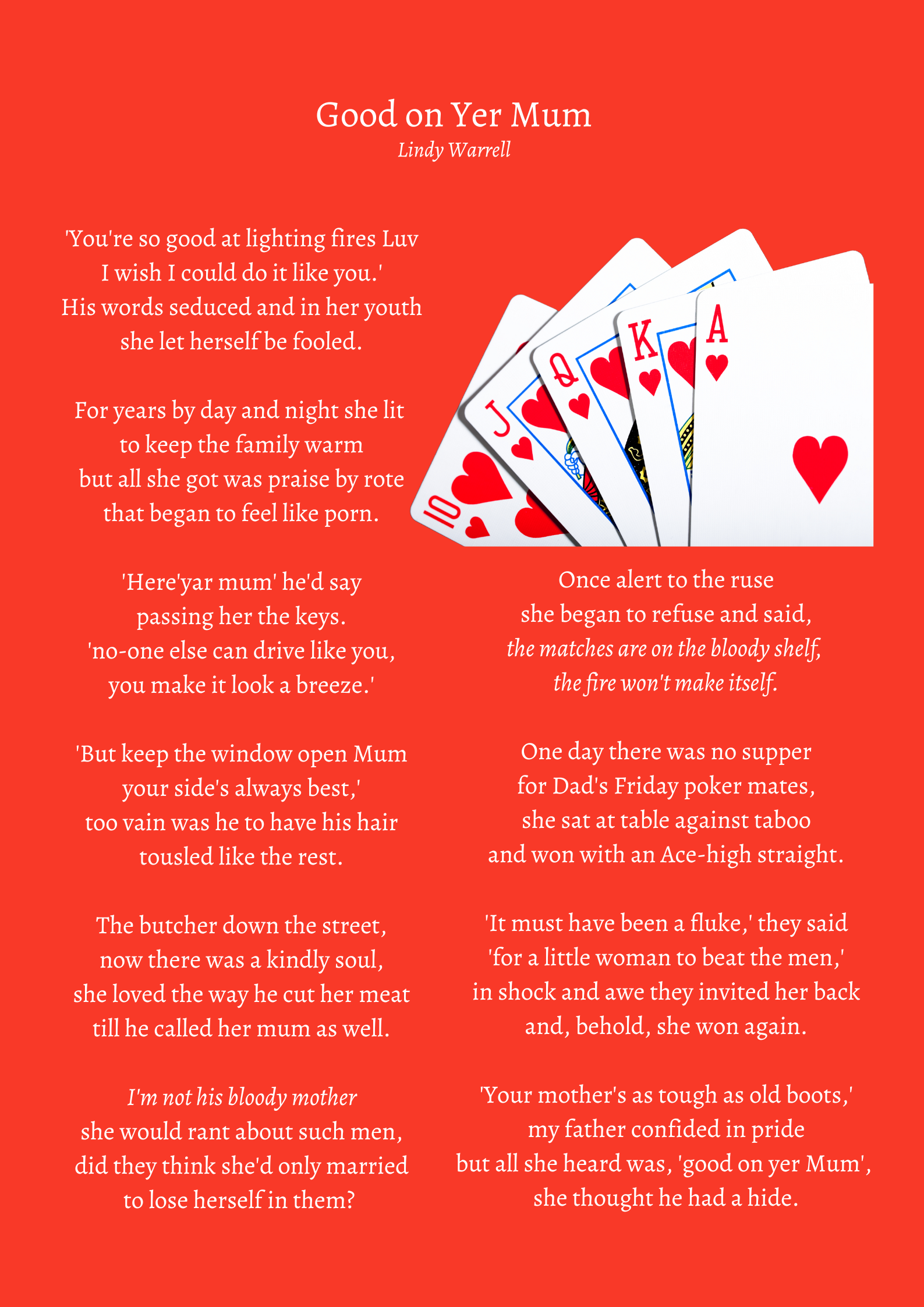
My parents seemed unchanged throughout my childhood and much of my adult life. Their gradual ageing became noticeable only after an absence. The setting for the following poem is a downstairs, inner-city flat in Melbourne where my parents lived after they married in 1938. Dad was a kitchen hand at the Hotel Windsor in Spring Street before becoming restaurant manager, and Mum was an apprentice hairdresser.
I was not yet born, but their oft-repeated words about those days allow me to portray something about the treatment of women in their time. My father’s voice and Mum’s reply still reverberate in me.
The poem records two actual moments but is not ‘real’. For example, nobody in my parents’ circle had a car until 30 years later. What is true is how Dad persuaded Mum she was the best at anything he didn’t want to do himself and that Mum joined the men’s poker school. Such remembered fragments make the whole.
As Confidence Grew
Only a few years later, the Australian Army promoted my father to Major in the Catering Corps and sent him to Japan with his family to refurbish and manage the Marunouchi Hotel in Tokyo, commandeered by British Occupation Forces.
As a girl from inner-city Melbourne, Mum arrived in a world of top military brass wearing a fox fur stole to socialise with generals, high-ranking political figures, and their arrogant aides and staff. She stands in the second shot, full of confidence in mink. In her mid-to-late forties, the third photo is from Oodnadatta, which Mum always said was the best time of her life.


Here is my elderly take on Japan with a child’s eye triggered by a penchant for Arnott’s Gingernut biscuits and clotted cream; my little-girl romance with the post-war era in Japan is clear. (Should I live long enough, I hope to write a third novel about that period. My title is Beyond Ginza, and my protagonist is a seven-year-old girl with synesthesia. It is OK to wish.)

Found Things Go Deep
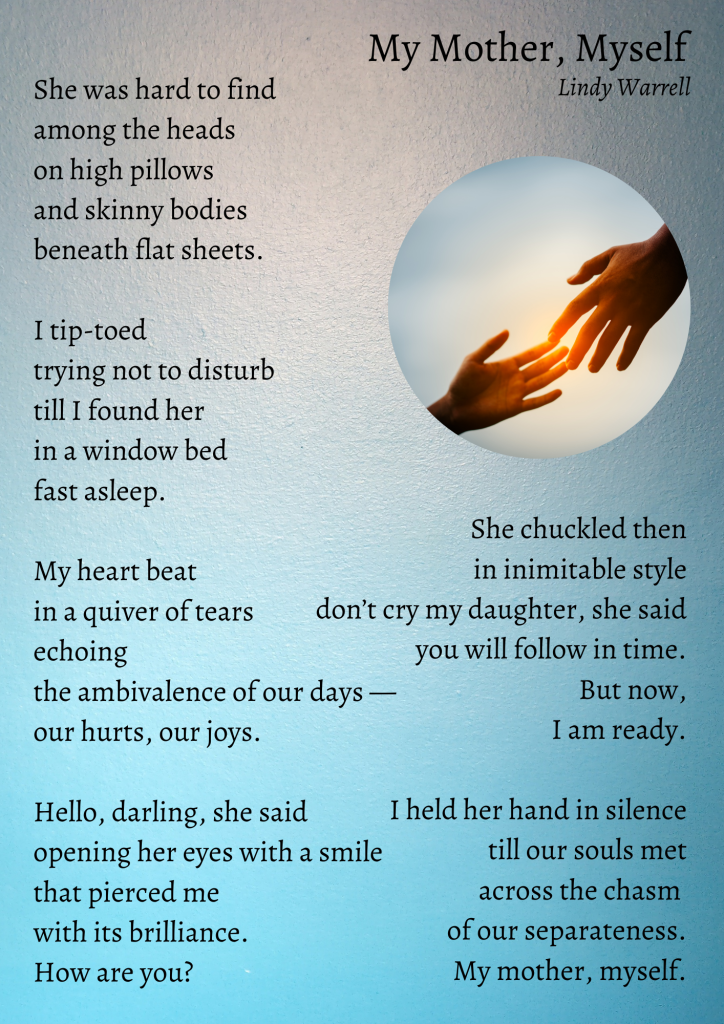
People always think the following poem is literally about my mother and me, and they respond to it with sympathy, kind voices, and even tears, but, strictly speaking, it is not real. Of course, relationships between mothers and daughters and, most likely, fathers and sons talk to universals, and I hope the poem does that. However, this poem arose from a random line I read somewhere about hands touching across the abyss.
To Finish
For ‘Nana in Sepia’, I used an old photo and shards of memory about my maternal grandmother and a child’s perspective to evoke an image of an earlier time.

I have talked mostly about my mother and maternal grandmother, the women who made me who I am. Indeed, like Mum’s mother, I raised three small children alone, albeit in different circumstances. My father’s voice only appears through words he gave me as I grew up, so I’d like to end with a poem about his parents for a bit of balance. It is another heritage-style poem about an old photograph, more ekphrastic than anything else. And, so, I give my father the final say.

For Reflection
We now know that memories are not fixed or frozen, like Proust’s jars of preserves in a larder, but are transformed, disassembled, reassembled, and recategorized with every act of recollection.
Oliver Sacks*
Happy Writing
Wattletales
ACKNOWLEDGEMENTS
*In The Marginalian
Lead photo by Martin Christmas
Dear Susan, thank you for reading. Your feedback touched me; I’m so pleased you found enjoyment in those poems. They were fun to write 🙂
Oh Lindy, you just keep pouring out these wonderful words. What a joy to read. ‘Good on Yer Mum’ & ‘My Mother, Myself’ are brilliant in their difference yet reverence for a mother loved & admired. I giggled with you & your skeleton when reading ‘My Skeleton and Me’. The imagery was stunning. Thank you for a terrific post.
Oh! Thanks for reading, Steve, and for your comment. Much appreciated. I’d love to see the poem 🙂
Well done, Lindy. Some real insights.
I seldom write about family but I do have a poem about a day with both my oldest child (when he was quite young) and my father as we worked on a pergola together. You’ve brought that back to me, thank you.
Dear Julie, Thank you so much 🙂 Our parents leave an imprint, don’t they?
I am often my father’s ventriloquist, my mother’s mood or even an earlier self as I write.
Sage words, Lindy, also in My Skelaton and Me.
My mother, myself . . .
and so I give my father the final say.
Another great read, dear friend, one of my favorite, (and take that as you will. 😁❤)
Love always
Julie Cahill. Xx
And, thank you, Carolyn, for reading and commenting.
A fine little collection of poems, Lindy, thank you for the insights on moments from ‘history’.
Oh, thank you, Andrew. Glad you liked my Skeleton and Me. Appreciate your reading and taking the time to comment. It’s fun, isn’t it writing about what matters to us…
Wonderful words Lindy I loved My Skeleton and Me. The way your words take us places telling stories evokes the very essence of why I love poetry
I have indeed led a storied life, Michael. I count myself as one of the lucky ones. Thank you for reading and taking the time to give me some feedback.
You’ve had a storied life, Lindy. Thanks to the photos and poems, my understanding of it is increased as is my gratitude to my parents for providing me with such a stable and loving upbringing. Love the rust, the strength, of Nana in Sepia! Please keep your skeleton intact.
Veronica, thank you as always for reading and commenting. Yes, I took a risk using poems that some like yourself will have seen before, but they suited the piece. I think we all ‘read’ our parents pretty well, especially as we get older 🙂 They are such an integral part of how we are/become.
As per usual Lindy, the poems and recollections are wonderful and sad to read. I’ve read a couple of the poems before, but have to say my favourite of this lot is ‘Good on Yer Mum’. That you gave your father the last word is contrary to what I expected. You knew exactly who was what with your parents.
Thank you Val, for reading and commenting. I agree that we are lucky to be more independent now bt sexism remains deeply embedded in our culture, doesn’t it?
I love to read your poems of reflections of past in a true to life manner Lindy.
Thank you for this thought prevoking read and I am reminded that the dialogue directed to women has not changed much over the years, but we are now much more independent and strong. Cheers Val.