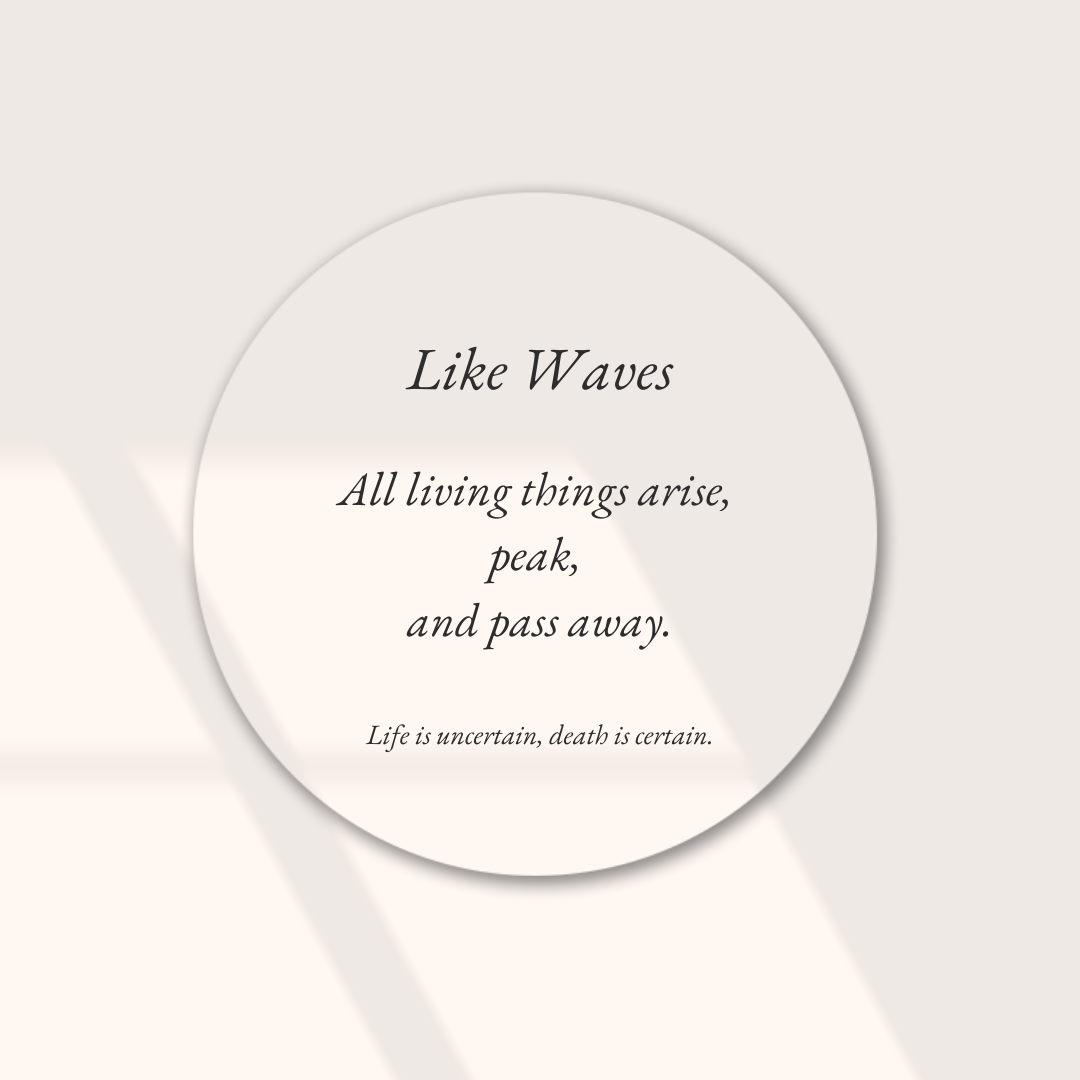
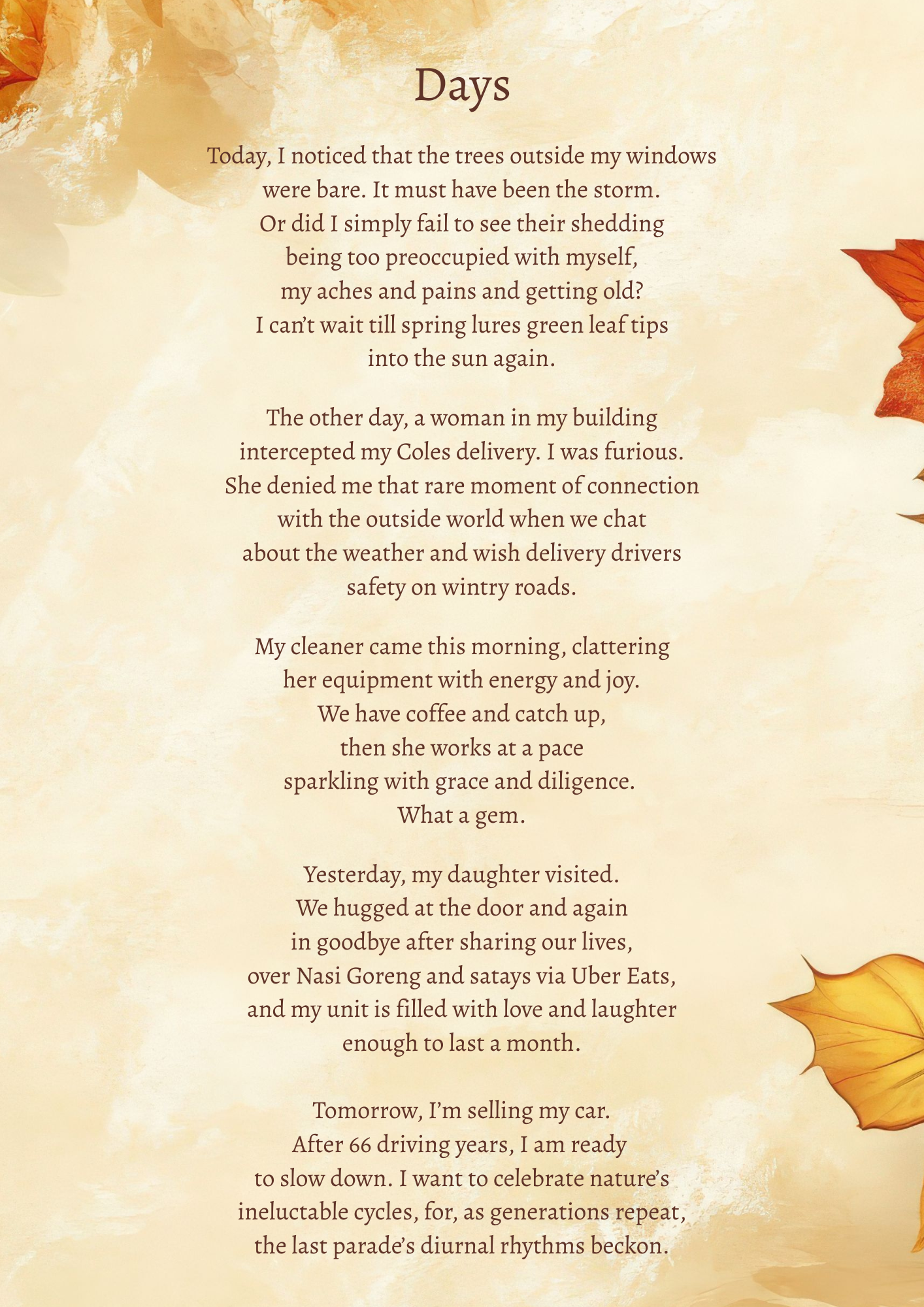
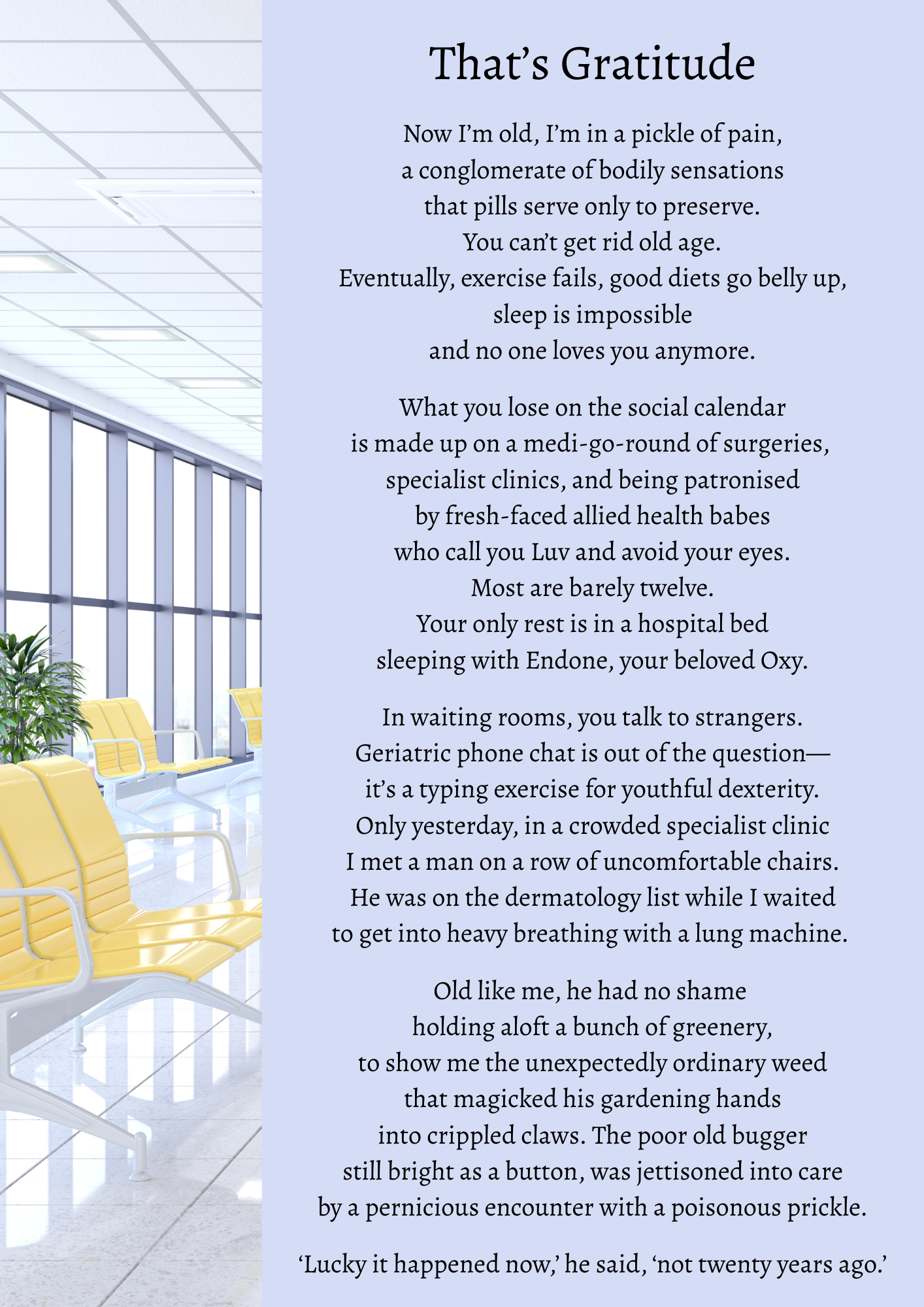
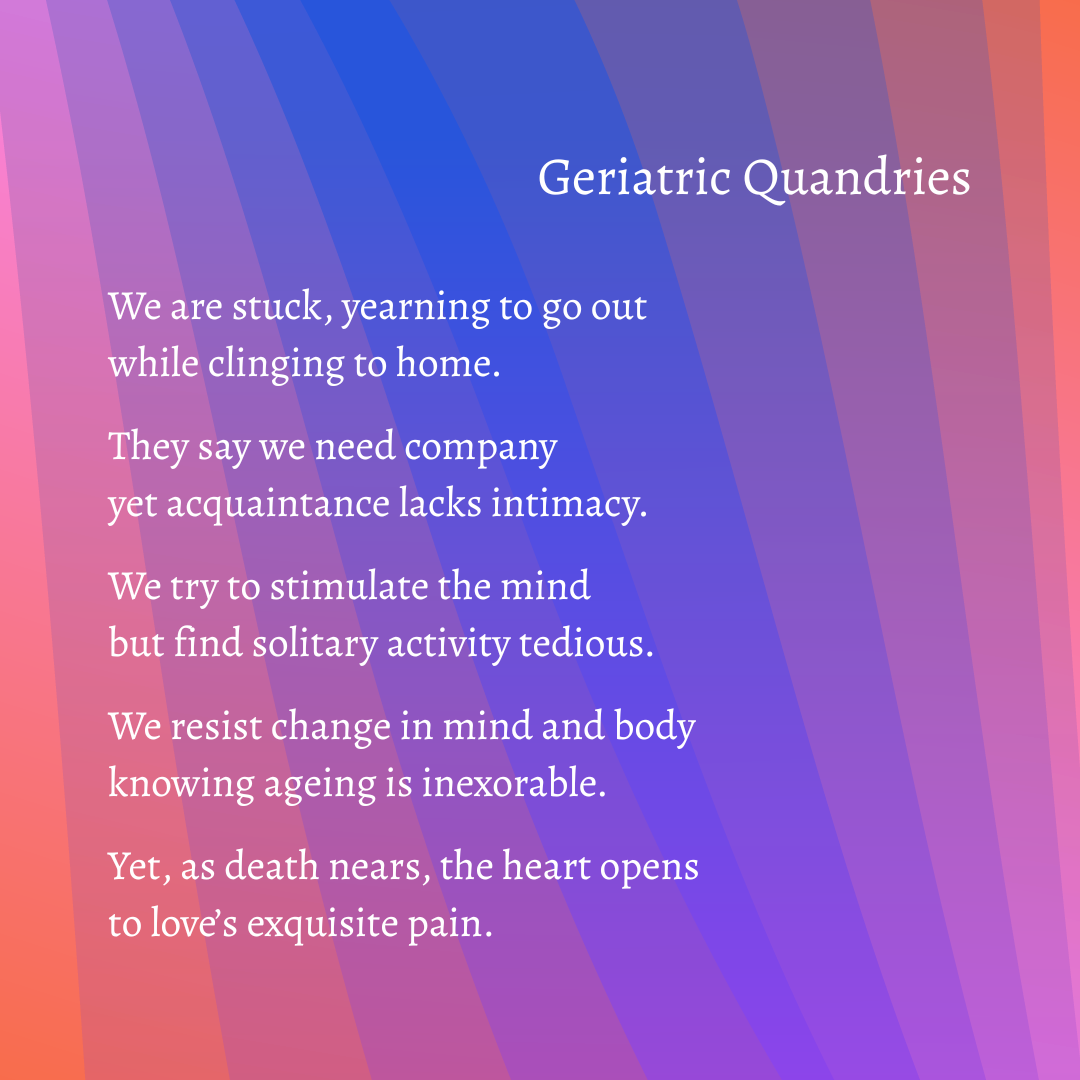
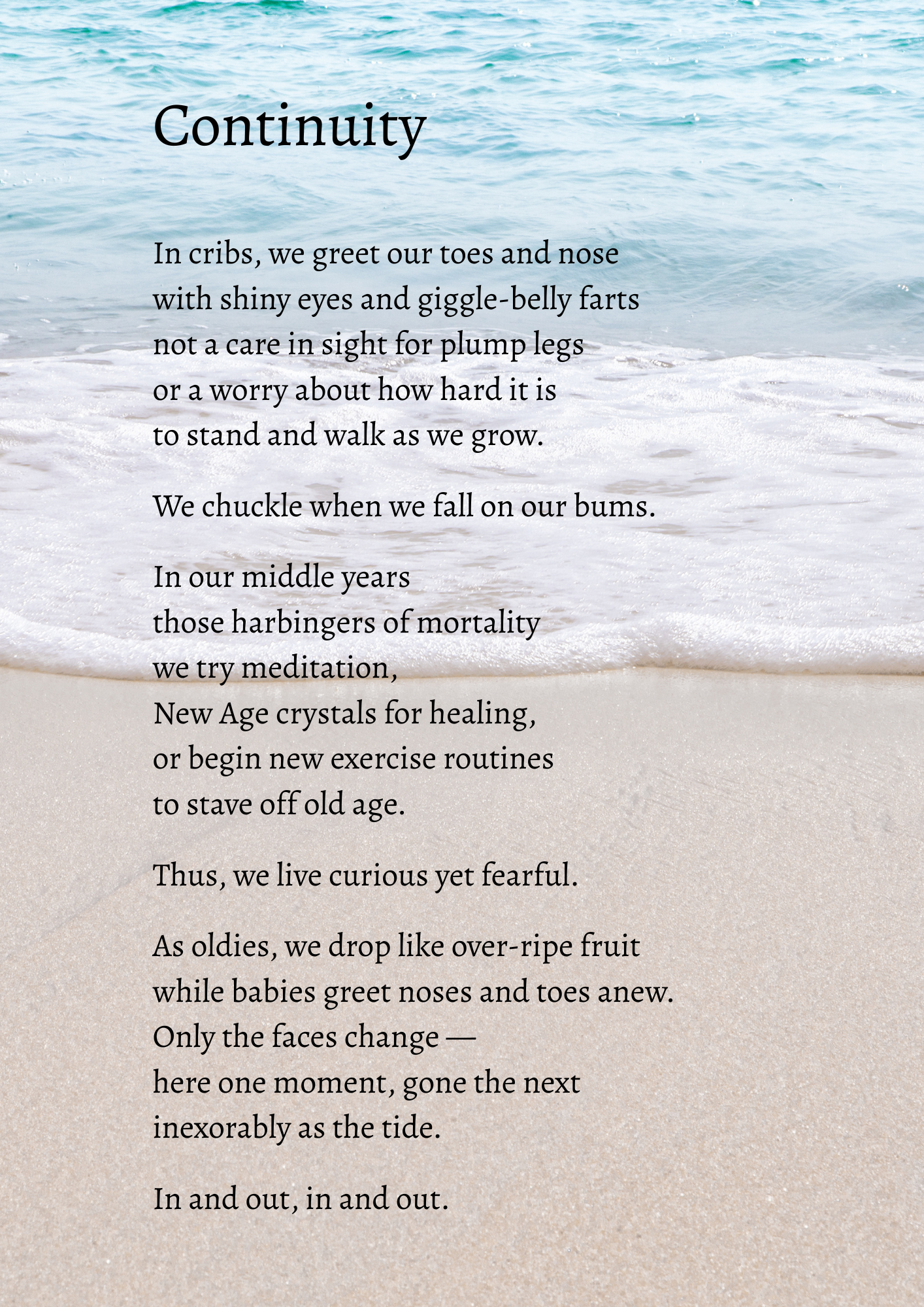
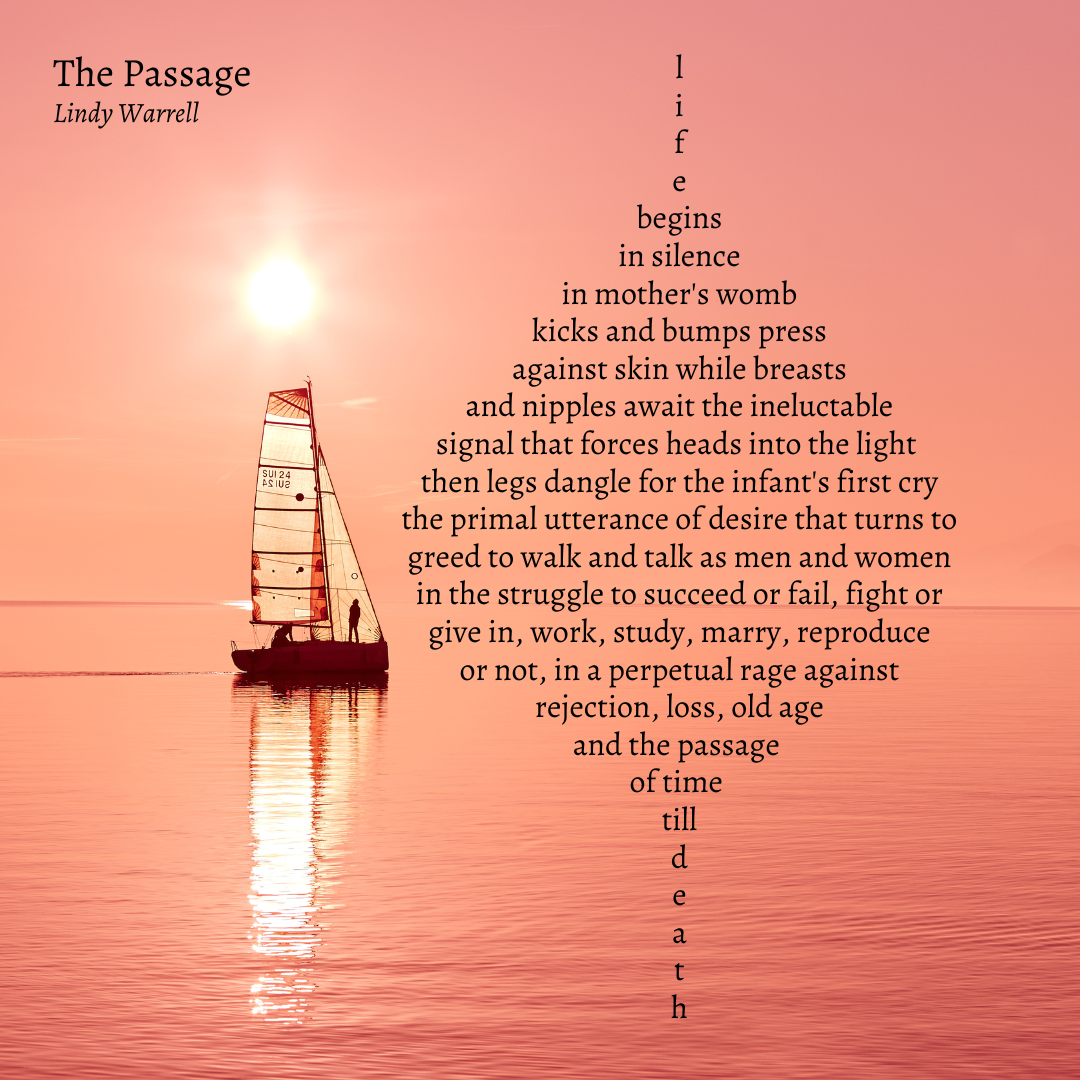
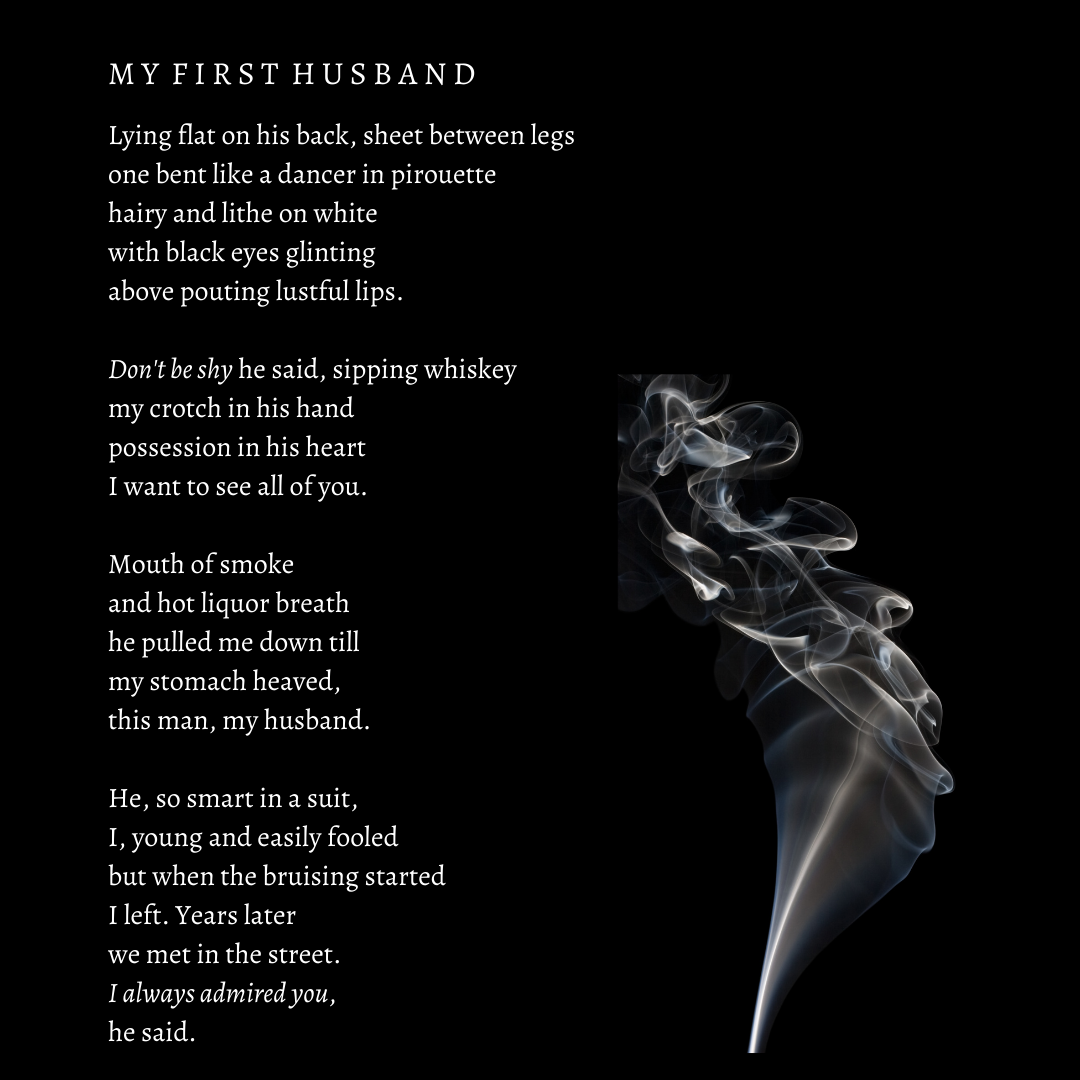
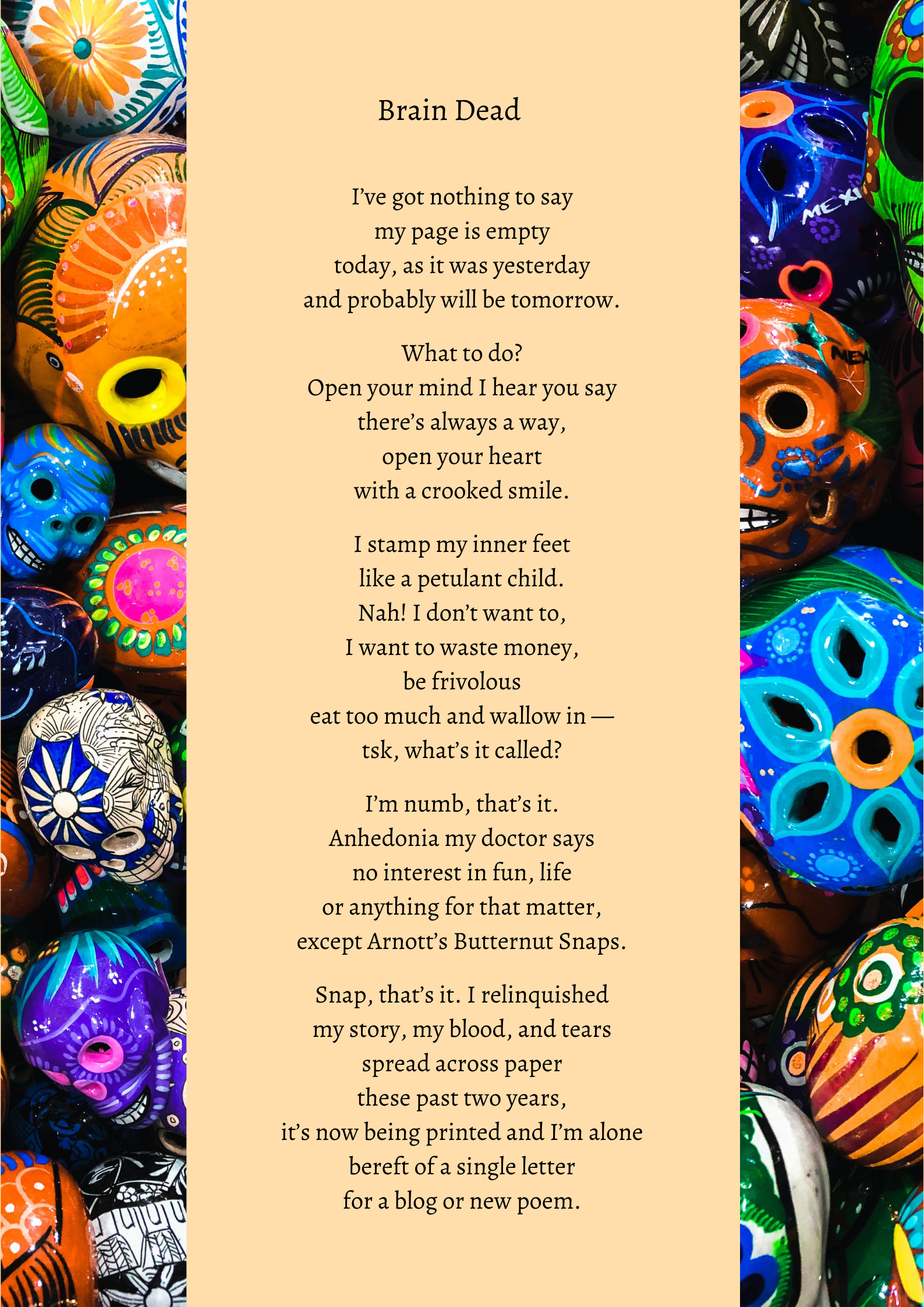
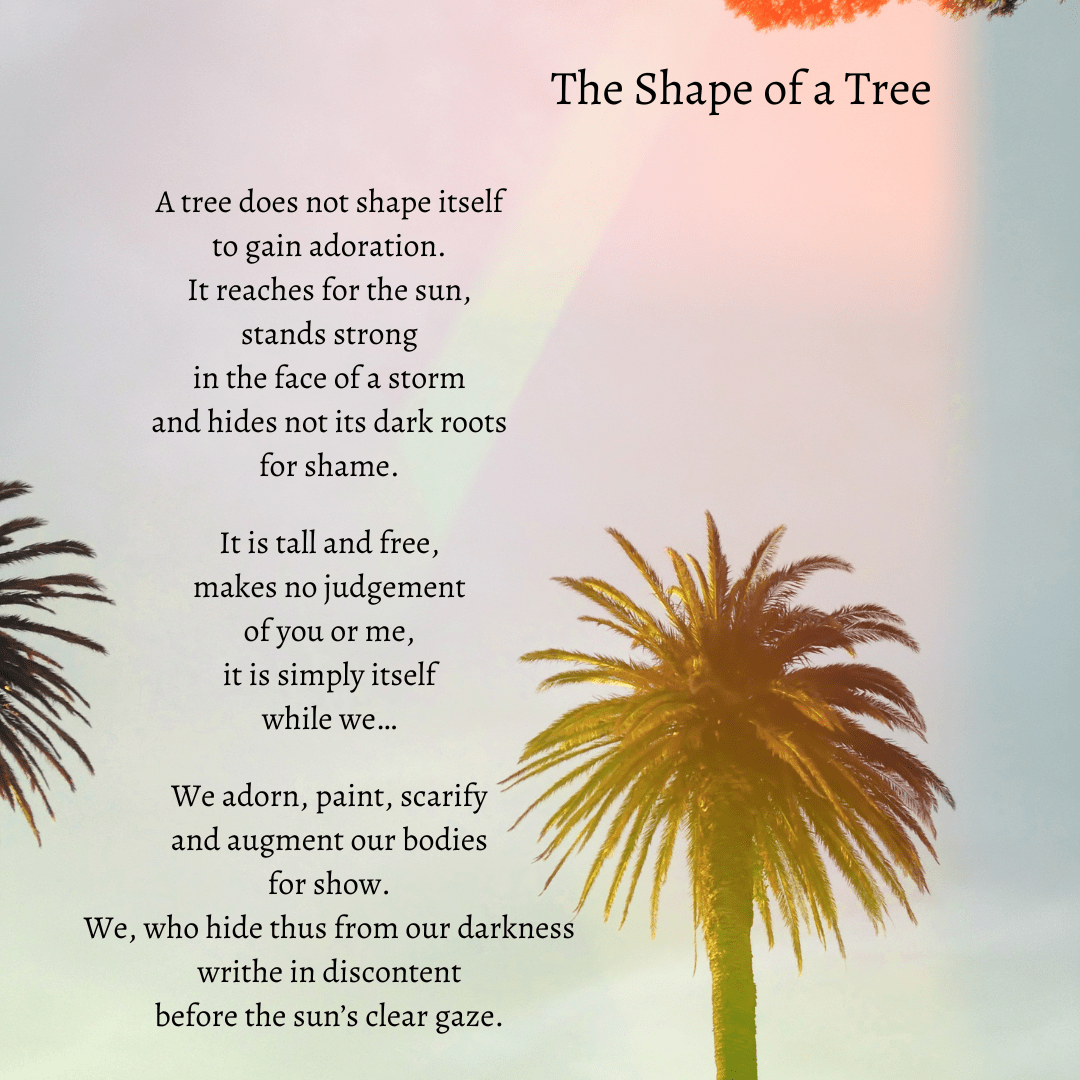
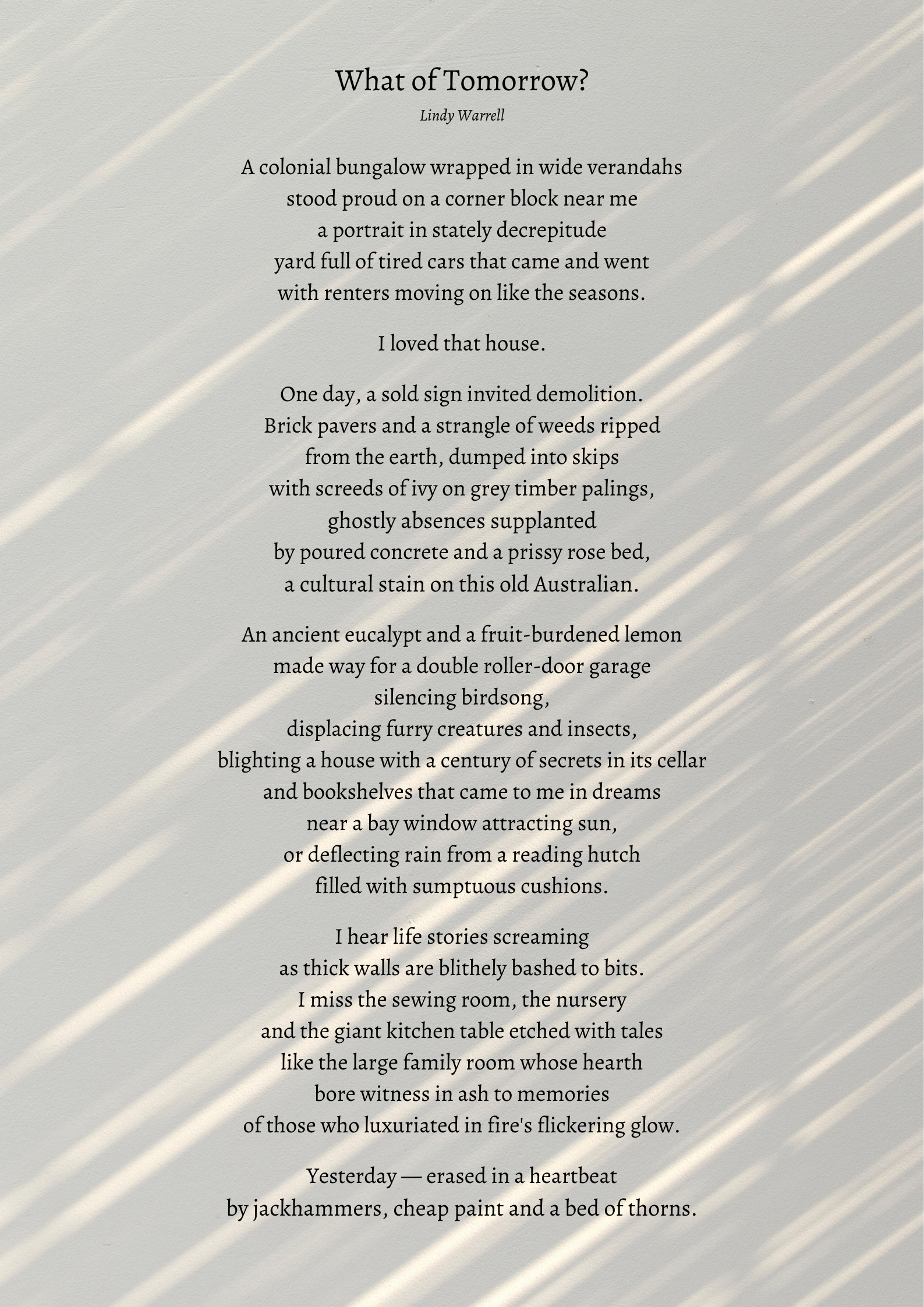
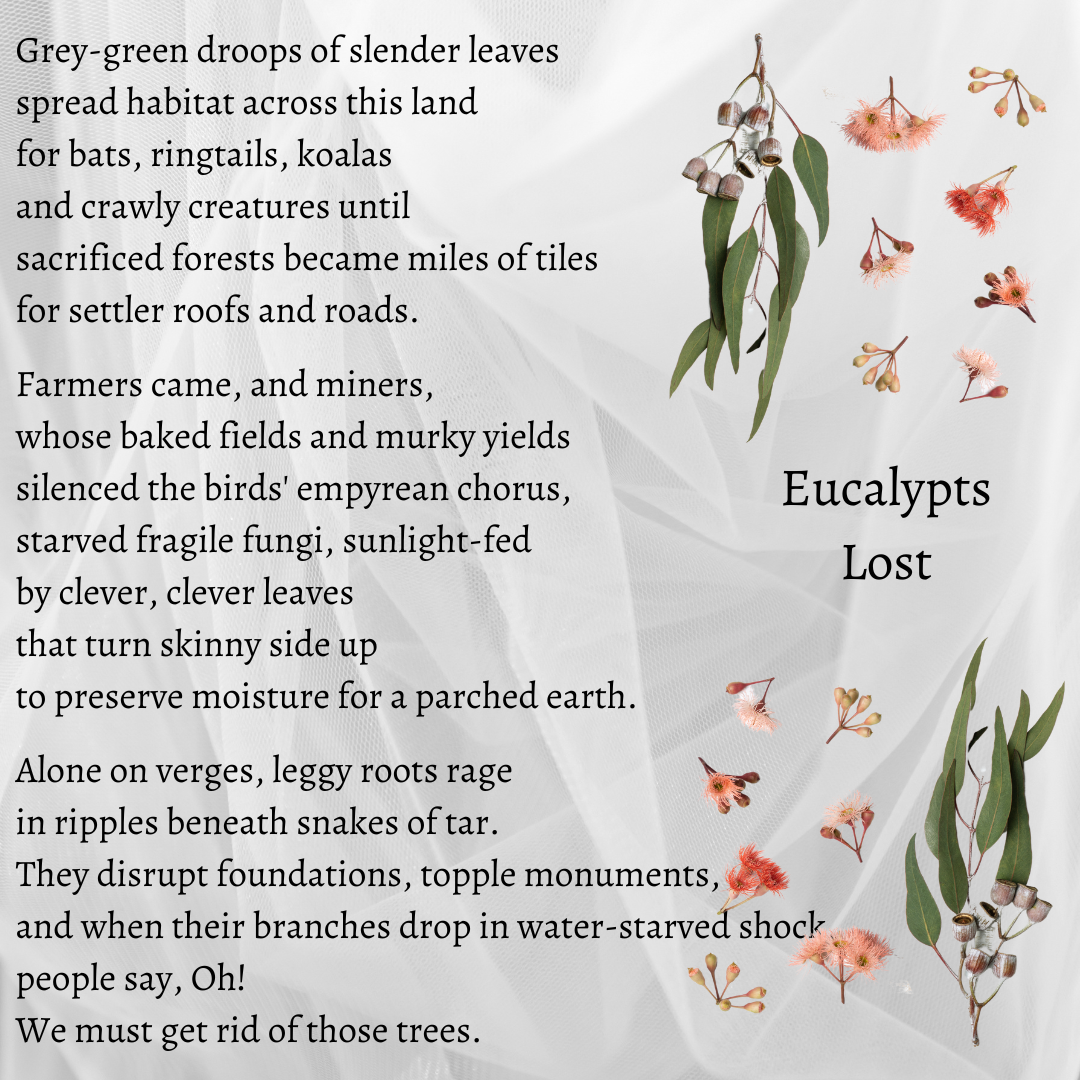
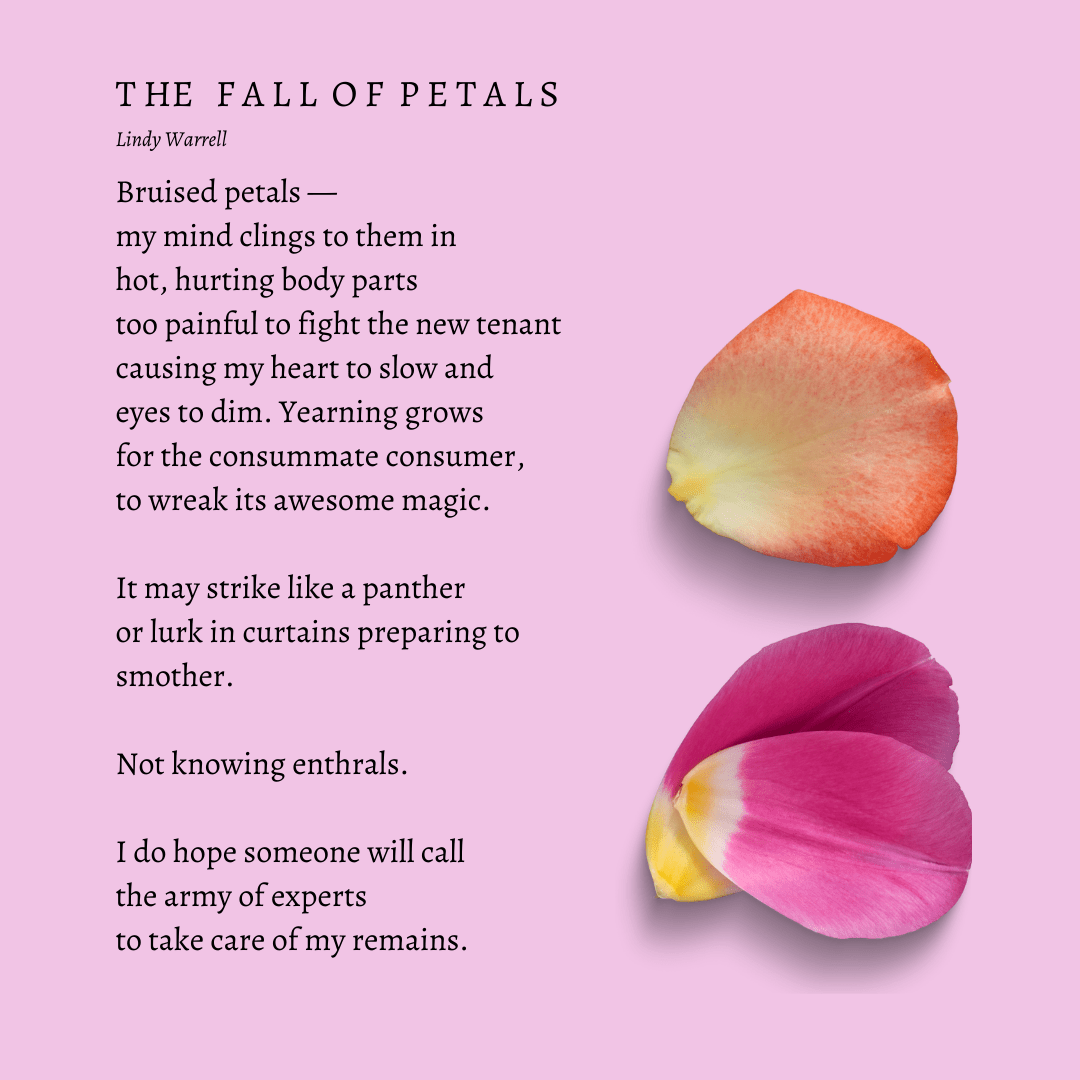
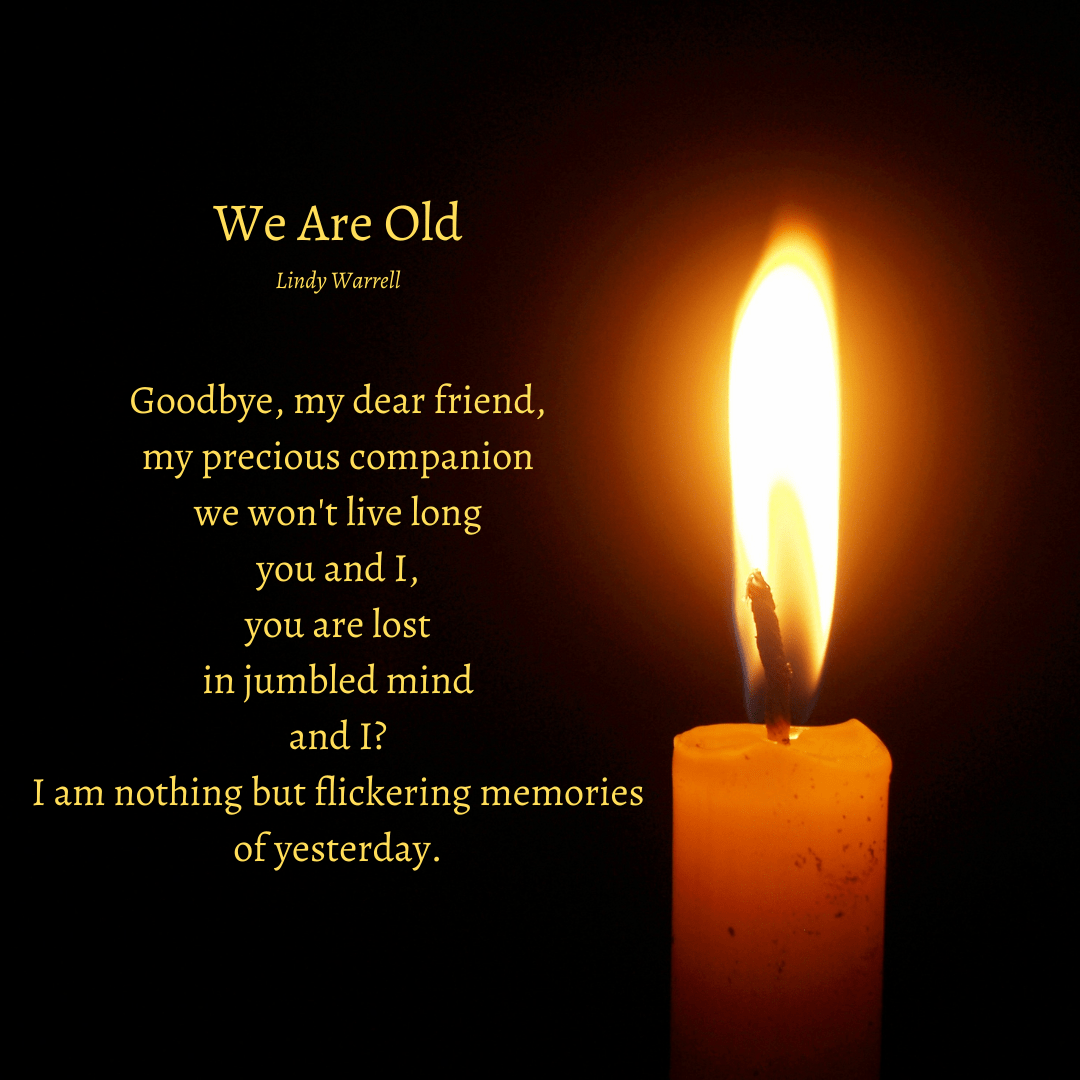
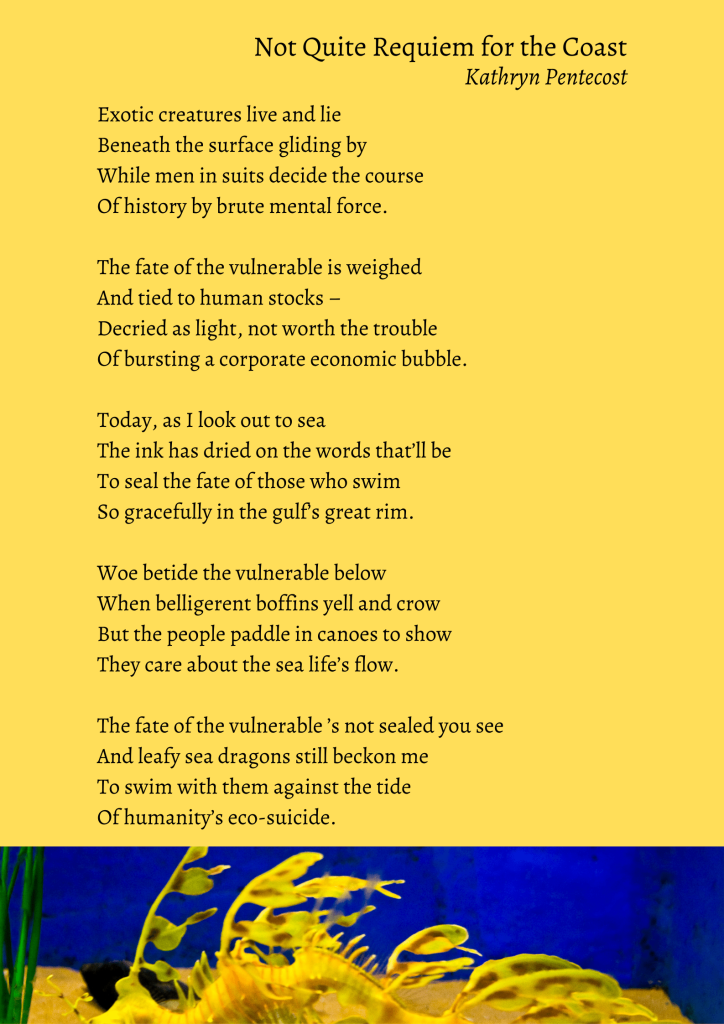
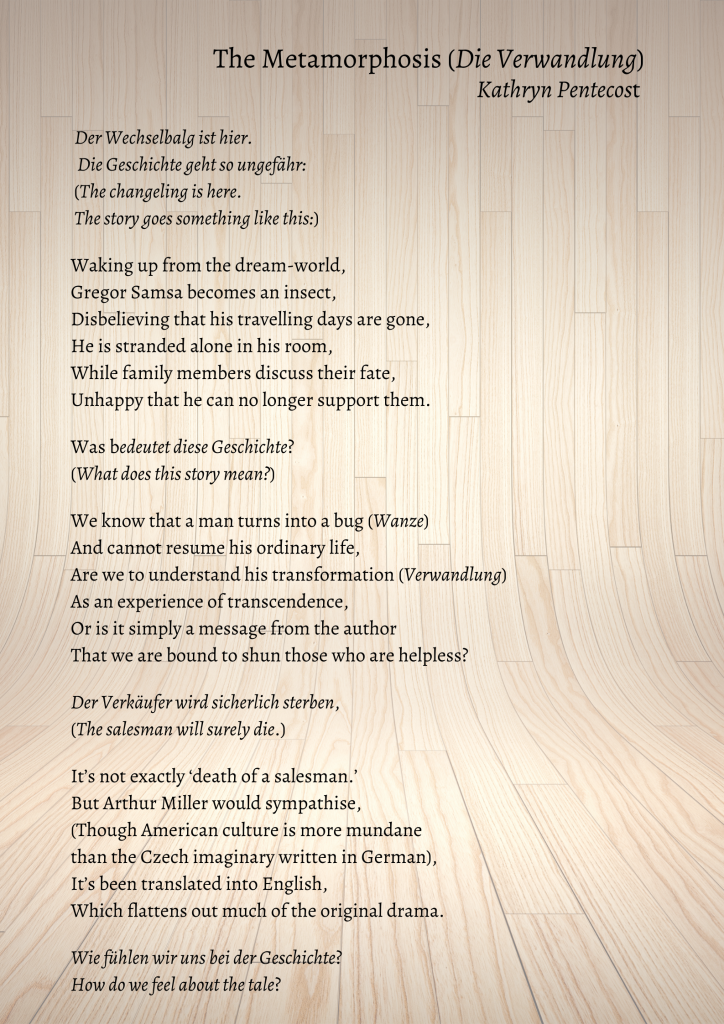
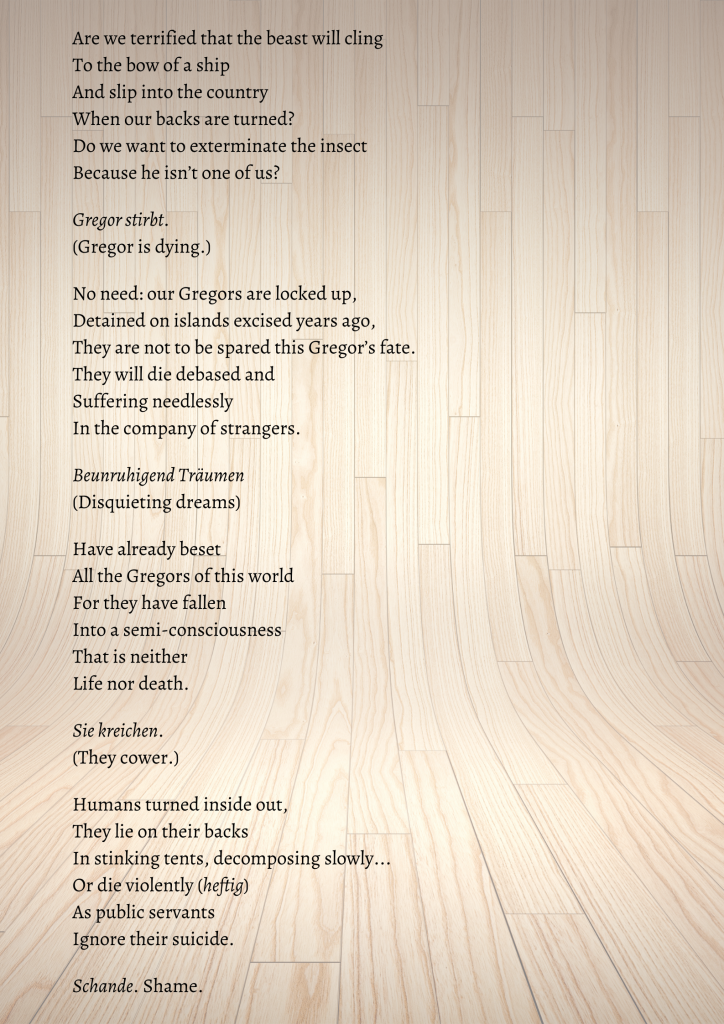
Lately, I seem to write a lot about ageing and old age. It makes me wonder if I’ve exhausted my earlier life as a source of ideas or whether, indeed, old age brings the focus home to the body in ways that others might only experience during illness. Old age may not be a sickness, but it is the gradual breakdown of one’s body, which increasingly demands more attention and time. It certainly brings focus into the now.
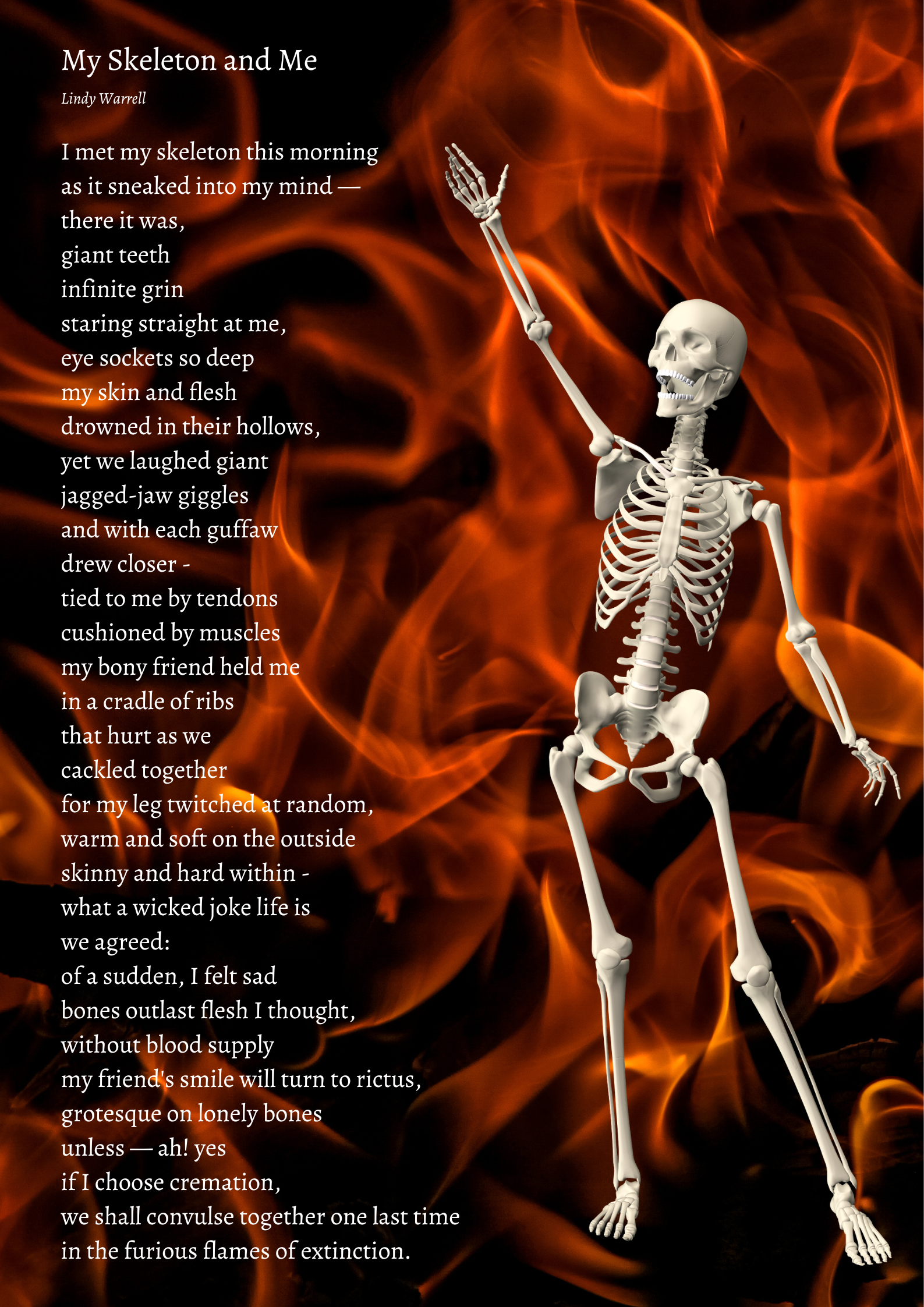
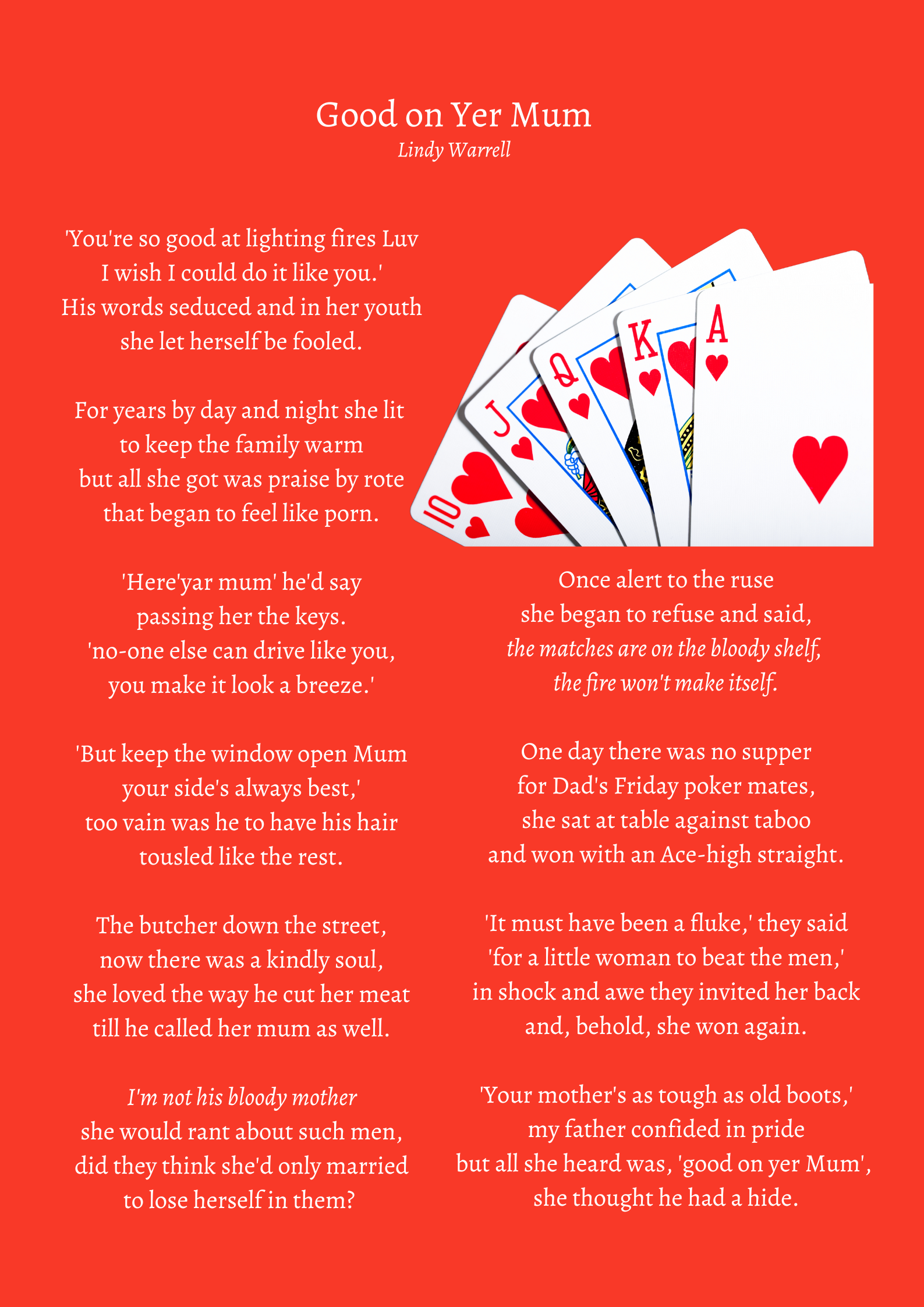
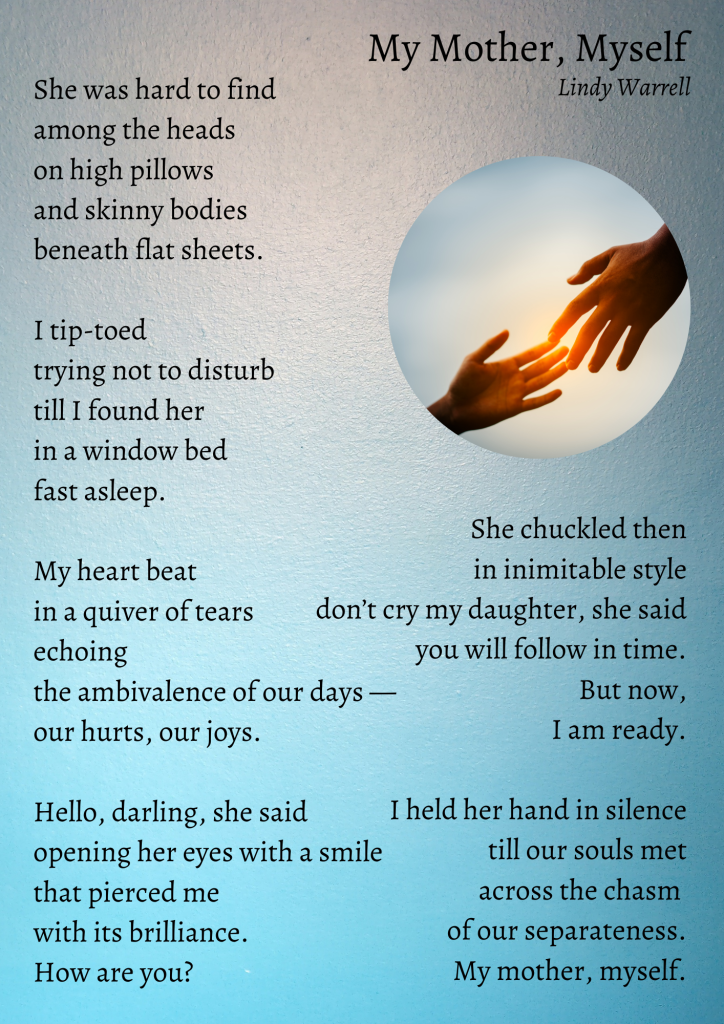
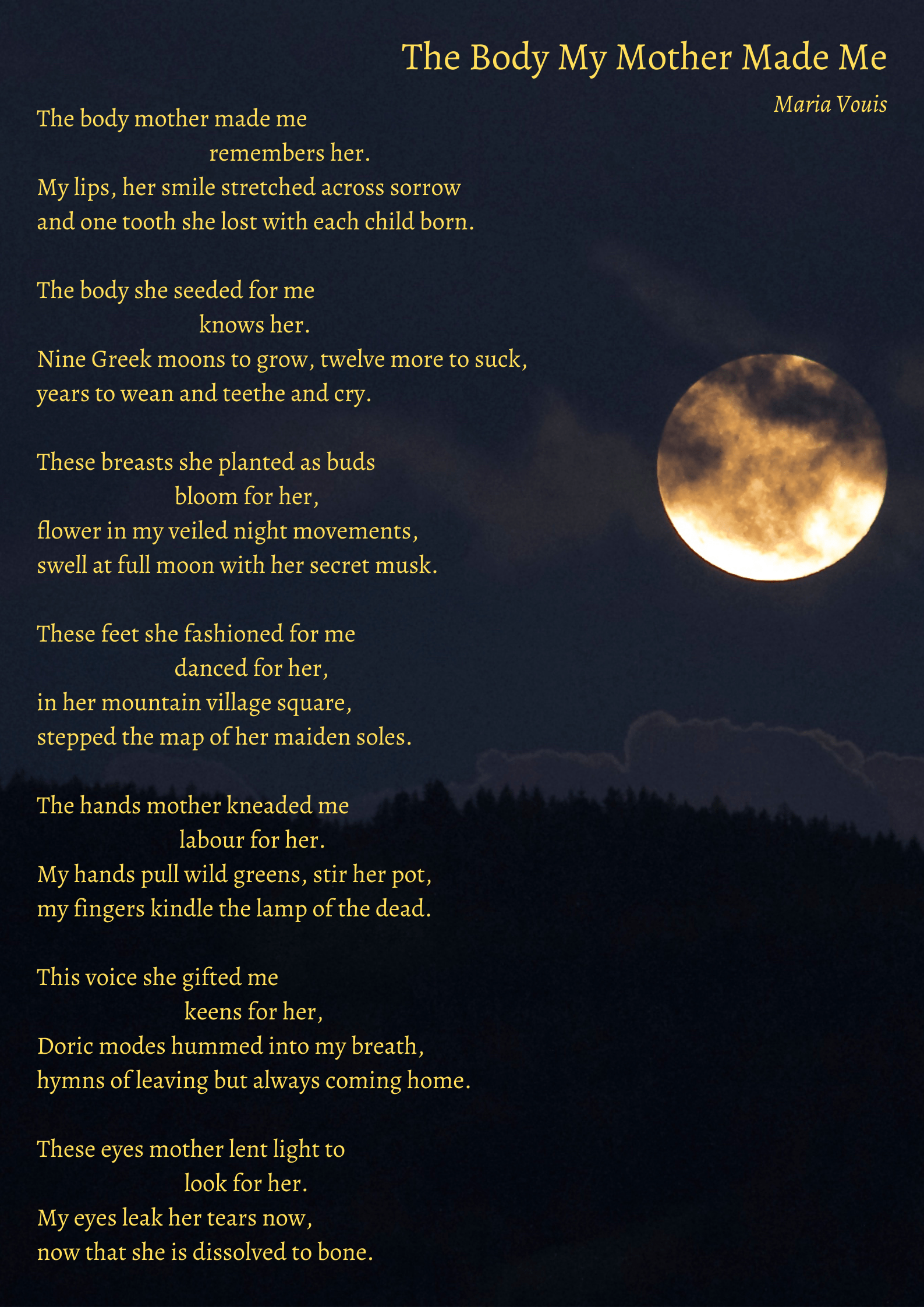
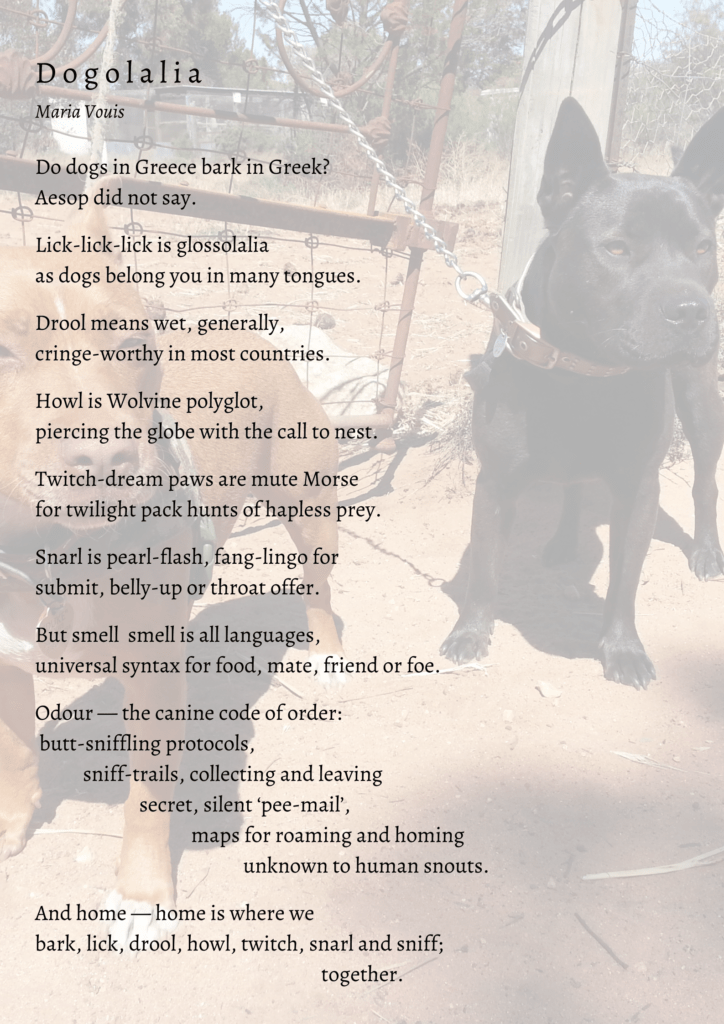
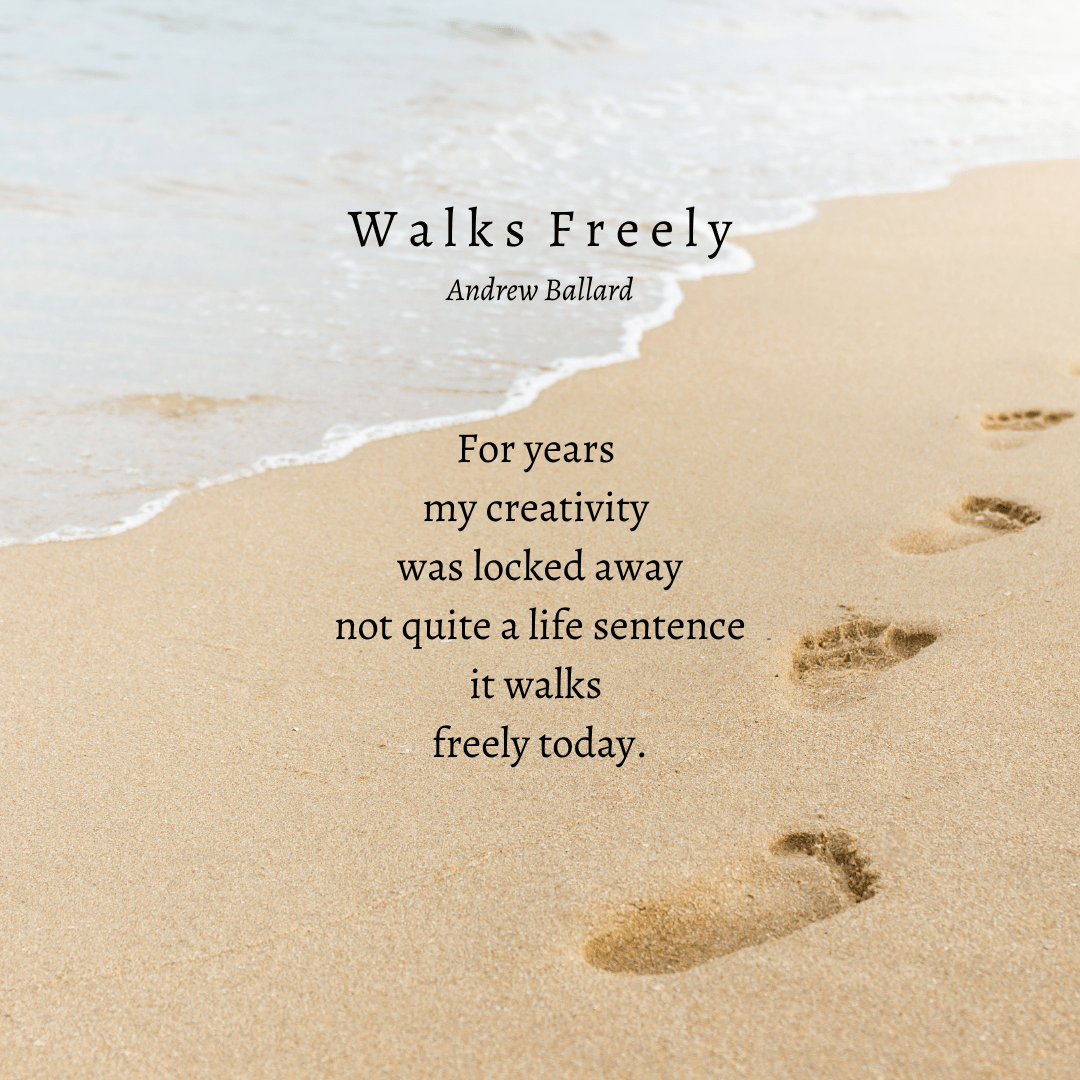
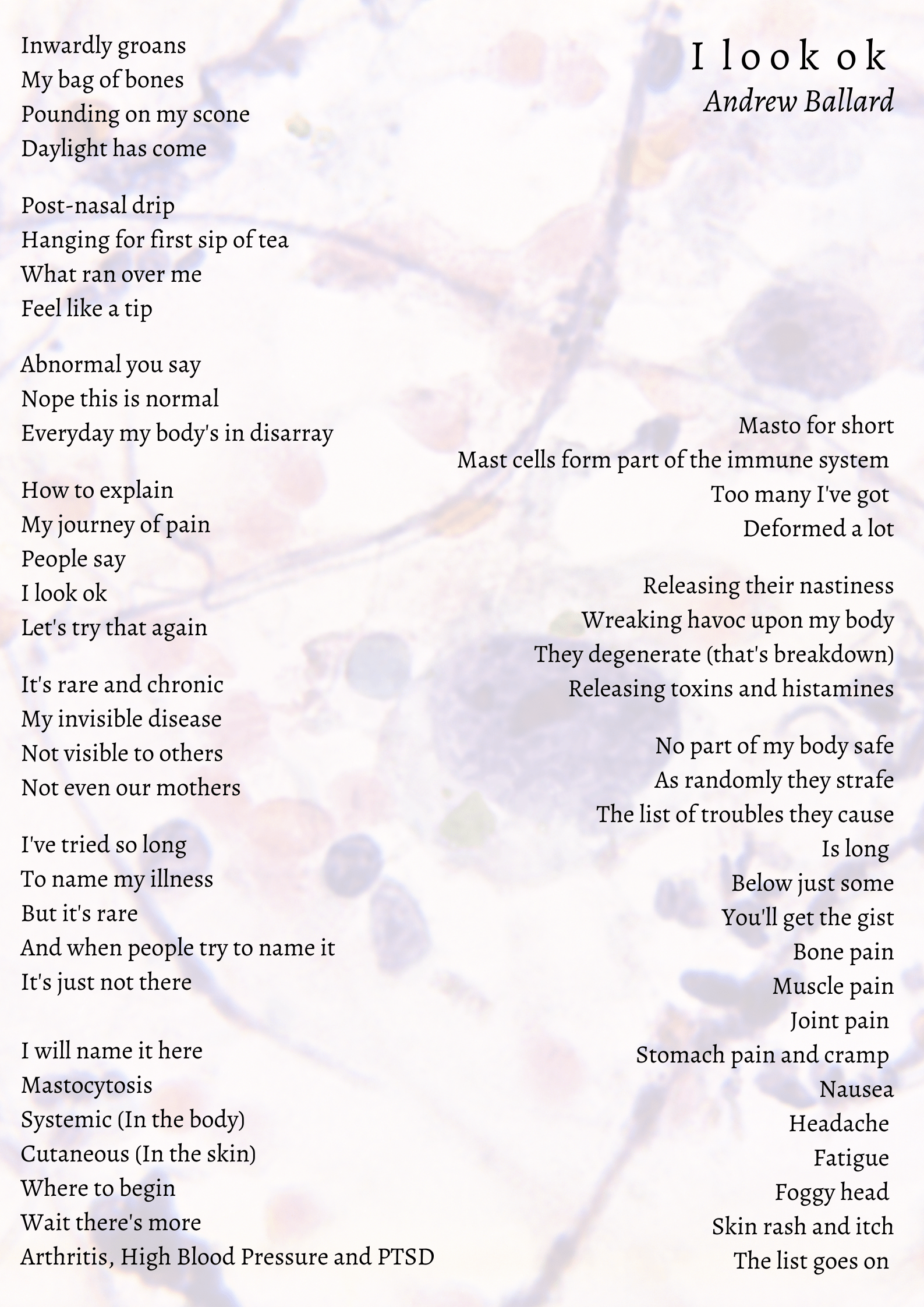
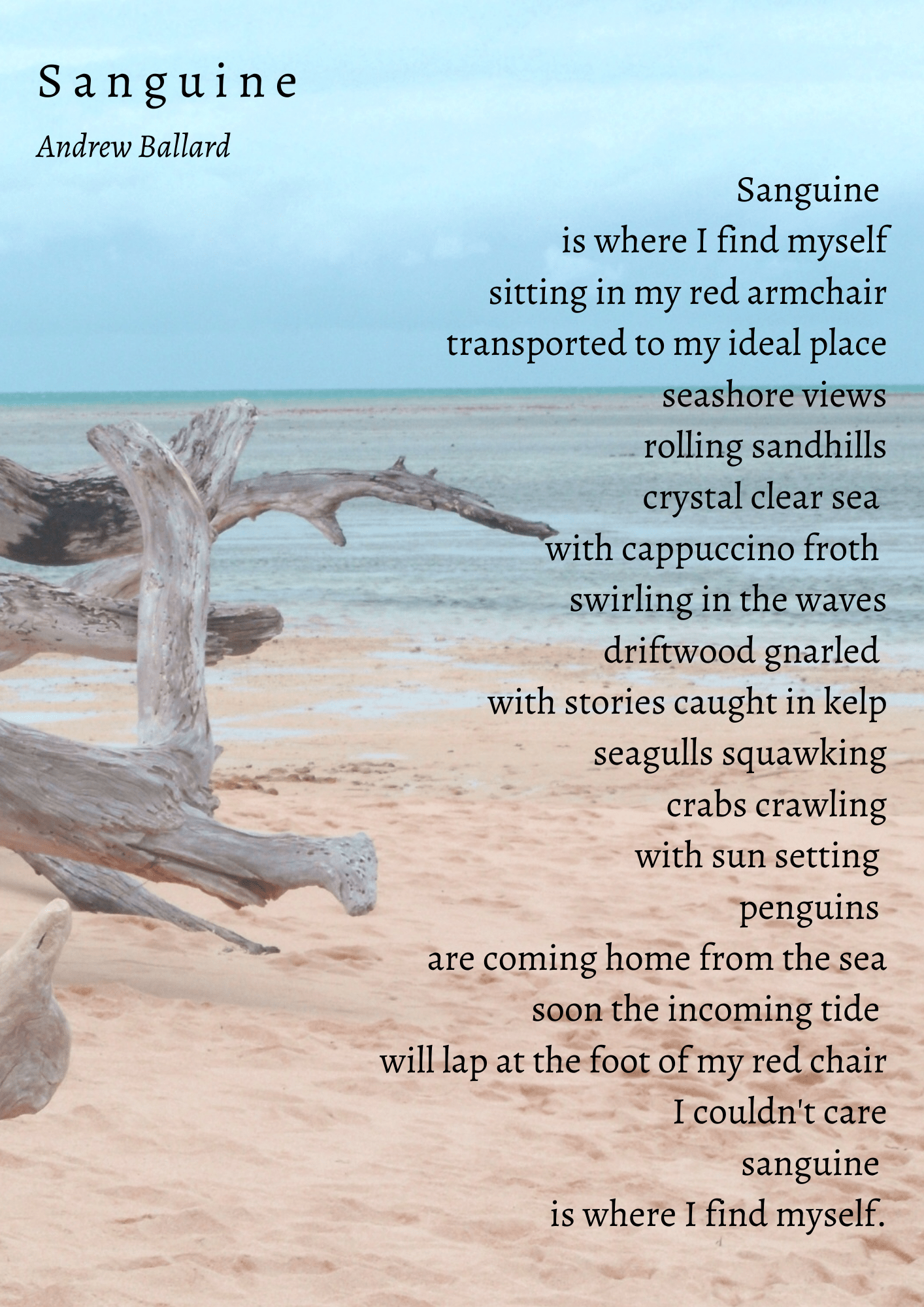
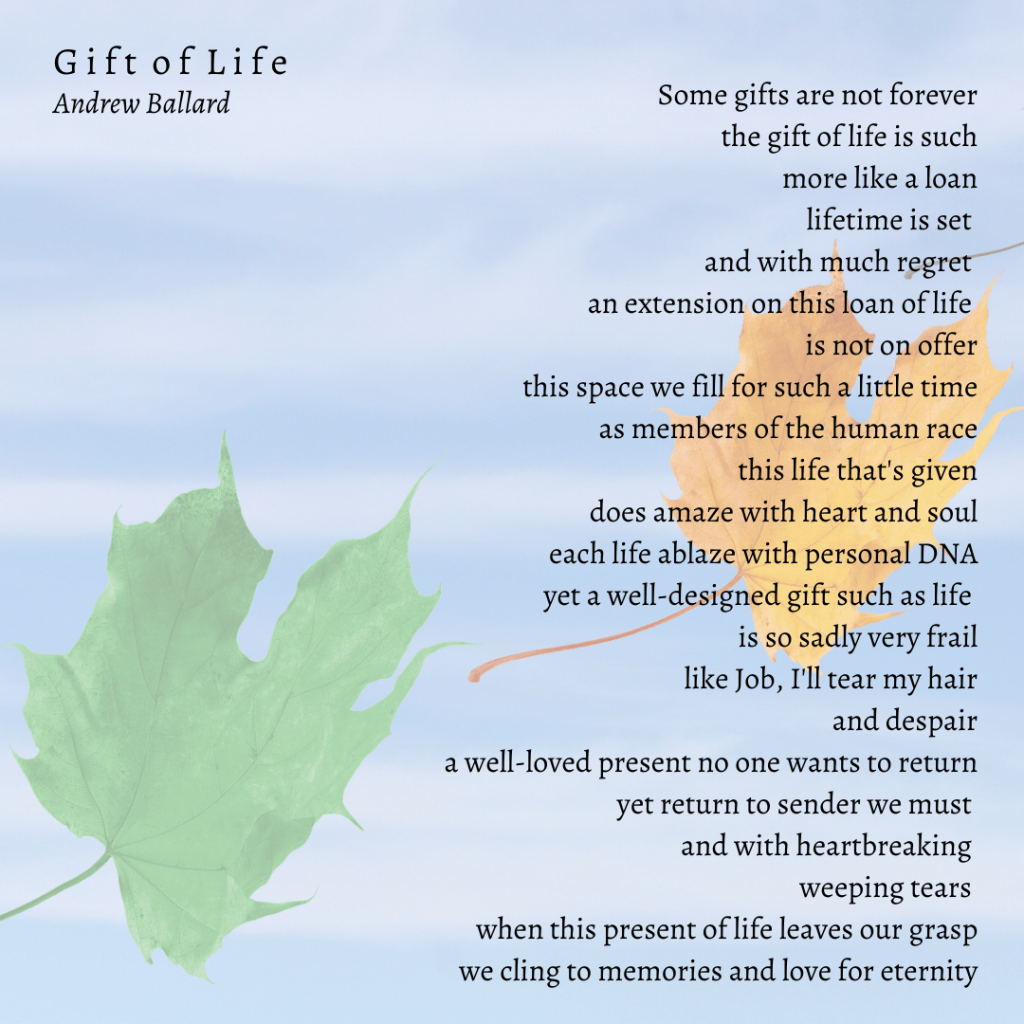
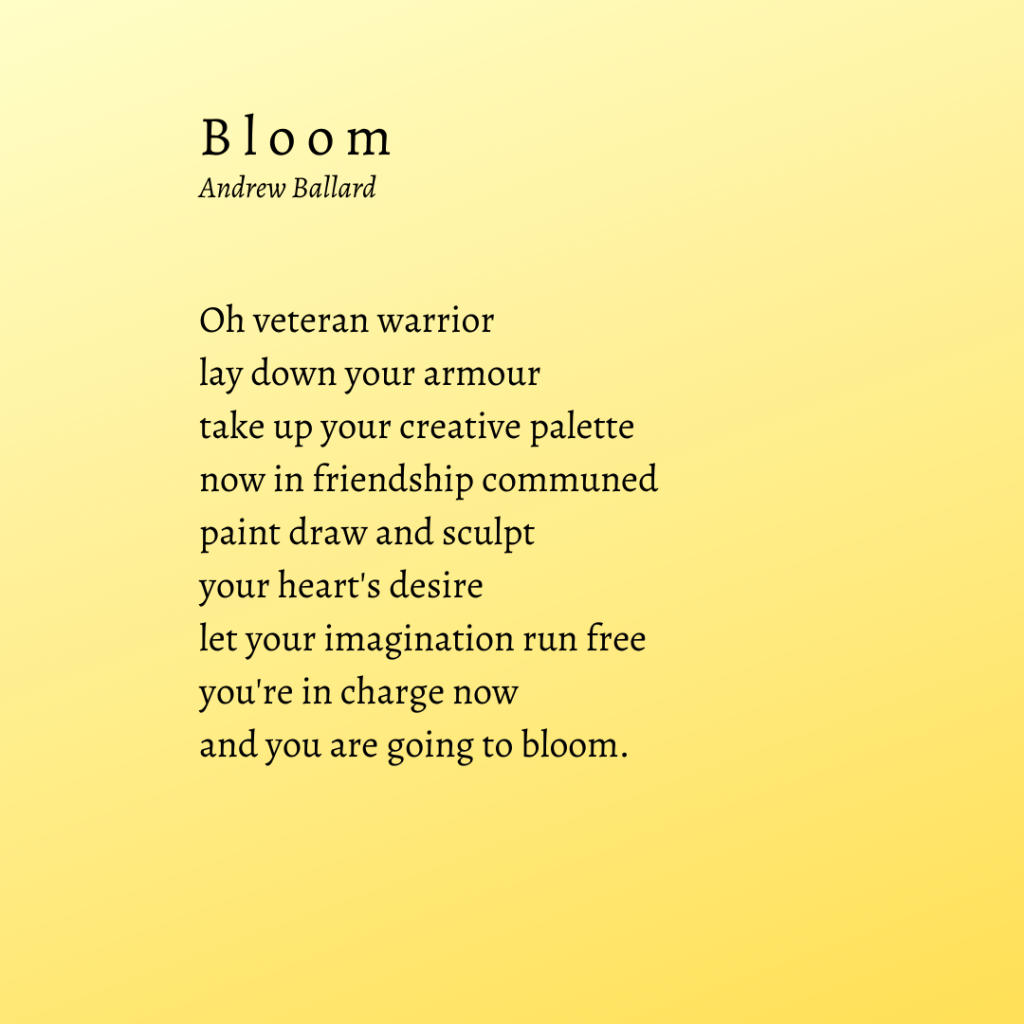
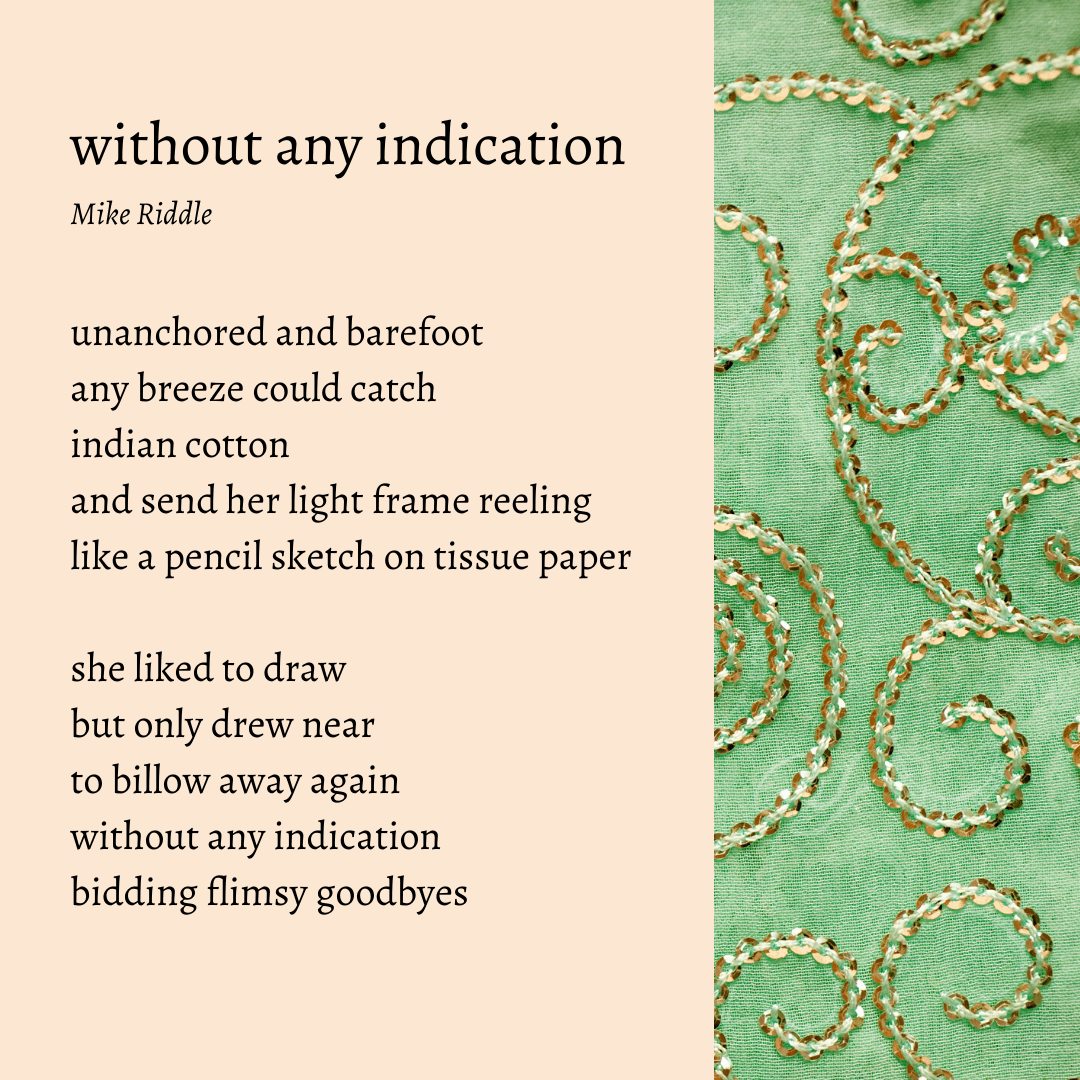
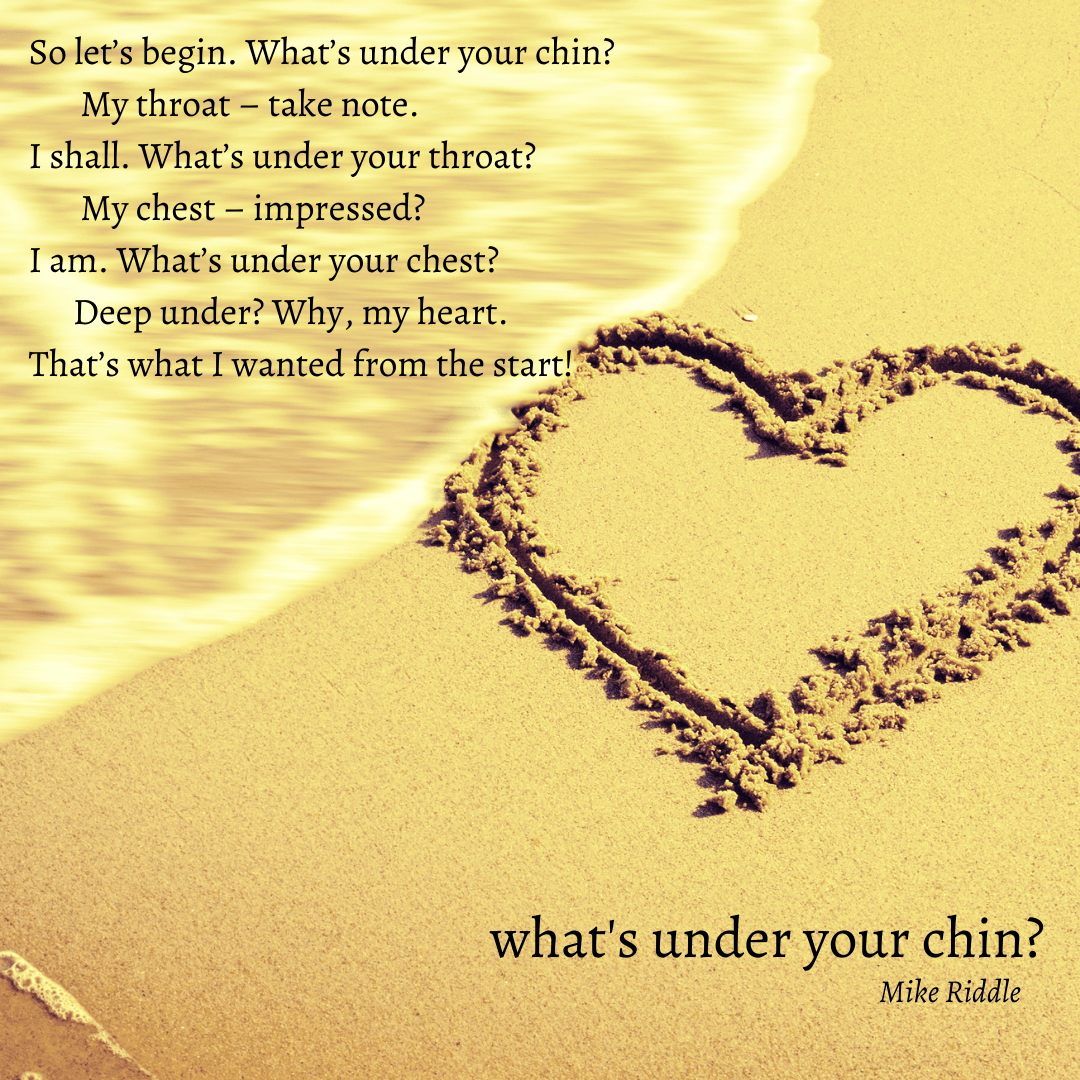
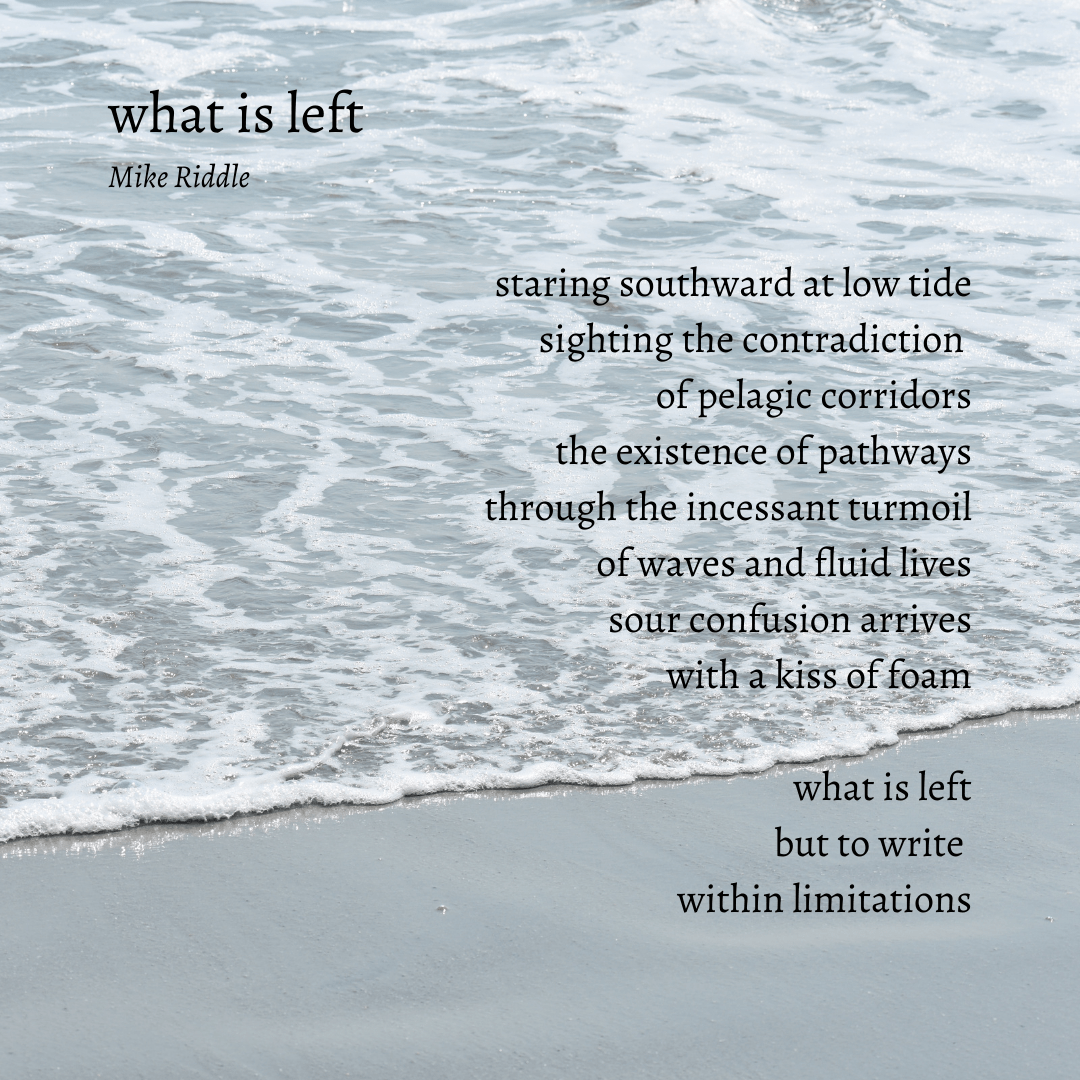
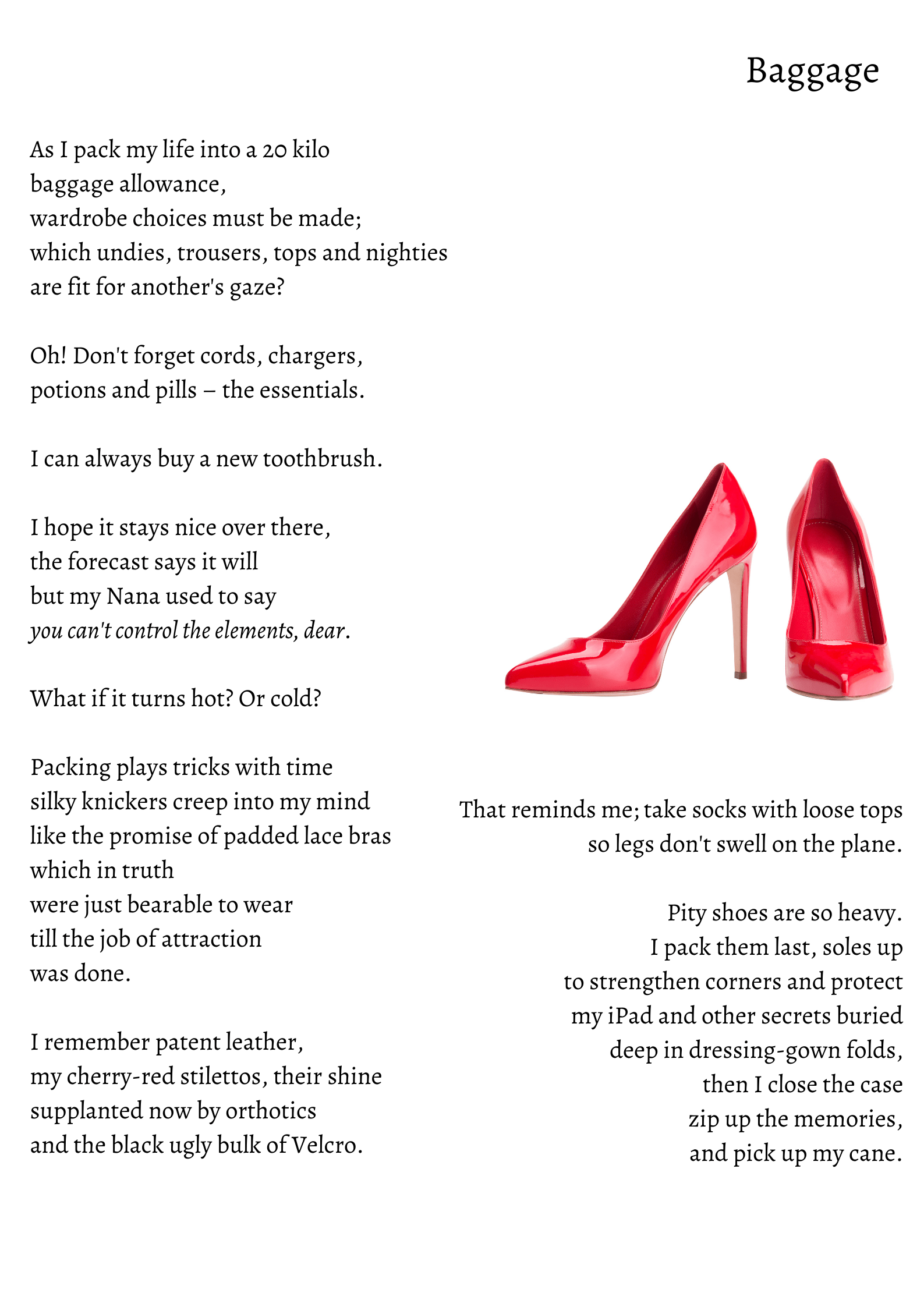
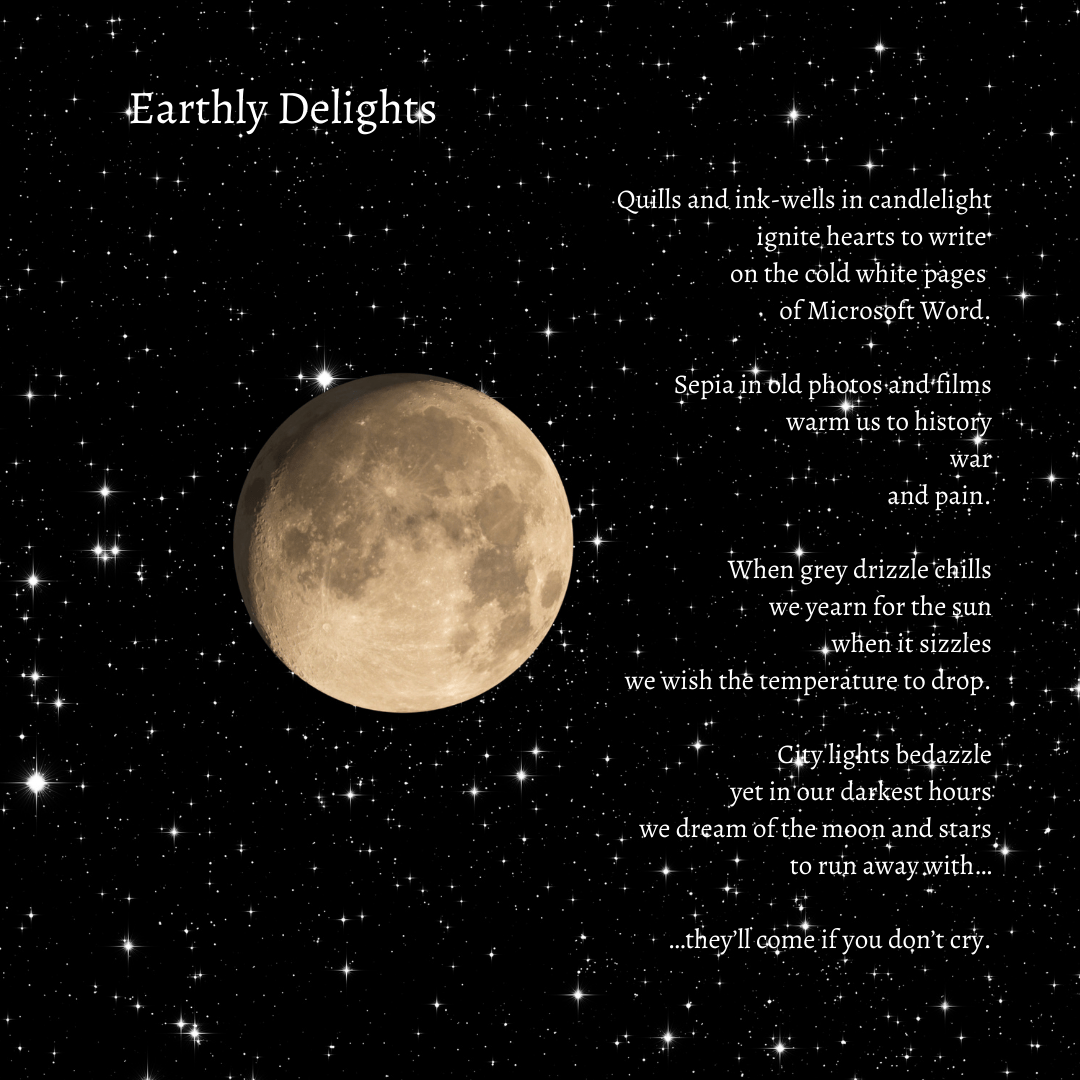
I realise old age is unromantic, often unattractive and, for some, a taboo subject like death; something they’d prefer to avoid. So, rather than rabbit on, today I’ve decided to post six of my most recent poems on some of the awkward truths of old age without comment. Make of them what you will.
Six Poems for your Consideration and Entertainment
It tickles me to write about being old. At times, I suspect people may find my interests a bit odd or of no interest whatsoever to anybody under the age of 50, 60, or even 70, when bodies are still relatively intact. But if I don’t talk about the last bit of life, who will? For what it’s worth, here are my contributions for today.
To me, stories come from the sandpit of life. When you dig your hands in, sift grains through your fingers, fleeting images and ideas appear. You try to grasp these ephemeral moments with words that may at first be inchoate. Yet your mind soon flashes with what feels like brilliance, and off you go with a story. Capturing these flashes is more complicated than it seems, but oh! what fun trying.
Sometimes, a story comes to you complete, and you quickly write or record its bones as though you are channelling. It is not yet literature, but it is the germ from which a poem or novel might grow. Unwritten ideas can dissipate fast, so it’s worth hanging onto them. I tend to record my flashes of brilliance (as they initially seem) on my iPhone when driving or those times when I wake at night. It scares me a bit to hear my sleep-ridden, old woman’s voice, but my clever Voice Memo app allows me to later save what I caught in print without having to type it up.
Ideas and Stories
I can’t remember for the life of me (sic) why I chose to write anything resembling a memoir, but my work in progress, entitled Call Me Marigold, is a novella-length piece I’m calling autofiction until someone corrects me. The only way I could think of to tackle this material was to unsettle the protagonist as a posthumous narrator, an 81-year-old woman who could not rest in death until she understood life.
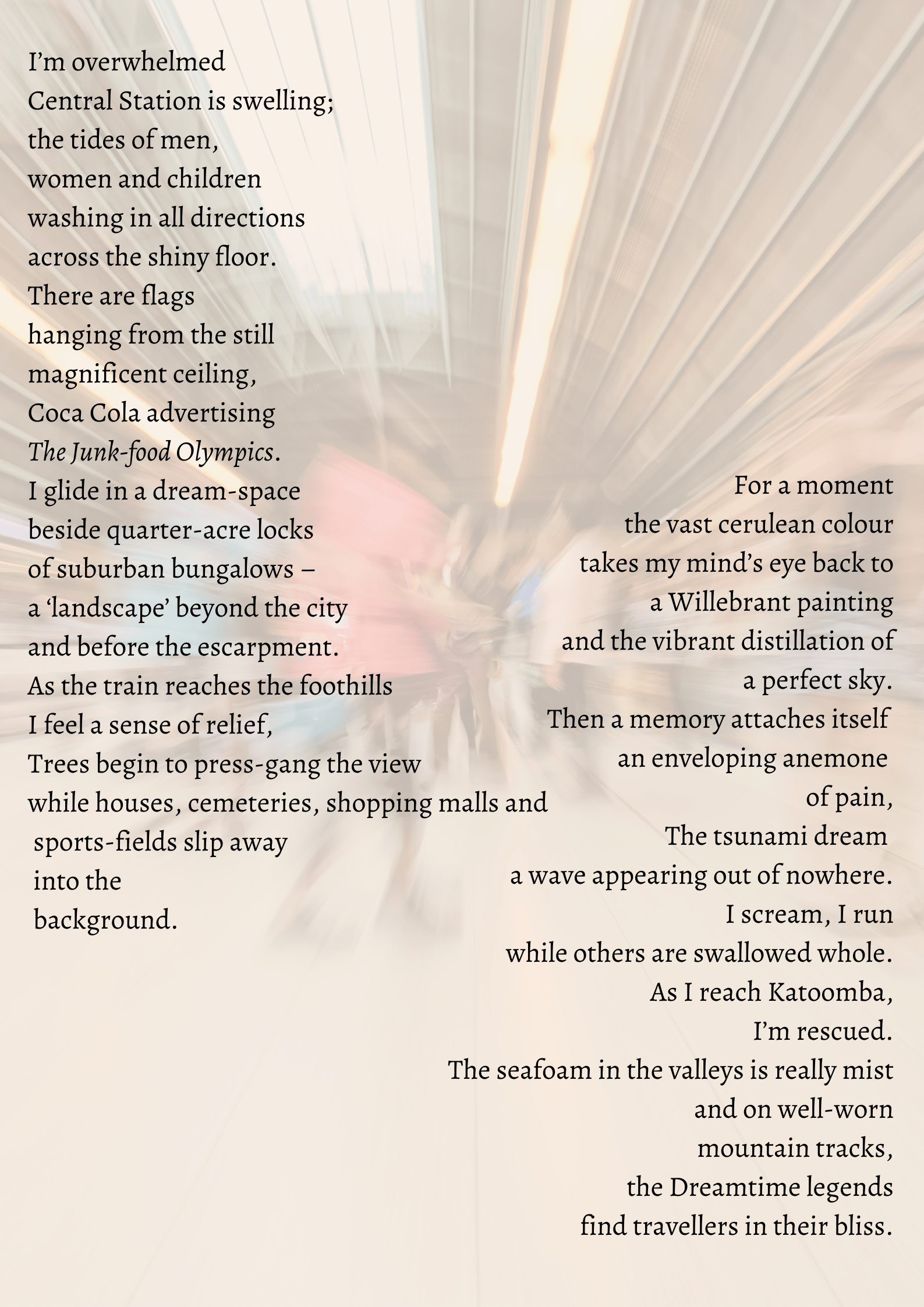
As I so often do on Wattletales, I decided to write from experience about the changes that take place between childhood and old age, using my life as an example. In other words, I wanted to explore the arc of life, similar to that depicted in the following poem, to ask what it really means to grow, age and die. We can’t know death, of course, but old age is a unique journey to consider anyway, as we move from the inside out. Or, as time goes on, outside in.
The Prologue
In the novella, Marigold (clearly not her real name) is a somewhat unreliable narrator stuck in a liminal space between life and the everafter with nothing more than memories. The story unfolds as a series of vignettes, texts and poems. Marigold refuses to name her characters. In her view, she is telling her story, so others are included only by role in relation to her. This is important because although she speaks of the joy of having children, she does not want to talk about them. After all, as she tells us, their lives are not hers to discuss.
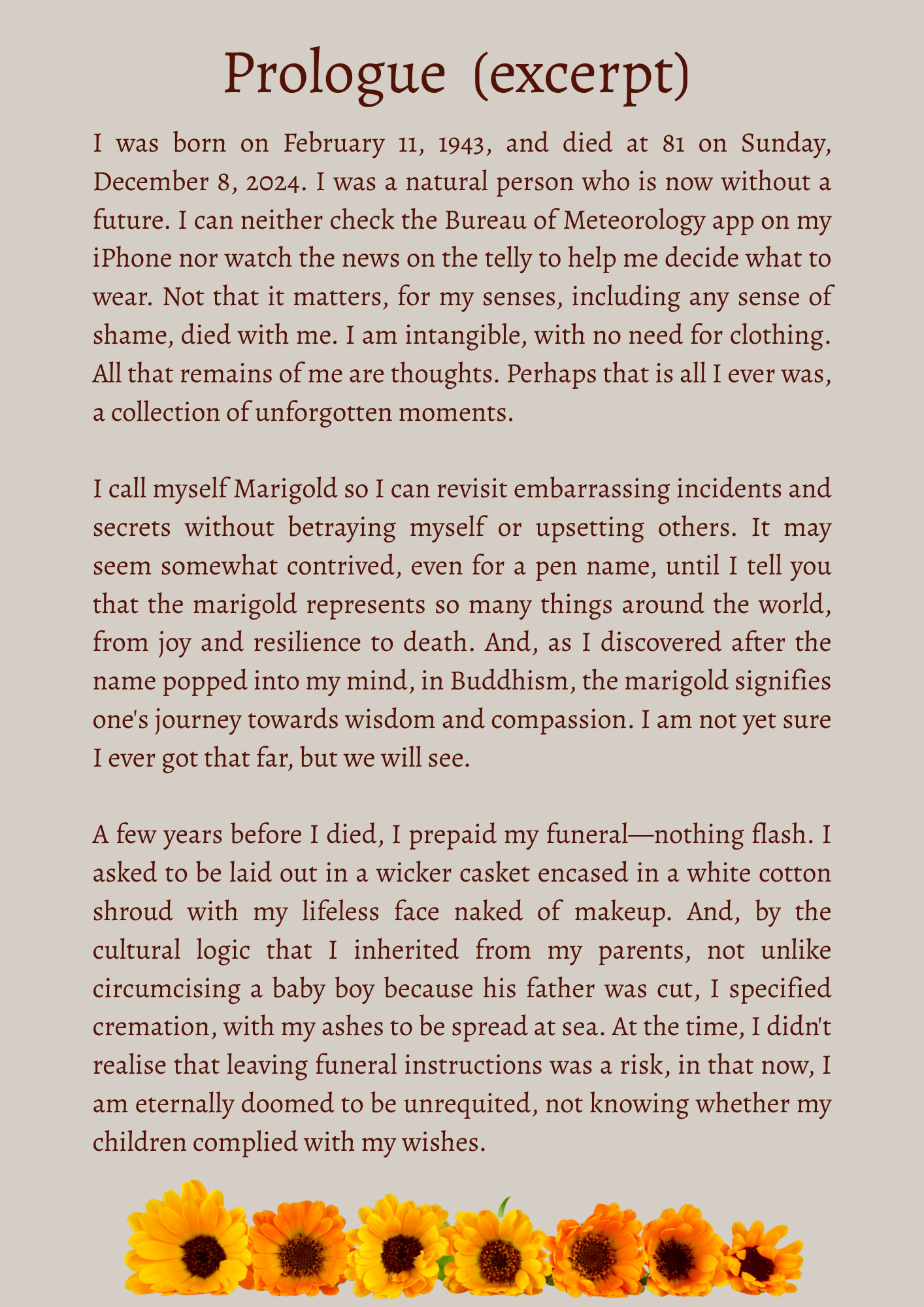
Here is an excerpt from Marigold’s Prologue.
The most significant other character in this tale is Marigold’s mother, to whom she speaks in an italicised throughline called Conversations with Mother.
As a Writer
There is no doubt that writing from one’s life while alive is no easy task. When writing close to the bone, finding the words and purpose of each story you tell takes you deeper into your emotions. Strangely enough, this teaches you what you have forgiven and what you still need to let go of. Writing intimately about your past is a bit like time travel; it takes you there, often with intense emotional impact.
Although I’m nearing the end of the first draft of Call Me Marigold, when I got bogged down a while ago, I decided to start a new novel for respite. Sometimes, letting one story rest for a while is refreshing.
Something New
My imaginary sandpit occasionally yields the oddest things for poems and stories. Still, my writing in general tends to explore ways in which we fall through the cracks. Under the heading Questions Over Coffee in my introduction to Wattletales, I ask what it means to become broke, mad, ill, destitute, deserted, disillusioned, or denounced. What happens to our sense of self and our identity when life wreaks havoc with our intentions, plans and happiness? How porous is our mind? Is there really a line between sanity and insanity, and how do we know when we tip over the edge?
In that vein, the first idea for a new novel was to write about gaslighting in marriage. My two previous books, The Publican’s Daughterand They Who Nicked the Sun, lived in me as ideas for years before coming to be on the page. Why, then, when I was seeking respite from the emotional drag of writing Marigold, did gaslighting come up?
Gaslighting
Part of me feels that the notion of gaslighting has haunted me ever since I watched the 1944 movie, Gaslight, with Ingrid Bergman and Alfred Hitchcock’s 1954 Dial M for Murder with Grace Kelly. I have no idea when I did that, but the portrayal of gaslighting by both actresses whom I admired and adored remains clear in my mind to this day. Another part of me knows the idea came from being raised on the idea ‘what will other people think’ which inclines one to disbelieve in oneself, and my first marriage, bearing in mind my husband was 13 years older than me at 17.
Nine Banksia Street
My gaslighting book’s working title is Nine Banksia Street. The main characters appeared in my mind simultaneously with the basic story concept, which came to me in a sandpit rush, pretty much word for word, as below. The story entices but remains unwritten for the time being.
The Latest from Lindy’s Sandpit
I was talking to a friend a couple of weeks ago, asking why I tend to focus on misery in my writing. When I suggested I might write something humorous about old age, she agreed.
One title that emerged from my sandpit years ago is The Grizzle and Giggle Club, which I’ve had in mind since middle age, when my women friends and I used to feel better after a grizzle and giggle together. But the more I think about it now, I’d rather use something like The Secrets Old Girls Take to Their Grave.
After several recent conversations with age-mates while waiting to see doctors and specialists, and in the Manson Towers Retirement Village, I’ve learned that we all have experiences that most of us would prefer to keep to ourselves. When I finish Call Me Marigold, it may come down to a toss-up between this idea and gaslighting.
This post is a slightly modified excerpt (in other words, a ripoff) from my work-in-progress, Call Me Marigold, a novella-length piece of autofiction. I’ve chosen from a section called My Six Buddhas and Three Husbands. While I may refer to husbands indirectly here, details will not be revealed until the book’s publication. However, I leave the references in because they indicate that husbands are treated in that book (in a literary sense) somewhat like ornaments, albeit with a modicum of respect.
I’m talking about ornaments because our ornaments refract time, memories and emotion. Our favourites satisfy us for years, if not a lifetime. While my Buddha figurines and statues are not my only ornaments, I have decided to discuss them primarily because they collectively create a presence or aura in my living space.
My Six Buddhas
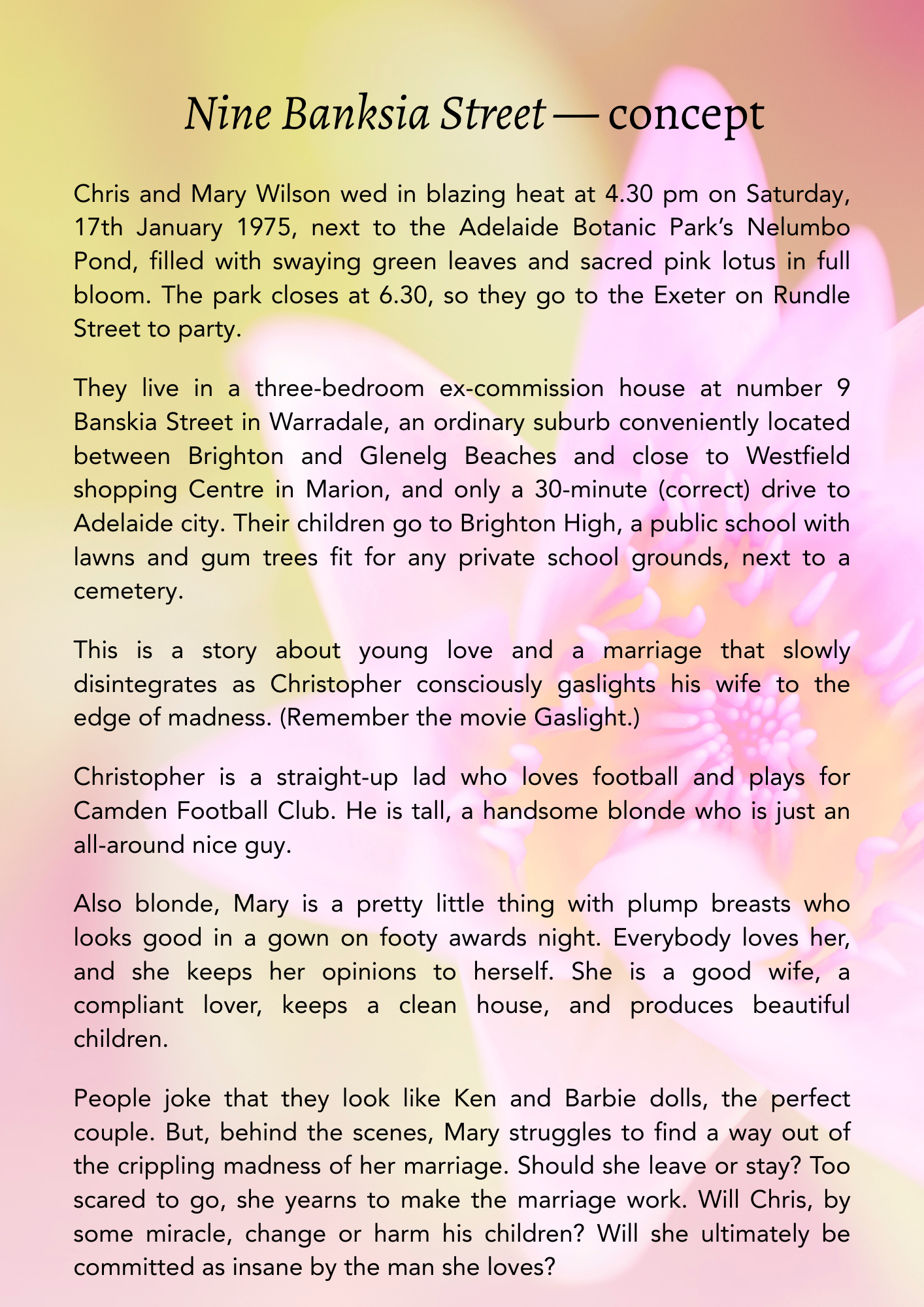
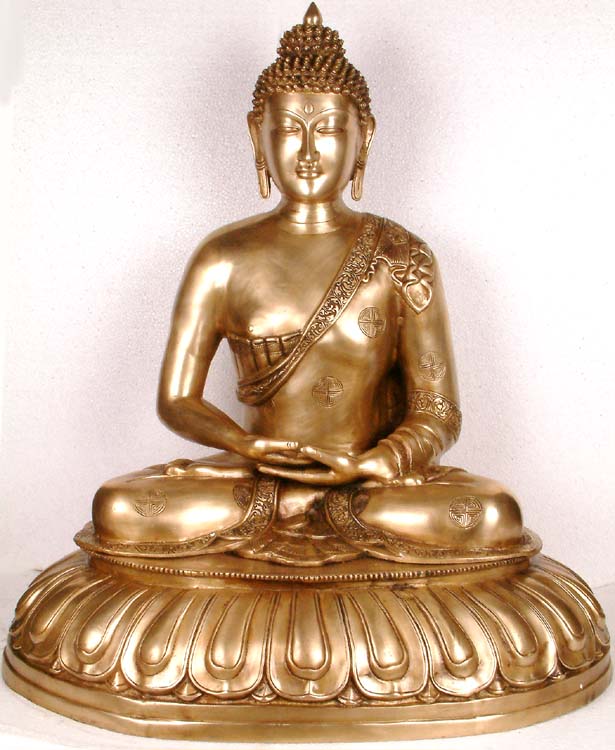
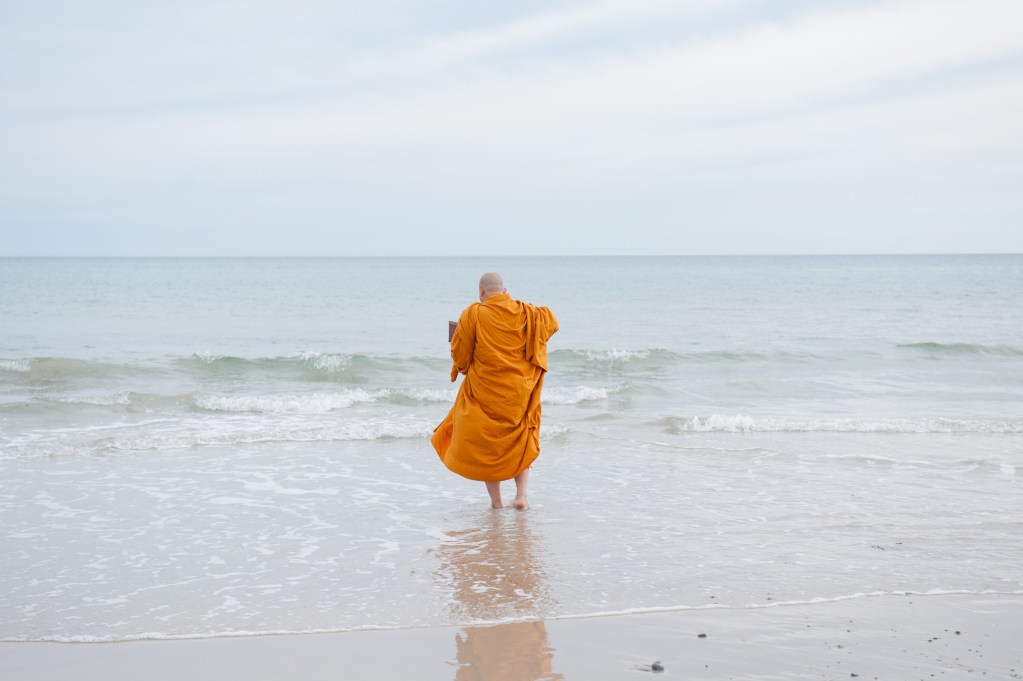
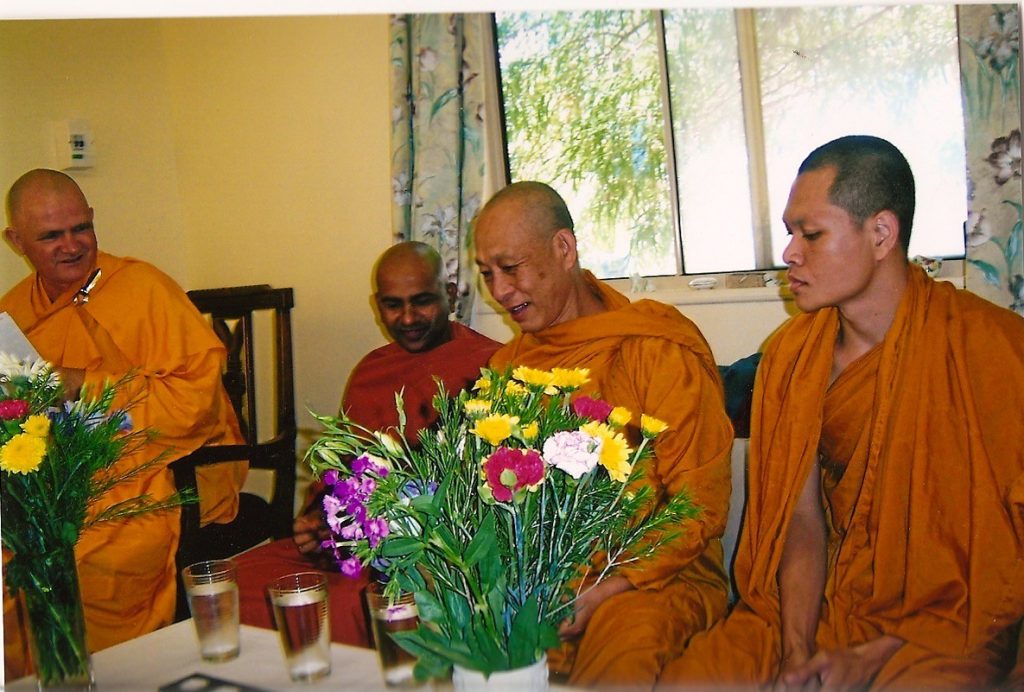
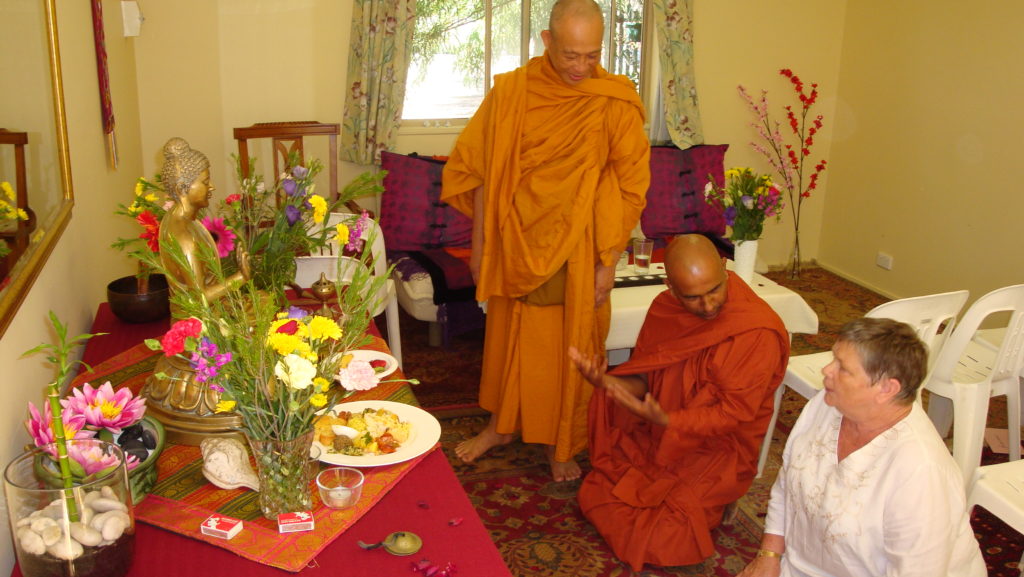
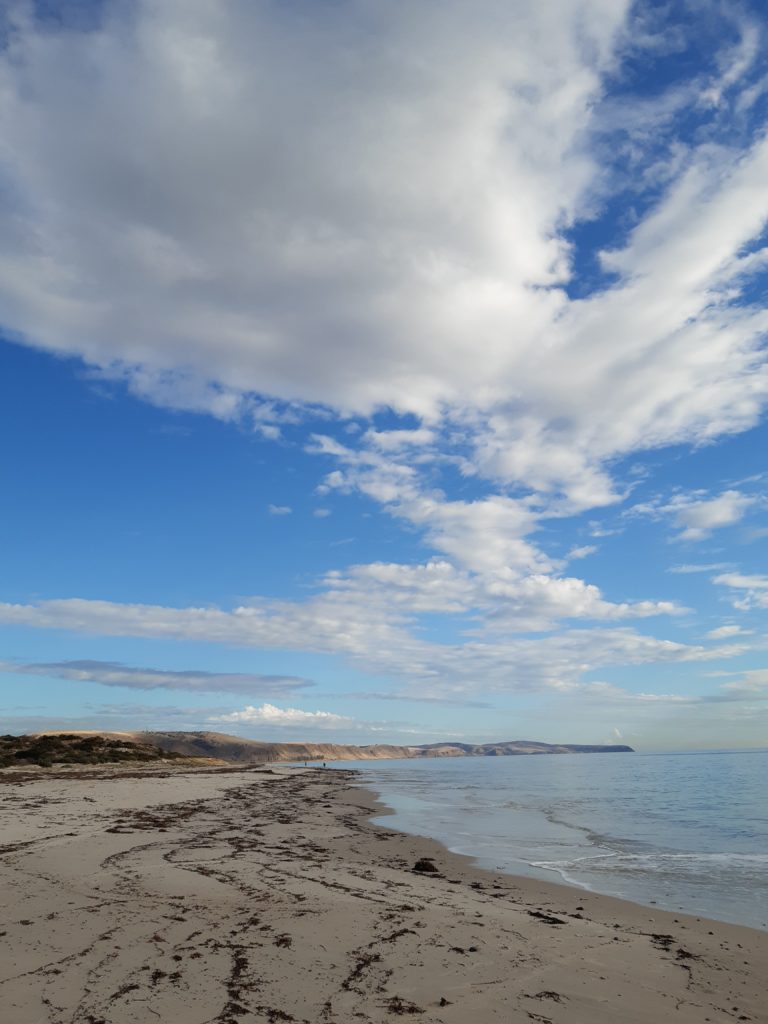
By the time I moved into my retirement village with the mass murderer’s name (Manson Towers), I only had six Buddha statues. I donated a large brass sitting Buddha, similar to the one pictured above, which was important for teaching meditation in my post-retirement days, to a Cambodian Buddhist monk, Bhante Ly, who was a dear friend. He blessed my eldest son’s ashes before we spread them at Aldinga Bay.
A small, transparent resin statue pictured later, given to me by the head monk of Adelaide’s Sri Lankan Buddhist Vihara, found a new home with my youngest son.
My First Buddha Statue
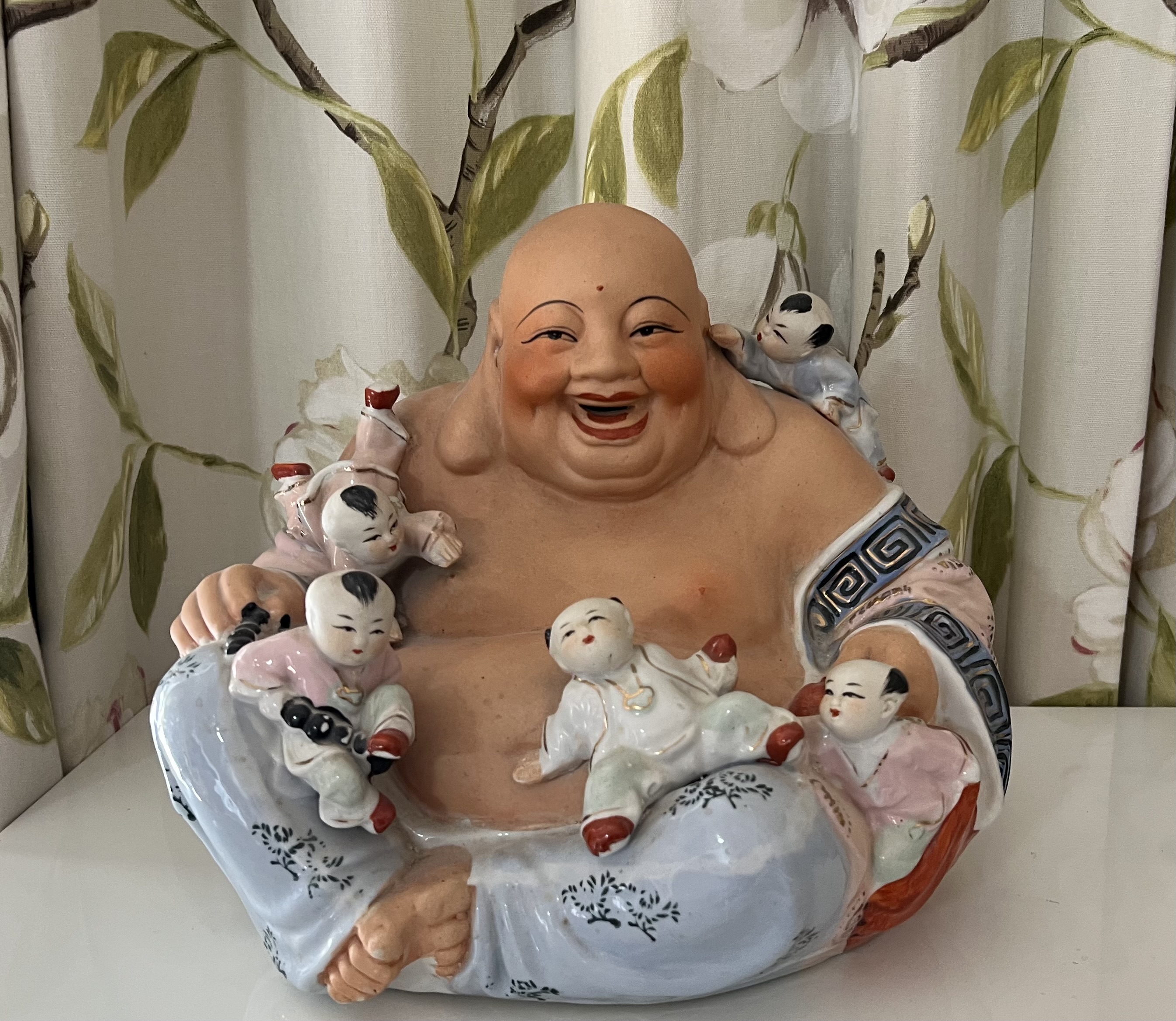
My first Buddha statue, shown in the lead photo of this post, entered my life half a lifetime ago, when I was in my early forties. I bought it in Chinatown while in Sydney to attend my first academic conference as a postgraduate. (My paper entitled ‘The Booze, the Bouncer and Adolescence Down Under’ (1994) was accepted immediately for publication and is still often accessed.)
Looking back, I fell in love with it, not because it sort of reminded me of my second husband’s desertion, but because this rotund Chinese laughing Buddha in blue robes has five little children crawling all over his bare shoulders, a profound symbol of the love and joy I felt for my three young children. At the time, I had not discovered Buddhism; my choice was both aesthetic and emotional.
Place is Important
The place of purchase carries more significance. I found the blue Buddha near Paddy’s Markets, where I worked when I was about 18, after the first of my three failed marriages ended. I found a job there with Pardy Providors as a stenographer and cord-and-plug telephone console operator. My boss was a tall, well-statured man who constantly hitched his brown trousers at the crotch. Being in my late teens, I had to stifle the urge to giggle at this unfortunate habit.
Still, I never mocked, as he was a kindly soul who looked after me when I had a telephone flirtation on the console with a supply officer from Ingleburn Army Camp, a WWII, purpose-built training centre that was wound down in the mid-1990s. I don’t recall his name, but we flirted when he called to place an order. The soldier finally persuaded me to meet him, until my darling boss saved me by telling me the guy was married with two little ones.
I was going to suggest we meet at The Broadway Hotel on George Street, where I worked a second job as a barmaid at night. Being a publican’s daughter had its benefits for much of my life; I could always get a pub job for extra money. In Sydney at the time, I first lived with my aunt, my father’s sister, in North Ryde, which was then considered the countryside. We had an outhouse and a dunny can.
Much as I loved my aunt, I disliked going to the loo on cold or wet nights with spiders and newspaper for toilet paper, or travelling to work and back each day, which entailed long, hilly walks, trains, and trams. With a second job, I was able to move into a rooming house right on the curve of Bondi Beach, next to the saltwater pool.
My first Buddha holds all of these memories.
In My Sixties
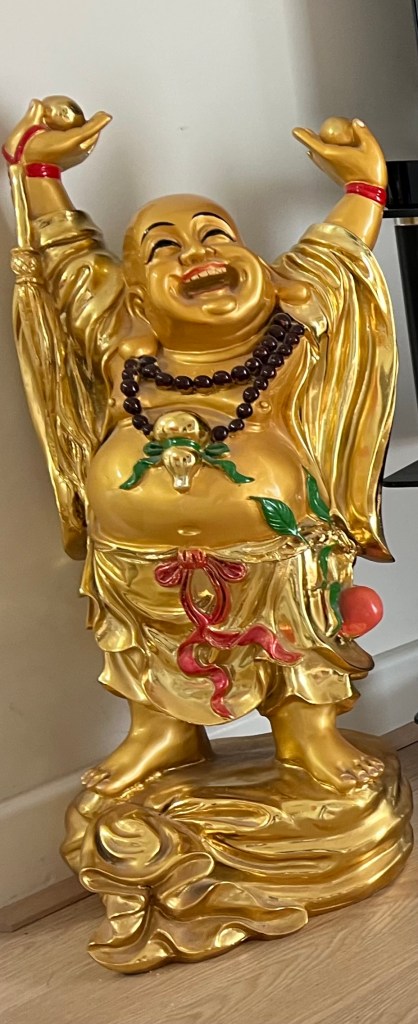
When I was in my sixties, after encountering Buddhism in Sri Lanka, I bought a 60cm-high, gold-coloured resin standing Buddha, with a ball aloft in each hand, held high, representing prosperity, happiness, and good luck. I found it one day after wandering the length of Melbourne’s Victoria Markets, already a lost soul after leaving the Northern Territory and the workforce for what seemed like forever, and looking for my car on the wrong side of the vast, sprawling marketplace. The statue’s golden smile winked at me from the window of a shop, drawing me in.
Inside, the shop was cool and calming. The old Chinese shopkeeper was dressed in what I guessed was traditional Chinese rural garb of loose trousers and a top made of rough hemp or cotton. He greeted me with a smile. ‘You like?’ he asked. ‘I’ll give it to you for a special price. You are my first customer, and that is my good luck.’ It was good luck for me, too, at a time when I was utterly drained by life, having found myself on an invalid pension and living in high-rise public housing in Prahran.
The luck of my gold Buddha was pivotal. It served me well in my transition from anthropology to a retirement filled with meditation, poetry and writing. And, as it turned out, the high-rise experience was a special time that both led to and informed my second novel, launched in 2024, They Who Nicked the Sun, set in Prahran, in Melbourne.
What may seem bad at the time often augurs better times to come.
From Sri Lanka
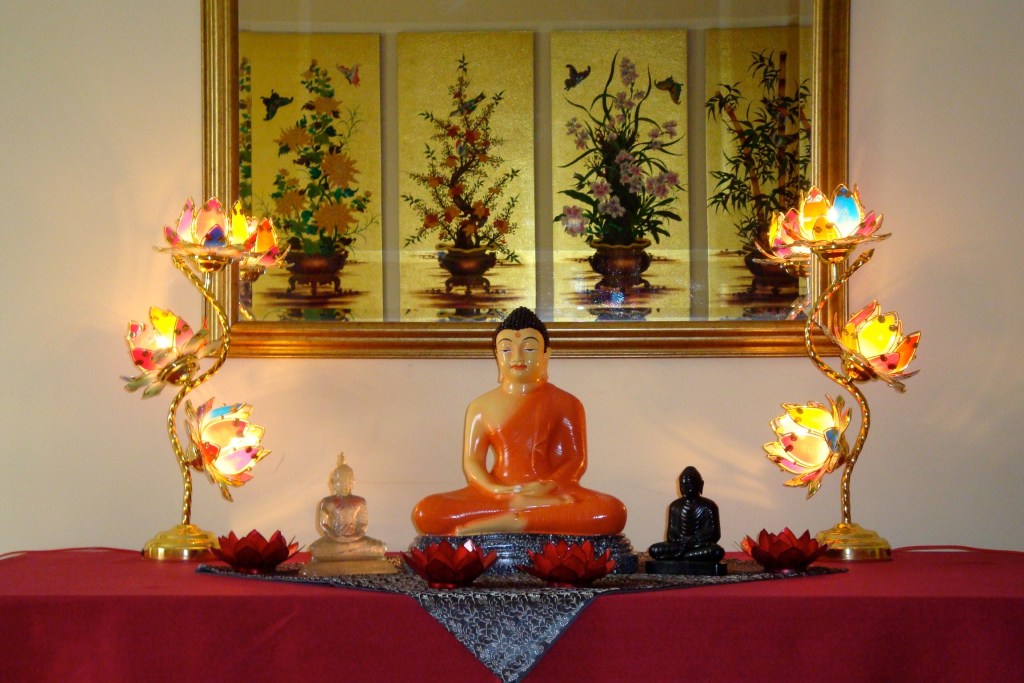
I concede there was an aesthetic impulse behind the purchase of the beautiful King Ebony figurine seen to the right below, which I bought for Rs 900 in the early 1980s from an expensive jeweller close to Colombo’s vibrant outdoor market, the Pettah. It is exquisitely carved to the correct proportions for a sitting Buddha and represents a country I lived in and loved, and where I met my third husband. On the left is the clear resin Buddha now treasured by my son.
From my meditation room at Aldinga Beach
The central Buddha in the photo above is a traditional Sinhalese Buddhist statue crafted by artisans as a gift from the man who was my research assistant back in the 1980s, with whom I became friends during my PhD research in Sri Lanka—a time and place that changed my life. My friend went on to become an international consultant and lifelong friend. He sent the statue unannounced, close to 30 years later. Even in our old age, we email a few times a year to stay in touch. He has a very special place in my heart.
Aldinga Beach
The Chinese gold and white porcelain meditating Buddha in the next photo evokes memories of my 16 years in Aldinga Beach. After being blocked for many years by local protests and the Council’s ignorance, the Nan Hai Pu Tuo Temple was built at Sellicks Beach.
At that time, I led three meditation groups: one at Aldinga U3A, another at the Aldinga Community Centre, and a private group at home. With my meditation students, I occasionally visited the Temple on Sundays to participate in the Temple’s Dana lunch. They were good years. People from all three groups also came together at my place monthly to share a vegetarian meal.
Childhood Memories
A few years ago, I scoured the internet to find a miniature Daibutsu Buddha, a replica of the giant bronze statue in Kamakura, Japan, built during the Kamakura period. It was first constructed in wood in 1243 and later recast in bronze circa 1252. We visited the giant Daibutsu Buddha when I was an Army kid, and I adored it even then. My tiny bronze statue, at 60mm high, is smooth, cool, and weighty in the palm of my hand. It calms me.
There’ll be more about my three husbands in Call Me Marigold, coming as fast as I can write it. They, too, have times and places that evoke experiences that, in retrospect, were transformative. Even taking into account the sad and bad bits, my memories come together in glistening vignettes, like brilliant gems of life. Till then —
On Ornaments
Ornaments are serious business. While I’ve focused on my Buddha statues today, my home contains a number of other special artefacts from my life, including wall hangings passed down to me by my mother, brother, and lost son, as well as gifts from my other children. We also keep mementos, such as letters, emails, and perhaps books by friends, as well as our own publications.
Just as museums are a testament to a culture, our ornaments give witness to our lives. What do you see when you look around at home? Do you have a favourite item that tells a deep story? Which pieces do you hope your children will cherish when you’ve gone? Do they know your history?
I was going to call this post Things I Ponder and had to change to ‘think about’ because there are so many ways of using ‘ponder’; ‘ponder upon’ (a little old fashioned), ‘ponder on’, which, like ‘ponder’ suggests particular topics and is therefore constraining), and ‘ponder about’ which is silly because the word ‘ponder’ means’ think about’, but after reading these variations online, I decided that, if I leave the word ponder dangling, it might be confusing. These are a few things that literally stick in my mind.
I mention this tiny research moment on pondering as a way to show how my mind works. Where once, post-childhood, when I daydreamed a lot, I didn’t ponder anything much, preferring to think I was right (which I often was, although it made me unpopular). Now, in old age, I find I second-guess myself to the extent that I search the World Wide Web to check most thoughts that may, to my shame, go viral if they’re wrong, like my poor failing body, so often told it’s not right by medical science. While I don’t like to be incorrect, I am aware that few things in life are straightforward, as my little ponderings today exemplify.
Welcome to Country
The Idea
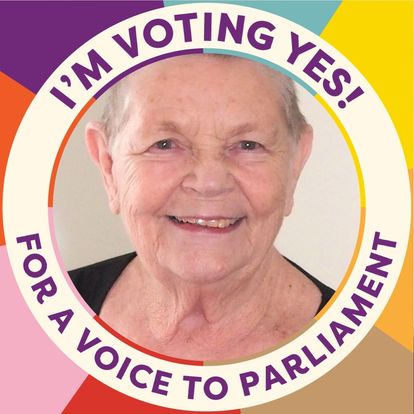
The idea to ponder Welcome to Country ceremonies in a post originated from my son, who encouraged me. These traditional ceremonies got a lot of bad press in the pre-election political discourse. Unlike me, he has travelled to New Zealand, where he was impressed by the way traditional Māori culture is integrated into daily life, from a visitor’s perspective. He wishes Australia could be like that towards First Nations culture and peoples here, as do I.
I am not an authority on this matter, but I am, as many know, an anthropologist and have worked with First Nations people across Australia. So, while it is not my place to speak for them or on their behalf, I can say, both as an anthropologist and as a publican’s daughter who was raised and worked in pubs for the first half of my life, I understand Australian culture at various levels. Well enough, I trust, to make a few general observations while sidestepping the specifics of recent journalistic and political discourse and similarly grossly ill-informed social media discourse.
It’s All To Do With Semantics
Much like my earlier discussion on the effective use of the word ‘ponder’. The term ‘country’ appears to be the main sticking point for those who perhaps operate under the notion that it means the same thing as ‘nation’. Such a flawed conflation leads many people to ask why the Australian population at large should be invited to their own country. They find it offensive.
The answer depends on what you mean by ‘country. Failing to understand this fuels racism.
Welcome Ceremonies
Bear with me if you know this already. A Welcome to Country ceremony is offered by a small group of people whose ‘country’ is defined by the stories they hold for a particular tract of land. The traditions of that land are part of their being, defining First Nations people as who they are. Tradition places the responsibility on them to take care of that land, their ‘county’, just as we look after ourselves and our homes.
Seen like this, it is easy to see that Welcome Ceremonies are more like opening the front door to welcome someone into your home than taking over Australia or speaking on behalf of the nation to which we all belong equally. Indigenous country is the literal territory of ‘their mob’ or ‘my mob’, and it does not threaten anybody’s rights as a citizen one iota. Everyone should know this by now. Those with a public megaphone should report it that way instead of fuelling division. After all, most of us are by now familiar with the name of the First Nations area in which we live.
Compiled over many years of research by the anthropologist Norman Tindale, the Adelaide Museum’s Map of Tribal Australia shows us the traditional lands occupied before conquest. You can find what is likely to be an updated version of this map in the Aboriginal and Torres Strait Islander Studies Library (AIATSIS) if you want to scroll through it for a closer look.
Other historical maps show First Nations songlines crisscrossing the entire continent like a great big web. It is a shame that these trade and ceremony routes are rarely shown or talked about by the mainstream media, as they would encourage understanding and a greater respect for First Nations traditions.
Smoking ceremonies are a special gift from those who still live in or know the ancient stories handed down over generations about the lands of their ancestors. It is the gift of welcome to a history that precedes the nation we all compose, and now resides within the island of Australia defined by national borders.
In Conclusion
I think the confusion comes because we tend to think of Australia as a country, our country. Whereas we are, strictly speaking, a nation, which is a nation-state. It says so on our passports. And, as an aside, the whole concept of nation and nationality is itself fraught when you look into it. We all get into high dudgeon about ‘my country’ and ‘my nationality’, but, after all, as Benedict Anderson said long ago in 1983, nations are imagined communities.
Historically and politically, a nation is far removed from the face-to-face networks of traditional community life, where kinship-bound people together as political entities. We divide ourselves by class, political persuasions, sports affiliations, and other cultural identities, including race, as well as age. Such cultural distinctions serve capitalism’s marketing purposes well. Extended kinship ties would be a threat to that.
Our island provides a natural national boundary, and our states are clearly delineated by jurisdictional boundaries. Anyone wishing to cross our national border must hold a passport or have the necessary right of entry (and exit) documentation. Crossing state lines requires us to comply with that state’s jurisdiction on entry. If our move is permanent, we must change our electoral entry, our driving licence and so on. Though we roundly resisted carrying a national ID card when the idea was mooted in the 1980s, we take all this jurisdictional ID stuff for granted. Our strings are pulled by bureaucracy.
In traditional Aboriginal society, as I understand it in the simplest of terms, groups passing through the ‘country’ of others don’t simply crash the campfire; they wait to be invited in. Now, all Australians are welcomed into traditional local areas (a First Nation’s traditional ‘country’) with a smoking ceremony that has transformed to meet the contemporary world. Things have to change to stay the same (a phrase that stuck with me from a book I read many years ago about Sicily as it moved away from landlords and peasants, giving rise to the Mafiosi and political bureaucracy).
Thoughts that end up in poems
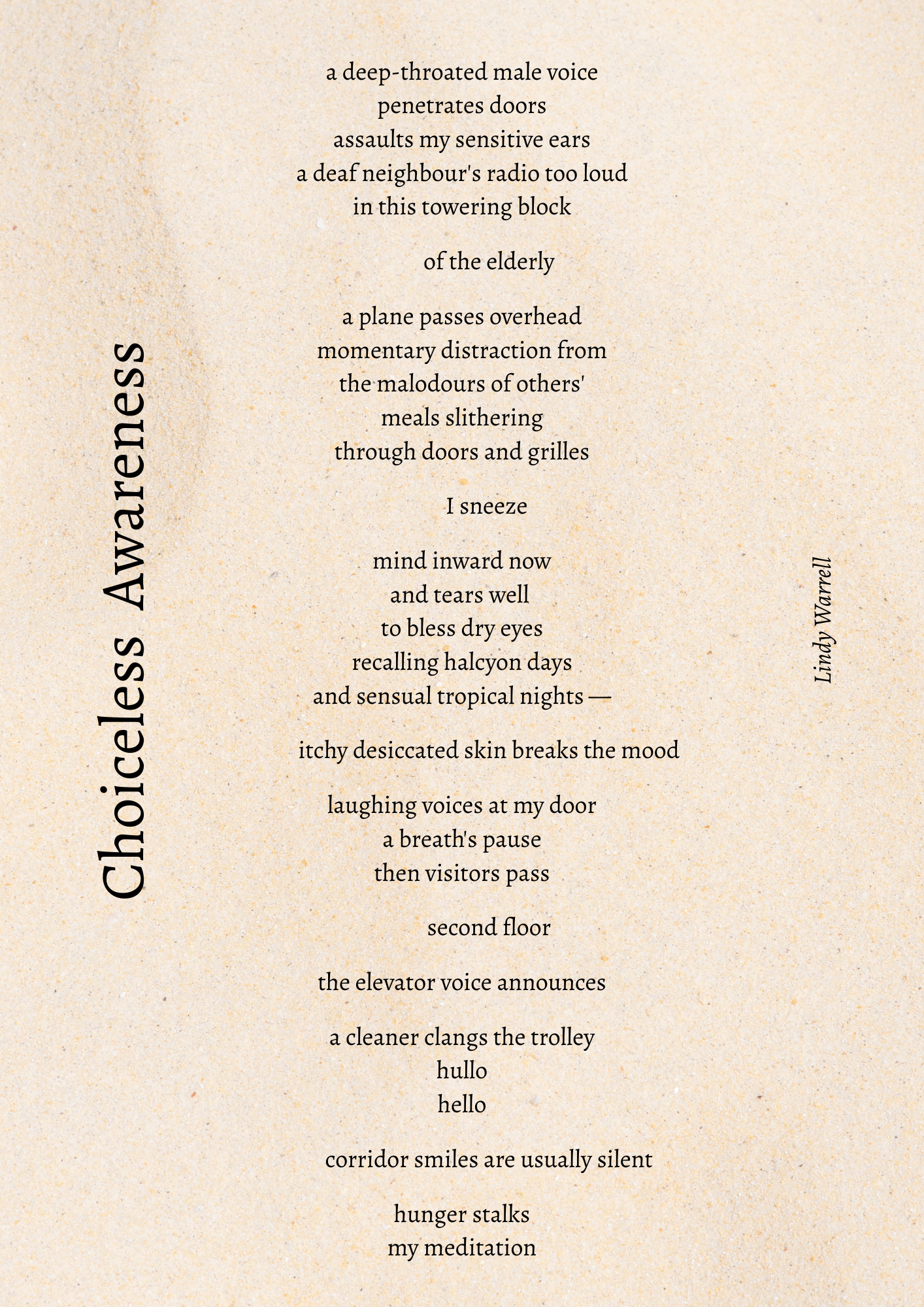
This first poem came from my meditative ponderings on living in a high-rise retirement unit that was built before soundproofing became a thing. It reminds me of old hotels in George Street and Chinatown in Sydney, many, many years ago. You didn’t need a glass to the wall to hear what was going on next door or anywhere else, for that matter. Even pipes creaked.
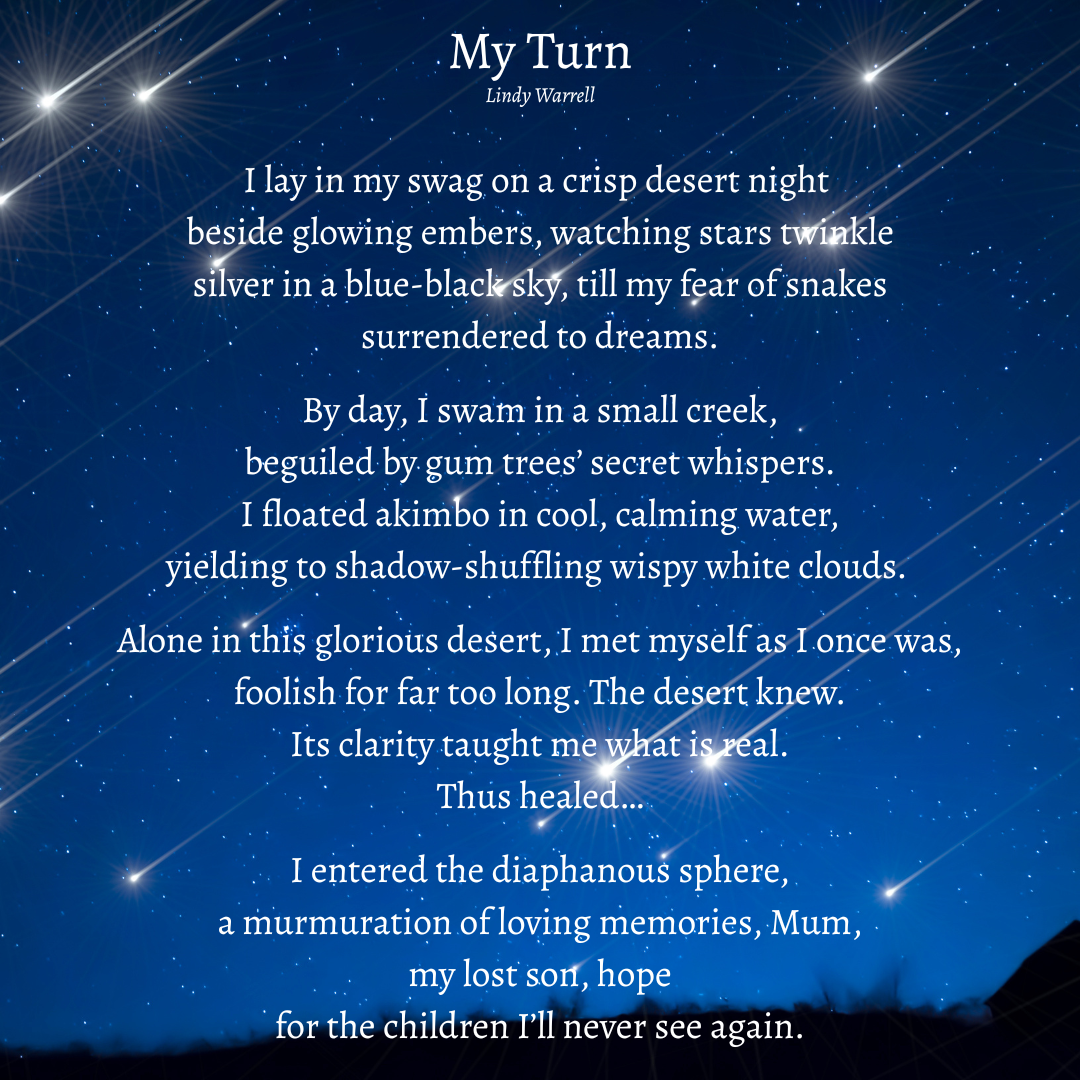
My Turn is something of a contemplative dream sequence predicated on my love for and experience of camping in the outback, often when working with First Nations people on their country. How could anyone forget such a privilege?
Thoughts about Hospital Stays
Toast
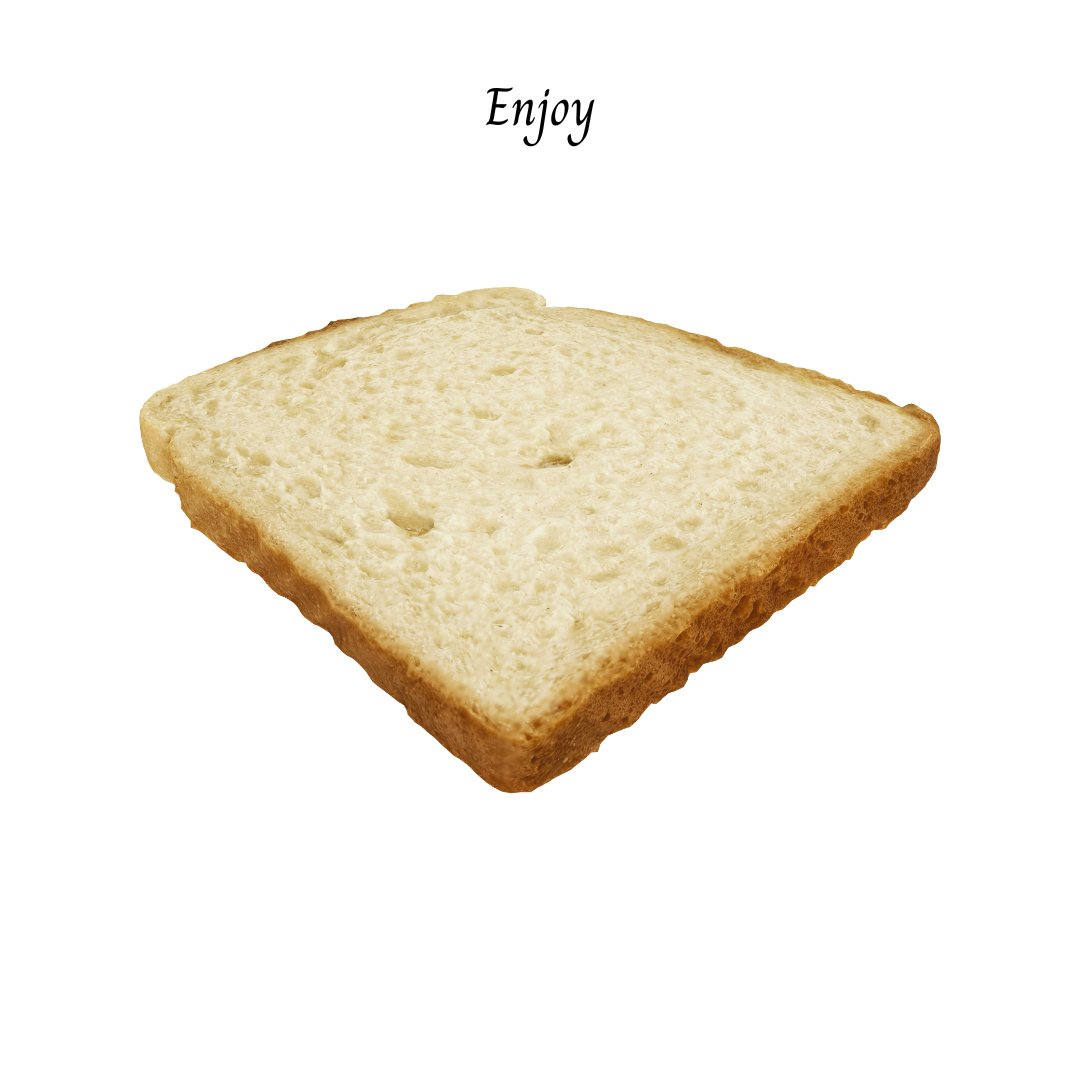
Toast has vanished from Flinders Medical Centre’s (FMC) breakfast menu.
Nobody will starve with cereal, fruit and a cuppa, but who eats pale white bread, butter and jam for breakfast? That was a treat (sans butter) for my father, born in 1910 to an impoverished family living in Sydney’s Glebe, then a slum, after his barefoot walk of three miles each way to school. To me, therefore, a single slice of white plastic bread is tantamount to workhouse food. Have hospital authorities never heard of croissants or muffins? I don’t like either—I’m a toast girl in the morning—but hey, I’d put that dislike aside in favour of flavour.
Showering
What has also disappeared, at least from the public wards at FMC, are white shower-chairs for the frail and elderly. Instead, some bright spark in finance has decided to give commodes a second use, minus the potty.
At 152 cm nowadays, I’m not very tall, so my feet do not hit the floor when I’m perched on the front edge of a bariatric-sized commode. (Most wheelchairs nowadays are bariatric too.) Furthermore, because of its size, the commode must face outwards from the cubicle, which requires you to shower sideways using a handheld shower rose; your arms are constrained by high armrests from which soap slips to the floor. A commode might almost be acceptable when someone else is washing you, but on your own, it’s a bugger. And yukky, too.
FMC’s commodes also feature shiny metal footrests resembling those of a wheelchair. Without a counterbalancing weight, these make it extremely hazardous to stand up. They cut into the back of your legs as you reach for the floor. You dare not put weight on them.
I was so appalled by this turn of events that the matter went beyond mere pondering. I wrote a letter of complaint to SA Health.
Unexpected Germs
I’ve since learned that I have been colonised, yes, that’s the right word, by pneumonitis. Although it is a non-contagious inflammation of the lungs, I must now advise hospital staff of this, if and when I am admitted again, as it can exacerbate other afflictions. I also had to undergo tests for a bug that colonises the digestive tract because SA’s Local Area Health Network (SAHLHN) advised that I may have been exposed during my last stay at FMC. Fortunately, that little bugger did not gain traction in my old body.
Ironically, hospitals were historically built to remove the populace from infectious community environments to promote healing and reduce the spread of disease. It would appear that this cycle is reversing.
Another Surprise
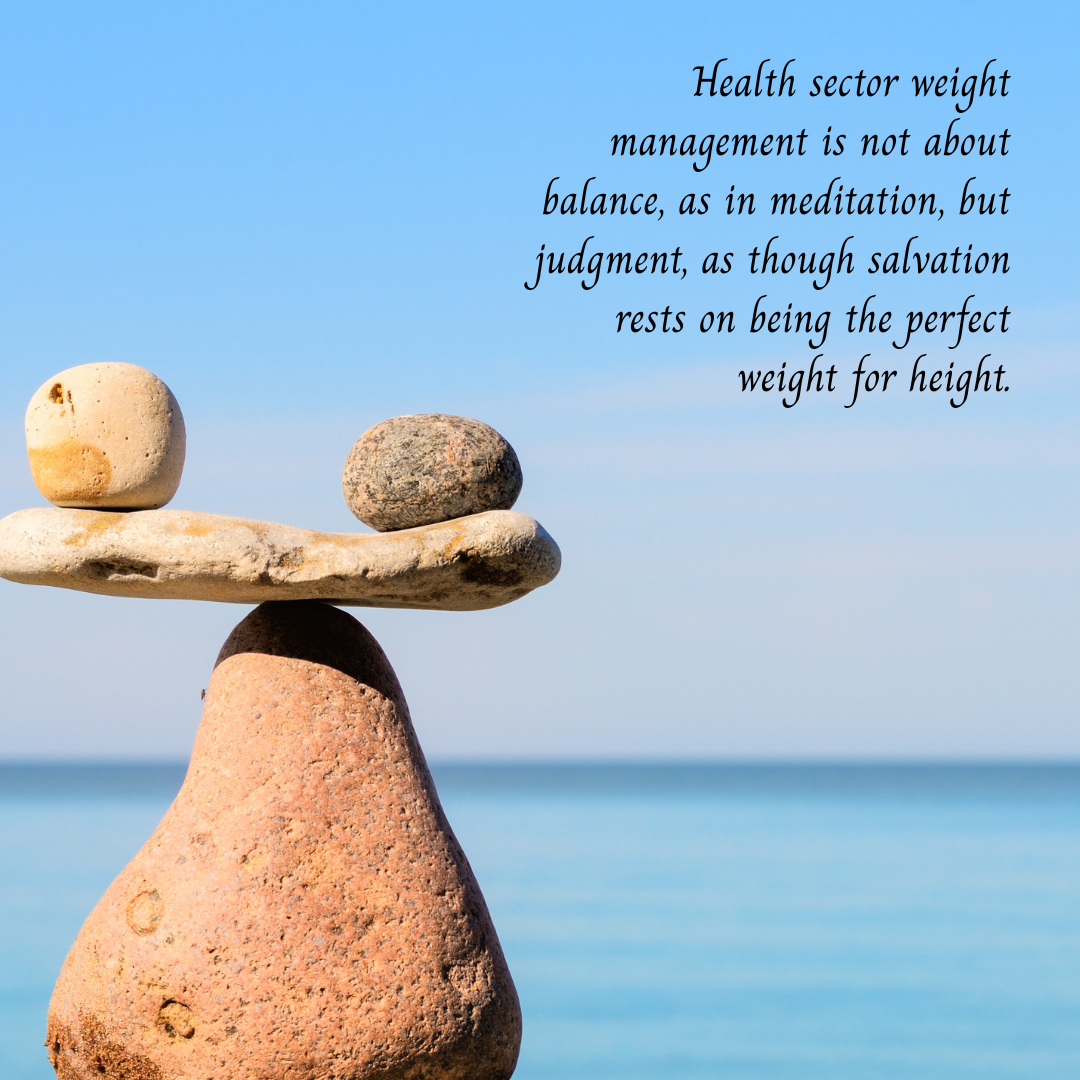
In addition to sneaking in their mandatory cognitive test for the elderly and the insane, no matter how cogent and intelligent you might be, one is always weighed on admittance to a ward at FMC.
It turned out that I had lost 6 kilos since my previous stay a few months earlier, without realising it. (I gave up on home scales 40 years ago.) Instead of congratulations, however, I was advised that I would be put on a special diet, because such rapid weight loss indicated that I was malnourished.
The nurse and I had been talking about white bread for breakfast until her remark about my weight loss had me roaring with incredulous laughter.
‘At least you’ll get scrambled eggs for breakfast,’ she said, laughing with me.
Can you imagine scrambled eggs on plain white sliced bread?
Happy Writing
Wattletales
If you'd like to be added to the Wattletales post mailing list, make a request in the comments below, your email address is always hidden from public view. Lindy
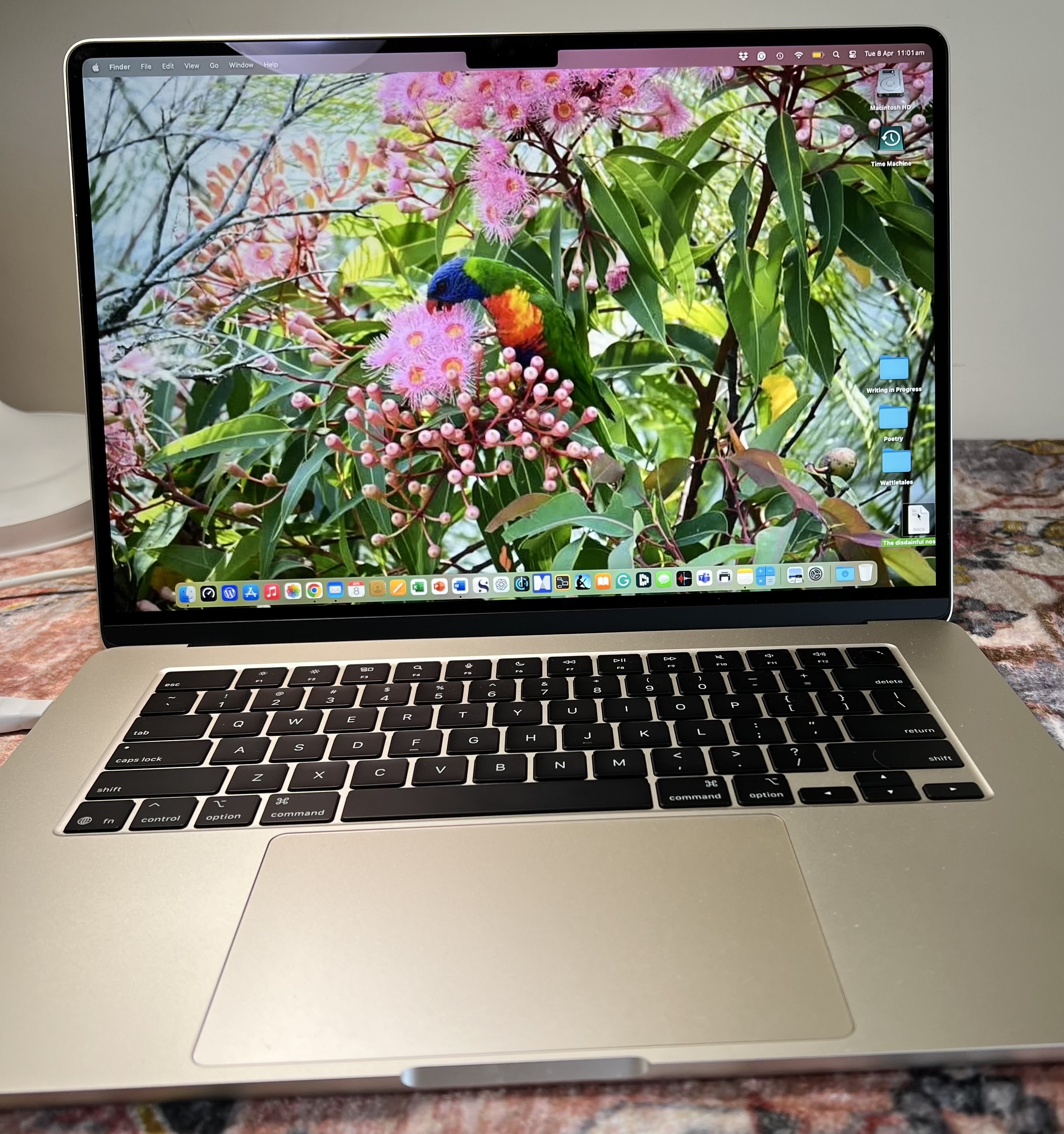
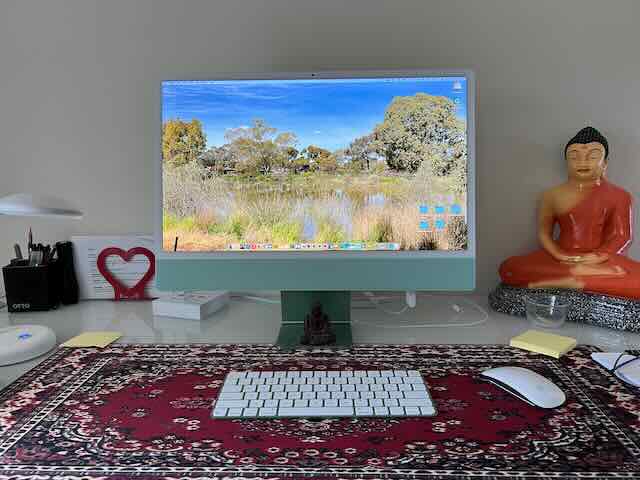
We oldies must first give thanks for being here. For those like me, with bodies burdened by the limitations doctors call multiple comorbidities, the best luck in the world is having a strong mind. By that, I mean I am still curious about the world; I get upset by wickedness and excited when good things happen. I follow politics with a keen eye and am lucky to have a good education, a computer and the will to write. I thank my new MacBook Air for inspiring me this month to showcase what I’ve been up to, both reading and writing-wise.
Many computers have centred my world and orchestrated my daily life for a long time. In fact, I spend more time on one in retirement than I did at work years ago, but I’ve been lusting for a new laptop as they served me well for many years as a roving anthropological consultant. Although I’d been saving for one, my son, who lives far away in Queensland, surprised me with his generous gift of a new MacBook Air. As I’d hoped, it makes the act of writing more intimate, more like handwriting. I like that.
This Time Last Year till Now
Although it seems like yesterday, this time last year, I was busy with the launch of my novel, They Who Nicked the Sun, a delightful occasion with Devonshire Tea. As the poem Braindead, written in March 2024, tells you, I was utterly lost for a while after that, with no book to work on.
Slowly, an idea seeped into my mind for a story about ageing. Initially, I came up with the title By Way of Dying, a story about a woman who could not rest in death until she understood life. It took time to formulate and find its shape, but now I think I have it!
Meanwhile, the title, By Way of Dying, morphed into Call Me Marigold. It is a novella, and yes, the narrator is posthumous; and yes, it is about me, despite the pseudonym, because, clearly, I am still alive, while Marigold is stuck in limbo and can only look back on life.
Call Me Marigold also morphed from memoir into autofiction, a genre that combines elements of true stories with fictional tools. We all draw on our lives when writing fiction, but memoir and autofiction should be distinguished from each other. To quote from the linked article —
The label of memoir comes with a promise: that the events described happened to you. Autofiction, on the other hand, promises an exploration of self. It is not just a fictionalized account of the author’s life, but a rendering of true experience in the midst of fictionalization, in which embellishments or deviations from reality may provide a commentary on the author’s journey. (my emphasis. American spelling in the article.)
What I am Reading
The universe is supporting Marigold. A dear friend gave me a book this week that I had borrowed from the library but had badly wanted to own: Nobel Prize-winning Orhan Pamuk’s wonderfully illustrated Memories of Distant Mountains. I’ve only read two of his earlier novels, My Name is Red and The Museum of Innocence, but I am a fan. In this 2025 coffee-table delight, he draws on a lifetime of personal notes and paintings to offer insight into his writing and himself. It is neither memoir nor novel, yet through his reflections, he shares his inner world.
Another genre-bending, multi-award-winning writer I admire is Australian author Michelle de Kretser, whose recent work, Theory & Practice, according to author Nicole Abadee in the Australian Book Review (Nov.2024), is not autofiction but a novel that introduces ‘a splinter’ of memoir. My de Kretser favourites are The Hamilton Case and Questions of Travel.
Last on my recent reading list, although I read it first, is The Chinese Postman by Brian Castro, a former Professor of Creative Writing at the University of Adelaide. I love this book because it also challenges taken-for-granted literary assumptions and reflects on ageing. I could not do justice to Castro’s story in a few words, so here is the publisher’s blurb (I have the eBook).
Abraham Quinn is in his mid-seventies, a migrant thrice divorced, a one-time postman and professor, a writer now living alone in the Adelaide Hills. In The Chinese Postman he reflects on his life with what he calls ‘the mannered and meditative, inaction of age. God, offering up memories and anxieties, obsessions, and opinions, his thoughts on solitude, writing, friendship, and time. He ranges widely with curiosity and feeling, digressing and changing direction as suits his experience, and his role as a collector of fragments and a surveyor of ruins. He becomes increasingly engaged in an epistolary correspondence with Iryna Zarebina, a woman seeking refuge from the war in Ukraine. As the correspondence opens him to others, the elaboration of his memories tempers his melancholy with a playful enjoyment in the richness of language, and a renewed appreciation of the small events in nature. This understanding of the experience of old age is something new and important in our literature. As Quinn comments, ‘In Australia, the old made way for the young. It guaranteed a juvenile legacy.’ (my emphasis)
I came across a sensitive and insightful article, “The Chinese Postman,” by Professor Tony Hughes-d’Aeth, Chair of Australian Literature at the University of Western Australia. In case you missed it in ‘The Conversation’ last year, Hughes-d’Aeth identifies a key ambiguity in the narrative, emanating from Castro’s transposition of his biographical data — ‘born in Hong Kong of mixed European and Chinese heritage’ — onto the protagonist, Abe Quinn. Is it Castro’s story, which Hughes-d’Aeth sees as a lament, or is it fictional to the core?
I am reading these books by authors who brilliantly cross genre boundaries to understand how top writers do it. Truth be told, I find the various ways they upend convention both fascinating and freeing. Their works gave me the confidence to experiment in my Call Me Marigold narrative, which takes a scrapbook approach to various aspects of my life, serving as an exploration of the self — a defining feature of autofiction.
A New Novel
During the lull that followed the publication of They Who Nicked the Sun, when I was floundering and trying to figure out how best to tell my story as autofiction, I began to yearn for a new novel to work on. My earlier novel ideas came to me long before I started writing them. I then met a fellow writer who works on several projects, alternating between them. I’ve usually stuck to one at a time, but as soon as I wished for a novel idea to come to me, an idea burst upon me in rough synoptic form, and I am now alternating between Marigold and a fictional story.
In the Welcome pages of Wattletales, I write about what fascinates me as a person and writer—
What does it mean to fall through the cracks, to become broke, mad, ill, destitute, deserted, disillusioned or denounced? What happens to our sense of self, and our identity when life wreaks havoc with our intentions, plans and happiness? How porous is our mind? Is there really a line between sanity and insanity, and how do we know when we tip over the edge?
So, it should not come as a surprise to say that I’m fascinated by gaslighting, which is what my new novel is about. The provisional title, On Banksia Street, tells the story of an everyday couple, Wendy and Peter Wilson, who live with their children in Warradale, where I raised my children (ordinary suburban life!). There is no real Banksia Street in Warradale, so the setting is fictional, as is the story. The Banksia reference is, of course, about our lovely native Banksia flowers and the scary Big Bad Banksia Men of Mae Gibb’s marvellous imagination that terrified me as a child.
New Poems
In between writing projects, including this blog, I have recently written a few new poems. Here is a small selection as part of this show-and-tell post for April 2025, my favourite month of the year for its promise of cooler weather.
Before you go, why not check out our wonderful Guest Posts, featuring some great stories and poems from local Adelaide poets? For a complete list, click here.
Happy Writing
Wattletales
If you'd like to be added to the Wattletales post mailing list, make a request in the comments below, your email address is always hidden from public view. Lindy
I have never been what you might call a shopper. I’m not a committed browser. I’ve always searched for particular things when I needed or wanted them, and I’m pretty much the same online, although I browse more. In my ageing lazy-bones, I do not fancy, nor could I cope with going from store to store seeking anything. The very thought of a trip to the vastness of Bunnings or Ikea fills me with dread.
From the cover of soft Toys for Grown-Ups, a poetry collection. See the eponymous poem later.
As for trying on clothes, well, I have long forgone that unpleasant, sweaty task in stores with tiny dressing rooms. I don’t wish to surrender my ageing body to the surrounding mirror gaze ever again. Still, as you might imagine, there are downsides to trying clothes on and assessing quality online.
My Shopping Story
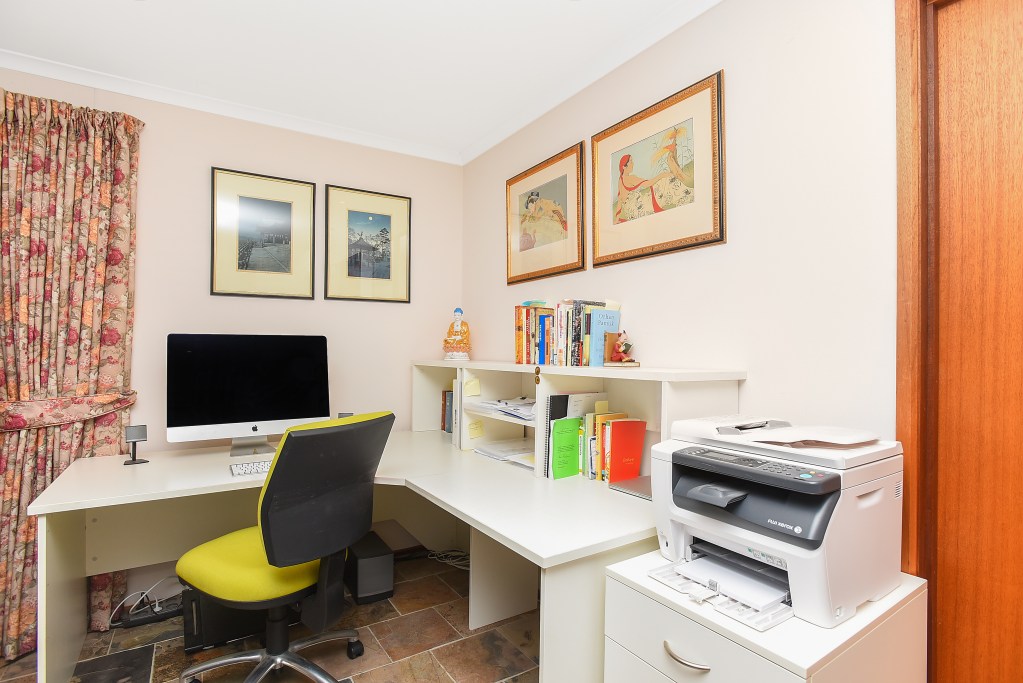
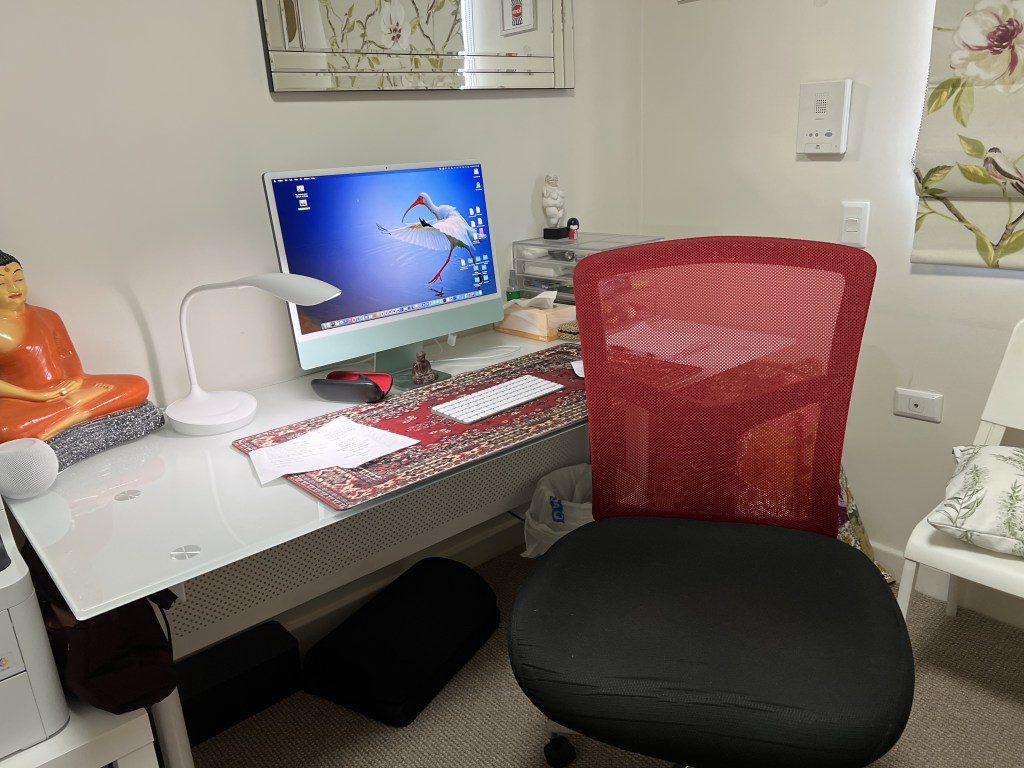
There are continuities in my shopping habits, one of which is to change furniture more frequently than most. There is a reason for this, which has more to do with my circumstances than the shopping medium, as the trifecta of office chairs below indicates. I bought the chartreuse office chair in the gallery below from a posh office furniture store at Mile End. It nearly got old, but I stopped loving it before it had a chance to do so. I ordered the other two online.
Chartreuse White Ruby and Black
The white chair from Temple & Webster was very smart, but it wasn’t comfortable. I am now sitting on the Office Works black and red chair on the right, but — dare I say it — it is also uncomfortable. All this may remind you of a little girl, beds and three bears. But there are differences.
First, my old body is hard to please nowadays. Second, buying such items online might be easy, yet it is a trap for innocent players. The nightmare is facing up to your errors. In choosing the bits and parts of this chair online, as I had to do, I failed to consider its size and weight properly. While attractive enough, it is big and too heavy to roll smoothly on my carpet! All we can do, as the adage has it, is live and learn. But there’s even more to it than that.
Choosing Furniture is a Serious Business
My penchant for changing furniture may have you thinking I’m a dilettante, but I’ve come to see that it reflects my current state of being. Let me unpack that, starting with a poem.
When I left Darwin, where I lived and entertained for many years, I had to relinquish a second-hand treasure: my beloved Jarrah dining table, which had so much history inscribed upon it.
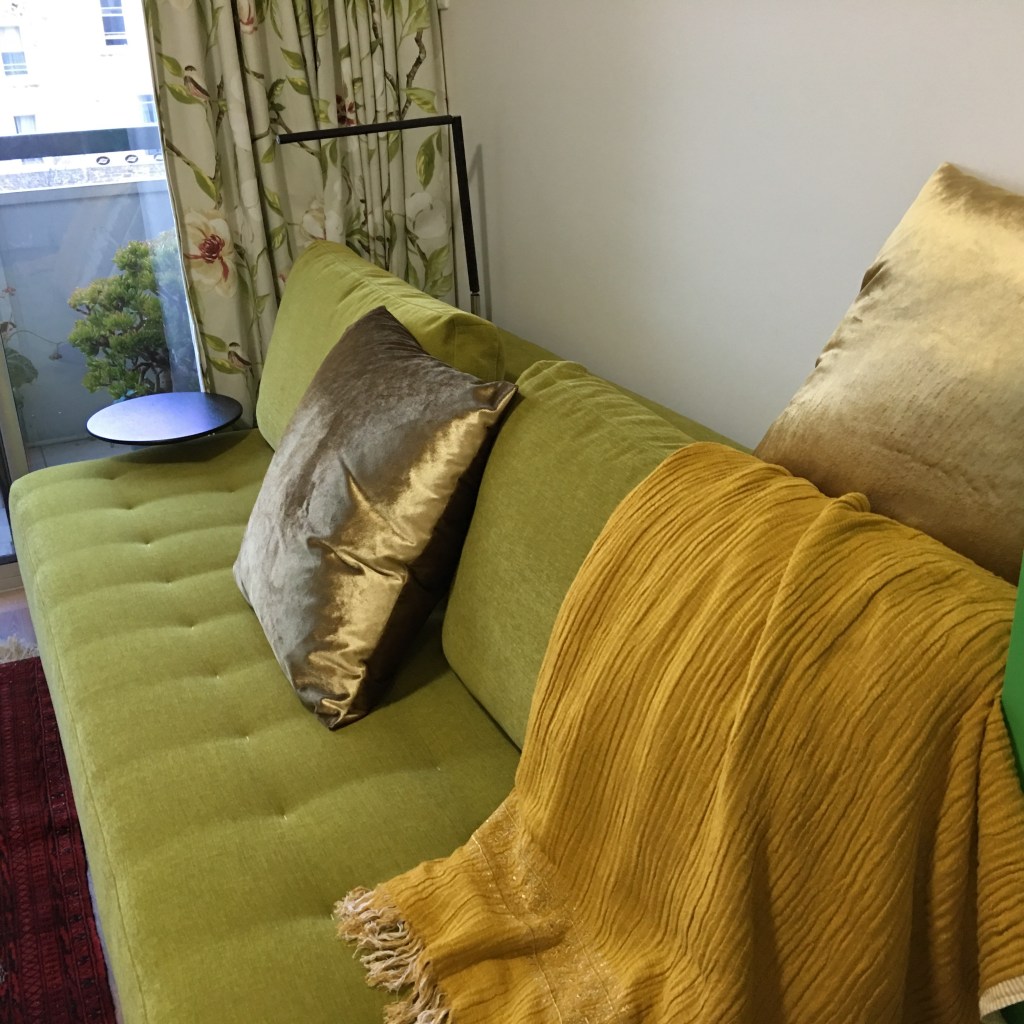
Rapid changes in lounge furniture years later, after I moved to Aldinga Beach, marked my initial ambivalence about settling back into South Australia while I still yearned for Darwin! At first, I had an apple-green three-piece lounge setting, which I soon replaced with two expensive American oversized camel-coloured armchairs. After a few months of discomfort, I sent them for auction, and the pair brought an embarrassing fraction of what I’d paid for them.
I replaced the California chairs with a lovely brown and tan leather and microfibre L-shaped lounge that settled in very well, and that was when I seriously got into writing — honoured by the chartreuse office chair.
And, Again
Furniture similarly symbolised my rocky start to retirement unit life in Glenelg. Clearly, the brown L-shaped lounge had to go, as it wouldn’t fit into any unit in Manson Towers. So, too, did my pre-bought fashion item, a King Living press-button but totally unsuitable sofa bed. After heaving those giant back cushions on and off morning and night (when they dangerously filled the floor space), I soon switched to a single bed—which I still have nine years later!
King Living Furniture press-button sofa-bed.
Pre-ordering, even in-store, is a risk best avoided. It is hard to imagine how small some of these units are until you are in them.
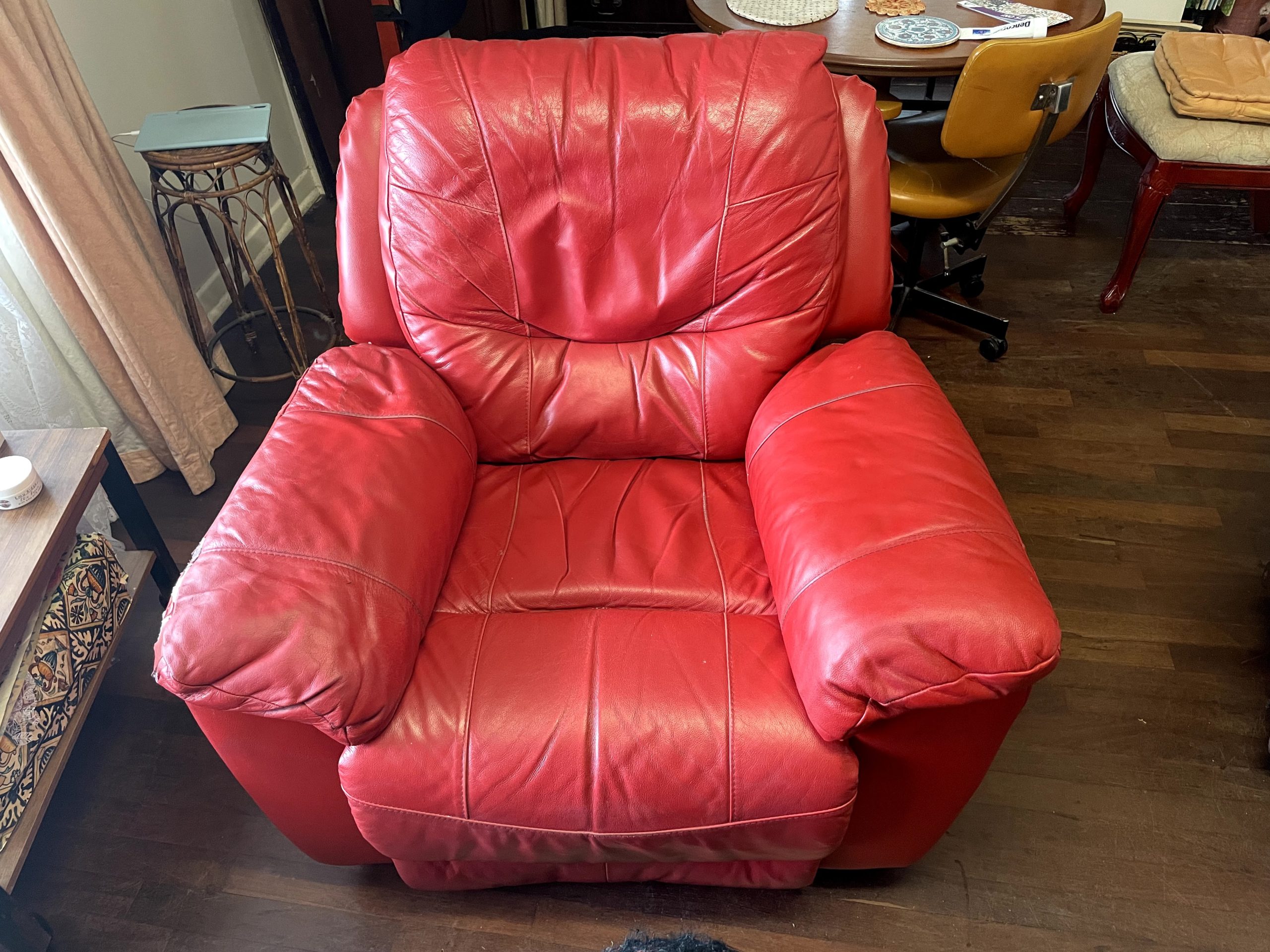
As Serious Nonsense describes, since losing the sofa bed, I’ve gone through three armchairs. Next month, a white leather electric recliner, more suitable for old ladies, will replace the Scandivanian Ruby Leather.
Shopping Satisfies
Shopping, in various forms, pertains to different stages of life, but it also gratifies inchoate yearnings.
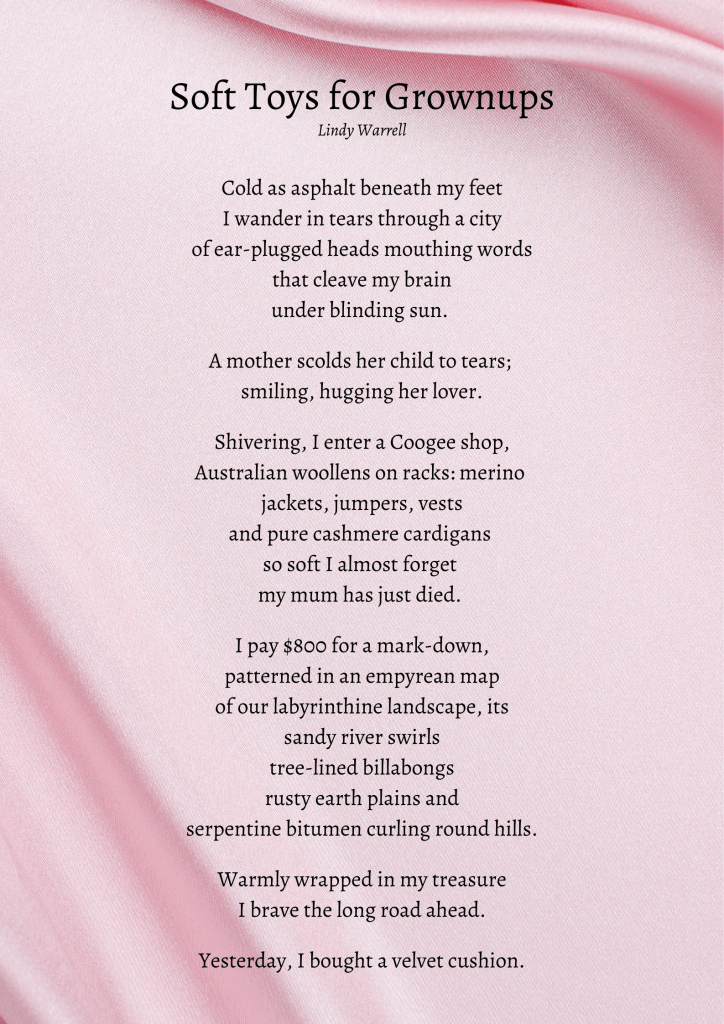
We all tend to buy for emotional reasons at times. Shortly after my mother died, I bought an expensive Coogee cashmere cardigan that I wore for many years. Without Mum, I was desolate and in need of comfort. I had no intention of buying anything when I stumbled into the Coogee shop on a side street off Adelaide’s Rundle Mall, but I treasured that cardi until it was threadbare, and I had to discard it.
I was so sad when Coogee went out of business. Today’s airport rip-offs simply do not match up in quality.
As December 1994 marked 30 years since Mum died, I hope you’ll forgive me for including here a little tribute to her adventurous spirit in old age.
Shopping Online is still Shopping
Whether in a showroom or online, shopping is easy. Credit cards work instantly when you pay for something. Online, however, refunds — if you can get one — take between five and ten working days. Hmm.
Most regular shops and stores have well-designed websites, and online business websites are equally tantalising. However, some are utterly disreputable, wherein lies the hidden nightmare of online shopping. A good website can lure money from your bank as fast as any shop might empty your purse, but the risks differ.
Online, we sometimes get it right, and, at others, we can lose as drastically as any gambler.
Getting it Right
I adore Persian rugs and have owned a few small ones with the Bokhara design. Browsing carpet websites on dull days lifts my heart and excites my passions. It takes me back to the carpet stores I visited in India, piled high with rugs of all qualities, shapes and sizes, including exquisite silk pieces of craftsmanship.
It is an immense privilege to enter those stores (better than any website by far), where staff and management treat you like someone significant, offering you a seat, a cool drink or a cuppa while peons roll out rug after rug for you to view. It’s not easy to extricate yourself without buying. I am sad that I didn’t buy a silk rug that I loved when I had the chance. Here, they cost many thousands of dollars more.
Yet a couple of years ago, I found a little treasure: a small Zardozi embroidered rug, a glittering delight that I found online one day when aimlessly browsing Persian and Indian rug sites. (Yes, I do browse online, where it is so much easier to fill tedious hours among tantalising possibilities.)The gilt frame I chose to set it off cost as much as the rug.
Zardozi Embroidered Feature Rug
You can’t see the gems shining in this photo, but they do. The poem below speaks of the Zardozi tradition.
Getting it Wrong
As simple as online shopping can be, it is easy to get it wrong. While I moon over rugs to fly away on or bags (my other favourite thing) to gather my personality in one convenient package — you know, phone, license, credit cards, poems to read and, lately, pills and potions rather than mirror and lipstick — there are pitfalls.
For example, take clothing. I once ordered what looked like a long, loose Jacob’s striped cardigan that looked gorgeous online, only to receive a shrunken piece of rubbish in tacky, unrecognisable fabric, its sleeves so small they could only fit a broomstick. Returns and refunds were impossible.
To avoid such a nightmare, choose your sites carefully. Check them out, and ask Google if there are risks or complaints about them. The same garment is still frequently advertised on Instagram by several different ‘companies’. All appear legitimate and offer lovely things, but pictures tell lies.
I now buy my clothes from Taking Shape. I order online, but I know my sizes and recognise the fabrics. Even if I get something wrong, returns are guaranteed, and you can even return by post.
Online Banking
I do all my banking online, and when a company is reputable, the bank is there to help you recover your money. However, you can’t trust official-looking renewal notices arriving via Australia Post.
Last year, I received a notice to renew my three-year business name registration for $198. I paid the company online, only to discover soon afterwards that the actual cost of business name registration through ASIC was $98. I fought with them but failed to get a refund. I only discovered my expensive error after a second company sent a similar renewal notice closer to the due date, causing me to check things properly.
Read the fine print; these things have twisted policy wording to entrap you.
Grocery Shopping
I even mess up my Coles orders at times. Only a couple of weeks ago, I accidentally bought a giant pack of Uncle Toby’s oats, enough for me for two years. I gave it away. Then, I purchased a four-litre liquid laundry detergent that I could not even lift to decant and had to ask my cleaner to do it for me. This week, I bought Arnott’s Shortbread Cream biscuits instead of Scotch Fingers! Yes, both are shortbread, so I’m not totally losing it, but these silly errors put a frightener on a girl in her 80s.
Deliveries
The worst nightmare for me with online shopping is the endless procession of deliveries. Living as I do in a ‘gated’ high-rise building, I need to stay in to let drivers into the building, which is a pain. Fortunately, Australia Post, Coles and other entities now give notice of a two-hour window for when things will arrive, but it’s tricky if you want to go out on that day or have plans for the time they allocate. I guess it is the price I pay to avoid shops.
I still go to Woollies, Coles, Baker’s Delight, and Caruso’s Greengrocer for top-ups or to the chemist for a visit, so my soul’s need to shop in person remains satisfied.
I’ve yet to find an online way to fill the car with petrol.
Happy Writing
Wattletales
If you'd like to be added to the Wattletales post mailing list, make a request in the comments below, where your email address is hidden. Lindy
We live in a world that encourages us to grow, follow our dreams, develop our creativity or achieve goals, pushing on to change, renew or better ourselves, but is there a time to stop? Moneymakers. powerbrokers and insane world leaders governed by iron egos don’t change as they wreak havoc upon us all. But as mere mortals, should we persist in seeking acclaim or find acceptance by turning inwards as we face the inevitability of death?
Does moving into a retirement home develop or limit our potential? What does it say about our society that the elderly gather, locked away, albeit in comfortable circumstances? We may be isolated from family, but we can reach out and do community work and creative stuff despite being subtly pointed towards the grave the moment we retire. TV ads don’t tell the full story.
We move into retirement living voluntarily in the expectation that smaller dwellings might save us from a nursing home. People in my building certainly live longer. One man will be 100 in February 2025. But who are we, really, when we leave our houses and pets behind? The overarching aura of independent retirement living often feels more like being institutionalised than independent, as I’ve written before.
What Does it Mean to be Old?
I first thought I was old at 30, fearing I’d lose my figure with my imminent third baby (born on Cyclone Tracy’s cusp of fury). When I turned 50, that same baby boy gave his mother a single red rose when I hosted a party for women friends; a powerful women’s party. After a tipple or three, some guests broke down at the thought that they had, indeed, achieved power and insight through tertiary education yet wondered who they’d become and mourned the innocence they’d left behind. Others bemoaned their failure to follow suit with excuses for not having achieved anything because of children and bad choices in men. It was an interesting evening.
Rejuvenated at 75, I published my first poetry chapbook with two novels and several other poetry collections to follow. Living the dream. I turned 80 on the Marina Boardwalk in Glenelg over lunch with my daughter, but this year, my 81st has seen me turn inwards. I find myself wondering whether that is a natural progression or a portend of decline.
I have come to believe we tend to settle into ourselves more as we age, but is that by adaptation, cultural isolation as we drop out of social things or something else altogether? When I see elderly friends who are younger than me but with healthy pockets and living partners tripping around the world or visiting interstate all the time, going places and doing things as though nothing has changed, I can’t help but wonder if the changes I see in myself are peculiar. But, changed I am.
Change Brings Grief
When I look back over the posts I’ve written over the years on Wattletales, I realise that I have often summarised those parts of my life that I’ve most valued, using them as a trigger to make a point about something that was niggling me at the time.
Recently, however, I’ve worried because, since the publication of my second novel, They Who Nicked the Sun and its recent launch at Manson Towers, where I live, I have not written a word until today. An article on grief gave me a clue as to what’s going on.
When I told my doctor recently that I often cried for no apparent reason first thing in the morning, she looked at me blankly. The topic got lost in the more important stuff that she thought a test or a different pill might assuage. It must be hard being a GP for the elderly in a discipline predicated on the heroics of scientific medicine more suited to acute conditions. You simply cannot fix ageing; most conditions thereof resist the force of nature.
But the grief article showed me that I am grieving for parts of myself now defunct, and living in the confined space of my independent unit seemed the most suitable thing to grizzle about. Instead of taking pride in myself for being content with my lot and commending myself as I usually do for not fearing death, I sought to blame.
Like those women at my powerful women’s party years ago who blamed husbands and children for their failure to achieve, I have been blaming retirement living for pretty well all the changes my mind and body have experienced of late. My tears dried up the moment I understood that fact and once again accepted who and what I am at this moment. Then, my words —these words — began to flow.
The Truth Is
I grieve the diminishment of my mental acuity, my way with words (when speaking), and the decline of my physical strength and energy. I have been independent for so many years and now have to go slow, take it easy and ask (or pay ) others to help. Yikes! We need to listen when they say ageing is not for cissies. Frailty and weakness are simply not valued in our world, and I’m not too shy to report that old age sucks at times. But, then, so can life.
Nevertheless, old age has rewards. I am content not to be on the constant ‘doing and going’ merry-go-round. Even if I had the money and energy, I know I’ve had my turn, and I’m still here. My mental meanderings always find answers, and there’s nobody around to tell me I’m wrong. In writing, I found my home, and that is true freedom.
Happy Writing
Wattletales
If you'd like to be added to the Wattletales post list, make a request in the comments below, where your email is hidden. Lindy
I ask the title’s question because I have long known that my words reveal me, they are keys to knowing who I am. Some people hide behind their words. I guess it comes down to whether you write from the heart or the intellect. Either way, as a reader, I tend to believe I have a poet’s measure from their words. This is, of course, an introductory palaver because I haven’t really got a proper topic today. Rather, I’m posting a few of my recent poems because, being a creature of habit, I find it hard to skip a month when I’ve been writing regular monthly posts for around five years, and this month, I have nothing to say.
Poems Past
Some of the poems here will be familiar to those who follow me on Instagram. Some are new, and the first one, ‘Brain Dead’, sums up my current situation quite nicely. I have just finished my second novel, They Who Nicked the Sun, which (see below) will become available soon, and until its launch in May, I feel in limbo.
‘The Shape of a Tree’ was written just before I finished my novel. Trees feature in my book, but the way the poem developed, I can now see, describes me writhing away, hiding from criticism, not that I knew it at the time of writing.
The next poem comes from meandering around the streets of Glenelg and the transformation of a lovely old colonial house that I dreamed of living in for many years. As I read it now, I think it is also a metaphor for ageing or being supplanted.
The next two poems are about trees. Funny that they formed in my mind as I wrote my tree-full novel.
I hope the following two poems are not too bleak. Death and dying have become central to my thinking as I age, and reflecting upon them fills me with love for this wonderful planet we share. My life has been enriched by many different landscapes, from the desert to the tropics.
It is a truism to say that life is fleeting, but I remember something the Dalai Lama once said when a journalist asked him if he got lonely travelling all the time as he then did. The monk replied, how could he be lonely, for every chair he sat on connected him to the carpenter who made it, every mouthful of food put him in the company of a farmer. I wish I could recall his actual words, but his point is that the world around us is alive with the history, activities and even personalities of people who are integral to our surroundings and his argument was therefore a question. How can we be lonely if we pay full attention?
Although this last poem was not consciously written with the Dalai Lama’s philosophy in mind, it echoes it.
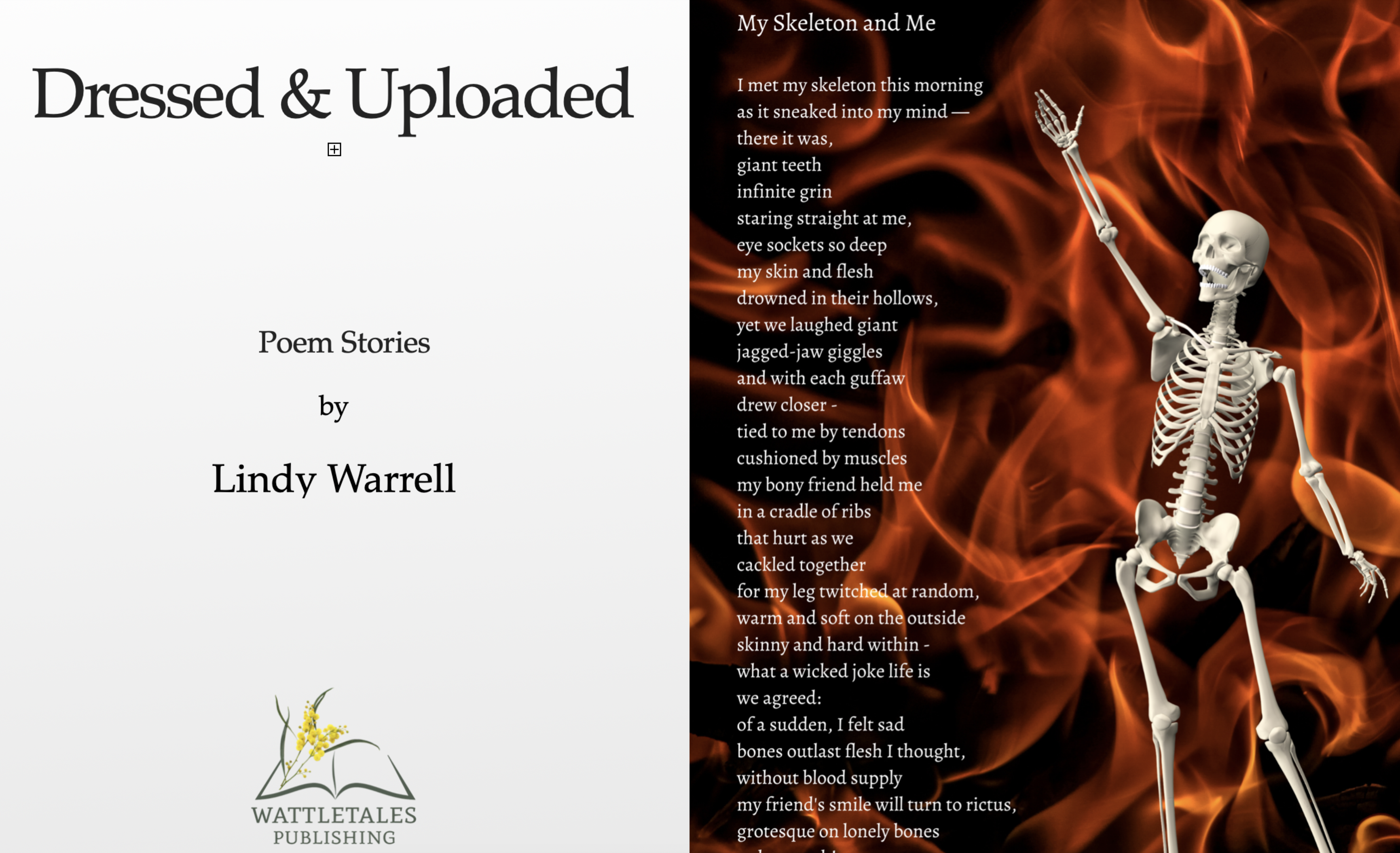
So, did these poems tell you something about me or offer something to you? Please click below to download a free ebook collection entitled Dressed & Uploaded, where I offer the stories that underpin many of the illustrated poems on Wattletales and Instagram.
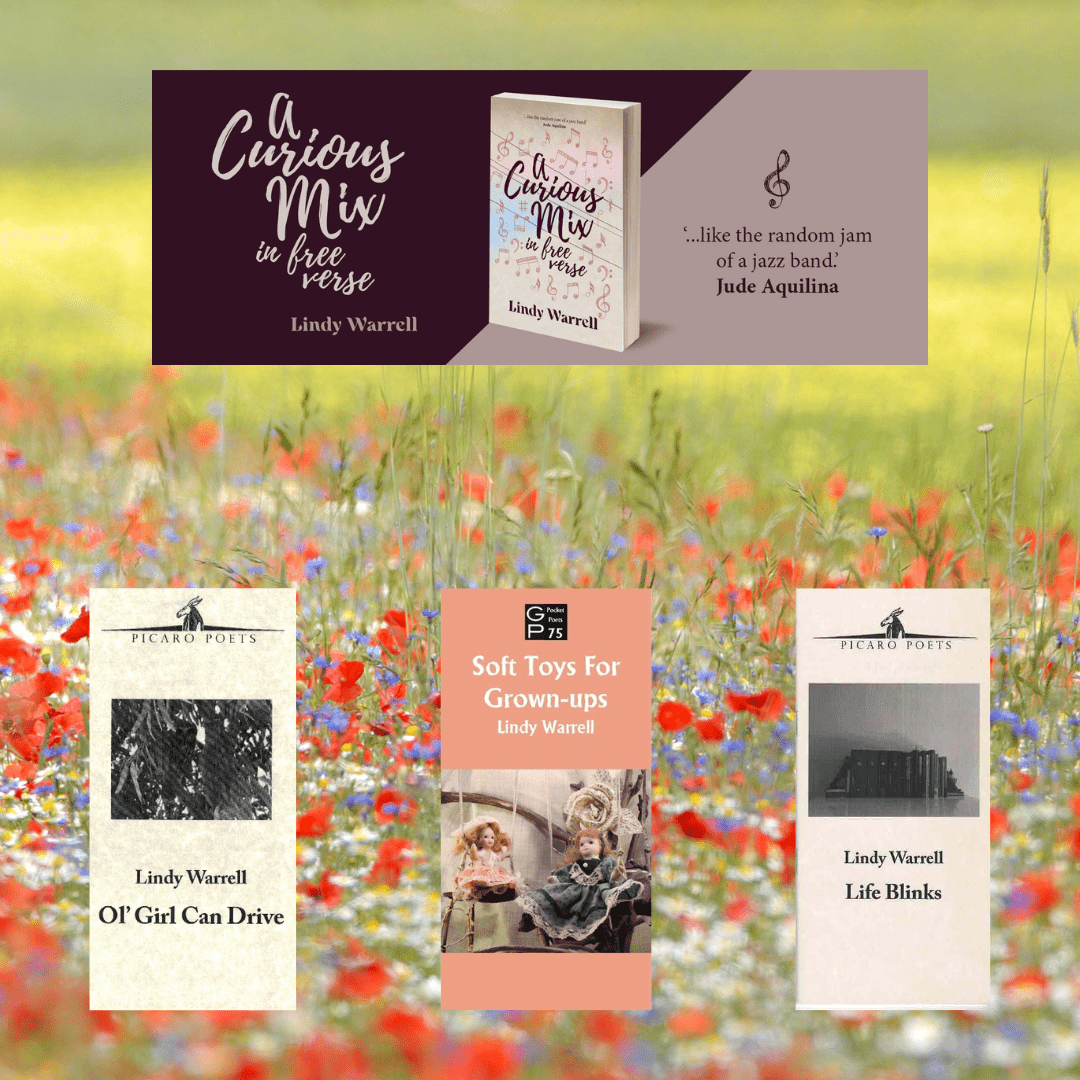
If you wish to purchase any of my other poetry books featured in the opening image, leave a message in the comments section below, and I’ll get in touch.
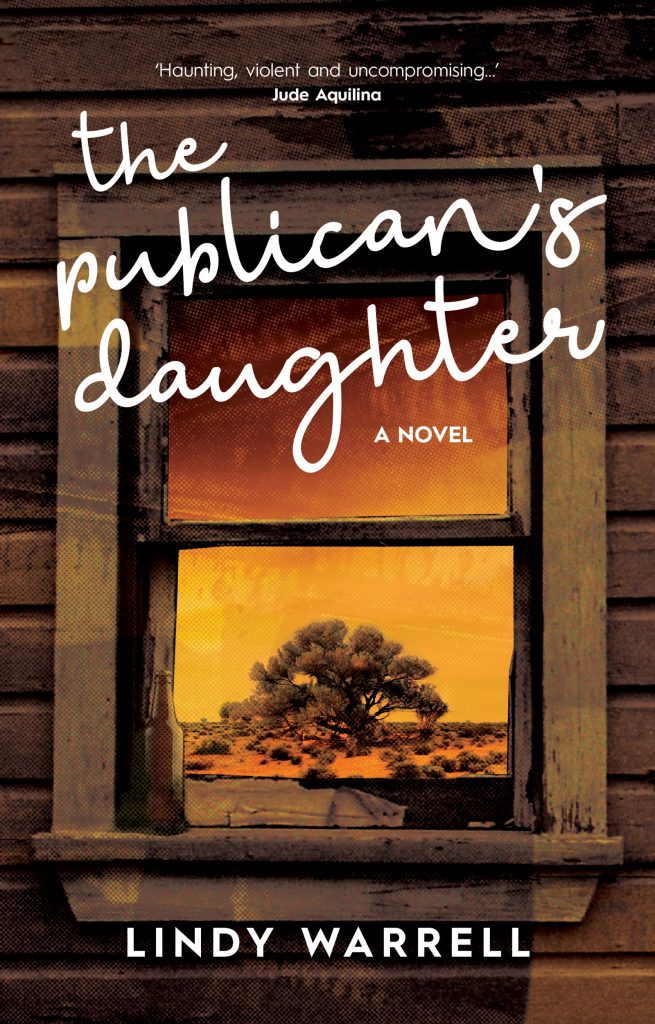
My novel, The Publican’s Daughter is available from Amazon and other print-on-demand outlets and Kindle. They Who Nicked the Sun will similarly be available as of 21 April. However, you can also purchase either or both books directly from me by leaving a message in the comments below or emailing me at lindy@wattletales.com.au.
Novel
Happy Writing
Wattletales
If you’d like to receive Wattletales posts regularly, drop a word in the comments below, and I’ll add you to the list.
The question for today is, what is it like to be an anthropologist in the field? So, I decided to explore my experience as a consultant working with Australia’s First Nations People. I write personally yet in general terms because I can’t divulge details not in the public domain. The reasons for this are manifold, but it is primarily because I am not authorised to speak for Aboriginal people or tell stories that are not mine to share.
Tranquility
To elaborate, when undertaking site mapping and gathering social history for environmental impact studies and related projects, sacred and historical sites must be documented if they are to be protected. Whatever a report’s findings, the document masks the differential power between traditional knowledge, copyright, and intellectual property rights. The first must be respected, but the latter wins at law.
For example, if I record oral histories or stories about places, the copyright in the report is mine by virtue of writing it. The physical report, however, belongs to the commissioning body, while the information recorded is First Nations people’s cultural and sacred knowledge — oral traditional knowledge. Tension is inherent.
Definitions
I use the term Country in my title advisedly because it is often susceptible to misinterpretation as meaning ‘all of Australia’ by those wishing to excite fear and cause harm, as happens in the media around the forthcoming Referendum on the First Nations Voice to parliament. Wherever I worked, Aboriginal people spoke of Country as the place on the land(scape) they and their Mob belonged to. To them, the word defines the areas they are required by tradition to look after.
I could have included ‘nation’, an entity we often conflate in everyday speech with Australia as a country. However, while patriotism is fine, I didn’t want to introduce the concept of nationalism and its associated politics. It is enough to say that all citizens of this nation are Australians. Belonging to Country in the Indigenous way is something else altogether.
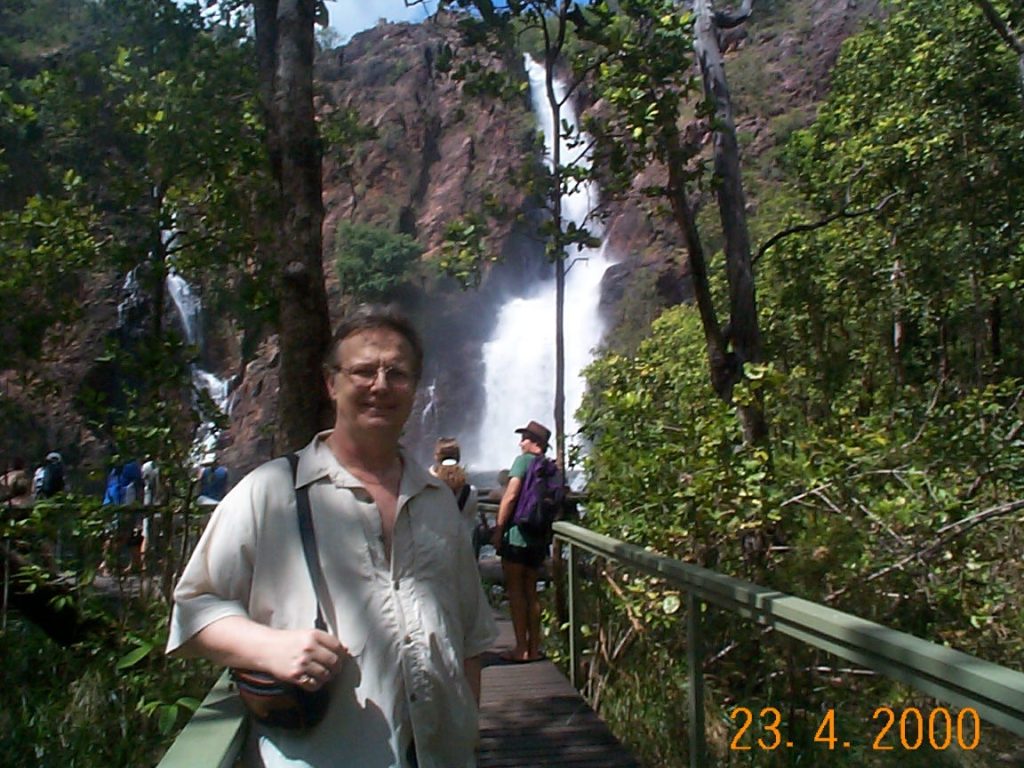
Wangi Falls, Litchfield NP NT
Nuts and Bolts
Being a consultant anthropologist requires business acumen to tender for projects against a brief, specifying costs, timelines and deadlines. You must carry professional indemnity insurance. While some lucky folk had their own Toyota or Mitsubishi four-wheel drive, as they were once called, I hired mine from Hertz. Vehicles then didn’t have the marvellous GPS coverage of today’s systems. I had to reset my clunky portable device every time I crossed state borders or moved outside the range of a previous pivotal setting. The old devices could put accurate site mapping at risk unless set correctly.
Consultancy projects frequently take you into remote areas. Basic bush tackle includes a gas bottle, a portable stove, a billy, matches, enamel plates and mugs, cutlery, a torch, batteries, a decent first aid kit, toilet paper and food. Plus, your bag, laptop and swag.
Outside Silverton, NSW
Project participants often took me to places only they knew where they’d hidden blackened barbecue hot plates. A feed of steak, onions, and snags with tomato or Worcestershire sauce cooked on old iron is the best, as is tea made in a tannin-stained billy boiled over a smoking fire to chatter and laughter.
I am grateful to the women Elders in the Northern Territory who encouraged me early on to wear loose-fitting dresses like them to let even the lightest breeze keep me cool in summer’s heat. I wore an Akubra and strong hiking sandals but avoided my profession’s jungle green fashion in favour of comfort. Like the women, I carried a strong stick, beating the ground to warn curious snakes of our impending presence.
On the Road
I love driving, but long hauls driving alone from Adelaide to the Queensland Gulf country via the Murray-Darling River basin or up and down The Track, as the Stuart Highway in the NT is fondly known, are exceptional. Experiencing the silence, the changing scenery, the solitude and an occasional off-road frisson of fear is awesome. I used to be proud as punch when my four-wheel drive got covered in red dust or mud; it spoke to me of adventure.
The Track
In my mid-sixties, I decided it was no longer wise to take other people, often older women and little kids, out bush alone. I have to say I was blessed never to blow a tire. However, I did get bogged in sand and mud a few times on longer trips, but stronger people (men and youths) got us out of trouble, thank goodness. One of my favourite poems came from a trip over the NT’s Daly River Crossing with a group of women, which resulted in one of my favourite poems, Ol’ Girl Can Drive.
The Wider Context
When First Nations People tell family and Dreaming stories to consultants hired for site clearance work, they are asked to prove who they are in kinship and biographical terms and demonstrate that they have the traditional right to speak for an area. Just imagine that for a moment. It is so invasive. Their traditional authority is questioned in favour of legal definitions.
Little wonder it causes deep concern to think that the information people provide might be misused or made public against their wishes; for example, in a court of law, should what they say be contested by another stakeholder’s legal representative. Such matters (think Native Title claims) can drag on for years. Can you imagine the stress?
Community Intrusion
Researchers often turn up in communities, expecting people to drop everything. Many remote communities are regularly bombarded by light planes and SUVs full of people wanting something from them: government officials, police, social and medical researchers, media and others. Visitors on a strict schedule often get frustrated (and show it) when the people they want to see are unavailable. In my day, few considered the inconvenience their visit might cause.
When you work with women, as I often did in places with no resident doctor, they care for others and often need to attend long-awaited medical and specialist appointments regardless of your schedule. A community may be in the middle of its ceremonial season, preparing a funeral or be in crisis. My point is that few of us experience the intrusions that Aboriginal people endure all the time. The context we enter when working in the field is life.
Droving, Qld
Going Fishing
In my day, sharing knowledge of stories and sites rewarded most First Nations participants little more than a free ride or two to an outstation and a modest day payment for their time. Longer trips were not too different in that regard. This may have changed, but as strangers, we should not be surprised to learn that we had to earn trust to achieve anything.
In anthropology, making sure we talk to the right people is vital, but at first, someone will point you in one direction, and another will send you to someone else, and this may continue until you think you’ll get nowhere.
I later learned that ‘going fishing’ is the metaphor for hanging around, being patient, and having a cuppa and casual conversation with whoever is willing so that people have time to observe and assess you before they decide whether to work with you. This happens even when you write well ahead, seeking permission and attaching a project outline with dates and times. Although you write to what you think is the right entity — an Aboriginal Association or Community Manager or call a recommended person — you still have to go fishing. It’s a different process.
Before long, someone with the authority to speak on behalf of the community takes you under their wing, and you know it’ll all be OK, just like that.
Dust Storm
First Nation’s people understand well what most projects need, and they take the lead to show you what has to be recorded. Apart from your analysis, what you write is, in that sense, determined by them. After all, it is their knowledge you are recording. Once your report is written, you present it as a draft at a meeting of the entire community for discussion and approval before submission.
The involvement of lawyers at such meetings introduces another layer of complexity. All I can say here is — if the notion of ‘going fishing’ disrupts the gaze of professional anthropology’s participatory observation method — who is looking at who — the law has different eyes again.
Accommodation
The best accommodation in the world is a swag around a campfire. Falling asleep beneath a sky of lambent stars awakens awe. Further delight comes when someone in an adjacent swag tells you tales about Venus, the Morning and Evening Star, and the Milky Way. As you drift off to sleep, other stories might be told about snakes slithering into vehicles and swags to pretend-frighten you. First Nations people have a wicked sense of humour.
A Bush Dream of Mine
Some jobs entail repeat day trips from town. That’s the time for motel accommodation, which varies in quality nationwide. As they get to know you, a few people might visit to talk things over, explain further or just sit down for a while; at other times, you are entirely alone with your computer and poor TV reception.
Staying in a community is different again. Most have visitor accommodation with basic facilities, and when it’s time to eat, you quickly learn how poorly stocked the community store is for people for whom fresh food is a luxury.
A Sample of Projects
While I mention only consultancy projects here, I was lucky enough to also work with First Nations people at different times in different capacities out of Katherine towards the Kimberley region, on the Tiwi Islands and in the Queensland Gulf country.
Site Clearance
A government or developer typically commissions site clearances for environmental protection work. My first site clearance consultancy with First Nations people was in Port Augusta. I learned women’s stories about the Pleiades, known as The Seven Sisters Dreaming and the significance of ceremonial dancing. My report was one of the first to document this.
I also worked for a long time down The Track when I lived in Darwin, travelling to places like Rum Jungle (I love that name), Yellow Waters in Kakadoo, Litchfield Park and the Daly River crossing mentioned earlier.
Family Histories
When recording family histories, I was fascinated to see how people deferred to each other to recount different aspects of their biography, history and traditions. Complex kinship rights and obligations are enacted in this way.
One project funded by a National Estate Grant gave me great joy. My brief was to document women’s knowledge in the far north of South Australia. Anthropology had, till then, largely ignored women’s knowledge. Although the women were well-known and often related to each other, at their request, I documented their stories in seven separately bound reports under the encompassing title, This is Women’s Business: An Anthropological Report on Aboriginal Women’s Cultural Knowledge in the North of South Australia. They imposed the condition that their stories could not be read by anyone without formal consent.
A senior woman who became my friend wanted me to share her tragic family history of inter-racial love, war and loss with my mother, who grew up in inner-city poverty and experienced WWII. Mum was fading from life at the time. Such a profound gift.
Despite the initial awkwardness of getting to know people, I made many friends as a consultant and, over the years, had some of the most memorable experiences of my life in the field, professional challenges notwithstanding. Although my task was to take notes and ask questions of others, in the end, I learned more about myself from First Nations people than I could have imagined.
Pastoral Lease Forensics
I spent periods in and around Mount Isa recording sites, stories and family histories for an Aboriginal organisation wanting to assert formal ownership of a pastoral property. I thoroughly enjoyed that project and was thrilled when I finally got the news that their claim was successful. The stony landscape in that part of the world is unique, different from the gibber plains of far north South Australia, but equally stunning in changing colours.
Cloncurry to Mount Isa, Qld
A Test Case
The NSW government commissioned me to undertake research along the route of a Bronzewing Pigeon story between the Flinders Ranges and Broken Hill. I was not to socialise at all with the participants or other parties after our field excursions. I was there to record stories and take photographs — no fishing required. The government had pre-selected the participants in consultation.
After the fieldwork, my brief mandated that I eat alone and isolate day and night for ten days to write up my findings. It was a tough gig. The government was keen to have a pristine piece of work as a test case to underpin proposed new sacred site legislation in NSW along the lines extant in South Australia. It was later enacted.
Flinders Ranges SA
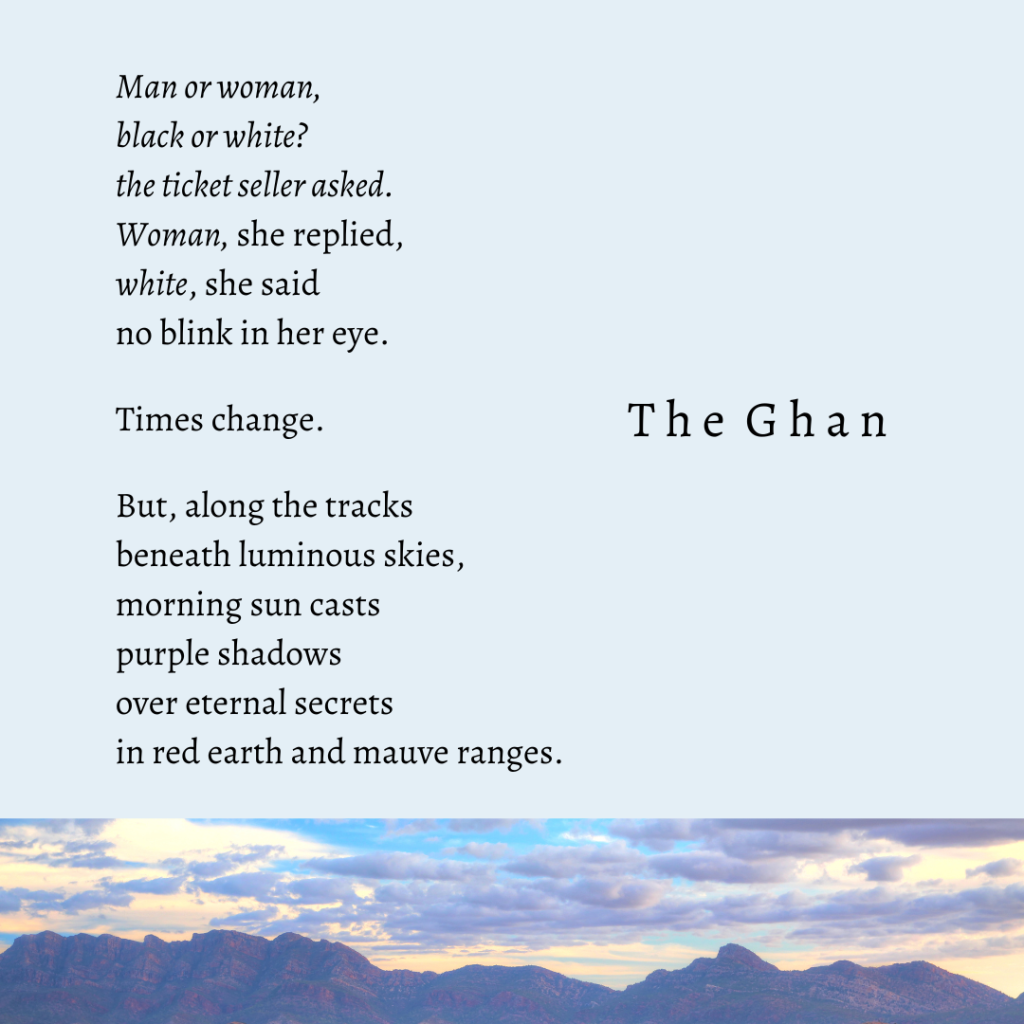
I documented the South Australian stretch of the storyline as we travelled by bus from Port Augusta to Broken Hill, stopping along the way. The NSW participants then shared their knowledge of the same story on sites out of Broken Hill. While working in Queensland a couple of years later, I learned that Bronzewing Pigeon also travelled up to Mount Isa and beyond. The next poem is my take on that story. The detail I use is on the public record; the poem is eclectic.
Research reports of any nature are peer-reviewed. Despite a moment of controversy when women in anthropology caught media flak in the wake of the Hindmarsh Island affair, my report achieved its aim. I was delighted to learn it was later lodged in the Aboriginal Institute of Aboriginal and Torres Strait Islander Studies (AIATSIS) Library by the authority of those with whom I worked for being a comprehensive record of the Bronzewing Pigeon story. It is available to view (not borrow) on request from any library.
Memories Linger
Often, we don’t understand an experience until it is in the past. We don’t analyse how we feel while dancing in a nightclub late at night. Only when we reflect in the morning can we see ourselves clearly. At times in my years as a consultant, I felt defeated, mainly by the politics of the scene, but when I look back, I see how fortunate I am to have had the experiences First Nations people gave me. It remains a miracle that they greet researchers so well.
It is thrilling to be taken to places you’d never otherwise see, drive across a landscape that breaks your heart with its diversity and rugged beauty and be entrusted with private family and sacred stories. That is to say, to learn some of the deeper meanings in the landscape. I cherish that experience and am grateful for the warmth, charm and care I received, often in difficult circumstances all around.
My mother died when I was a total stranger in far west Queensland, yet people there treated me with great compassion. There, and in other places, people often took me to the back of beyond, far outside the scope of my brief, to show me secret places especially significant to them, a privilege I shall never forget.
Stuart National Park, New South Wales
Homage to a Life’s Work
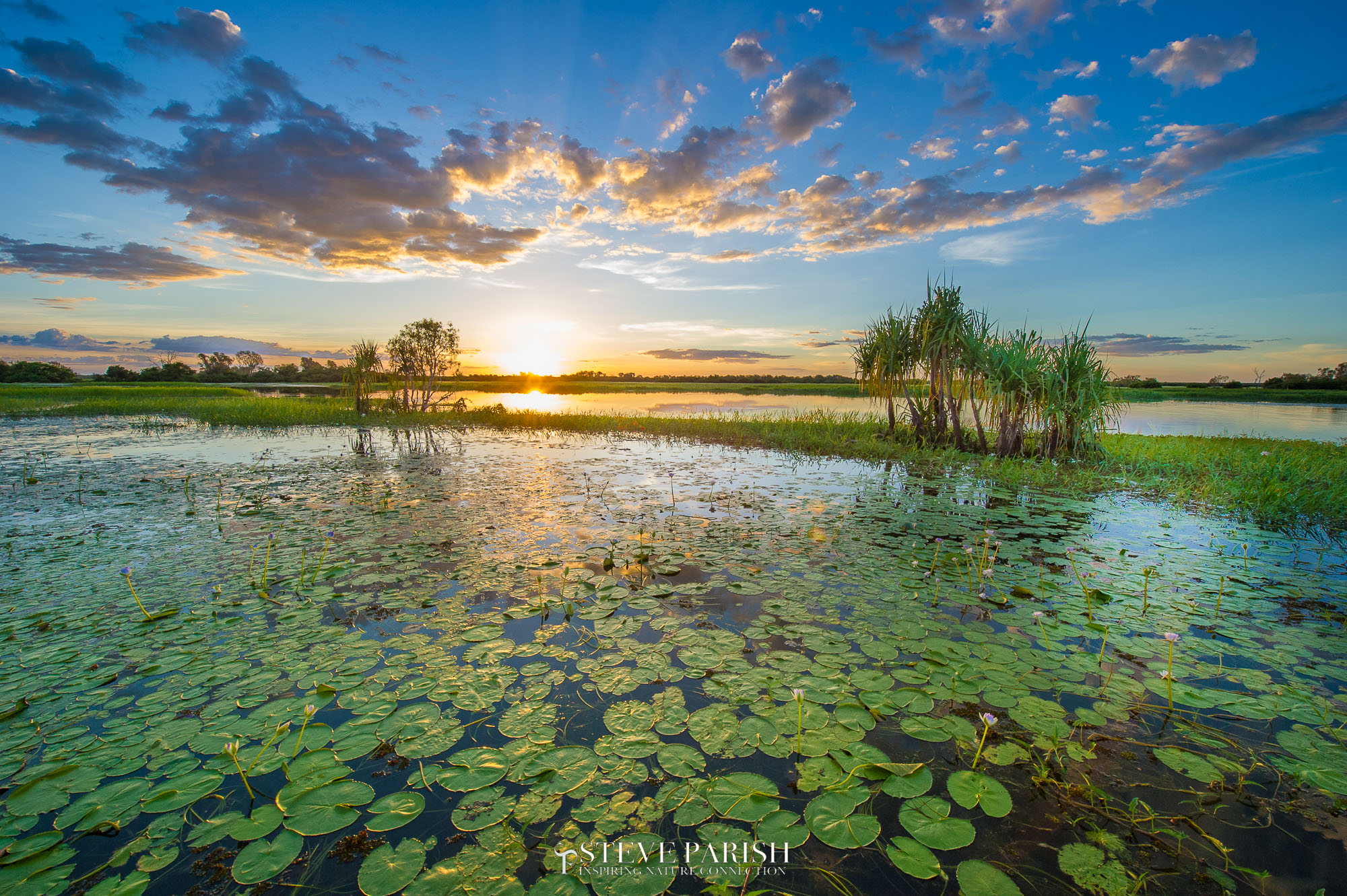
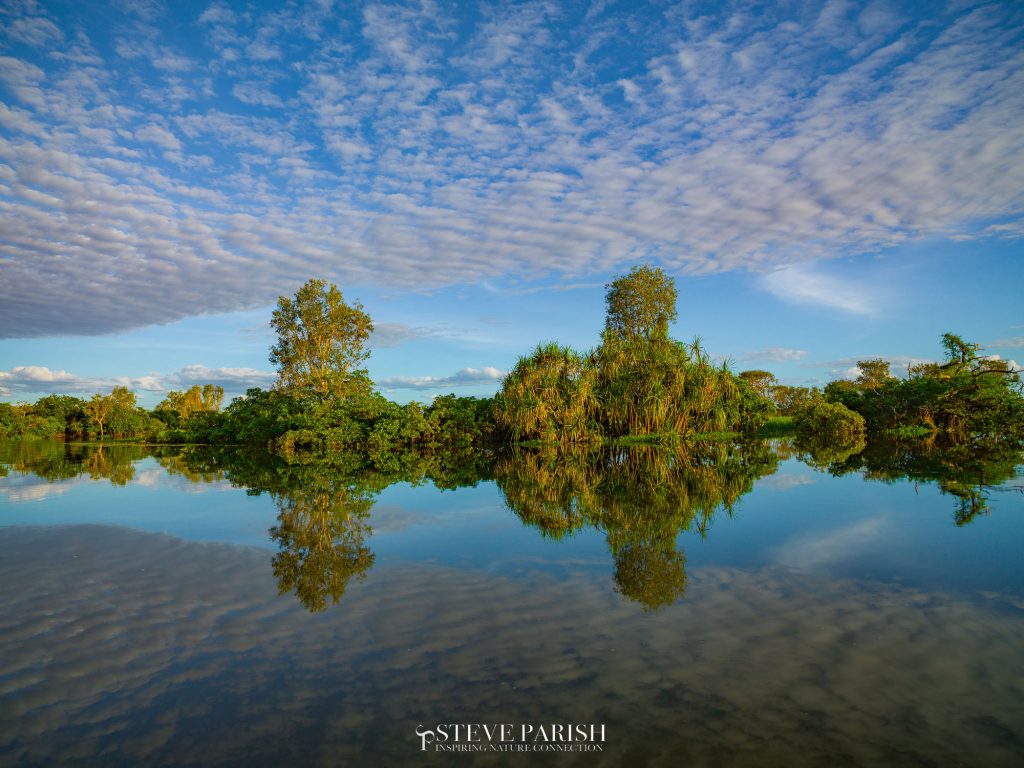
I first came across Steve Parish’s work at the University of Adelaide in the 1980s, a photographic record of the outback I fell in love with as a child who lived in books. I often gave his beautiful publications as gifts.
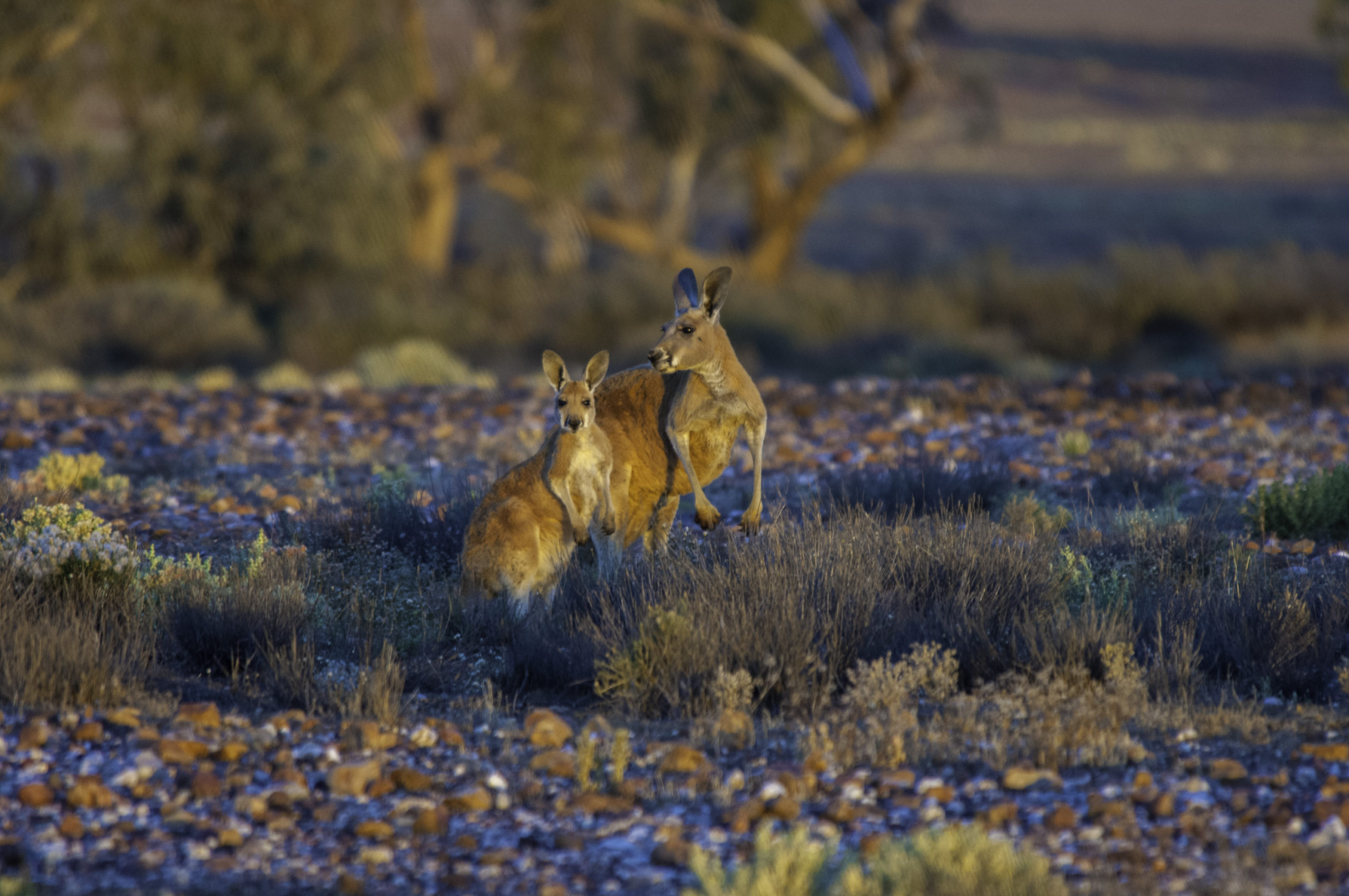
Last year, Steve invited me via Facebook to contribute a piece of writing to his webpage. I was both honoured and thrilled. He then generously offered his photos for use on my website, a perfect fit for this post in particular. Steve has spent his life capturing the beauty and diversity of the land and the creatures we all love and want to save from destruction by overdevelopment, mining and climate change.
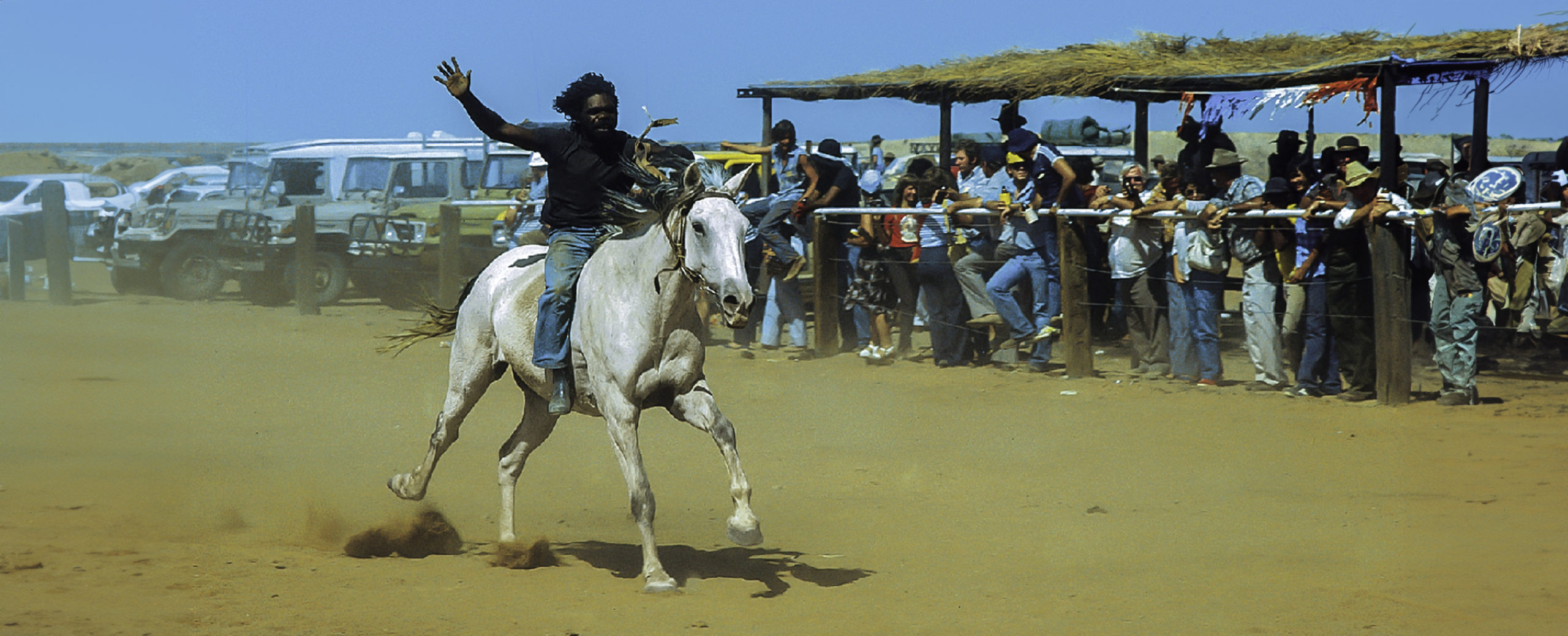
Steve describes the photo below as one of his most treasured images. It is of a young bloke from Oodnadatta coming in last, riding like a winner at the William Creek races. Read Steve’s account here.
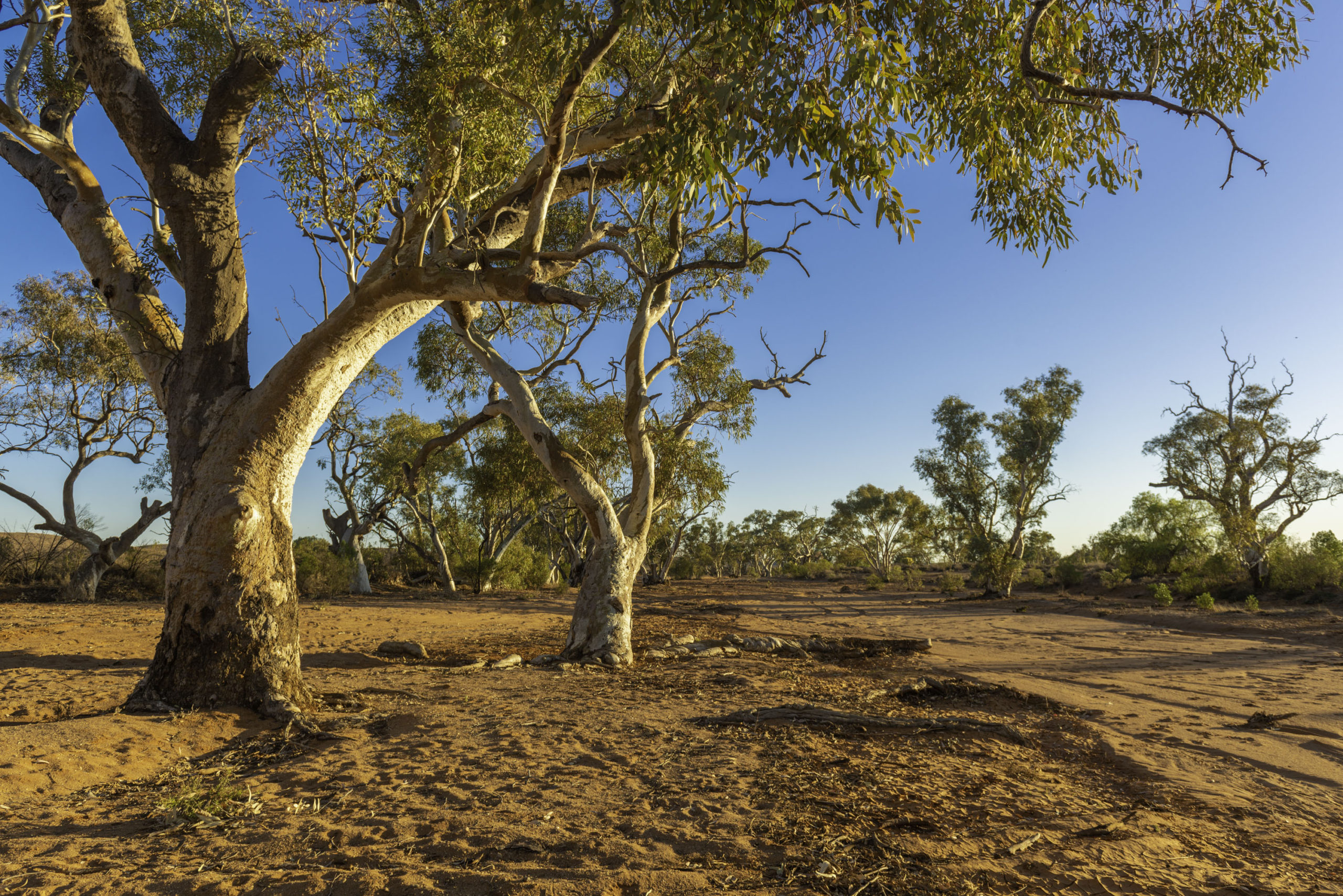
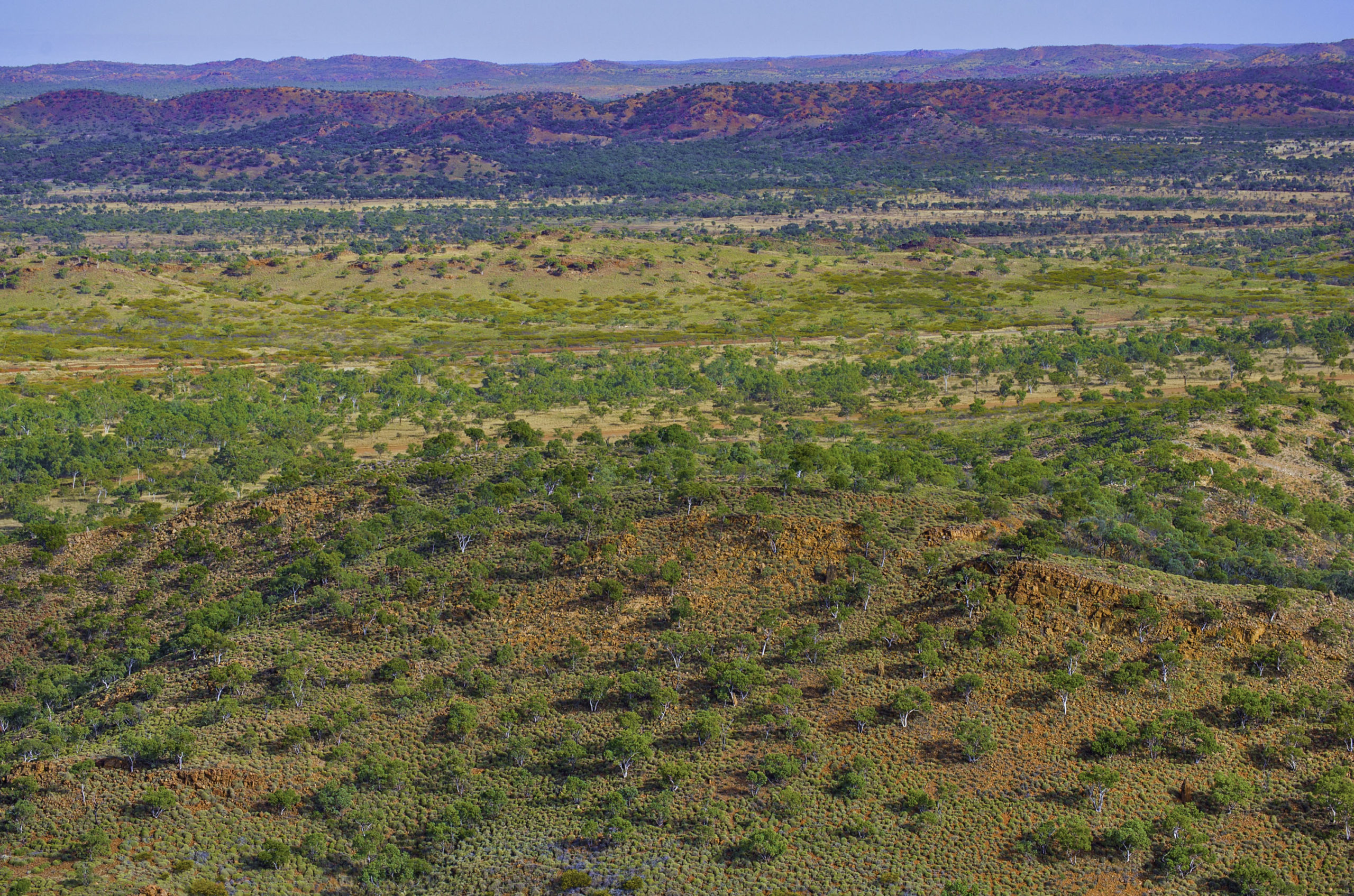
Thank you, Steve. Your photos bring this land alive. Here, they hint at the areas where I worked and demonstrate what it must be like for First Nations people to belong to and care for Country.
ACKNOWLEDGEMENT
All Photographs by Steve Parish.
‘A Distinctly Aussie Morph’ first appeared in 2013 in Jill Sampson’s Brindlebox Nature Reserve Project: Brindlebox Birds 153 (also read on Radio Adelaide with Julia Wakefield) and in Life Blinks, Ginninderra Press, 2019.
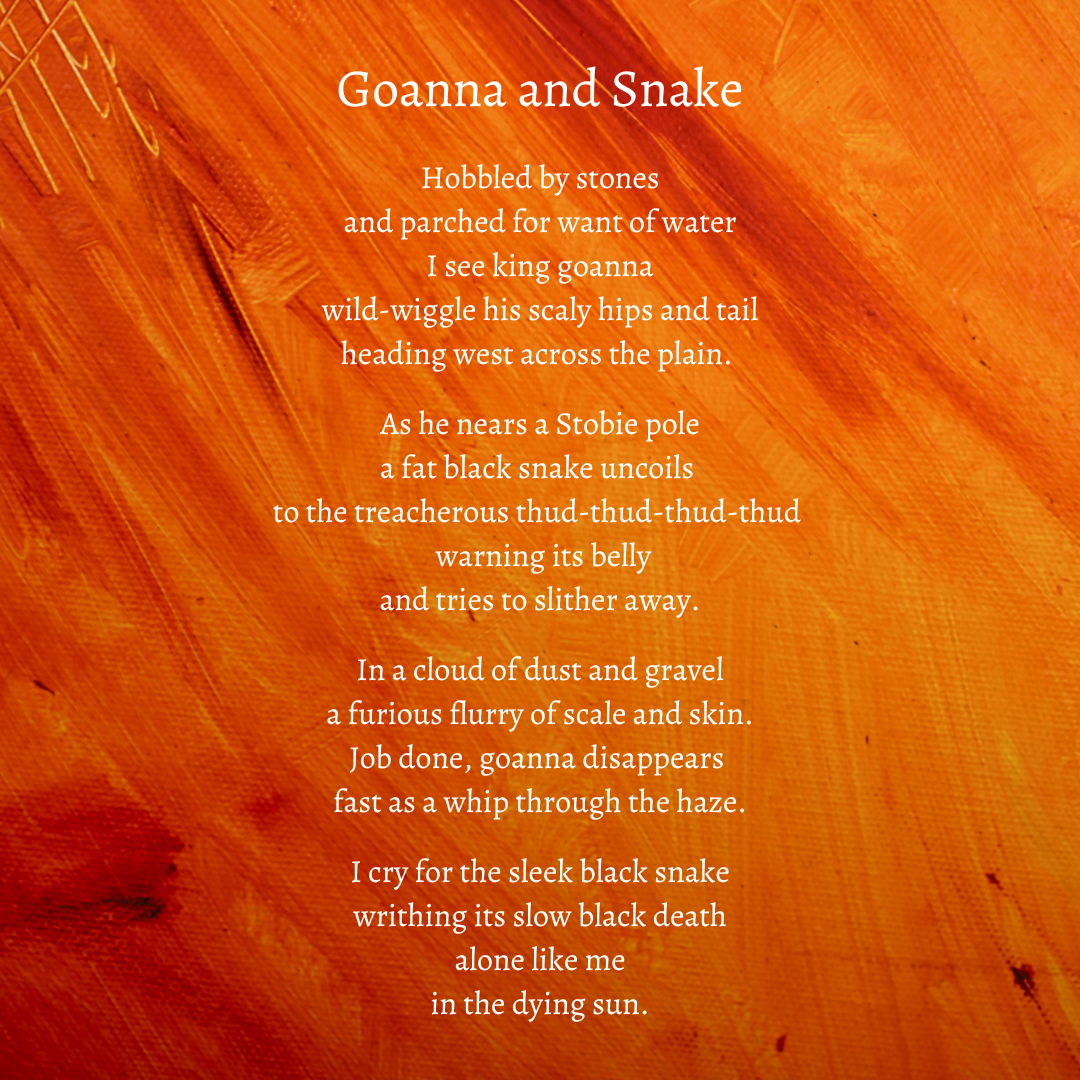
‘Goanna and the Snake’ in Life Blinks, Ginninderra Press 2019
‘Of Heat and Flies’ in Alchemy Friendly Street Poets Anthology 43, 2019
As life forces me inwards in old age, I find I have less and less to talk about. We complain, of course, that society renders us invisible as we age, and so it does, but are we complicit in that process when we make our world smaller?
I first noticed this turning-in business in my mother years ago. Even though her phone (a dial-up) might ring only once a week — if that — she used to take it off the hook for morning and afternoon tea and at mealtimes. She would say, “As sure as eggs if the phone rings, it will do so when I’m busy”.
Even if you are lucky enough to find yourself in old age (I don’t say ‘reach’, for few of us aspire to that state), the decline is likely to be there in one form or another, like it or not and retreating inward is probably a natural part of that process, as is resisting onslaughts that prevent peace.
Why is My Life Limited?
Mum also took the phone off when she showered because the sensuality of hot water flowing over her ageing body brought comfort by dissolving the rest of the world, as it does for me. Still, when you are alone in a limited social and physical space, your sensitivity to others and outside forces increases. I hope articulating my irritations here will alleviate boredom, if only for a moment.
Electronic Communications
The Imperious Buzzer
Living as I do in a multi-storey retirement village, I am often on tenterhooks when a delivery is due, waiting for the imperious buzzer that tells me I must let someone into the building. When I’m expecting a delivery, I’m scared to go to the loo in case I miss it.
From buzzers to ring tones, my new iPhone rings as infrequently as Mum’s old green handset used to. Yet it beeps with endless messages around deliveries, first of all advising me something is due. A second message telling me a parcel has been delivered comes after delivery, as though I couldn’t guess that from buzzing someone into my building.
Mum’s Life as PalimpsestWe think we have time to do it all.
I signed up for an Australia Post Parcel Locker to avoid the tension of waiting beside the buzzer. Like other deliverers, Australia Post texts to say something is ready for collection, then emails a thank you once I collect, as though I’ve done it a service. The first two texts are followed, often by email and text, by a request for a rating. These nuisance texts — misnamed communications — allow the source of goods to give itself points for good customer relations.
As I order most things online, this triple electronic bombardment surrounding deliveries is bloody invasive. Does it forestall loneliness? No! It is not communication but an interruption to one’s peace on par with noisy neighbours.
Noisy Neighbours
I am often subjected to the continuous sound of someone’s radio or television in the background when I am trying to write. Not quite loud enough to hear what is being said or played, it is a muffled but insane-making thrum of media cadences that penetrates not ears but the mind. For someone like me who loves silence, it touches all the wrong buttons. It may seem odd if I tell you that identifiable sounds, like traffic and trams outside, don’t bother me. I can even withstand the weekend invasion of motorbikes, but I’m allergic to evidence of neighbours.
One person on my level is 97. She leaves her door open day and night unless she goes out, which is rare. Every morning, two people from Meals on Wheels shout cheery greetings at her door at 11:30 as though they are Father Christmas. She is deaf, and her TV regularly drowns mine out through my tightly locked door, as does the indecipherable chatter and laughter that erupt from her unit on weekends and the late afternoon gossip fest she seems to host with others on our level every afternoon — in the corridor outside my door.
When I hear Meals on Wheels’ daily happy-clappy voices, the word patronising leaps to mind. It’s fine to feel good for doing good, serving the elderly as a volunteer, but I prefer the genuine friendliness of my harried commercial delivery drivers from Coles, Lite & Easy and Uber Eats, for they treat you like a person in control of your faculties. That said, if the day comes that I need or want Meals on Wheels, I may allow myself to enjoy that jollity.
Then There’s the Laundry
I used to silently mock my mother in Glenelg’s Kapara Nursing Home when she begged me to wash her tiny nighties (she was four and a half stone when she died) because she didn’t want her clothes washed “with the dementia patients’ stuff”.
My problem is similarly laundry-related. I loathe the cloying odours of someone else’s stale fabric softener and soap scale lining the rim of the shared washing machine’s barrel. I wonder if the offending residents believe there is a magical staff member who will appear in a cloud of stardust to clean up after them. I should write a poem about that.
Does anybody remember these old clotheslines and machines or days when the poles fell over, and wet washing hit the lawn?
Not everybody on my floor is inconsiderate, but one new resident adds insult to injury. Despite a prominent laundry roster, she seems to think her washing can stay in the dryer, in the machine or on the line forever. I could go on about my laundry blues, but I don’t want to bore myself so much that I won’t finish this post.
My Solutions
How do I turn inward? In the laundry, I limit myself by washing around 5 or 6 in the morning when nobody else is around. It’s not hard as I am always awake at that time. I also refuse to store anything in each floor’s small residents’ storeroom. (I don’t want my stuff leaning against theirs!) I lock myself in to luxuriate in solitude and comfort to write or look out at the City of Glenelg from my balcony.
In recent months, I’ve had two new friends across the way, two cranes. One is blue and the other yellow. I watch in wonder as the operators work high in the sky with such precision. What a job. They must climb hundreds of zig-zagging fire escape-style steps in a small vertical cage to get into their pod.
Seeing novel things up close like that is a delight. My balcony view excites my imagination. Sadly, the yellow crane disappeared last week as its building nears completion, but the blue one will be there to entertain me for months to come.
External Factors
While hiding or retreating (looking out from within) offers a solution at home, external factors also play a role in diminishing one’s quality of life.
Health Checks for the Elderly is a doozy. Like Meals on Wheels, the intention of geriatric (75 and up) checkups is good, but they create a profile for posterity denuded of history and personality. All identity is effaced as formal detail constructs a failing body for management.
In my sixties, I scorned the idea of these tests, but by 75, after my first, I learned that they could help provide access to support services and funding. Recently, I asked for an 80-year-old assessment. The completed 10-page form appears in the photo. After seeking consent, the assessor probes your life against these headings —
Background information (domicile) — Medical History — Relevant Family History — Medications — Immunisation Status — Allergies — Alcohol — Smoking History — Social History (a misnomer)— Other Health Care Providers — Mobility/Activity — Home Safety (can you bathe yourself)— Nutrition — Frailty Screen — Oral Health — Vision — Hearing — Personal Wellbeing and Safety Assessment — Cognition — Continence — Skin and Feet — Assessor Comments and Assessment. (my inserts in brackets)
Wow! What a profile it makes. I have now been screened as pre-frail.
Not so long ago, I was also required to undertake a supplementary assessment with My Aged Care. They lost the original done seven years ago to access subsidised ancillary services such as podiatry, physiotherapy, a nutritionist and exercise classes. The recent assessment took 1.5 hours. The assessor had no medical or nursing training, yet the last thing the questionnaire asked of me was to demonstrate how I get in and out of bed. That took me by surprise.
Forgive me for breaching taboo by writing about these things. I cannot imagine having a scintillating conversation over wine about the potential impact all this measuring of ageing bodies can have. Faced with such facts, it is instinctive to fall silent and turn further inward. These are not popular topics for lunchtime chit-chat chat, even though they start to fill one’s life in old age.
Time
Ageing disorganises our success calendar as book launches, theatre, concerts, poetry gigs, parties, and coffee or lunch on the sidewalk with friends give way to a merry-go-round of medical appointments. The slow loss of social identity that ensues tends to limit acceptable topics of conversation. Relatedly, people increasingly speak to or address us by age grade rather than in terms of our character or personality, which is painfully patronising.
I say we turn inward as we age, and I certainly have. It may not happen to everyone or at the same time for all. The sad thing is that it would be so easy to succumb to the official view that we are nothing more than our failing bodies. It is a form of silencing when people cease to find our history, achievements and experience interesting because of our age.
For Sanity’s Sake
In the meantime, I have poetry and creative friends in my life with the TramsEnd Poets critique group. I run a poetry workshop at the local community centre, and the first draft of my new novel is nearing completion. Then, there is Facebook, and I have Wattletales. While my writing keeps me happy, I am once again pretending I can paint.
Paints and the beginning of something on my kitchen bench.
I prefer sketching, but the Glenelg Community Centre offers a watercolour group at a good time, so painting it is. I thought it was a sign of regression to use block paints as we did in childhood, albeit in a plastic ‘tin’ as pictured above, but I’m told they are more acceptable now.
Playing with desert colours — unfinished and naive but lots of fun
When I moved into my retirement unit, I gave away hundreds of dollars worth of art supplies I’d accumulated over the years. So, I nearly died of shock to discover that a small tube of Winsor & Newton watercolour paint now costs around $23. Still, paint is paint, and I’m no artist, so what the heck? You’ve gotta live while you can.
To read more about Retirement Living, click here. For further insight into old age, click here.
In the past few years, I’ve so enjoyed finding suitable background images for the poems in my posts (and those of my guests) that they started to appear together in a colourful, recurring dream that gave me the idea of creating a little eBook. This month, that dream became a new publication called Dressed & Uploaded. The subtitle, Poem Stories, refers to how I reverse the way I illustrate poems in my posts to comment instead on each poem’s significance to me.
A Small Gift
Dressed & Uploaded is free to download below as my little gift. You are also welcome to share the file if you wish. Many of you will recognise some poems, but I hope you find the presentation and commentary titillating.
The eBook is also available to purchase through Apple, Kobo, Libreka, OverDrive and Scribd or to borrow from SA Libraries on Libby.
The Launch
This post is Dressed & Uploaded’s official launch, giving me a chance to publicly thank my daughter, Vanessa Warrell, for copy editing and Jude Aquilina, Veronica Cookson and Susan Thrun Willett for writing wonderful promotional words for the inside cover. To give you a taste, this is from Jude —
Dressed and Uploaded speaks from the big fiery heart of a poet whose raw honesty, original imagery and no-holds-barred subject matter make for memorable reading. Lindy Warrell gives voice to the people of our era, to women, to the marginalised and to the forgotten. Lindy’s poetry also speaks to the inner self, especially through this genre of poetic memoir. Knowing yourself is the beginning of all wisdom, wrote Aristotle. Lindy’s blog Wattletales and this collection, Dressed and Uploaded, are visually attractive records of our time and valuable additions to South Australia’s poetic wealth. Jude Aquilina
Formal acknowledgements are, of course, in the book itself. Here is the cover poem writ large.
While You’re Here
As this is a short post, I decided to celebrate the launch of Dressed & Uploaded by promoting my other publications, starting with my three chapbooks published in 2018 and 2019 by Ginninderra Press. To read a little more about each, click on the links below. To buy a copy, email me at lindy@wattletales.com.au. The books are $5 each, and postage for a single item is $1.50.
My poetry collection and debut novel were both self-published in 2022 under my imprint, Wattletales Publishing. The link for A Curious Mix takes you to a record of its wonderful launch party. The Publican’s Daughter link offers several reader reviews.
You will find these books in the South Australian Libraries collection in paperback and ebook.
You can also purchase both books (or eBooks) from your favourite supplier. Dymocks has priced the paperbacks of A Curious Mix at $29.33 and The Publican’s Daughter at $42.78. Booktopia is closer to the mark at $23.50 and $32.63.
To celebrate the launch of Dressed & Uploaded, I offer A Curious Mix and The Publican’s Daughter at the author price of $20.00 and $25.00, respectively, plus postage — email me at lindy@wattletales.com.au.
I am of the view that poetry refracts who we are. If stories constitute us as humans, then poetry’s words and lines distil and distort them, yet find truth through variations of content, tone, imagery, and style. In this way, I am often my father’s ventriloquist, my mother’s mood or even an earlier self as I write. Such complexity bears no resemblance to frozen moments captured in photos like the one below. Our poetic voice works with a rich recollection of sensory details, people, places, and times.
The Essential Me
My favourite poem is ‘My Skeleton and Me’, where I appear alone, albeit with my skeleton. I post it here in contrast with other poems below. This one is just me. The poem earned a High Commendation certificate for the Nova prize thanks to Murray Alfredson, one of the Friendly Street Anthology Editors, in 2016.
This poem wrote itself in my mind during a lazy afternoon on my couch, where I experienced my skeleton as integral to my being and as my lifelong compatriot. It came to me during a period when I meditated regularly, so it was a close-to-the-bone moment of clarity, which made me giggle with delight. It still does.
Change and Continuity
My parents seemed unchanged throughout my childhood and much of my adult life. Their gradual ageing became noticeable only after an absence. The setting for the following poem is a downstairs, inner-city flat in Melbourne where my parents lived after they married in 1938. Dad was a kitchen hand at the Hotel Windsor in Spring Street before becoming restaurant manager, and Mum was an apprentice hairdresser.
I was not yet born, but their oft-repeated words about those days allow me to portray something about the treatment of women in their time. My father’s voice and Mum’s reply still reverberate in me.
The poem records two actual moments but is not ‘real’. For example, nobody in my parents’ circle had a car until 30 years later. What is true is how Dad persuaded Mum she was the best at anything he didn’t want to do himself and that Mum joined the men’s poker school. Such remembered fragments make the whole.
As Confidence Grew
Only a few years later, the Australian Army promoted my father to Major in the Catering Corps and sent him to Japan with his family to refurbish and manage the Marunouchi Hotel in Tokyo, commandeered by British Occupation Forces.
As a girl from inner-city Melbourne, Mum arrived in a world of top military brass wearing a fox fur stole to socialise with generals, high-ranking political figures, and their arrogant aides and staff. She stands in the second shot, full of confidence in mink. In her mid-to-late forties, the third photo is from Oodnadatta, which Mum always said was the best time of her life.
Fox FurMink (with American brass)Shorts (with her sister)
Here is my elderly take on Japan with a child’s eye triggered by a penchant for Arnott’s Gingernut biscuits and clotted cream; my little-girl romance with the post-war era in Japan is clear. (Should I live long enough, I hope to write a third novel about that period. My title is Beyond Ginza, and my protagonist is a seven-year-old girl with synesthesia. It is OK to wish.)
Found Things Go Deep
People always think the following poem is literally about my mother and me, and they respond to it with sympathy, kind voices, and even tears, but, strictly speaking, it is not real. Of course, relationships between mothers and daughters and, most likely, fathers and sons talk to universals, and I hope the poem does that. However, this poem arose from a random line I read somewhere about hands touching across the abyss.
To Finish
For ‘Nana in Sepia’, I used an old photo and shards of memory about my maternal grandmother and a child’s perspective to evoke an image of an earlier time.
I have talked mostly about my mother and maternal grandmother, the women who made me who I am. Indeed, like Mum’s mother, I raised three small children alone, albeit in different circumstances. My father’s voice only appears through words he gave me as I grew up, so I’d like to end with a poem about his parents for a bit of balance. It is another heritage-style poem about an old photograph, more ekphrastic than anything else. And, so, I give my father the final say.
For Reflection
We now know that memories are not fixed or frozen, like Proust’s jars of preserves in a larder, but are transformed, disassembled, reassembled, and recategorized with every act of recollection.
What is it about an image, a narrative or poem, tactile only to the eye and mind, that has the power to move us so? Why do we let artistic contrivances fool us into thinking they represent reality? What about them gives us a spiritual lift when we know they frame, pan, or use sharp focus in soft light for visual effect? How do the contrived words of a writer arouse emotion? I can’t answer these questions, but I want to interrogate a few things to see what’s beneath this lovely flush of waterlilies.
Wetlands, Top End, NT
Our response to photos amuses me. ‘That’s the real me’, we say, eliding dimension from a small flat, shiny photograph. How is any representation real? Are words the things they represent? Indeed, isn’t reality a mystery? Is there not magic in this beautiful photo of a waterlily wetland with the sun rising (I think), as though imbued by divine power? Whether divine or not, there is magic in those glorious lilies.
I often wonder at the way the tourism industry has parcelled the planet we live on and the landscape we love into products. We always see the flower, not the watery murk beneath. TV advertising works hard to elicit yearning in potential customers with artificial constructs. For example, the promotional imagery for outback Australia fails to prepare us for the scorching heat, prickly grasses, sticky flies or the fine red dust in our baggage. Sound, smell, taste and touch don’t get a look-in. As anthropologist Michael Taussig tells us —
…the strange thing about this silly if not desperate place between the real and the really made-up is that it appears to be where most of us spend most of our time as epistemically correct, socially created and occasionally creative beings. We dissimulate. We act and have to act as if mischief were not afoot in the kingdom of the real. (Mimesis and Alterity 1992)
Engaging an Audience
Nourlangie Rock Kakadu NP NT World Heritage areaNourlangie Rock Kakadu NP NT World Heritage area
Which of these two gorgeous photos by Steve Parish is the real Burrungkuy or Nourlangie Rock? Both are beautiful, and both are of that rock and its surroundings from different vantage points, but Burrungkuy is a sacred place not because it is natural but for the culture it hosts. The numinous quality we experience when visiting such a place comes from both nature and culture, and First Nation sacred sites remove any boundary between the two.
On Representation
Any representation is framed, parcelled, limited, and directed to an idea or a feeling in the producer; it is a contrivance, as anyone who has painted, taken photos, or written creatively knows. I still say I am a ‘realist’ writer, but have you ever read anything real? I once saw two versions of a story in a literary journal, one ‘real’ and the other contrived, a fascinating read. The purportedly real version was overly long on the page, confusing and boring to the point of making little sense. The representation or contrivance, by contrast, evoked a believable reality that was a pleasure to read.
I was a court reporter (stenographer) many years ago, an experience that taught me that people do not speak in ‘lines’ in court as they might in film or a novel where dialogue has multiple purposes such as conveying character, evoking emotion, heightening tension, building suspense, moving the action along or heralding something. On the page, dialogue is not about two people communicating. It is the author communicating with a reader. Writing and photography are similar; both are directed at an unknown gaze.
Nevertheless, when I taught life writing, I got people to write from their guts in exercises that provoked them to pour their reality onto the page. Splat. Like that. It is then easy to get to the kernel of things. The gold is always there, to be polished with the contrivances of the literary craft to give it style and embellish to turn the story around to face a reader, to show, not tell. This work must be done because to say, ‘It broke my heart’ talks about the narrator but has little to no effect on a reader seeking their own experience.
Heart and Mind
Stories and images can linger in one’s mind or heart and assume a flag’s numinous, almost spiritual qualities. A flag is really (sic) a piece of colourful fabric, but people have laid down their lives for one they love while burning one is an expression of rage. Why? Because, flags, like photos and stories or poems, are symbols that condense inchoate meanings in a way that arouses emotion.
To return to nature. When I lived in Oodnadatta in my youth, we often travelled up and down to Adelaide on The Ghan. There was no romance in buying a ticket, for they used to ask if we were male or female, black or white, so as not to permit the mingling of what then was supposed to be kept separate in cabins. True!
But, waking up to the mauve and purple glory of the Flinders Ranges against a red earth foreground in the morning was one of those views that, 60 odd years later, is still as alive in my heart now as it was then as you can see in this little poem, written in 2017.
Outback SA
Take a moment. What do you see in this arial mage of the Lake Eyre and Simpson Desert area?
Lake Eyre/Simpson Desert aerials, Painted Desert west of Lake Eyre SA
Over the years, in different parts of the country, I have been lucky enough to fly over our vast landscape, witnessing a multitude of configurations not unlike this delightful photo of South Australia. The Queensland channel country and the Diamantina that flows towards Lake Eyre are most spectacular when it rains. I’ve always thought that such country, riven with channels, tree lines and multicoloured earth, is what inspired the original Coogee woollens I wrote about in this eponymous poem in my second chapbook.
Being There — Kakadu
Wetlands, Yellow Waters Lagoon, Kakadu NP NT World Heritage
Believe it or not, when I was in my early twenties, we used to water ski on Yellow Waters in Kakadu National Park during the Top End Dry Season. Crocodile hunters abounded back then and advised that it was safe. Crocodiles mate and produce their young between October and April — at the same time when waterlilies grow. If it does nothing else, this is a testament to the fact that surfaces cannot always be trusted.
In the early 1960s, the notion of national parks was seminal — if that — even among the educated classes. We knew nothing of the sacred nature of Kakadu.
If you think about it, it has taken over 200 years for this nation to publicly begin to recognise the numinous beauty of our land as understood by First Nations people. Steve Parish’s ground-breaking nature photography in particular has been instrumental in developing our appreciation of that and I was recently honoured when he invited me to write a piece for his website.
Then There’s Litchfield
Florence Falls Litchfield NP NT
On the other side of the track (the Stuart Highway) and a bit closer to Darwin is the magnificent Litchfield National Park, where I regularly swam for many years when I lived in the Territory. I took my eldest son Grant to the Buley Rockhole nearby when he once visited me from the UK, and he revelled in its beauty and took this photo of a black water goanna.
Taken by Grant Warrell
My favourite place to swim in Litchfield until I left the Territory was Wangi Falls which was closer to home than Florence Falls, and I mention this because Steve Parish’s photo elicited memories. Memories of sitting for hours beneath the fall, allowing the pounding rush of water to cleanse, destress, and make me feel whole again when I felt terrible. I loved that place, that fall and pool, which I understand to have traditional feminine associations.
A photograph often has the power to trigger memories, and take us back to love, and that is a decidedly spiritual experience.
My brother Phillip in 2000 at Wangi Falls when he wasn’t well enough to swim.
Numinosity, I would argue, lies in the interaction between the contrivance or creation and the observer or reader, even with tourism ads. Bugger the flies the heart says; I want to go there.
The tropical Top End of the Northern Territory is one of my great loves. The desert in the far north of South Australia is another. They are my history. Both exist as characters in my life, vibrant, living, breathing and giving. I mourn that I cannot be there now even where there might be green frogs in the toilets.
My brother died in 2004, and Grant in 2014. It was long ago that they visited me in the Top End where I always felt most like my true self. I have since renewed, of course, but I often wonder why I’m the one who has had the privilege of living a longer life.
ACKNOWLEDGEMENTS
I thank Steve Parish for sharing his photographs with me for this post.
A little girl, aged 23 months, recently smiled at me from beneath her bonnet as she toddled by with her parents on Glenelg Jetty in a fashionable pink gingham dress. I smiled back, saying, ‘hello baby,’ and the family stopped to chat. The little girl was carrying a baby-sized boy doll in preparation for her new brother, due to arrive soon. That moment was as satisfying for me as it was going to nightclubs, achieving professional goals or, more recently, standing up in front of an audience to get its take on my poetry.
My daughter, Vanessa, at the same age in a party dress made by her Oma.
To see such a happy family brought memories of my childbearing years. By the time I was 31, I had two toddlers, thirteen months apart, and a miscarriage soon after. A year later, I had a third child who liked to poke his head high under my ribs for the last few months of the pregnancy. My mother scolded me for breeding like a rabbit. I wondered as I waddled past a dress shop in discomfort one day if I’d ever get back into the sleek little number on display. I did until time took its chance with me.
A Long Life Has Benefits
The diversity of baby bumps around today fascinates me; some protrude naked from bikinis, others are swathed in Lycra, and a few, perhaps less fashionable, reside beneath loose summer dresses. I wonder whether appearing sexy while pregnant is easy.
Being pregnant was not all about baby bumps or glamour in my generation. We wore maternity dresses that hung stiff as an A-frame from neck to knee to hide our changing bodies with what felt like shame. On reflection, I give thanks that we were at least physically comfortable.
I reflect a lot now. My mind bobs from present to past and back in a way that revises views. There’s much to play with after a long life, and it brings joy to view things in perspective to find they don’t matter too much now. Shame diminishes with age, too, when one’s vital force has pretty much left the building, like Elvis.
Body image has always been an issue for women, but I suspect it is a transforming one. When I was 13, I wore a blue check halter-neck dress once before throwing it away. So ashamed was I of my budding breasts that 50 odd years later, I wrote this poem.
The Inevitability of Ageing
Most people my age quit work long ago, and what younger people may not know is that being old is itself a job; it takes work to maintain body and mind. It does not matter how good one’s diet is, how well we exercise or follow health rules. The aging body declines.
In the medical world of the ageing and elderly, not everything is as it seems.
So, I decided to introduce the article below entitled ‘Body Ritual Among the Nacirema’, which was on the syllabus as a cruel joke to tease first-year anthropology students in my day. ‘Nacirema’ is, of course, ‘America’ spelt backwards, but the detail is precisely how an anthropologist might render the lives and activities of what was once called primitive society.
Taking an indirect queue from the article, I describe below some taken-for-granted medical processes to explore their power to disempower the elderly.
Age Stripped Bare…
Patients must strip then don a blue gown that opens at the back for day surgery. Our heads sport a blue mob cap, with feet covered in matching disposable slippers, like those used at crime scenes.
Thus clad, patients are invited into a nurse’s room for a consult about ailments and medications. This is followed by cognitive testing. My nurse told me she had to ask some ‘silly questions’ without advising me that she was actually measuring my mental acuity. Notably, cognitive testing is a treat reserved for concussion patients and, without discrimination or consent, the elderly.
When the nurse is finished with us, we return to the waiting area to be summoned next by an anaesthetist. My young male doctor explained what he would do to me in breathless haste designed to defray questions. So keen was he to be in command, he literally arced up when I asked what sedative he proposed to use.
At the Noarlunga Hospital’s day surgery hub (which offers a splendid service), patients (young and old) in blue are each issued a warm white cotton blanket to keep them from shivering while they wait in anonymity to be called for their procedure. I counted about 20 blue and white figures sitting in rows on straight back chairs with me, facing a blank wall with blank eyes as though attending the theatre. I experienced a strong urge to take a photo, but my iPhone was under lock and key. The identity strip is complete.
The only trace one leaves as an oldie, it seems, is the unknown result of an involuntary cognitive test.
…then Trapped
Whatever our age, as humans, our backs are vulnerable. We keep them to the wall when confronted, and most people don’t like having an open door behind them, but on the operating table, our backs and bums are exposed under bright lights, open to the gaze of several strangers.
Whether for day or life-saving surgery, the moments before you lose consciousness are curious. As you lie on the operating table, unable to move, a nurse’s hand creeps beneath your gown to affix sticky heart monitor leads to your chest while the anaesthetist inserts a cannula in your arm from behind. Your masked surgeon hovers above, asking if you consent to the procedure. Another nurse tells you to recite why you are where you are, what is about to take place and to repeat your full name and date of birth for the umpteenth time while checking your armband; probably a good idea.
Recovery team members are always friendly. It is nice to come back into the world to the sound of your name, a call that proves you’ve survived. That first cuppa is sweet and hospital sandwiches remain one of my favourite old-fashioned foods.
Medical Pin-ball
At home, we oldies begin to feel like the ball in a pinball machine as our declining bodies usurp our time. Our calendars fill with appointments; for the GP, specialist clinics, podiatrists, dentists, ophthalmologists, physiotherapists and more. Hospital admissions become more frequent, and the possibility of ending up in a nursing home lurks.
Death is on the horizon as we spin from one speciality to the next, none of which communicates with the other. The risk is high for losing our sense of identity in proportion to the increasing height and weight of our medical files. The myriad determinants of what we are in various doctors’ notes in these bulging documents begin to define us.
Measuring the Mind
In youth and middle years, a therapist might be helpful as we confront disturbing things or need to find direction. However, at my age, it becomes tedious to repeat well-rehearsed stories that have long lost heat, as it were. Time, as they say, does heal even though memories linger and are frequently triggered, as I found with my little girl in pink gingham.
We spend more time reflecting on the past, but that does not mean that we have abdicated our former intelligent self. Indeed, it would be nice at times if others would treat us as people. Being old suffers more than invisibility; being unseen and unheard is dehumanising.
Yes, we make typos in emails and social media, but they are arguably more signs of deformed, arthritic fingers than a loss of faculties. Failing eyesight and forgetting the specs don’t help. And, senior moments are trivial in the scheme of things when one’s memory has reached capacity.
Comprehensively ignored is the wisdom that accumulates in a long life. Few are interested. We live in ‘going forward’ mode where specialist and expert knowledge abounds; reified. We search Google before we ask an older person anything of note. Valuing the experience of elders does not pertain.
Care
The assumption that we are unsafe to ourselves and others increases in medical circles as we age. At 70, 75 and 80+, we are again measured like we were as babies. Our General Practice nurse visits us at home to make sure we are coping with things like shopping, diet, personal hygiene, etc. These jollified interviews with kind practitioners make for a nice visit and may produce official supports you didn’t know about. But, it all adds up as a way of seeing old people as diminished physically and mentally.
Any recognition of intellect is predicated on age. Our achievements are deemed significant because we are old (aren’t you clever for your age), not because we are good at what we do. For the elderly, such thinking infantilises; denies old people their full status as adults.
Most people think I’m nuts when I say these things, but how could we describe it when someone asks with a false smile and the royal plural, ‘how are we today?’ Well, lady, I’m fine, I want to say, and I don’t care a whit about you. But we behave. We accept and say nothing. It’s easier than fighting with people in power who cannot understand or won’t listen (as my aunt used to say when her husband abused her). Any sign of anger risks a mental health assessment.
Of course, dementia can take us away.
Current studies are ongoing into the extent of ageism in health care in Australia. The health sector is the second most likely place for the elderly to experience ageism.
Over Time
When my children were little, I remember thinking about how they first moved out from my body and into the room, then moving from cradle to school in graduated steps towards the wider world. Being old — if we are lucky enough to make it to this unlikely state of grace — is the reverse.
I watched my mother approach her dying by closing in on herself. Where previously she walked longish distances every day, she ordered Meals on Wheels. No more shopping, no need to go out.
She started taking the phone off the hook to make a cuppa, eat and shower. ‘Sure enough,’ she’d say of a phone that never rang, ‘someone will ring the minute I can’t get to it.’ Bit by tiny bit, she moved closer to her inner world where there was no more worry. She didn’t entertain, had less need for people and towards the end, became peaceful in herself.
My gradual social withdrawal over the past couple of years could be due to COVID or be the result of my having to take greater care of my pennies. The pension doesn’t stretch to as many coffees and lunches with friends as I would like. But there’s also the fact that my calendar is filled with increasing numbers of medical appointments. Given how long it takes to get to the top of a specialist’s list, you can’t mess with those.
A Last Word
We who live long lives are lucky to experience the distress and wonder of human life. We are also fortunate to have the health care system that exists in Australia. Abroad, I once witnessed a patient die alone on a corridor floor, mewling in vain for succour. Here, infants, children, young people and adults of all ages with chronic and life-threatening conditions have a robust medical system that works well most of the time; often for free. It has its flaws, but doesn’t everything?
Writing Tip
Never fear grovelling in the underbelly of things when you write. It is so important to reveal what goes on beneath the surface, to open wounds and have a good look. We would never know what the sunnyside is, without the rain.
My mother’s songs seeded the starburst of my poetry. Like a bird sings to its eggs, she sang the melodically and rhythmically fertile songs of the Aegean Islands while I was in her womb. When I hatched, she continued to prime me through infancy and childhood. I still sing and drum the haunting modes and hiccupping rhythms of Greek music. They feed my poetry with metre and syncopation.
Maria reading at SPIN 2018
Oral and Musical Roots
It’s tempting to believe my pilgrimage with poetry began at Flinders University, where I completed a Creative Writing Graduate Diploma. Academic learning validates. It teaches the craft, but the richest source for poetry for most poets is ancestral.
I inherited a deep, unconscious, but musical and poetic pulse from my family; my mother’s voice permeates my writing. More than theory, I draw power from this heritage. It lends authenticity to my poetic voice, which comes from deep within.
Many cultures, Greek, Ethiopian, Arabic, and Irish, to name a few, have strong oral traditions. Poetry in our Anglo-Celtic society does too, both in form and musicality.
Before Europe invented the Guttenberg Press, poetry was sung and recited in communal groups. The rhyme and metre we know from traditional poetry were mnemonic devices. Today, slam poetry which is almost a sport, has a similar musicality. Being performance, it is popular among young people and attracts large audiences and cash prizes.
I run an open mic with Julia Wakefield called SPIN (Southern Performers Interactive Network). We celebrate the connection between music and poetry and support early and emerging poets and musicians to develop their craft and confidence. I performed at the Goolwa Poetry Cup in 2017 with my show, Little Poems about Kisses. It was thrilling to win an award for Mr Lizard Lips.
Stones of Dislocation
My father’s forced migration as a political refugee is a troubling childhood memory. My family travelled from cosmopolitan Piraeus, a traditionally built home, to a Housing Trust duplex in Whyalla, South Australia, where Dad worked at the BHP steelyards as a rigger. His ship’s captain qualifications were not accepted.
Dislocated like many migrant families, fractured clan roots caused suffering. I felt I did not belong. Already bi-lingual, my father picked up English as his third language of necessity. My mother struggled.
The Strange Gift of a Double Tongue
Torn as a child between my Greek mother tongue and English was bewildering. I morphed into a bi-lingual child and quickly qualified to act as an amateur translator of adult medical mysteries, a junior social worker for my mother and a legal document reader for my father: a common situation for migrant children.
School classified me as ‘English-less’, which was a shock at five years of age. However, I graduated with the Year 12 English prize and have written mainly in English since. I gravitated towards creative writing and drama and was always the top performer in most English classes. Sadly, my Greek language is now much weaker than English, an expected loss for migrant children.
A Life Raft
Poetry was a life raft for me during my mid-thirties when I experienced a series of traumatic losses. My father died of cardiac arrest on a public health waiting list. My mother committed suicide. I left my de-facto husband, lost the job I held in our business then lost my own business and singing career. Even my cat died. For a time, I was homeless. Grief choked my song. Anxiety set in, and panic attacks still plague me.
Poetry, for me, was firstly a therapeutic tool. Though I rolled punch-drunk with grief, I scratched my sorrow into journal scribbles. Later, many of those raw feelings turned into published poems. I captured trauma in words, which eased the pressure of that catastrophic period. As Bessel Van Der Kolk notes in The Body Keeps the Score, trauma is visceral. Creative practices such as writing, painting, singing, and exercises like yoga, dance, walking in nature and ocean swimming are healing remedies.
What is poetry? Who knows?
Poetry can be anything, everything and something in words. It is mercurial. I use Samuel Taylor Coleridge’s definition to guide me: ‘The best words in the best order.’ His words are my mantra, and I ask the question constantly as I practice. Is this the best word in its best place? It helps me progress through a poem, especially if my writing is stuck. Of course, the judgement of ‘best’ is often a personal one.
As a poet, I like traditional poetic forms. Form in poetry is like a corset: it restricts but gives support and shape. I enjoy the challenge and practice of villanelles, haiku, sonnets, tanka and sestina.
Even free verse is not as liberating as its name might suggest. When I write freeform poetry, which I do a lot, it forces me to make an oppressive number of personal choices about rhyme, metre, lineation, punctuation and many other things. Decision fatigue happens even before the engine of a poem — its literary tropes, metaphors, similes, hyperbole, personification and others — fires up.
How I Craft a Poem
In 2007 I returned to university to study poetic craft, history, and traditional forms with Professor Jeri Kroll and A/Professor Steve Evans. Learning poetics enhanced the instinctive skill I inherited from my ancestral heritage.
While studying, I held down a job and acquired my first dog, Dora, a beautiful companion. The discipline of crafting a poem helped me order my thoughts and shape my journal scribbles into readable poems. It also aided my recovery from the previous decade’s ‘personal holocaust’, as I now call it.
My best poems, I think, do two things at once. They draw with clarity on raw personal situations and emotions that link to human universals when honed. My first poetry collection, Eye Print, won the Friendly Street New Poets 19 manuscript prize.
Keeping Poetry Muscles Fit
Poetry is a continual practice for me. I often get it wrong and sometimes get it right. Some helpful things are participating in critique groups such as Ochre Coast Poets and TramsEnd Poets and elsewhere. Collaboration and critique are invaluable in the journey to polished poetry.
A poem in GRIEVE
Musical Trio, Maria on Drum
L — Parents, Antonios and Kalliope Koukovas R —The Trio includes Demeter Tsounis and Mary Raptis
In the Community
But, all engagement in poetry helps me learn as I build my profile as a practising poet.
I professionally edit manuscripts and mentor young and emerging poets like Asher Seiler Simmons, a Year 12 Steiner student whose project culminated in a published poetry collection.
Between 2019 and 2020, I conceived the idea of poetry as a Life Writing project for seniors. The seed for this came through many fruitful conversations with Dr Lindy Warrell, who successfully ran Life Writing workshops in her local community.
In creative partnership with Steve Evans, I successfully sought funding from the Onkaparinga Council and SA Health, resulting in ‘Your Story Life Writing’, a workshop series we delivered throughout regional South Australia. I used poetry, mainly haibun, and prose to help participants create memoirs and record family histories. I loved working one-on-one with participants; the learning went both ways. We had fun.
Another initiative was my‘Frolic with Forms’workshop. In 2020, I collaborated in the publication of Ochre 10,an Anthology. Running school-based workshops in poetry across four schools in the South was an exciting experience. The local poet Virgil Concalves won an Onkaparinga Council grant for this project.
Where to now?
Over the last fourteen years, I have poured a lot of money, time and energy into poetry. But poetry is a fragile axle to drive your life on. Very few people earn money from it, and the satisfaction derived from publications and prizes is fleeting. Banging your odes against gatekeepers like editors and judges is a formula for disgruntled disappointment. To run the long race and stay sane, a poet needs to have a deeper purpose for writing poetry than publication.
The pilgrimage is about binding the ephemeral to words then sending them out to bond with another. It is a sacred linguistic process.
Poetry continues to lure and torment me. Its language compression, sinuous syntax, magic metaphors and rhythmic heart prey on my time and energy.
Like a true addict, I quit poetry 20 times a day and return to it for one more line.
AUTHOR BIO
Maria is a child migrant. The schism of a two-tongue world fuels her poems. Maria is polishing her manuscripts Two Tongue World and Dogolalia, bothering editors, publishers, and literary friends alike.
Her poetry won a place in the Newcastle Poetry Prize 2020 Anthology and a manuscript prize for Friendly StreetNew Poets 19. Maria’s poems are also in the Canberra Times, Victorian Writer and SCUM Magazine, Poetica Christie, Friendly Street and Ochre Coast Anthologies.
The night I first stepped from the plane into Sri Lanka’s humid midnight arms, I fell in love with the lush greenery, tropical fragrances, and warm-hearted, welcoming people. This beautiful, bejewelled island, shaped like a teardrop at the southeastern tip of India, hosts an annual caparisoned elephant procession that parades the Buddha Dalada (eyetooth relic) surrounded by costumed dancers, drummers, and fire throwers, attracting huge local and international crowds every year. Such an adventure.
Kandy Asala Perahara (Agence France-Press). The Palace of the Tooth (Dalada Maligawa) in the background.
I returned to Sri Lanka in 1984 as a postgraduate researcher to examine the Perahara and another large-scale ritual called the Gam Maduwa or village hut. The Gam Maduwa celebrates and propitiates the only female deity in the Sinhala pantheon, Pattini Amma.
Once sponsored by kings, the Perahara has proliferated. As one famous dancer once told me, nowadays, everyman is king. Similarly, individuals may now host what was a community and harvest festival, the Gam Maduwa, for a small crowd or an entire village for personal reasons. Ritual has democratised.
Where to Start?
With one suitcase apiece, my children Grant, 12, Vanessa, 11 and Mark, 9 and I spent 18 months In Sri Lanka while I did postgraduate research. When we arrived, we first stayed in homeshare accommodation in Colombo. Our hosts helped us find a place to live. My landlord then introduced me to a marvellous woman called Soma who cleaned, cooked and otherwise looked after my family. My children attended Alethea International School, an English medium school for Sri Lankans near the beach in Dehiwala-Mount Lavinia.
We were thus kindly facilitated to where we were supposed to be, in Sri Lanka, by Sri Lanka.
L-R Mark, Grant and Vanessa
Soma with her charges
Sri Lankan school uniform
Once settled in our home in Sri Jayawardenapura Kotte, my precious children took the bus to and from school each day. My youngest, Mark, learned to recite the conductor’s spiel, rapidly naming one suburb after another at each stop, much to our delight.
I could not have done fieldwork without Soma who, sadly died many years ago. I was away a lot, travelling on jam-packed buses to attend more than 54 rituals of different types, big and small. Many were all-night affairs. Others took longer, always somewhere different.
Mine was a peripatetic life. Following ritual performers across the southern littoral, I walked many tropical miles through jungles, paddy fields (and occasional leeches) in flat leather thongs to attend magical nights of ritual drumming, dancing, and deity propitiation. Large crowds gathered in delight and devotion at these events (more of which later). In this adventure, I was never alone.
The Best Assistant is a Friend
Once I’d sorted accommodation and schooling, I had to find an assistant. One applicant whose resume was perfect didn’t show for his interview. I ended up engaging someone with whom I struggled because he insisted that the people we met pay me deference, find me a chair and so on. I did not want that. It went against the Aussie spirit for one thing and was alienating for my purposes. I began to panic.
A small village deity shrine. This faded little photo won a prize at the time.
Three weeks later, the missing applicant, LR Perera, showed up unannounced to apologise for not attending for interview. A shy man with a Batchelor’s degree majoring in Sinhalese Language and Literature, LR taught himself to speak and write English in his remote home village by reading English novels and poetry. In Colombo later, he studied newspapers too. LR said he stayed away because he’d been teased for his spoken-English accent and lacked confidence. Our people, he said, are very cruel. LR went on to achieve acclaim as an international consultant.
LR’s English was then (and is) excellent, and having similar interests, we got on like a house on fire, travelling everywhere together month after month. To this day, nearly 40 years later, LR and I remain in touch. As you do in Sri Lanka, we became siblings where, as anywhere, kinship terms define a moral code that structures appropriate behaviour. The use of kinship terms there, however, extends to strangers as well as actual kin. (Do we still call daddy’s girlfriend aunty?)
Under Scrutiny
Speaking of kinship, What I hadn’t realised, and nobody thought to warn me, was that it was probably thoughtless of me a single woman to do fieldwork alone among male ritual performers. Not because I’d be unsafe, for that was never and could never be the case, but because my presence could compromise those with whom I worked. I am grateful for how well everybody looked after me.
Still, the predominant question I got until people knew my circumstances was, where is your husband, Madam. I told the truth (that I was divorced), and I think that earned some respect but, I should have read the clues. How could I not guess from a visa application process requiring the name of my husband or father? No wonder touts called a white woman travelling on her own, Tani Aliya (lone elephant).
Methods and Possibilities
When I did my research, anthropological fieldwork employed a participant-observation methodology. I didn’t speak Sinhala, and back then, such research did not yet require ethical clearance. The idea was not to become the Other (I didn’t wear a sari) but to hang around and watch others live their lives.
Even then, I used to wonder how I’d feel if a foreigner knocked on my door to ask if they could live with me and follow me around for months on end, recording minutiae of my daily life to get a degree. (In Australia, we can only empathise with our First Nations people on this.)
Fortunately, the ritual practitioners I worked with welcomed the chance to share their traditional knowledge, their cultural gems, and they were always in charge of how much they divulged!
Both of my boys wanted to learn the traditional arts. The drums especially fascinated them. Here is a small taste of the sound of Sinhalese ritual drumming. In performance, it gets louder and faster as it goes, especially for trance dances.
(press twice to play if necessary)
Unfortunately, Grant was already too tall to dance, being taller than many performers. However, Mark learned the traditional dances of the Gam Maduwa. The press got wind of this just before we left.
Media release — Mark in costume
Elaris Weerasinghe with Mark and son, Chaminda, off to work
Life Bleeds Into Research
I was in Sri Lanka to research myth, ritual and religion. Strictly speaking, it was about the politics of specific rites, but that did not stop me from learning about Sri Lankan food, social mores and everyday customs. It took me years and being back in Australia before I was game to serve rice to anyone. In Sri Lanka, a woman who can’t steam rice properly is almost inconceivable. I learned to cook decent chicken curry, Kukulmas (chicken meat), but, as this poem attests, I couldn’t help but contextualise the recipe in my world.
The Gam Maduwa
One of the most spectacular aspects of a Gam Maduwa is a trance dance performed by a deity priest, dressed in a strict ritual process as the Goddess.
Early in the proceedings, members of the dance troupe wear white sarongs to propitiate the deities and invite their presence. In the poem below, you will see them in silhouette. Such ritually washed white cloth separates the sacred from the profane and pure from impure. Boundaries abound if only we look. In church, a woman must cover her head in the sight of God, but men may go bareheaded.
Dancers introduce their intricate hand-made, glass-beaded costumes later in the performance as a build-up to the main event. They gradually dance faster and the drums get louder although drummers stay in white throughout. Their music mediates sacred and profane as they facilitate performance and costumes indicate that we are in the presence of the divine (or demonic).
Performers worship their costumes and instruments before use, and dressing the priest is a sacred duty. In this photo, a drummer dresses Sirisena Kapumahattea (a diety priest is a kapurala, and mahattea is ‘sir’) in preparation for Pattini’s midnight dance. The priest fasts for a specified time to ritually cleanse before the event. In dance, his sari instantiates the Goddess.
Sirisena Kapumahattea.
The Goddess and the Demon
Pattini Amma was once a village goddess overseeing harvest and community wellbeing. Pregnant women propitiate the divine mother to this day, but she has historically become one of the four major deities of the Sinhalese pantheon. In a Perahara, where male deities (their icons) sit atop caparisoned elephants, Pattini travels in a palanquin. (Remember hats and no hats?)
A Gam Maduwa of any size may be a votive offering, but mostly they give thanks for good fortune. Their size varies according to a host’s wealth. Some feed their entire village, the many performers and an occasional anthropologist and assistant. Dignitaries and Buddhist monks sometimes attend.
The Gam Maduwa is an elaborate affair. Ritual practitioners spend days preparing the arena to build the coconut-frond palace for the gods, in which Pattini appears at midnight. This poem gives an idea of what it’s like to be there.
Photo of Gara Yakka in comic performance.
This is my Gara Yakka. He hangs over the door inside my flat. I was humbled when an internationally renowned dancer took his mask off after a tiring performance to present it to me publicly.
Gara Yakka (Benign Demon Gara)
Sri Jayawardenapura Rajamaha Viharaya (Kotte Temple)
At the spectacular Kotte Perahara, after I’d worked closely for some time with the same loose coalition of Low Country ritual practitioners, something changed.
Back then, I used to smoke — we all used to smoke — and in the beginning, I got into the habit of taking a couple of extra packets of cigarettes to rituals to share. Over time, people who knew me started offering me a cigarette, and I’d take the extras home.
However, at this particular perahara, performers from the central highlands (Up Country or Hill Country), the home of the original royal Perahara, were also performing. Quite rightly, they saw me as a stranger and approached me for a cigarette en masse. As though by magic, familiar faces surrounded me and shooed them away. Funny how unspoken gestures like this still touch so deeply, years later.
The first two stanzas refer respectively to the Perahara and the Gam Maduwa. I structured the poem to echo the perahara (procession).
In the Crowd
Bigger Peraharas like the one in Kandy, where the Dalada resides throughout the year, and those in cities like Sri Jayawardenapura and regional centres, take many days (up to three weeks) to complete. Even small processions in villages are at least all-night affairs. They take place on or around the full moon night of Asala in the Buddhist lunar calendar. In Sri Lanka, every full moon commemorates an event in the life of Buddha and full moon (poya) days are public holidays.
Maybe COVID has stopped the Perahara in recent years. But I used to imagine multiple brightly lit, vibrant clockwise processions as auspicious spinning wheels illuminating the entire island, an apt metaphor for ancient South Asian Chakravartin Kings and Buddhism’s Dhamma Wheel (Dhammachakra).
Perahara processions of elephants, dignitaries, dancers, drummers, acrobats, flame-throwers and more can be a mile long on the critical night when the Buddha relic joins the parade. When I was there, kerosine lanterns lit the procession on the bare shoulders of men. Gone were the dangerous oil lamps of old and the sweet smell of burning coconut oil.
A Perahara is far too big to describe in full. They are exhausting. Yet, people line up for hours to get a good vantage point, and police cars drive very close to their toes to keep them in line. Before it all starts, young men promenade along cleared streets, making subtle eyes at girls who giggle behind their families behind the line.
Stands are built, primarily for dignitaries (and tourists). Through high-volume loudspeakers, a voice endlessly recites the names and status of event donors and how much they contributed, an act that brings merit. It’s a hot, humid crush of humanity that takes getting used to after the open plains of Australia. LR and I devised means to make it fun.
Back Home
The line between life and fieldwork is tenuous. Many who know me know I married Mark’s teacher, Elaris Weerasinghe. Sadly, Elaris died some years ago, but his children in Sri Lanka are in touch with me on Facebook. When I heard the news, I organised a Buddhist rite called Dana, a giving which can be a big public event or as simple as a gift of food or personal donation to a Buddhist monk or temple.
Remember, the Buddhist Order (Sangha) is a mendicant order, reliant on donations to survive. Dana creates merit for the giver. Sponsoring a ritual puts the giver in a symbiotic relationship with Buddhism, like that between the Sangha and Kings of old. The last paragraph of my poem, The Tourist, equates begging with Dana. Beggars offer an opportunity to give, to earn merit, which is the logic of Dana.
My Dana at Aldinga Beach in February 2010 honoured my parents, my brother, Phillip and Elaris. Four Buddhist monks officiated, and about 35 people came. It was such a special day.
Four monks (see below)
Bhantes showing me what to do
Chairs filled, some outside
Pic. 1, L-R — Thay Thich Thong Phap Vietnam, Bhante U-Sumedha Sri Lanka, Cambodians Bhantes Ly and John.
Writing Tip
As for an anthropologist, observation is an invaluable skill for a writer to develop. But, it doesn’t always bring heart and soul into the picture. Always remember the little things and share them with your readers.
Happy Writing
Wattletales
ACKNOWLEDGEMENTS
The photo of the caparisoned elephant in Kandy is licenced to AFP.
‘The Tourist’ is published Kaleidoscope, 2019, Friendly Street Anthology edited by Nigel Ford and Valerie Volk.
There is a lot to be said about having a comfortable place to go. For me, it’s my red armchair. Most of my writing and digital art happens from there.
Living with a rare and chronic disease, daily nausea, cramps, bone pain, joint and muscle pain, gut problems, headaches, PTSD, anxiety and depression, I often retreat to the embrace of the red armchair.
It was from this place of chronic disarray, impacted by COVID restrictions, that just over a year ago, at the tender age of sixty, I found my creative side.
I started to write somewhat prolifically, a few short stories and lots of poetry. This productivity coincided with my digital doodling becoming full-on abstract digital art.
On Poetry
Throughout my life, I’ve admired and somewhat envied talented people who could paint, sing, play a musical instrument or write. For me, poetry was a flowery thing requiring a dictionary to understand strange words. It therefore never appealed to me, so to be a year down the track, having had multiple poems published in journals, blogs, online newspapers and read on the radio, and having some of my art exhibited in galleries, is surreal.
Now, I find poetry a great way to tell a story or explain something, as in this poem, ‘I Look OK’, one of my earliest about the rare disease I have.
Poetry over this last year hasn’t been one-sided. I’ve found great enjoyment in reading other poets’ works. I joined Friendly Street Poets and, with my wife, went to a few open mics at Goolwa. There we met a wonderful and charismatic man, Nigel Ford. He is a wonderful poet and has been very encouraging to new poets.
I don’t go to many poetry events due to my poor health, but for several months I was involved in a weekly Zoom poetry workshop with a group of poets in New Jersey, USA. Here I the first poem I had published in Pinky Thinker Press, Mignolo Arts Group, New Jersey.
One of the first poets I read was Geoff Goodfellow. His writing inspired me. A few months after my writing started, I was very fortunate to have a phone conversation with Geoff, who was very encouraging and gave me a few tips.
I’m a storyteller who has a lot to learn. However, after a long life, I have a lot of words trying to escape. So hopefully, I will be writing for some time to come.
Over Last Year
Abstract digital art, sometimes combined with photo manipulation, has exploded with colour over the last year. From digital doodling, I’ve created brightly coloured abstracts like those below. Art and writing have been therapeutic for both my physical and mental health.
What I Write
I’m sixty-one years old, a husband, son, proud father, and grandfather. While a lot of what I write is about life and actual events, albeit somewhat patchwork, I’m not yet quite prepared to write about some things.
Last winter, I emerged from boredom and depression when a counsellor suggested that I look for something to do as a hobby. Working with my hands like woodwork or some craft was very quickly ruled out as I have ten thumbs and would have lost fingers.
So, I joined the University of the Third Age (U3A) online. The first course that caught my eye was about writing creatively. I thought I could try that. In my first effort, I sat down and wrote a concise story, a bit over seven hundred words, about a crazy Irish guy I had known in the Navy.
I started writing poems when I learned that poetry didn’t have to be flowery and rhyming but could be a conduit to tell a tale. The floodgates opened, and in just one year, I wrote over two hundred poems.
In addition to my health, I’ve written about life events. For example, a poem entitled, ‘What Could Possibly Go Wrong’, emerged from the time when my wife and I were swept out to sea with friends in our kayaks. We had to be rescued by sea rescue and ended up in the news.
“Sorry To Say” is the title of a poem written about a friend we took in and cared for in his last eighteen months of life before he died from bowel cancer. Last year a different friend died from a stroke in her fifties, way too young. I wrote this little poem.
Poems and Art are My Life
‘Love Me Forever is the title of a poem I wrote for my wife based on when she agreed to marry me sitting next to a campfire on the bank of a creek in the Flinders Ranges where we had witnessed a flash-flood a few hours earlier.
After pumping out poems, I first posted them to Facebook then set up my first Instagram account, where my digital art took off. I used the art as a background for poems and ended up with an Instagram following. The poetry didn’t take off, but the art certainly did.
Earlier this year learned of a weekly veterans’ art group. As I served in the Royal Australian Navy for over 11 years, I was eligible, and the group encouraged me to exhibit my art. I’m also learning about other art forms like flow painting and mosaic’s which I enjoy even with ten thumbs. I wrote ‘Bloom’ to honour this group.
I haven’t found it easy to write about myself. But, writing about it in poetry feels like I’m writing outside of myself, freeing me up to release the words. So maybe as I continue, I’ll be able to explore the more challenging parts of my life poetically.
AUTHOR BIO
Andrew Ballard lives in Adelaide. He was a Petty Officer Medical in the Royal Australian Navy for 11 years. He worked for medical companies selling devices and instruments, then as a support worker in mental health and first aid and aged care trainer. Diagnosed with Systemic Macrocytosis, he took early retirement. In 2020, with activities curtailed, Andrew turned to writing and digital art. He has published In quick succession, in the US in the inaugural edition of the New Jersey Mignolo Arts Group’s journal, the New York poetry journal ‘Open Skies’, The Beckindale Poetry Journal and InDaily, Poets Corner.
I have recently published my first anthology of poems called Metamorphosis. I’ll admit now that poetry has been my secret love for over 40 years. I’m better known for my prose: art & theatre criticism, online journal articles, publicity material for artists, writing workshop notes, and my doctoral thesis on colonial Indonesia. In other words, I’m more used to ‘telling’ than ‘showing’ – so my two novels languish on the backburner after harsh criticism from my son, who is a published author of fiction.
Poetry is, for me, the literary reprieve for the right-side of the brain. Akin perhaps to drawing and other visual creativity that is part of my world, it seems to spring from a mysterious place in my psyche and has been a recurring motif in my artistic journey.
Phases of Poetry
I’m old-fashioned. I still like to write first drafts with pen on paper. I have many lined writing journals filled with notes, poems, and diary entries from various stages of my life.
I wrote my first published poem at age 14. It was a contribution to our high school magazine, Catalyst. A small group of interested writers, including The New Yorker cartoonist Victoria Roberts, created only one issue of the magazine on the school’s Gestetner machine.
These two photos are from the 1980s in Sydney.
Some of the group continued with creative pursuits after school days; others did not. Victoria and I are still in touch, having met up at ‘The Met’ (The Metropolitan Museum of Art) in New York in 2014.
In my life, poetry has had several distinct phases: youthful love poems and teenage Angst kept only in old handwritten journals; a stint as a ‘performance’ poet (at the Balmain Loft) in the 1980s in Sydney with work in an anthology called Readings Aloft; a brief sojourn into poetry again in Katoomba (Blue Mountains, NSW) in the 1990s; and a slow-building resurgence after 2005 when I moved to South Australia. It is in South Australia that my poetic journey has been consolidated.
Poetry and Performance
In 2018, a poem I had written in English and Dutch called Baby Elephants about a family incident was selected for the first edition online of Australian Multilingual Writing. The poem was a humorous piece about my family background and the visit of an aunt to Australia in the 1990s. In late 2018, I organised a poetry event at Yankalilla Library with two other female poets Esther Ratner and Elizabeth Snow (aka Jade Wyatt), called Metamorphosis, the linking theme for all our works. It was received warmly by the audience, and Conker Productions made a short film of the event.
In 2019, I was invited to contribute to a multimodal multimedia project by instigators Carl Kuddell, and Jen Lyons-Reid called _this breath is not mine to keep. Surprised and heartened that three poems were selected – Hopeless, On Being Swept Away, and Dark Times – I collaborated with my son Sam Herzog to produce three videos that encapsulated the spirit of the poems for the website. I was also invited to ‘perform’ my poem Dark Times at the launch at Coral Street Art Space and Signal Point Gallery in Goolwa. It was thrilling, especially because I was surprised that one of my ‘darkest’ poems received genuine approbation.
In early 2020 (before Covid-19 upended all our lives), I launched my anthology Metamorphosis: Poems 1980 – 2020. I wanted the book to reflect my creative values. Hence, it is made as a tactile object d’art: lovingly crafted, illustrated by me, produced on high-quality paper, with marbling on the edge of the pages. I also chose to write a preface about poetry itself. To some degree, I wanted to situate my poetry within the broader historical context and to demystify it a little for the general reader.
The Book
Contents
Poetic Inspiration
I started life in NSW, so I wrote some poems about that phase. Others were inspired by my life in South Australia. Right now, I am fortunate enough to live on the Fleurieu Peninsula near the coast, and poems often spring to mind when I’m walking on the beach.
Second Valley
View of Rapid Bay
South Coast
I’m moved by the visual and sensory aspects of life near the coast, and I am concerned for the creatures we live amongst. When the Great Australian Bight was under threat recently by oil companies wanting to activate oil and gas exploration, I found myself penning this.
Poetry Rituals
My maternal ancestors came from Indonesia – formerly the Dutch-East Indies – and, after the Indonesian independence, many of the ‘Indo’ (mixed blood) community went to the Netherlands. I love the idea that in the Netherlands if you die without friends or family, the state assigns you a civil servant and a poet to attend your funeral where a custom-made poem is read for you. Poet and artist F. Starik started the Lonely Funeral Project.
Recently, while watching the 2017 British film called The Sense of an Ending, I was struck by the fact that poetry was interwoven into the story. The main character had aspired to be a poet in his youth, and Dylan Thomas and Philip Larkin tripped (or stumbled) off the tongue of various players. I am delighted to find poetry written into the script to demonstrate something about the lives and temperaments of the main characters.
Touchstones
‘Dark’ topics often fuel my imagination. I love history, politics, philosophy, languages. As a person from a very multicultural background, I am endlessly curious about the often complex lives of my ancestors. Not long ago, I read Clive James’ masterful book Cultural Amnesia: Notes on the Margins of My Time (2007). It led me onto Stefan Zweig’s book The World of Yesterday: Memoirs of a European (1942). I read these books as touchstones to my family’s past.
My grandfather, a writer who spoke seven languages, was born in Vienna, and I had recently discovered his previously unknown half-brother, who is still alive in Vienna. My grandfather had spent a stint in the Dachau concentration camp after Der Anschluss (union of Austria with Germany) in 1938. Consequently, I have an underlying interest or even obsession with the history of the Holocaust/Shoah; hence, my ode to Paul Celan.
Metamorphosis
I include the eponymous poem in my recent collection because Afghani women and families are fleeing the Taliban. Even as I write, my thoughts are with them as they are with the millions of refugees worldwide. At the moment, I think particularly of those who languish in limbo at the bureaucratic hands of our own government.
Metamorphosis is written in German and English because German is one of the languages of my European ancestors. It references Franz Kafka’s famous novella The Metamorphosis, initially published in German in 1915. I love the richly textured onomatopoeia of the German language, which reminds me of my Viennese great-grandmother, whom I knew (in Australia) as a child. Though bleak on the surface, the poem has for me a nostalgic beauty and melancholy.
I’ll share here a quote from 13th-century Afghan poet Jalaluddin Rumi:
‘Let’s get away from all the clever humans who put words in our mouth.
Let’s only say what our hearts desire.’
Right now, my heart desires the safety and freedom of the two young women (and others) our small refugee group has been assisting. This writing is dedicated especially to Laila and Fatima. May they travel safely to the place their hearts desire.
AUTHOR BIO
Kathryn is a published author of poetry, essays, scholarly articles, arts’ critique and publicity. She has worked in the arts and education for about 40 years. You can find her plays and short films on YouTube’s Bohemian Palace of Art channel. In 2020, she published her first anthology of poetry called Metamorphosis: Poems 1980 – 2020 (www.conkerproductions.com). She writes for The Indo Project (www.theindoproject.org). She is also currently writing a biography called Born at Sea and revising her play Ghost Train.
What follows is an unashamed and unapologetic South Australian road map to a list of poetic waterholes that have provided sustenance and provoked at least a degree of creativity throughout my life. Please forgive me for offering a specific sample of poems – after choosing the first two, I continued to select only those titles beginning with W to pay homage to (Lindy) Warrell’s Wattletales.
Born in Yorketown, I was blessed to be raised by a mother who treasured poetry, from Shakespeare and Coleridge to Ogden Nash (and whose performance in Ionesco’s The Lesson in the splendid theatrical isolation of Southern Yorke Peninsula, ignited my passion for drama); by a father, the town’s overworked newsagent, who would make brief appearances around the house to quote his favourite poem, Fuzzy Wuzzy Was a Bear or impersonate Mo McCackie; and in a family where puns went unpardoned.
It was a glorious childhood of books, wordsmithing and 78 rpm records; my soul being drained with every play of Bing Crosby reading Oscar Wilde’s The Happy Prince. Amongst all this, surely there had to beat a poetic pulse. While never attaining the moderate achievements of Shakespeare, I have given Nash a crack.
A Different Decade
Roll forward a decade, and following Dad’s loss of health, the family moved to Kensington. Late secondary, early tertiary years saw confusions and wisdom; long-haired and bearded protest against nukes in yak jacket and alpaca beanie; and theatrical inspiration from Samuel Beckett, Howard Brenton and surprisingly, Mother Goose (the often-suppressed nursery rhyme, Barney Butt triggering the writing of my first publicly acclaimed script.)
Poetically, Yeats and McGough had influence, but the purchase of Richard Tipping’s Soft Riots/TV News had a huge impact. The title work and the sexuality, angst and breakdown of the literary form of Multiple 1 exploded my preconceptions of poetry. It could be brief, biting or sometimes beautiful. As Rory Harris said in our one meeting, it could also be the silence before the boot goes in.
Parenting, teaching and community involvement in Port Augusta, Waikerie and Minnipa dominated the late seventies to early nineties, but tiny ponds of inspiration like Porta Bloody Gusta, Bald Man’s Bravado and The Ballad of Western Districts entertained the locals. Collisions, poems with a vehicular or crash-referenced title, upon impact, reduce speed, turning circles, about people I had collided with, were self-deemed as worthy.
Directing two full-length and one shorter production per year, coordinating music and end of year concerts at Naracoorte High School and Lucindale Area School for the twelve years leading into July 2006 left little time for reflection and anything creative but incidental writing. The exception was a successful short but deviously clever (for deviously clever read silly) absurdist play, Sometimes We Lie.
Then, the World Changed
Then, just after beginning to write for and reinvigorating the outrageous Lucindale Players, the world changed, not because of the excision of the twice misdiagnosed malignant squamous cell carcinoma on my right cheek, but possibly because of the extensive chemo’ and radiotherapy that followed. Having dealt with the head and neck dissection, I returned to teaching only to become aware of ever-increasing facial pain. By March 2008, fatigued and reliant upon high-end opioids, a wealth of other medications and Botox, to relieve palsy and promote neck movement, my career of working with children was over.
I grieved, particularly in the dream state, but maintained what I believe to be a commendable positivity and within a year had splashed wholeheartedly into an entirely new plunge pool, writing and self-publishing. A company – Caught Jester Books – came into existence. Interaction with illustrators led to excellent collegiate relationships being formed as a mixture of homegrown and professionally printed children’s books and illustrated poetry anthologies were published.
Melbourne-based Jody Pratt, a beautiful soul, delightfully illustrated the poems of Missile Annie & Whinging William, tales to be read aloud of a three and a half-year-old missile and a four-year-old whinger. Attendance at local markets began CJB’s association with charities, with a percentage from each sale donated to the local branch of the Royal Flying Doctor Service.
Three Cornered Hat included three separate anthologies. The Way to Dusty Death, sparked by my original party piece, Four Hairs Had I, an adolescent male taking a bath with his rubber duck called Spot, reflected life’s journey in five-year intervals from zero to ninety with a Macbeth reference in every poem. A Lesser Life chronicled the experiences and emotions of the early years of my cancer journey while The Word Mugger mucked about with words presenting quirky poems with titles ranging from A to Z.
But it is The Kanceroo, written for children (or families) with cancer, illustrated by the now highly successful writer/illustrator and dear friend, Mandy Foot, that remains my most valued achievement.
Me at the Market
Mandy brought poems about distorted Australian animals such as the evil title character, The Pitypus and The Numbutt, to life, with humour and verve. But may it never be forgotten that all began with the cancer-attacking warrior wombat, The Wombattleon!
Wombattleon Poster
Launched by Peter Goers (who joyously for my ego, twice declared me Hot in his Sunday Mail articles), The Kanceroo (supported by I’m Confused with its granting of human characteristics to Australian animals) was given to ailing and grieving friends and their families, to children in the Adelaide Children’s Hospital, the Leukemia Foundation Village in Northfield and distributed around the country by the Lions Club of Naracoorte. A percentage from sales was directed towards Cancer Council SA.
Trying to raise interest in poetry in Naracoorte led to the establishment of The Poet’s Pen.
A small group of five or six gathered monthly to share offerings but gradually dwindled over two years until there was only ex-colleague and good friend Joyleen Gibbons (now of Happy FM fame) sitting around the dining-room table.
A self-imposed challenge arose in 2012, when, responding to the strange opioid-inspired phrases being thrust into my head daily, I wrote a seven-line poem of no more than seven words every day, collated them and published them independently as one talk.
Hamlette Pedante by Mandy Foot
By 2016 Mandy Foot and I had collaborated a second time upon Animaulia, humorous, sadistic poems in which insects, birds, crustaceans and small mammals experience life’s difficulties or come to sticky ends. No one to my knowledge, apart from me, has ever written a page-filler poem entitled Marvin the Maggot, the Sequel to the Sequel.
New Horizons
It’s been since arriving in Goolwa to nest in the creative wetlands of the southern Fleurieu that I believe my writing has reached another level. Never have I lived in such a rich, poetic and artistic environment. Suddenly I was exposed to the inimitable enthusiasm and openness of performance poet Nigel Ford, the acute, astute and superb poetry of David Cookson, the equally observant, gloriously complementary poems of Veronica Cookson, the short, sharp knifing of Geoff Aitken’s social poetry. Suddenly I was listening to the mellifluous voice of Keith MacNider stunning me just by saying, that man, to the sincerity of Margaret Clark and the naughtiness of Christina Haack. Suddenly I’m writing poems with Cedric Varcoe and Clyde Rigney Junior for Jen Lyons-Reid and Carl Kuddell of Change Media.
These days, I spend the second Saturday of the month critiquing with the Ochre Coast Poets. The second Sunday sees me reading in the Signal Point Theatrette with the Southern Fleurieu Poets. And a wealth of further opportunities exists should I seek them out.
My writing has developed over time and walks around the Goolwa wharf and the Southern Ocean coast. The fertility of the poetic environment has allowed me to explore more in style (apologies for lack of punctuation – blame Tipping) as I become more comfortable with the content and finding and expressing personal beliefs. Through mentorship by the exceedingly encouraging and poetically insightful Jude Aquilina, I’ve almost finished another anthology, which may, one day, be published. The title poem follows.
Am I yet a poet? Perhaps, some days. I don’t know. After all …
Author Bio
Mike Riddle has scratched and scribbled poetry, plays and children’s books, somewhat intermittently, across schools and communities in country South Australia for over forty years. His work can be quirky, filled with black humour or compassionate and purposeful.
As the founder of Caught Jester Books, he has been blessed to have had exceptional artists illustrate his self-published books, seven being published by Hansen Print, Naracoorte and to have engaged with many wonderful people at markets in the south-east and on the Fleurieu. Living in Goolwa, he reads at Poetry on the Fleurieu and is a member of Ochre Coast Poets.
You can find out more about Mike’s work on his website and Facebook.
ACKNOWLEDGEMENTS
What’s under your chin? Published in one talk (Caught Jester Books 2015)
Wombattleon Published in The Kanceroo (Caught Jester Books, Hansen Print 2013)
whale Published in Three Cornered Hat (Caught Jester Books, Hansen Print 2011)
We live in a world that invites us to plan, develop, strive, grow, improve and make things better on the assumption that we can right all wrongs. We compare today with yesterday when we exclaim — how can such and such still happen? It’s 2021— as though history somehow will deliver — or ought to have delivered us — from ignorance and evil. We tend to use history as a measure of progress. Yet, we play with time to hold it in place.
How long since you just allowed your mind and attention to alight upon anything that took your fancy? Were you able to pay full attention without a guilty voice saying you must be somewhere, doing something? We always seem too busy for stillness.
Even if we are not industriously engaged, we create habits and routines that shore ourselves up with the appearance of being so. As any monastic will tell you, it takes routine — and discipline — to find the time to do or produce nothing with equanimity.
Common Routines
We play with time without knowing that is what we do. For example, most of us move unconsciously through daily routines that cradle us from morning to night, week to week or year to year. If we don’t have behaviour patterns, why do we drive the same way to work and get upset if roadworks block our path? Why do we panic if we miss our regular bus or tram?
We tend to either have a packed lunch or go to a favourite café every day. After work, we go home anticipating what we must do and how others should do things. When our expectations are not met, we are discomforted. On weekends, we patronise our favourite pub or club. Saturdays are religiously dedicated to beloved codes, and Sundays see many family get-togethers. Variations exist, of course, but this is the collective pattern.
Of course, annual events like Christmas, New Year, anniversaries and birthdays are negotiated or fought over. Still, the imperative to celebrate, to mark out those times, remains part of the festive routine that helps us feel like we are part of something bigger than ourselves.
Many of us, especially writers who write about this stuff, get stuck somewhere between the routines of daily living and wanting to be disciplined enough to write a set number of words every day. The need to clean or cook or do household chores makes procrastination acceptable whenever we allow habit or a different routine to prevail over the active discipline of writing at a set time. Most of us struggle with priorities.
Contemplative Routines
I admire those who can live in profound peace with their habits and routines. I first pondered these things years ago in Sri Lanka, where I became fascinated by a grandfather who lived with his daughter and her family in a place where I stayed for a while. The old man took tea (made by his daughter) at the same time every morning, read the paper, then meditated before settling into a day of rumination, alone and in silence, albeit sometimes in the village square. His uncomplaining dignity has inspired me ever since.
Maybe I’ve taken less notice of women. I mean, the Sri Lankan daughter had a domestic routine that included giving her father his tea at the right time. But there is something about these male practices that stand out for me. I think because they occur more often in public spaces.
The practices of bushmen I have worked with and old bushies living in single-men’s quarters are a case in point. Making their first cup of tea bordered on ritual, such was the reverence given to each moment: fill the billy, roll a cigarette, stoke the fire and stare at the embers in contemplative silence until the water boils. My cuppa, when it came, tasted like nectar.
Even in towns and suburbs in various parts of Australia, I’ve noticed men (again), not only the old but younger men, with an early-morning routine of walking to the service station to pick up a pack of cigarettes and the day’s paper. This was during my bush-working years when I filled the SUV tank before heading out.
Habits Become Routines
When I lived for a year in high-rise housing in Melbourne in 2005, I settled into a park routine with doggy-loving souls to walk my dog Lolo every day. The novel I’m writing now, High Rise Society, is based on that time.
Lolo in Aldinga Beach
One man, a Vietnam veteran in his early 70s, always headed to Coles after walkies to buy the paper and a day’s supply of beer. After the evening doggy-walk, he’d settle in to drink himself to sleep. He proudly informed me that he changed his own bed linen and did the washing every Monday at 9 am. And, on the last day of every month, he defrosted his refrigerator without fail.
This man had no family or friends apart from his dog-walking companions. It made sense to me that a solitary person might create a routine to give meaning to an otherwise disconnected life. It is as if having to do something makes one feel needed. The absence of structure leaves humans emotionally adrift, and that can be terrifying.
As she aged, my mother got into the habit of lifting the phone off the hook (no mobiles then) for various activities. It might not ring all week, but Mum insisted it would inevitably do so at mealtimes or when she was taking a shower or having morning tea. She certainly didn’t like surprises or changes of plan, which left her feeling out of control. Vulnerable.
Although I have a daily writing habit, age has commandeered the content.
Turning Inwards
For some, habits might be age or circumstance-induced or sub-consciously selected for comfort or sanity. Our nature may determine how we establish control over our environment. Monks choose an inward journey, and religions of all persuasions provide the monastic context. Monastic discipline forces one to confront fears, guilts and regrets, to come to know ourselves with all our failings.
I’ve always been attracted by silence and recommend the three-hour silent documentary, Into Great Silence if such things appeal to you. A related but far more relaxing look at a Buddhist contemplative tradition in Nepal is the movie Samsara, now on Netflix.
For ordinary mortals, having the discipline to meditate may bring about healing, but like any habit or routine that involves withdrawing from distraction, making time for it requires the same prioritising as making time to write.
Living as we do frenetically outside of ourselves through selfies and self-representations of one sort or another at work and play, we are often distracted to the point that we lose a sense of who we are. Meditation can bring us back into the present moment, which is really all there is.
It’s Like This
In many ways, the world is too big for any of us to comprehend, so we fixate on our trajectories, our beginnings, futures and possible endings. Along the way, we order time to bring chaos under control, and that is called routine. The moral of this story is to enjoy the ride – it is, as they say, the only one we get.
As for me, I like to dream, and this little poem is me. I love to write. I abhor the use of sepia to make things look authentic (as against real sepia photos). I grizzle about everything, but in the end, I come back to a lullaby my father crooned to me called Lula, Lula, Bye, Bye. It always brought tears of love.
If You Love Writing
Do it whenever you want to. Routines are good but not essential as long as you write from the heart. Just dump stuff on the page without that critical editor peering over your shoulder. Cast the editor out, your teachers, mothers, fathers, tell them all to bugger off while you write.
Then sift through your words for the gems. Collect them all, polish them and make them into a thing of beauty for others to enjoy. If you trust the process, they will tell you what you are trying to say. Writing is a bit like painting. You keep changing things until they make sense.