

The Context
Journalism and media reportage in the lead-up to our forthcoming Federal election on 21 May is appalling. Whether in print, news media or related outlets and forums, we have a Fourth Estate riddled with bias, misrepresentation, tasteless jokes and nasty personal put-downs of politicians that any thinking person must find repugnant. It is cheap, rude and often bullying behaviour that patronises the population. I decided, therefore, that it is time to talk about writers who put their lives on the line to speak truth to power. The contrast, as you will see, is stark.
On 9 May, Crikey.com also came out with a similar argument about the abysmal behaviour of journalists lately —
…while journalists are being imprisoned and intimidated in China, Hong Kong and Russia, and while Maria Ressa fights the raging spread of fake news in the Philippines and is arrested and charged for criticising President Rodrigo Duterte, some Nine bozo thinks that tripping up the opposition leader is Journalism At Its Best. Thus, we can see how far Australian journalism has disappeared up its own fundamental. David Hardaker
Such is the entitled idiocy prevailing in Australia in 2022 when hundreds of writers across the globe — sometimes over a thousand — continue to be harassed, silenced, exiled, disappeared, kidnapped, imprisoned, forced into hiding or detained annually without justice. Many live under the threat of death; some are summarily killed. Writers who speak out in countries where freedom of expression is considered the highest value are not exempt. We only have to think of the treatment of our fellow Australian, Julian Assange, which brings me to International PEN.
International PEN
International PEN (an acronym for Poets Essayists and Novelists) was founded in 1921 to promote literature. It was the first human rights organisation in the world. Today, it has 147 Centers in over 100 countries advocating for and supporting writers, readers, writing and freedom of speech.
PEN’s mission is to engage with and empower individuals, societies and communities across cultures and languages through reading and writing. It believes that writers can play a crucial role in changing and developing civil society by promoting literature, campaigning internationally on translation and freedom of expression, and improving access to literature worldwide at national and regional levels.
Membership is open to all published writers who subscribe to the PEN Charter regardless of nationality, language, race, colour or religion. International PEN is non-political and has special consultative status at UNESCO and the United Nations.
PEN centres operate on the ground through a committee structure: Writers in Prison, Writers for Peace, Writers in Exile, Translation and Linguistic Rights and Women Writers. International PEN monitors and advocates on behalf of writers in trouble worldwide and issues a Case List every six and twelve months. (You can download this .pdf to read now or save.)
Arbitrary enforcement of COVID-19 measures
Here is a taste of the latest case list readings — a point of comparison perhaps for those who grumble and groan in this country about lockdowns.
In the pretext of enforcing COVID-19 health measures repressive governments intensified attacks on freedom of expression and press freedom across the (African) continent. Human rights and freedom of expression organisations reported a sharp rise in attacks and restrictions on journalists, editors, reporters and digital content producers in Nigeria, Democratic Republic of Congo, Rwanda, Eswatini, Tanzania, Zimbabwe, South Africa, Uganda, Comoros, Kenya, Ghana and Ethiopia for their reporting on the pandemic and its effect on their respective populations. Journalists were assaulted, shot, had their equipment seized or destroyed, were arrested and detained arbitrarily; they were also harassed through bogus trials and some were forced to flee their countries. Others were banned from practice and media outlets were shut down for reporting on the pandemic. In Kenya, the police unlawfully stopped peaceful protests calling for police accountability over excessive use of force and extrajudicial killings while enforcing lockdown measures. (my addition)
The Adelaide Chapter
I first joined PEN in Melbourne and, when I decided to head back to Adelaide to live in 2005, was keen to join here, but there was no centre. On the recommendation of Melbourne PEN, I got in touch with author Nicholas Jose, the then head of Creative Writing at the University of Adelaide and, with his guidance and support, founded what was called an Adelaide Chapter of PEN.
I had wanted to create a centre, but Jose advised against it. He was an active member of Sydney PEN, and I was more comfortable working with Melbourne, so a chapter seemed to be a good compromise. Australia is not big enough for three centres. While there was a bit of rivalry between Sydney and Melbourne PEN, as there is in most things between the two states, both supported our chapter.
Once the group formed, our energies focused on the Writers in Prison Committee’s activities involving the inauguration of an annual International PEN Day of the Imprisoned Writer on 15 November 2006.
The Day of the Imprisoned Writer — Adelaide 2006
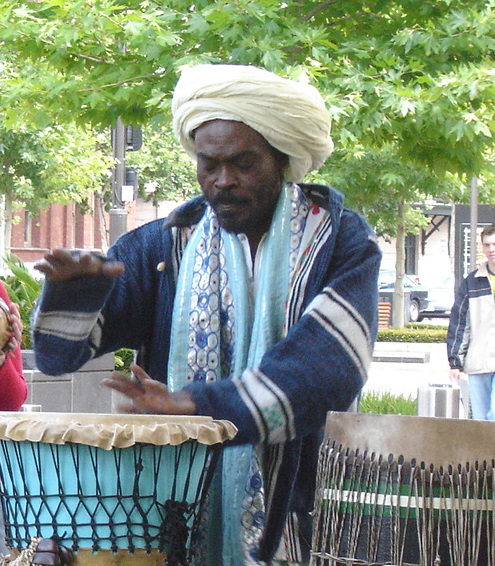
Sam Oshodi, pictured in the introduction, welcomed onlookers and introduced the day with his marvellous African drums.
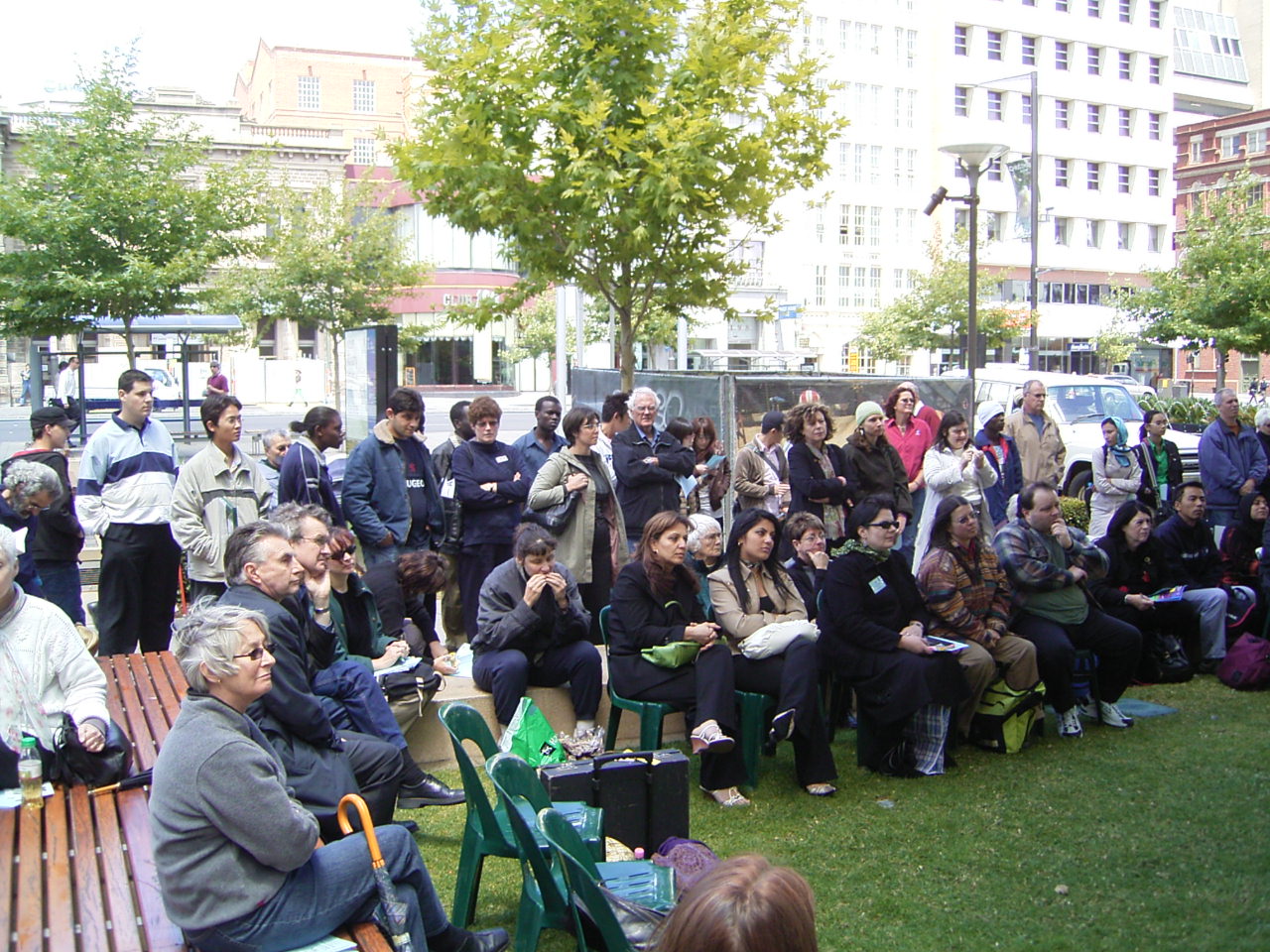
You will recognise some of the people in the audience, John Hill, then SA’s Health Minister, on the left and, next to him, author and poet Peter Goldsworthy. Mike Ladd, then of ABC Adelaide’s Poetica, is on the far right.
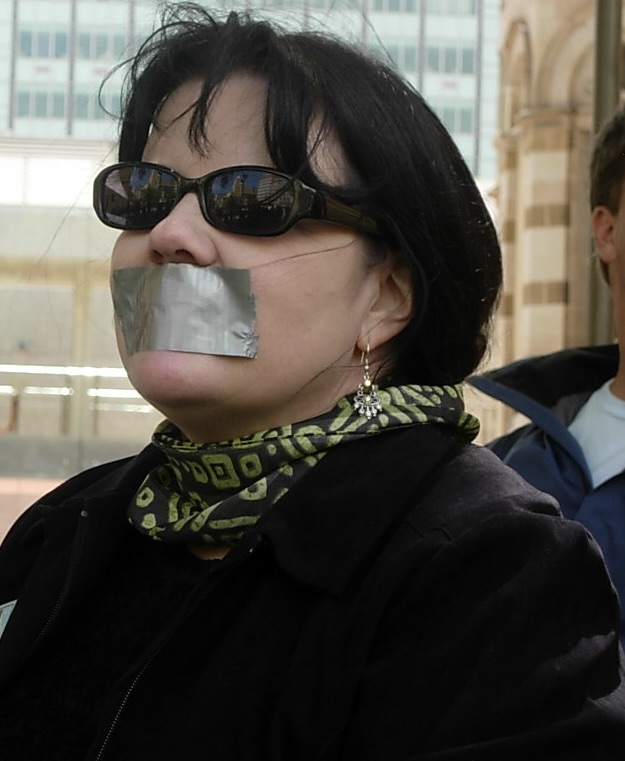
Jude Aquilina, another well-known Adelaide poet in the centre of the top photo, soon did a stint with masking tape over her mouth to represent the silencing of writers. Others took turns. in rotation. In PEN, an Empty Chair symbolises those who have died, disappeared or find themselves imprisoned for speaking out.

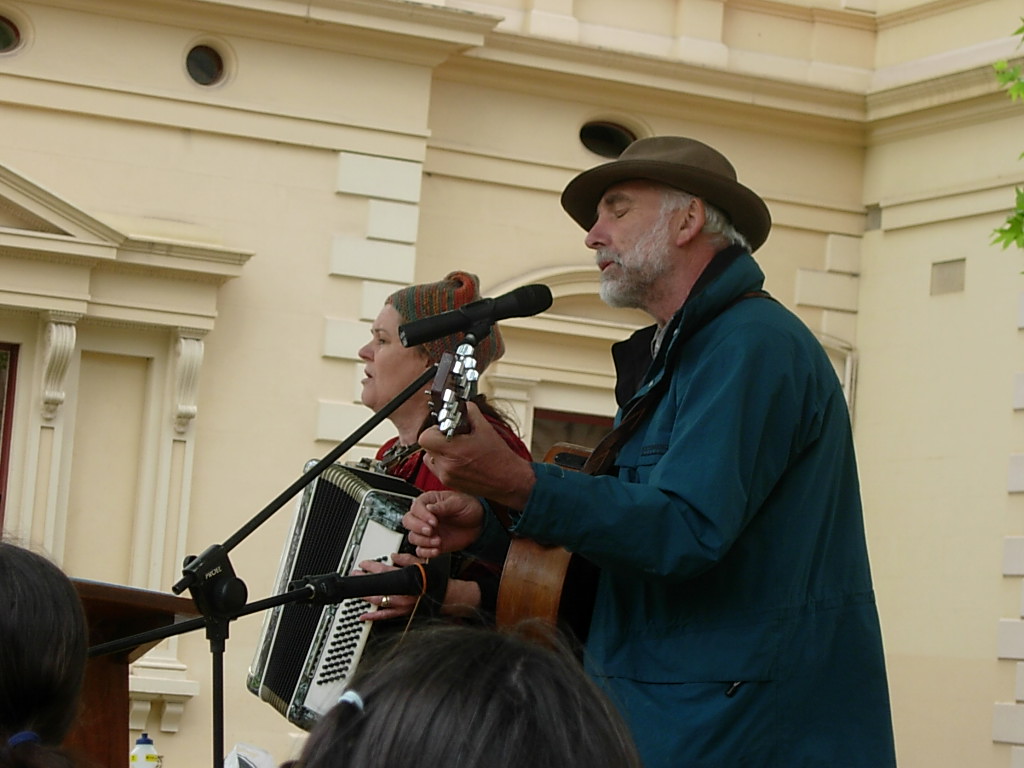
Australia’s National Human Rights Commissioner and Aboriginal and Torres Strait Islander Social Justice Commissioner at the time, Dr Tom Calma AO, was the keynote speaker. I once worked with Dr Calma’s family in Darwin so it was a thrill that he accepted our invitation. That is him holding papers in the photo below.
Click here to read Dr Calma’s speech, ‘Freedom of Expression, Censorship and Race Relations’.

At meetings, Adelaide PEN members also wrote regular letters to prisoners and sent greeting cards during the Xmas festive season. After two years, I stepped down as Chair, making way for others. Unfortunately, PEN is no longer active in Adelaide.
The Juxtaposition
I juxtapose the poems below with the inanities of today’s political media. The poignancy in each poem reveals a depth of suffering from poets who nevertheless have the courage to speak out against war and human rights abuses. We are fortunate that the first three poets live in Adelaide.
Apart from a brief introduction to each poet, I’ll let their poems do the talking.
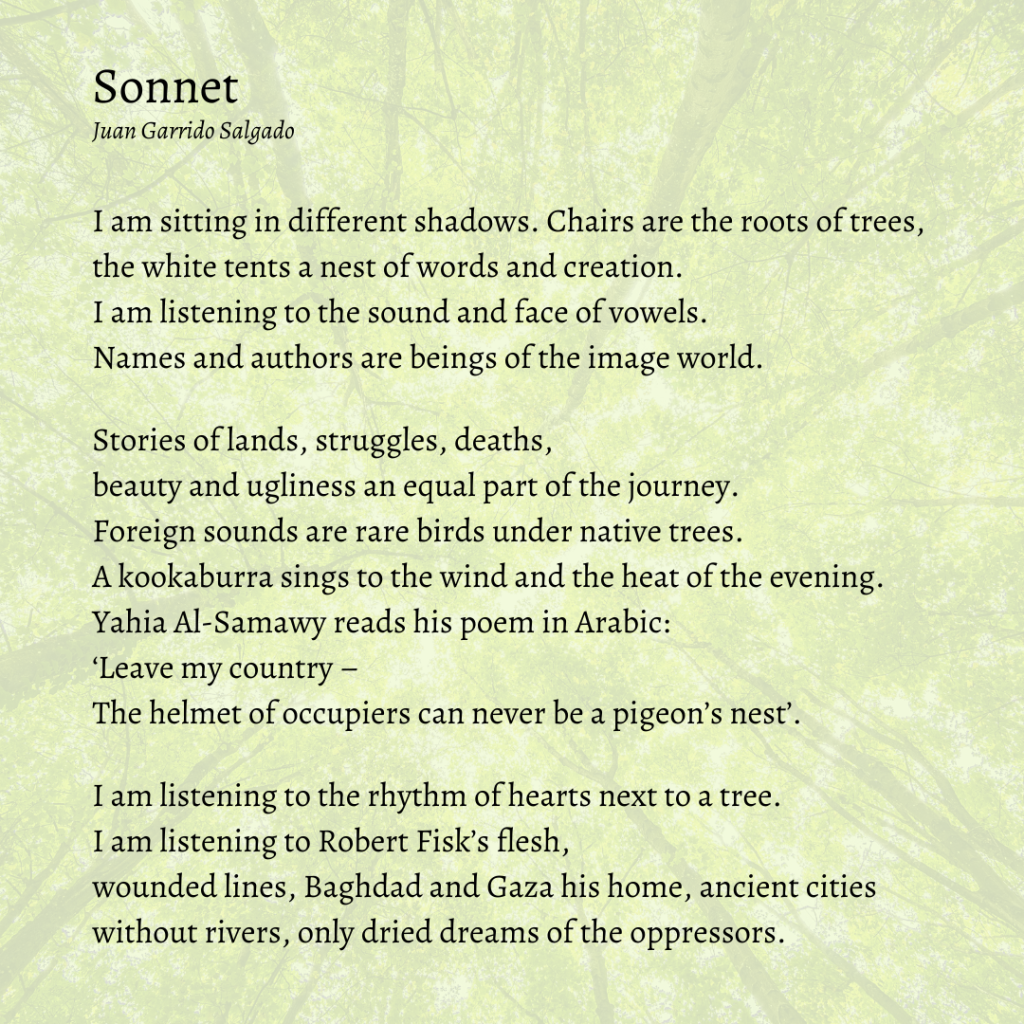
Juan Garrido Salgado
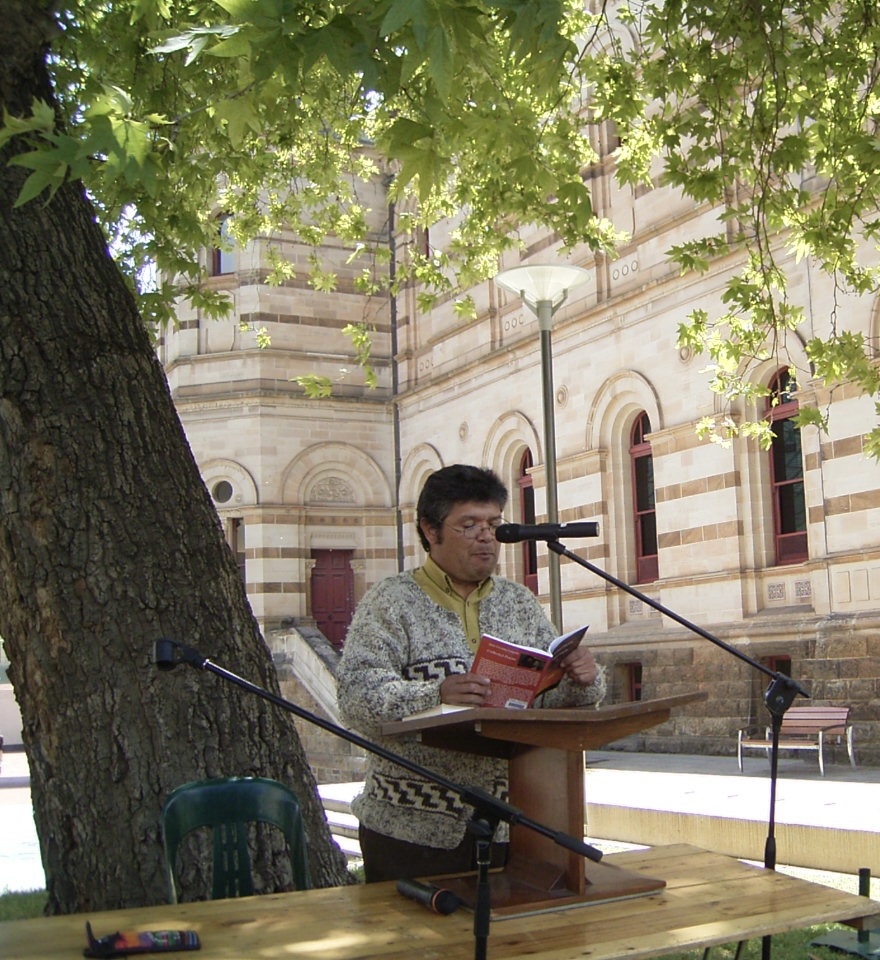
Juan migrated to Australia from Chile in 1990, fleeing the regime that burned his poetry and imprisoned and tortured him for political activism. He has published eight poetry books, and his work has been widely translated. He has also translated into Spanish works by a number of leading Australian and five Aboriginal poets for the anthology Espejo de Tierra/ Earth Mirror (2008). With Steve Brock and Sergio Holas, Juan also translated the Trilingual Mapuche Poetry Anthology into English.
In 2019, Juan read poems from his book, When I was Clandestine as part of a poetical tour at the Granada International Poetry Festival in Nicaragua and at a series of literary events in Mexico and Cuba. His most recent collection is Hope Blossoming in their Ink. (Puncher & Wattmann 2020).
With Judith Nangala Crispin and Anthony Lawrence, Juan judged the 67th Blake Poetry Prize. At Adelaide Writers Week in 2022, he contributed to ‘a ruthless muse’, a poetry performance with some of the finest and most dedicated of our local poets.
Read more about Juan here.
Yahia Alsamawi

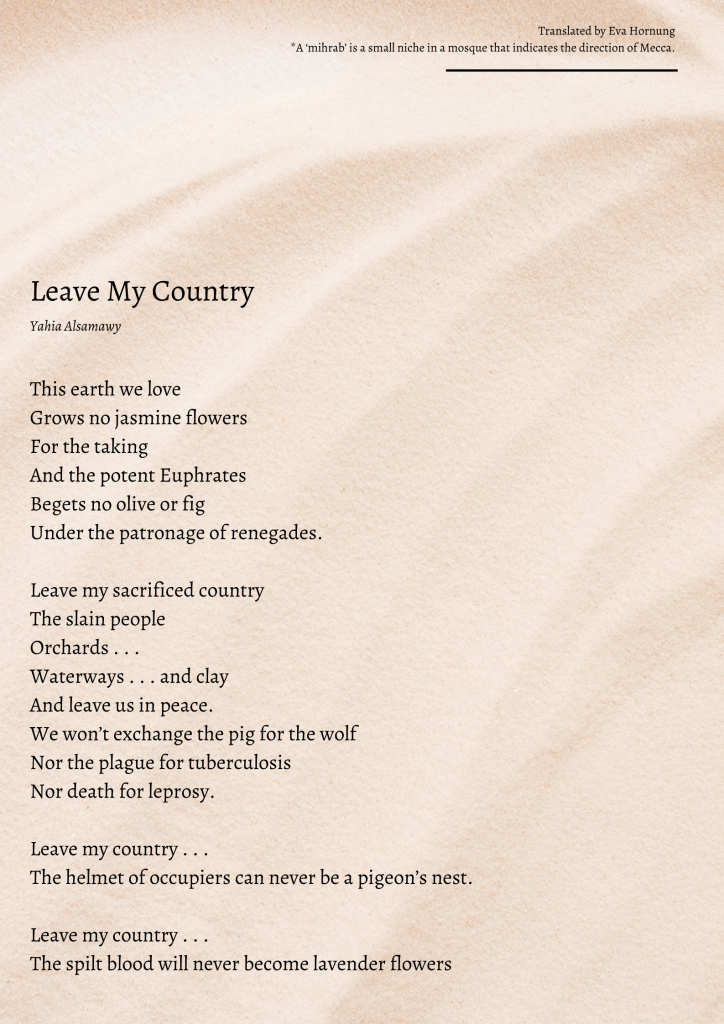
Yahia Alsamawy was born in Samaway in Iraq in 1949. He was a teacher, writer, poet, and part of a following to overthrow or challenge Saddam Hussein’s regime, which was successful for a while but failed in 1991. When Yahia heard about attempts to execute him, he fled alone to the Kuwait border and then to Saudi Arabia, from where he sent others to bring his family to join him. Then, after suffering years of threats and attempts to silence him, he brought his family to Australia.
Yahia has published many poetry collections and is considered a leading Arab poet who has won several prizes for his achievements.
I want to point out that, at Adelaide PEN’s inaugural Day of the Imprisoned Writer, Yahia read this poem in Arabic, followed by a reading in English by his translator, Eva Hornung. Just listening to the Arabic sent chills through me and brought tears. Yes, the language is poetic, but the anguish of Yahia’s reading touched me without understanding the words.
Read more about Yahia here.

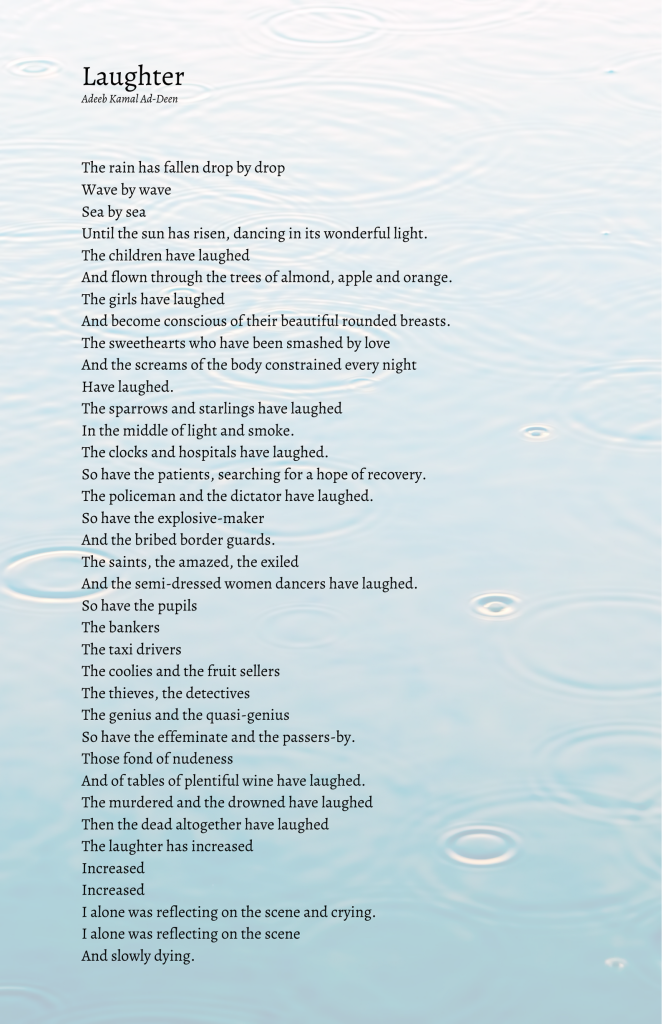
Adeeb Kamal Ad-Deen
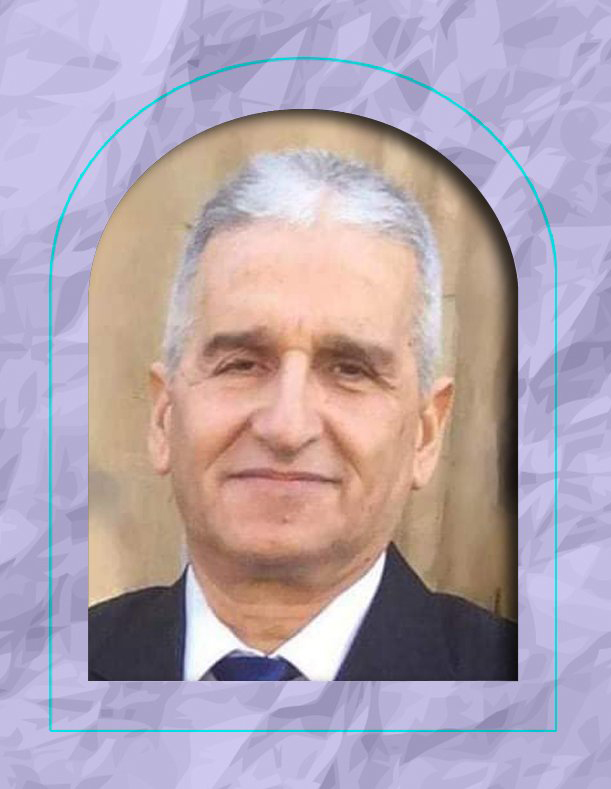
Adeeb Kamal Ad-Deen studied Economics and English Literature at Baghdad University and has a Diploma of Interpreting (Arabic-English) from the Adelaide Institute of TAFE in South Australia.
He has published 25 poetry collections and, in 1999, won the major prize of Iraqi poetry. His work has been translated into many languages and reviewed in Iraqi, Tunisian, Lebanese, Palestinian, Yemeni and Moroccan. He has written Arabic translations of short stories and poems from Australia, Japan, New Zealand, China and the United States.
Read more about Adeeb here in English and here in Arabic.
Ranjan Abayasekera
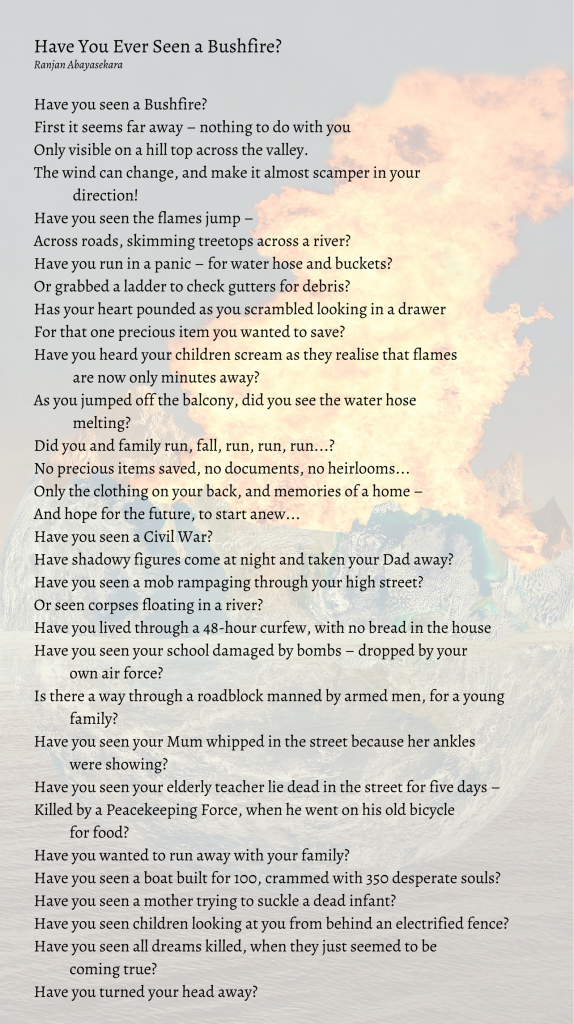
I discovered Ranjan Abayasekera’s poem ‘Have You Seen a Bushfire’ in Another Country, a Sydney PEN anthology edited by Rosie Scott and Thomas Keneally (1984). The writings are primarily from refugees held in the Baxter Detention Centre. The Introduction reads —
This ‘other country’ is a place that poets map, “...a nightmare country which lies in the heart of Australia...a place where innocents are locked up for years without charge, without trial, without hope where children live behind razor wire without trees or dreams. It is a country where people sew their lips together in acts of courage and despair, and the fostering of hopelessness is law, deceit, the language, the breaking of the human spirit official policy. ... This is a country where people are driven mad by despair, die by their own hand, or slowly, day by day as the years wear on. It is a country where mercy has no place and children die of grief.
Another Country describes Ranjan Abayasekera as an electrical engineer from Sri Lanka, then working in Whyalla. He was active at the Baxter Detention Centre and founded the Centre’s Newsletter. In this poem, he brings Australia and Sri Lanka together because he feels that tragedy allows people to recognise their shared humanity.
International PEN Women Writers Committee (IPWWC)
It is not always easy to find women’s political poetry, especially in countries where women’s writing, like their voices, is frequently marginalised. The IPWWC was created in 1991 to redress this imbalance within International PEN’s framework and now enjoys representation in over 70 PEN Centres.
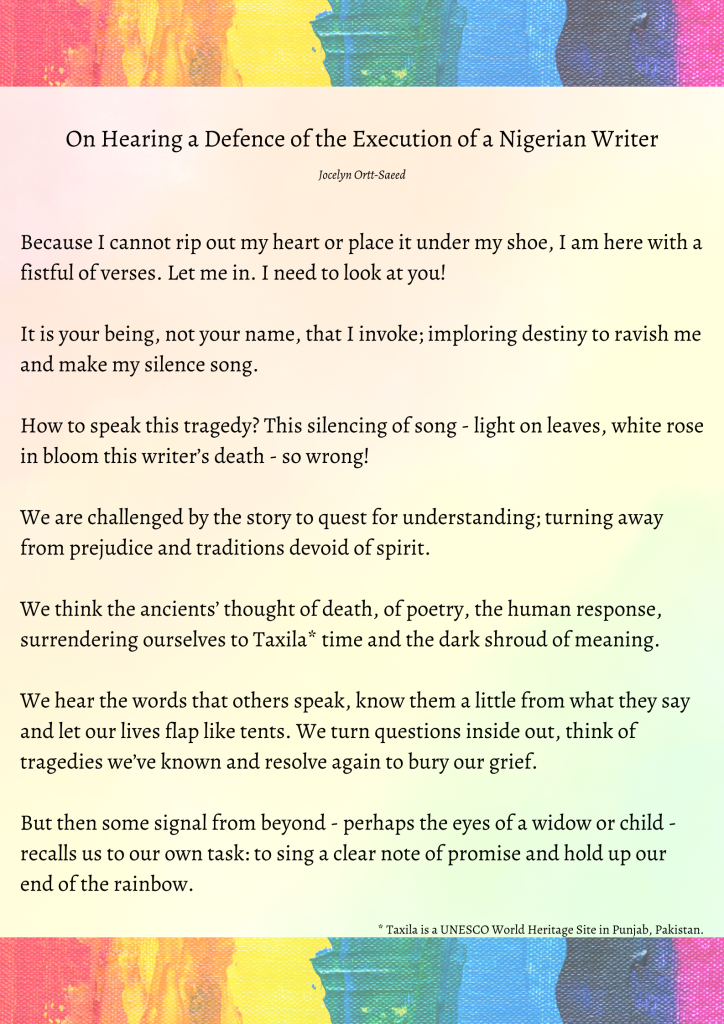
Dr Judith Buckrich, Vice-President of the Melbourne Centre of PEN in Australia until 2017 and Chair of IPWWC between 2003 and 2009 introduced me to PEN and provided the following poem by Jocelyn Ortt-Saeed.
Jocelyn Ortt-Saeed
Jocelyn Ortt-Saeed is a Pakistani poet living in Brisbane. Born in Australia and educated in Germany, she spent a large part of her life in Pakistan, and her poetry draws on the Suffi tradition.
A Final Word
I started with journalists misbehaving and juxtaposed that contemporary unpleasantness with uplifting poems of grief and wisdom from talented people who write with hope as they share their pain. We all need to be mindful of how fortunate most of us are in this country — excluding those in detention, as we all know. Are we complicit?
I survived Cyclone Tracy in 1974 and lived in Japan post WWII as a child, where I can still remember as I write, seeing white ash scenes of Hiroshima after the atomic bomb from a train window. I had ringworm smothered with Gentian Violet! And I lived in Sri Lanka during curfews just before the great turmoil that Ranjan Abayasekera’s poem highlights.
While I heard stories of earlier pogroms, flaming tire necklaces and floating bodies, I cannot conceive what it must be like to live through or survive war and persecution like the poets who have generously shared their work here and writers, including journalists worldwide, who are often imprisoned or killed for speaking out to power.
Tip
Each time we pick up our pens, we have a responsibility to write with integrity and bring truth into the light.
ACKNOWLEDGEMENTS:
‘Sonnet’ by Juan Garrido-Salgado in Hope Blossoming. Puncher & Wattman 2020
‘Laughing’ and photo with permission, Adeeb Kamal Ad-Deen
‘Leave My Country’ with permission, Yahia Alsamawi
Photos from Adelaide PEN’s 2006 Day of the Imprisoned Writer are from my collection.
Oh! Thank you, Veronica. It gave me great pleasure to revisit these poems, they are as you say so moving and powerful. Everybody was happy for me to publish them again here which was also gratifying.
Lindy…so powerful, so sad. Hats off to you for putting this out there. I was very moved by all the poets and poems, but especially by the intro to ‘Other Country’ and the poem ‘Have you ever seen a bushfire?” We have such a stupid government with no empathy. I can only wonder at how they all sleep at night and just what some of these desperate people from other lands are meant to do to escape their horrible lot. How would we manage in the same situation?
My goodness, you’ve done such a lot in your life – and it ain’t finished yet.
Thank you Lindy