

Overview
As human beings, we all get triggered daily by various feelings, emotions and events. Nature’s beauty does wonders for many, and it is even true for those who are entangled in the material nexus of our globalised modern world. Expressions of feelings in poetry can have a cathartic effect, primarily for the poet and secondarily for readers who identify themselves in a poem or when somebody narrates their story. The Greek-derived word ‘catharsis’ literally means purification or cleansing. Therefore, creative writers and their readers can both purge or assimilate powerful emotions.
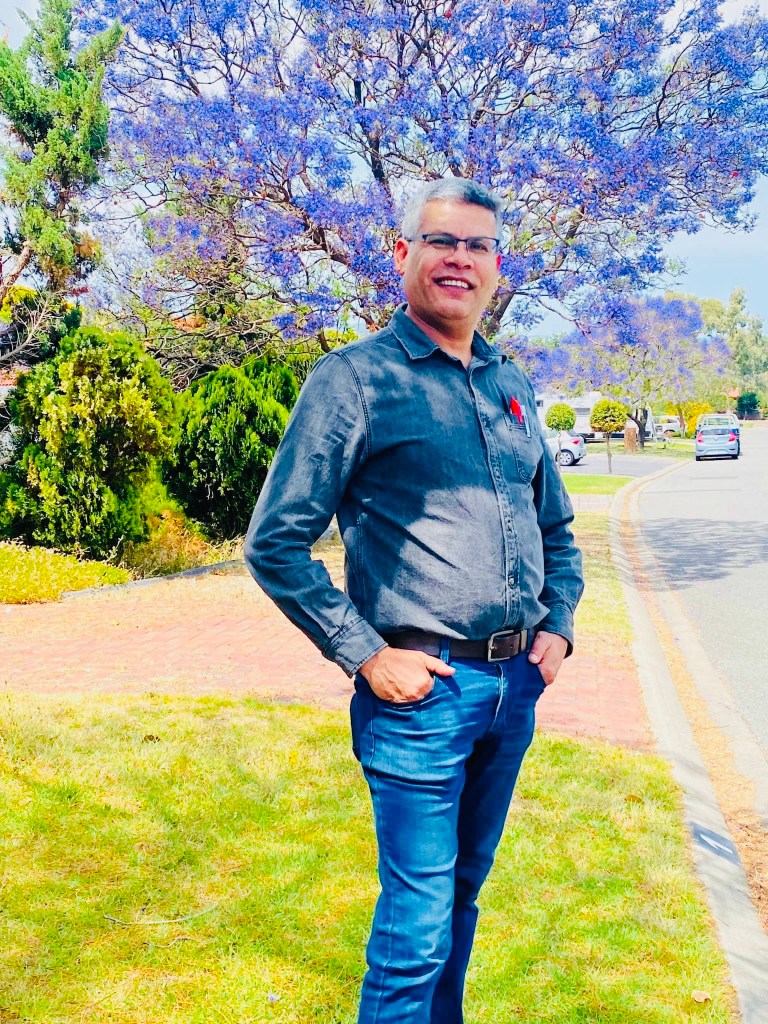

Influences in My Formative Years
I grew up reading poetry and other genres by luminaries of Nepali literature such as Bhanu Bhakta Acharya, Laxmi Prasad Devkota, Lekha Nath Poudyal, and Balakrishna Sama. The earliest poems that inculcated my love of poetry was Kishan Ko Rahar ( A Farmer’s Desire) by the poet laureate, and founding father of modern Nepali poetry and literature Lekhna Paudyal’s Pinjada Ko Suga (A Caged Parrot).
Because of A Caged Parrot, I dedicated my time to the preservation of birds and their habitat; I felt utterly uncomfortable seeing caged birds in the community I grew up in. Chitwan National Park (CNP) in Nepal is considered a paradise for bird watchers as it houses over 700 bird species, even today.
I have read all of these poems many times and sung among peers during the rice seeding and planting season and in gatherings. The simplicity and highly rhythmic nature of the poems made me proud to be a child of a farmer and a political activist. Later I read significant works of BP Koirala, Bhawani Vikhchhu and some contemporary Nepali writers like Ram Babu Ghimire, Dhan Raj Giri, Bijay Kumar Pandey and so on.
My love for writing poetry in English was catapulted by Shakespearean sonnets, W. B. Yeats, Robert Browning, Andrew Marvell, Sylvia Plath and P. B Shelley. I dearly admire E.E Cumming’s and Emily Dickinson’s style, and was profoundly influenced by the romantic elements in Wordsworth and Keats.
Nature
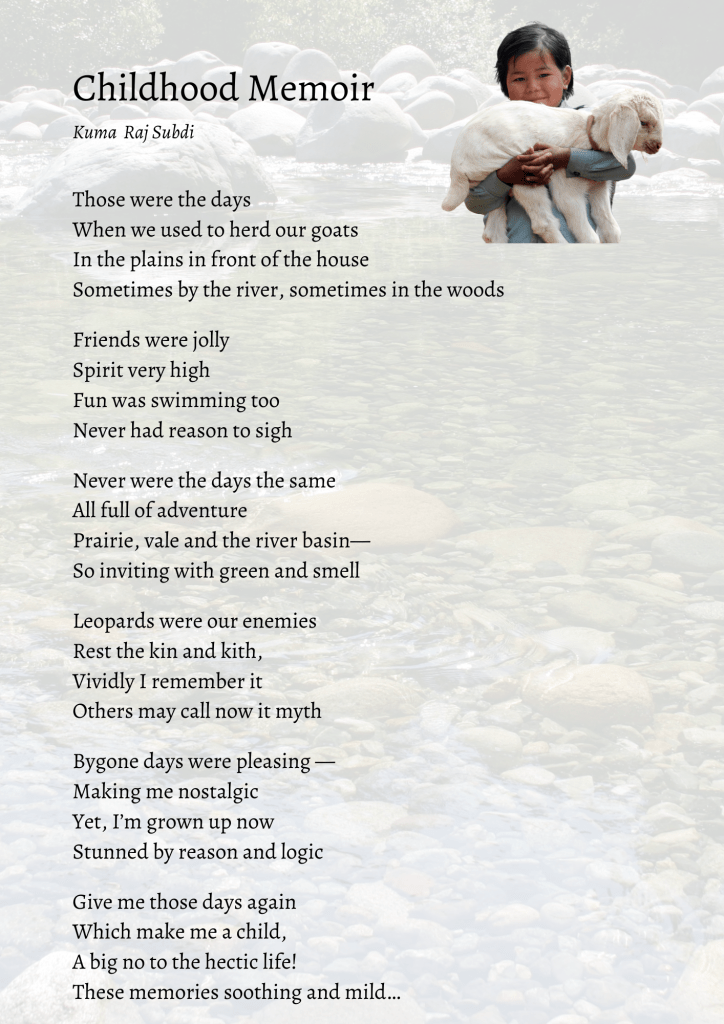
My childhood days were well spent in the lap of nature’s abundance. I swam fearlessly in the rivers Rapti and Dhungre infested with crocodiles: gharial and marsh magar, be it in the monsoon or in the summer. Goat herding in the vicinity of the Chitwan National Park as a young boy and exploring the nooks and corners of it as a naturalist in search of rare flora and fauna with enthusiastic travellers.
My first published poem in the newsletter of the then King Mahendra Trust was about the beauty of the CNP and birds. The poem was titled “Suryodaya Sangai Chara Ra Ma”. It was the only poem published in that edition. My affiliation with the Bird Education Society (BES) and time in nature to study birds helped me exploit vivid symbols and imagery in my poems.
Bygone days and coming of age are also evident in the poems I have written in adulthood.
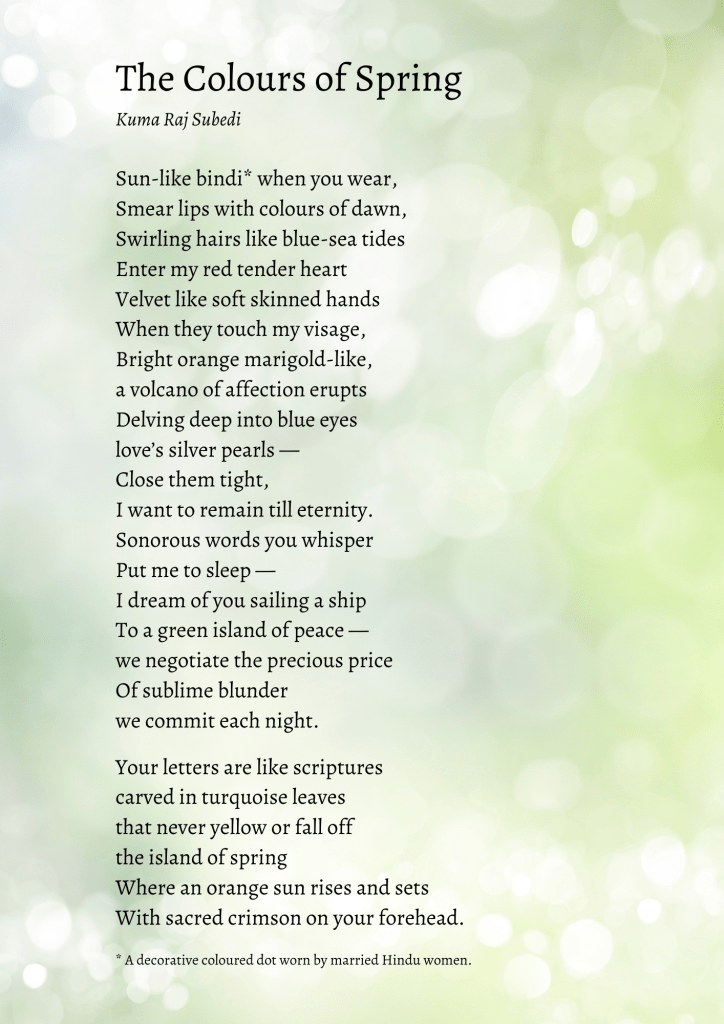
Love is an obscure and abstract symbol commonly used in creative writing. In human history, we have seen now it can cause great wars and settle disputes! It is another frequently occurring theme in my poetry. This instinctive human emotion can bind two souls as one and give hope to move forward. At the same time, love is agony for a person denied. In both its physical and metaphysical sense, a human heart can bleed and experience exaltation. At both extremes, it triggers unique emotions such as nostalgia, euphoria, intimacy, passion, and commitment, which have the power to heal a troubled monkey-mind. My own intense jealousy and companionship always played a crucial catalyst in my early love poems.
Exploring these emotions mingled with the natural beauty in a pristine and peace-loving country, has resulted in a number of my poems being well-received internationally.
Oppression
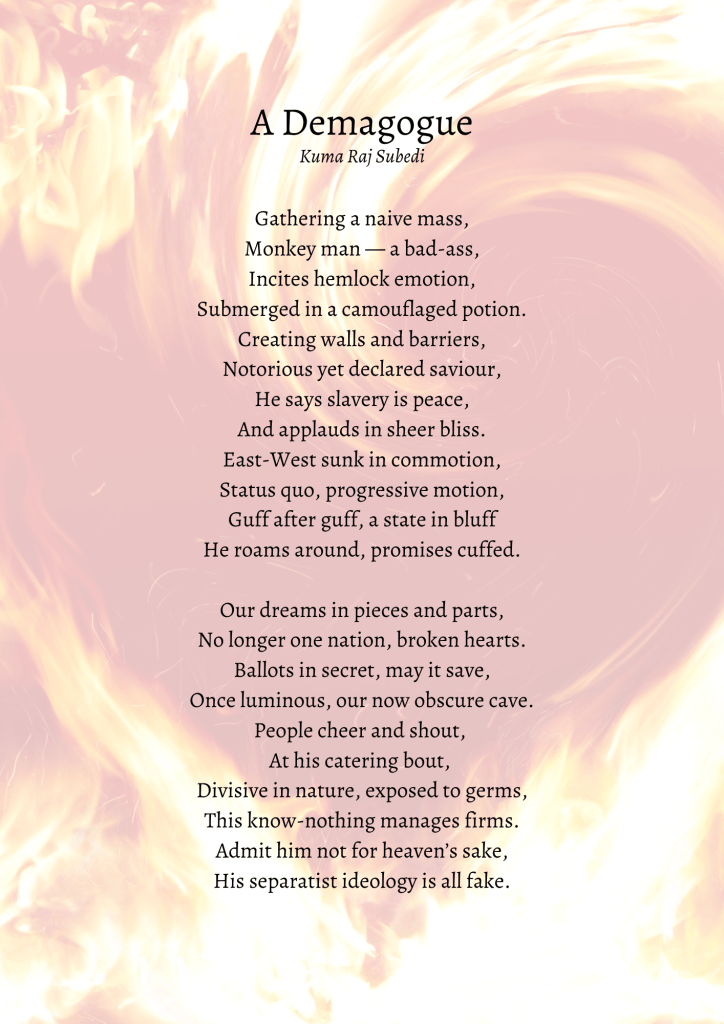
It would be a lie to say that I’m apolitical. Politics has a direct impact on people’s everyday lives. A country bumpkin like me, I gained political awareness as a teen, listening to the BBC news in Nepali on Dad’s licensed radio. I also experienced a major political upheaval in 1990 and again at the beginning of this century.
For the first time in my life, I had the opportunity to exercise freedom of speech when democracy was restored in Nepal — in 2046 by the Historical Hindu Calendar, Bikram Sambat or, in Gregorian terms, 1990. My family supported the freedom fighter of the time rebelling against the Panchayat Governance System, and Dad occasionally had to go underground to escape arrest. His politically oriented stories and events of the 1990s movement impacted me profoundly when I was at school.
I started writing poems and short farcical political satire on big cardboard, released weekly and erected them on a wooden display board by the roadside for villagers. I received some inspiring feedback! Political awareness and restoration of freedom of speech worked as catalysts in my creative writing until now.
Later, in my college days, when I was also working as a lower secondary level English language teacher and Free and Open-Source Software (FOSS) activist, my political satire, write-ups and interviews on Information Technology were published for some years in The Chitwan Post, the oldest national daily in Chitwan district.
Women’s Suffering
Nepal is still a developing country. Although women have been given equal rights in rural villages, they are still subservient. The Patriarchal structure of conservative communities does not allow women’s voices to flourish. There have been recent changes in the situation due to education and government initiatives, but up until a couple of decades ago, women mostly busied themselves daily with household chores. They had neither financial freedom nor the freedom to protest polygamy.
In some cultures, polygamy is still practised. Female education has largely been neglected in conservative societies that regard males as the charioteers of family life! My mother was fortunate enough to attend school, but she was utterly subordinated like other women living in a joint family: looking after younger siblings, working on farms and adhering to rigid cultural practices which were barriers to their smooth education.
Later, working as a permanent government English language teacher, I witnessed the effect of prevalent social practices on young girls. Some of my poetry echoes the voices of these voiceless gems of the Nepalese societies.
AUTHOR BIO

Kuma Raj Subedi, born in 1997, is a bilingual Australian poet and translator. He is also the recipient of The Best Poet of the Event Award at the International Nazrul Poetry Festival 2023, in Bangladesh. As an ESL lecturer, Kuma often writes about nature, female suffrage, religion, memories and identity. His numerous poems have been featured in a variety of international journals, magazines, anthologies and reviews. Subedi’s debut anthology, The Colours of Spring, was published in Nepal in 2023.
ACKNOWLEDGEMENTS
“Childhood Memoir” was first published in The Misty Mountain Review 2013
“The Colours of Spring” was first featured in The Gorkha Times in March 2021
“A Demagogue” was first published in The Indian Review
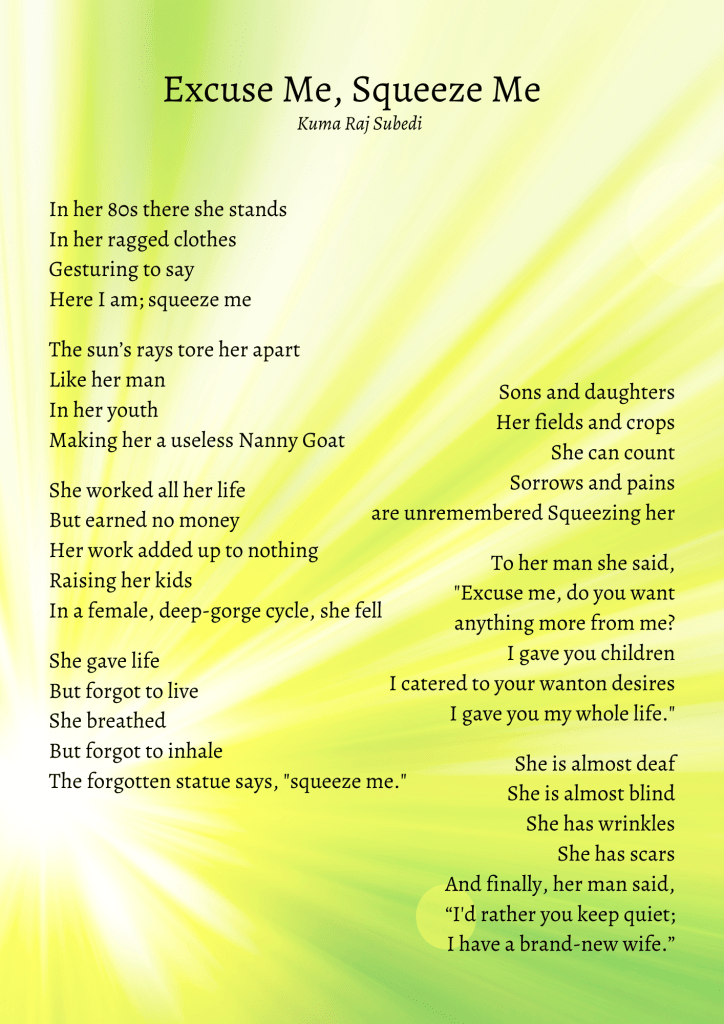
“Excuse Me Squeeze Me” was first published in Muse India in 2021
Hi Gillian
Thank you for taking some time to read the blogpost and sharing your inspiring thoughts.
Cheers
Kuma
Wow Kuma, what a sensitive talent you are !
I have only just seen and read this. No wonder you didn’t want to look me in the face the other day – no doubt thinking how rude and ignorant I was … Congratulations on beautiful writing, sensitivity , intelligence and kindness. For your relative youth, you are inspiring. Bravo, do keep it up. Gillian x
Thank you Bhoj for going through the blog and sharing your thoughts. 🙂
I really enjoyed the poetry which made me feel nostalgic. Thank you for sharing your beautiful thoughts and sentiments.
Dear Jenny,
Thank you for taking sometime to share your thoughts after reading the blog with poems. I am glad to know that these poems also resonate with your own experiences 🙂
Hi Zobia,
Thank you for going through the blog and sharing your experience. Your kind words have encouraged me 🙂
Hi Veronica,
Thank you enjoyed the poem . Yes, it’s really sad to see such plight in the rural villages. Thanks again for sharing your thoughts as well.
Thank you Krishna for reading this blog and taking time to comment 🙂
Thank you very Julie for your inspiring words and I’m glad that this post made you explore more about Nepali poets .
What breadth your life has had and is Kuma. All of your poems speak to me. Their insight on your part is astounding.
I think many of us, both women and men, never dared to dream / or had that chance to be noticed or listened to. Your ‘Squeeze me’ poem is poignant in so many levels.
I wonder what you will do next? I will explore other references you have included.
Go well.
Thank you.
Jenny
Kuma I read all of your poems but overall your first poem is the touching tribute to the world of childhood. “Childhood Memories” explores the theme of innocence lost, and the contrast between the simplicity of childhood and the complexities of adulthood is striking.Your depiction of childhood reminds me of my own experiences, particularly the way you described the ‘unspoken bonds’ between friends. It brought back a flood of memories.
Hi Kuma
Thank you for sharing some of your story. It’s always interesting to be able to hear others’ experiences but at the same time to feel blessed that it’s alien to us, except through their words. This time, your words.
I especially loved your poem Excuse me, Squeeze me. It’s a powerful piece, so sad but wonderful that you see her world and recognize how wrong it was/is.
Thank you for sharing your heart rending but hopeful story. I enjoyed reading them especially ‘childhood memoir poem”You write with such feeling,its memorized my chicldhood. I appreciate your words.
Thank you Val for a such a wonderful response. It has made my day 🙂
Hi Kuma,
Thanks for giving some background to your love of poetry. I’m extremely ignorant when it comes to these poets, so I enjoyed looking them up and I understand why you found them inspiring. I gather from the commentary of the translator, that ‘A Farmer’s Desire’ rhymes in Nepali, but that song-like quality has been lost in the English translation. However, the unbreakable bond between the farmer, his family and the land still shines through. It is a sad reminder that, for so many of us, that connection between us and the land has been severed.
I also read ‘The Parrot in the Cage’ which reminded me of the much shorter poem, ‘I Know Why the Caged Bird Sings’ by Maya Angelou, but I felt that Lekhnath Paudyal goes much further than sympathising with the caged bird’s lament for his lost freedom and the pathos of singing about that freedom that he has never known. Instead, I feel that the parrot is a metaphor for the poet who feels the enormous pressure of choosing a different life from the familiar one in the country. He is under pressure to be a poetic voice – the realisation of his dream – yet he feels constrained to please others. He realizes that writing his poetry is not giving him the freedom he expected because of the pressure of others (perhaps societal and political) and so he is torn between the joy of writing and the sorrowful acknowledgement that his reality as a poet is far from his dream that gave birth to his life as a poet sharing his unique voice. I could write a whole essay on this!
However, best I just say thank you for opening me up to this poetry and for sharing your life experiences and observations. I enjoyed reading your poetry, especially two lines describing the life of the old lady. I think they are lines for us all, men and women. How often we bring life into this world and then forget to live it ourselves. We forget why we are here. We forget who we are. We become automatons going through the rituals of responsibility for our families and forget that none of our doings, and even our dreams for them, can compare with expressing our deep, sincere and faithful love for them in all that we do and say. That is the only solid foundation for our family relationships and it enables us to feel free to find our own voice without leaving our families and our childhoods behind. Our families are the deep draft of love that carries us up out of the nest, confident that we can fly off into the big, wide world and survive every storm and crosswind.
All the best with your poetry.
Cheers,
Julie
Thank you Kuma for sharing your poems. I enjoyed reading them especially ‘Squeeze me’. You write with such feeling, and I appreciate your words.
Thank you Heather for your kind message.
Thank you Brian for your appreciation.
I enjoyed the poetry and prose.
The writing is evocative and the concepts explored resonated for me.
Thank you for sharing.
Thank you for sharing your heart rending but hopeful story