

Following Smoke
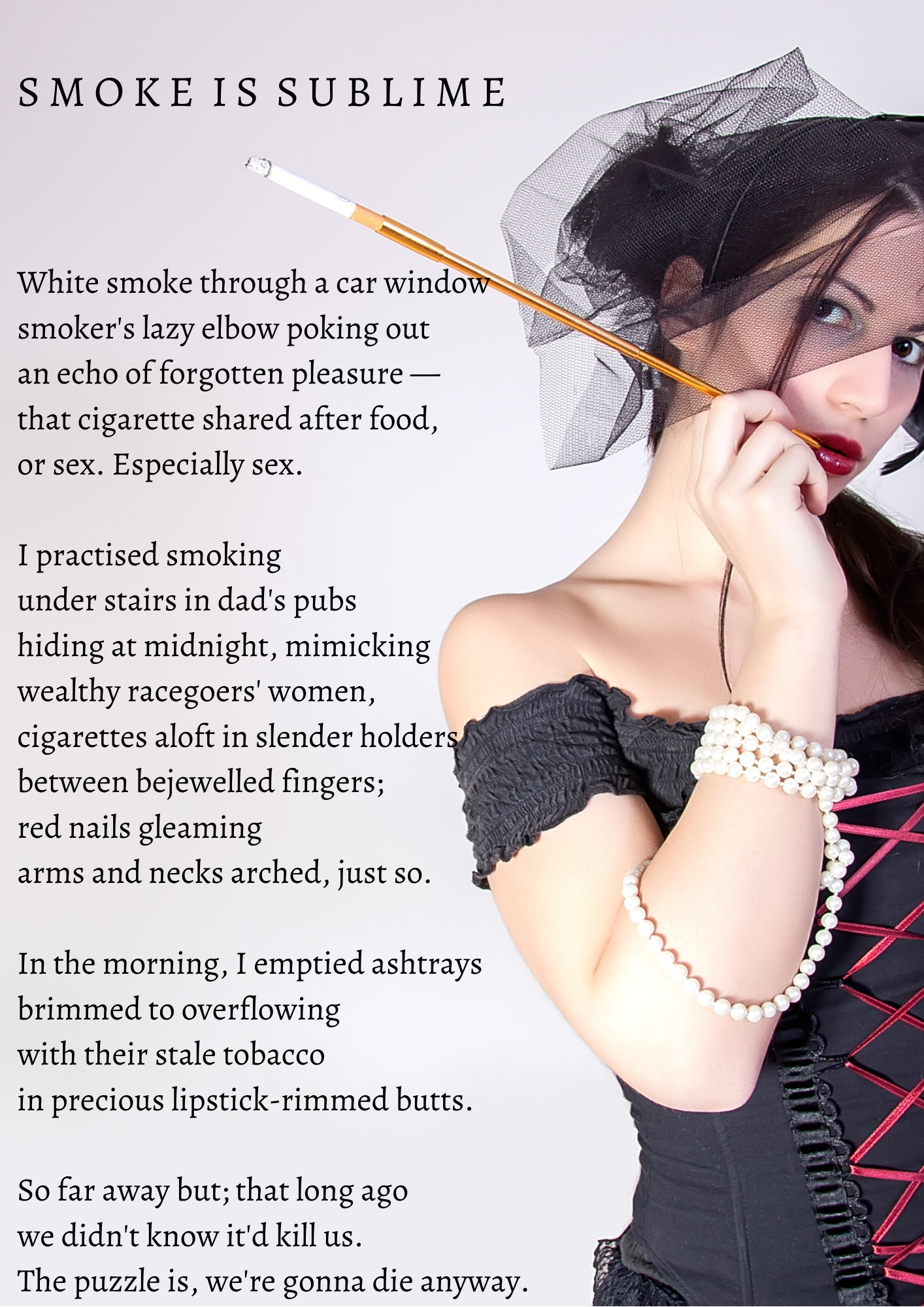
On the way home from Westfield Marion on Christmas Eve 2020, I tailed a small red car, not vintage but an older model that emitted clouds of white tobacco smoke from the driver’s window at regular intervals. As it reached for the sun before dissipating, the smoke reminded me of yesterday’s freedoms; a nostalgia in today’s COVID-19, hog-tying context. The moment spoke to my youth, forcing me to reflect by comparison on how I feel now, in a restricted pandemic scenario.
Who’s a Quitter Then?

Being born and bred in pubs as I was, cigarettes were simply part of my life. We emptied full ashtrays into tins so that glowing butts could not ignite. They smouldered a bit, then magically smothered each other.
It was once a deadly put-down to call someone a ‘quitter’.
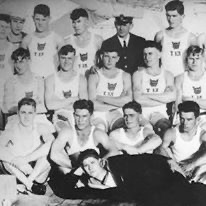
In my Dad’s day in both the Navy and Army where he served, cigarettes were combat issue. In my late teens, I learned in the bush that smoking would clear your sinuses. At work in my twenties, my cigarettes sat proudly next to my typewriter. Nobody questioned the fact that we smoked at our desks, either in front of or with the boss.
My father, Stanley James Warrell, the boy sailor sitting second from the R in the first row.
Did you know that smoking had gendered rules?
The offer of a cigarette was a romantic overture. Any man who lit your cigarette before his own was a gentleman. When a post-coital lover lit two cigarettes simultaneously then took one glowing fag from his mouth to put into yours, it was a gesture of, well, of something. Anyone else who did this was a creep.
Doctors and Nurses
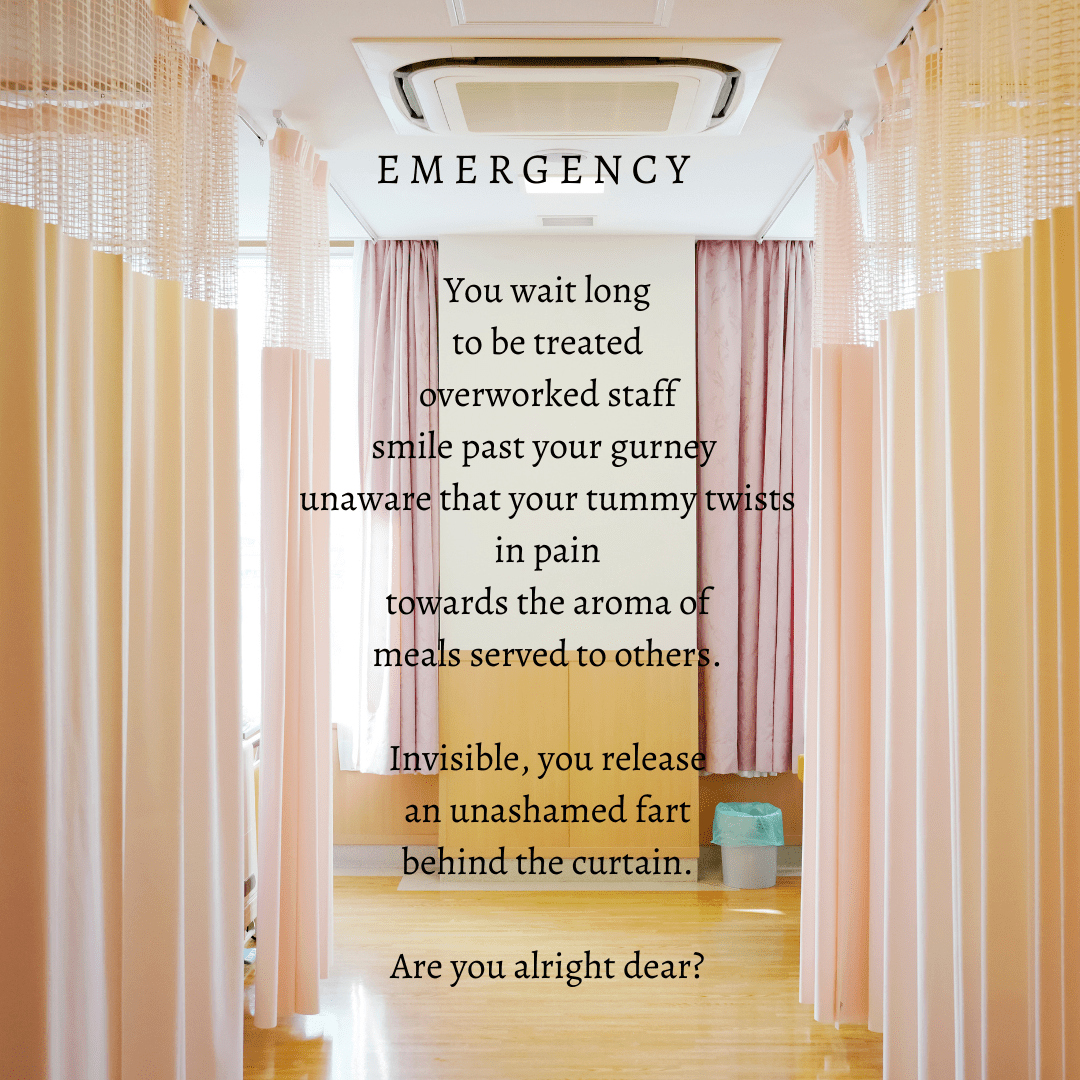
Throughout my youth and early motherhood, general practitioners would offer a ciggy from the pack on their desk, light it for you and push the ashtray forward so you could reach. Once, after I’d had major surgery in the Wakefield Street Private Hospital, two nurses produced an ashtray in my private room, sat it on my tummy and joined me in a smoko. What a giggle! The pain had not yet set in.
A timely cigarette used to allay hunger but now, waiting to be seen in the emergency department is a special form of torture.
In the early seventies, when my first two children were born in Adelaide’s Calvary Hospital, and my third in the Royal Darwin Hospital, mothers smoked in the wards with newborns. Doctors, matrons and nurses joined in at bedside while we fed our infants.
Here are two generations of children thus raised in smoke. As daughter (L) and mother (R), I am the articulating generation. Our cat was called Christmas, and the dog, Melly. The cat got its name from wrecking its first Christmas tree as a kitten and of course, as a pair, they became Melly Christmas.
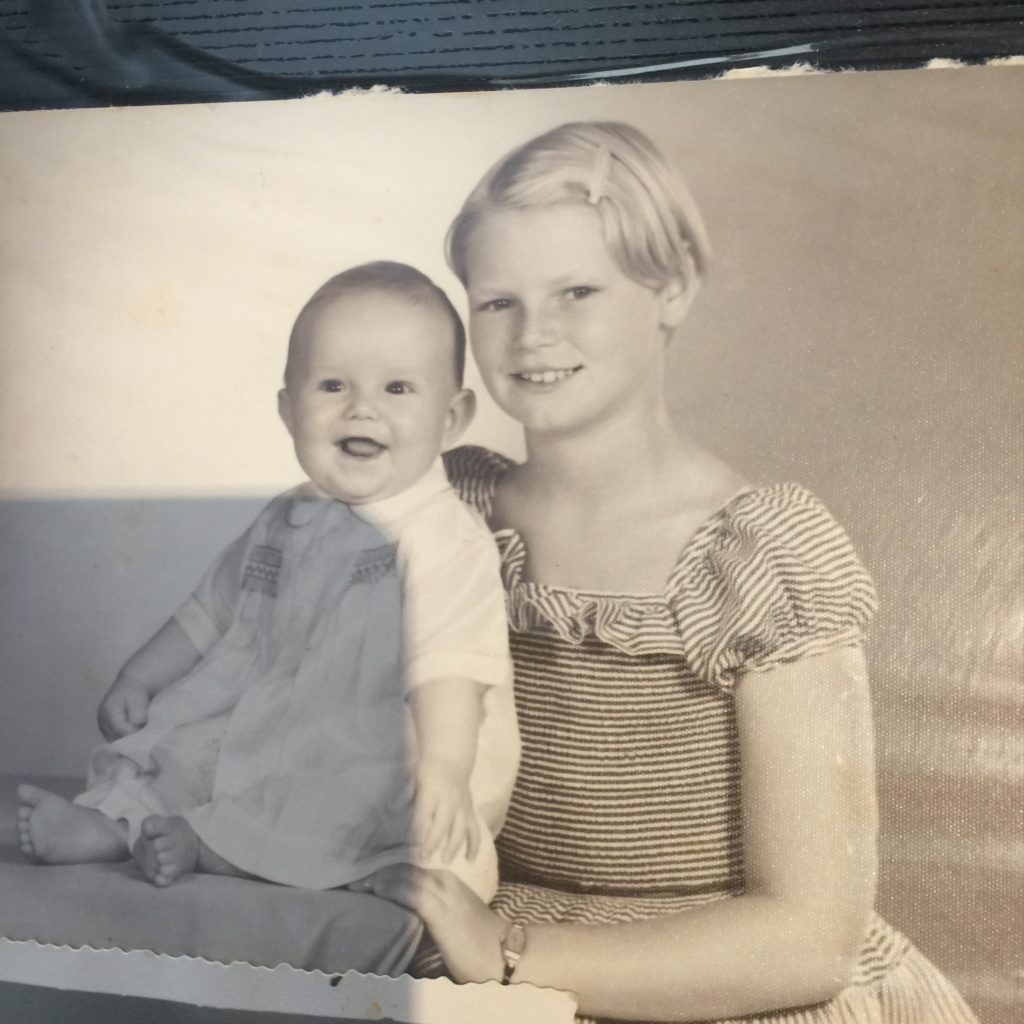
Me with brother Phillip 
L-R Vanessa, Mark and Grant
The Winds Changed
By the mid-1970s, it was becoming acceptable to find smoking unacceptable. I often found myself mocked for my previously unquestioned habit to the extent that I wrote an angry letter, published in ‘The Advertiser’, suggesting it was about time people gave more attention to the deadly dangers of alcohol for individuals and families.
The abusive replies defending the booze were a thing to behold. Grog was, and remains a national icon!

Argue with me if you will, but we can do a pretty good social analysis based on who drinks how, what, when and where. Thirty-plus years on from my letter to the Editor, there is still ambivalence about alcohol; refined drinking is OK, drinking from casks, not so much. In elegant restaurants, yes, on the streets, no. Boozeups are apparently still OK for the right occasion.
Nobody questions the taken-for-granted nature of alcohol consumption. Nor do we as a culture, ask why that is true. The question seems almost silly. You only have to consider how indulgent we are towards schoolies week. There is even a dedicated website for that licence for adolescents to get drunk. Judgement around alcohol remains focused only on method and quantity of intake.
In contrast, as the onslaught on smoking grew, cigarette packets were branded with monstrous images nobody really needs to see. Tobacco promotion at sporting events is now banned. From the mid-1980s, smoking became prohibited in workspaces and public places. Some took these steps as justification for abuse. I remember sitting outside the Morphettville Medical Centre at the corner of Anzac Highway and Morphett Road once when, from ten feet away, people waved ostentatious hands past their noses. And the looks!
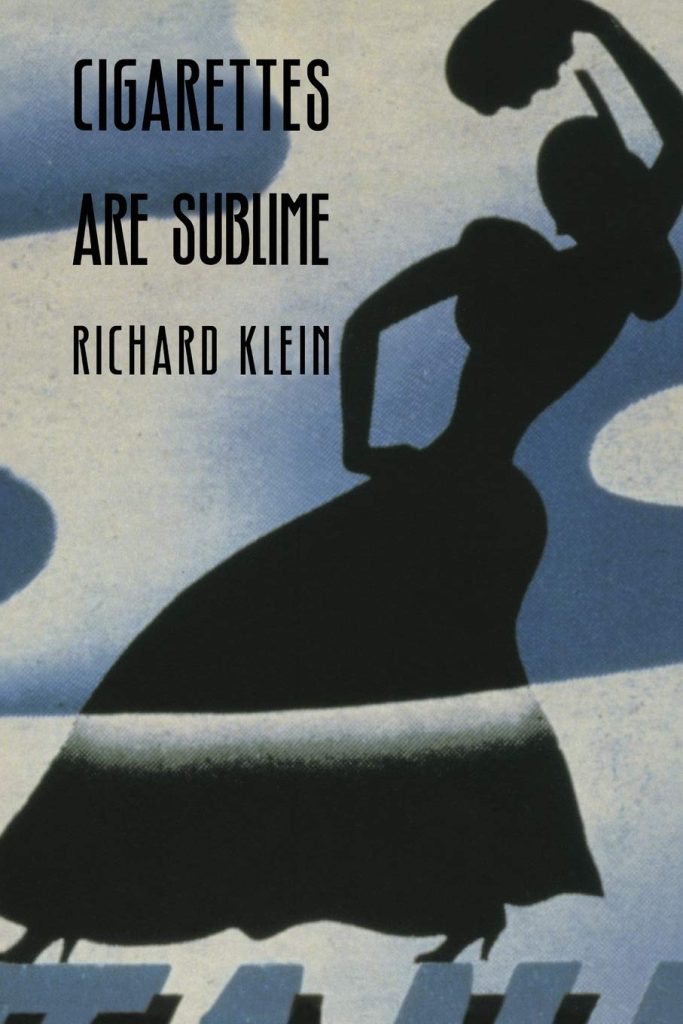
In 1993, social analyst Richard Klein published a remarkable book provocatively entitled; Cigarettes are Sublime.
As a struggling quitter, he explored cigarette smoking’s history and culture to argue that one of the reasons that cigarettes taste so good is that they are bad for you.
We could question how the hell people grew up at all with cigarettes all around for so long but, enough of the smokes.
Let me take you further back to speak of past freedoms.
We Got Away With Heaps
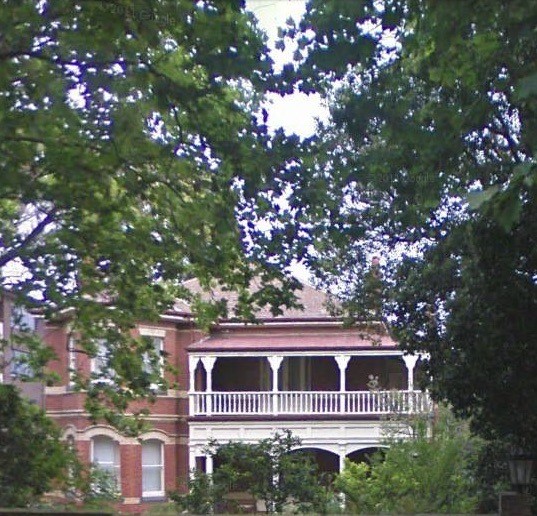
As a primary school child and younger, I lived in a boarding house in Melbourne’s busy suburb of St Kilda where Clysdale horses left hot, steamy droppings when the iceman and others delivered goods on carts. As a pre-schooler, I could stay out until dusk with friends. Nobody worried about us; the dying sun told the time.
7 Redan Street from Google Maps. This is the building, now a posh residence. We had the room facing the front on the top left.
As primary-school kids, we sometimes collected acorns on suburban streets all weekend to feed the zoo elephants, or so we thought. I actually believed that was what we were doing until I wrote this here. Perhaps our parents were telling porkies? In my mind, though, an ethereal poster asking kids to do this still wafts in and out, but I have no recollection of how the acorns got to the zoo.
In Albury NSW in my early teens, a friend and I treadled our clumsy Western Star cycles for miles out of town on weekends to roam in paddocks with dry creek beds, pretending we were explorers (No fancy gears on bikes back then.) We were warned of hermits and given sandwiches, but there was no family car to collect us — no mobile phone to keep tabs. We were on our own. Our parents trusted us in a world that seemed trustworthy, and the frisson of fear served only to heighten the adventure in our imaginations.
Despite the potential risk to their vehicles, various Port Lincoln men taught me to drive at night. Make of that what you will, but there were no permits, L or P plates as I recall. One day, a local policeman called in at the Pier Hotel where I was living and working as a receptionist in dad’s pub to say I’d better hop into the station to apply. All I had to do was answer questions on road rules—no driving test.
No matter that I have come and gone many times over the years, my SA driving test gave me permission, with a transfer, to drive all over this country. It gave me my international licence. I’ve driven free across thousands of kilometres here and elsewhere, on and off-road in the outback and up and down between Darwin and Adelaide many times on the basis of a simple test when I was 16.
The Past is Another Country
As you can see, the past, my past, is another country in ways other than the smoky place my recalcitrant driver sent me to. As I burrow deeper into this rabbit hole of memory, I turn to food; history is there, too.
My parents (born 1910 and 1919) came home from school to a box of seasonal fruit on the back porch: apples, pears, oranges, sometimes stone fruit. It was a challenge to empty the box before the fruit turned brown or succumbed to worms, but this was wholesome tree-to-home fruit. Another snack they had as kids was thick, hand-sliced bread smothered in butter if they could afford it, or dripping when money was tight. Good times saw spreads of honey, jam, Golden Syrup or Vegemite.
Can you imagine eating bread and dripping? Sometimes, as a meal?
I remember watermelon treats, sitting in our St Kilda guesthouse gutter as a small child, red juice dripping, spitting seeds as far as we could and laughing out loud when horse shit hit the road steaming behind the carts of the iceman, milkman or baker. When refrigerators superseded ice-boxes, fruit disappeared from the verandah along with the earthy fragrance of fresh horse dung.
In our Melbourne pails, fresh milk had an inches deep layer of cream on top. When milk was delivered in bottles, the cream was less but was still there for my children as it waited on the front door-step every morning. Before I married, we used to stop the milky’s van after parties (often on Port Road) to buy milk that we joyfully swigged on the way home in the wee hours. Does anyone else remember that?

My kids grew up on home-cooked meals at the kitchen table. Takeaway food was a weekly treat, not the norm. Now, I order frozen meals from Lite and Easy, with Uber Eats on occasion because I like to indulge myself. I also dine with friends in local restaurants and cafes at The Bay, which costs too much but celebrates friendship. On this merry-go-round, the next step could be Meals on Wheels. Oddly enough, though, I just bought some new saucepans. Revival is perhaps afoot.
Then Came COVID-19
Writing this post is a reminder to me of my mental escape routine; a trick of the mind. The puff of white smoke from the red car in front of me last December invited me to look back in nostalgia. The cigarette smoke was just a way in. Had I felt free in the present rather than constrained by the virus, I doubt I’d have needed to take the journey. Indeed, I may not have noticed the driver at all.
My mind likes to take me elsewhere when I am unwell or feeling low. It especially likes to travel back to Darwin and Sri Lanka in yearning for times when I felt loved and happy. I associate feelings with places. I find it hard when thus entangled, to remember that, when I was there, and things got tough, I would sit in the same heaviness, aching for Adelaide or Australia. Anywhere I was not.
To visualise what I am describing, think of the smoke arising from Aladdin’s lamp. That is a metaphor for my mind’s wish to leave the present or depart my weighty, miserable body. My mind drifts or floats away to better times and places. Smoke in this sense really is sublime and, after all, doesn’t Aladdin promise to fulfil wishes?
A Cambodian Buddhist monk friend of mine always laughs at my escape habit. That is the human life, he says. Another friend teases me, saying it’s time to bring out my spotted cloth of belongings on a stick and run away. It only takes a few puffs of white smoke from a red car to send me to another place or, as today, to that lost country called the past.
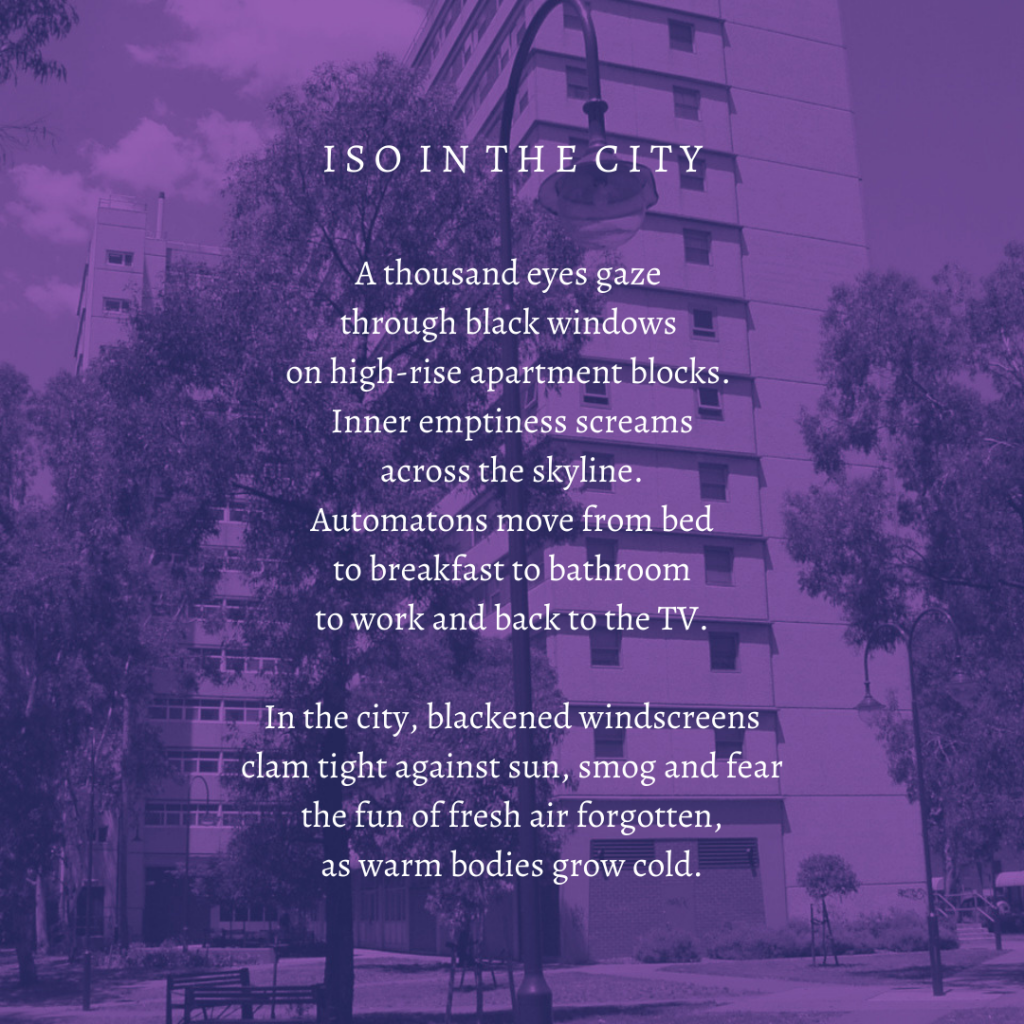
As for COVID-19’s strangle-hold on me, this little poem says it all.
Try This
How about telling your truth about the 2020 pandemic year to a page? Don’t let it swirl in your head where it can make you crazy. Grizzle on the page about everything you lost, missed or regret. Write your heart out about what you yearned for.
Tell the page how you feel now, what you felt then, and what happened or didn’t come about. Did these experiences change the way you view others? Yourself? Are you who you were before March 2020? What’s changed? What have you learned?
These questions are merely a guide.
You must write in a ‘stream of consciousness’. That is, without trying to be intelligent or creative, without trying to control the narrative. Just start wherever and write and write what comes to mind until the impetus fades. This could take 10 minutes or an hour. Write until you run out of things to say. Write through tears and laughter, just write.
Then —
— Try to extract a theme. Did you learn something about yourself during 2020?
— Do you view others, and your life differently now?
— Take an incident, a moment and write a poem about it.
Repeat each of these steps until there is nothing left. Tell as many stories as you like, as vignette or in short form, but work on one story at a time for clarity’s sake.
Writing like this helps us understand which is the first step on the path to overcoming.
Wishing You Happy Writing in 2021
Wattletales
Thanks for reading Veronica, I was a bit worried, this one being about smokes. You did tell me once that you hated cigarettes when you were a kid. I’m glad to know I was not the only one all those years ago who recognised the evils of the booze, which is where my hatred went. Hence I’m a non-drinker 🙂 But those rides in the scrub, bush whatever…gosh we had fun, didn’t we 🙂
Oh Lindy, so many memories. My parents both smoked – never any money and I resented what was spent on those fags (plus Dad’s drinking and gambling), promising myself I would never smoke if it meant my children went without. And the milk-pail left hanging out on the front gate. The freedom of being able to take off on my bike and ride up into the scrub and build cubby houses, with no-one asking where I’d been or worried about the time away. I do remember someone (likely not you) writing to the Advertiser about the fuss made over smoking when alcohol was a far greater danger. I loved your poems too – can hardly imagine nursing staff putting the ashtray on your tummy and having a ‘ciggy’ with you. Thanks for the memories.
Thanks, Julie, I’m glad my memories echoe in someone else’s experience. Times have changed, haven’t they?
Thank you, Lindy for another great Wattltale.
Gosh you took me back to my father’s stinky smoke stained car. No air-cons then to freshen it up.
‘I’ll never smoke,’ I said before I did.
Isn’t it laughable how romantic gestures were passed through the good-old-fag.
My parents bought me a glomesh cigarette case, for goodness sakes.
As products of experience we become in some way or another our parents, flaws and all. Thank goodness they loved us. ♥️
I remember bottled milk, and the baker visiting daily. I always met him, eager for him to roll up the back tarp and for the smell of freshly baked delights to curl through my being.
As for the genie of Aladdin’s lamp, I became him too as well as my parents – years ago at ballet.
Poof- off in a puff of smoke, after all it is 2am. 😁
Thanks Andrew, I hoped I would not be alone! I totally forgot about planes..but the point remains LOL
You write so well, I remember smoking in hospitals and on planes.