

My Peripatetic Life
Now 77, I’ve moved on average, every 18 months throughout my life. To date, I’ve set up home in 50 dwellings in three countries — Australia, Japan and Sri Lanka — and numerous towns and suburbs across Victoria, New South Wales, South Australia, Queensland and the Northern Territory. I moved with my parents when I was young, with children till they left the nest and occasionally with, but mostly without, various husbands.

My lifetime residential record includes eight hotels, three guest houses, a government hostel, a boarding house, a rooming house, a residential delicatessen and numerous free-standing houses, units and flats, not to speak of the occasional short-term outback donga. I’ve shared places, rented others, owned a few and now live in a retirement village. I’ve even had a stint in a high-rise public housing tower.
A decade or so ago, I compiled a list of my dwellings. I draw on a few below to highlight odd moments as a basis for considering the dislocation entailed in moving. It is sometimes hard to make a home.
Growing Up in Pubs

In bios for poetry and writing, I often say I was born and bred in pubs. It is true. My father was a publican, and I list above the hotels I grew up in. I also worked as a receptionist, barmaid, waitress, cook or housemaid in the last four and, in others in various places when times got tough. Even as a mature university and postgrad student with three kids, I was weekend breakfast cook and housemaid at the Hotel Franklin.
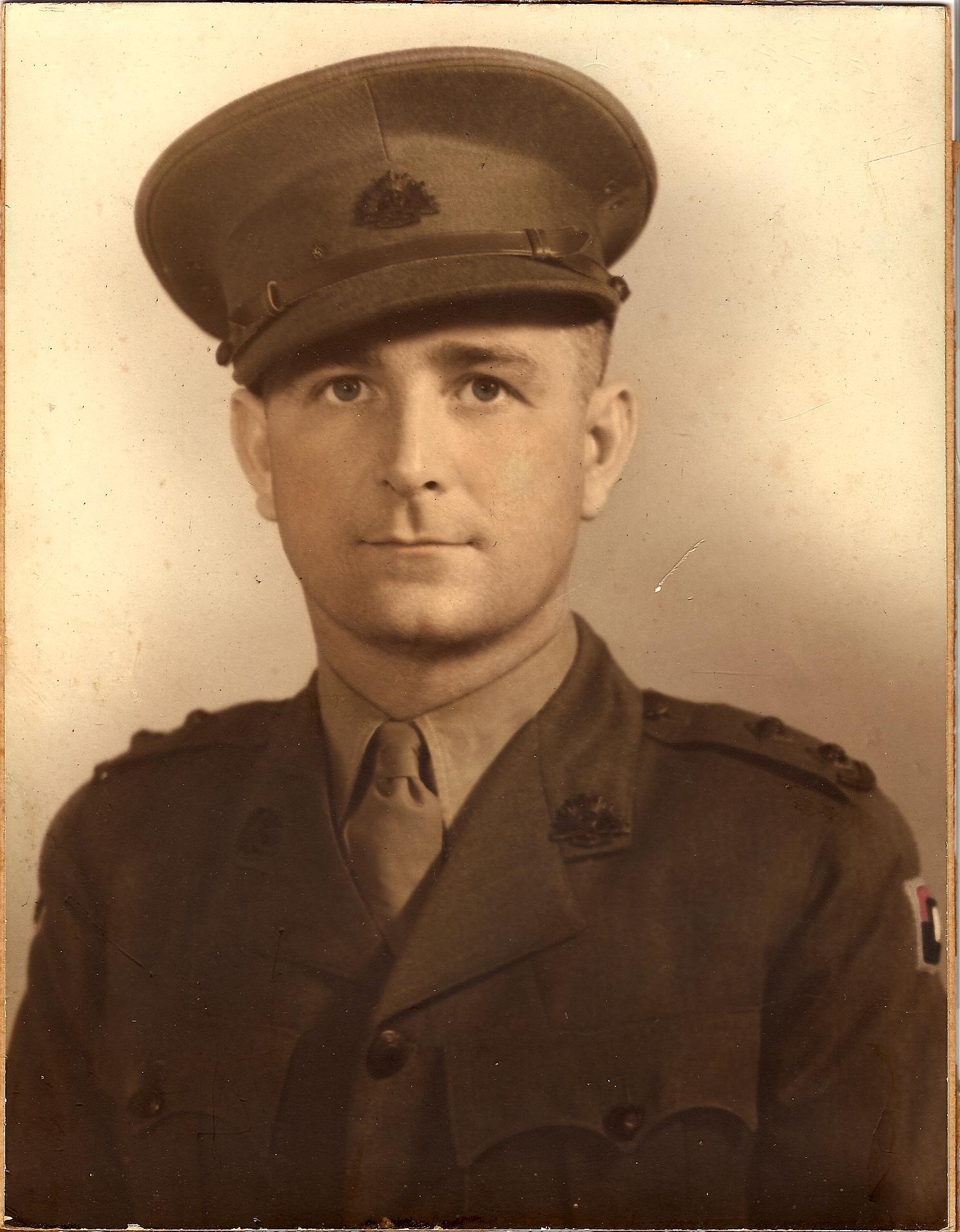
The Marunouchi Hotel in Tokyo, Japan, was commandeered for use by the British Commonwealth Occupation Force (BCOF) and refurbished for purpose and managed by my father, Stan Warrell, promoted to the rank of Major for the role.
I was a sullen and lonely child, and although I was safe, I was isolated and often alone in Japan and daydreamed a lot. I didn’t like my nursemaid. I wanted mum and was only truly happy when touring with her. However, our Japanese chauffeur Kanamtsu and a bellboy called ‘Micky’ whose Japanese name I never knew spoilt me. I adored them.

My bedroom. 
Sullen or sulking? 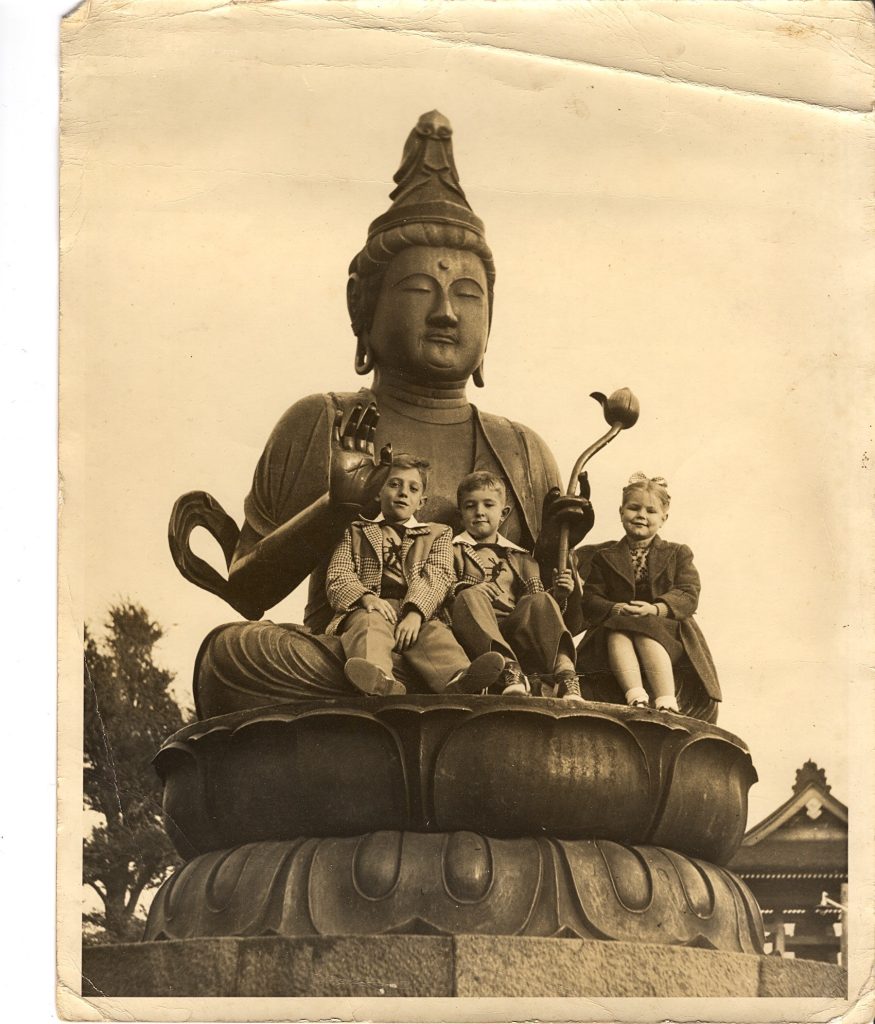
Me with two American boys.
Take a moment to think about the photo of me with two American boys, brothers and children of one of dad’s American counterparts. Nobody considered it wrong to pose children on a statue of the Bodhisattva, Konnan (Chinese, Quan Yin).
My parents took occasional weekend leave in Nikko, where dad played golf with his military friends while mum drank with their wives. I played with naked Japanese children in a nearby rockpool and learned to speak a little Japanese. An old woman my mother inaccurately called mamasan took pity and fed me fluffy steamed rice when I visited her kitchen. I still love plain rice.
In the early 1950s, we moved into the New Albury Hotel. On the cusp of womanhood. I fell in love there with Elvis Presley and had one close friend whose father worked on the railways. Most parents did not approve of my hotel environment. It was in this hotel that my new brother spoilt my single-child status, but a lesbian waitress on staff befriended me and taught me how to play chess. I adored her. One day, she disappeared.
I later discovered that mum had sacked her to protect me. In her defence, years later, when Mum learned that my brother was gay, it made her love him more. In the New Albury Hotel, a fat, female cook took pity on me and allowed me to sit in her pantry to devour two packets of Arnott’s Milk Coffee biscuits after school. Nobody sacked her or the young, foreign kitchenhand who flirted with me before puberty.
Boarding House Life
For me as a child, the boarding house at 7 Redan Street, St Kilda, was my most nurturing home, even though my father, being in the Army, was away a lot. I adored this Redan Street dwelling. We lived here both before, and after my father’s military tour of Japan.
We had an upstairs room where we played a game, calling each other mummy frog, daddy frog and baby frog. After Japan, we sat cross-legged on the floor to eat at our prized Japanese chow table. I remember how big the double bed seemed. I slept on a divan. The building is now up for sale on Realestate.com as an expensive ‘illustrious c1888 solid brick Victorian residence’.
Guest Houses
After the New Albury Hotel, my parents bought a guest house called Tara. A red-headed young journalist staying as a guest made me blush when he wrote this poem in my autograph book for my 13th birthday.
In my late teens, I lived in a couple of other guest houses, one in Bondi, the other in Rushcutters Bay near Kings Cross. I could write books about both, but I’ll just tell you that I nearly fainted one pay-night in a Bondi fish and chip shop while waiting for my hamburger to cook.
Two Sri Lankan students in Australia on the Colombo Plan kindly walked me home that night and took me on tour next day to see The Three Sisters in the Blue Mountains with their posh friend who had a car. They urged me to return to my violent first husband because, they said, a young woman should not be alone or without a husband in a place like Bondi. Bless them. I did try, but it was a disaster.
Another night, two Bondi cops stalked me in their police vehicle as I walked home on the then mandatory high heels from a bus stop after work in the dark. They invited themselves into my boarding house room. Intimidating, handsome and in lust. Finally, I squirmed my way out of trouble by agreeing to bring a friend on another night. Next day, I moved.
A Hostel in Darwin and the House that Changed Everything
In the early 1960’s I lived in a Government Hostel in Darwin in a group of buildings that extends from Mitchell Street through to the Esplanade. It is now backpacker accommodation.
A decade or so later, hippies invaded Lameroo beach opposite the hostel. While they hung in tree houses on the hill leading down to the beach, swam naked in the sea-baths, smoked dope and horrified everyone, I was busy playing housewife in a new police house in an outer suburb until in 1974, Cyclone Tracy blew it away. Soon after that, my marriage broke up and blew me off with three little children under four.

Dislocation
If we accept that the idea of home is a tale of many mansions: of growing up, love, loss, disaster, recovery and, ultimately a place of belonging, then moving is a story of change. A new location often brings the transformation of identity. A move can also entail a shift in status as in my marital breakup.
But there is more to it. Cyclone or not, whenever we move into a new house, our bodies are extracted from a web of places, people, networks, activities, feelings and attachments. We have to start pretty much from scratch making new networks and connections in a process that we loosely call ‘settling in’.
But moving dislocates. Despite the internet, moving house rips bodies and minds out of their previous environment. It is thus a much bigger deal than many think. Psychologists tell us moving is one of the highest stress factors after the death of a loved one. What they don’t say is that, over time, connections and memories fade; continuity is erased.
Few people think of themselves as organisms out of place when we move, but that is what we are. The first time I sought a visa to travel to Sri Lanka, the question asking who my father was, tickled my sense of the ridiculous but it tells us something about belonging.
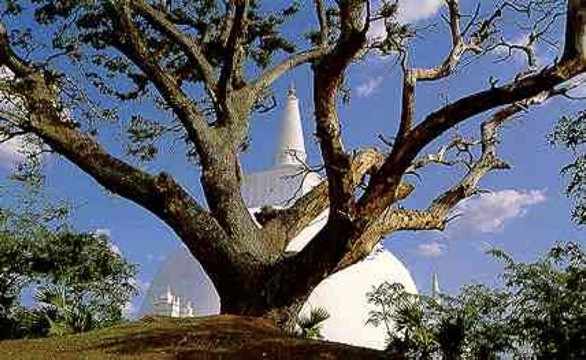
In Sinhalese culture, when someone wants to know who you are, people use the phrase, ‘where is your village?’ (koheede gama?’) Together with Sinhalese surname endings this tells a tale of caste and family. In Aboriginal society, country and family constitute identity. There is consonance.
L= Buddhist Dagaba, or reliquary mound.
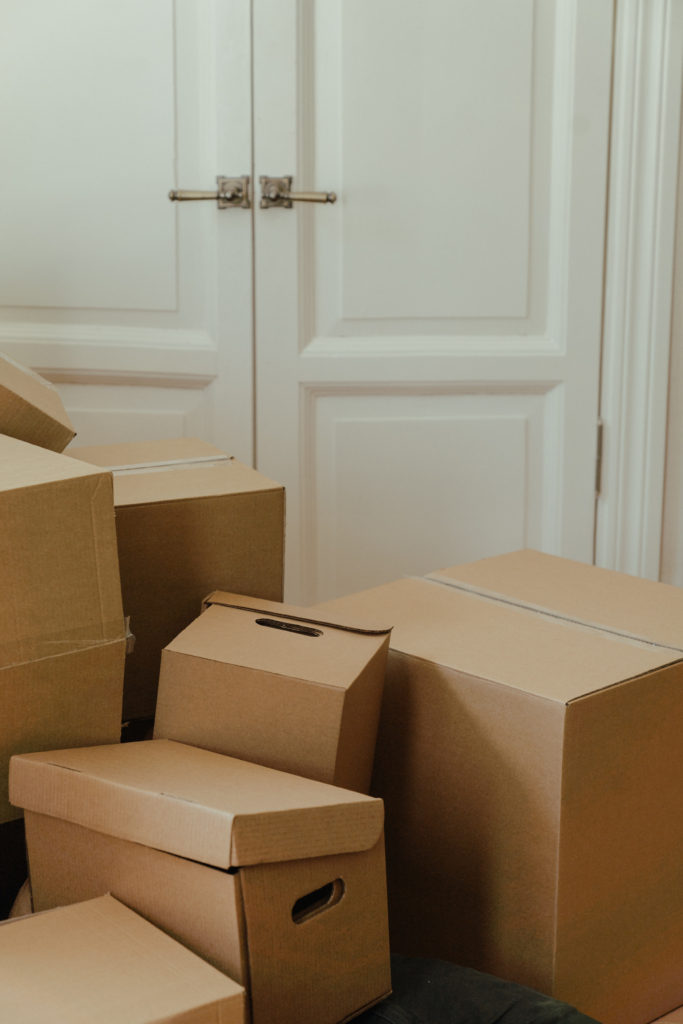
Packing itself takes a toll on both body and mind. Unpacking symbolises the discomfort of dislocation. Unless we’re smart enough to put the kettle, toaster and iron at the top of a box marked ‘kitchen’, we are powerless to find comfort on arrival. And, when the removalists leave, there we are, bereft with a new mountain to climb.
Packing cases by the door.
Just yesterday, I read an article in The Monthly, which makes a similar connection to the one I allude to above between Sri Lankan and Aboriginal culture. It may seem a bit off-topic, but it is an insightful read in its own right exploring as it does the significance of the body in space. Drawing on the work of Bas Luhrmann and David Gulpilil in my favourite movie ‘Australia’, the article speaks more broadly about things we often fail to notice.
Displaced People
Millions in this world stand alone to leave with nothing in their foray into the unknown. Their order of terror and courage is hard to conceive.
Despite my discomforts, I hope this short exploration of the dislocation of moving home resonates enough to let you consider with compassion what migrants, asylum seekers and refugees go through. Can you imagine being ripped from the bosom of loved ones, often to become stateless and homeless for years in teeming refugee camps, unable to re-embed yourself in the fullness of life?
In 2018 World Vision wrote that “Most people remain displaced within their home countries, but about 25.9 million people worldwide have fled to other countries as refugees. More than half of the refugees are children. In 2018, 13.6 million people were newly displaced, either as refugees or IDPs (internally displaced people).”
The figure of 25.9 million refugees worldwide is more than the entire population of Australia and, at the risk of repeating, half of these 25.9 million refugees are children.
UNHCR recently reported that 79.5 million people worldwide had been forcibly displaced by the end of 2019. See the details here.
In Summary
What has emerged for me in writing this post is that at worst, I had a safe but somewhat isolated childhood. I was lucky enough to be able to seek comfort in books and, all the while, I dreamed of being a writer. As a young woman, life was not as safe for me, but I always had the love of my family. Having no single place to call home meant that my parents’ deaths cast me adrift. I had nowhere to belong.
One of the reasons I take friendship so seriously I think is that I lack any sense of continuity in time or place. Apart from my children, few people in my life today have known me for much more than a decade. I have led a fortunate but dislocated life. What I have shared here is a mere taste of its diversity.
A Writing Tip
Try going through your life in terms of where you have lived and how. Make a list and see where that takes you as I have here. That would be a pretty good start if you are interested in writing your life story.
If you have a particular period in your life that stands out, write a memoir.
Happy Writing
Well, thank you. And I do those who make steadfast homes.
And too it is difficult to imagine the life of a gypsy. Having said that, Lindy, I hold wanderers in high esteem- many experiences first-hand, much knowledge gained. Julie Cahill Xx
Julie Cahill, Thank you as always for your kind words. It always fascinates me to meet or know people who have been in one place for many years…I can’t imagine what it must be like. I have friends my age who still know people from school. OMG I went to 10 schools in 10 years (left at 15) and don’t know a soul from my childhood or youth.We are so different in those ways.
Gosh, Lindy, I love this story even more on the second-round. No wonder you write as a filing-cupboard of homes.
I remember when you wrote 1974. I remember waking to the news of Cyclone Tracy, me fourteen and thanking my parents’ decision to live in Adelaide.
‘Removalists leave, there we are, bereft with a new mountain to climb.’
Your evocative story of dislocation has stirred my blood, me who has lived in our current home for 22 years. My husband and I have had only three homes in almost 40.
Paul pried me from the other two, me wailing like a banshee, he comforting with words.
‘Home is where our family is, where our things are. We will soon make a new home to cherish.’
Your parents’ deaths, girlfriend, your no place of belonging, and the millions of displaced refugees you mentioned have hit a new level of gratitide for me set within charmed life.
Thank you so very much. Xx
Thanks for your observations Carolyn. My life has been unusual I know but I admire those who have stayed put like yourself. Even now tho, the urge to move remains strong in me 🙂 I think at this age I’ll probably resist 🙂
I’m glad you had words to help you keep things together to some extent, Lindy, and even more glad that you have shared this story with us, as we wonder at the idea of moving around so much! I’ve lived in the one home since moving to from the suburbs to the country, and the idea of having to move again fills me with what, not horror, but something else despair perhaps at the things I’ve accumulated in my stay right there life, since 1988 …
Thanks for reading Veronica. It is interesting to look back sometimes 🙂
This is splendid Lindy…it’s a wonder you’re as together as you are with all the shifts and changes you’ve experienced.
But it is said, the things we experience shape us to be the person we are meant to be – and makes us stronger.
What kind words Julie, thank you for reading and appreciating my stuff. And, for being my friend if I dare say that on here.
. . . a fortunate but dislocated life . . . having lost sense of home with your parent’s deaths.
Wow, Lindy. I love this story of displacement, the rich understated details.
No wonder you are so knowledgeable with all that luscious experience. But I sympathise with young Lindy, forging new friendships in unfamiliar territory where friendships were already established.
I remember and love your poem, Cyclone Tracy. I remember the incodent well from the safety of SA, on a joyious Christmas morning.
No wonder you are who you are, compassionate and open with story.
I too have had a privileged life, more grounded literally than yours, dislocated from my homeland as a preschooler, (and with seven dislocated shoulders above my belt,) but with the permanancy of home.
Friends do drift off, new ones arrive as we relocate and change focus. At this stage in my life I am delighted and honoured to be classed as one of your friends. Ditto. We have similar mindsets, when mine behaves. How could we not connect, armed with story and passion? ♥️
Cheers
Julie Cahill.
Thanks for your comment Jenny. Much appreciated. Glad you liked it and possibly find it helpful 🙂
Dear Lindy,
Your insightful writing leaves with with so much more understanding about you – thank you! I will go back over it and look up the places where you lived. I am left also re pondering the many moves in my life.
Jenny