

For Example
I was going to call this post Things I Ponder and had to change to ‘think about’ because there are so many ways of using ‘ponder’; ‘ponder upon’ (a little old fashioned), ‘ponder on’, which, like ‘ponder’ suggests particular topics and is therefore constraining), and ‘ponder about’ which is silly because the word ‘ponder’ means’ think about’, but after reading these variations online, I decided that, if I leave the word ponder dangling, it might be confusing. These are a few things that literally stick in my mind.

I mention this tiny research moment on pondering as a way to show how my mind works. Where once, post-childhood, when I daydreamed a lot, I didn’t ponder anything much, preferring to think I was right (which I often was, although it made me unpopular). Now, in old age, I find I second-guess myself to the extent that I search the World Wide Web to check most thoughts that may, to my shame, go viral if they’re wrong, like my poor failing body, so often told it’s not right by medical science. While I don’t like to be incorrect, I am aware that few things in life are straightforward, as my little ponderings today exemplify.
Welcome to Country
The Idea
The idea to ponder Welcome to Country ceremonies in a post originated from my son, who encouraged me. These traditional ceremonies got a lot of bad press in the pre-election political discourse. Unlike me, he has travelled to New Zealand, where he was impressed by the way traditional Māori culture is integrated into daily life, from a visitor’s perspective. He wishes Australia could be like that towards First Nations culture and peoples here, as do I.
I am not an authority on this matter, but I am, as many know, an anthropologist and have worked with First Nations people across Australia. So, while it is not my place to speak for them or on their behalf, I can say, both as an anthropologist and as a publican’s daughter who was raised and worked in pubs for the first half of my life, I understand Australian culture at various levels. Well enough, I trust, to make a few general observations while sidestepping the specifics of recent journalistic and political discourse and similarly grossly ill-informed social media discourse.
It’s All To Do With Semantics
Much like my earlier discussion on the effective use of the word ‘ponder’. The term ‘country’ appears to be the main sticking point for those who perhaps operate under the notion that it means the same thing as ‘nation’. Such a flawed conflation leads many people to ask why the Australian population at large should be invited to their own country. They find it offensive.
The answer depends on what you mean by ‘country. Failing to understand this fuels racism.
Welcome Ceremonies
Bear with me if you know this already. A Welcome to Country ceremony is offered by a small group of people whose ‘country’ is defined by the stories they hold for a particular tract of land. The traditions of that land are part of their being, defining First Nations people as who they are. Tradition places the responsibility on them to take care of that land, their ‘county’, just as we look after ourselves and our homes.
Seen like this, it is easy to see that Welcome Ceremonies are more like opening the front door to welcome someone into your home than taking over Australia or speaking on behalf of the nation to which we all belong equally. Indigenous country is the literal territory of ‘their mob’ or ‘my mob’, and it does not threaten anybody’s rights as a citizen one iota. Everyone should know this by now. Those with a public megaphone should report it that way instead of fuelling division. After all, most of us are by now familiar with the name of the First Nations area in which we live.
Compiled over many years of research by the anthropologist Norman Tindale, the Adelaide Museum’s Map of Tribal Australia shows us the traditional lands occupied before conquest. You can find what is likely to be an updated version of this map in the Aboriginal and Torres Strait Islander Studies Library (AIATSIS) if you want to scroll through it for a closer look.
Other historical maps show First Nations songlines crisscrossing the entire continent like a great big web. It is a shame that these trade and ceremony routes are rarely shown or talked about by the mainstream media, as they would encourage understanding and a greater respect for First Nations traditions.
Smoking ceremonies are a special gift from those who still live in or know the ancient stories handed down over generations about the lands of their ancestors. It is the gift of welcome to a history that precedes the nation we all compose, and now resides within the island of Australia defined by national borders.

In Conclusion
I think the confusion comes because we tend to think of Australia as a country, our country. Whereas we are, strictly speaking, a nation, which is a nation-state. It says so on our passports. And, as an aside, the whole concept of nation and nationality is itself fraught when you look into it. We all get into high dudgeon about ‘my country’ and ‘my nationality’, but, after all, as Benedict Anderson said long ago in 1983, nations are imagined communities.
Historically and politically, a nation is far removed from the face-to-face networks of traditional community life, where kinship-bound people together as political entities. We divide ourselves by class, political persuasions, sports affiliations, and other cultural identities, including race, as well as age. Such cultural distinctions serve capitalism’s marketing purposes well. Extended kinship ties would be a threat to that.
Our island provides a natural national boundary, and our states are clearly delineated by jurisdictional boundaries. Anyone wishing to cross our national border must hold a passport or have the necessary right of entry (and exit) documentation. Crossing state lines requires us to comply with that state’s jurisdiction on entry. If our move is permanent, we must change our electoral entry, our driving licence and so on. Though we roundly resisted carrying a national ID card when the idea was mooted in the 1980s, we take all this jurisdictional ID stuff for granted. Our strings are pulled by bureaucracy.
In traditional Aboriginal society, as I understand it in the simplest of terms, groups passing through the ‘country’ of others don’t simply crash the campfire; they wait to be invited in. Now, all Australians are welcomed into traditional local areas (a First Nation’s traditional ‘country’) with a smoking ceremony that has transformed to meet the contemporary world. Things have to change to stay the same (a phrase that stuck with me from a book I read many years ago about Sicily as it moved away from landlords and peasants, giving rise to the Mafiosi and political bureaucracy).
Thoughts that end up in poems
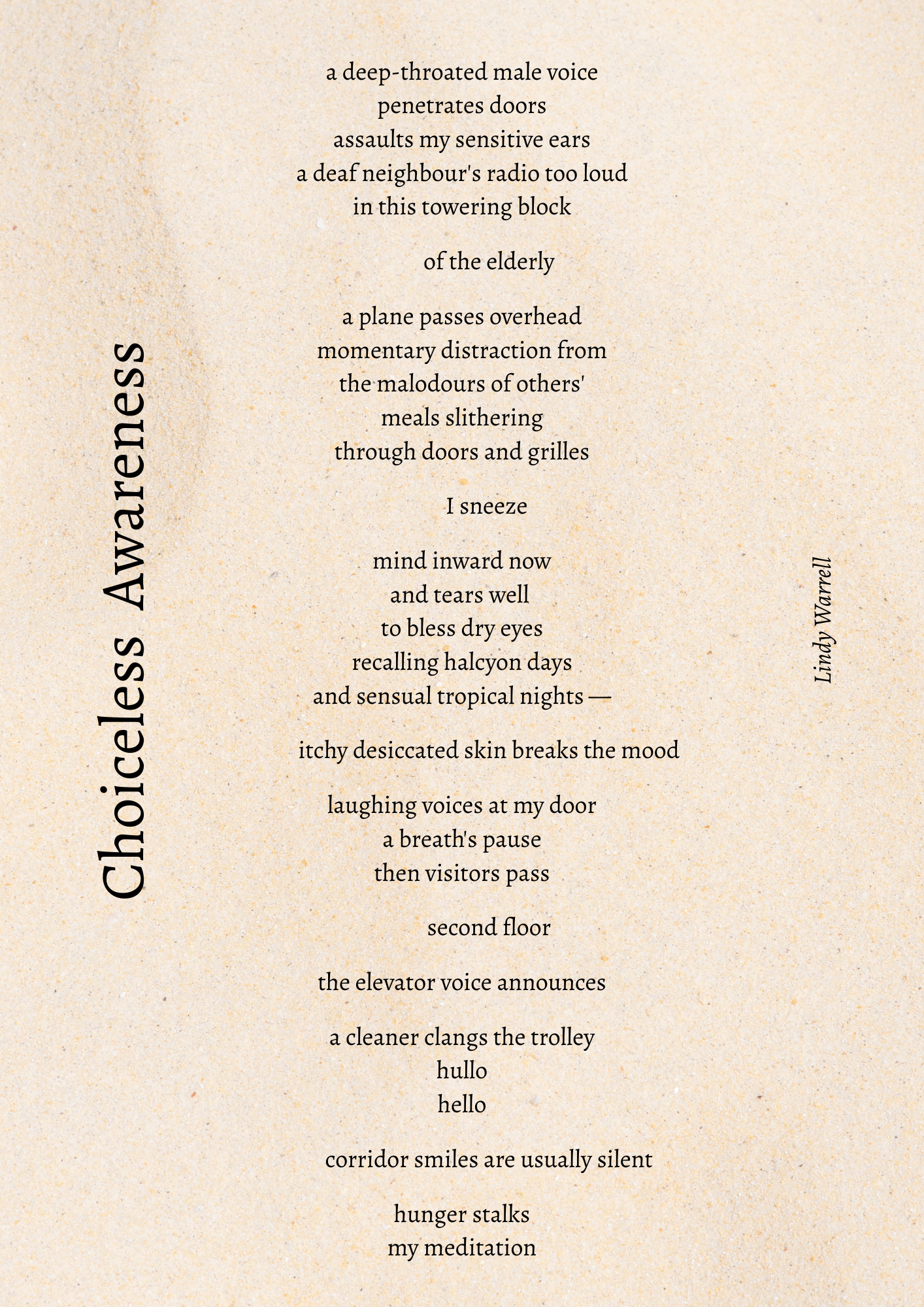
This first poem came from my meditative ponderings on living in a high-rise retirement unit that was built before soundproofing became a thing. It reminds me of old hotels in George Street and Chinatown in Sydney, many, many years ago. You didn’t need a glass to the wall to hear what was going on next door or anywhere else, for that matter. Even pipes creaked.
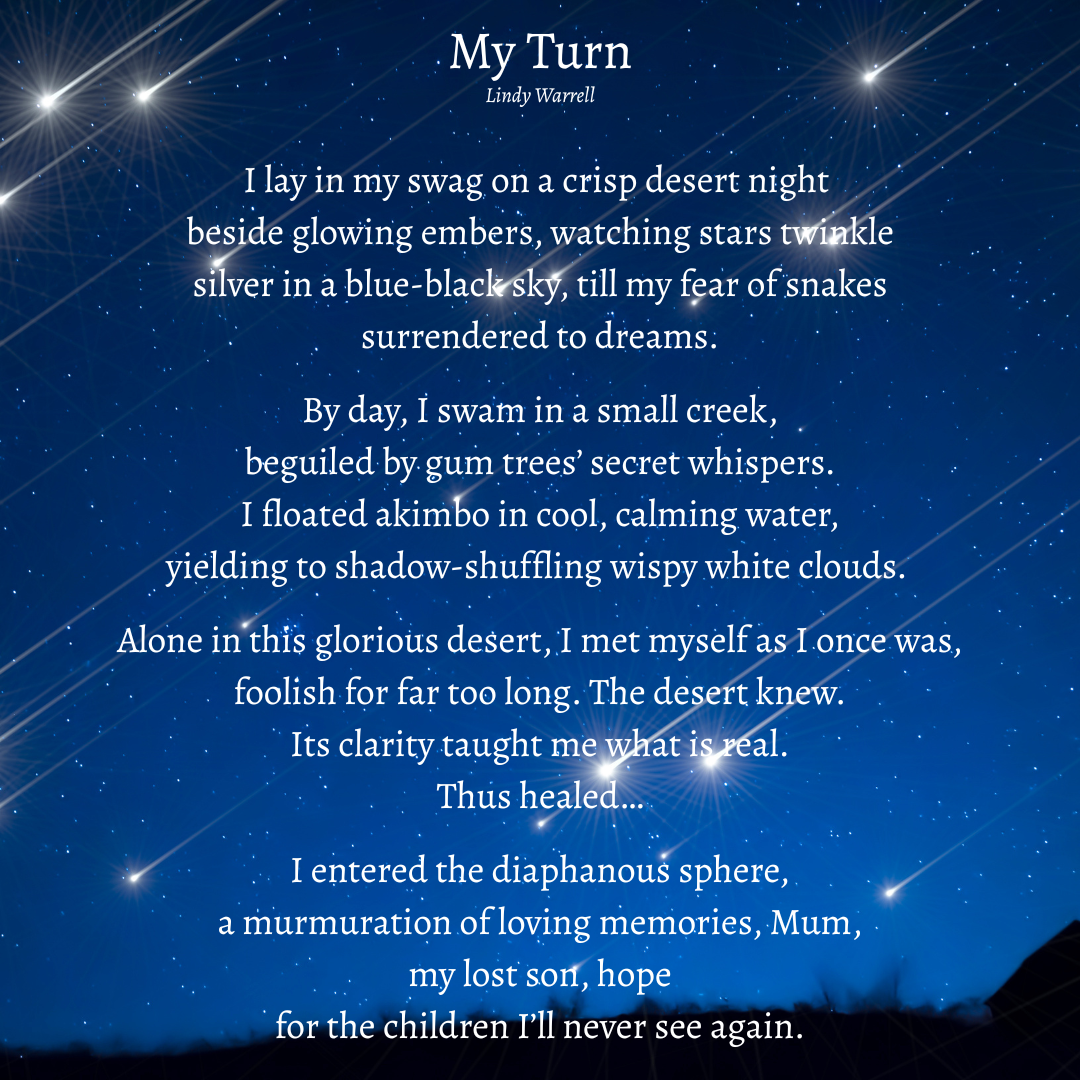
My Turn is something of a contemplative dream sequence predicated on my love for and experience of camping in the outback, often when working with First Nations people on their country. How could anyone forget such a privilege?
Thoughts about Hospital Stays
Toast
Toast has vanished from Flinders Medical Centre’s (FMC) breakfast menu.
Nobody will starve with cereal, fruit and a cuppa, but who eats pale white bread, butter and jam for breakfast? That was a treat (sans butter) for my father, born in 1910 to an impoverished family living in Sydney’s Glebe, then a slum, after his barefoot walk of three miles each way to school. To me, therefore, a single slice of white plastic bread is tantamount to workhouse food. Have hospital authorities never heard of croissants or muffins? I don’t like either—I’m a toast girl in the morning—but hey, I’d put that dislike aside in favour of flavour.
Showering
What has also disappeared, at least from the public wards at FMC, are white shower-chairs for the frail and elderly. Instead, some bright spark in finance has decided to give commodes a second use, minus the potty.
At 152 cm nowadays, I’m not very tall, so my feet do not hit the floor when I’m perched on the front edge of a bariatric-sized commode. (Most wheelchairs nowadays are bariatric too.) Furthermore, because of its size, the commode must face outwards from the cubicle, which requires you to shower sideways using a handheld shower rose; your arms are constrained by high armrests from which soap slips to the floor. A commode might almost be acceptable when someone else is washing you, but on your own, it’s a bugger. And yukky, too.
FMC’s commodes also feature shiny metal footrests resembling those of a wheelchair. Without a counterbalancing weight, these make it extremely hazardous to stand up. They cut into the back of your legs as you reach for the floor. You dare not put weight on them.
I was so appalled by this turn of events that the matter went beyond mere pondering. I wrote a letter of complaint to SA Health.
Unexpected Germs
I’ve since learned that I have been colonised, yes, that’s the right word, by pneumonitis. Although it is a non-contagious inflammation of the lungs, I must now advise hospital staff of this, if and when I am admitted again, as it can exacerbate other afflictions. I also had to undergo tests for a bug that colonises the digestive tract because SA’s Local Area Health Network (SAHLHN) advised that I may have been exposed during my last stay at FMC. Fortunately, that little bugger did not gain traction in my old body.
Ironically, hospitals were historically built to remove the populace from infectious community environments to promote healing and reduce the spread of disease. It would appear that this cycle is reversing.
Another Surprise
In addition to sneaking in their mandatory cognitive test for the elderly and the insane, no matter how cogent and intelligent you might be, one is always weighed on admittance to a ward at FMC.
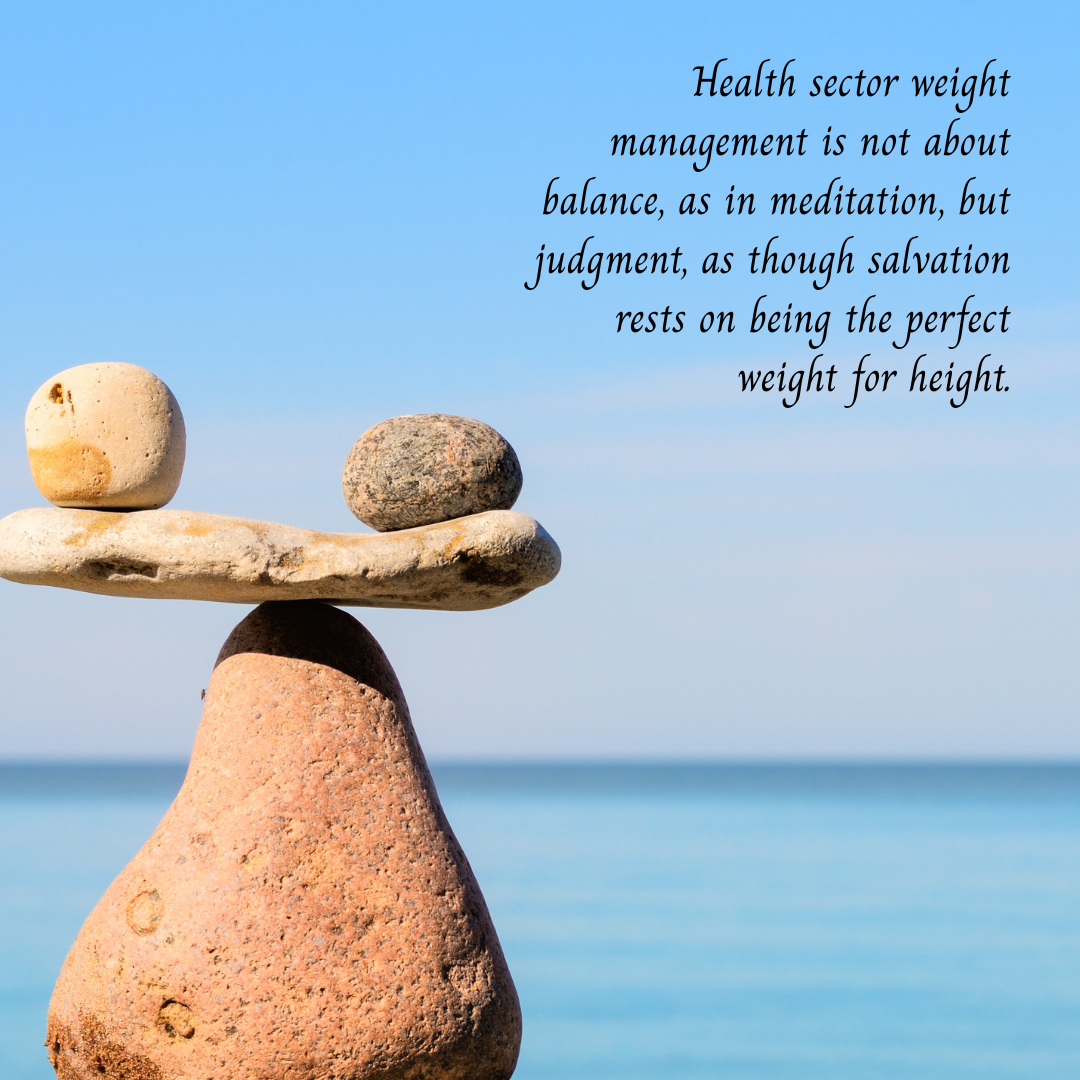
It turned out that I had lost 6 kilos since my previous stay a few months earlier, without realising it. (I gave up on home scales 40 years ago.) Instead of congratulations, however, I was advised that I would be put on a special diet, because such rapid weight loss indicated that I was malnourished.
The nurse and I had been talking about white bread for breakfast until her remark about my weight loss had me roaring with incredulous laughter.
‘At least you’ll get scrambled eggs for breakfast,’ she said, laughing with me.
Can you imagine scrambled eggs on plain white sliced bread?
Happy Writing
Wattletales
If you'd like to be added to the Wattletales post mailing list, make a request in the comments below, your email address is always hidden from public view. Lindy
Thanks for reading, Veronica. I knew you would understand about Welcome to Country, but many have only the MSM and RW
politicians to misguide them
Thanks for this latest effort Lindy. Yes, it’s hard to understand why it’s so hard for some people to appreciate the appropriateness of the welcome to country ceremony.
Have to say, your poem ‘My Turn’ has turned into much more than it was – it’s quite beautiful.
I haven’t yet showered at Flinders, but yes, I do recall plain white gluten-free bread (my request) with jam at breakfast time.
Love, Veronica
Dear Val, thank you for finding the time to comment. I may not have made it clear enough that the welcoming is open to everyone. The particularity is only in who has the right to speak for the First Nations group who belong to the place where the welcome ceremony happen. in Adelaide it’s the Kaurna people. On the fleurieu it’s the Narrindgerri. And so
On.
Thanks for liking the poem My Turn – which it will be soon enough lol
Hi Lindy, I always enjoy your well written thoughts about life here in Australia. Wattletales blog makes us think deeply.
On the subject of ‘Welcome to my country’ I have always thought I would have preferred to call it a ‘welcoming ceremony’ to be performed at the beginning of events. Making it welcoming to all living here in Australia or those visiting.
I think that awful white bread for patients at breakfast in the hospital leaves me cold just like it is served.
I guess toast cannot be kept lovely and hot so we miss our hot toast in hospital.
I loved your poem ‘My Turn’.
Lying looking at the stars gives one a time for reflection. Thank you Lindy