

Being Here
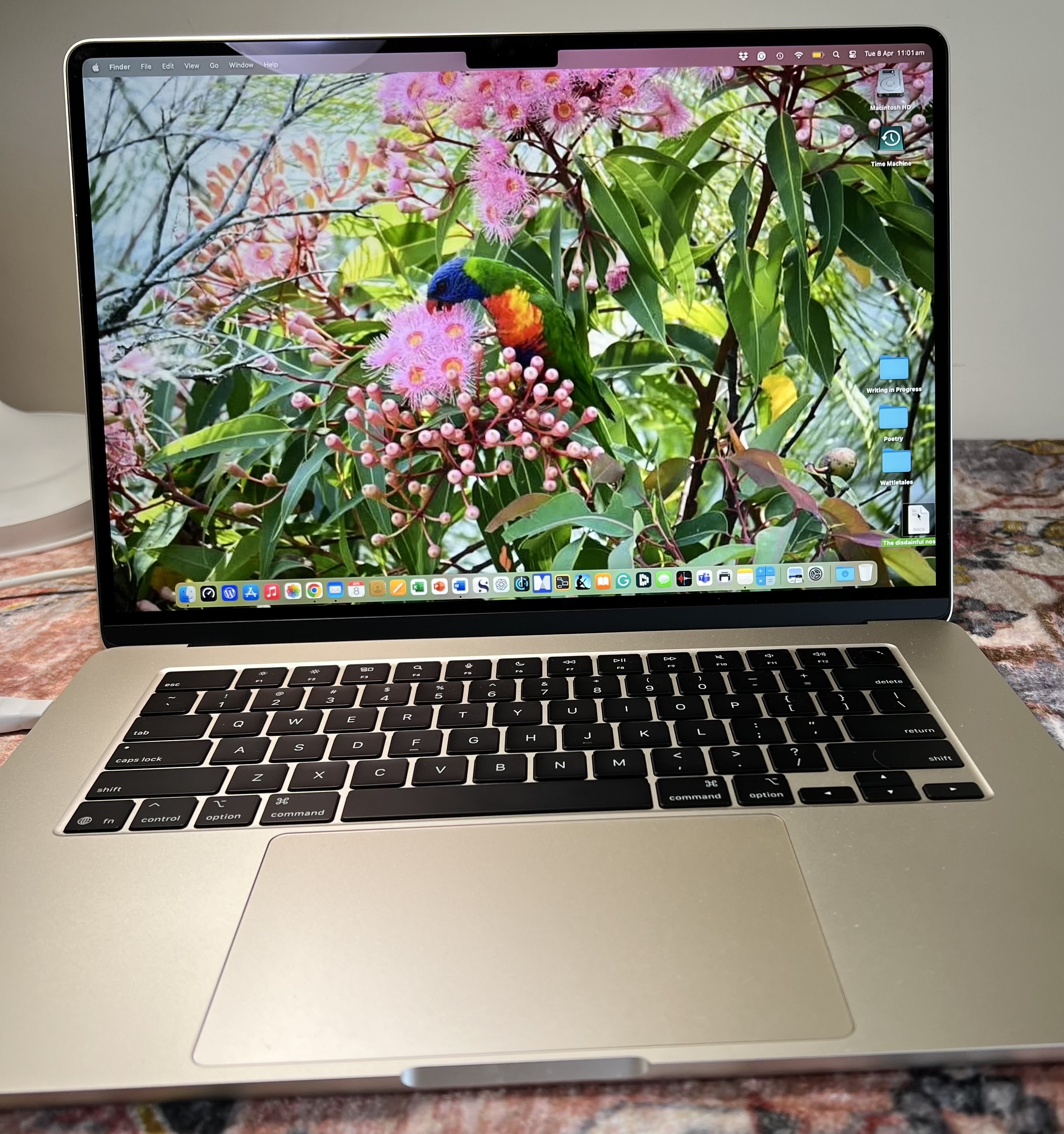
We oldies must first give thanks for being here. For those like me, with bodies burdened by the limitations doctors call multiple comorbidities, the best luck in the world is having a strong mind. By that, I mean I am still curious about the world; I get upset by wickedness and excited when good things happen. I follow politics with a keen eye and am lucky to have a good education, a computer and the will to write. I thank my new MacBook Air for inspiring me this month to showcase what I’ve been up to, both reading and writing-wise.
Many computers have centred my world and orchestrated my daily life for a long time. In fact, I spend more time on one in retirement than I did at work years ago, but I’ve been lusting for a new laptop as they served me well for many years as a roving anthropological consultant. Although I’d been saving for one, my son, who lives far away in Queensland, surprised me with his generous gift of a new MacBook Air. As I’d hoped, it makes the act of writing more intimate, more like handwriting. I like that.
This Time Last Year till Now
Although it seems like yesterday, this time last year, I was busy with the launch of my novel, They Who Nicked the Sun, a delightful occasion with Devonshire Tea. As the poem Braindead, written in March 2024, tells you, I was utterly lost for a while after that, with no book to work on.

Slowly, an idea seeped into my mind for a story about ageing. Initially, I came up with the title By Way of Dying, a story about a woman who could not rest in death until she understood life. It took time to formulate and find its shape, but now I think I have it!
Meanwhile, the title, By Way of Dying, morphed into Call Me Marigold. It is a novella, and yes, the narrator is posthumous; and yes, it is about me, despite the pseudonym, because, clearly, I am still alive, while Marigold is stuck in limbo and can only look back on life.
Call Me Marigold also morphed from memoir into autofiction, a genre that combines elements of true stories with fictional tools. We all draw on our lives when writing fiction, but memoir and autofiction should be distinguished from each other. To quote from the linked article —
The label of memoir comes with a promise: that the events described happened to you. Autofiction, on the other hand, promises an exploration of self. It is not just a fictionalized account of the author’s life, but a rendering of true experience in the midst of fictionalization, in which embellishments or deviations from reality may provide a commentary on the author’s journey. (my emphasis. American spelling in the article.)
What I am Reading

The universe is supporting Marigold. A dear friend gave me a book this week that I had borrowed from the library but had badly wanted to own: Nobel Prize-winning Orhan Pamuk’s wonderfully illustrated Memories of Distant Mountains. I’ve only read two of his earlier novels, My Name is Red and The Museum of Innocence, but I am a fan. In this 2025 coffee-table delight, he draws on a lifetime of personal notes and paintings to offer insight into his writing and himself. It is neither memoir nor novel, yet through his reflections, he shares his inner world.
Another genre-bending, multi-award-winning writer I admire is Australian author Michelle de Kretser, whose recent work, Theory & Practice, according to author Nicole Abadee in the Australian Book Review (Nov.2024), is not autofiction but a novel that introduces ‘a splinter’ of memoir. My de Kretser favourites are The Hamilton Case and Questions of Travel.
Last on my recent reading list, although I read it first, is The Chinese Postman by Brian Castro, a former Professor of Creative Writing at the University of Adelaide. I love this book because it also challenges taken-for-granted literary assumptions and reflects on ageing. I could not do justice to Castro’s story in a few words, so here is the publisher’s blurb (I have the eBook).
Abraham Quinn is in his mid-seventies, a migrant thrice divorced, a one-time postman and professor, a writer now living alone in the Adelaide Hills. In The Chinese Postman he reflects on his life with what he calls ‘the mannered and meditative, inaction of age. God, offering up memories and anxieties, obsessions, and opinions, his thoughts on solitude, writing, friendship, and time. He ranges widely with curiosity and feeling, digressing and changing direction as suits his experience, and his role as a collector of fragments and a surveyor of ruins. He becomes increasingly engaged in an epistolary correspondence with Iryna Zarebina, a woman seeking refuge from the war in Ukraine. As the correspondence opens him to others, the elaboration of his memories tempers his melancholy with a playful enjoyment in the richness of language, and a renewed appreciation of the small events in nature. This understanding of the experience of old age is something new and important in our literature. As Quinn comments, ‘In Australia, the old made way for the young. It guaranteed a juvenile legacy.’ (my emphasis)
I came across a sensitive and insightful article, “The Chinese Postman,” by Professor Tony Hughes-d’Aeth, Chair of Australian Literature at the University of Western Australia. In case you missed it in ‘The Conversation’ last year, Hughes-d’Aeth identifies a key ambiguity in the narrative, emanating from Castro’s transposition of his biographical data — ‘born in Hong Kong of mixed European and Chinese heritage’ — onto the protagonist, Abe Quinn. Is it Castro’s story, which Hughes-d’Aeth sees as a lament, or is it fictional to the core?
I am reading these books by authors who brilliantly cross genre boundaries to understand how top writers do it. Truth be told, I find the various ways they upend convention both fascinating and freeing. Their works gave me the confidence to experiment in my Call Me Marigold narrative, which takes a scrapbook approach to various aspects of my life, serving as an exploration of the self — a defining feature of autofiction.
A New Novel
During the lull that followed the publication of They Who Nicked the Sun, when I was floundering and trying to figure out how best to tell my story as autofiction, I began to yearn for a new novel to work on. My earlier novel ideas came to me long before I started writing them. I then met a fellow writer who works on several projects, alternating between them. I’ve usually stuck to one at a time, but as soon as I wished for a novel idea to come to me, an idea burst upon me in rough synoptic form, and I am now alternating between Marigold and a fictional story.
In the Welcome pages of Wattletales, I write about what fascinates me as a person and writer—
What does it mean to fall through the cracks, to become broke, mad, ill, destitute, deserted, disillusioned or denounced? What happens to our sense of self, and our identity when life wreaks havoc with our intentions, plans and happiness? How porous is our mind? Is there really a line between sanity and insanity, and how do we know when we tip over the edge?
So, it should not come as a surprise to say that I’m fascinated by gaslighting, which is what my new novel is about. The provisional title, On Banksia Street, tells the story of an everyday couple, Wendy and Peter Wilson, who live with their children in Warradale, where I raised my children (ordinary suburban life!). There is no real Banksia Street in Warradale, so the setting is fictional, as is the story. The Banksia reference is, of course, about our lovely native Banksia flowers and the scary Big Bad Banksia Men of Mae Gibb’s marvellous imagination that terrified me as a child.
New Poems
In between writing projects, including this blog, I have recently written a few new poems. Here is a small selection as part of this show-and-tell post for April 2025, my favourite month of the year for its promise of cooler weather.


Before you go, why not check out our wonderful Guest Posts, featuring some great stories and poems from local Adelaide poets? For a complete list, click here.
Happy Writing
Wattletales
If you'd like to be added to the Wattletales post mailing list, make a request in the comments below, your email address is always hidden from public view. Lindy
Dear Alison, Thank you for reading. It’s nice to know my words spark your imagination, as yours do mine 🙂 Yes, the suburbs are a hive of fascinating anthropological material that we all take for granted. I’m intrigued by your characterisation of variuns national literatures, that was something new to me. I’ll reply at length to your email privately.
Both writing projects sound exciting, Lindy.
I’m keen to read your novel about gaslighting set in our suburb. It’s a mistake to assume that nothing of note happens in suburbia. The older I become, the more I take delight in reading realistic fiction, memoir, and travel writing.
I still make time for the fantastical and speculative. I’ve been interspersing science fiction short stories from the 50s that blend comic and tragic with a darkly witty travel memoir from 70s Japan and a biography of an 80s punk/hardcore band. If we can juggle our reading, surely we can juggle our writing?
Please let me know how you go with working on the two projects simultaneously — or, more accurately perhaps, alternately.
Autofiction is a tricky art form — do you find yourself torn, or sense a tension, between a feeling of duty or obligation (giri) to faithfully tell the truth as you remember it and a humanising impulse (ninjo) to embellish, enliven, or streamline for the sake of narrative?
These two Japanese words are often used to discuss Japanese fiction. Whereas American literature is often about the individual versus society, British literature is often about class struggle, and Russian literature is often just plain unmitigated misery (I’m not a fan), Japanese literature and story-telling often centres on the tension or conflict between two drives that sometimes compete and sometimes complement each other: giri (obligation, duty, responsibility, expected action or behaviour, social, often civic, familial, or religious) and ninjo (human feeling). I see autofiction as pitting the drive towards empirical truth (as murky as that can be thanks to subjectivity, unreliable memory, and lack of record-keeping) against the drive to narrativize. The first seems civic, scientific, and judicial, and therefore bound by ethical concerns and duty, while the latter seems to satisfy human feelings such as defining the self or identity, defining a space and time (orientation, conflict, resolution), belonging, shared story, community and communion and the communal.
Thanks for your blog posts, Lindy. Always spark my imagination!
Thank you, Carolyn, for taking the time to read this post, and for your encouragement. It makes a difference 🙂
I loved reading your new things here, Lindy, and it’s wonderful to read what you’re currently working on as well! May the words keep on for as many years into the future as you want (and please, may that be many more).
Love to you
Carolyn
Dear Veronica, It is so good to get your positive feedback on these posts. It keeps me going to get your thoughtful feedback 🙂
Thank you for reading, Mandy, and for you kind comments. Your feedback is so supportive which is great.
Lindy, as always I’m riveted by your ideas, your enquiring mind, and then I’m moved to my depths by your poems. Your ability to get out and about may be restricted but never that crystal sharp way with language. Please keep writing, for our sake.
Dear Lindy
I love the way you articulate your thoughts, then go on to show us exactly what you mean, adding to them in the process.
It’s great that you still have that seemingly never-ending enthusiasm for each project, in spite of the on-going medical merry-go-round.
Long may it continue.
Thank you once again.
Thank you, Juie. It’s a struggle at times LOL
Great to witness your sharp mind and wit are soldiering on, Lindy.
Mine plays leap frog.
Thank you.
Love always
Julie Cahill. Xx